air LEXUS RX450H 2020 Owner's Guide
[x] Cancel search | Manufacturer: LEXUS, Model Year: 2020, Model line: RX450H, Model: LEXUS RX450H 2020Pages: 777, PDF Size: 13.14 MB
Page 52 of 777
521-1. For safe use
RX350/RX350L_U
WARNING
■Front passenger occupant classification system precautions
●Do not recline the front passenger seatback so far that it touches a rear seat. This may
cause the “AIR BAG OFF” indicator light to be illuminated, which indicates that the
SRS airbags for th e front passenger will no t activate in the event of a severe accident.
If the seatback touches the rear seat, return the seatback to a position where it does
not touch the rear seat. Keep the front passenger seatback as upright as possible
when the vehicle is moving. Reclining the seatback excessively may lessen the effec-
tiveness of the seat belt system.
●If an adult sits in the fron t passenger seat, the “AIR BAG ON” indicator light is illumi-
nated. If the “AIR BAG OFF” indicator is illuminated, ask the passenger to sit up
straight, well back in the seat, feet on the floor, and with the seat belt worn correctly. If
the “AIR BAG OFF” indicator still remain s illuminated, either ask the passenger to
move to the rear seat, or if that is not possible, move the front passenger seat fully
rearward.
●When it is unavoidable to in stall a forward-facing child re straint system on the front
passenger seat, install the ch ild restraint system on the front passenger seat in the
proper order. ( P. 57)
●Do not modify or remove the front seats.
●Do not kick the front passenger seat or subject it to severe impact. Otherwise, the
SRS warning light may come on to indica te a malfunction of the front passenger
occupant classification system. In this cas e, contact your Lexus dealer immediately.
●Child restraint systems installed on the rear se at should not contact the front seat-
backs.
●Do not use a seat accessory, such as a cushion and seat cover, that covers the seat
cushion surface.
●Do not modify or replace the upholstery of the front seat.
●Adjust the front passenger seat so that the head restraint does not touch the ceiling. If
the head restraint is left in contact with the ceiling, the system may not detect the front
passenger properly, leading to improper operation of the airbags.
Page 53 of 777

531-1. For safe use
1
For safety and security
RX350/RX350L_U
Exhaust gas precautions
Harmful substance to the human body is contained in exhaust gases if inhaled.
WARNING
Exhaust gases contain harmful carbon monoxi de (CO), which is colorless and odorless.
Observe the following precautions.
Failure to do so may cause exhaust gases enter the vehicle and may lead to an accident
caused by light-deadness, or may lead to death or a serious health hazard.
■Important points while driving
●Keep the back door closed.
●If you smell exhaust gases in the vehicle even when the back door is closed, open the
windows and have the vehicle inspected at your Lexus dealer as soon as possible.
■When parking
●If the vehicle is in a poorly ventilated area or a closed area, such as a garage, stop the
engine.
●Do not leave the vehicle with the engine running for a long time.
If such a situation cannot be avoided, park the vehicle in an open space and ensure
that exhaust fumes do not enter the vehicle interior.
●Do not leave the engine running in an area with snow build-up, or where it is snowing.
If snowbanks build up around the vehicle while the engine is running, exhaust gases
may collect and enter the vehicle.
■Exhaust pipe
The exhaust system needs to be checked periodically. If there is a hole or crack caused
by corrosion, damage to a joint or abnormal exhaust noise, be sure to have the vehicle
inspected and repaired by your Lexus dealer.
Page 60 of 777
591-2. Child safety
1
For safety and security
RX350/RX350L_U
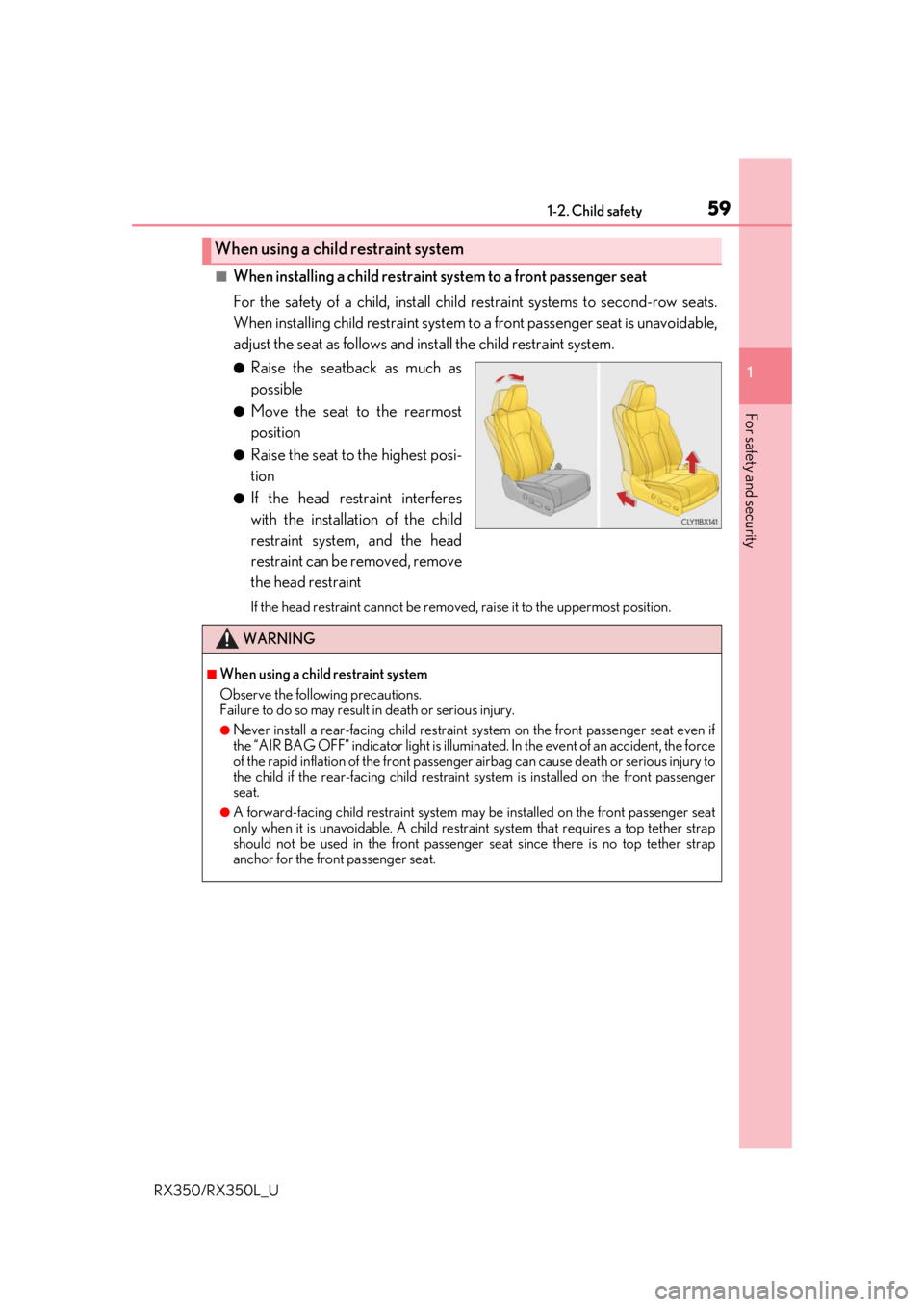
■When installing a child restraint system to a front passenger seat
For the safety of a child, install child restraint systems to second-row seats.
When installing child restraint system to a front passenger seat is unavoidable,
adjust the seat as follows and install the child restraint system.
●Raise the seatback as much as
possible
●Move the seat to the rearmost
position
●Raise the seat to the highest posi-
tion
●If the head restraint interferes
with the installation of the child
restraint system, and the head
restraint can be removed, remove
the head restraint
If the head restraint cannot be removed, raise it to the uppermost position.
When using a child restraint system
WARNING
■When using a child restraint system
Observe the following precautions.
Failure to do so may result in death or serious injury.
●Never install a rear-facing ch ild restraint system on the front passenger seat even if
the “AIR BAG OFF” indicator lig ht is illuminated. In the event of an accident, the force
of the rapid inflation of the front passenger airbag can cause death or serious injury to
the child if the rear-facing ch ild restraint system is installed on the front passenger
seat.
●A forward-facing child restraint system ma y be installed on the front passenger seat
only when it is unavoidable. A child restraint system that requires a top tether strap
should not be used in the front passenger seat since there is no top tether strap
anchor for the front passenger seat.
Page 61 of 777
601-2. Child safety
RX350/RX350L_U
WARNING
■When using a child restraint system
If the head restraint interferes with the installation of the child restraint system, and the
head restraint can be removed, remove the head restraint.
If the head restraint cannot be removed, raise it to the uppermost position.
●When a booster seat is installed, always en sure that the shoulder belt is positioned
across the center of the child’s shoulder. The belt should be kept away from the child’s
neck, but not so that it coul d fall off the child’s shoulder.
●Use child restraint system suitable to the age and size of the child and install it to the
rear seat.
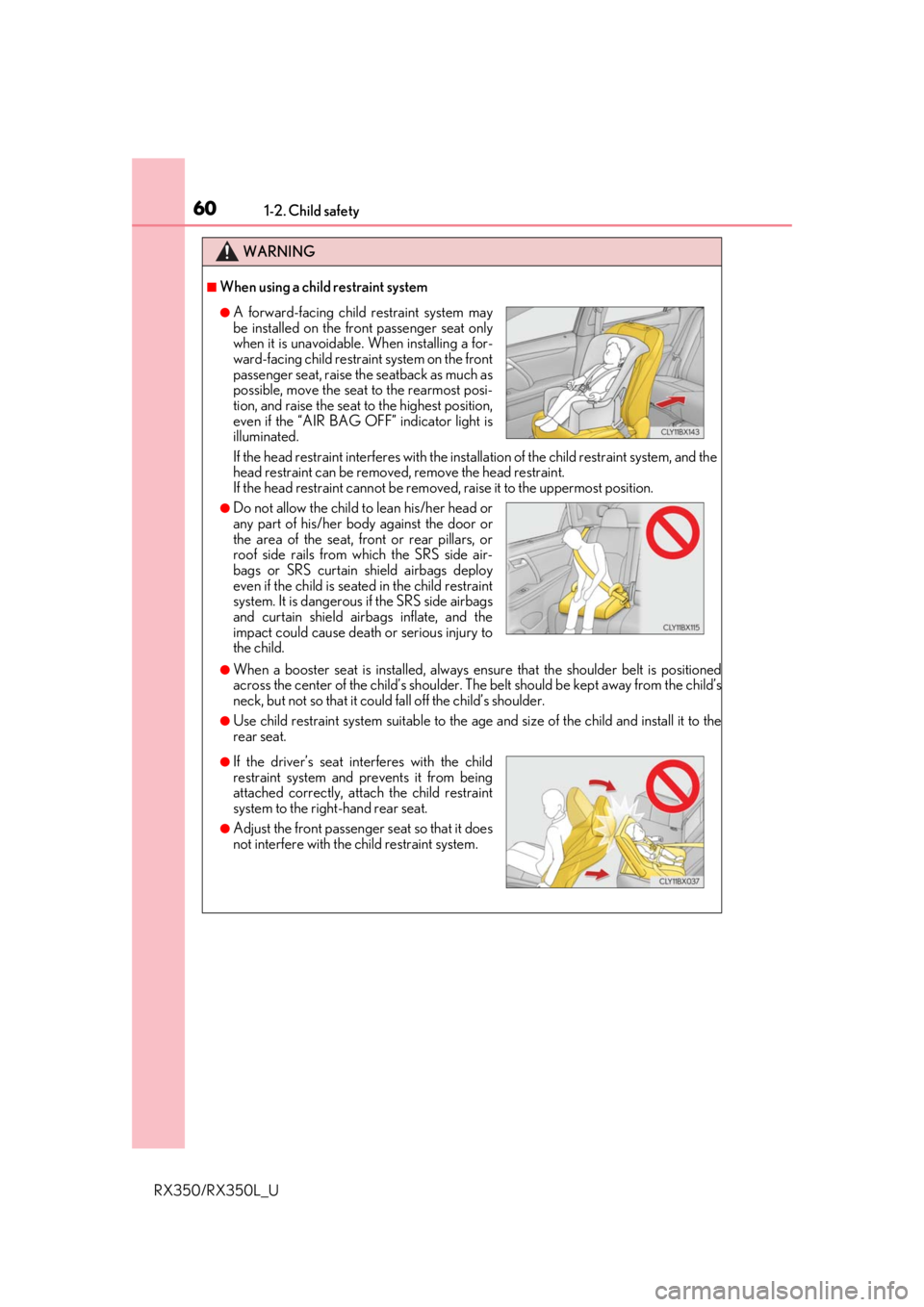
●A forward-facing child restraint system may
be installed on the front passenger seat only
when it is unavoidable. When installing a for-
ward-facing child restrain t system on the front
passenger seat, raise the seatback as much as
possible, move the seat to the rearmost posi-
tion, and raise the seat to the highest position,
even if the “AIR BAG OFF” indicator light is
illuminated.
●Do not allow the child to lean his/her head or
any part of his/her body against the door or
the area of the seat, front or rear pillars, or
roof side rails from which the SRS side air-
bags or SRS curtain shield airbags deploy
even if the child is seat ed in the child restraint
system. It is dangerous if the SRS side airbags
and curtain shield airbags inflate, and the
impact could cause death or serious injury to
the child.
●If the driver’s seat interferes with the child
restraint system and prevents it from being
attached correctly, atta ch the child restraint
system to the right-hand rear seat.
●Adjust the front passenger seat so that it does
not interfere with the child restraint system.
Page 84 of 777
832. Instrument cluster
2
Instrument cluster
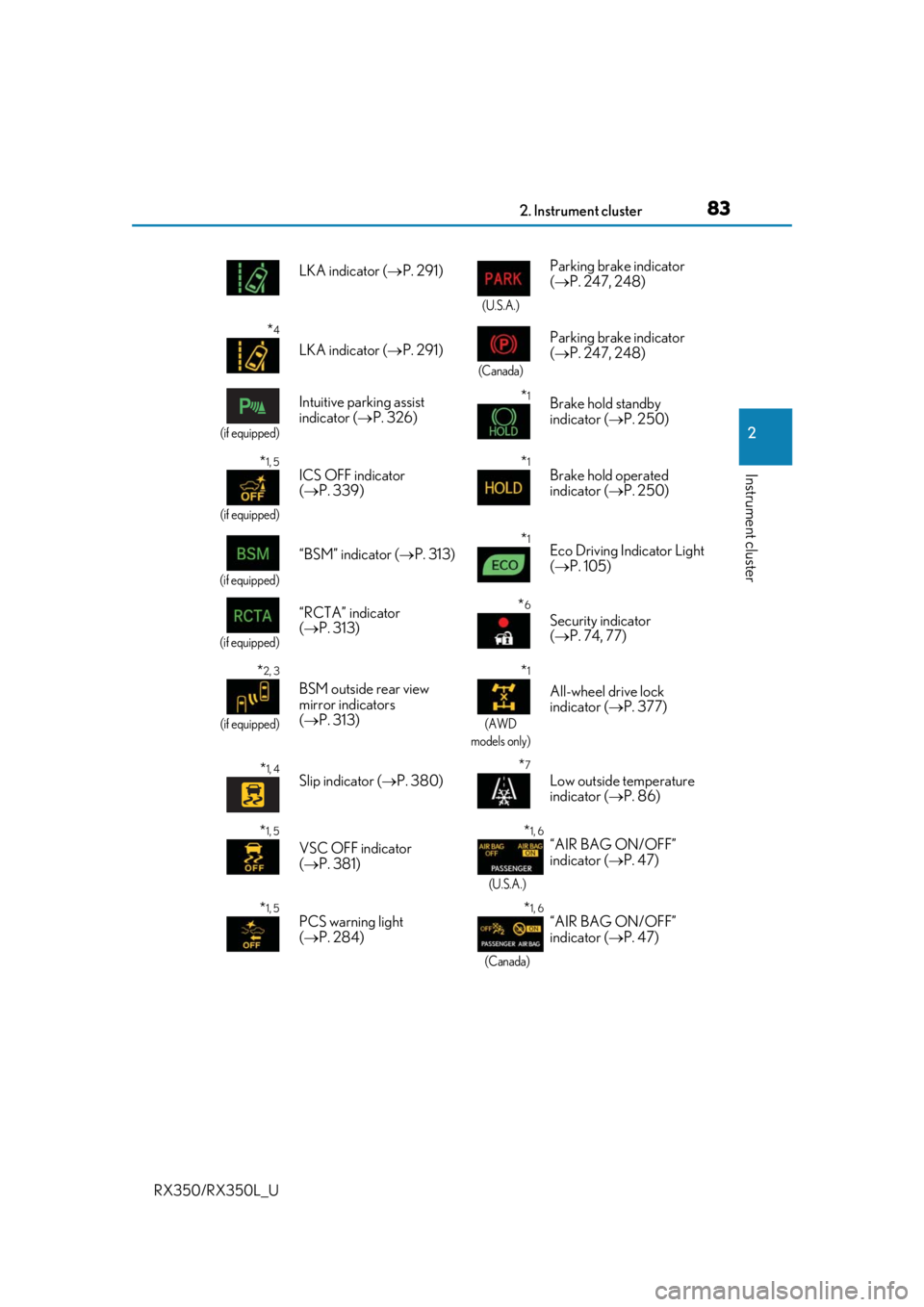
RX350/RX350L_ULKA indicator (
P. 291)
(U.S.A.)
Parking brake indicator
( P. 247, 248)
*4
LKA indicator ( P. 291)
(Canada)
Parking brake indicator
( P. 247, 248)
(if equipped)
Intuitive parking assist
indicator ( P. 326)*1Brake hold standby
indicator ( P. 250)
*1, 5
(if equipped)
ICS OFF indicator
( P. 339)*1Brake hold operated
indicator ( P. 250)
(if equipped)
“BSM” indicator ( P. 313)*1Eco Driving Indicator Light
( P. 105)
(if equipped)
“RCTA” indicator
( P. 313)*6
Security indicator
( P. 74, 77)
*2, 3
(if equipped)
BSM outside rear view
mirror indicators
( P. 313)
*1
(AWD
models only)
All-wheel drive lock
indicator ( P. 377)
*1, 4Slip indicator ( P. 380)*7
Low outside temperature
indicator ( P. 86)
*1, 5
VSC OFF indicator
( P. 381)
*1, 6
(U.S.A.)
“AIR BAG ON/OFF”
indicator ( P. 47)
*1, 5PCS warning light
( P. 284)*1, 6
(Canada)
“AIR BAG ON/OFF”
indicator ( P. 47)
Page 122 of 777
1213-1. Key information
3
Operation of each component
RX350/RX350L_U
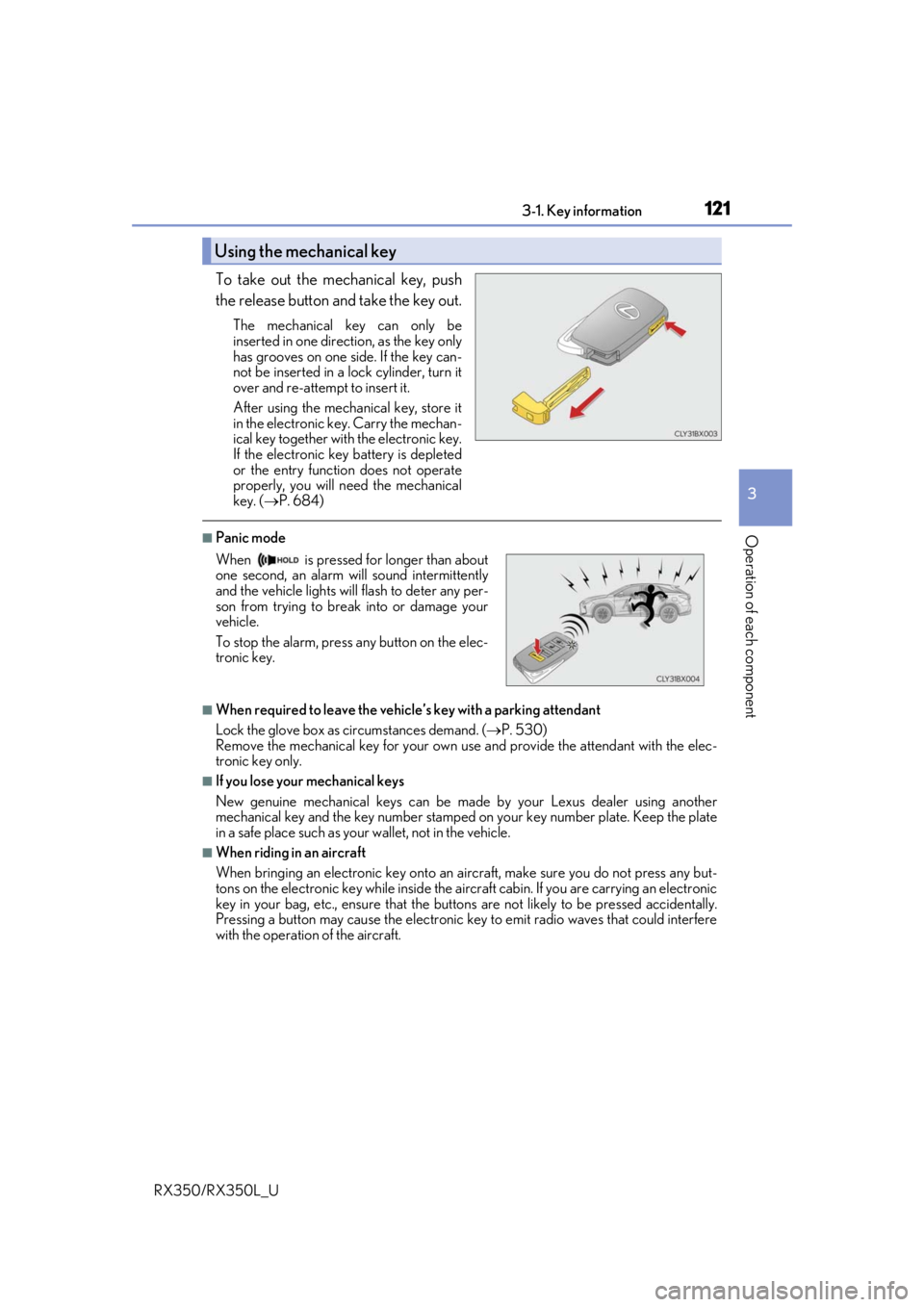
To take out the mechanical key, push
the release button and take the key out.
The mechanical key can only be
inserted in one direction, as the key only
has grooves on one side. If the key can-
not be inserted in a lock cylinder, turn it
over and re-attempt to insert it.
After using the mechanical key, store it
in the electronic key. Carry the mechan-
ical key together with the electronic key.
If the electronic key battery is depleted
or the entry function does not operate
properly, you will need the mechanical
key. ( P. 684)
■Panic mode
■When required to leave the vehicle’s key with a parking attendant
Lock the glove box as circumstances demand. ( P. 530)
Remove the mechanical key for your own use and provide the attendant with the elec-
tronic key only.
■If you lose your mechanical keys
New genuine mechanical keys can be made by your Lexus dealer using another
mechanical key and the key number stamped on your key number plate. Keep the plate
in a safe place such as your wallet, not in the vehicle.
■When riding in an aircraft
When bringing an electronic key onto an aircraft, make sure you do not press any but-
tons on the electronic key while inside the airc raft cabin. If you are carrying an electronic
key in your bag, etc., ensure that the butt ons are not likely to be pressed accidentally.
Pressing a button may cause the electronic key to emit radio waves that could interfere
with the operation of the aircraft.
Using the mechanical key
When is pressed for longer than about
one second, an alarm will sound intermittently
and the vehicle lights will flash to deter any per-
son from trying to break into or damage your
vehicle.
To stop the alarm, press any button on the elec-
tronic key.
Page 149 of 777

1483-2. Opening, closing and locking the doors
RX350/RX350L_U
■Electronic Key battery-Saving Function
When battery-saving mode is set, battery depletion is minimized by stopping the elec-
tronic key from re ceiving radio waves.
■Conditions affecting operation
The smart access system with push-button start, wireless remote control and engine
immobilizer system use weak radio waves. In the following situations, the communication
between the electronic key and the vehicle ma y be affected, preventing the smart access
system with push-button star t, wireless remote control and engine immobilizer system
from operating properly. (Ways of coping: P. 684)
●When the electronic key battery is depleted
●Near a TV tower, electric power plant, gas st ation, radio station, large display, airport or
other facility that generates strong radio wave s or electrical noise
●When the electronic key is in contact with, or is covered by the following metallic
objects
• Cards to which aluminum foil is attached
• Cigarette boxes that have aluminum foil inside
• Metallic wallets or bags
•Coins
• Hand warmers made of metal
• Media such as CDs and DVDs
●When other wireless keys (that emit radio waves) are being used nearby
●When carrying the electronic key together with the following devices that emit radio
waves
• Portable radio, cellular phone, cordle ss phone or other wireless communication
devices
• Another vehicle’s electronic key, another electronic key of your vehicle, or a wireless
key that emits radio waves
• Personal computers or person al digital assistants (PDAs)
• Digital audio players
• Portable game systems
●If window tint with a metallic content or me tallic objects are attached to the rear win-
dow
●When the electronic key is placed near a battery charger or electronic devices
●When the vehicle is parked in a pay parking spot where radio waves are emitted
Press twice while pressing and holding .
Confirm that the electronic key indicator flashes
4 times.
While the battery-saving mode is set, the smart
access system with push
-button start cannot be
used. To cancel the function, press any of the
electronic key buttons.
Page 208 of 777

2074-1. Before driving
4
Driving
RX350/RX350L_U
WARNING
Observe the following precautions.
Failure to do so may result in death or serious injury.
■When the vehicle is stopped
●Do not race the engine.
If the shift lever is in any position other than P or N, the vehicle may accelerate sud-
denly and unexpectedly, causing an accident.
●In order to prevent accidents due to the vehicle rolling away, always keep depressing
the brake pedal while the engine is running, and apply the parking brake as neces-
sary.
●If the vehicle is stopped on an incline, in order to prevent accidents caused by the
vehicle rolling forward or backward, alwa ys depress the brake pedal and securely
apply the parking brake as needed.
●Avoid revving or racing the engine.
Running the engine at high speed while the vehicle is stopped may cause the exhaust
system to overheat, which could result in a fire if combustible material is nearby.
■When the vehicle is parked
●Do not leave glasses, cigarette lighters, sp ray cans, or soft drink cans in the vehicle
when it is in the sun.
Doing so may result in the following:
• Gas may leak from a cigarette lighter or spray can, and may lead to a fire.
• The temperature inside the vehicle may cau se the plastic lenses and plastic mate-
rial of glasses to deform or crack.
• Soft drink cans may fracture, causing the contents to spray over the interior of the
vehicle, and may also cause a short circui t in the vehicle’s electrical components.
●Do not leave cigarette lighters in the vehicle. If a cigarette lighter is in a place such as
the glove box or on the floor, it may be lit accidentally when luggage is loaded or the
seat is adjusted, causing a fire.
●Do not attach adhesive discs to the windsh ield or windows. Do not place containers
such as air fresheners on th e instrument panel or dashboard. Adhesive discs or con-
tainers may act as lenses, ca using a fire in the vehicle.
●Do not leave a door or window open if th e curved glass is coated with a metallized
film such as a silver-colored one. Reflecte d sunlight may cause the glass to act as a
lens, causing a fire.
●Always apply the parking brake, shift the shift lever to P, stop the engine and lock the
vehicle.
Do not leave the vehicle unattend ed while the engine is running.
If the vehicle is parked with the shift leve r in P but the parking brake is not set, the
vehicle may start to move, possibly leading to an accident.
●Do not touch the exhaust pipes while the engine is running or immediately after turn-
ing the engine off.
Doing so may cause burns.
Page 209 of 777

2084-1. Before driving
RX350/RX350L_U
WARNING
Observe the following precautions.
Failure to do so may result in death or serious injury.
■When taking a nap in the vehicle
Always turn the engine off. Otherwise, if you accidentally move the shift lever or
depress the accelerator pedal, this could cause an accident or fire due to engine over-
heating. Additionally, if the ve hicle is parked in a poorly ventilated area, exhaust gases
may collect and enter the vehicle, leading to death or a serious health hazard.
■When braking
●When the brakes are wet, drive more cautiously.
Braking distance increases when the brakes are wet, and this may cause one side of
the vehicle to brake differently than the other side. Also, the parking brake may not
securely hold the vehicle.
●If the brake booster device does not operate, do not follow other vehicles closely and
avoid hills or sharp turns that require braking.
In this case, braking is still possible, bu t the brake pedal should be depressed more
firmly than usual. Also, the braking distan ce will increase. Have your brakes fixed
immediately.
●Do not pump the brake pedal if the engine stalls.
Each push on the brake pedal uses up the reserve for the power-assisted brakes.
●The brake system consists of 2 individual hy draulic systems; if one of the systems fails,
the other will still operate. In this case, the brake pedal should be depressed more
firmly than usual and the bra king distance will increase.
Have your brakes fixed immediately.
■If the vehicle becomes stuck (AWD models)
Do not spin the wheels excessive ly when any of the tires is up in the air, or the vehicle is
stuck in sand, mud, etc. This may damage the driveline components or propel the vehi-
cle forward or backward, causing an accident.
Page 225 of 777

2244-1. Before driving
RX350/RX350L_U
●To maintain engine braking efficien cy and charging system performance
when using engine braking, do not put th e transmission in D. If in the M or S
mode, the transmission shift range po sition must be in 6 or lower. (P. 240)
●Instability happens more fr equently when descending steep or long downhill
grades. Before descending, slow down and downshift. Do not make sudden
downshifts while descending st eep or long downhill grades.
●Avoid holding the brake pedal down too long or applying the brakes too fre-
quently. This could cause the brakes to overheat and result in reduced braking
efficiency.
●Due to the added load of the trailer, yo ur vehicle’s engine may overheat on hot
days (at temperatures over 85 F [30 C]) when driving up a long or steep
grade. If the engine coolant temperat ure gauge indicates overheating, imme-
diately turn off the air conditioning (if in use), pull your vehicle off the road and
stop in a safe spot. ( P. 692)
●Always place wheel blocks under both the vehicle’s and the trailer’s wheels
when parking. Put the transmission in P and apply the parking brake. Avoid
parking on a slope, but if unavoidable, do so only after performing the follow-
ing:
Apply the brakes and keep them applied.
Have someone place wheel blocks under both the vehicle’s and trailer’s
wheels.
When the wheel blocks are in place, release the brakes slowly until the
blocks absorb the load.
Shift into P and apply the parking brake.
Turn off the engine.
●When restarting afte r parking on a slope:
With the transmission in P, start the en gine. Be sure to keep the brake pedal
depressed.
Shift into a forward gear. If reversing, shift into R.
If the parking brake is in manual mode, release the parking brake.
( P. 248)
Release the brake pedal, and slowly pull or back away from the wheel
blocks. Stop and apply the brakes.
Have someone retrieve the blocks.
1
2
3
4
5
1
2
3
4
5