ignition LEXUS SC300 1991 Service Repair Manual
[x] Cancel search | Manufacturer: LEXUS, Model Year: 1991, Model line: SC300, Model: LEXUS SC300 1991Pages: 4087, PDF Size: 75.75 MB
Page 1071 of 4087

DTC15, 16TRAC Solenoid Relay Circuit
CIRCUIT DESCRIPTION
This relay circuit supplies power to each traction actuator solenoid.When th\
e ignition switch is turned on, the
relay goes on.
DTC No.DTC Detecting ConditionTrouble Area
15
Conditions (1) through (3) continue for 0.2 sec.or more:
(1) TRAC solenoid relay (TSR) terminal voltage: Bat-
tery positive voltage
(2) All TRAC actuator solenoid: OFF(3) All TRAC ac-
tuator solenoid monitor voltage (in ECU): 0V
TRAC solenoid relay
Open or short in TRAC solenoid relay circuit
ECU
16
Conditions (1) through (3) continue for 0.2 sec.or more:
(1) TRAC solenoid relay (TSR) terminal voltage: 0V
(2) All TRAC actuator solenoid: OFF
(3) TRAC actuator solenoid monitor voltage (in ECU):
Battery positive voltage
TRAC solenoid relay
B+ short in TRAC solenoid relay circuit
ECU
Fail safe function: If tr ouble occurs in this relay circuit, the ECU cuts off the current to the ABS and TRAC
solenoid relays and prohibits ABS and TRAC control.
DIAGNOSTIC CHARTDIAGNOSTIC CHART
BR±102±
BRAKE SYSTEM ANTI±LOCK BRAKE SYSTEM (ABS)
WhereEverybodyKnowsYourName
Page 1087 of 4087

DTC
31, 32,
33, 34,35, 36
Speed Sensor Circuit
CIRCUIT DESCRIPTION
The speed sensor detects the wheel speed and sends the ap-
propriate signals to the ECU. These signals are used for control
of both the ABS and TRAC control systems. The front and rear
rotors each have 48 serrations. When the rotors rotate, the
magnetic field emitted by the permanent magnet in the speed
sensor generates an AC voltage. Since the frequency of this
AC voltage changes in proportion to the speed of the rotors
(wheels) the frequency is used by the ECU to detect the speed
of each wheel.
BR3583
BR3582
DTC No.DTC Detecting ConditionTrouble Area
31, 32,
33, 34
Detection of any of conditions (1) through (3):
(1) At vehicle speed of 10 km/h (6 mph) or more,
pulses are not input for 5 sec.
(2) Momentary interruption of the vehicle speed sen-
sor signal occurs at least 7 times in the time between
switching the ignition switch ON and switching it OFF.
(3) Abnormal fluctuation of speed sensor signals with
the vehicle speed 20 km/h (12 mph) or more.
Right front, left front, right rear and left rear
speed sensor.
Open or short in each speed sensor circuit.
ECU
35
Vehicle speed sensor signal is not input for about 1 sec.
while the left front and right rear with the vehicle speed
sensor signals are being checked IG switch ON.
Open in left front, right rear speed sensor cir-
cuit.
ECU
36
Vehicle speed sensor signal is not input for about 1 sec.
while the right front and left rear vehicle speed sensor
signals are being checked with the IG switch ON.
Open in right front, left rear speed sensor cir-
cuit.
ECU
HINT: DTC No. 31 is for the right front wheel speed sensor.
DTC No. 32 is for the left front wheel speed sensor.
DTC No. 33 is for the right rear wheel speed sensor.
DTC No. 34 is for the left rear wheel speed sensor.
Fail safe function: If trouble occurs in the speed sensor circuit, the ECU cuts off current to the ABS
solenoid relay and prohibits ABS control.
BR±118
±
BRAKE SYSTEM ANTI±LOCK BRAKE SYSTEM (ABS)
WhereEverybodyKnowsYourName
Page 1092 of 4087
 ECU connec\
to")
OKNG
NGOK
INSPECTION PROCEDURE
1Check battery positive voltage.
Voltage: 10 ± 14 VOK
Check and repair the charging system.
2Check voltage between terminals IG1 and GND or ABS (& TRAC) ECU connec\
tor.
C
OK
PRemove ABS (& TRAC) ECU with connectors still con-
nected.
1. Turn ignition switch on.
2. Measure voltage between terminals IG1 and GNDof ABS (& TRAC) ECU connector.\
Voltage: 10 ± 14 V
Check and replace ABS (& TRAC) ECU.
±
BRAKE SYSTEM ANTI±LOCK BRAKE SYSTEM (ABS)BR±123
WhereEverybodyKnowsYourName
Page 1098 of 4087
.
Repair or replace harness or connector.
4Check voltage between terminals PR and E2 of ABS")
OKNG
NGOK
OKNG
3Check harness and connector between ABS & TRAC ECU and TRAC pump & motor (Se\
e page
IN±33).
Repair or replace harness or connector.
4Check voltage between terminals PR and E2 of ABS & TRAC ECU connector.
C
OK
P
OK
C
Notice
1. Remove ABS & TRAC ECU with connectors still
connected.
2. Operate the engine for about 30 seconds at idle speed to raise the pressure of the TRAC actuator
to a high level.
1. Stop the engine and then turn ignition switch ON.
2. Measure voltage between terminals PR and E2 of ABS & TRAC ECU connector.
Voltage: 4 ± 8 V
1. Drain the fluid out of the actuator to reduce the pres-
sure.
2. Measure voltage between terminal PR and E2 of ABS & TRAC ECU connector.
Voltage: 10 ± 14 V
Add fluid to reservoir after the check.
Check and replace ABS & TRAC ECU.
5Check harness and connector between ABS & TRAC ECU and TRAC actuator (See page IN±33).
Repair or replace harness or connector.
Replace TRAC actuator.
±
BRAKE SYSTEM ANTI±LOCK BRAKE SYSTEM (ABS)BR±129
WhereEverybodyKnowsYourName
Page 1100 of 4087
NGOK
OKNG
INSPECTION PROCEDURES
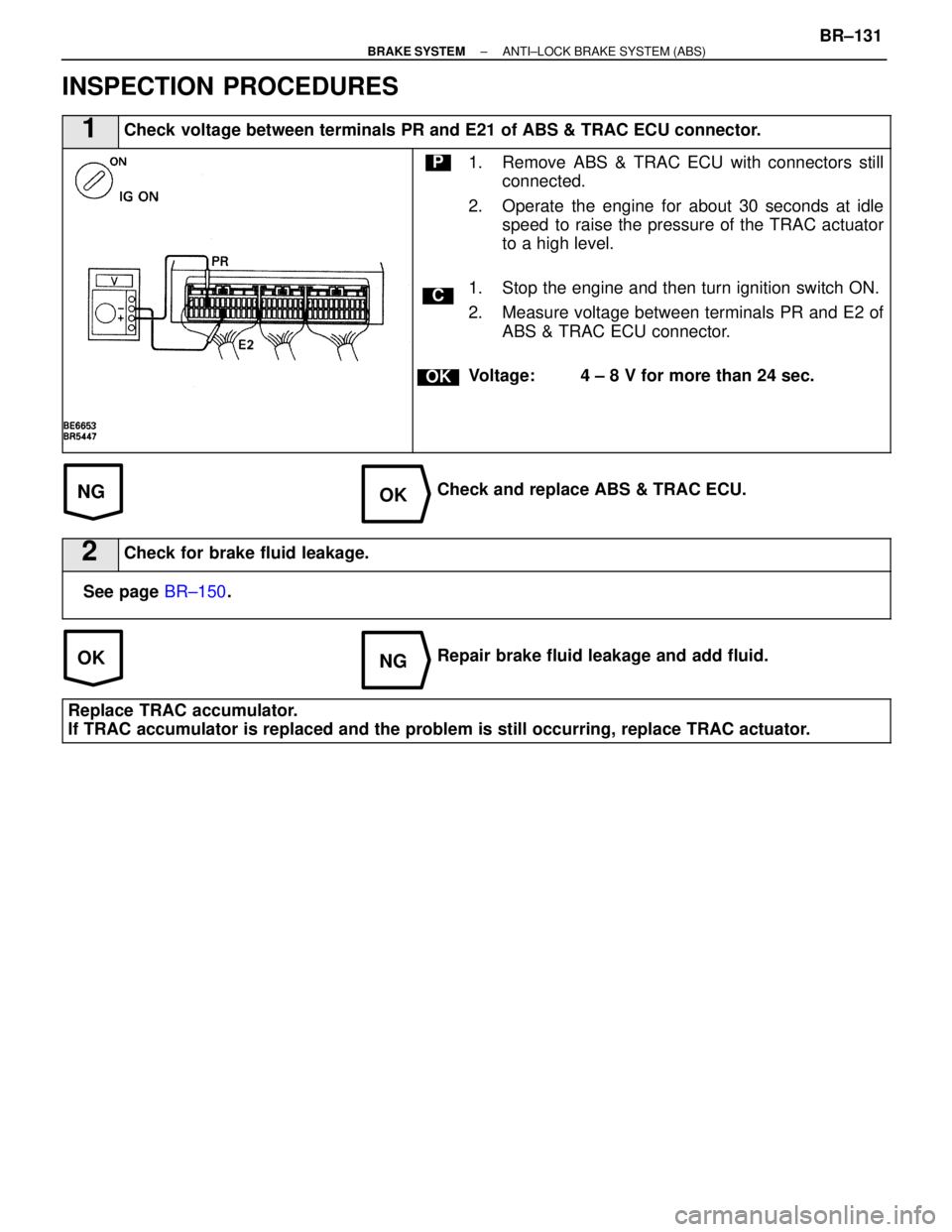
1Check voltage between terminals PR and E21 of ABS & TRAC ECU connector.
C
OK
P1. Remove ABS & TRAC ECU with connectors stillconnected.
2. Operate the engine for about 30 seconds at idle speed to raise the pressure of the TRAC actuator
to a high level.
1. Stop the engine and then turn ignition switch ON.
2. Measure voltage between terminals PR and E2 of ABS & TRAC ECU connector.
Voltage: 4 ± 8 V for more than 24 sec.
Check and replace ABS & TRAC ECU.
2Check for brake fluid leakage.
See page BR±150.
Repair brake fluid leakage and add fluid.
Replace TRAC accumulator.
If TRAC accumulator is replaced and the problem is still occurring, repl\
ace TRAC actuator.
±
BRAKE SYSTEM ANTI±LOCK BRAKE SYSTEM (ABS)BR±131
WhereEverybodyKnowsYourName
Page 1105 of 4087
NGOK
OKNG
INSPECTION PROCEDURE
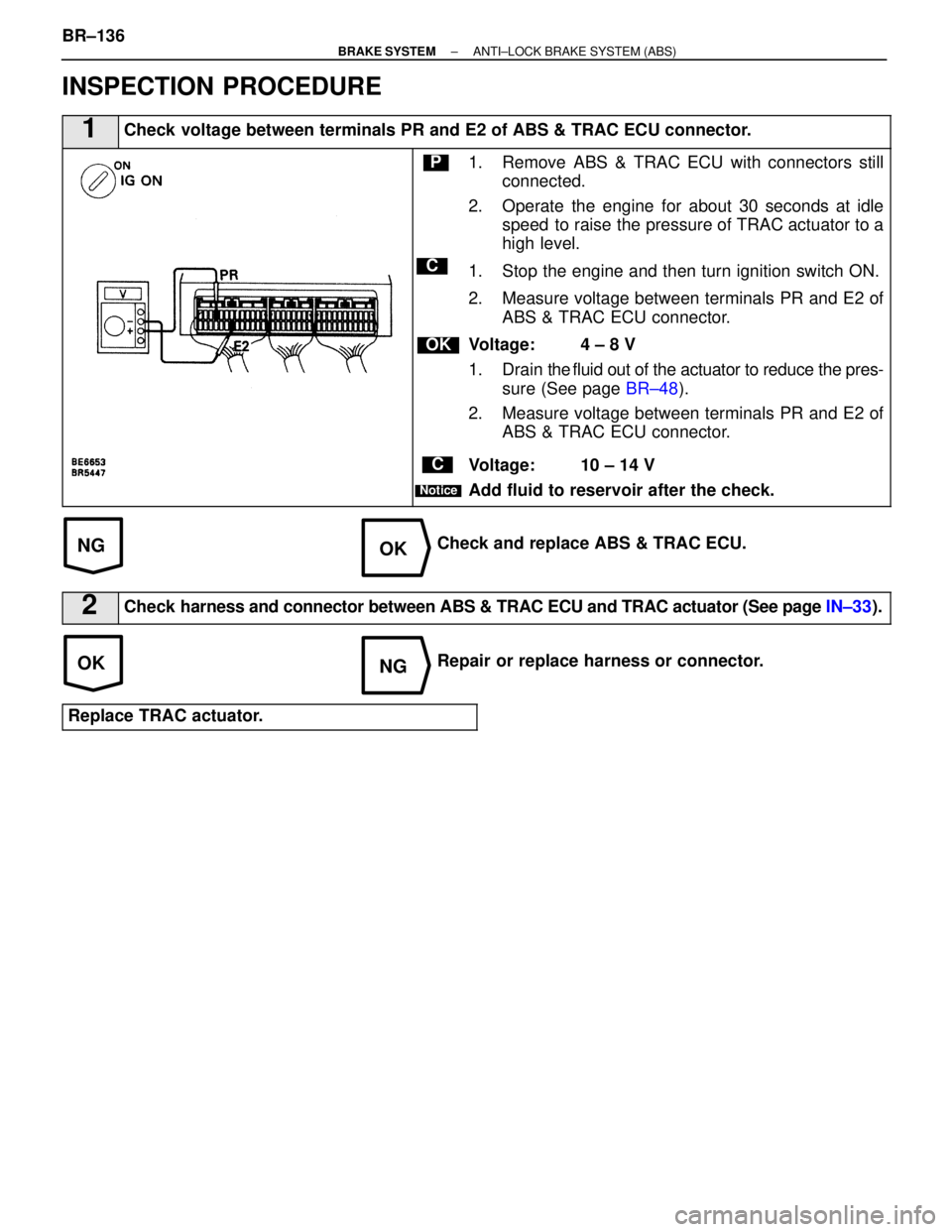
1Check voltage between terminals PR and E2 of ABS & TRAC ECU connector.
C
OK
P
C
Notice
1. Remove ABS & TRAC ECU with connectors stillconnected.
2. Operate the engine for about 30 seconds at idle speed to raise the pressure of TRAC actuator to a
high level.
1. Stop the engine and then turn ignition switch ON.
2. Measure voltage between terminals PR and E2 of ABS & TRAC ECU connector.
Voltage: 4 ± 8 V
1. Drain the fluid out of the actuator to reduce the pres-
sure (See page BR±48).
2. Measure voltage between terminals PR and E2 of ABS & TRAC ECU connector.
Voltage: 10 ± 14 V
Add fluid to reservoir after the check.
Check and replace ABS & TRAC ECU.
2Check harness and connector between ABS & TRAC ECU and TRAC actuator (See page IN±33).
Repair or replace harness or connector.
Replace TRAC actuator.
BR±136±
BRAKE SYSTEM ANTI±LOCK BRAKE SYSTEM (ABS)
WhereEverybodyKnowsYourName
Page 1108 of 4087
OKOK
OKNG
OKNG
INSPECTION PROCEDURE
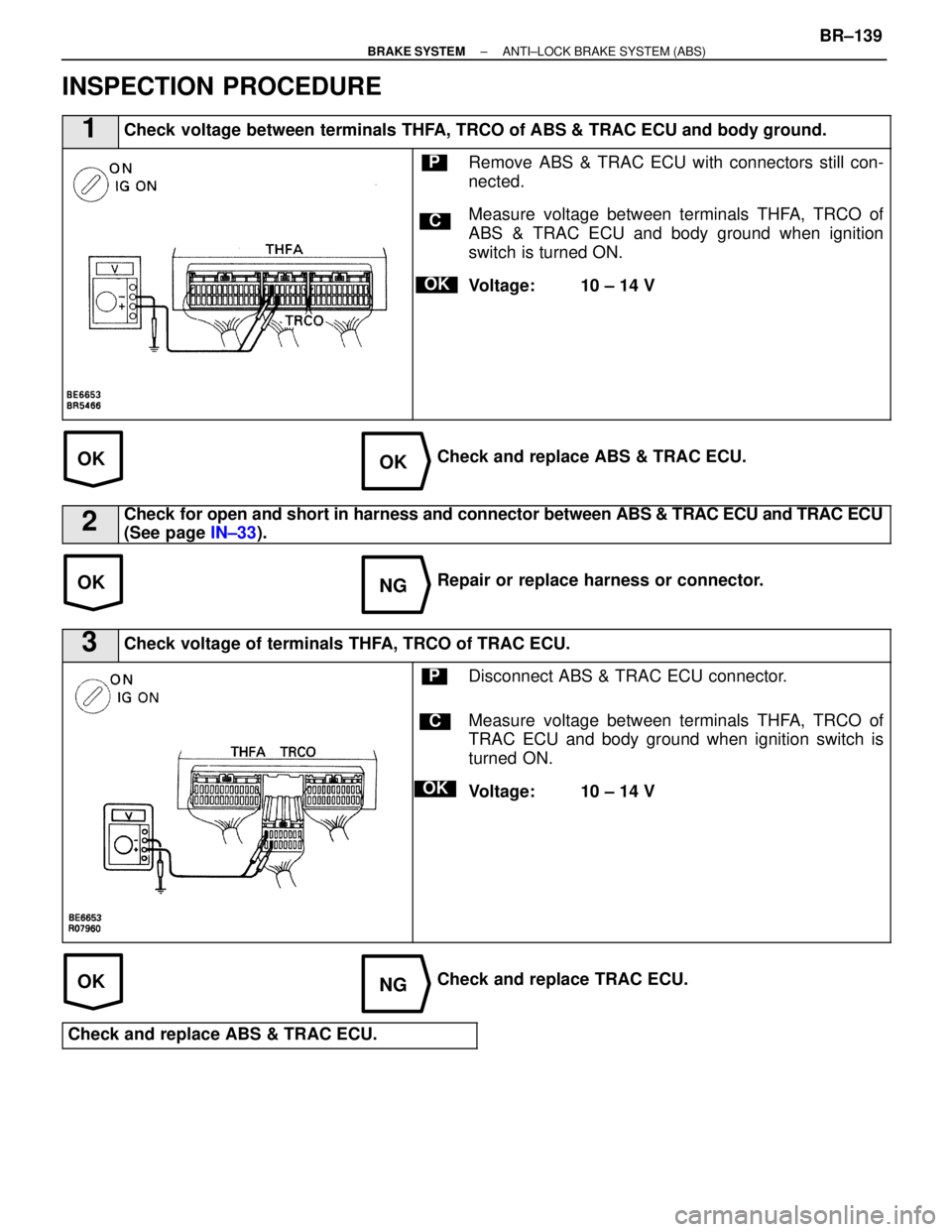
1Check voltage between terminals THFA, TRCO of ABS & TRAC ECU and body ground.
C
OK
PRemove ABS & TRAC ECU with connectors still con-
nected.
Measure voltage between terminals THFA, TRCO of
ABS & TRAC ECU and body ground when ignition
switch is turned ON.
Voltage: 10 ± 14 V
Check and replace ABS & TRAC ECU.
2Check for open and short in harness and connector between ABS & TRAC ECU and TRAC ECU
(See page IN±33).
Repair or replace harness or connector.
3Check voltage of terminals THFA, TRCO of TRAC ECU.
C
OK
PDisconnect ABS & TRAC ECU connector.
Measure voltage between terminals THFA, TRCO of
TRAC ECU and body ground when ignition switch is
turned ON.
Voltage: 10 ± 14 V
Check and replace TRAC ECU.
Check and replace ABS & TRAC ECU.
±
BRAKE SYSTEM ANTI±LOCK BRAKE SYSTEM (ABS)BR±139
WhereEverybodyKnowsYourName
Page 1118 of 4087
NGOK
OKNG
INSPECTION PROCEDURE
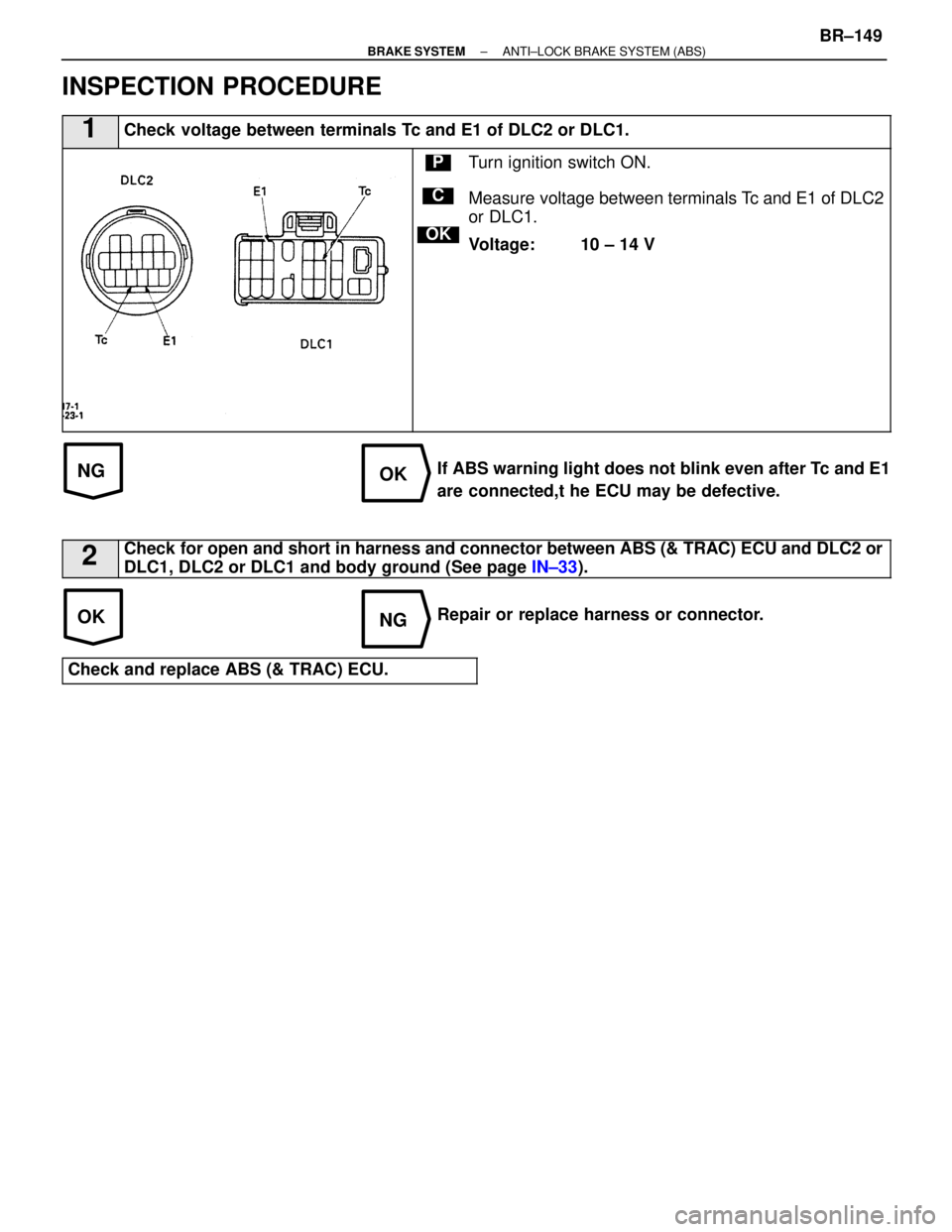
1Check voltage between terminals Tc and E1 of DLC2 or DLC1.
C
OK
PTurn ignition switch ON.
Measure voltage between terminals Tc and E1 of DLC2
or DLC1.
Voltage: 10 ± 14 V
If ABS warning light does not blink even after Tc and E1
are connected,t he ECU may be defective.
2Check for open and short in harness and connector between ABS (& TRAC) ECU \
and DLC2 or
DLC1, DLC2 or DLC1 and body ground (See page IN±33).
Repair or replace harness or connector.
Check and replace ABS (& TRAC) ECU.
±
BRAKE SYSTEM ANTI±LOCK BRAKE SYSTEM (ABS)BR±149
WhereEverybodyKnowsYourName
Page 1120 of 4087
NGOK
OKNG
INSPECTION PROCEDURE
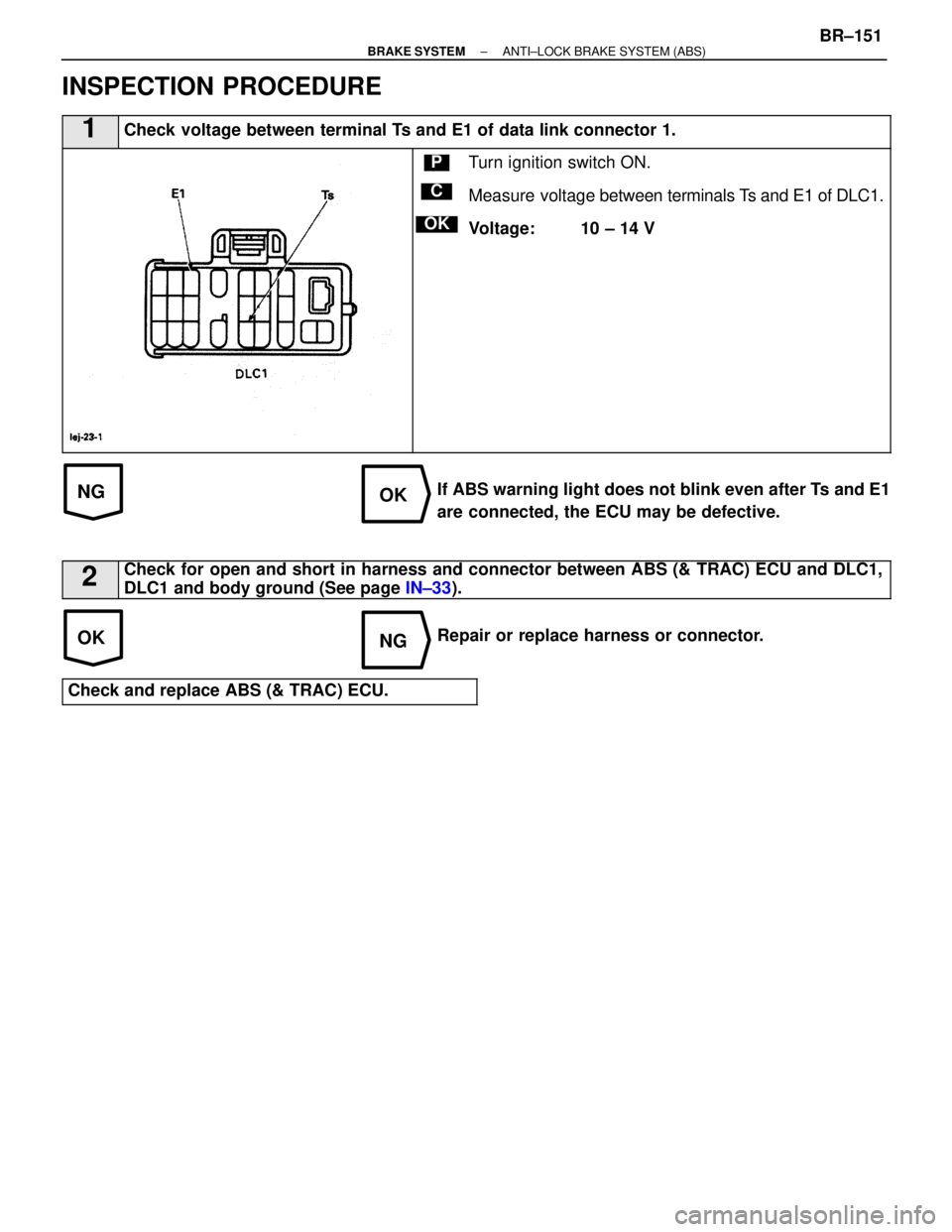
1Check voltage between terminal Ts and E1 of data link connector 1.
C
OK
PTurn ignition switch ON.
Measure voltage between terminals Ts and E1 of DLC1.
Voltage: 10 ± 14 V
If ABS warning light does not blink even after Ts and E1
are connected, the ECU may be defective.
2Check for open and short in harness and connector between ABS (& TRAC) ECU and D\
LC1,
DLC1 and body ground (See page IN±33).
Repair or replace harness or connector.
Check and replace ABS (& TRAC) ECU.
±
BRAKE SYSTEM ANTI±LOCK BRAKE SYSTEM (ABS)BR±151
WhereEverybodyKnowsYourName
Page 1135 of 4087

SYSTEM CIRCUIT
OPERATION
When the ignition switch is turned ON, current from the battery flows from t\
erminal L of the alternator through
the IC regulator to terminal E, causing the discharge warning light to ligh\
t up. Then when the engine is started, the voltage output increases as the alt\
ernator rpm increases. When the
voltage output becomes greater than the battery voltage, current for recharging\
flows from terminal B. Simulta-
neously, volt age at terminal L increases and the potential difference between battery and terminal L disappears,
causing the discharge warning light to go off. When the voltage output exceeds the regulator adjustment volt-
age, the transistor inside the IC regulator regulates the voltage so tha\
t the voltage from the alternator remains
constant.
±
CHARGING SYSTEM System Circuit, OperationCH±3
WhereEverybodyKnowsYourName