ignition LEXUS SC300 1991 Service Service Manual
[x] Cancel search | Manufacturer: LEXUS, Model Year: 1991, Model line: SC300, Model: LEXUS SC300 1991Pages: 4087, PDF Size: 75.75 MB
Page 209 of 4087
5. DISPOSAL OF STEERING WHEEL PAD (WITH AIRBAG)CAUTION:
w The steering wheel pad is very hot when the airbag is
deployed, so leave it alone for at least 30 minutes after
deployment.
w Use gloves and safety glasses when handling a steering
wheel pad with deployed airbag.
w Do not apply water, etc. to a steering wheel pad with
deployed airbag.
w Always wash your hands with water after completing the
operation.
(a) When scrapping a vehicle, deploy the airbag and scrap
the vehicle with the steering wheel pad still installed.
(b) When moving a vehicle for scr apping which has a
steering wheel pad with deployed airbag, use gloves
and safety glasses.
AIRBAG DEPLOYMENT PROCEDURE
(PROCEDURE FOR DISPOSAL OF
STEERING WHEEL PAD ONLY)
When disposing of the steering wheel pad (with airbag)
only, never use the customer's vehicle to deploy the
airbag.
Remove the steering wheel pad from the vehicle and be sure
to follow the procedure given below when deploying the
airbag.
HINT: Have a battery ready as the power source to deploy the
airbag.
1. REMOVE STEERING WHEEL PAD (SEE PAGE AB±16)
CAUTION:
wWhen removing the steering wheel pad (with
airbag), work must be started after approx. 30
seconds or longer from the time the ignition switch
is turned to the LOCK position and the negative (±)
terminal cable is disconnected from the battery.
w When storing the steering wheel pad, keep the upper
surface of the pad facing upward.
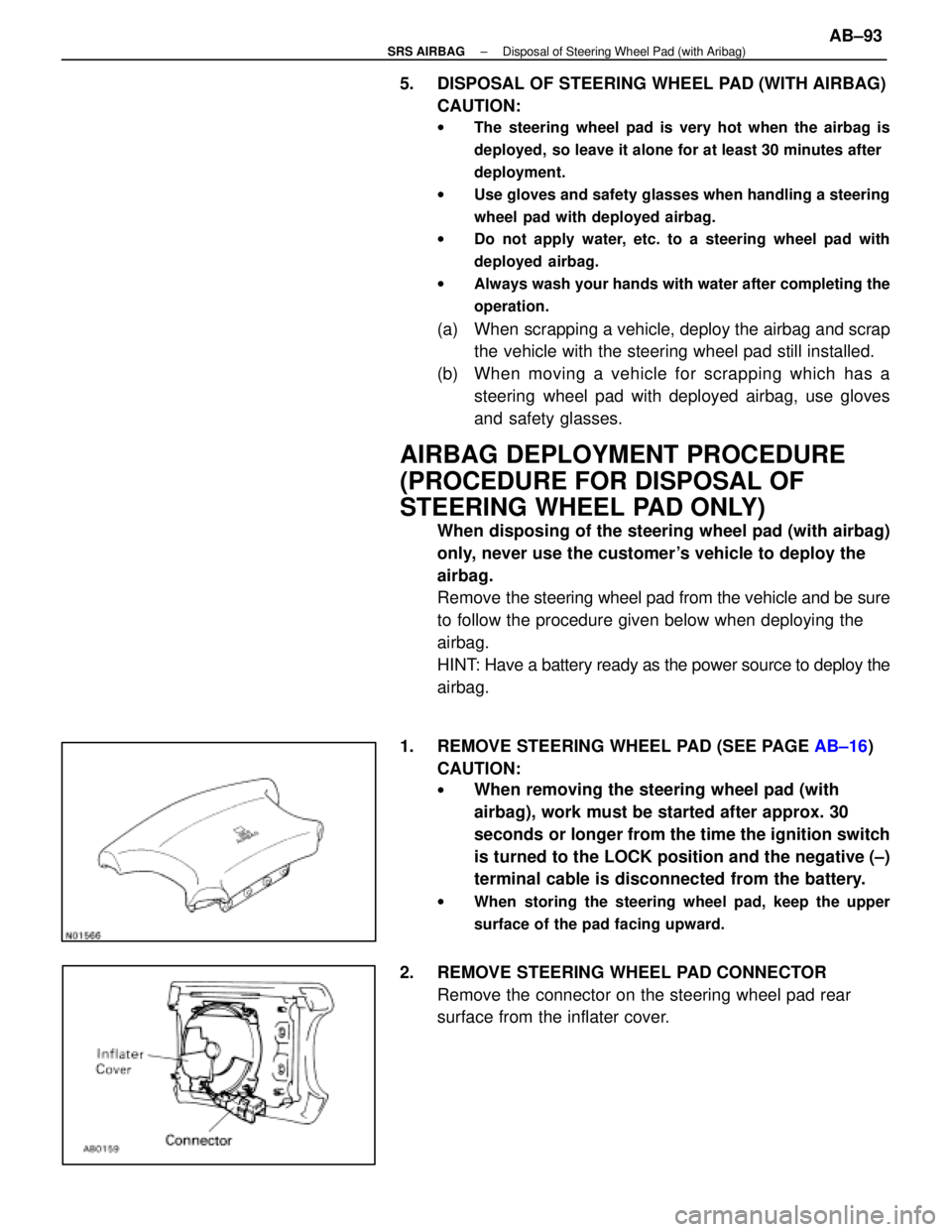
2. REMOVE STEERING WHEEL PAD CONNECTOR
Remove the connector on the steering wheel pad rear
surface from the inflater cover.
±
SRS AIRBAG Disposal of Steering Wheel Pad (with Aribag)AB±93
WhereEverybodyKnowsYourName
Page 218 of 4087

3. Grease should not be applied to the steering wheel pad and the pad should not b\
e cleaned with detergents
of any kind.
4. Store the steering wheel pad where the ambient temperature remains below 93 °C (200 °F), without high
humidity and away from electrical noise.
5. When using electric welding, first disconnect the airbag connector (yellow \
color and 2 pins) under the steering column near the combination switch connector before starting work.
6. When disposing of a vehicle or the steering wheel pad alone, the airbag shou\
ld be deployed using an SST before disposal (See page AB±91). Perform the operation in a place away from electrical noise.
CENTER AIRBAG SENSOR ASSEMBLY
The connector of the center airbag sensor assembly should be connected or d\
isconnected with the sensor
mounted on the floor. It the connector is connected or disconnected while the center airbag \
sensor assem-
bly is not mounted to the floor, it could cause undesired ignition of the airbag system.
WIRE HARNESS AND CONNECTOR
The airbag system wire harness is integrated with the cowl wire harness ass\
embly. The wires for the airbag
wire harness are encased in a yellow corrugated tube. All the connectors\
for the system are also a standard
yellow color. If the airbag system wire harness becomes disconnected or the connecto\
r becomes broken
due to an accident, etc., repair or replace it as shown on page AB±20.
AB±4
SRS AIRBAG
± General Description
WhereEverybodyKnowsYourName
Page 219 of 4087

OPERATION
FUNCTION OF COMPONENTS
1. FRONT AIRBAG SENSORA front airbag sensor is mounted inside each of the front
fenders. The sensor unit is a mechanical type. When the sen-
sor detects deceleration force above a predetermined limit in
a collision, the contacts in the sensor make contact, sending
a signal to the center airbag sensor assembly. The sensor
cannot be disassembled.
2. SPIRAL CABLE (in COMBINATION SWITCH) A spiral cable is used as an electrical joint from the vehicle
body side to the steering wheel.
3. STEERING WHEEL PAD (with AIRBAG) The inflater and bag of the airbag system are stored in the
steering wheel pad and cannot be disassembled.
The inflater contains a squib, igniter charge, gas generant,
etc., and inflates the bag in case of a frontal collision.
4. AIRBAG WARNING LIGHT The airbag warning light is located on the combination meter.
It goes on to alert the driver of trouble in the system when a
malfunction is detected in the center airbag sensor assembly
self±diagnosis. In normal operating condition when the igni-
tion switch is turned to the ACC or ON position, the light goes
on for about 6 seconds and then goes off.
5. CENTER AIRBAG SENSOR ASSEMBLY The center airbag sensor assembly is mounted on the floor
inside the center cluster. The center airbag sensor assembly
consists of a center airbag sensor, safing sensors, ignition
control and drive circuit, diagnosis circuit, etc. It receives sig-
nals f rom the airbag sensors, judges whether the airbag must
be activated or not and diagnoses system malfunctions. AB±5
± OperationSRS AIRBAG
WhereEverybodyKnowsYourName
Page 222 of 4087
 Connector Twin±Lock MechanismWith this mechanism connectors (male and female connectors) are locked by \
two locking devices to
increase connection reliability. If the primary lock is incomplet")
(4) Connector Twin±Lock MechanismWith this mechanism connectors (male and female connectors) are locked by \
two locking devices to
increase connection reliability. If the primary lock is incomplete, ribs interfere and prevent the seco\
nd-
ary lock.
When the vehicle is involved in a frontal collision in the hatched area (Fi\
g. 1) and the shock is larger than a prede-
termined level, the airbag is activated automatically. Safing sensors are designed to go on at a smaller decelera-
tion rate than the front and center airbag sensors. As illustrated in Fig. 2\
below, ignition is caused when current
flows to the squib, which happens when a safing sensor and a front airbag sen\
sor and/or the center airbag sen-
sor go on simultaneously.
When a deceleration force acts on the sensors, it causes the squib to ignite\
. Gas is then generated, increasing
the pressure inside the bag rapidly. The inflated bag breaks open the steering wheel pad. Bag inflation then
ends, and the gas is discharged through discharge holes provided behind the b\
ag. The bag becomes deflated
as a result.
AB±8SRS AIRBAG ± Operation
WhereEverybodyKnowsYourName
Page 228 of 4087
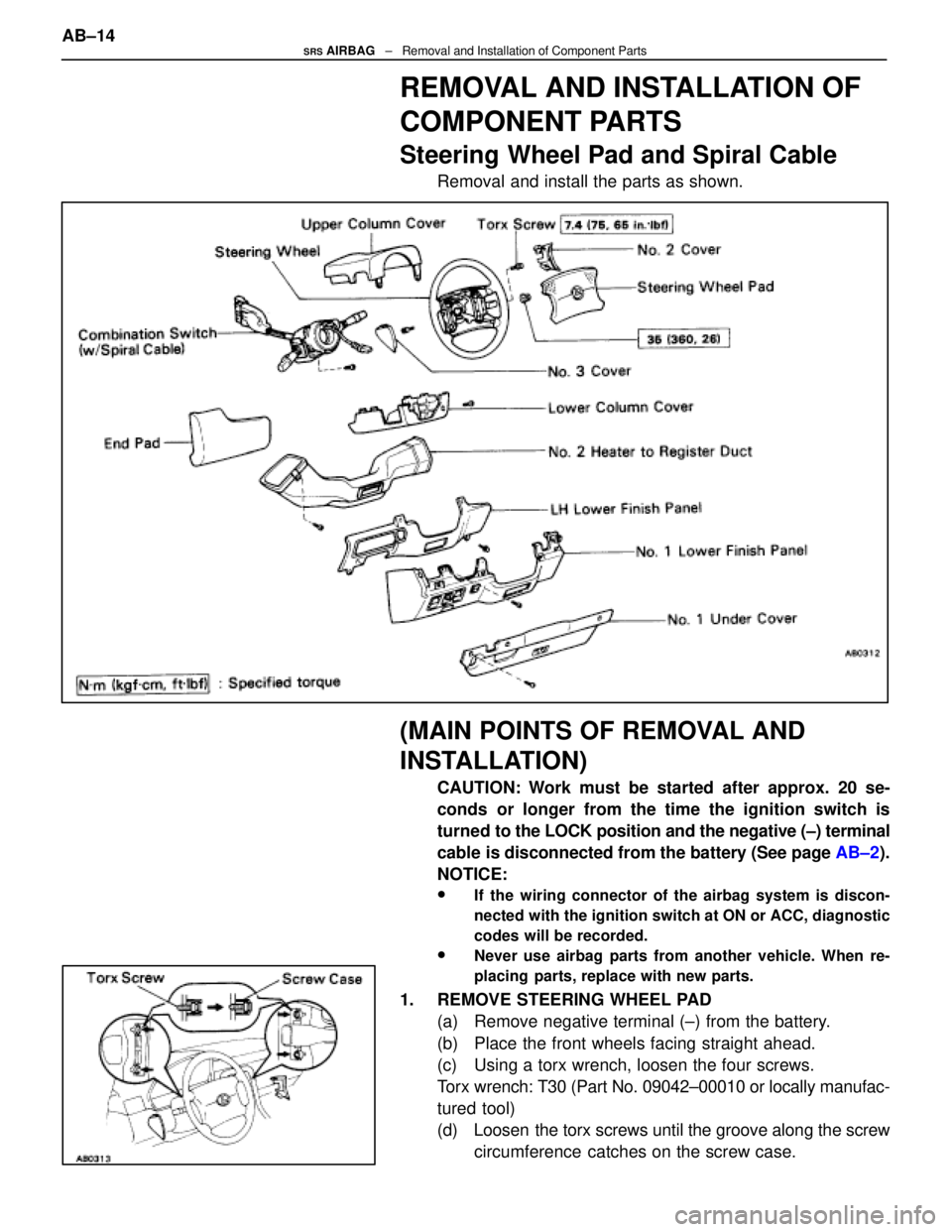
REMOVAL AND INSTALLATION OF
COMPONENT PARTS
Steering Wheel Pad and Spiral Cable
Removal and install the parts as shown.
(MAIN POINTS OF REMOVAL AND
INSTALLATION)
CAUTION: Work must be started after approx. 20 se-
conds or longer from the time the ignition switch is
turned to the LOCK position and the negative (±) terminal
cable is disconnected from the battery (See page AB±2).
NOTICE:
wIf the wiring connector of the airbag system is discon-
nected with the ignition switch at ON or ACC, diagnostic
codes will be recorded.
wNever use airbag parts from another vehicle. When re-
placing parts, replace with new parts.
1. REMOVE STEERING WHEEL PAD (a) Remove negative terminal (±) from the battery.
(b) Place the front wheels facing straight ahead.
(c) Using a torx wrench, loosen the four screws.
Torx wrench: T30 (Part No. 09042±00010 or locally manufac-
tured tool)
(d) Loosen the torx screws until the groove along the screwcircumference catches on the screw case.
AB±14
SRS AIRBAG
± Removal and Installation of Component Parts
WhereEverybodyKnowsYourName
Page 230 of 4087
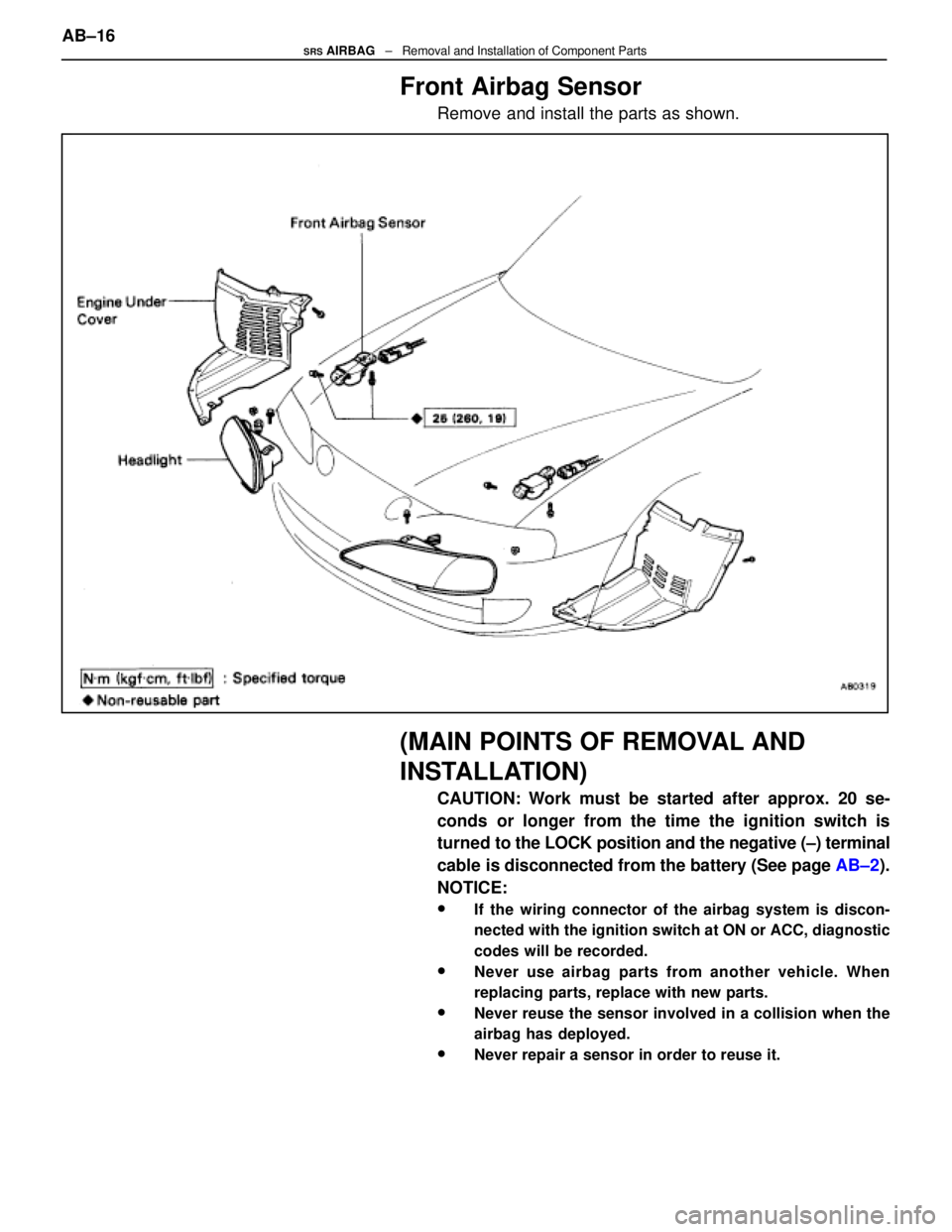
Front Airbag Sensor
Remove and install the parts as shown.
(MAIN POINTS OF REMOVAL AND
INSTALLATION)
CAUTION: Work must be started after approx. 20 se-
conds or longer from the time the ignition switch is
turned to the LOCK position and the negative (±) terminal
cable is disconnected from the battery (See page AB±2).
NOTICE:
wIf the wiring connector of the airbag system is discon-
nected with the ignition switch at ON or ACC, diagnostic
codes will be recorded.
wNever use airbag parts from another vehicle. When
replacing parts, replace with new parts.
wNever reuse the sensor involved in a collision when the
airbag has deployed.
wNever repair a sensor in order to reuse it.
AB±16SRS AIRBAG ± Removal and Installation of Component Parts
WhereEverybodyKnowsYourName
Page 233 of 4087
(MAIN POINTS OF REMOVAL AND
INSTALLATION)
CAUTION: Work must be started after approx. 20 se-
conds or longer from the time the ignition switch is
turned to the LOCK position and the negative (±) terminal
cable is disconnected from the battery (See page AB±2).
NOTICE:
wDo not open the cover or the case of the ECU and various
computers unless absolutely necessary. (If the IC termi-
nals are touched, the IC may be destroyed by static elec-
tricity.)
wNever use airbag parts from another vehicle. When
replacing parts, replace with new parts.
wNever reuse the center airbag sensor assembly involved
in a collision when the airbag has deployed.
wNever repair a sensor in order to reuse it.
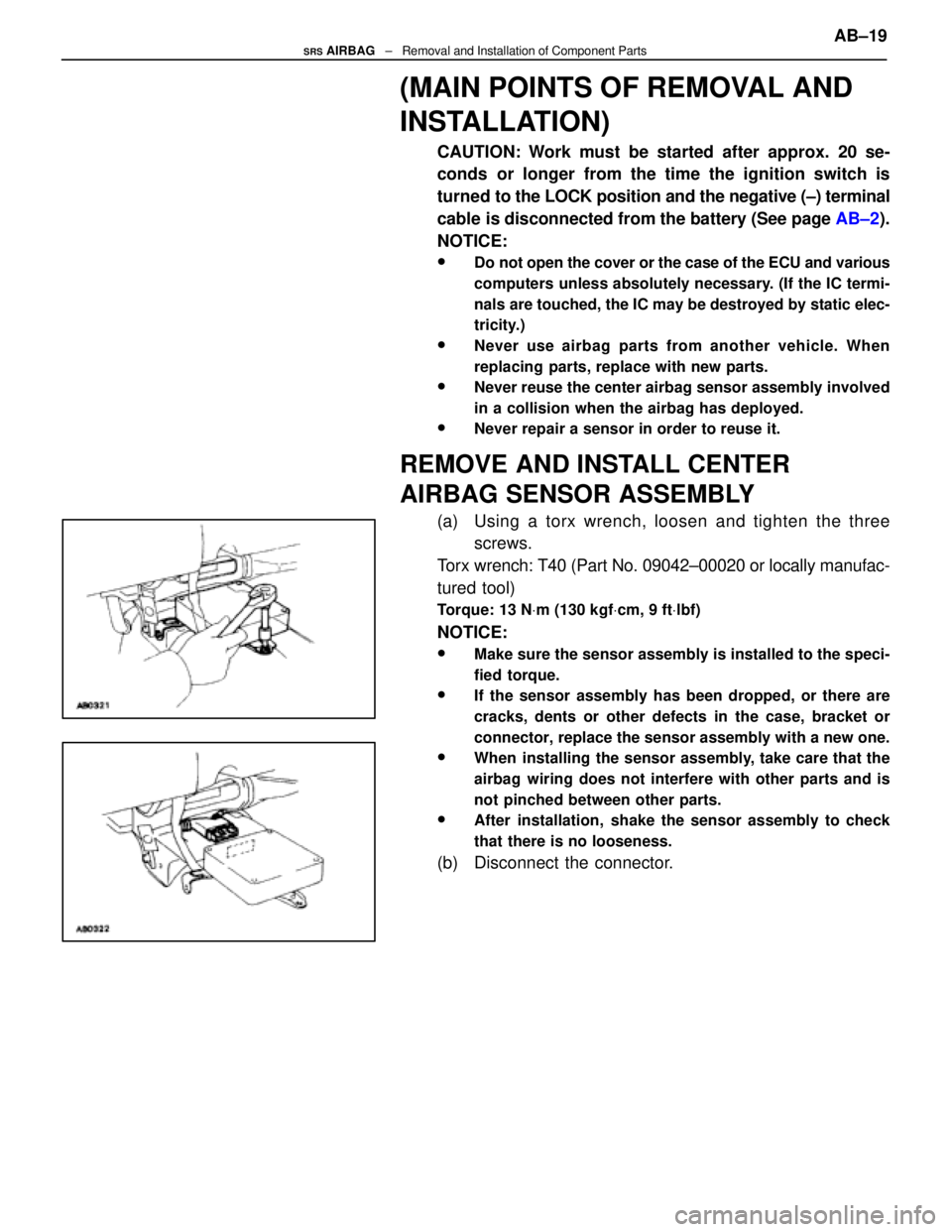
REMOVE AND INSTALL CENTER
AIRBAG SENSOR ASSEMBLY
(a) Using a torx wrench, loosen and tighten the three screws.
Torx wrench: T40 (Part No. 09042±00020 or locally manufac-
tured tool)
Torque: 13 N Vm (130 kgf Vcm, 9 ft Vlbf)
NOTICE:
wMake sure the sensor assembly is installed to the speci-
fied torque.
wIf the sensor assembly has been dropped, or there are
cracks, dents or other defects in the case, bracket or
connector, replace the sensor assembly with a new one.
wWhen installing the sensor assembly, take care that the
airbag wiring does not interfere with other parts and is
not pinched between other parts.
wAfter installation, shake the sensor assembly to check
that there is no looseness.
(b) Disconnect the connector. AB±19
SRS AIRBAG
± Removal and Installation of Component Parts
WhereEverybodyKnowsYourName
Page 234 of 4087
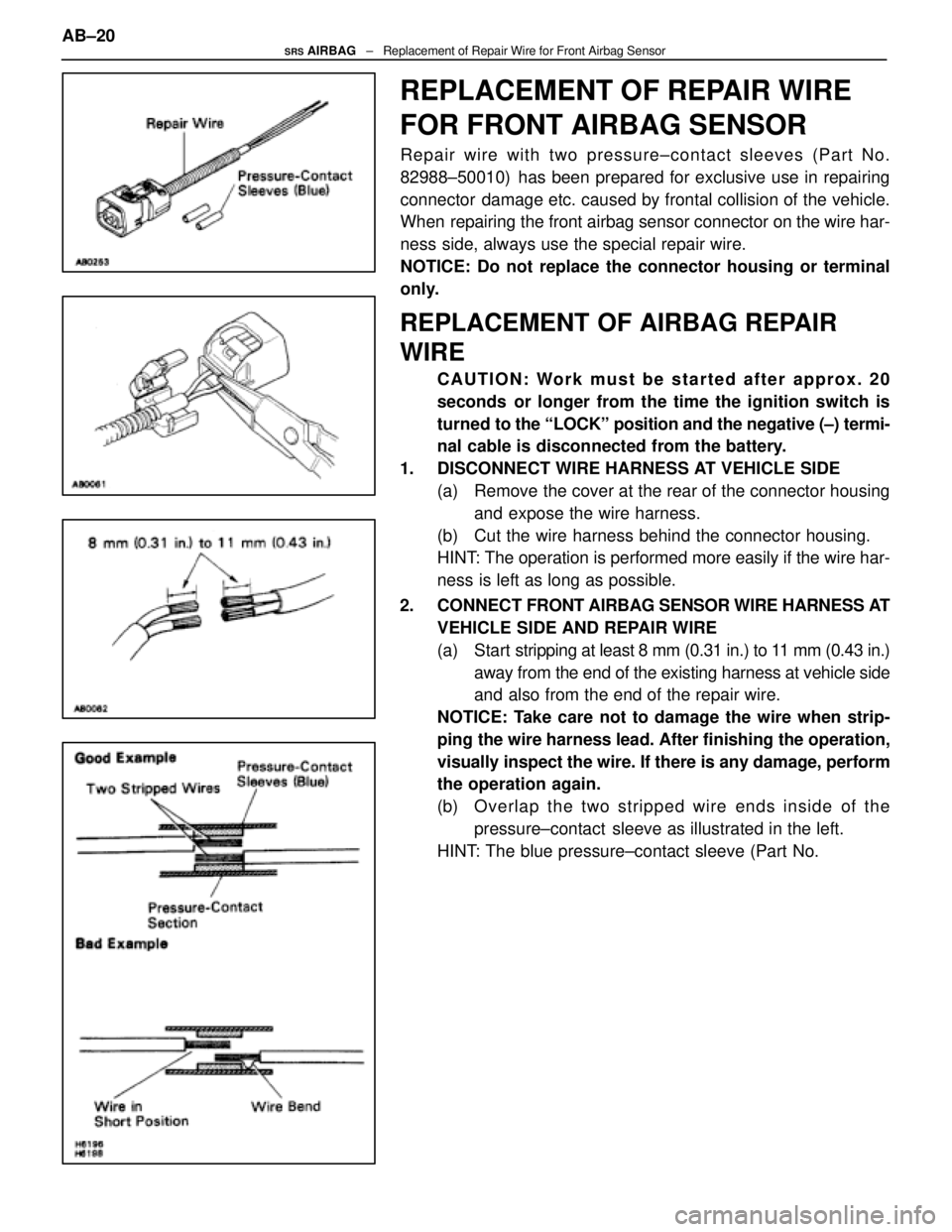
REPLACEMENT OF REPAIR WIRE
FOR FRONT AIRBAG SENSOR
Repair wire with two pressure±contact sleeves (Part No.
82988±50010) has been prepared for exclusive use in repairing
connector damage etc. caused by frontal collision of the vehicle.
When repairing the front airbag sensor connector on the wire har-
ness side, always use the special repair wire.
NOTICE: Do not replace the connector housing or terminal
only.
REPLACEMENT OF AIRBAG REPAIR
WIRE
CAUTION: Work must be started after approx. 20
seconds or longer from the time the ignition switch is
turned to the ªLOCKº position and the negative (±) termi-
nal cable is disconnected from the battery.
1. DISCONNECT WIRE HARNESS AT VEHICLE SIDE (a) Remove the cover at the rear of the connector housingand expose the wire harness.
(b) Cut the wire harness behind the connector housing.
HINT: The operation is performed more easily if the wire har-
ness is left as long as possible.
2. CONNECT FRONT AIRBAG SENSOR WIRE HARNESS AT
VEHICLE SIDE AND REPAIR WIRE
(a) Start s tripping at least 8 mm (0.31 in.) to 11 mm (0.43 in.)
away from the end of the existing harness at vehicle side
and also from the end of the repair wire.
NOTICE: Take care not to damage the wire when strip-
ping the wire harness lead. After finishing the operation,
visually inspect the wire. If there is any damage, perform
the operation again.
(b) O ve rla p th e two stri pped wire ends inside of the
pressure±contact sleeve as illustrated in the left.
HINT: The blue pressure±contact sleeve (Part No.
AB±20
SRS AIRBAG
± Replacement of Repair Wire for Front Airbag Sensor
WhereEverybodyKnowsYourName
Page 239 of 4087

How To Proceed With Troubleshooting
Malfunction symptoms of the airbag system are difficult to confirm, so the diagnostic codes become the most
important source of information when troubleshooting. Perform troubleshooting of the airbag system in ac\
cor-
dance with the following procedure:
HINT: Do not disconnect the battery negative (±) terminal cable until st\
ep [ 3 ], Diagnostic Code Check and Re-
cording, has been completed.1. CUSTOMER PROBLEM ANALYSIS Using the CUSTOMER PROBLEM ANALYSIS CHECK SHEET (See page AB±29) for reference, ask the
customer in as much detail as possible about the problem.
2. WARNING LIGHT CHECK Check the airbag warning light. If the light remains on, a malfunction is sto\
red in the center airbag sensor,
assembly, so proceed to step [ 3 ]. If the airbag warning light is not on, a malf\
unction has occurred in the
airbag warning light circuit, so perform troubleshooting for code 22.
HINT: Code 22 is recorded when a malfunction occurs in the airbag warning li\
ght system.
If an open malfunction occurs in the airbag warning light system, the airb\
ag warning light does not light up,
so that until the malfunction is repaired, the diagnostic codes (includin\
g code 22) cannot be confirmed.
3. DIAGNOSTIC CODE CHECK AND RECORDING Check the diagnostic codes and make a note of any malfunction codes which are\
output. If a normal code
is output, an abnormality in the power source circuit may have occurred, so perform troubleshootin\
g for
source voltage in step [ 8 ].
If code 22 is output, skip steps [ 4 ] and [ 5 ] and proceed to step [ 7\
].
4. CLEARING OF MALFUNCTION CODE (EXCEPT CODE 41) Clear the malfunction code.
HINT: The malfunction code output in step [ 3 ] indicates that a malfunction \
has occurred in the circuit desig-
nated by the malfunction code, but does not indicate whether the malfunction \
is still occurring or whether
it was in the past.
Accordingly, it is necessary to find out the present condition of the malfunction oc\
currence by clearing the
malfunction code and performing the diagnostic code check again. If this\
operation is neglected and trou-
bleshooting is performed using only the malfunction code confirmed in step [ 3 ], isola\
ting the problem com-
ponent becomes difficult and invites mistaken diagnosis.
5. DIAGNOSTIC CODE CHECK AND RECORDING [ 6 ] SYMPTOM SIMULATION After repeating ignition switch ON±OFF operation (ON: wait 20 secs., OFF: wait 20 secs.) 5 times, check
the diagnostic codes. If any code other than code 41 is output, the malfunc\
tion is still occurring, so proceed
to step [ 7 ].
If code 41 only is output, the following three cases are possible:
w Intermittent trouble occurred previously, but it is now normal.
w The problem has been corrected, but clearing of code 41 has been forgott\
en.
w There is a malfunction in the circuit for code 41.
Focusing on the circuit of the malfunction code stored in step 3, use th\
e simulation method in step [ 6 ]
in order to simulate the malfunction. If the malfunction occurs, proceed t\
o step [ 7 ]; if not, proceed to step.
[ 12 ]. AB±25
SRS AIRBAG
± Troubleshooting
WhereEverybodyKnowsYourName
Page 240 of 4087

NOTICE: When connecting the battery after clearing the malfunction code, always\
do it with the igni-
tion switch in LOCK position. When the battery has been reconnected, turn the ignition switch to
ACC or ON position after at least 2 seconds have elapsed.
If the battery is reconnected with the ignition switch in ACC or ON posi\
tion, or the ignition switch
is turned to ACC or ON within 2 seconds of connecting the battery, it is possible that the diagnosis
system will not operate normally.
HINT: Determine the malfunction in the airbag system in step [ 6 ] by whethe\
r or not a malfunction code
other than code 41 is output.
7. DIAGNOSTIC CODE CHART Proceed to the appropriate flow chart in step [ 8 ] in accordance with the malfunction code found in step
[ 5 ] or [ 6 ].
8. CIRCUIT INSPECTION [ 9 ] REPAIR Find out if the problem lies in a sensor, actuator or wire harness and connector, and repair the problem.
After the problem part is repaired, reinstall the disassembled parts. Do not \
start work until at least 20 se-
conds after the ignition switch is turned to the LOCK position and the negati\
ve (±) terminal cable is discon-
nected.
CAUTION: If incorrect procedure is used, a malfunction may occur in the system o\
r there is the dan-
ger that airbag may be accidentally activated during the repair operation. Carefully read the GEN-
ERAL DESCRIPTION (See page AB±2) and the cautions for each operation, and perform repairs in
the correct order using the correct methods.
HINT: The following illustration for the CIRCUIT INSPECTION shows each conne\
ctor for the circuit from
the center airbag sensor assembly to the steering wheel pad (squib).
10 CLEARING OF MALFUNCTION CODE (EXCEPT CODE 41) When all the malfunction codes found in steps [ 5 ] and [ 6 ] have been repa\
ired, clear the malfunction
codes.
AB±26
SRS AIRBAG
± Troubleshooting
WhereEverybodyKnowsYourName