ect LEXUS SC300 1991 Service Repair Manual
[x] Cancel search | Manufacturer: LEXUS, Model Year: 1991, Model line: SC300, Model: LEXUS SC300 1991Pages: 4087, PDF Size: 75.75 MB
Page 963 of 4087
NGOK
OKNG
INSPECTION PROCEDURE
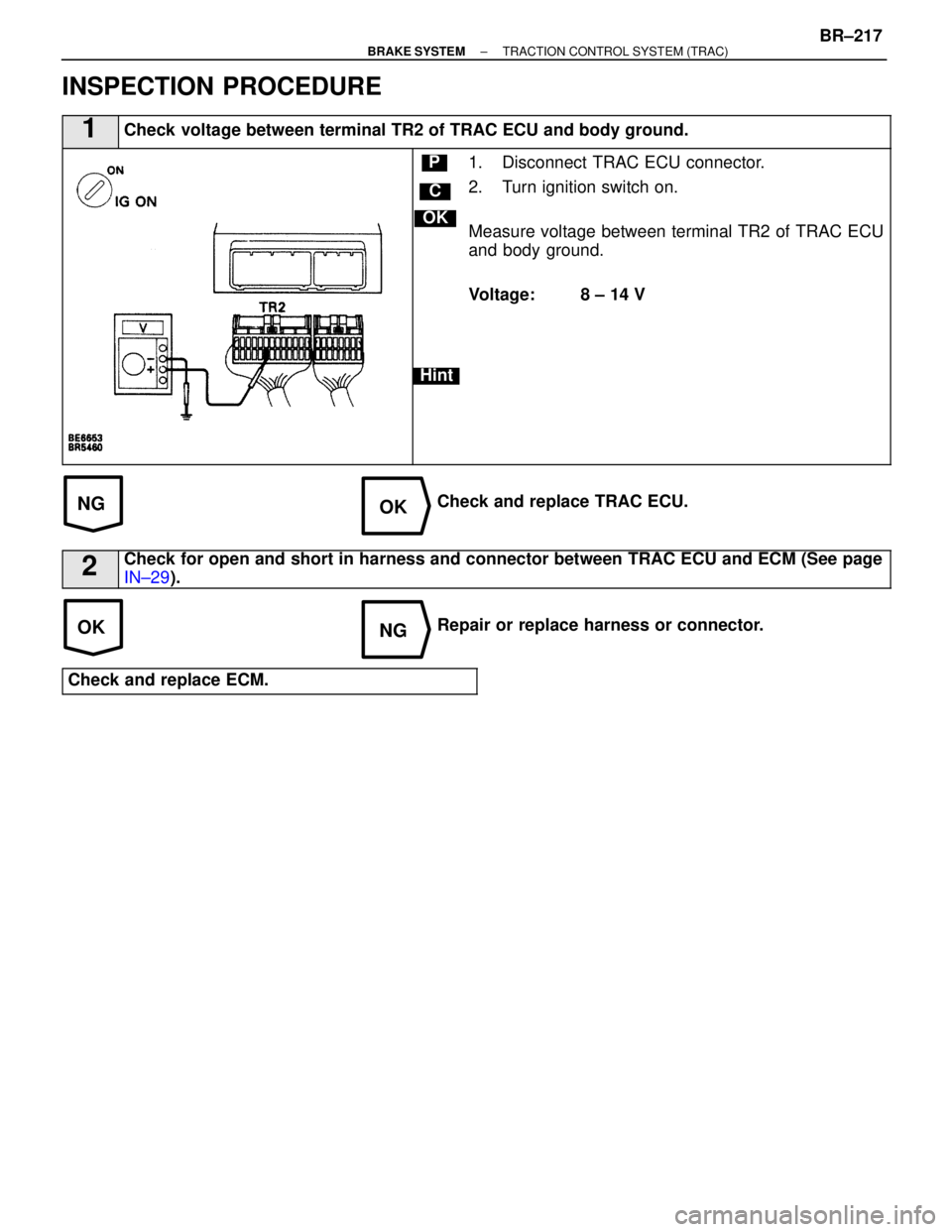
1Check voltage between terminal TR2 of TRAC ECU and body ground.
C
OK
Hint
P1. Disconnect TRAC ECU connector.
2. Turn ignition switch on.
Measure voltage between terminal TR2 of TRAC ECU
and body ground.
Voltage: 8 ± 14 V
Check and replace TRAC ECU.
2Check for open and short in harness and connector between TRAC ECU and E\
CM (See page
IN±29).
Repair or replace harness or connector.
Check and replace ECM.
±
BRAKE SYSTEM TRACTION CONTROL SYSTEM (TRAC)BR±217
WhereEverybodyKnowsYourName
Page 964 of 4087
 occurs in the engine control system")
TR±11
WIRING DIAGRAM
DTC51Engine Malfunction Detection Circuit
CIRCUIT DESCRIPTION
If trouble (trouble which causes the malfunction indicator light to light\
up) occurs in the engine control system,
this circuit senses the trouble and prohibits TRAC control.
DTC No.DTC Detecting ConditionTrouble Area
51
Either of the following (1) and (2) continues formore
than 1 sec.:
(1) Engine speed: 500 RPM or more
(2) Voltage of TRAC ECU terminal TR5: 1 V or less
Short in TR5 circuit
ECM
TRAC ECU
DIAGNOSTIC CHARTDIAGNOSTIC CHART
BR±218±
BRAKE SYSTEM TRACTION CONTROL SYSTEM (TRAC)
WhereEverybodyKnowsYourName
Page 966 of 4087

WIRING DIAGRAM
DTC61ABS & TRAC ECU Communication Circuit
Malfunction
CIRCUIT DESCRIPTION
DTC No.DTC Detecting ConditionTrouble Area
61Malfunction in ABS & TRAC ECU communication cir-
cuit.
Open or short in ABSO, BRC, BRP circuit
ABS & TRAC ECU
TRAC ECU
DIAGNOSTIC CHARTDIAGNOSTIC CHART
BR±220±
BRAKE SYSTEM TRACTION CONTROL SYSTEM (TRAC)
WhereEverybodyKnowsYourName
Page 967 of 4087
OKNG
NGOK
OKNG
INSPECTION PROCEDURE
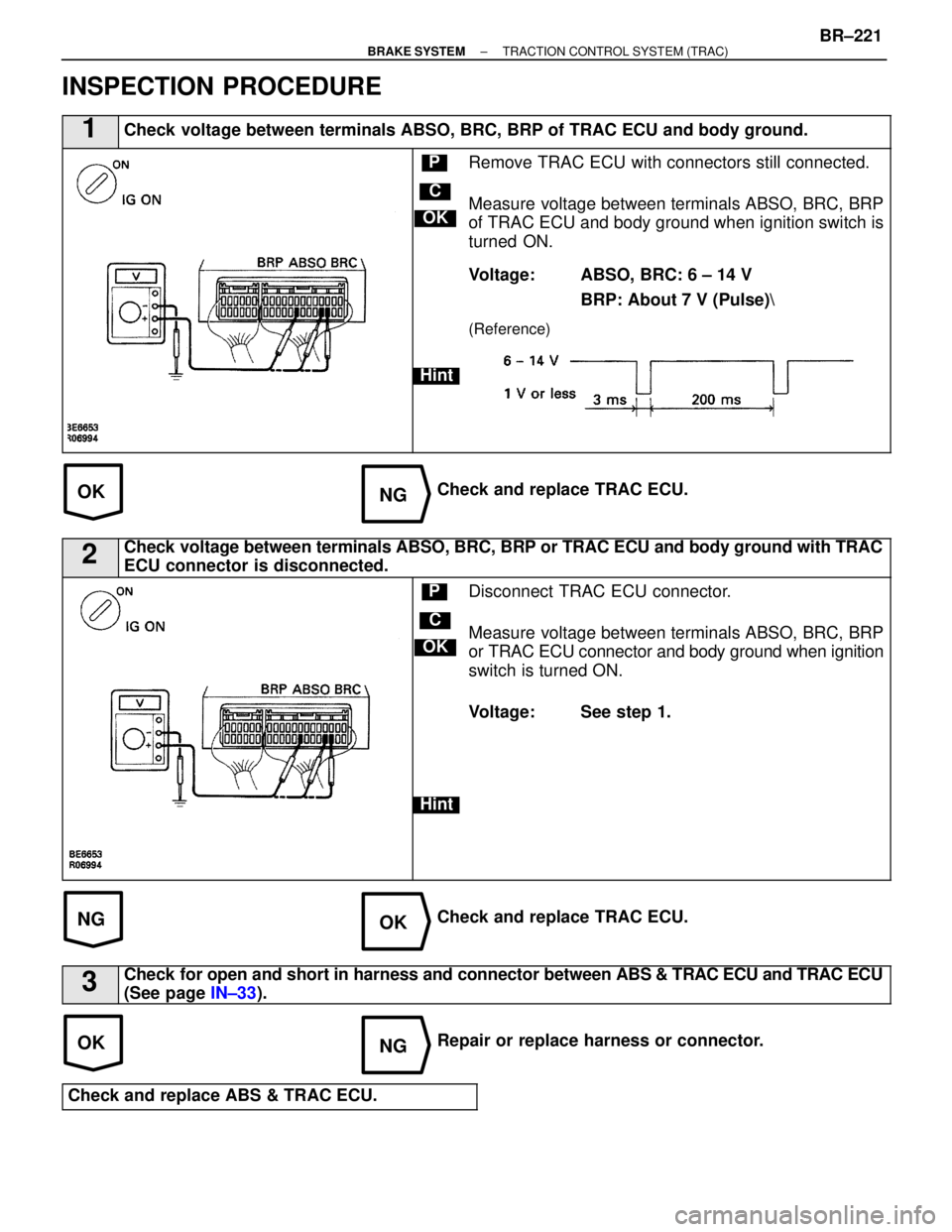
1Check voltage between terminals ABSO, BRC, BRP of TRAC ECU and body ground.
C
OK
Hint
PRemove TRAC ECU with connectors still connected.
Measure voltage between terminals ABSO, BRC, BRP
of TRAC ECU and body ground when ignition switch is
turned ON.
Voltage: ABSO, BRC: 6 ± 14 VBRP: About 7 V (Pulse)\
(Reference)
Check and replace TRAC ECU.
2Check voltage between terminals ABSO, BRC, BRP or TRAC ECU and body ground wi\
th TRAC
ECU connector is disconnected.
C
OK
Hint
PDisconnect TRAC ECU connector.
Measure voltage between terminals ABSO, BRC, BRP
or TRAC ECU connector and body ground when ignition
switch is turned ON.
Voltage: See step 1.
Check and replace TRAC ECU.
3Check for open and short in harness and connector between ABS & TRAC ECU and TRAC ECU
(See page IN±33).
Repair or replace harness or connector.
Check and replace ABS & TRAC ECU.
±
BRAKE SYSTEM TRACTION CONTROL SYSTEM (TRAC)BR±221
WhereEverybodyKnowsYourName
Page 970 of 4087
NOYES
OKNG
OKNG
OKNG
OKNG
INSPECTION PROCEDURES
1Is diagnostic trouble code output?
Perform diagnostic trouble code check on page BR±184.
Repair circuit indicated by the code output.
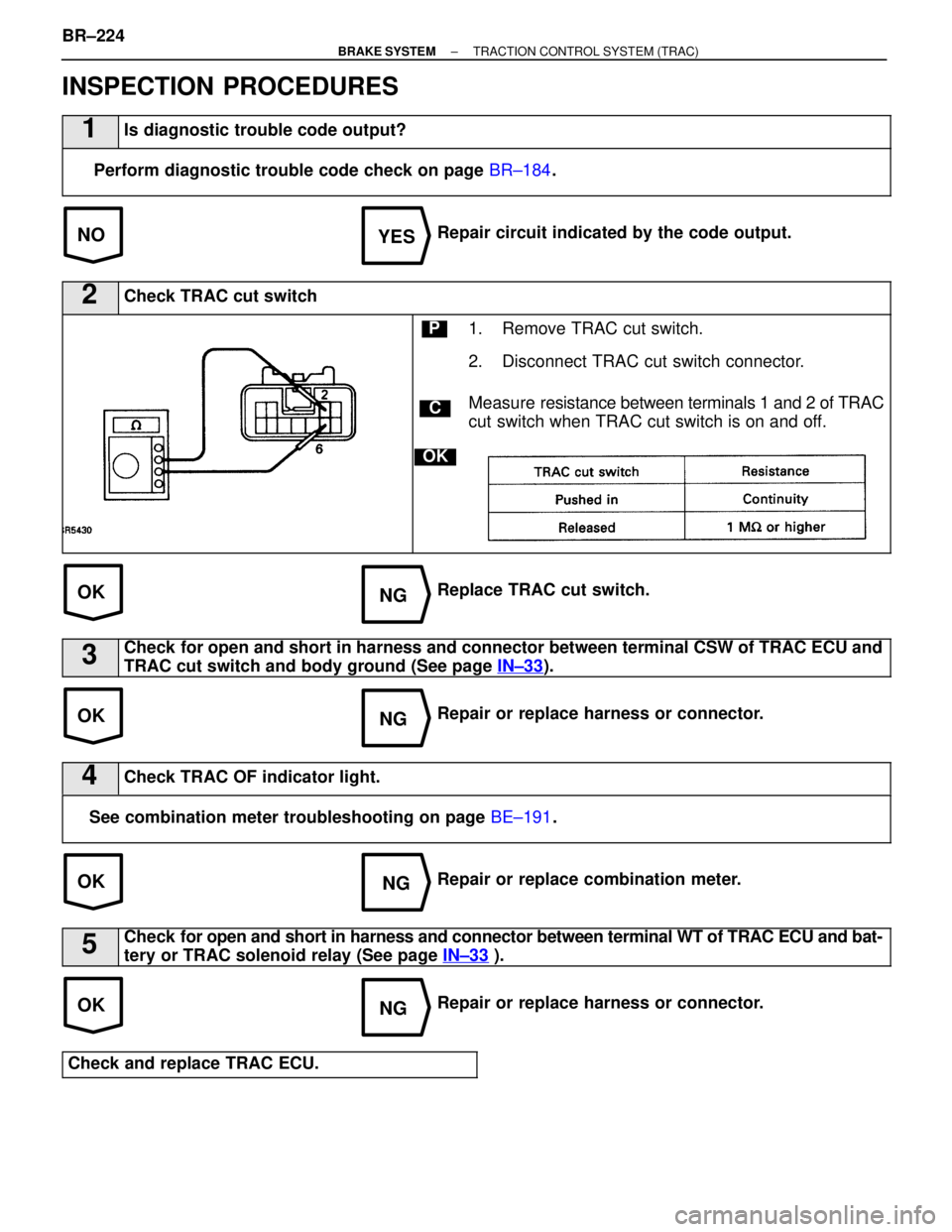
2Check TRAC cut switch
C
OK
P1. Remove TRAC cut switch.
2. Disconnect TRAC cut switch connector.
Measure re sistance between terminals 1 and 2 of TRAC
cut switch when TRAC cut switch is on and off.
Replace TRAC cut switch.
3Check for open and short in harness and connector between terminal CSW of TRA\
C ECU and
TRAC cut switch and body ground (See page IN±33
).
Repair or replace harness or connector.
4Check TRAC OF indicator light.
See combination meter troubleshooting on page BE±191.
Repair or replace combination meter.
5Check for open and short in harness and connector between terminal WT of TRAC ECU \
and bat-
tery or TRAC solenoid relay (See page IN±33
).
Repair or replace harness or connector.
Check and replace TRAC ECU.
BR±224±
BRAKE SYSTEM TRACTION CONTROL SYSTEM (TRAC)
WhereEverybodyKnowsYourName
Page 972 of 4087
BR±160).
IN±33 ).
WIRING DIAGRAM
Tc Terminal Circuit
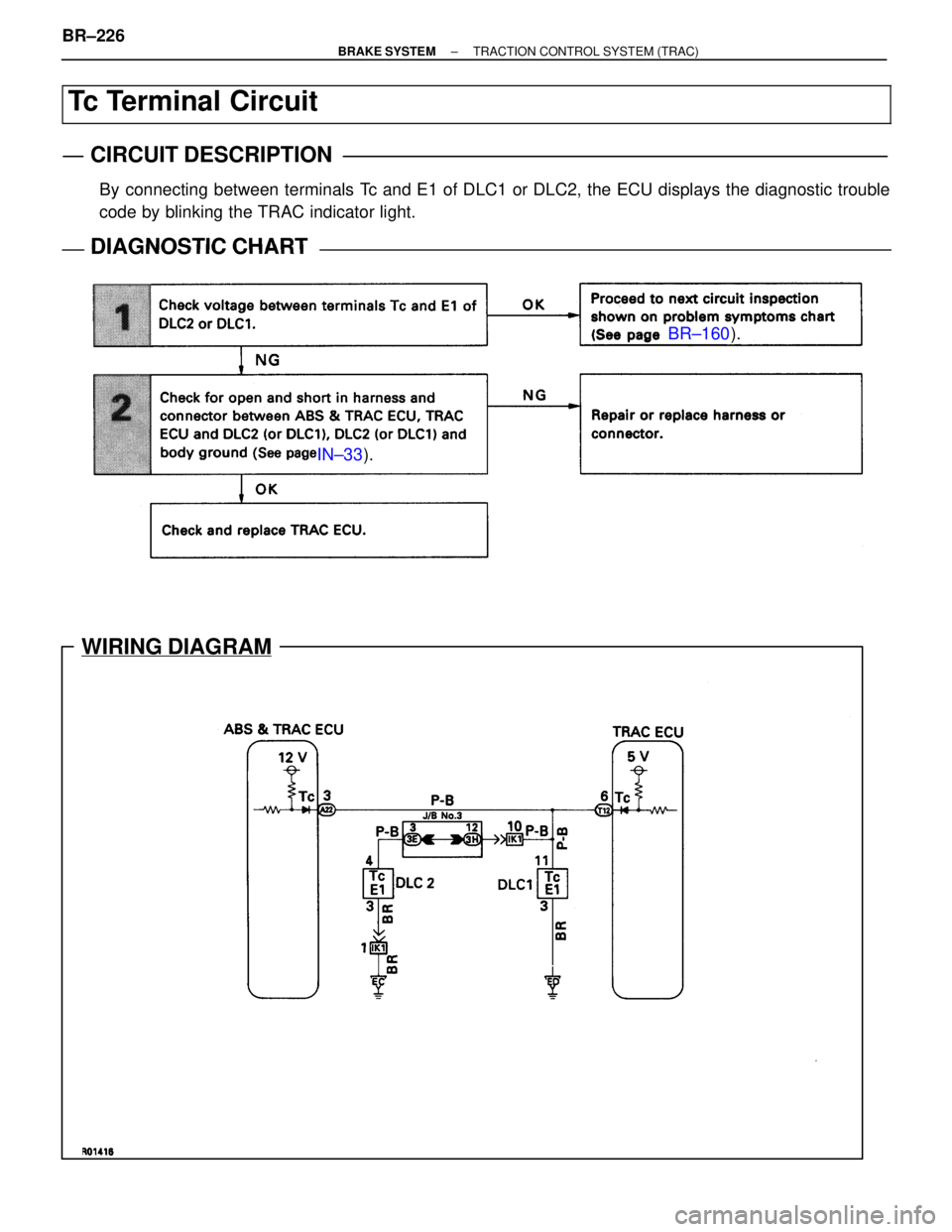
CIRCUIT DESCRIPTION
By connecting between terminals Tc and E1 of DLC1 or DLC2, the ECU displays the diagnostic trouble
code by blinking the TRAC indicator light.
DIAGNOSTIC CHARTDIAGNOSTIC CHART
BR±226±
BRAKE SYSTEM TRACTION CONTROL SYSTEM (TRAC)
WhereEverybodyKnowsYourName
Page 973 of 4087
NGOK
OKNG
INSPECTION PROCEDURE
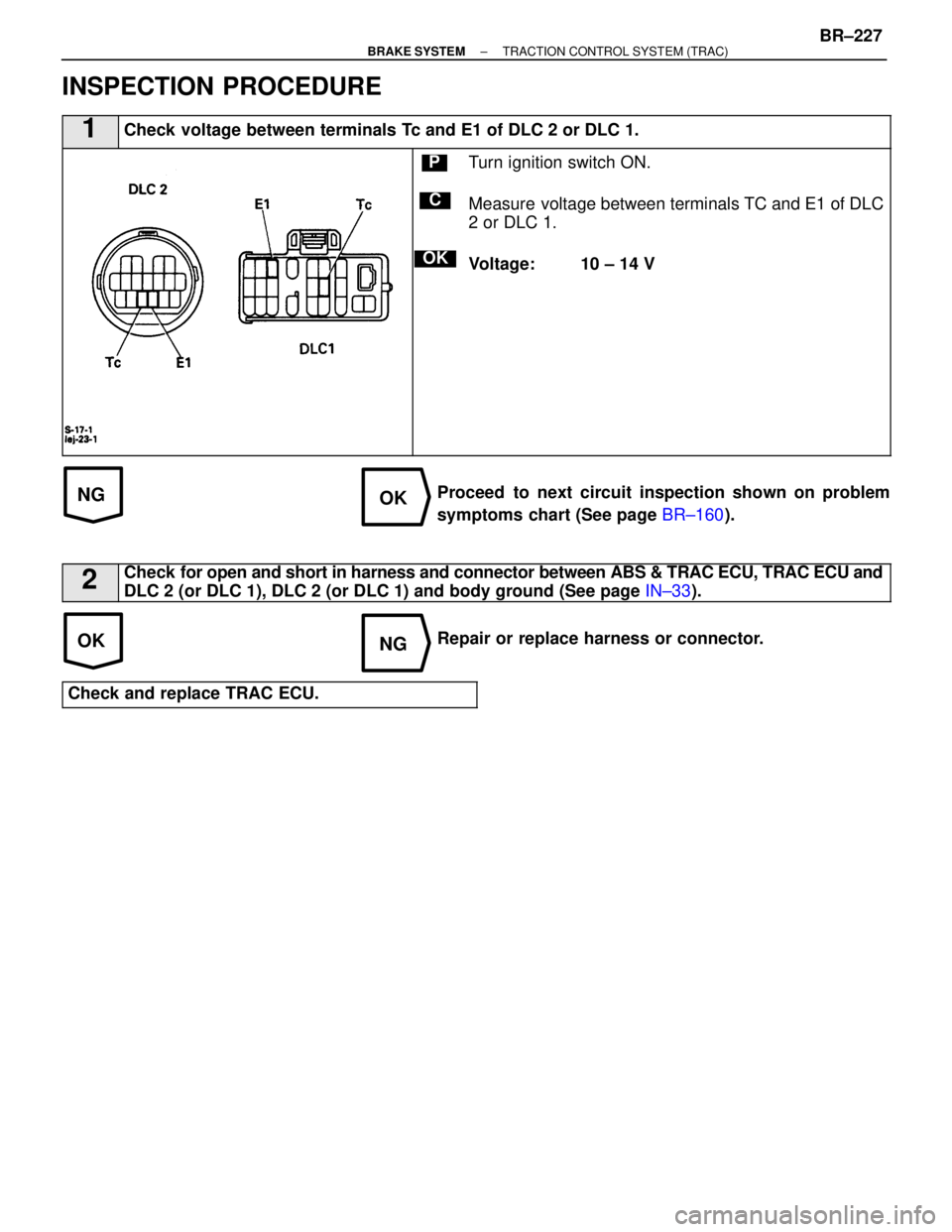
1Check voltage between terminals Tc and E1 of DLC 2 or DLC 1.
C
OK
PTurn ignition switch ON.
Measure voltage between terminals TC and E1 of DLC
2 or DLC 1.
Voltage: 10 ± 14 V
Proceed to next circuit inspection shown on problem
symptoms chart (See page BR±160).
2Check for open and short in harness and connector between ABS & TRAC ECU, TRAC\
ECU and
DLC 2 (or DLC 1), DLC 2 (or DLC 1) and body ground (See page IN±33).
Repair or replace harness or connector.
Check and replace TRAC ECU.
±
BRAKE SYSTEM TRACTION CONTROL SYSTEM (TRAC)BR±227
WhereEverybodyKnowsYourName
Page 978 of 4087

GENERAL DESCRIPTION
BR03E±06
1. Care must be taken to replace each part properly as it could affect the \
performance of the brakesystem and result in a driving hazard. Replace the parts with parts of the same part number or
equivalent.
2. It is very important to keep parts and the area clean when repairing the\
brake system.
3. If the vehicle is equipped with a mobile communication system, refer to the precaution \
in the IN section.
DESCRIPTION
BR03F±03
The service brakes consist of a foot brake which changes rotational energy to therma\
l energy to stop the
vehicle while it is being driven and a parking brake to keep the vehicle from m\
oving while it is parked.
OPERATION
FOOT BRAKE
BR03G±06
When the brake pedal is depressed, a vacuum builds up in the booster whi\
ch amplifies the pedal force,
pressing on the piston in the master cylinder. The piston movement raises the hydraulic pressure in the
cylinder. This hydraulic pressure is then applied to each respective brake cylin\
der, and acts to press the
brake pads against the rotating discs. The resulting friction converts the ro\
tational energy to thermal ener-
gy, stopping the vehicle.
BR±2±
BRAKE SYSTEM OPERATION
WhereEverybodyKnowsYourName
Page 979 of 4087

GENERAL DESCRIPTION
BR03E±06
1. Care must be taken to replace each part properly as it could affect the \
performance of the brakesystem and result in a driving hazard. Replace the parts with parts of the same part number or
equivalent.
2. It is very important to keep parts and the area clean when repairing the\
brake system.
3. If the vehicle is equipped with a mobile communication system, refer to the precaution \
in the IN section.
DESCRIPTION
BR03F±03
The service brakes consist of a foot brake which changes rotational energy to therma\
l energy to stop the
vehicle while it is being driven and a parking brake to keep the vehicle from m\
oving while it is parked.
OPERATION
FOOT BRAKE
BR03G±06
When the brake pedal is depressed, a vacuum builds up in the booster whi\
ch amplifies the pedal force,
pressing on the piston in the master cylinder. The piston movement raises the hydraulic pressure in the
cylinder. This hydraulic pressure is then applied to each respective brake cylin\
der, and acts to press the
brake pads against the rotating discs. The resulting friction converts the ro\
tational energy to thermal ener-
gy, stopping the vehicle.
BR±2±
BRAKE SYSTEM OPERATION
WhereEverybodyKnowsYourName
Page 984 of 4087

CHECK AND ADJUSTMENT
BR0EC±07
BRAKE PEDAL CHECK AND
ADJUSTMENT
1. CHECK THAT PEDAL HEIGHT IS CORRECT
Pedal height from asphalt sheet:150.4±160.4 mm (5.92±6.31 in.)
If the pedal height is incorrect, adjust it.
2. IF NECESSARY, ADJUST PEDAL HEIGHT
(a) Disconnect the connector from the stop light switch.
(b) Loosen the stop light switch lock nut and remove the stop light switch.
(c) Loosen the push rod lock nut.
(d) Adjust the pedal height by turning the pedal push rod.
(e) Tighten the push rod lock nut.
Torque: 25 N Vm (260 kgf Vcm, 19 ft Vlbf)
(f) Install the stop light switch and turn it until it lightly contacts
the pedal stopper.
(g) Turn the stop light switch back one turn.
(h) Check the clearance (A) between stop light switch and pedal.
Clearance:
0.5±2.4 mm (0.02±0.09 in.)
(i) Tighten the stop light switch lock nut.
(j) Connect the connector to the stop light switch.
(k) Check that the stop lights come on when the brake pedal isdepressed, and go off when the brake pedal is released.
(l) After adjusting the pedal height, check the pedal free±play.
HINT: If clearance (A) between the stop light switch and the
brake pedal stopper has been adjusted correctly, the pedal
freeplay will meet the specifications.
3. CHECK THAT PEDAL FREEPLAY IS CORRECT, AS SHOWN
(a) Stop the engine and depress the brake pedal several times until there is no more vacuum left in the booster.
(b) Push in the pedal by hand until the beginning of the second point of resistance is felt, then measure the distance, as
shown.
Pedal freeplay:
1±6 mm (0.04±0.24 in.)
If incorrect, check the stop light switch clearance. And if the
clearance is OK, then troubleshoot the brake system.
HINT: The freeplay to the first point of resistance is due to the
play between the clevis and pin. It is 1±3 mm (0.04±0.12 in.)
on the pedal.
±
BRAKE SYSTEM CHECK AND ADJUSTMENTBR±7
WhereEverybodyKnowsYourName