belt LEXUS SC400 1991 Service Repair Manual
[x] Cancel search | Manufacturer: LEXUS, Model Year: 1991, Model line: SC400, Model: LEXUS SC400 1991Pages: 4087, PDF Size: 75.75 MB
Page 2769 of 4087
ON±VEHICLE INSPECTION
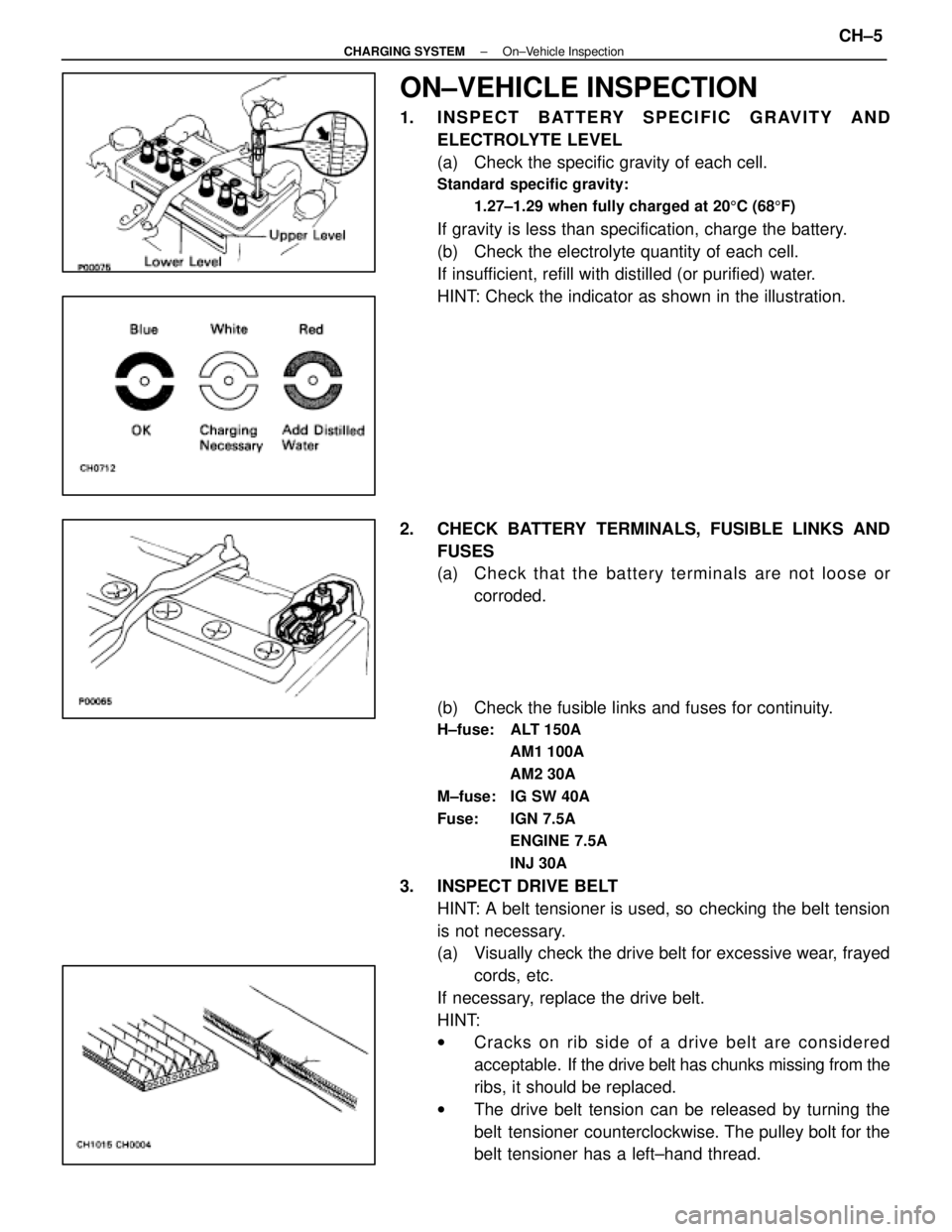
1. INSPECT BATTERY SPECIFIC GRAVITY ANDELECTROLYTE LEVEL
(a) Check the specific gravity of each cell.
Standard specific gravity:
1.27±1.29 when fully charged at 20 5C (68 5F)
If gravity is less than specification, charge the battery.
(b) Check the electrolyte quantity of each cell.
If insufficient, refill with distilled (or purified) water.
HINT: Check the indicator as shown in the illustration.
2. CHECK BATTERY TERMINALS, FUSIBLE LINKS AND FUSES
(a) Check that the battery terminals are not loose orcorroded.
(b) Check the fusible links and fuses for continuity.
H±fuse: ALT 150A AM1 100A
AM2 30A
M±fuse: IG SW 40A
Fuse: IGN 7.5A ENGINE 7.5A
INJ 30A
3. INSPECT DRIVE BELTHINT: A belt tensioner is used, so checking the belt tension
is not necessary.
(a) Visually check the drive belt for excessive wear, frayedcords, etc.
If necessary, replace the drive belt.
HINT:
w Cracks on rib side of a drive belt are considered
acceptable. If the drive belt has chunks missing from the
ribs, it should be replaced.
w The drive belt tension can be released by turning the
belt tensioner counterclockwise. The pulley bolt for the
belt tensioner has a left±hand thread.
±
CHARGING SYSTEM On±Vehicle InspectionCH±5
WhereEverybodyKnowsYourName
Page 2770 of 4087
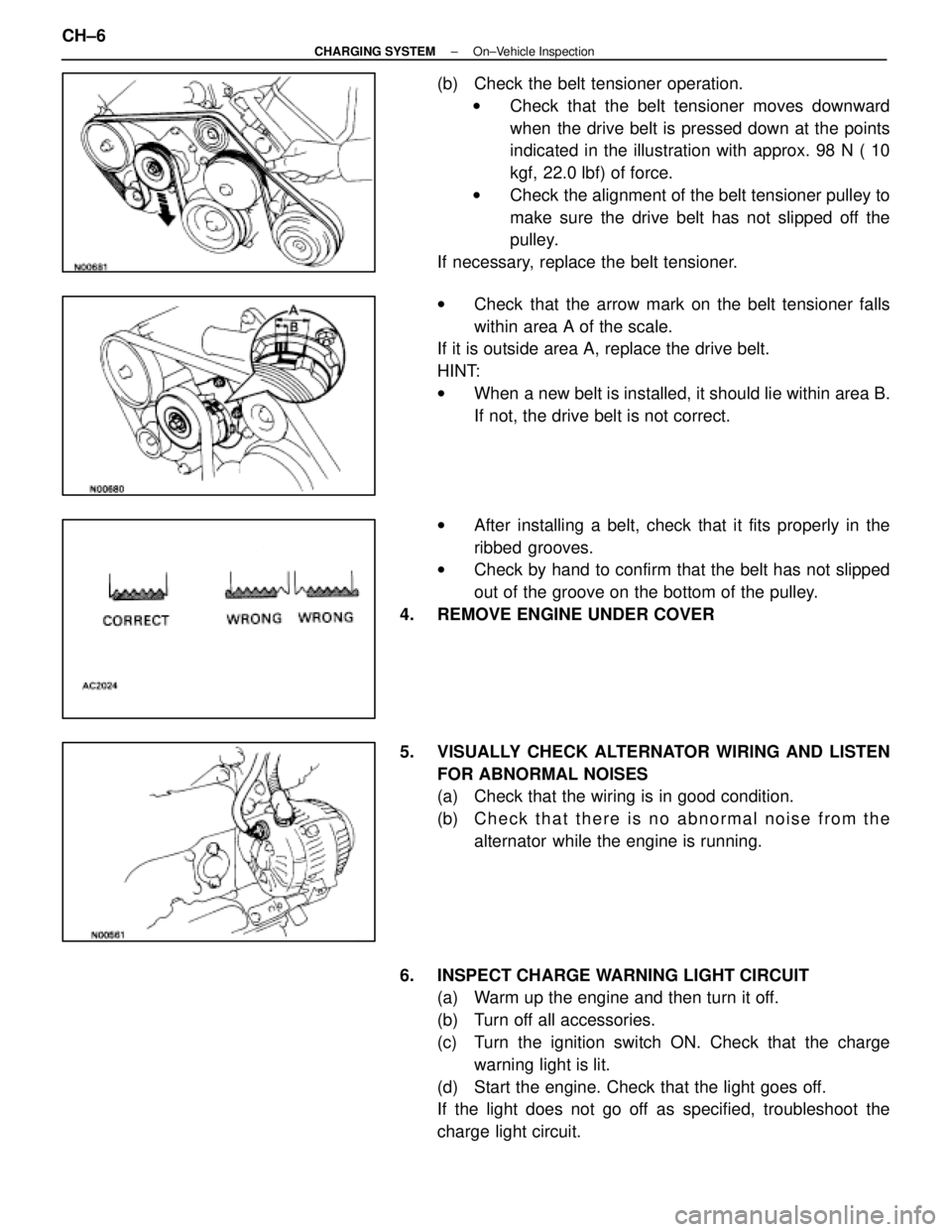
(b) Check the belt tensioner operation.w Check that the belt tensioner moves downward
when the drive belt is pressed down at the points
indicated in the illustration with approx. 98 N ( 10
kgf, 22.0 lbf) of force.
w Check the alignment of the belt tensioner pulley to
make sure the drive belt has not slipped off the
pulley.
If necessary, replace the belt tensioner.
w Check that the arrow mark on the belt tensioner falls
within area A of the scale.
If it is outside area A, replace the drive belt.
HINT:
w When a new belt is installed, it should lie within area B.
If not, the drive belt is not correct.
w After installing a belt, check that it fits properly in the
ribbed grooves.
w Check by hand to confirm that the belt has not slipped
out of the groove on the bottom of the pulley.
4. REMOVE ENGINE UNDER COVER
5. VISUALLY CHECK ALTERNATOR WIRING AND LISTEN FOR ABNORMAL NOISES
(a) Check that the wiring is in good condition.
(b) C h e c k t h a t t h e r e i s n o a bnormal noise from the
alternator while the engine is running.
6. INSPECT CHARGE WARNING LIGHT CIRCUIT (a) Warm up the engine and then turn it off.
(b) Turn off all accessories.
(c) Turn the ignition switch ON. Check that the charge
warning light is lit.
(d) Start the engine. Check that the light goes off.
If the light does not go off as specified, troubleshoot the
charge light circuit.
CH±6
±
CHARGING SYSTEM On±Vehicle Inspection
WhereEverybodyKnowsYourName
Page 2773 of 4087
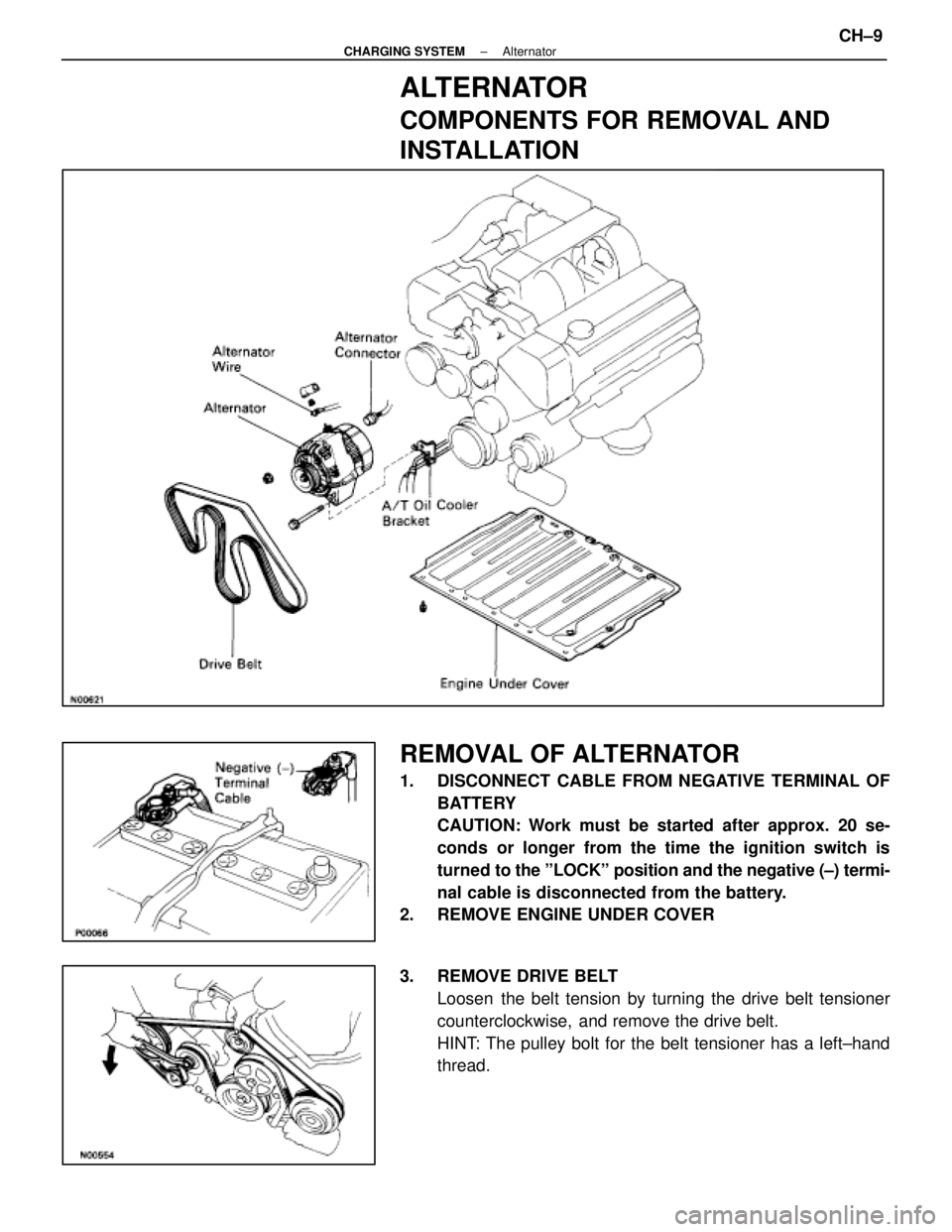
ALTERNATOR
COMPONENTS FOR REMOVAL AND
INSTALLATION
REMOVAL OF ALTERNATOR
1. DISCONNECT CABLE FROM NEGATIVE TERMINAL OFBATTERY
CAUTION: Work must be started after approx. 20 se-
conds or longer from the time the ignition switch is
turned to the ºLOCKº position and the negative (±) termi-
nal cable is disconnected from the battery.
2. REMOVE ENGINE UNDER COVER
3. REMOVE DRIVE BELT
Loosen the belt tension by turning the drive belt tensioner
counterclockwise, and remove the drive belt.
HINT: The pulley bolt for the belt tensioner has a left±hand
thread.
±
CHARGING SYSTEM AlternatorCH±9
WhereEverybodyKnowsYourName
Page 2784 of 4087
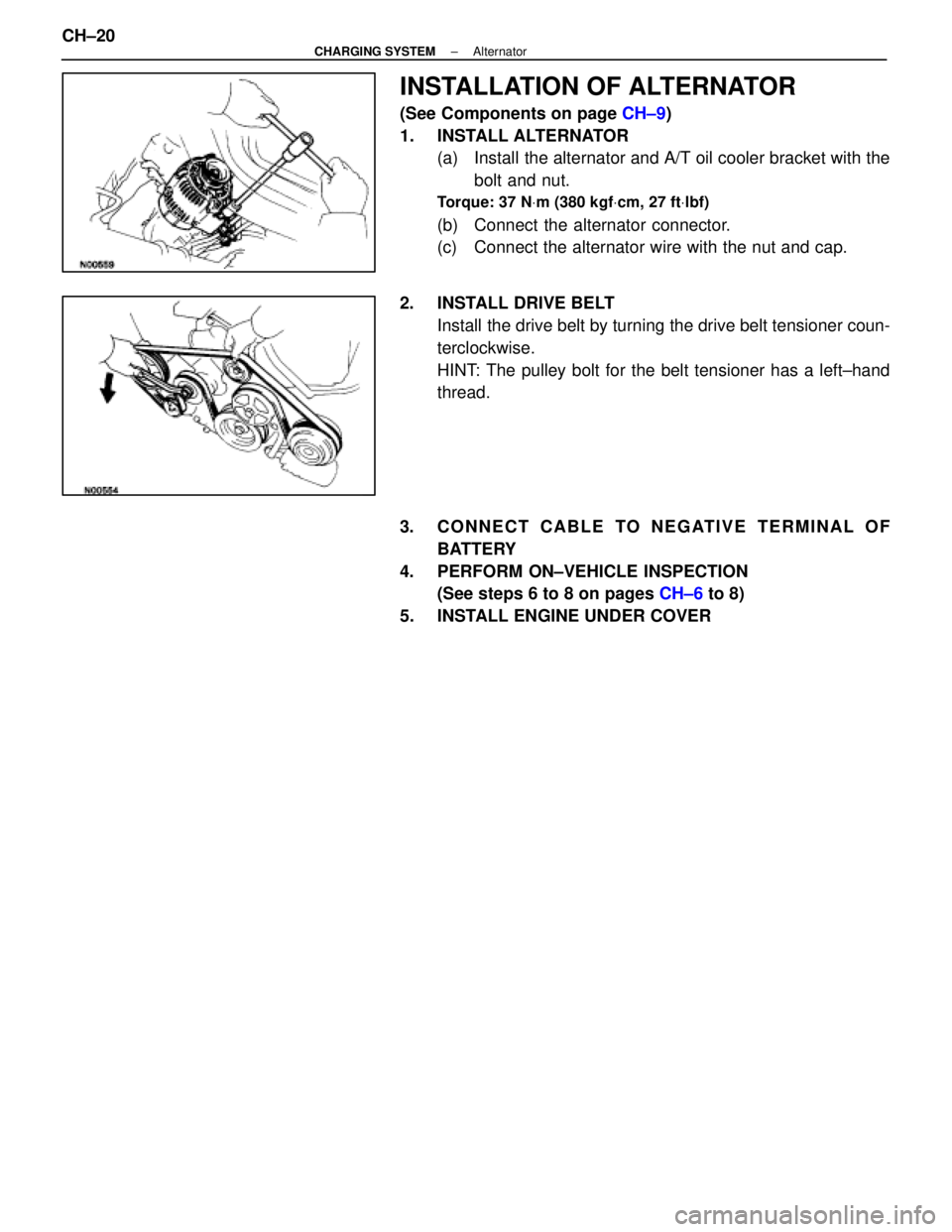
INSTALLATION OF ALTERNATOR
(See Components on page CH±9)
1. INSTALL ALTERNATOR (a) Install the alternator and A/T oil cooler bracket with the
bolt and nut.
Torque: 37 N Vm (380 kgf Vcm, 27 ft Vlbf)
(b) Connect the alternator connector.
(c) Connect the alternator wire with the nut and cap.
2. INSTALL DRIVE BELT Install the drive belt by turning the drive belt tensioner coun-
terclockwise.
HINT: The pulley bolt for the belt tensioner has a left±hand
thread.
3. CONNECT CABLE TO NEGATIVE TERMINAL OF BATTERY
4. PERFORM ON±VEHICLE INSPECTION (See steps 6 to 8 on pages CH±6 to 8)
5. INSTALL ENGINE UNDER COVER
CH±20
±
CHARGING SYSTEM Alternator
WhereEverybodyKnowsYourName
Page 2789 of 4087

Coolant which is heated in the water jacket is pumped to the radiator, through which a cooling fan blows
air to cool the coolant as it passes through. Coolant which has been coo\
led is then sent back to the engine by
the water pump, where it cools the engine. The water jacket is a network of channels in the shell of the cylinder bloc\
k and cylinderhead through which
coolant passes. It is designed to provide adequate cooling through the cylinders and combus\
tion chambers
which become heated during engine operation.
RADIATOR The radiator performs the function of cooling the coolant which has pass\
ed through the waterjacket and
become hot, and it is mounted in the front of the vehicle. The radiator consis\
ts of an upper tank and lower tank,
and a core which connects the two tanks. The upper tank contains the inlet \
for coolant from the water jacket
and the filler inlet. It also has a hose attached through which excess cool\
ant or steam can flow. The lower tank
contains the outlet for coolant and drain plug. The core contains many t\
ubes through which coolant flows from
the upper tank to the lower tank as well as cooling fins which radiate heat\
away from the coolant in the tubes.
The air sucked through the radiator by the cooling fan, as well as the wind generated by the ve\
hicle's travel,
passes through the radiator, cooling the coolant. Models with automatic transmission include an aut\
omatic
transmission fluid cooler built into the lower tank of the radiator. A cooling fan is mounted behind radiator to assist
the flow of air through the radiator. When the coolant temperature is low, the fan operates slowly to help the warm
up, and when the coolant temperature becomes high, the fan speed is increas\
ed to provide the air flow required
for cooling.
RADIATOR CAP (on Reservoir Tank)
The radiator cap is a pressure type cap which seals the radiator, resulting in pressurization of the radiator
as the coolant expands. The pressurization prevents the coolant from boi\
ling even when the coolant tempera-
ture exceeds 100 5C (212 5F). A relief valve (pressurization valve) and a vacuum valve (negati\
ve pressure valve)
are built into the radiator cap. The relief valve opens and lets steam esca\
pe through the overflow pipe when
the pressure generated inside the cooling system exceeds the limit (coolant temperature: 110±120 5C
(230±248 5F) pressure; 29.4±98.1 kPa (0.3±1.0 kgf/cm2, 4.3±14.2 psi)). The vacuum v\
alve opens to alleviate
the vacuum which develops in the coolant system after the engine is stopped\
and the coolant temperature
drops.
RESERVOIR TANK The purpose of the reservoir tank is to catch coolant overflows created by \
volumetrix expansion when the
coolant temperature increases. The cap of the reservoir tank is a pressure type\
which prevents deterioration
of the LLC (Long Life Coolant) caused by contact with atmospheric air, increases vaporization performance and
reduces loss of the coolant volume.
WATER PUMP The water pump is mounted on the front of the cylinder block and driven by t\
he reverse side of the timing
belt.
THERMOSTAT The thermostat has a wax type by±pass valve and is mounted in the wat\
er inlet housing. The thermostat
begins to open at the temperature of 80 5C (180 5F). When the coolant temperature is low, the valve closes to
prevent coolant flow to the radiator, thus permitting the engine to warm up rapidly. When the by±pass valve
opens the by±pass circuit, the engine coolant continues to circulate \
inside the engine, quickly and uniformly
warming up to the appropriate temperature. When the coolant temperature is high\
, the valve opens and coolant
flows to the radiator where it is cooled. When the wax inside the thermostat \
is heated, it expands and thus
creates pressure which overpowers the force of the spring which keeps the valve\
closed. When the wax cools,
its contraction causes the force of the spring to take effect once more, closing the valve.
ELECTRONICALLY CONTROLLED HYDRAULIC COOLING FAN (See page CO±22)
±
COOLIING SYSTEM DescriptionCO±3
WhereEverybodyKnowsYourName
Page 2794 of 4087
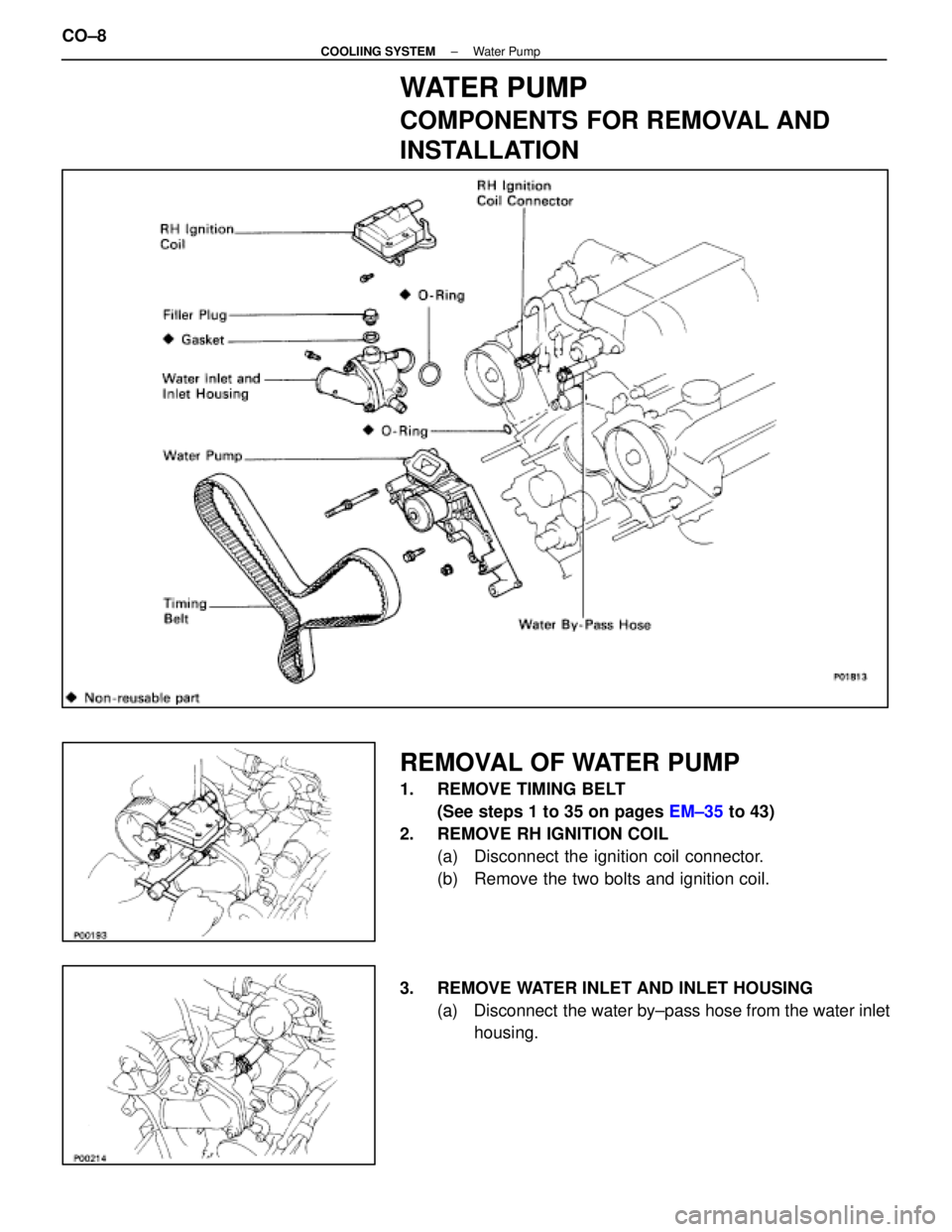
WATER PUMP
COMPONENTS FOR REMOVAL AND
INSTALLATION
REMOVAL OF WATER PUMP
1. REMOVE TIMING BELT(See steps 1 to 35 on pages EM±35 to 43)
2. REMOVE RH IGNITION COIL (a) Disconnect the ignition coil connector.
(b) Remove the two bolts and ignition coil.
3. REMOVE WATER INLET AND INLET HOUSING (a) Disconnect the water by±pass hose from the water inlethousing.
CO±8
±
COOLIING SYSTEM Water Pump
WhereEverybodyKnowsYourName
Page 2797 of 4087
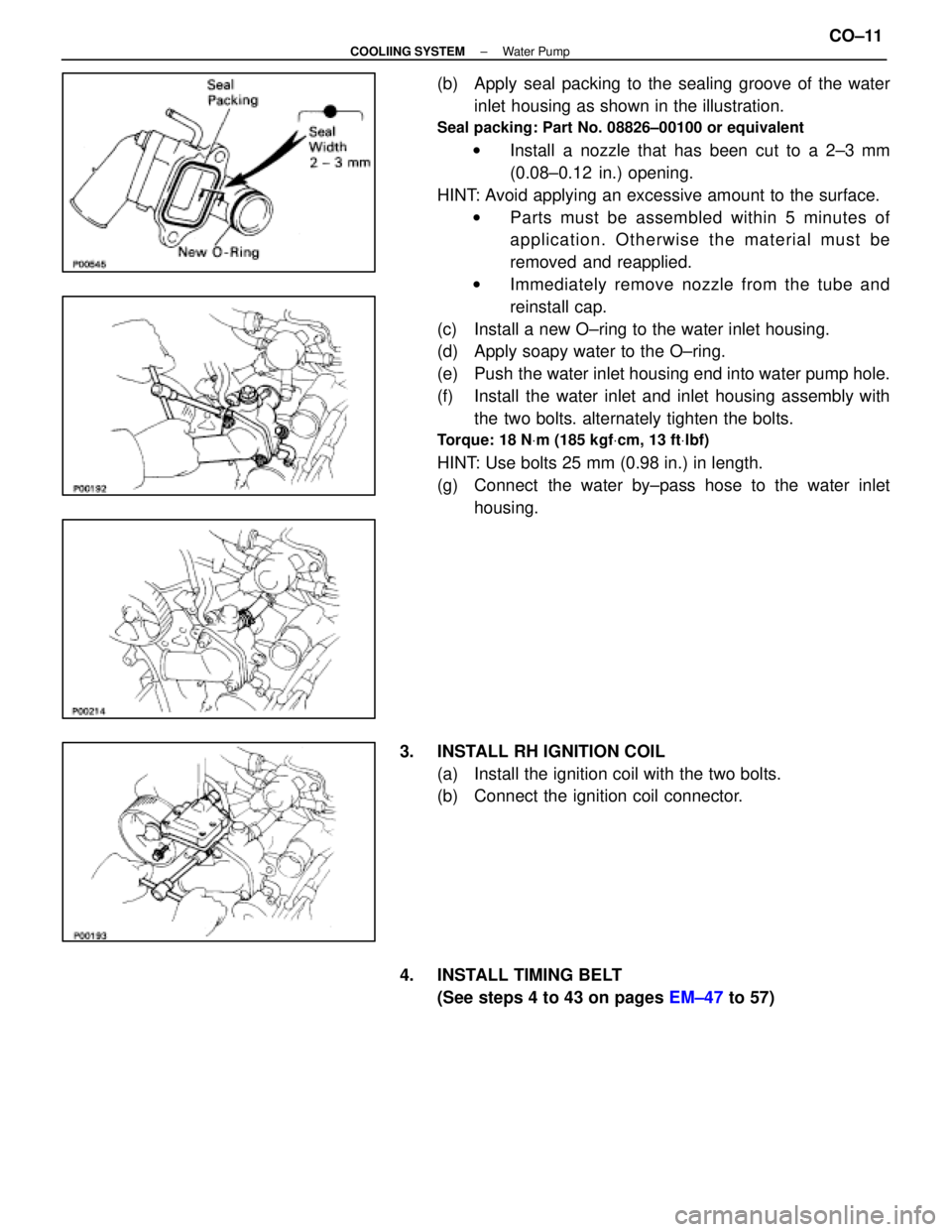
(b) Apply seal packing to the sealing groove of the waterinlet housing as shown in the illustration.
Seal packing: Part No. 08826±00100 or equivalent
w Install a nozzle that has been cut to a 2±3 mm
(0.08±0.12 in.) opening.
HINT: Avoid applying an excessive amount to the surface. w Parts must be assembled within 5 minutes of
application. Otherwise the material must be
removed and reapplied.
w Immediately remove nozzle from the tube and
reinstall cap.
(c) Install a new O±ring to the water inlet housing.
(d) Apply soapy water to the O±ring.
(e) Push the water inlet housing end into water pump hole.
(f) Install the water inlet and inlet housing assembly with the two bolts. alternately tighten the bolts.
Torque: 18 N Vm (185 kgf Vcm, 13 ft Vlbf)
HINT: Use bolts 25 mm (0.98 in.) in length.
(g) Connect the water by±pass hose to the water inlet
housing.
3. INSTALL RH IGNITION COIL (a) Install the ignition coil with the two bolts.
(b) Connect the ignition coil connector.
4. INSTALL TIMING BELT (See steps 4 to 43 on pages EM±47 to 57)
±
COOLIING SYSTEM Water PumpCO±11
WhereEverybodyKnowsYourName
Page 2808 of 4087

ELECTRONICALLY CONTROLLED HYDRAULIC COOLING FAN
Description
In this way system, the cooling fan ECU controls the hydraulic pressure ac\
ting on the hydraulic motor, thus
controlling the speed of the cooling fan steplessly in response to the c\
ondition of the engine and air conditioner.
Operation
The hydraulic pump is driven by a drive belt (V±ribbed belt). The sole\
noid valve adjusts the volume of oil
sent from the hydraulic pump to the hydraulic motor which drives the fan dir\
ectly, thereby controlling the fan
speed. Oil which has passed through the hydraulic motor is cooled by the oil coole\
r before returning to the reservoir
tank. The solenoid valve is controlled by the computer in accordance with the E/G\
rpm, water temp. and A/C
signals. CO±22
±
COOLIING SYSTEM Electronically Controlled Hydraulic
Cooling Fan (Description, Operation)
WhereEverybodyKnowsYourName
Page 2809 of 4087
On±Vehicle Inspection
INSPECTION OF DRIVE BELT
(See step 1 on page CH±5)
INSPECTION OF FLUID LEVEL
1. KEEP VEHICLE LEVEL
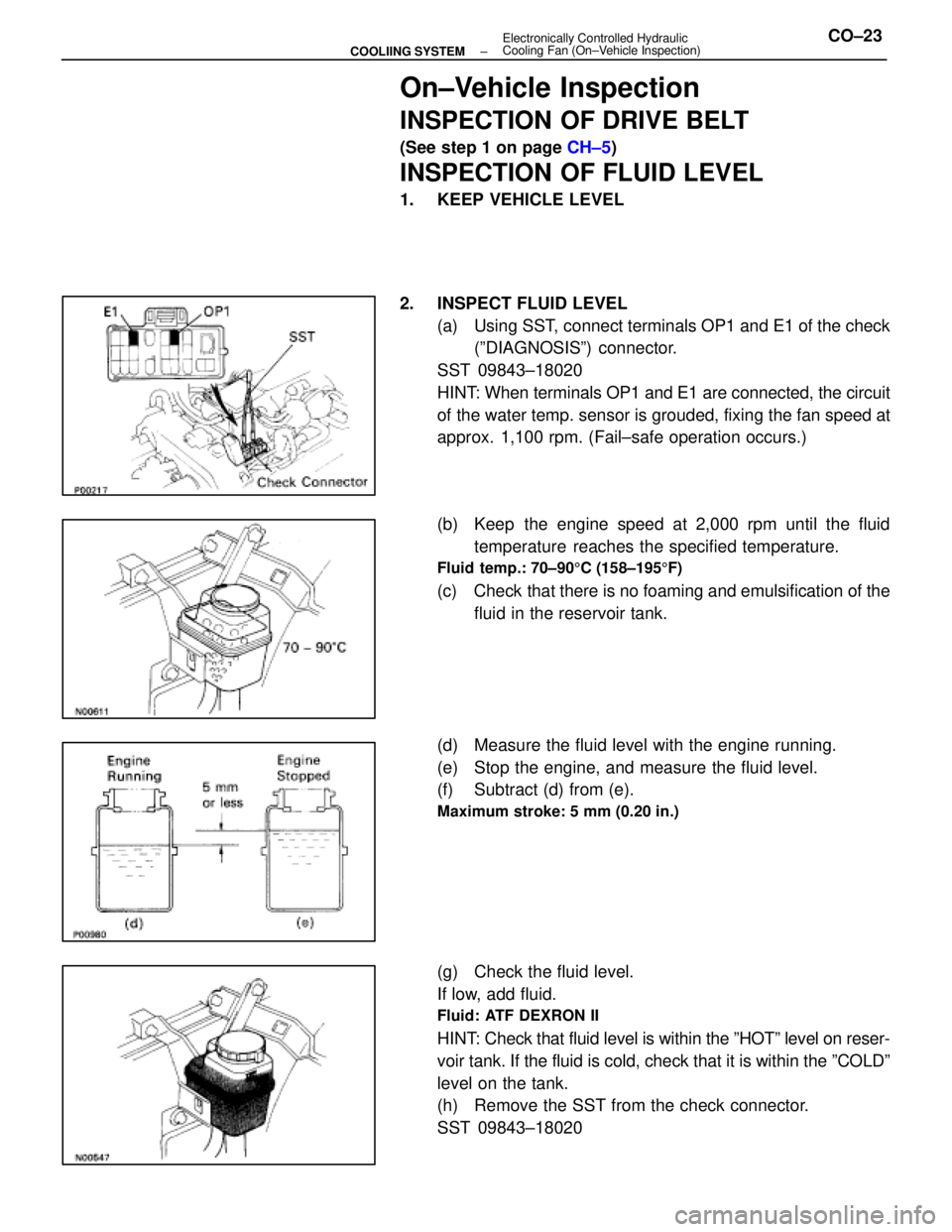
2. INSPECT FLUID LEVEL
(a) Using SST, connect terminals OP1 and E1 of the check(ºDIAGNOSISº) connector.
SST 09843±18020
HINT: When terminals OP1 and E1 are connected, the circuit
of the water temp. sensor is grouded, fixing the fan speed at
approx. 1,100 rpm. (Fail±safe operation occurs.)
(b) Keep the engine speed at 2,000 rpm until the fluid temperature reaches the specified temperature.
Fluid temp.: 70±90 5C (158±195 5F)
(c) Check that there is no foaming and emulsification of the
fluid in the reservoir tank.
(d) Measure the fluid level with the engine running.
(e) Stop the engine, and measure the fluid level.
(f) Subtract (d) from (e).
Maximum stroke: 5 mm (0.20 in.)
(g) Check the fluid level.
If low, add fluid.
Fluid: ATF DEXRON II
HINT: Check that fluid level is within the ºHOTº level on reser-
voir tank. If the fluid is cold, check that it is within the ºCOLDº\
level on the tank.
(h) Remove the SST from the check connector.
SST 09843±18020
±
COOLIING SYSTEM Electronically Controlled Hydraulic
Cooling Fan (On±Vehicle Inspection)CO±23
WhereEverybodyKnowsYourName
Page 2813 of 4087
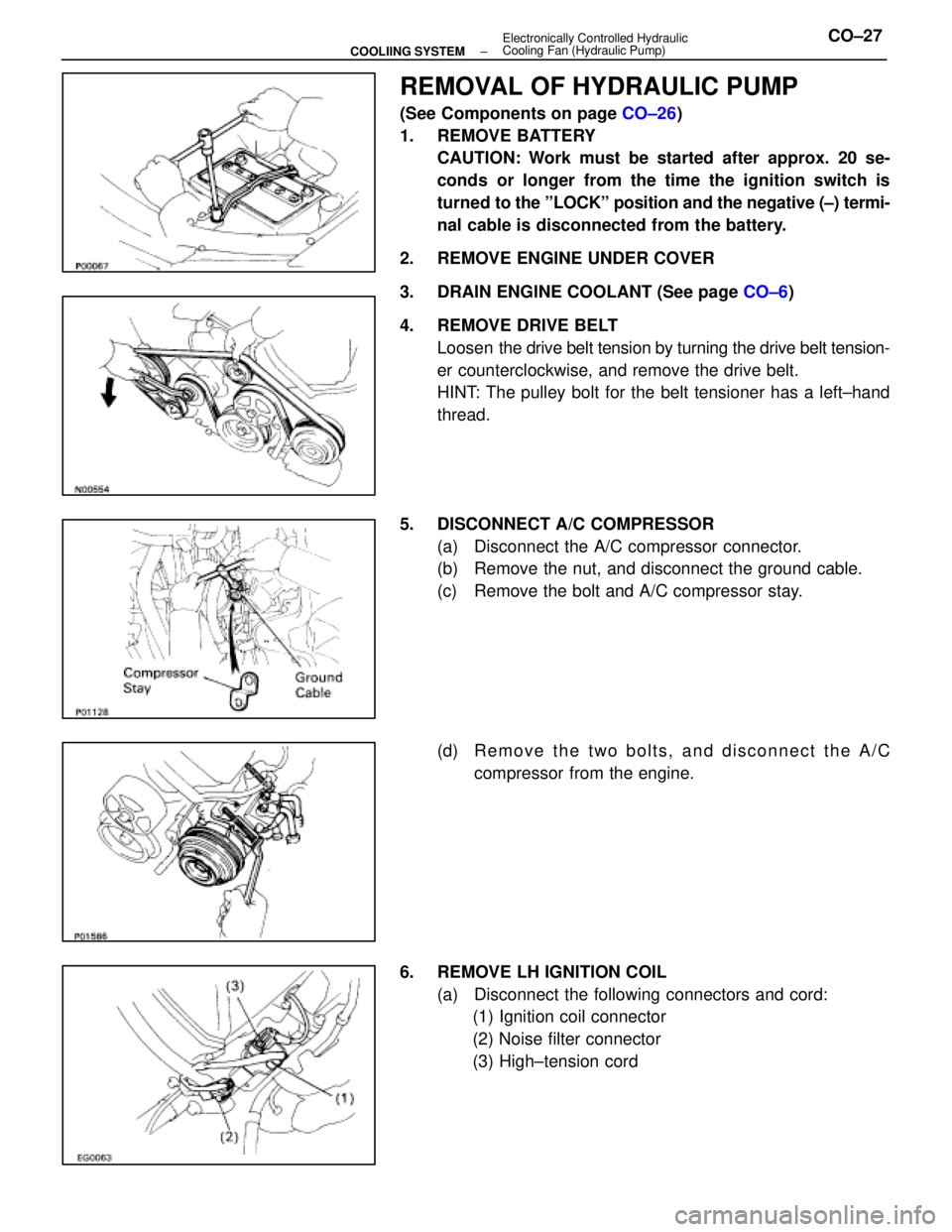
REMOVAL OF HYDRAULIC PUMP
(See Components on page CO±26)
1. REMOVE BATTERY CAUTION: Work must be started after approx. 20 se-
conds or longer from the time the ignition switch is
turned to the ºLOCKº position and the negative (±) termi-
nal cable is disconnected from the battery.
2. REMOVE ENGINE UNDER COVER
3. DRAIN ENGINE COOLANT (See page CO±6)
4. REMOVE DRIVE BELT Loosen the drive belt tension by turning the drive belt tension-
er counterclockwise, and remove the drive belt.
HINT: The pulley bolt for the belt tensioner has a left±hand
thread.
5. DISCONNECT A/C COMPRESSOR (a) Disconnect the A/C compressor connector.
(b) Remove the nut, and disconnect the ground cable.
(c) Remove the bolt and A/C compressor stay.
(d) R e m o v e t h e t w o b o l t s , a n d d i s c onnect the A/C
compressor from the engine.
6. REMOVE LH IGNITION COIL (a) Disconnect the following connectors and cord:(1) Ignition coil connector
(2) Noise filter connector
(3) High±tension cord
±
COOLIING SYSTEM Electronically Controlled Hydraulic
Cooling Fan (Hydraulic Pump)CO±27
WhereEverybodyKnowsYourName