roof LEXUS SC400 1991 Service Manual PDF
[x] Cancel search | Manufacturer: LEXUS, Model Year: 1991, Model line: SC400, Model: LEXUS SC400 1991Pages: 4087, PDF Size: 75.75 MB
Page 2886 of 4087

The 1 UZ±FE engine has 8±cylinders in a V±arrangement at a bank an\
gle of 905. From the front of the RH
bank cylinders are numbered 2±4±6±8, and from the front of the LH b\
ank cylinders are numbered 1 ±3±5±7.
The crankshaft is supported by 5 bearings specified by the inside of the cr\
ankcase. These bearings are made
of a copper and lead alloy. The crankshaft is integrated with 8 weights which are cast along with it\
for balancing. Oil holes are built
into the center of the crankshaft for supplying oil to the connecting ro\
ds, pistons and other components. The ignition order is 1±8±4±3±6±5±7±2. The cylinder\
head is made of aluminum alloy, with a cross flow
type intake and exhaust layout and with pent±roof type combustion chambers. The spark plugs are loca\
ted in
the center of the combustion chambers.
At the front and rear of the intake manifold, a water passage has been p\
rovided which connects the RH
and LH cylinder heads. Exhaust and intake valves are equipped with irregular pitch springs made\
of special valve spring carbon
steel which are capable of following no matter what the engine speed.
The RH and LH intake camshafts are driven by a single timing belt, and a ge\
ar on the intake camshaft en-
gages with a gear on the exhaust camshaft to drive it. The camshaft jour\
nal is supported at 5 (intake) or 4 (ex-
haust) places between the valve lifters of each cylinder and on the front end of the cylinder \
head. Lubrication
of the cam journal gear is accomplished by oil being supplied through the \
oiler port in the center of the camshaft. Adjustment of the valve clearance is done by means of an outer shim type\
system, in which valve adjusting
shims are located above the valve lifters. This permits replacement of the sh\
ims without removal of the cam-
shafts. Pistons are made of high temperature±resistant aluminum alloy, and a depression is built into the piston
head to prevent interference with valves.
Piston pins are the full±floating type, with the pins fastened to neither the piston boss nor the connecting
rods. Instead, snap rings are fitted on both ends of the pins, preventing the\
pins from falling out. The No.1 compression ring is made of steel and the No.2 compression ring\
is made of cast iron. The oil
ring is m ade of a combination of steel and stainless steel. The outer diameter of\
each piston ring is slightly larger
than the diameter of the piston and the flexibility of the rings allows them\
to hug the cylinder walls when they
are mounted on the piston. Compression rings No.1 and No.2 work to prevent \
the leakage of gas from the cylin-
der and the oil ring works to scrape oil off the cylinder walls to prevent it from entering the combustion chamber. The cylinder block is made of aluminum alloy with a bank angle of 90 5. Cast iron cylinders are installed
inside the cylinder block. It has 8 cylinders which are approximately twice the length of th\
e piston stroke. The
top of each cylinder is closed off by the cylinder heads and the lower end of the cylinders becomes the crank-
case, in which the crankshaft is installed. In addition, the cylinder bl\
ock contains a water jacket, through which
coolant is pumped to cool the cylinders. The No.1 and No.2 oil pans are bolted onto the bottom of the cylinder block\
. The No.1 oil pan is made of
aluminum alloy. The No.2 oil pan is an oil reservoir made of pressed steel sheet. An o\
il level sensor is installed
in the No.1 oil pan (If the oil level drops below a set level, a warnin\
g light lights up.). A oil pan baffle plate keeps
sufficient oil in the bottom of the No.2 oil pan even when the vehicle is tilted. \
This dividing plate also prevents
the oil from making waves when the vehicle is stopped suddenly and the oil \
shifts away from the oil pump suction
pipe. Plastic region tightening bolts are used for the cylinder head, main bearing ca\
p and connecting rod.
EM±4
±
ENGINE MECHANICAL Operation
WhereEverybodyKnowsYourName
Page 3404 of 4087
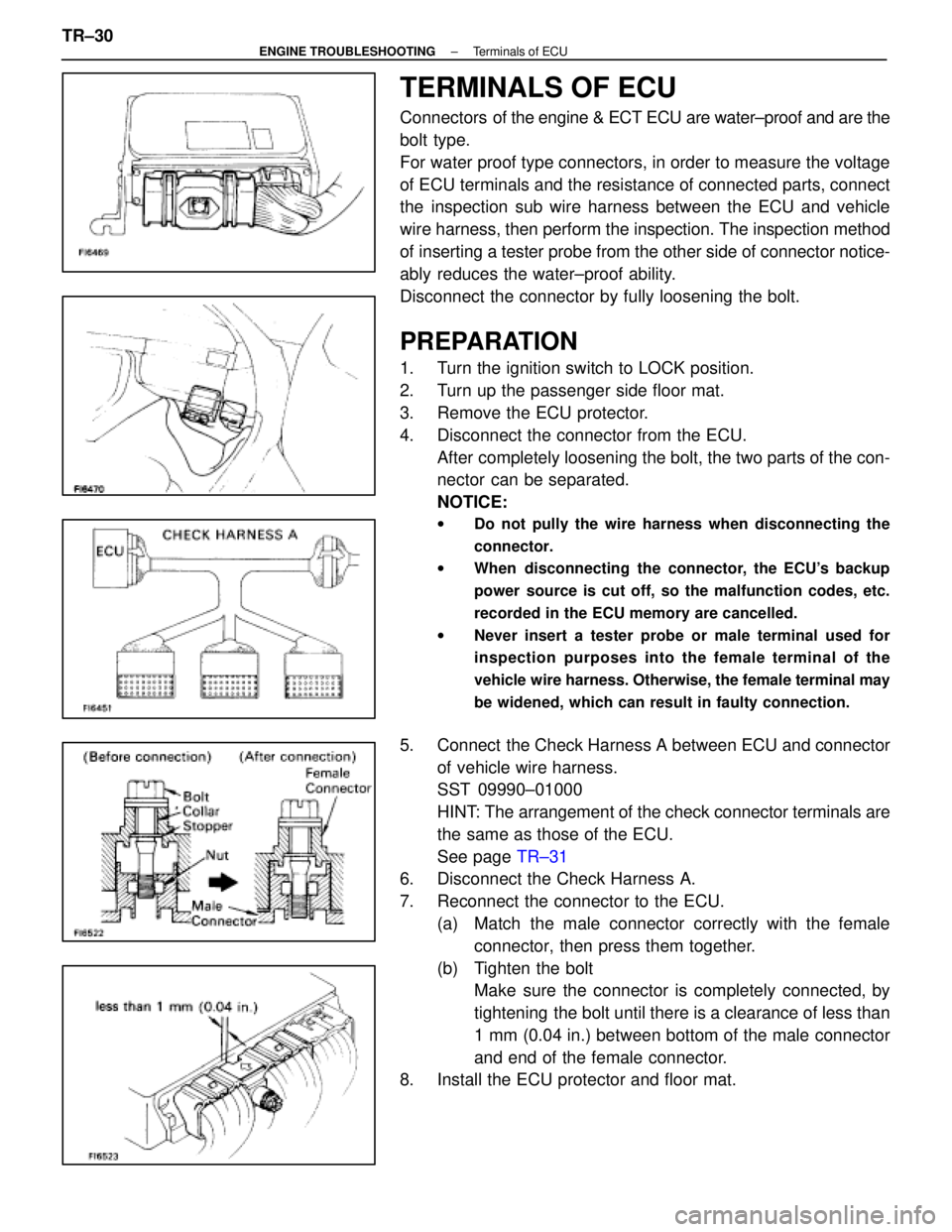
TERMINALS OF ECU
Connectors of the engine & ECT ECU are water±proof and are the
bolt type.
For water proof type connectors, in order to measure the voltage
of ECU terminals and the resistance of connected parts, connect
the inspection sub wire harness between the ECU and vehicle
wire harness, then perform the inspection. The inspection method
of inserting a tester probe from the other side of connector notice-
ably reduces the water±proof ability.
Disconnect the connector by fully loosening the bolt.
PREPARATION
1. Turn the ignition switch to LOCK position.
2. Turn up the passenger side floor mat.
3. Remove the ECU protector.
4. Disconnect the connector from the ECU. After completely loosening the bolt, the two parts of the con-
nector can be separated.
NOTICE:
w Do not pully the wire harness when disconnecting the
connector.
w When disconnecting the connector, the ECU's backup
power source is cut off, so the malfunction codes, etc.
recorded in the ECU memory are cancelled.
w Never insert a tester probe or male terminal used for
inspection purposes into the female terminal of the
vehicle wire harness. Otherwise, the female terminal may
be widened, which can result in faulty connection.
5. Connect the Check Harness A between ECU and connector
of vehicle wire harness.
SST 09990±01000
HINT: The arrangement of the check connector terminals are
the same as those of the ECU.
See page TR±31
6. Disconnect the Check Harness A.
7. Reconnect the connector to the ECU.
(a) Match the male connector correctly with the femaleconnector, then press them together.
(b) Tighten the bolt Make sure the connector is completely connected, by
tightening the bolt until there is a clearance of less than
1 mm (0.04 in.) between bottom of the male connector
and end of the female connector.
8. Install the ECU protector and floor mat.
TR±30
±
ENGINE TROUBLESHOOTING Terminals of ECU
WhereEverybodyKnowsYourName
Page 3412 of 4087
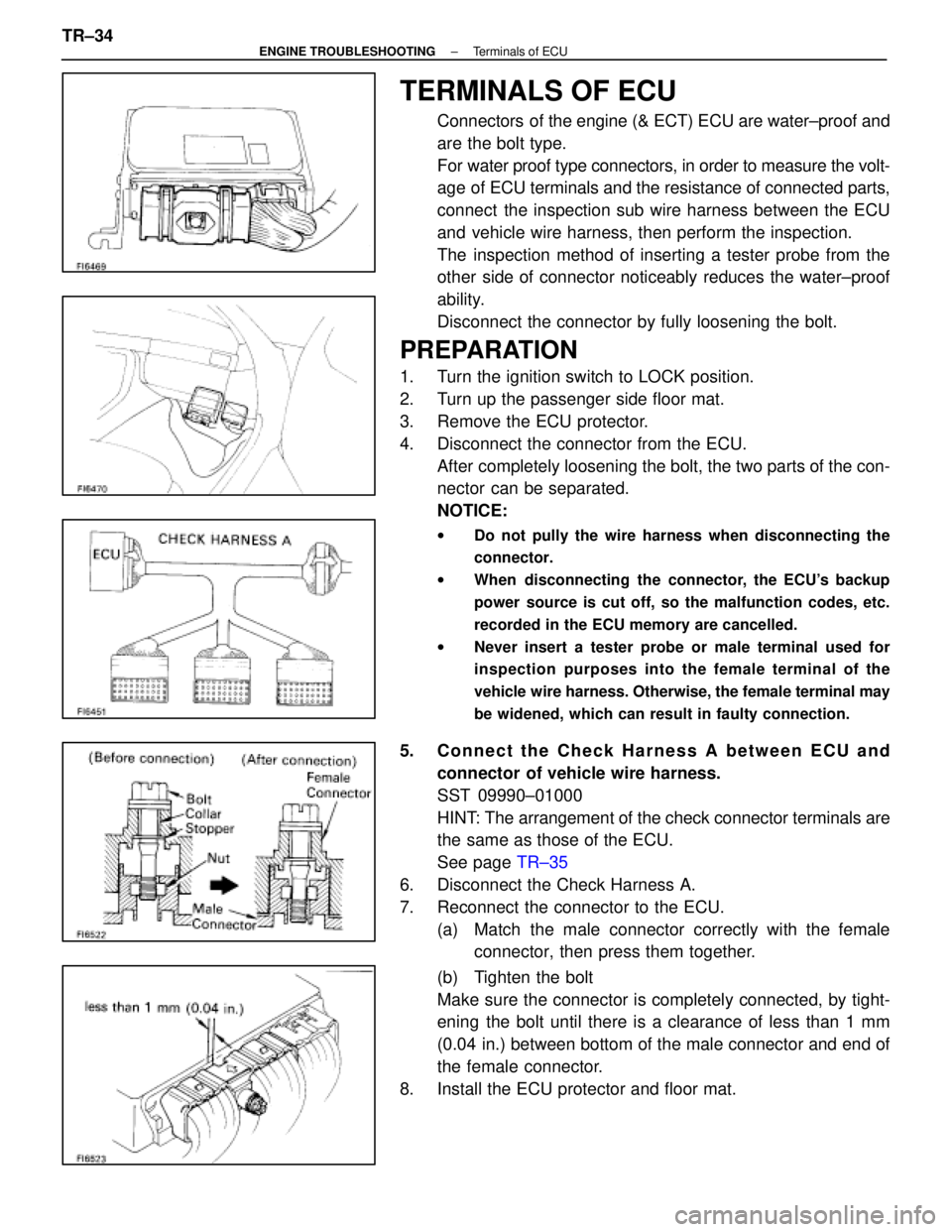
TERMINALS OF ECU
Connectors of the engine (& ECT) ECU are water±proof and
are the bolt type.
For water proof type connectors, in order to measure the volt-
age of ECU terminals and the resistance of connected parts,
connect the inspection sub wire harness between the ECU
and vehicle wire harness, then perform the inspection.
The inspection method of inserting a tester probe from the
other side of connector noticeably reduces the water±proof
ability.
Disconnect the connector by fully loosening the bolt.
PREPARATION
1. Turn the ignition switch to LOCK position.
2. Turn up the passenger side floor mat.
3. Remove the ECU protector.
4. Disconnect the connector from the ECU.After completely loosening the bolt, the two parts of the con-
nector can be separated.
NOTICE:
w Do not pully the wire harness when disconnecting the
connector.
w When disconnecting the connector, the ECU's backup
power source is cut off, so the malfunction codes, etc.
recorded in the ECU memory are cancelled.
w Never insert a tester probe or male terminal used for
inspection purposes into the female terminal of the
vehicle wire harness. Otherwise, the female terminal may
be widened, which can result in faulty connection.
5. Connect the Check Harness A between ECU and
connector of vehicle wire harness.
SST 09990±01000
HINT: The arrangement of the check connector terminals are
the same as those of the ECU.
See page TR±35
6. Disconnect the Check Harness A.
7. Reconnect the connector to the ECU. (a) Match the male connector correctly with the femaleconnector, then press them together.
(b) Tighten the bolt
Make sure the connector is completely connected, by tight-
ening the bolt until there is a clearance of less than 1 mm
(0.04 in.) between bottom of the male connector and end of
the female connector.
8. Install the ECU protector and floor mat.
TR±34
±
ENGINE TROUBLESHOOTING Terminals of ECU
WhereEverybodyKnowsYourName
Page 3616 of 4087
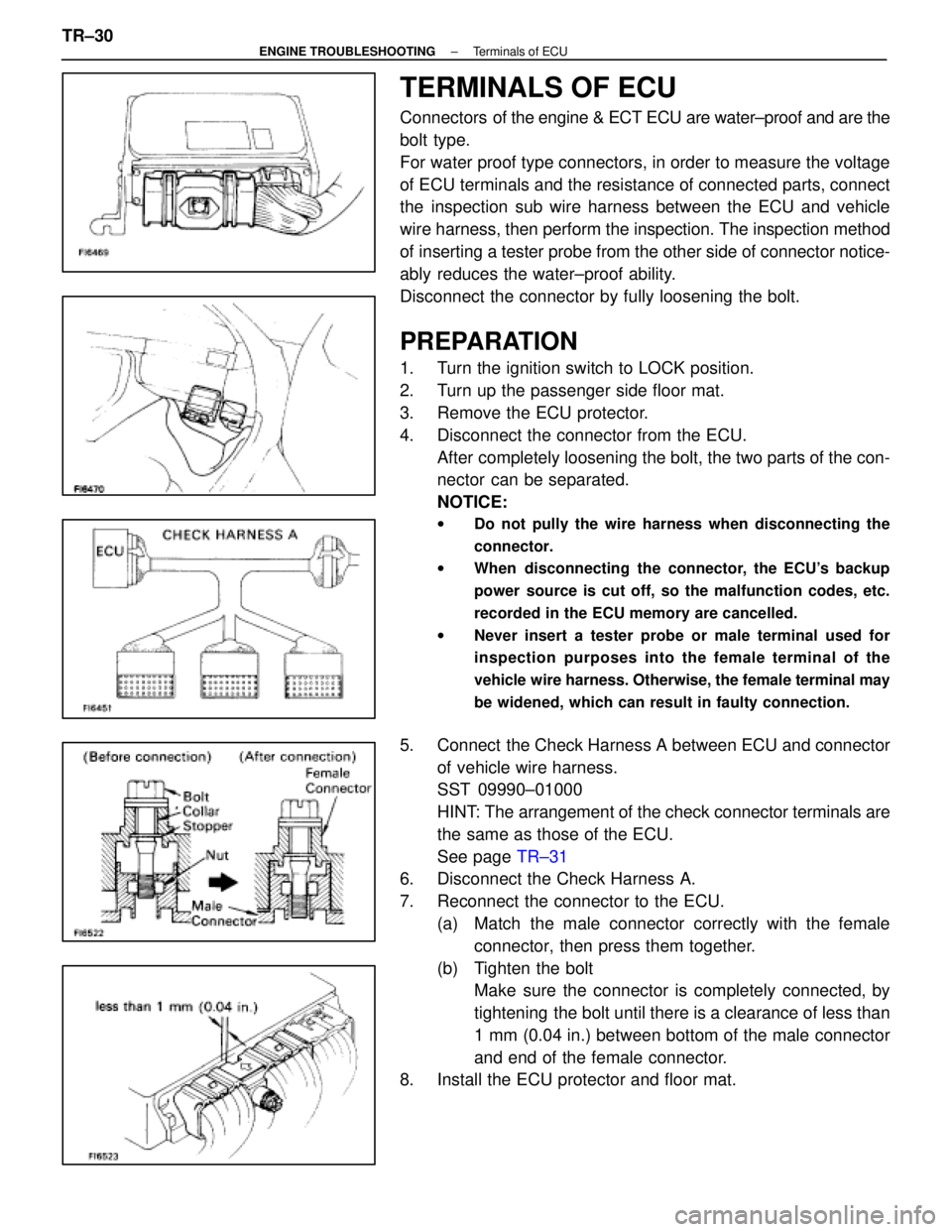
TERMINALS OF ECU
Connectors of the engine & ECT ECU are water±proof and are the
bolt type.
For water proof type connectors, in order to measure the voltage
of ECU terminals and the resistance of connected parts, connect
the inspection sub wire harness between the ECU and vehicle
wire harness, then perform the inspection. The inspection method
of inserting a tester probe from the other side of connector notice-
ably reduces the water±proof ability.
Disconnect the connector by fully loosening the bolt.
PREPARATION
1. Turn the ignition switch to LOCK position.
2. Turn up the passenger side floor mat.
3. Remove the ECU protector.
4. Disconnect the connector from the ECU. After completely loosening the bolt, the two parts of the con-
nector can be separated.
NOTICE:
w Do not pully the wire harness when disconnecting the
connector.
w When disconnecting the connector, the ECU's backup
power source is cut off, so the malfunction codes, etc.
recorded in the ECU memory are cancelled.
w Never insert a tester probe or male terminal used for
inspection purposes into the female terminal of the
vehicle wire harness. Otherwise, the female terminal may
be widened, which can result in faulty connection.
5. Connect the Check Harness A between ECU and connector
of vehicle wire harness.
SST 09990±01000
HINT: The arrangement of the check connector terminals are
the same as those of the ECU.
See page TR±31
6. Disconnect the Check Harness A.
7. Reconnect the connector to the ECU.
(a) Match the male connector correctly with the femaleconnector, then press them together.
(b) Tighten the bolt Make sure the connector is completely connected, by
tightening the bolt until there is a clearance of less than
1 mm (0.04 in.) between bottom of the male connector
and end of the female connector.
8. Install the ECU protector and floor mat.
TR±30
±
ENGINE TROUBLESHOOTING Terminals of ECU
WhereEverybodyKnowsYourName
Page 3624 of 4087
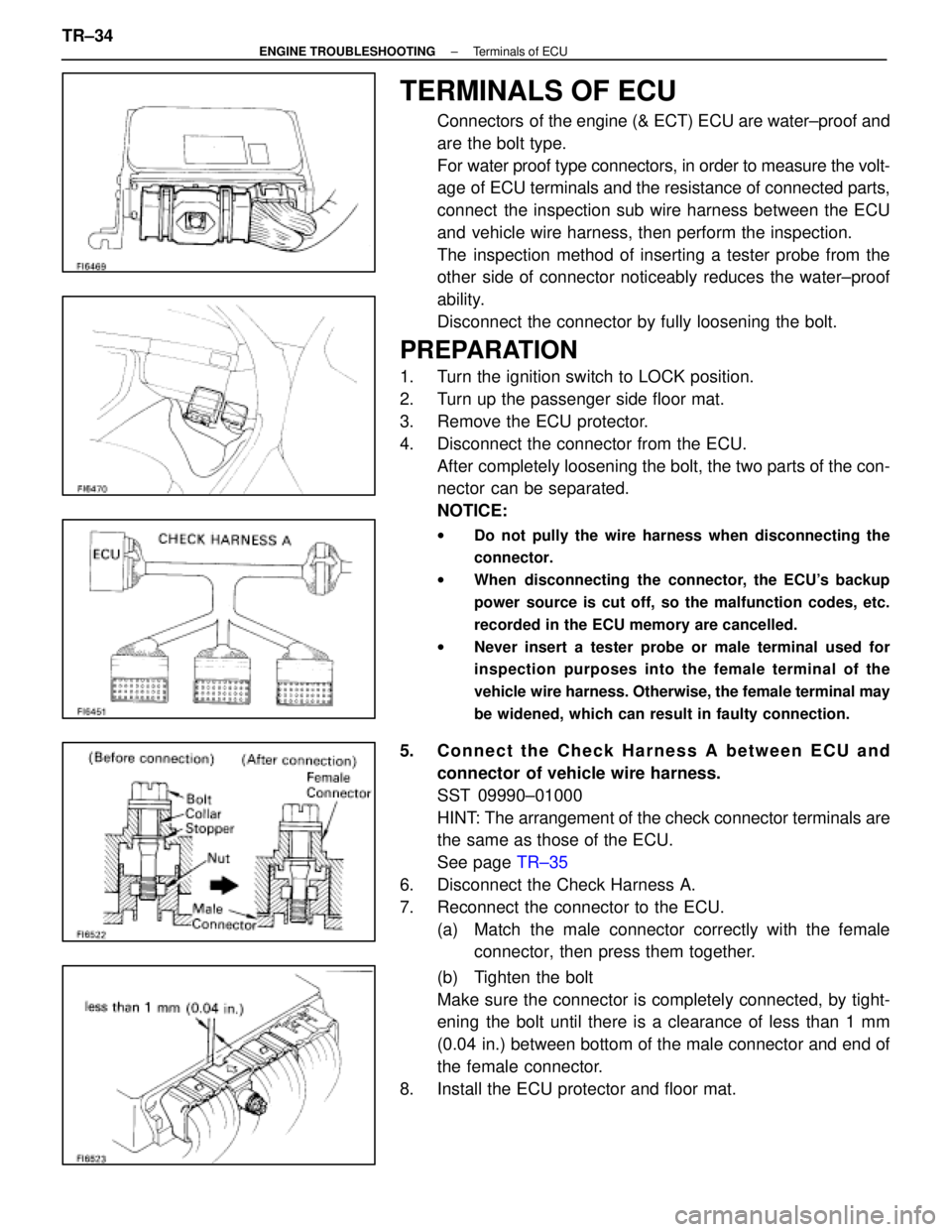
TERMINALS OF ECU
Connectors of the engine (& ECT) ECU are water±proof and
are the bolt type.
For water proof type connectors, in order to measure the volt-
age of ECU terminals and the resistance of connected parts,
connect the inspection sub wire harness between the ECU
and vehicle wire harness, then perform the inspection.
The inspection method of inserting a tester probe from the
other side of connector noticeably reduces the water±proof
ability.
Disconnect the connector by fully loosening the bolt.
PREPARATION
1. Turn the ignition switch to LOCK position.
2. Turn up the passenger side floor mat.
3. Remove the ECU protector.
4. Disconnect the connector from the ECU.After completely loosening the bolt, the two parts of the con-
nector can be separated.
NOTICE:
w Do not pully the wire harness when disconnecting the
connector.
w When disconnecting the connector, the ECU's backup
power source is cut off, so the malfunction codes, etc.
recorded in the ECU memory are cancelled.
w Never insert a tester probe or male terminal used for
inspection purposes into the female terminal of the
vehicle wire harness. Otherwise, the female terminal may
be widened, which can result in faulty connection.
5. Connect the Check Harness A between ECU and
connector of vehicle wire harness.
SST 09990±01000
HINT: The arrangement of the check connector terminals are
the same as those of the ECU.
See page TR±35
6. Disconnect the Check Harness A.
7. Reconnect the connector to the ECU. (a) Match the male connector correctly with the femaleconnector, then press them together.
(b) Tighten the bolt
Make sure the connector is completely connected, by tight-
ening the bolt until there is a clearance of less than 1 mm
(0.04 in.) between bottom of the male connector and end of
the female connector.
8. Install the ECU protector and floor mat.
TR±34
±
ENGINE TROUBLESHOOTING Terminals of ECU
WhereEverybodyKnowsYourName
Page 3813 of 4087
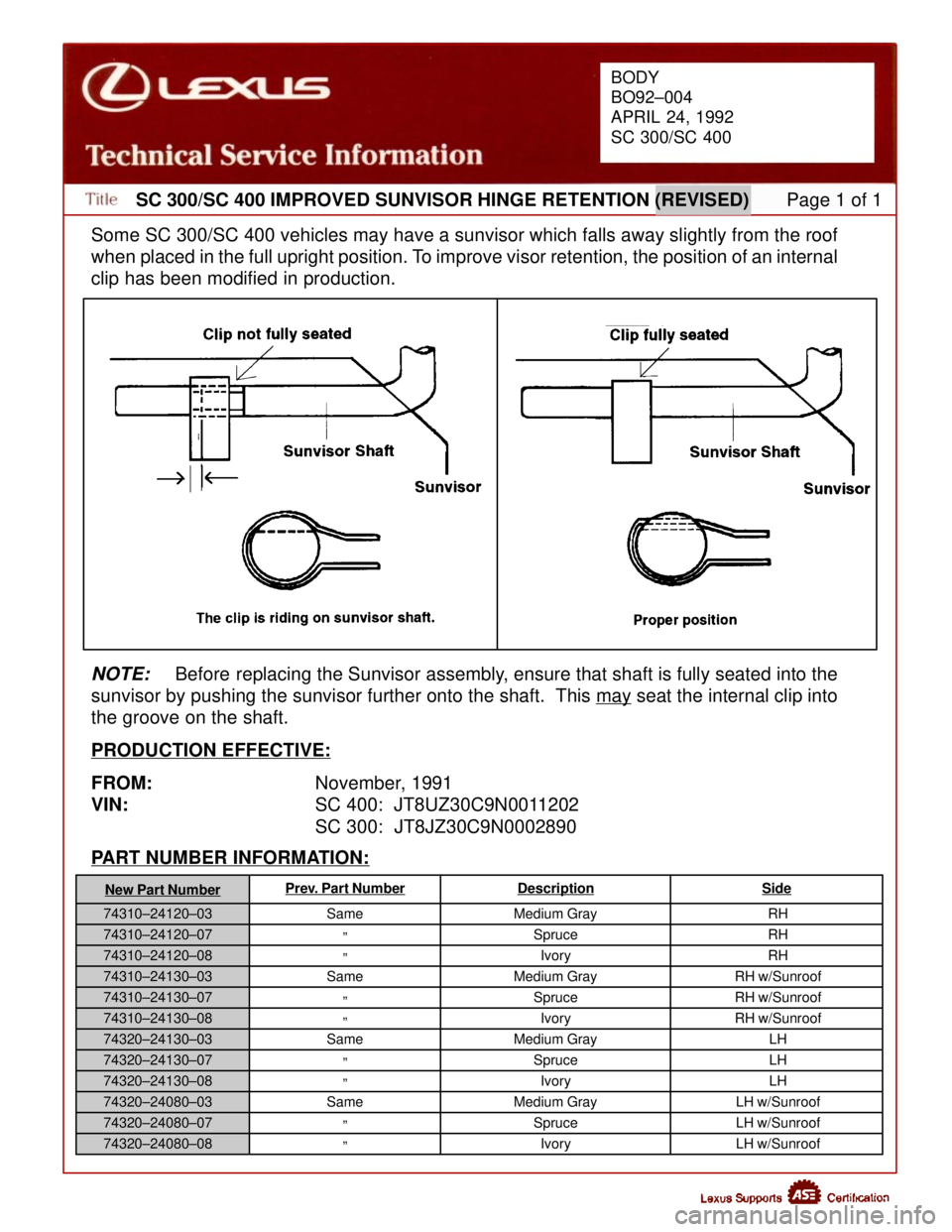
Some SC 300/SC 400 vehicles may have a sunvisor which falls away slightly from the roof
when placed in the full upright position. To improve visor retention, the position of an internal
clip has been modified in production.
BODY
BO92±004
APRIL 24, 1992
SC 300/SC 400
PART NUMBER INFORMATION:
New Part NumberPrev. Part NumberDescriptionSide
NOTE:Before replacing the Sunvisor assembly, ensure that shaft is fully seated into the
sunvisor by pushing the sunvisor further onto the shaft. This may
seat the internal clip into
the groove on the shaft.
PRODUCTION EFFECTIVE:
FROM: November, 1991
VIN: SC 400: JT8UZ30C9N0011202
SC 300: JT8JZ30C9N0002890
Same
º
º
Same
º
º
Same
º
º
Same
º
º Medium Gray
SpruceIvory
SC 300/SC 400 IMPROVED SUNVISOR HINGE RETENTION (REVISED) Page 1 of 1
Medium Gray
SpruceIvory
Medium Gray SpruceIvory
Medium Gray SpruceIvory RH
RH
RH
RH w/Sunroof
RH w/Sunroof
RH w/Sunroof LH
LH
LH
LH w/Sunroof
LH w/Sunroof
LH w/Sunroof
74310±24120±03
74310±24120±07
74310±24120±08
74310±24130±03
74310±24130±07
74310±24130±08
74320±24130±03
74320±24130±07
74320±24130±08
74320±24080±03
74320±24080±07
74320±24080±08
WhereEverybodyKnowsYourName
Page 3873 of 4087

31
Position of Parts in Body
M 1 Mobilephone R 16 Remote Control Mirror LH
M 2 Moon Roof Control Relay R 17 Remote Control Mirror RH
M 3 Moon Roof Control SW R 18 Remote Control Mirror SW
M 4 Moon Roof Motor and Limit SWS 13 Stereo Power Amplifier
O 8 Oxygen Sensor Sub (for California) S 14 Stereo Power Amplifier
P 4 Power Window Control SW RH T 16 Telephone Transceiver and Speaker Relay
P 5 Power Window Master SW and Door Lock Control SW LH T 17 Telephone Transceiver and Speaker Relay
P 6 Power Window Motor LH T 18 Tension Reducer Solenoid LH
P 7 Power Window Motor RH T 19 Tension Reducer Solenoid RH
P 20 Personal Light V 5 Vanity Light LH
R 10 Rear Combination Light LH V 6 Vanity Light RH
R 11 Rear Combination Light RH
R 12 Rear Speaker LH W 8 Wireless Door Lock ECU
R 13 Rear Speaker RH W 9 Woofer Speaker
R 14 Rear Window Defogger (+) W 10 Woofer Speaker Amplifier
R 15 Rear Window Defogger (±)
WhereEverybodyKnowsYourName
Page 3882 of 4087

41
CODEJOINING WIRE HARNESS AND WIRE HARNESS (CONNECTOR LOCATION)
BS1ENGINE ROOM MAIN WIRE AND FLOOR WIRE (LEFT KICK PANEL)
BT1FLOOR WIRE AND COWL WIRE (LEFT KICK PANEL)
BU1INSTRUMENT PANEL WIRE AND FLOOR WIRE (LEFT KICK PANEL)
BV1
BV2FLOOR NO. 3 WIRE AND CONSOLE BOX WIRE (UNDER THE INSTRUMENT PANEL CENTER)
BV3
FLOOR NO. 3 WIRE AND CONSOLE BOX WIRE (UNDER THE INSTRUMENT PANEL CENTER)
BW1ENGINE ROOM MAIN WIRE AND FLOOR NO. 3 WIRE (RIGHT KICK PANEL)
BX1FLOOR NO. 3 WIRE AND COWL WIRE (RIGHT KICK PANEL)
BY1INSTRUMENT PANEL WIRE AND FLOOR NO. 3 WIRE (RIGHT KICK PANEL)
BZ1ROOF WIRE AND MOON ROOF WIRE (FRONT SIDE OF ROOF LEFT)
Bc1FLOOR NO 3 WIRE AND FLOOR WIRE (UNDER THE LEFT SIDE OF REAR SEAT CUSHION)Bc2FLOOR NO. 3 WIRE AND FLOOR WIRE (UNDER THE LEFT SIDE OF REAR SEAT CUSHION)
Bd1FLOOR NO. 3 WIRE AND LUGGAGE NO. 2 WIRE (RIGHT SIDE OF LUGGAGE COMPARTMENT)
WhereEverybodyKnowsYourName
Page 3920 of 4087
237
GLOVE BOX LIGHT SW
CIGARETTE LIGHTER
LUGGAGE COMPARTMENT
DOOR OPENER SW
COMBINATION METER
(EP )
O/D MAIN SW
RHEOSTAT
DO OR LOCK MOTOR,
DOOR UNLOCK
DETECTION SW AND
DOOR OPEN DETECTION
SW LH
MIRROR HEATER LH DOOR KEY LOCK AND
UNLOCK SW LH
POWER WINDOW
MASTER SW
RE MOTE CO NTROL
MIRROR SW
KEY INTER LOCK
SOLENOID
[IGNITION SW]
UNLOCK WA RNING SW
[IGNITION SW]
TURN SIGNAL SW
[COMB. SW]
WIPER AND WASHER SW
[COMB. SW]
LIGHT CONTROL SW
[COMB. SW]
DIMMER SW
[COMB. SW] INTEGRATION RELAY POWER MAIN RELAY HA ZARD S W A/C CONTROL
ASSEMBLY A/T INDICATOR LIGHT
(
FOR SHIFT LEVER )
SEAT HEATER SW TRACTION CUT SW AND
SEAT HEATER SW SHIFT LOCK ECU
3G 8
3F 8
3F 7
3D 10
3D 9
3A 2
1F 6
1K 6 3H
15
3H 14
3H 3
1D 10
1G 3
1G 4
IF
IG 1E
18 3A
1
W±B W±B W±B
W±B
W±B
W±B W±B W±B
W±B W±B
W±B W±B W±B W±B
W±B W±B
W±B W±B
W±B
W±B
W±B
CE NTER AI RB AG
SENSOR ASSEMBLY
I29
W±B
W±B
3G
3
I38 I8 1K 5
WIPER MOTOR
SEAT HEATER RELAY
KICK DOWN SW
THEFT DETERRENT
AND DOOR LOCK ECU
HE ADLIGHT HI RH
HE ADLIGHT HI LH
COMBINATION METER
(
HIGH BEAM )
CRUISE CONTROL SW
[COMB. SW] E3
I1
4
4
1K
12
IE1
11
IH11
CRUISE CONTROL ECU
( GND ) 1J
1
I7
1G1
8
I5 W±B
W±B
W±B
W±B
W±B
W±B
W±B
W±B R
W±B
W±B W±B W±B W±B W±BW±BW±B
W±B W±B W±B
W±B W±B
W±B
W±B
W±B
W±B
W±B W±B
W±B
W±B
IQ1 10
W±B
(E1 )
( E2 )
TILT AND POWER
TELESCOPIC ECU
( GND2 )
W±B ( A/T )
( M/T )
W±B
1H 13
I38
B4
B31
MOO N ROOF CO NTROL
RE LAY
MOON ROOF LIMIT SW
MOO N ROOF MOTOR
MOO N ROOF CO NTROL
SW
PERSONAL LIGHT
VANITY LIGHT LH
VANITY LIGHT RH
PERSONAL LIGHT
VANITY LIGHT RH
VANITY LIGHT LH B3
B1
B1
B2
B
W±B B
W±B
W±B
W±B
W±B
W±B
W±B
W±B W±BW±B
BZ1
4 BZ1
5
B
W±B
W±B
( CANADA )
W±B
( W/O MOON ROOF )(
W/ MOON ROOF )
(
W/O MEMORY MIRROR )
W±B
(
CANADA )
WhereEverybodyKnowsYourName
Page 3923 of 4087
240
GROUND POINT
: RELAY BLOCKS
CODESEE PAGERELAY BLOCKS (RELAY BLOCK LOCATION)
219ENGINE COMPARTMENT LEFT
422LEFT KICK PANEL (J/B NO.1 LEFT)
: JUNCTION BLOCK AND WIRE HARNESS CONNECTOR
CODESEE PAGEJUNCTION BLOCK AND WIRE HARNESS (CONNECTOR LOCATION)
1D20FRONT DOOR LH WIRE
1E20INSTRUMENT PANEL WIRE
1F20ROOF WIRE
1G20COWL NO. 2 WIRE
1H
1J20COWL WIRE
1K
20COWL WIRE
3A
3D
3F22INSTRUMENT PANEL WIRE
3G
22INSTRUMENT PANEL WIRE
3H
: CONNECTOR JOINING WIRE HARNESS AND WIRE HARNESS
CODESEE PAGEJOINING WIRE HARNESS AND WIRE HARNESS (CONNECTOR LOCATION)
IE136ENGINE ROOM MAIN WIRE AND COWL WIRE (R/B NO.4)
IE236ENGINE ROOM MAIN WIRE AND COWL WIRE (BEHIND GLOVE BOX)
IF236FRONT DOOR LH WIRE AND COWL WIRE (LEFT KICK PANEL)
IG136INSTRUMENT PANEL WIRE AND COWL WIRE (R/B NO.5)
IH136COWL NO. 2 WIRE AND COWL WIRE (BEHIND COMBINATION METER)
IJ136ENGINE WIRE AND COWL WIRE (RIGHT KICK PANEL)
IK136ENGINE WIRE AND INSTRUMENT PANEL WIRE (RIGHT KICK PANEL)IK236ENGINE WIRE AND INSTRUMENT PANEL WIRE (RIGHT KICK PANEL)
IN138ENGINE ROOM MAIN WIRE AND A/C WIRE (BEHIND GLOVE BOX)
IP138FRONT DOOR RH WIRE AND COWL WIRE (RIGHT KICK PANEL)
IQ138INSTRUMENT PANEL WIRE AND CONSOLE BOX WIRE (UNDER THE INSTRUMENT PANEL CENTER)IQ238INSTRUMENT PANEL WIRE AND CONSOLE BOX WIRE (UNDER THE INSTRUMENT PANEL CENTER)
BS140ENGINE ROOM MAIN WIRE AND FLOOR WIRE (LEFT KICK PANEL)
BT140FLOOR WIRE AND COWL WIRE (LEFT KICK PANEL)
BU140FLOOR WIRE AND INSTRUMENT PANEL WIRE (LEFT KICK PANEL)BU240FLOOR WIRE AND INSTRUMENT PANEL WIRE (LEFT KICK PANEL)
BV240FLOOR NO. 3 WIRE AND CONSOLE BOX WIRE (UNDER THE INSTRUMENT PANEL CENTER)
BX140FLOOR NO. 3 WIRE AND COWL WIRE (RIGHT KICK PANEL)
BY140INSTRUMENT PANEL WIRE AND FLOOR NO. 3 WIRE (RIGHT KICK PANEL)
BZ140ROOF WIRE AND MOON ROOF WIRE (FRONT SIDE OF ROOF LEFT)
Ba142FLOOR WIRE AND FRONT SEAT LH WIRE (UNDER THE FRONT LH SEAT)Ba242FLOOR WIRE AND FRONT SEAT LH WIRE (UNDER THE FRONT LH SEAT)
Bb142FLOOR NO. 3 WIRE AND FRONT SEAT RH WIRE (UNDER THE FRONT RH SEAT)
Bd142FLOOR NO. 3 WIRE AND LUGGAGE NO. 2 WIRE (RIGHT SIDE OF LUGGAGE COMPARTMENT)
: GROUND POINTS
CODESEE PAGEGROUND POINTS LOCATION
EA34FRONT SIDE OF RIGHT FENDER
EB34FRONT SIDE OF LEFT FENDER
EC34REAR SIDE OF INTAKE MANIFOLD
ED34REAR SIDE OF CYLINDER HEAD RH
IF36LEFT KICK PANEL
IG36INSTRUMENT PANEL BRACE LH
IH36UNDER THE ASHTRAY LH
II36UNDER THE ASHTRAY RH
IJ36RIGHT KICK PANEL
BK40UNDER THE CENTER PILLAR LH
BL40UNDER THE CENTER PILLAR RH
BM40BACK PANEL CENTER
WhereEverybodyKnowsYourName