seat LEXUS UX200 2019 Manual Online
[x] Cancel search | Manufacturer: LEXUS, Model Year: 2019, Model line: UX200, Model: LEXUS UX200 2019Pages: 452, PDF Size: 10.06 MB
Page 362 of 452
3627-2. Steps to take in an emergency
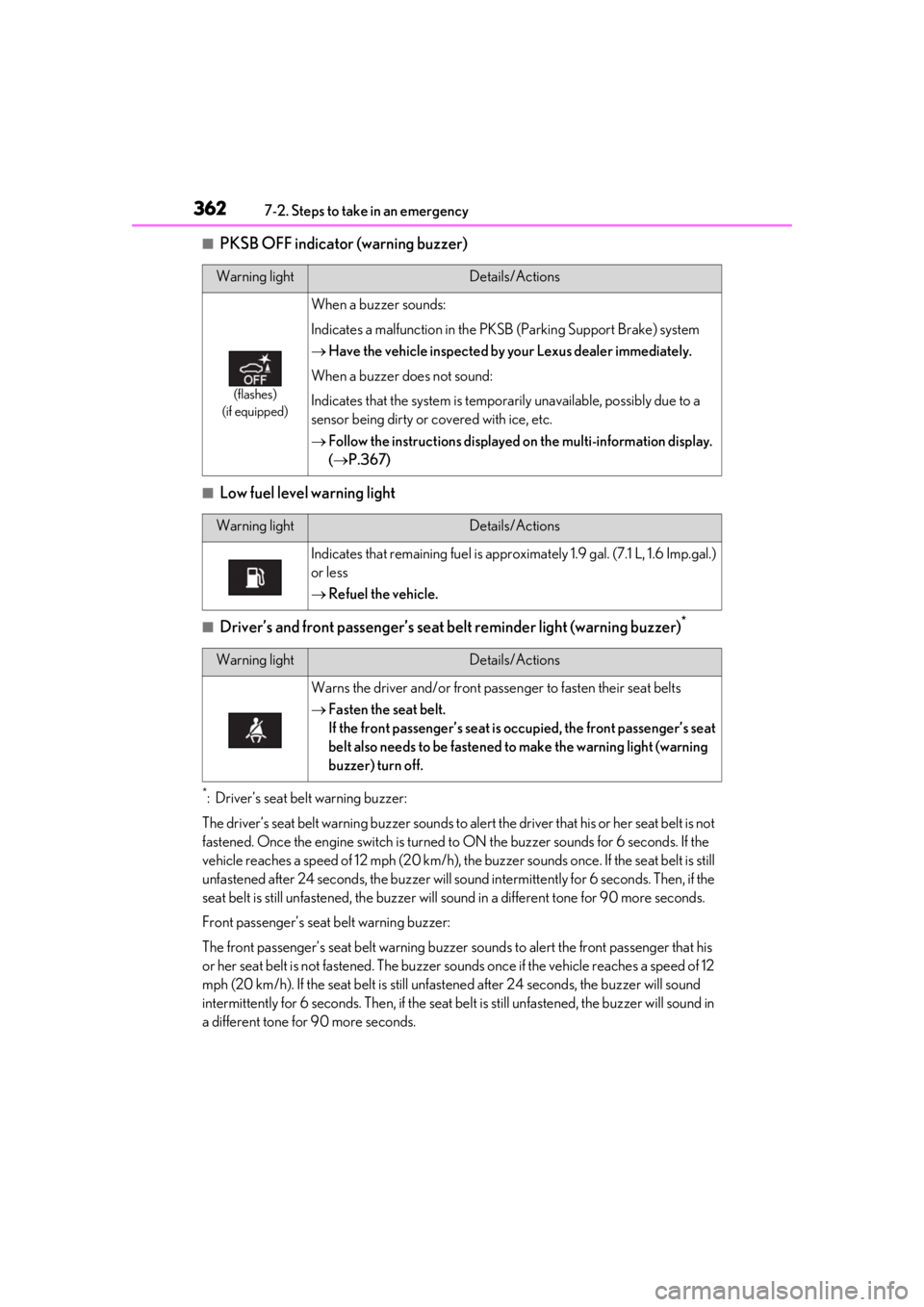
■PKSB OFF indicator (warning buzzer)
■Low fuel level warning light
■Driver’s and front passenger’s seat belt reminder light (warning buzzer)*
*: Driver’s seat belt warning buzzer:
The driver’s seat belt warning buzzer sounds to al ert the driver that his or her seat belt is not
fastened. Once the engine switch is turned to ON the buzzer sounds for 6 seconds. If the
vehicle reaches a speed of 12 mph (20 km/h), the buzzer sounds once. If the seat belt is still
unfastened after 24 seco nds, the buzzer will sound intermitte ntly for 6 seconds. Then, if the
seat belt is still unfastened, the buzzer will sound in a different tone for 90 more seconds.
Front passenger’s seat belt warning buzzer:
The front passenger’s seat belt warning buzzer sounds to alert the front passenger that his
or her seat belt is not fastened. The buzzer sounds once if the vehicle reaches a speed of 12
mph (20 km/h). If the seat belt is still unfastened after 24 seconds, the buzzer will sound
intermittently for 6 seconds. Th en, if the seat belt is still unfastened, the buzzer will sound in
a different tone for 90 more seconds.
Warning lightDetails/Actions
(flashes)
(if equipped)
When a buzzer sounds:
Indicates a malfunction in the PK SB (Parking Support Brake) system
Have the vehicle inspected by your Lexus dealer immediately.
When a buzzer does not sound:
Indicates that the system is temporarily unavailable, possibly due to a
sensor being dirty or covered with ice, etc.
Follow the instructions displayed on the multi-information display.
( P.367)
Warning lightDetails/Actions
Indicates that remaining fu el is approximately 1.9 gal. (7.1 L, 1.6 Imp.gal.)
or less
Refuel the vehicle.
Warning lightDetails/Actions
Warns the driver and/or front passe nger to fasten their seat belts
Fasten the seat belt.
If the front passenger’s seat is occupied, the front passenger’s seat
belt also needs to be fastened to make the warning light (warning
buzzer) turn off.
Page 363 of 452
3637-2. Steps to take in an emergency
7
When trouble arises
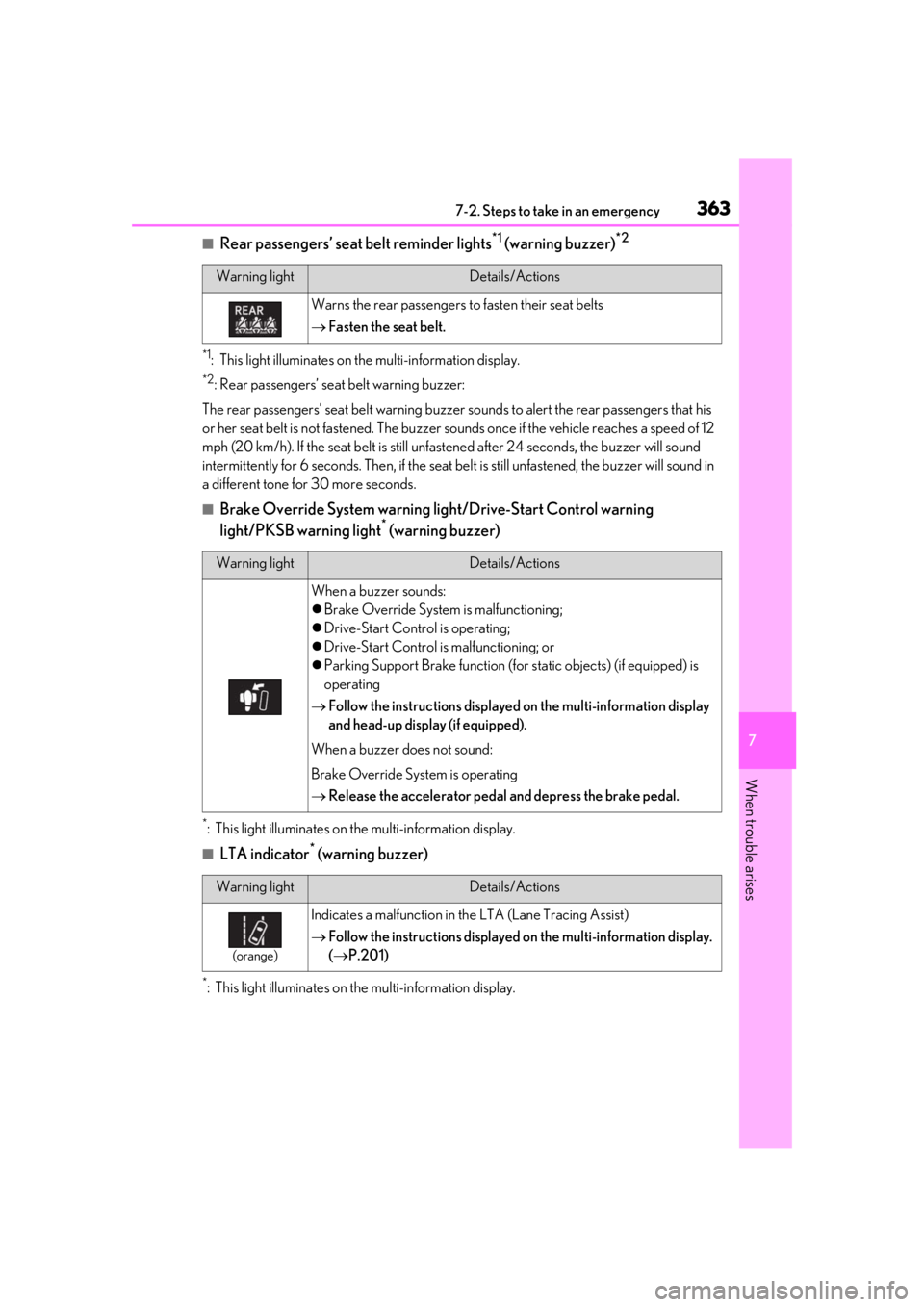
■Rear passengers’ seat belt reminder lights*1 (warning buzzer)*2
*1: This light illuminates on the multi-information display.
*2: Rear passengers’ seat belt warning buzzer:
The rear passengers’ seat belt warning buzzer sounds to alert the rear passengers that his
or her seat belt is not fastened. The buzzer sounds once if the vehicle reaches a speed of 12
mph (20 km/h). If the seat belt is still unfastened after 24 seconds, the buzzer will sound
intermittently for 6 seconds. Th en, if the seat belt is still unfastened, the buzzer will sound in
a different tone for 30 more seconds.
■Brake Override System warning light/Drive-Start Control warning
light/PKSB warning light* (warning buzzer)
*: This light illuminates on the multi-information display.
■LTA indicator* (warning buzzer)
*: This light illuminates on the multi-information display.
Warning lightDetails/Actions
Warns the rear passengers to fasten their seat belts
Fasten the seat belt.
Warning lightDetails/Actions
When a buzzer sounds:
Brake Override System is malfunctioning;
Drive-Start Control is operating;
Drive-Start Control is malfunctioning; or
Parking Support Brake function (for static objects) (if equipped) is
operating
Follow the instructions displayed on the multi-information display
and head-up display (if equipped).
When a buzzer does not sound:
Brake Override System is operating
Release the accelerator pedal and depress the brake pedal.
Warning lightDetails/Actions
(orange)
Indicates a malfunction in the LTA (Lane Tracing Assist)
Follow the instructions displayed on the multi-information display.
( P.201)
Page 364 of 452
3647-2. Steps to take in an emergency
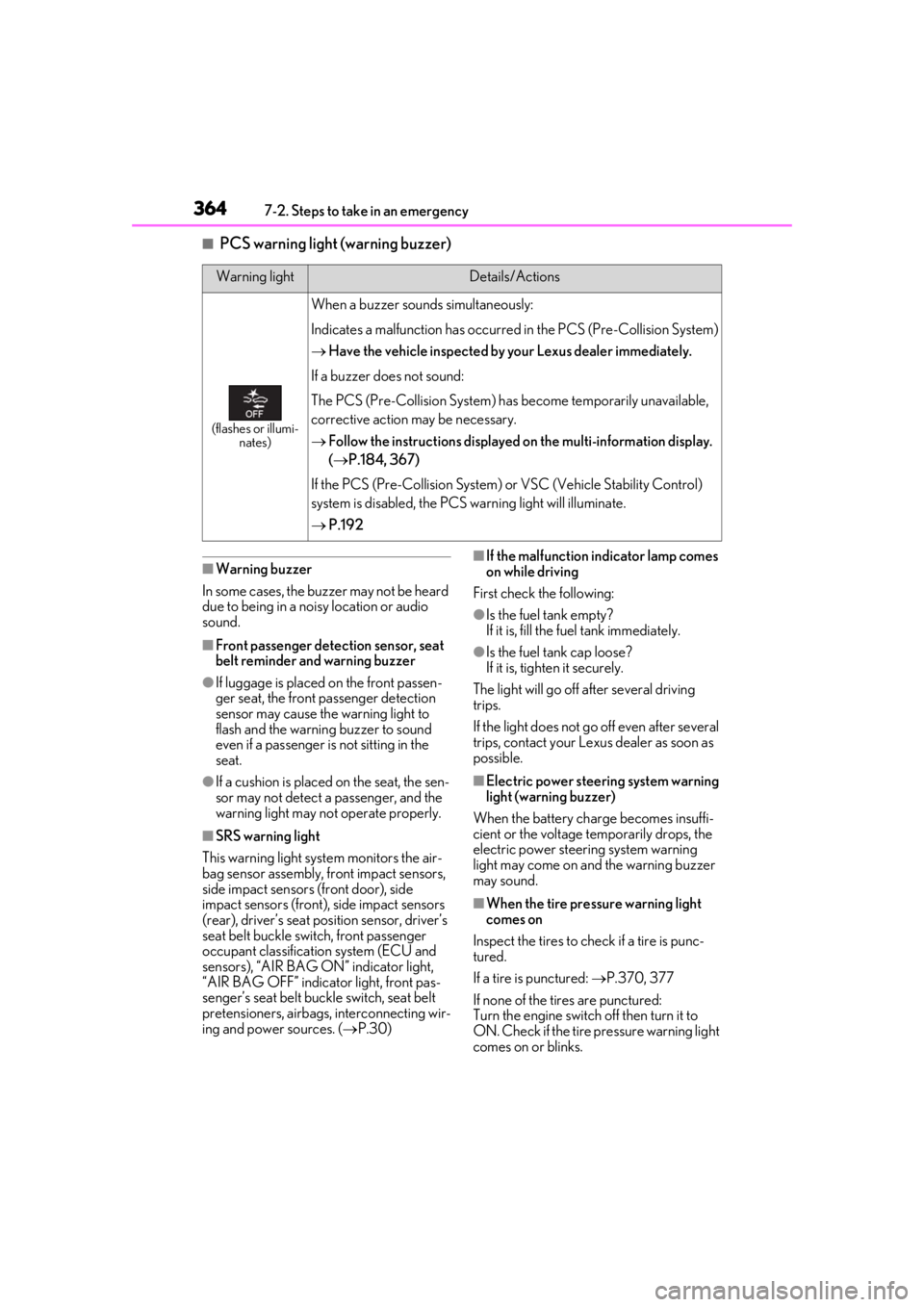
■PCS warning light (warning buzzer)
■Warning buzzer
In some cases, the bu zzer may not be heard
due to being in a noisy location or audio
sound.
■Front passenger detection sensor, seat
belt reminder and warning buzzer
●If luggage is placed on the front passen-
ger seat, the front passenger detection
sensor may cause th e warning light to
flash and the warning buzzer to sound
even if a passenger is not sitting in the
seat.
●If a cushion is placed on the seat, the sen-
sor may not detect a passenger, and the
warning light may not operate properly.
■SRS warning light
This warning light system monitors the air-
bag sensor assembly, fr ont impact sensors,
side impact sensors (front door), side
impact sensors (front), side impact sensors
(rear), driver’s seat position sensor, driver’s
seat belt buckle switch, front passenger
occupant classification system (ECU and
sensors), “AIR BAG ON” indicator light,
“AIR BAG OFF” indicator light, front pas-
senger’s seat belt buc kle switch, seat belt
pretensioners, airbags, interconnecting wir-
ing and power sources. ( P.30)
■If the malfunction indicator lamp comes
on while driving
First check the following:
●Is the fuel tank empty?
If it is, fill the fuel tank immediately.
●Is the fuel tank cap loose?
If it is, tighten it securely.
The light will go off after several driving
trips.
If the light does not go off even after several
trips, contact your Lexus dealer as soon as
possible.
■Electric power steering system warning
light (warning buzzer)
When the battery charge becomes insuffi-
cient or the voltage temporarily drops, the
electric power steering system warning
light may come on and the warning buzzer
may sound.
■When the tire pressure warning light
comes on
Inspect the tires to check if a tire is punc-
tured.
If a tire is punctured: P.370, 377
If none of the tires are punctured:
Turn the engine switch off then turn it to
ON. Check if the tire pressure warning light
comes on or blinks.
Warning lightDetails/Actions
(flashes or illumi- nates)
When a buzzer sounds simultaneously:
Indicates a malfunction has occurred in the PCS (Pre-Collision System)
Have the vehicle inspected by your Lexus dealer immediately.
If a buzzer does not sound:
The PCS (Pre-Collision System) has become temporarily unavailable,
corrective action may be necessary.
Follow the instructions displayed on the multi-information display.
( P.184, 367)
If the PCS (Pre-Collision System) or VSC (Vehicle Stability Control)
system is disabled, the PCS warning light will illuminate.
P.192
Page 375 of 452
3757-2. Steps to take in an emergency
7
When trouble arises
come off.
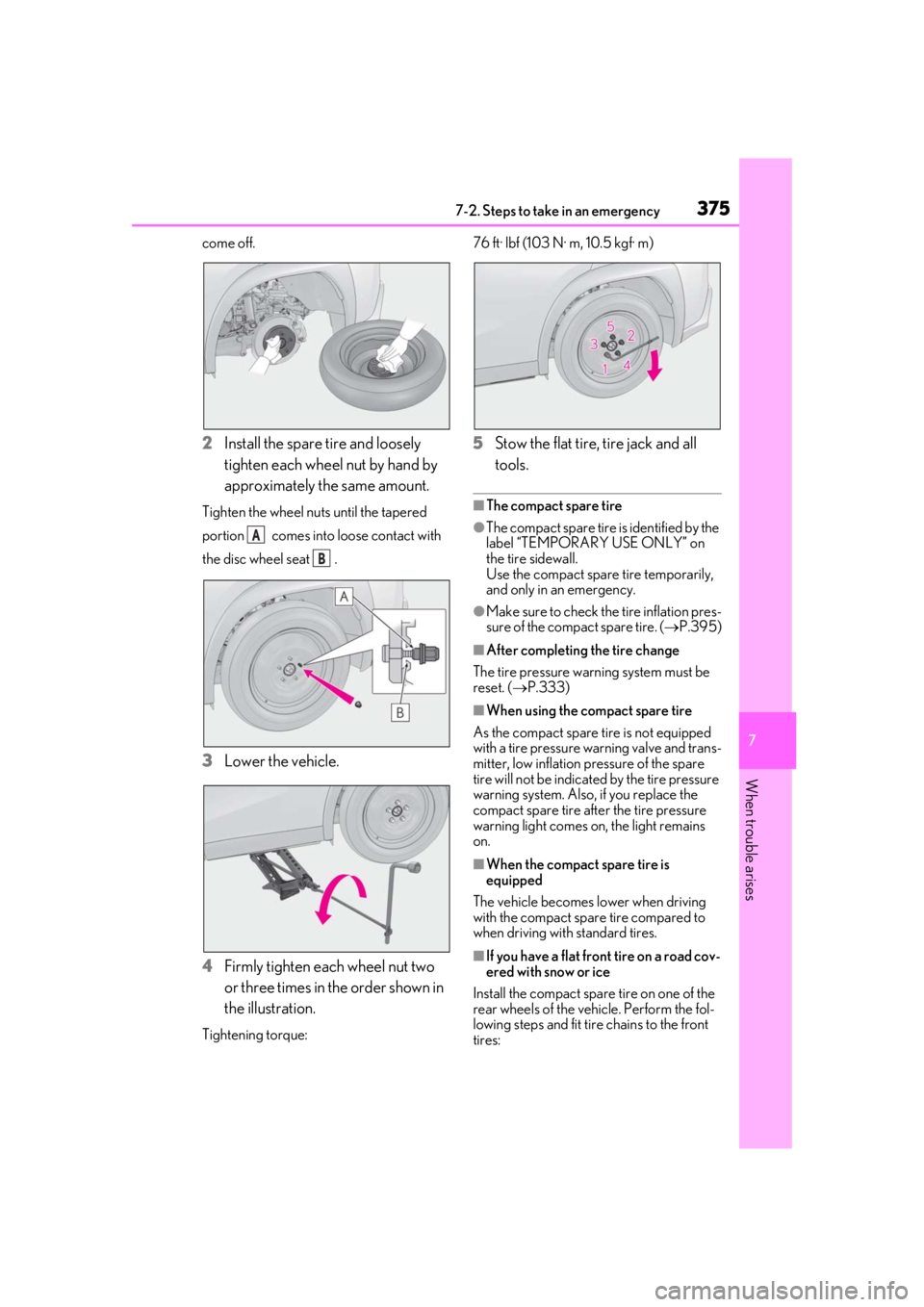
2Install the spare tire and loosely
tighten each wheel nut by hand by
approximately the same amount.
Tighten the wheel nuts until the tapered
portion comes into loose contact with
the disc wheel seat .
3Lower the vehicle.
4 Firmly tighten each wheel nut two
or three times in the order shown in
the illustration.
Tightening torque: 76 ft· lbf (103 N· m, 10.5 kgf· m)
5
Stow the flat tire, tire jack and all
tools.
■The compact spare tire
●The compact spare tire is identified by the
label “TEMPORARY USE ONLY” on
the tire sidewall.
Use the compact spar e tire temporarily,
and only in an emergency.
●Make sure to check the tire inflation pres-
sure of the compact spare tire. ( P.395)
■After completing the tire change
The tire pressure warn ing system must be
reset. ( P.333)
■When using the compact spare tire
As the compact spare tire is not equipped
with a tire pressure warning valve and trans-
mitter, low inflation pressure of the spare
tire will not be indicated by the tire pressure
warning system. Also, if you replace the
compact spare tire afte r the tire pressure
warning light comes on, the light remains
on.
■When the compact spare tire is
equipped
The vehicle becomes lower when driving
with the compact spare tire compared to
when driving with standard tires.
■If you have a flat front tire on a road cov-
ered with snow or ice
Install the compact spare tire on one of the
rear wheels of the vehicle. Perform the fol-
lowing steps and fit tire chains to the front
tires:
A
B
Page 391 of 452
3918-1. Specifications
8
Vehicle specifications
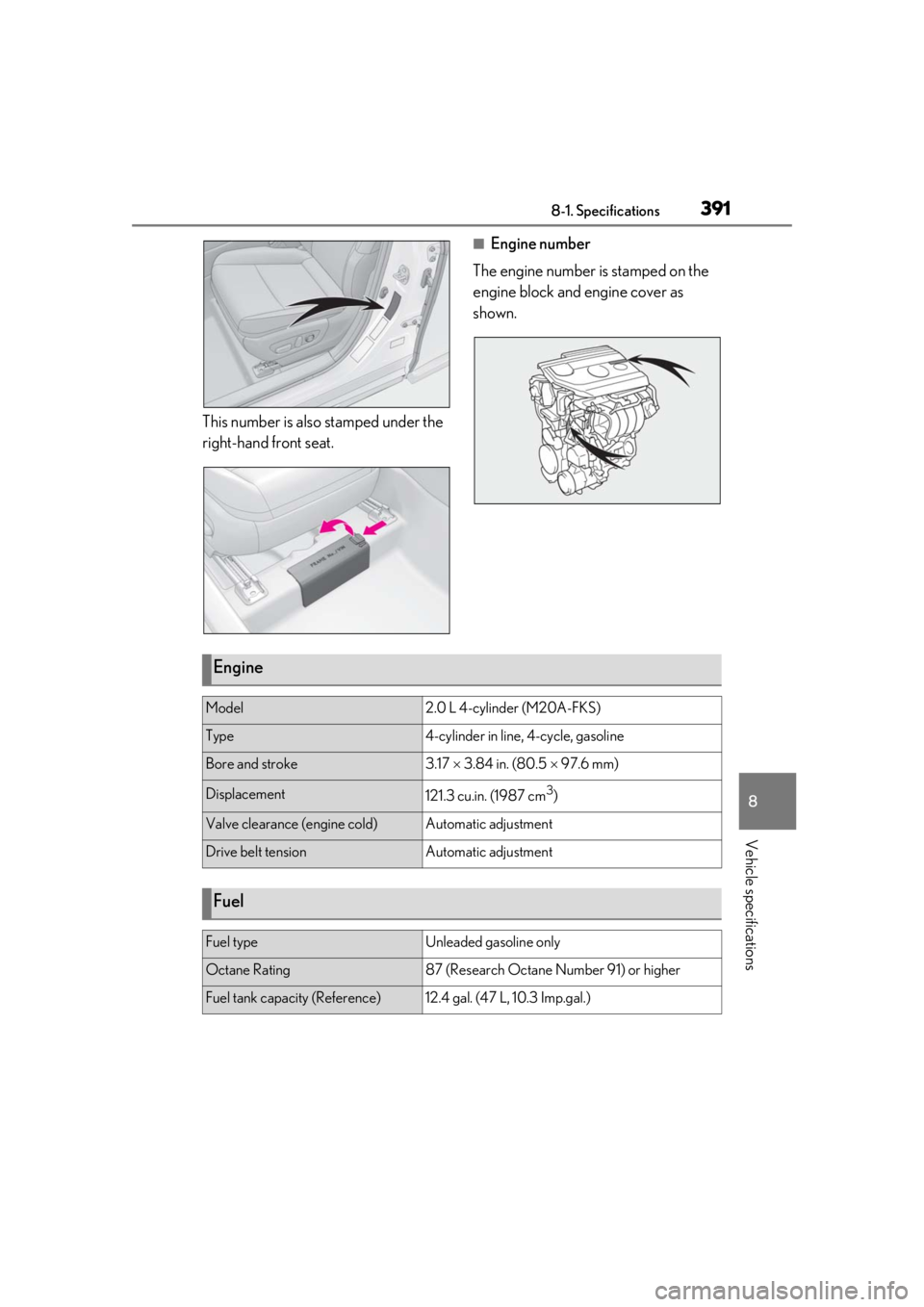
This number is also stamped under the
right-hand front seat.
■Engine number
The engine number is stamped on the
engine block and engine cover as
shown.
Engine
Model2.0 L 4-cylinder (M20A-FKS)
Type4-cylinder in line, 4-cycle, gasoline
Bore and stroke3.17 3.84 in. (80.5 97.6 mm)
Displacement121.3 cu.in. (1987 cm3)
Valve clearance (engine cold)Automatic adjustment
Drive belt tensionAutomatic adjustment
Fuel
Fuel typeUnleaded gasoline only
Octane Rating87 (Research Octane Number 91) or higher
Fuel tank capacity (Reference)12.4 gal. (47 L, 10.3 Imp.gal.)
Page 403 of 452
4038-1. Specifications
8
Vehicle specifications
■Traction AA, A, B, C
The traction grades, from highest to
lowest, are AA, A, B and C, and they
represent the tire’s ability to stop on
wet pavement as measured under con-
trolled conditions on specified govern-
ment test surfaces of asphalt and
concrete.
A tire marked C may have poor traction
performance.
Warning: The traction grade assigned to
this tire is based on braking (straight
ahead) traction tests and does not include
cornering (turning) traction.
■Temperature A, B, C
The temperature grades are A (the
highest), B, and C, representing the
tire’s resistance to the generation of
heat and its ability to dissipate heat when tested under controlled condi-
tions on a specified indoor laboratory
test wheel.
Sustained high temperature can cause the
material of the tire to degenerate and
reduce tire life, and excessive temperature
can lead to sudd
en tire failure.
Grade C corresponds to a level of perfor-
mance which all passenger car tires must
meet under the Fede ral Motor Vehicle
Safety Standard No. 109.
Grades B and A represent higher levels of
performance on the laboratory test wheel
than the minimum required by law.
Warning: The temperature grades for this
tire are established for a tire that is prop-
erly inflated and not overloaded.
Excessive speed, unde rinflation, or exces-
sive loading, either separately or in combi-
nation, can cause heat buildup and
possible tire failure.
Glossary of tire terminology
Tire related termMeaning
Cold tire inflation pressure
Tire pressure when the vehicle has been parked for three
hours or more, or has not been driven more than 1 mile or
1.5 km under that condition
Maximum inflation pressureThe maximum cold inflated pressure to which a tire may
be inflated, shown on the sidewall of the tire
Recommended inflation pres-
sureCold tire inflation pressure recommended by a manufac-
turer
Accessory weight
The combined weight (in excess of those standard items
which may be replaced) of automatic transmission, power
steering, power brakes, powe r windows, power seats,
radio and heater, to the extent that these items are avail-
able as factory-installed equi pment (whether installed or
not)
Page 404 of 452
4048-1. Specifications
Curb weight
The weight of a motor vehicle with standard equipment,
including the maximum capacity of fuel, oil and coolant,
and if so equipped, air conditioning and additional weight
optional engine
Maximum loaded vehicle
weight
The sum of:
(a) Curb weight
(b) Accessory weight
(c) Vehicle capacity weight
(d) Production options weight
Normal occupant weight150 lb. (68 kg) times the number of occupants specified in
the second column of Table 1
* that follows
Occupant distributionDistribution of occupants in a vehicle as specified in the
third column of Table 1
* below
Production options weight
The combined weight of in stalled regular production
options weighing over 5 lb. (2.3 kg) in excess of the stan-
dard items which they replace, not previously considered
in curb weight or accessory weight, including heavy duty
brakes, ride levelers, roof rack, heavy duty battery, and
special trim
RimA metal support for a tire or a tire and tube assembly upon
which the tire beads are seated
Rim diameter
(Wheel diameter)Nominal diameter of the bead seat
Rim size designationRim diameter and width
Rim type designationThe industry manufacturer’s designation for a rim by style
or code
Rim widthNominal distance between rim flanges
Vehicle capacity weight
(Total load capacity)The rated cargo and luggage load plus 150 lb. (68 kg)
times the vehicle’s desi gnated seating capacity
Vehicle maximum load on the
tireThe load on an individual tire that is determined by distrib-
uting to each axle its share of the maximum loaded vehicle
weight, and dividing by two
Vehicle normal load on the tire
The load on an individual tire that is determined by distrib-
uting to each axle its shar e of curb weight, accessory
weight, and normal occupant we ight (distributed in accor-
dance with Table 1
* below), and dividing by two
Tire related termMeaning
Page 407 of 452
4078-1. Specifications
8
Vehicle specifications
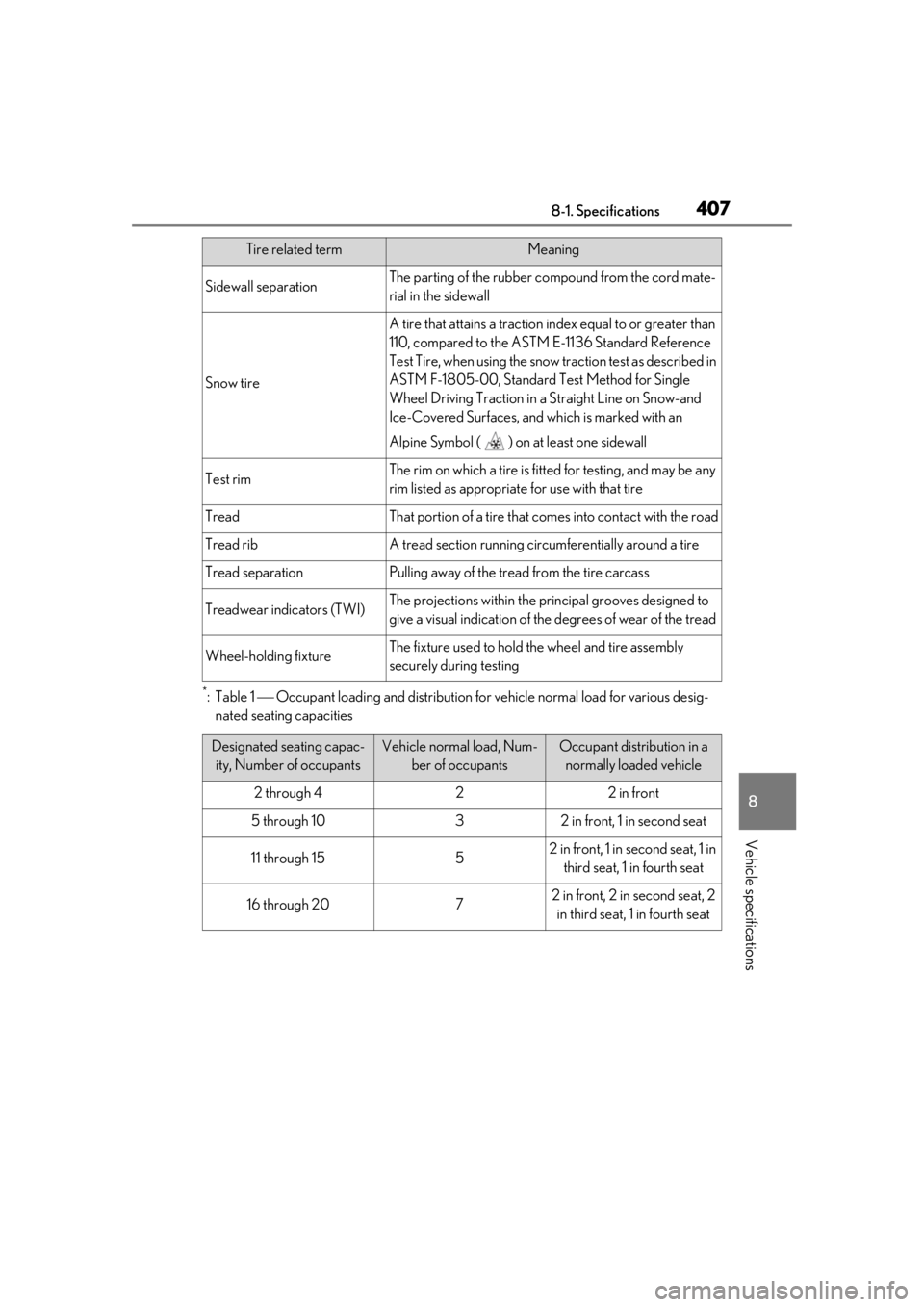
*:Table 1 Occupant loading and distribution for vehicle normal load for various desig-
nated seating capacities
Sidewall separationThe parting of the rubber co mpound from the cord mate-
rial in the sidewall
Snow tire
A tire that attains a traction index equal to or greater than
110, compared to the ASTM E-1136 Standard Reference
Test Tire, when using the snow traction test as described in
ASTM F-1805-00, Standard Test Method for Single
Wheel Driving Traction in a Straight Line on Snow-and
Ice-Covered Surfaces, and wh ich is marked with an
Alpine Symbol ( ) on at least one sidewall
Test rimThe rim on which a tire is fitt ed for testing, and may be any
rim listed as appropriate for use with that tire
TreadThat portion of a tire that comes into contact with the road
Tread ribA tread section running circ umferentially around a tire
Tread separationPulling away of the tread from the tire carcass
Treadwear indicators (TWI)The projections within the pr incipal grooves designed to
give a visual indication of th e degrees of wear of the tread
Wheel-holding fixtureThe fixture used to hold the wheel and tire assembly
securely during testing
Designated seating capac-
ity, Number of occupantsVehicle normal load, Num- ber of occupantsOccupant distribution in a normally loaded vehicle
2 through 422 in front
5 through 1032 in front, 1 in second seat
11 through 1552 in front, 1 in second seat, 1 in third seat, 1 in fourth seat
16 through 2072 in front, 2 in second seat, 2 in third seat, 1 in fourth seat
Tire related termMeaning
Page 413 of 452
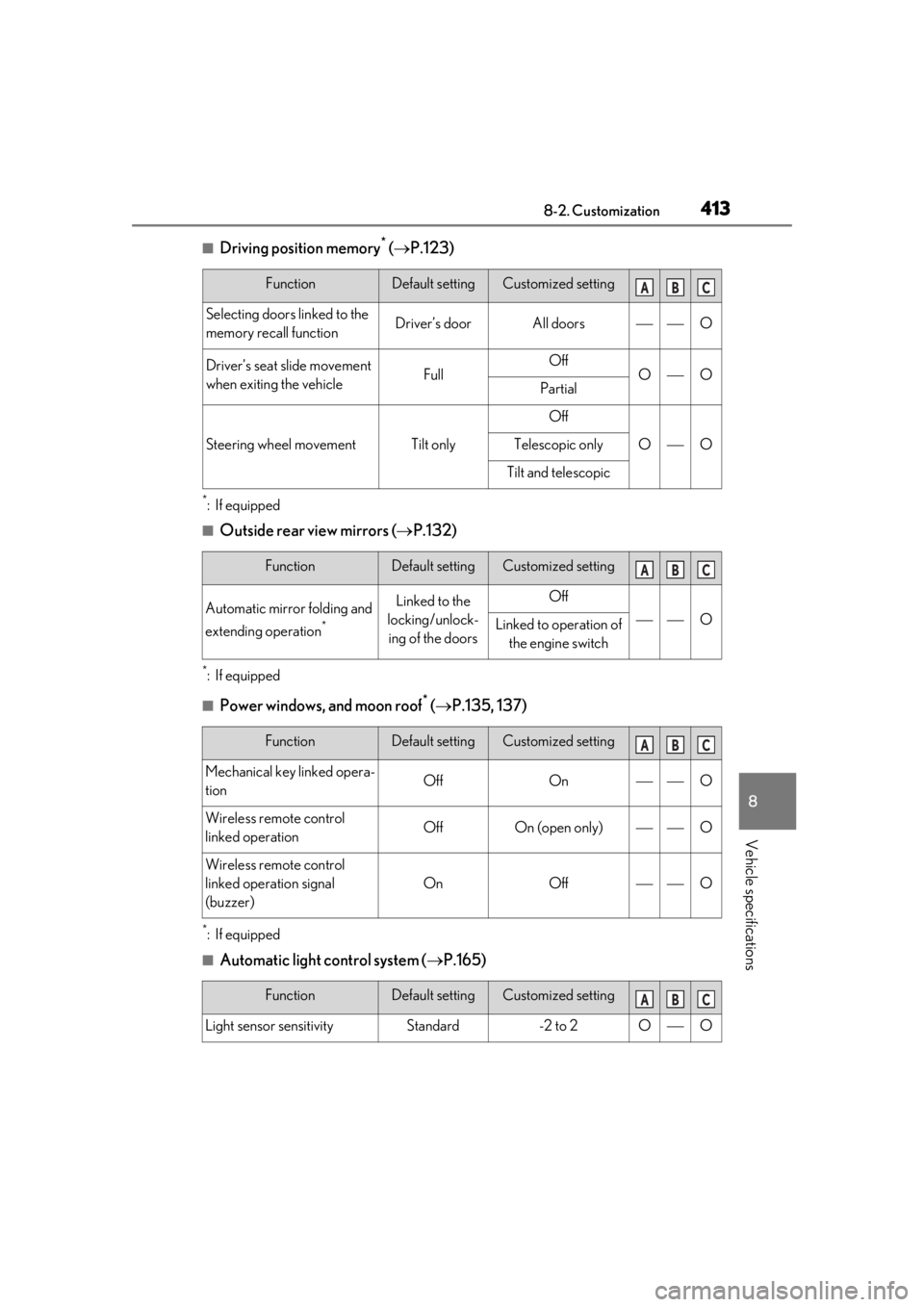
4138-2. Customization
8
Vehicle specifications
■Driving position memory* ( P.123)
*:If equipped
■Outside rear view mirrors ( P.132)
*:If equipped
■Power windows, and moon roof* ( P.135, 137)
*:If equipped
■Automatic light control system ( P.165)
FunctionDefault settingCustomized setting
Selecting doors linked to the
memory recall functionDriver’s doorAll doorsO
Driver’s seat slide movement
when exiting the vehicleFullOffOOPartial
Steering wheel movementTilt only
Off
OOTelescopic only
Tilt and telescopic
FunctionDefault settingCustomized setting
Automatic mirror folding and
extending operation
*
Linked to the
locking/unlock- ing of the doorsOff
OLinked to operation of the engine switch
FunctionDefault settingCustomized setting
Mechanical key linked opera-
tionOffOnO
Wireless remote control
linked operationOffOn (open only)O
Wireless remote control
linked operation signal
(buzzer)
OnOffO
FunctionDefault settingCustomized setting
Light sensor sensitivityStandard-2 to 2OO
ABC
ABC
ABC
ABC
Page 417 of 452
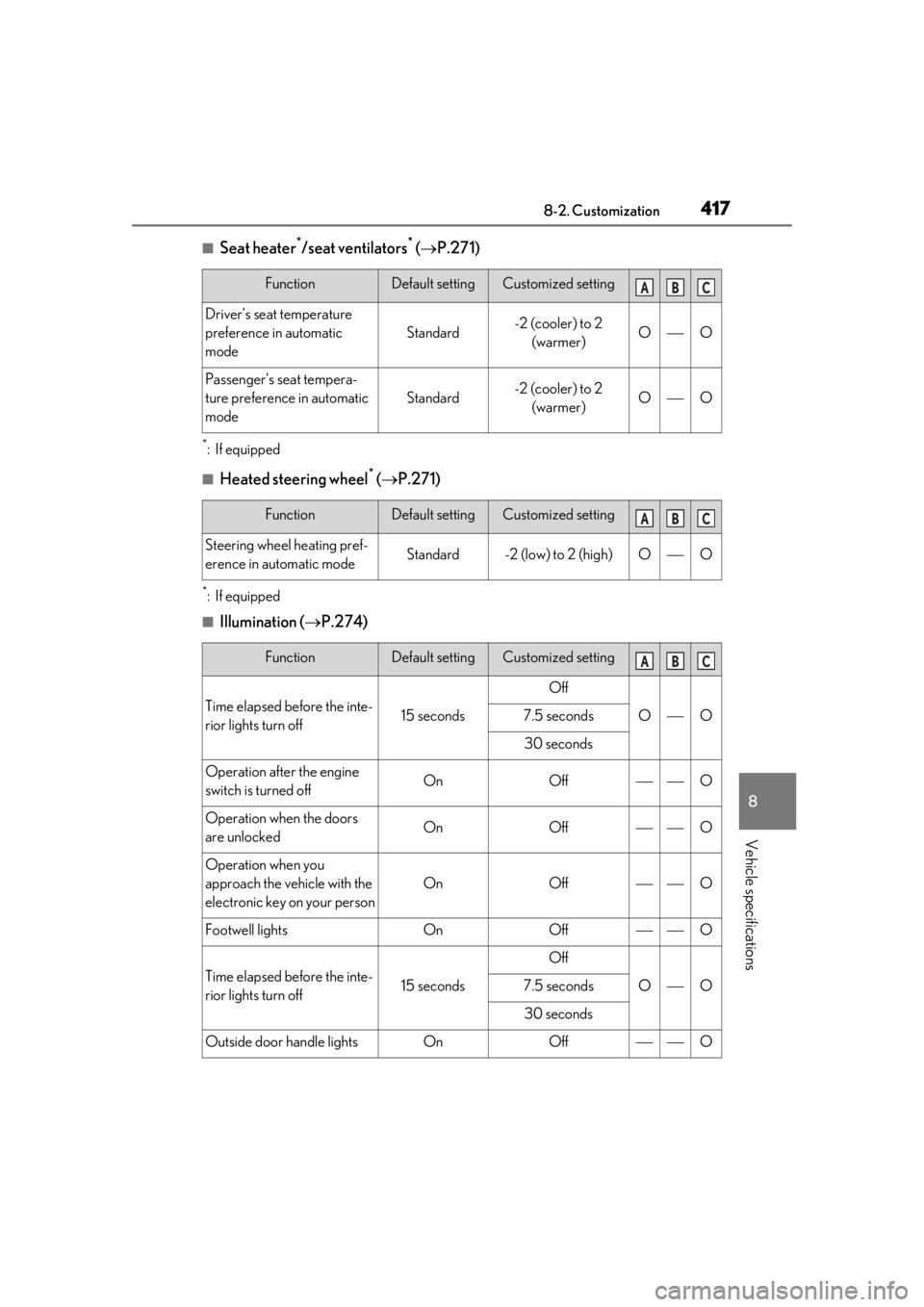
4178-2. Customization
8
Vehicle specifications
■Seat heater*/seat ventilators* ( P.271)
*:If equipped
■Heated steering wheel* ( P.271)
*:If equipped
■Illumination ( P.274)
FunctionDefault settingCustomized setting
Driver’s seat temperature
preference in automatic
mode
Standard-2 (cooler) to 2
(warmer)OO
Passenger’s seat tempera-
ture preference in automatic
mode
Standard-2 (cooler) to 2 (warmer)OO
FunctionDefault settingCustomized setting
Steering wheel heating pref-
erence in automatic modeStandard-2 (low) to 2 (high)OO
FunctionDefault settingCustomized setting
Time elapsed before the inte-
rior lights turn off15 seconds
Off
OO7.5 seconds
30 seconds
Operation after the engine
switch is turned offOnOffO
Operation when the doors
are unlockedOnOffO
Operation when you
approach the vehicle with the
electronic key on your person
OnOffO
Footwell lightsOnOffO
Time elapsed before the inte-
rior lights turn off15 seconds
Off
OO7.5 seconds
30 seconds
Outside door handle lightsOnOffO
ABC
ABC
ABC