seat LEXUS UX250H 2019 Owner's Guide
[x] Cancel search | Manufacturer: LEXUS, Model Year: 2019, Model line: UX250H, Model: LEXUS UX250H 2019Pages: 476, PDF Size: 10.51 MB
Page 47 of 476
471-2. Child safety
1
For safety and security
■When installing a child restraint
system to the front passenger seat
For the safety of a child, install child
restraint systems to a rear seats. When
installing child restraint system to the
front passenger seat is unavoidable,
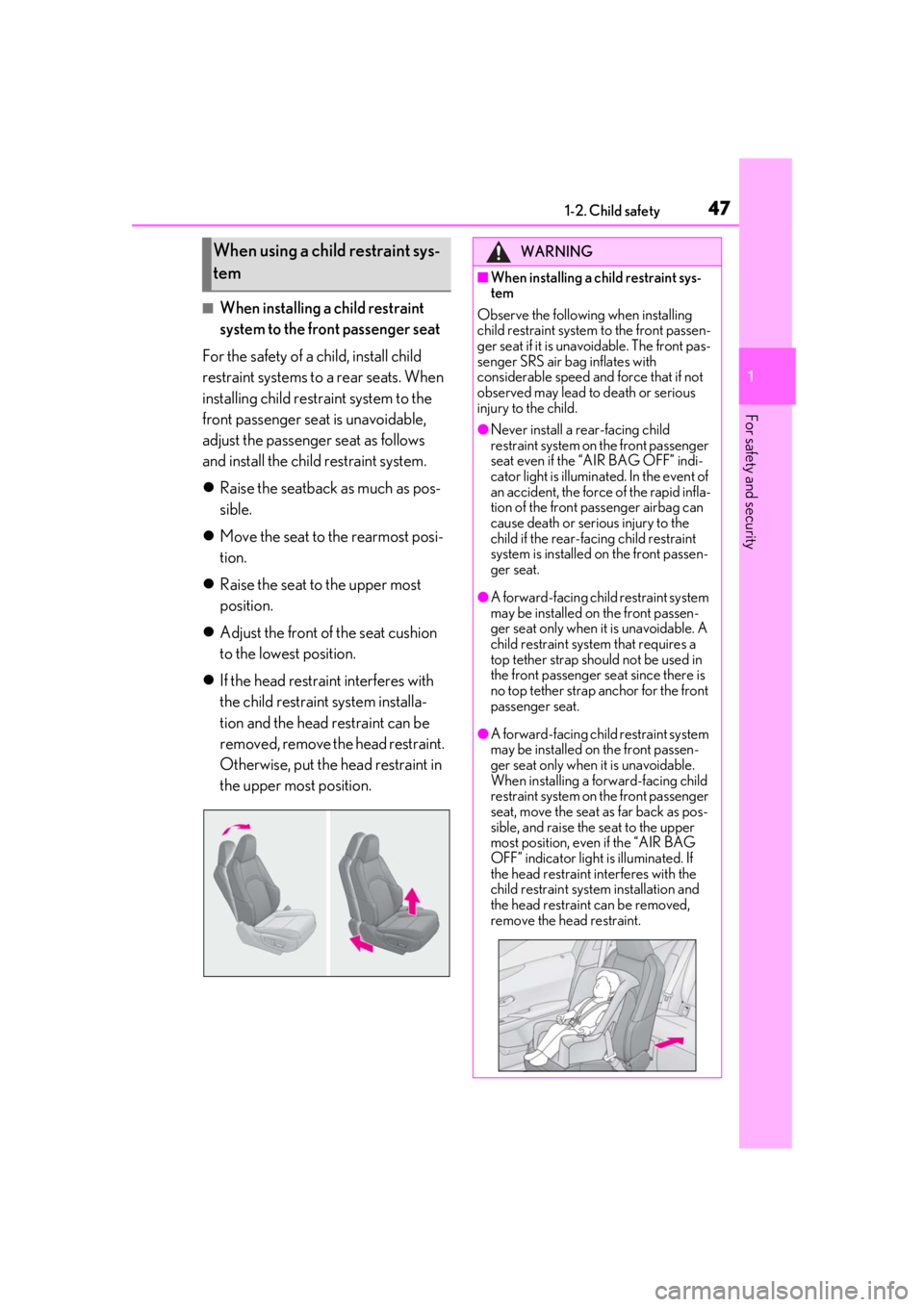
adjust the passenger seat as follows
and install the child restraint system.
Raise the seatback as much as pos-
sible.
Move the seat to the rearmost posi-
tion.
Raise the seat to the upper most
position.
Adjust the front of the seat cushion
to the lowest position.
If the head restraint interferes with
the child restraint system installa-
tion and the head restraint can be
removed, remove the head restraint.
Otherwise, put the head restraint in
the upper most position.
When using a child restraint sys-
temWARNING
■When installing a child restraint sys-
tem
Observe the following when installing
child restraint system to the front passen-
ger seat if it is unavoidable. The front pas-
senger SRS air bag inflates with
considerable speed and force that if not
observed may lead to death or serious
injury to the child.
●Never install a rear-facing child
restraint system on the front passenger
seat even if the “AIR BAG OFF” indi-
cator light is illuminated. In the event of
an accident, the force of the rapid infla-
tion of the front passenger airbag can
cause death or serious injury to the
child if the rear-facing child restraint
system is installed on the front passen-
ger seat.
●A forward-facing child restraint system
may be installed on the front passen-
ger seat only when it is unavoidable. A
child restraint system that requires a
top tether strap should not be used in
the front passenger seat since there is
no top tether strap anchor for the front
passenger seat.
●A forward-facing child restraint system
may be installed on the front passen-
ger seat only when it is unavoidable.
When installing a forward-facing child
restraint system on the front passenger
seat, move the seat as far back as pos-
sible, and raise the seat to the upper
most position, even if the “AIR BAG
OFF” indicator light is illuminated. If
the head restraint interferes with the
child restraint system installation and
the head restraint can be removed,
remove the head restraint.
Page 48 of 476
481-2. Child safety
A child restraint system for a small
child or baby must itself be properly
restrained on the seat with the lap por-
tion of the lap/shoulder belt.
■Installing child restraint system
using a seat belt (child restraint
lock function belt)
Install the child restraint system in
accordance to the operation manual
enclosed with the child restraint sys-
tem.
■Rear-facing Infant seat/con-
vertible seat
1
Adjust the seatback
If there is a gap between the child seat and
the seatback, adjust the seatback until
good contact is achieved.
WARNING
●Do not allow the child to lean his/her
head or any part of his/her body
against the door or the area of the seat,
front pillars or roof side rails from
which the SRS side airbags or SRS
curtain shield airbags deploy even if
the child is seated in the child restraint
system. It is dangerous if the SRS side
and curtain shield airbags inflate, and
the impact could cause death or seri-
ous injury to the child.
●When a booster seat is installed,
always ensure that th e shoulder belt is
positioned across the center of the
child’s shoulder. The belt should be
kept away from the child’s neck, but
not so that it could fall off the child’s
shoulder.
When using a child restraint sys-
tem on a rear seat
WARNING
■When installing a child restraint sys-
tem
Observe the following precautions. Fail-
ure to do so may result in death or seri-
ous injury.
●Use child restraint system suitable to
the age and size of the child and install
it to the rear seat.
●If the driver’s seat interferes with the
child restraint system and prevents it
from being attached correctly, attach
the child restraint system to the right-
hand rear seat.
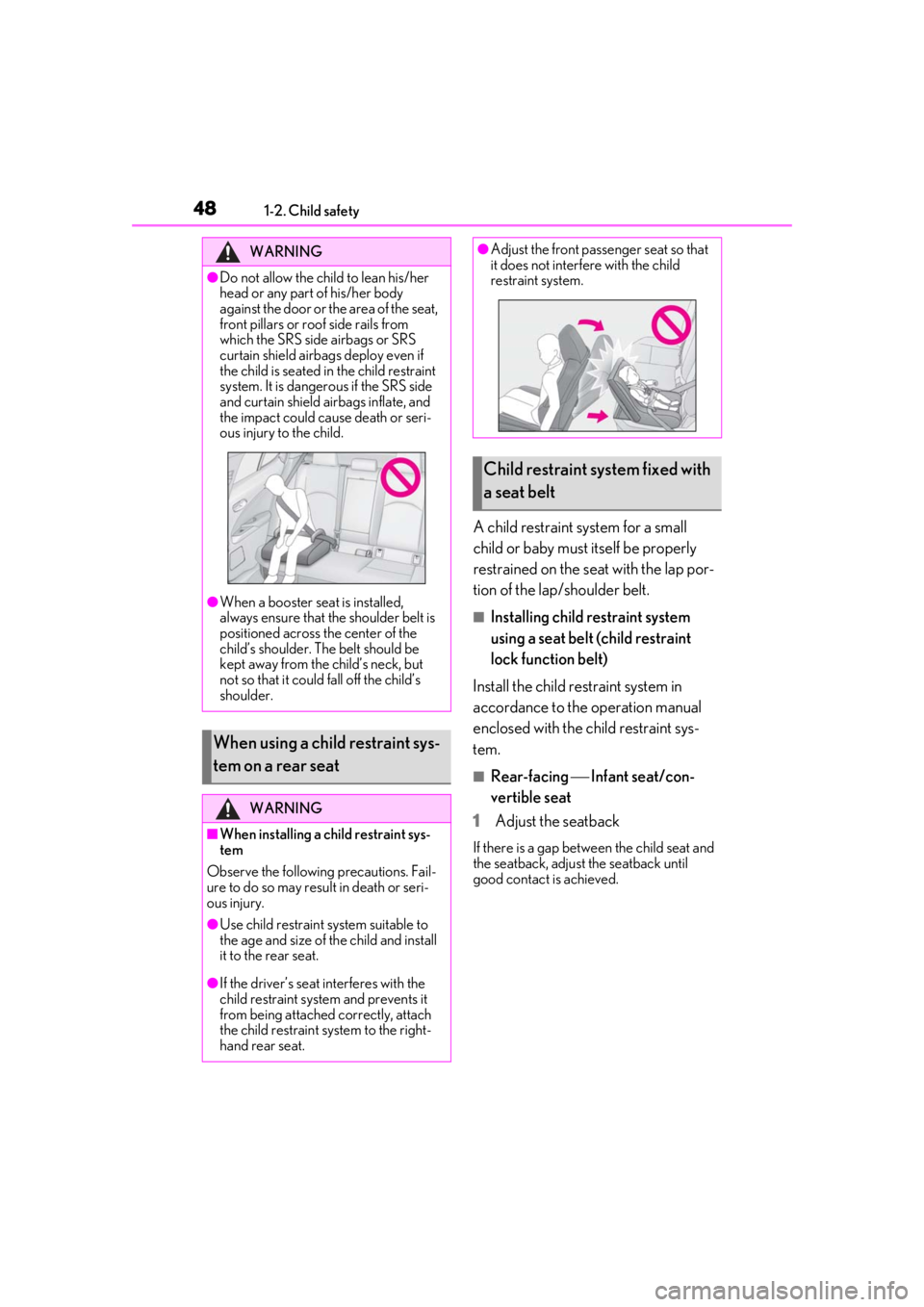
●Adjust the front passe nger seat so that
it does not interfere with the child
restraint system.
Child restraint system fixed with
a seat belt
Page 49 of 476
491-2. Child safety
1
For safety and security
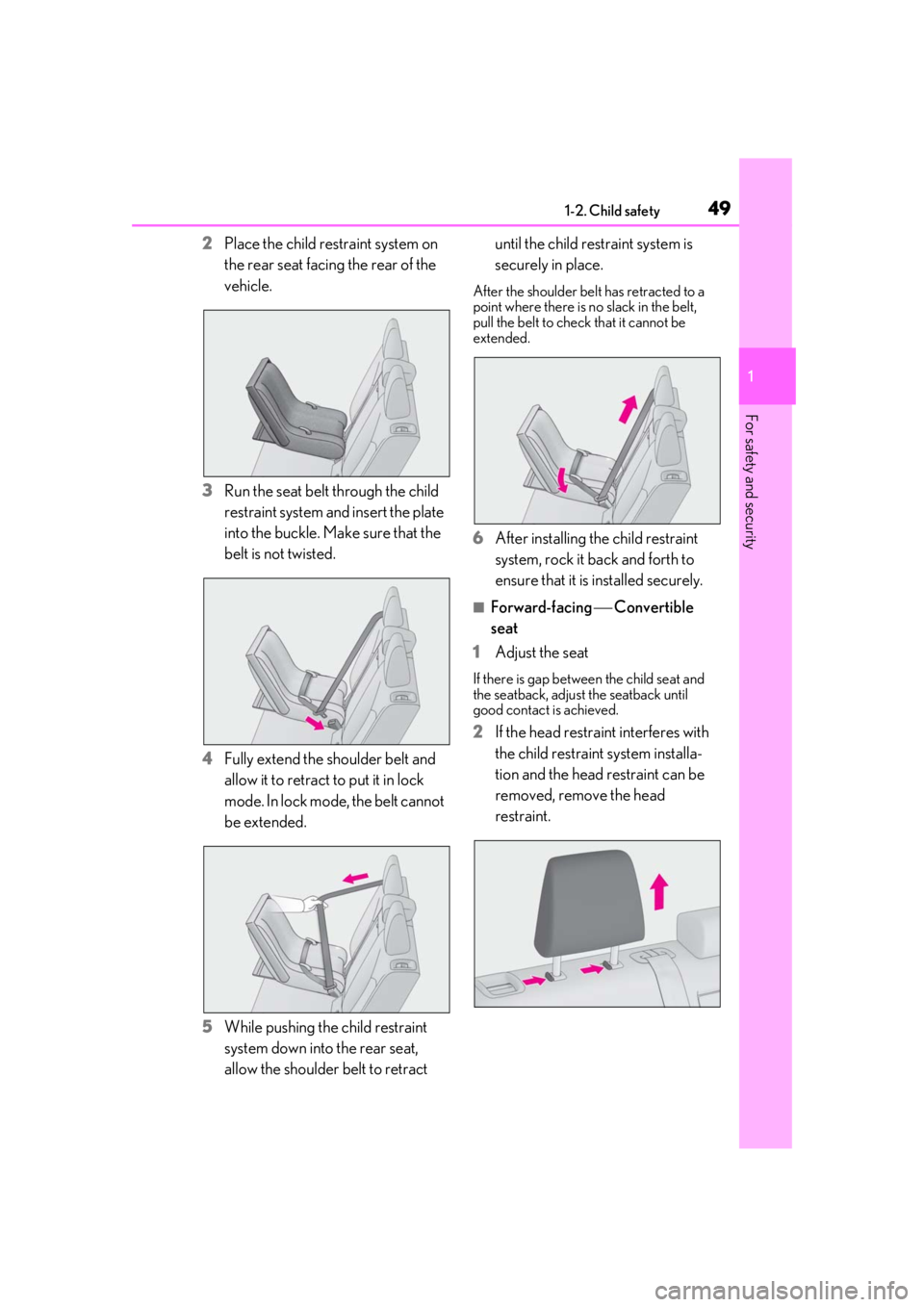
2Place the child restraint system on
the rear seat facing the rear of the
vehicle.
3 Run the seat belt through the child
restraint system and insert the plate
into the buckle. Make sure that the
belt is not twisted.
4 Fully extend the shoulder belt and
allow it to retract to put it in lock
mode. In lock mode, the belt cannot
be extended.
5 While pushing the child restraint
system down into the rear seat,
allow the shoulder belt to retract until the child restraint system is
securely in place.
After the shoulder belt has retracted to a
point where there is no slack in the belt,
pull the belt to check that it cannot be
extended.
6
After installing the child restraint
system, rock it back and forth to
ensure that it is installed securely.
■Forward-facing Convertible
seat
1 Adjust the seat
If there is gap between the child seat and
the seatback, adjust the seatback until
good contact is achieved.
2If the head restraint interferes with
the child restraint system installa-
tion and the head restraint can be
removed, remove the head
restraint.
Page 50 of 476
501-2. Child safety
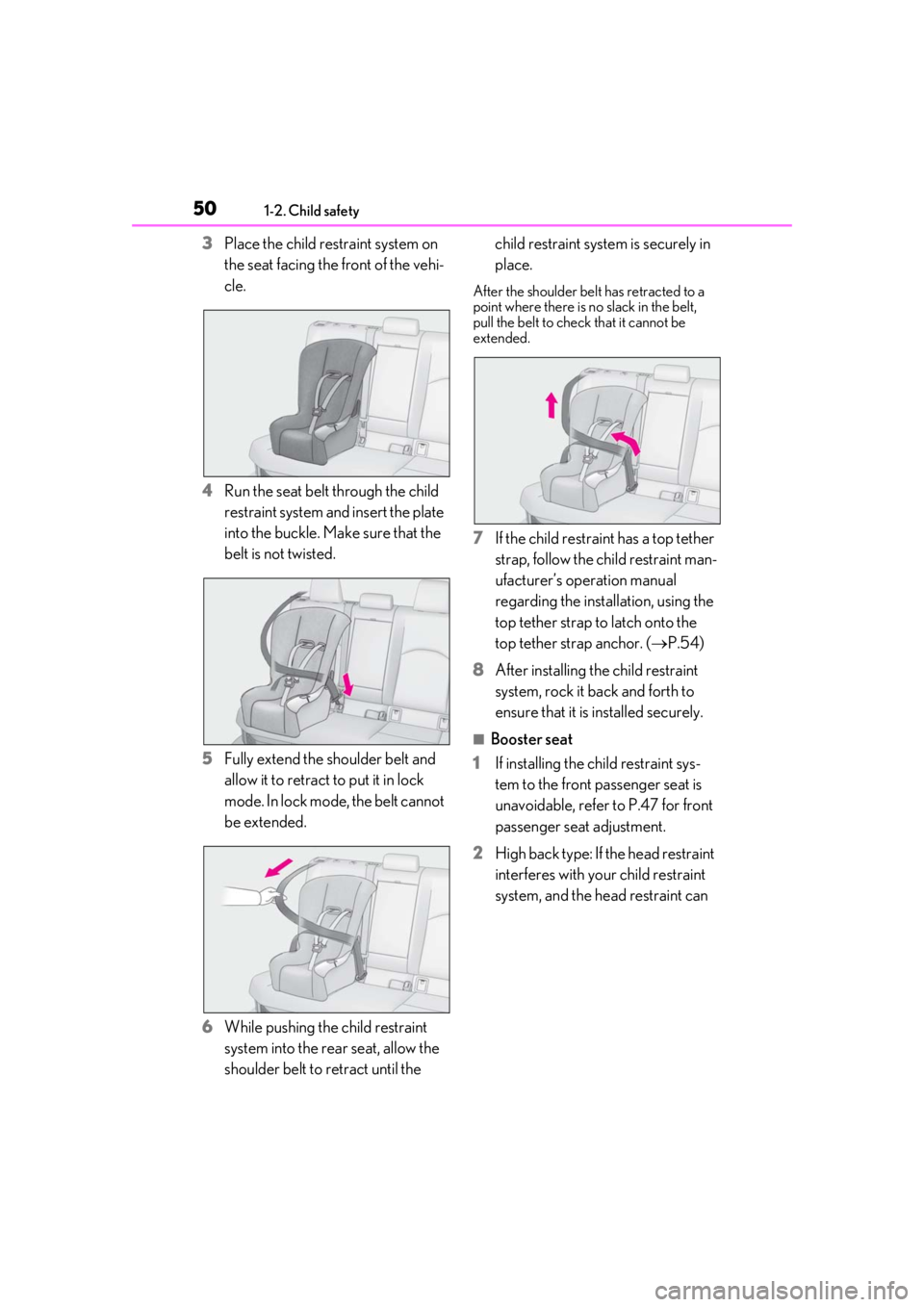
3Place the child restraint system on
the seat facing the front of the vehi-
cle.
4 Run the seat belt through the child
restraint system and insert the plate
into the buckle. Make sure that the
belt is not twisted.
5 Fully extend the shoulder belt and
allow it to retract to put it in lock
mode. In lock mode, the belt cannot
be extended.
6 While pushing the child restraint
system into the rear seat, allow the
shoulder belt to retract until the child restraint system is securely in
place.
After the shoulder belt has retracted to a
point where there is no slack in the belt,
pull the belt to check that it cannot be
extended.
7
If the child restraint has a top tether
strap, follow the child restraint man-
ufacturer’s operation manual
regarding the installation, using the
top tether strap to latch onto the
top tether strap anchor. ( P.54)
8 After installing the child restraint
system, rock it back and forth to
ensure that it is installed securely.
■Booster seat
1 If installing the child restraint sys-
tem to the front passenger seat is
unavoidable, refer to P.47 for front
passenger seat adjustment.
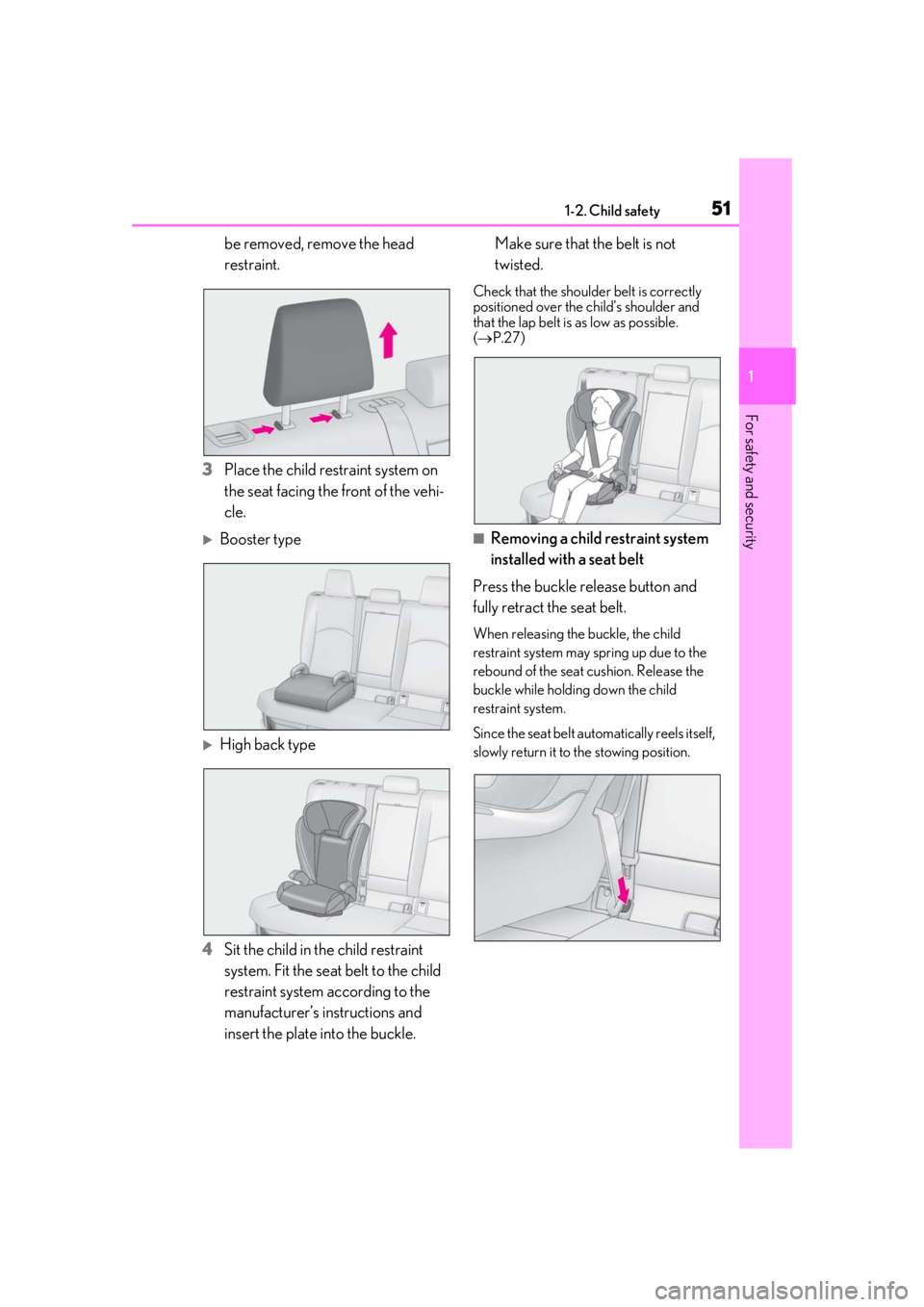
2 High back type: If the head restraint
interferes with your child restraint
system, and the head restraint can
Page 51 of 476
511-2. Child safety
1
For safety and security
be removed, remove the head
restraint.
3 Place the child restraint system on
the seat facing the front of the vehi-
cle.
Booster type
High back type
4 Sit the child in the child restraint
system. Fit the seat belt to the child
restraint system according to the
manufacturer’s in structions and
insert the plate into the buckle. Make sure that the belt is not
twisted.
Check that the shoulder
belt is correctly
positioned over the child’s shoulder and
that the lap belt is as low as possible.
( P.27)
■Removing a child restraint system
installed with a seat belt
Press the buckle release button and
fully retract the seat belt.
When releasing the buckle, the child
restraint system may sp ring up due to the
rebound of the seat cushion. Release the
buckle while holding down the child
restraint system.
Since the seat belt auto matically reels itself,
slowly return it to the stowing position.
Page 52 of 476
521-2. Child safety
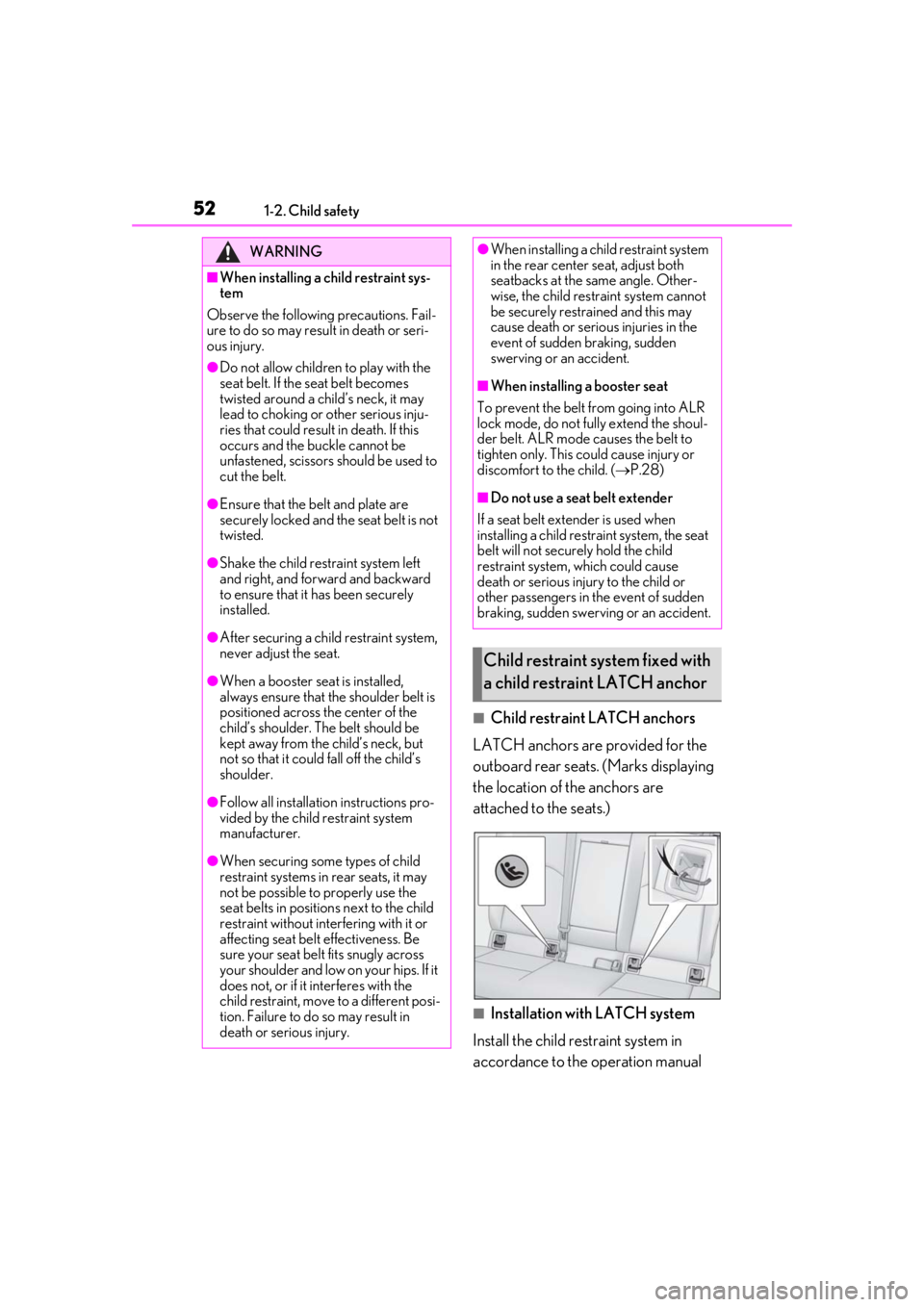
■Child restraint LATCH anchors
LATCH anchors are provided for the
outboard rear seats. (Marks displaying
the location of the anchors are
attached to the seats.)
■Installation with LATCH system
Install the child restraint system in
accordance to the operation manual
WARNING
■When installing a child restraint sys-
tem
Observe the following precautions. Fail-
ure to do so may result in death or seri-
ous injury.
●Do not allow children to play with the
seat belt. If the seat belt becomes
twisted around a child’s neck, it may
lead to choking or other serious inju-
ries that could result in death. If this
occurs and the buckle cannot be
unfastened, scissors should be used to
cut the belt.
●Ensure that the belt and plate are
securely locked and the seat belt is not
twisted.
●Shake the child restraint system left
and right, and forward and backward
to ensure that it has been securely
installed.
●After securing a child restraint system,
never adjust the seat.
●When a booster seat is installed,
always ensure that th e shoulder belt is
positioned across the center of the
child’s shoulder. The belt should be
kept away from the child’s neck, but
not so that it could fall off the child’s
shoulder.
●Follow all installation instructions pro-
vided by the child restraint system
manufacturer.
●When securing some types of child
restraint systems in rear seats, it may
not be possible to properly use the
seat belts in positions next to the child
restraint without inte rfering with it or
affecting seat belt effectiveness. Be
sure your seat belt fits snugly across
your shoulder and low on your hips. If it
does not, or if it interferes with the
child restraint, move to a different posi-
tion. Failure to do so may result in
death or serious injury.
●When installing a child restraint system
in the rear center seat, adjust both
seatbacks at the same angle. Other-
wise, the child restraint system cannot
be securely restrained and this may
cause death or serious injuries in the
event of sudden braking, sudden
swerving or an accident.
■When installing a booster seat
To prevent the belt from going into ALR
lock mode, do not fully extend the shoul-
der belt. ALR mode causes the belt to
tighten only. This could cause injury or
discomfort to the child. ( P.28)
■Do not use a seat belt extender
If a seat belt extender is used when
installing a child restra int system, the seat
belt will not securely hold the child
restraint system, which could cause
death or serious injury to the child or
other passengers in the event of sudden
braking, sudden swerving or an accident.
Child restraint system fixed with
a child restraint LATCH anchor
Page 53 of 476
531-2. Child safety
1
For safety and security
enclosed with the child restraint sys-
tem.
1Adjust the seat
If there is a gap between the child seat and
the seatback, adjust the seatback until
good contact is achieved.
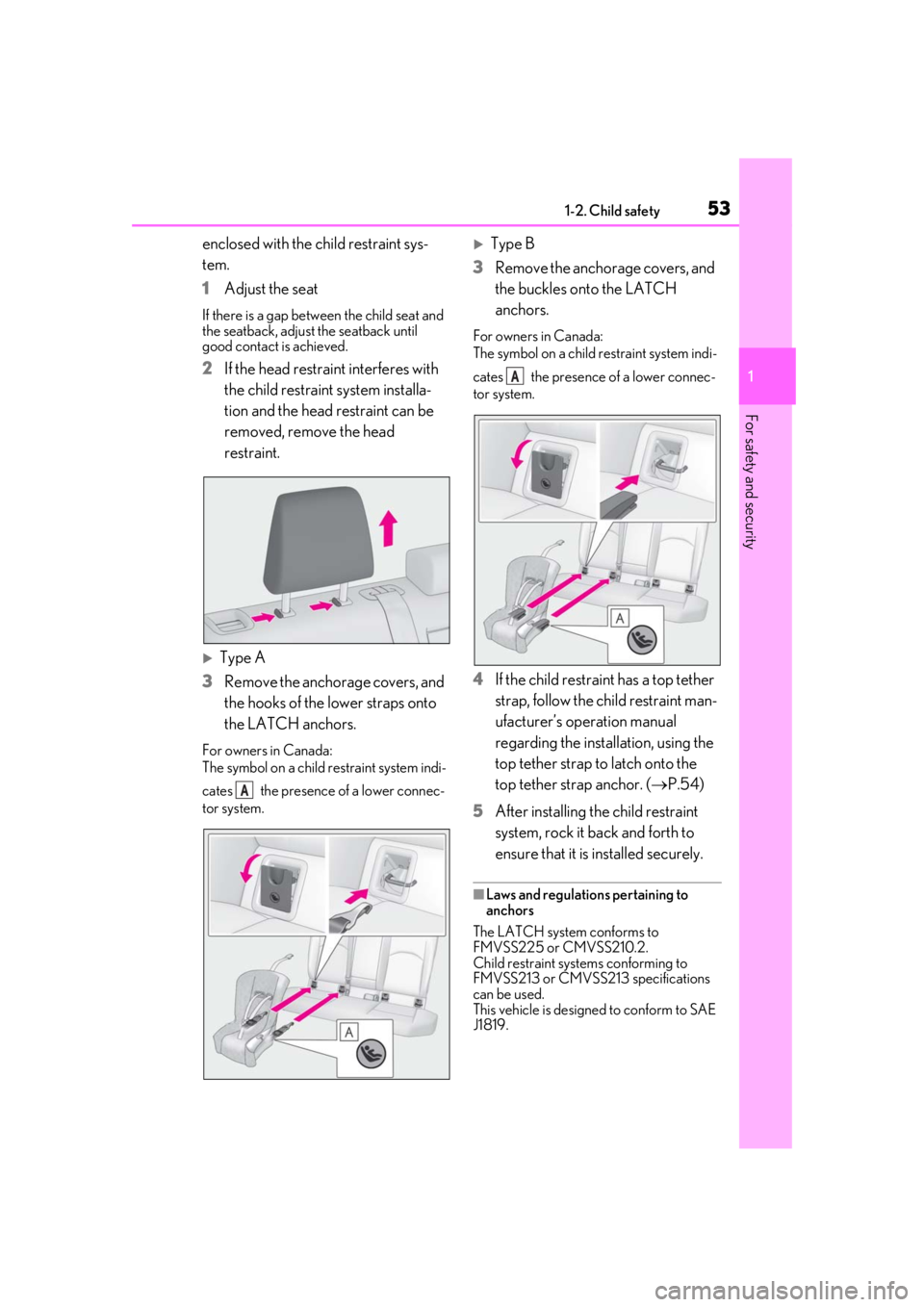
2If the head restraint interferes with
the child restraint system installa-
tion and the head restraint can be
removed, remove the head
restraint.
Type A
3 Remove the anchorage covers, and
the hooks of the lower straps onto
the LATCH anchors.
For owners in Canada:
The symbol on a child restraint system indi-
cates the presence of a lower connec-
tor system.
Type B
3 Remove the anchorage covers, and
the buckles onto the LATCH
anchors.
For owners in Canada:
The symbol on a child restraint system indi-
cates the presence of a lower connec-
tor system.
4If the child restraint has a top tether
strap, follow the child restraint man-
ufacturer’s operation manual
regarding the installation, using the
top tether strap to latch onto the
top tether strap anchor. ( P.54)
5 After installing the child restraint
system, rock it back and forth to
ensure that it is installed securely.
■Laws and regulations pertaining to
anchors
The LATCH system conforms to
FMVSS225 or CMVSS210.2.
Child restraint systems conforming to
FMVSS213 or CMVSS213 specifications
can be used.
This vehicle is designed to conform to SAE
J1819.
A
A
Page 54 of 476
541-2. Child safety
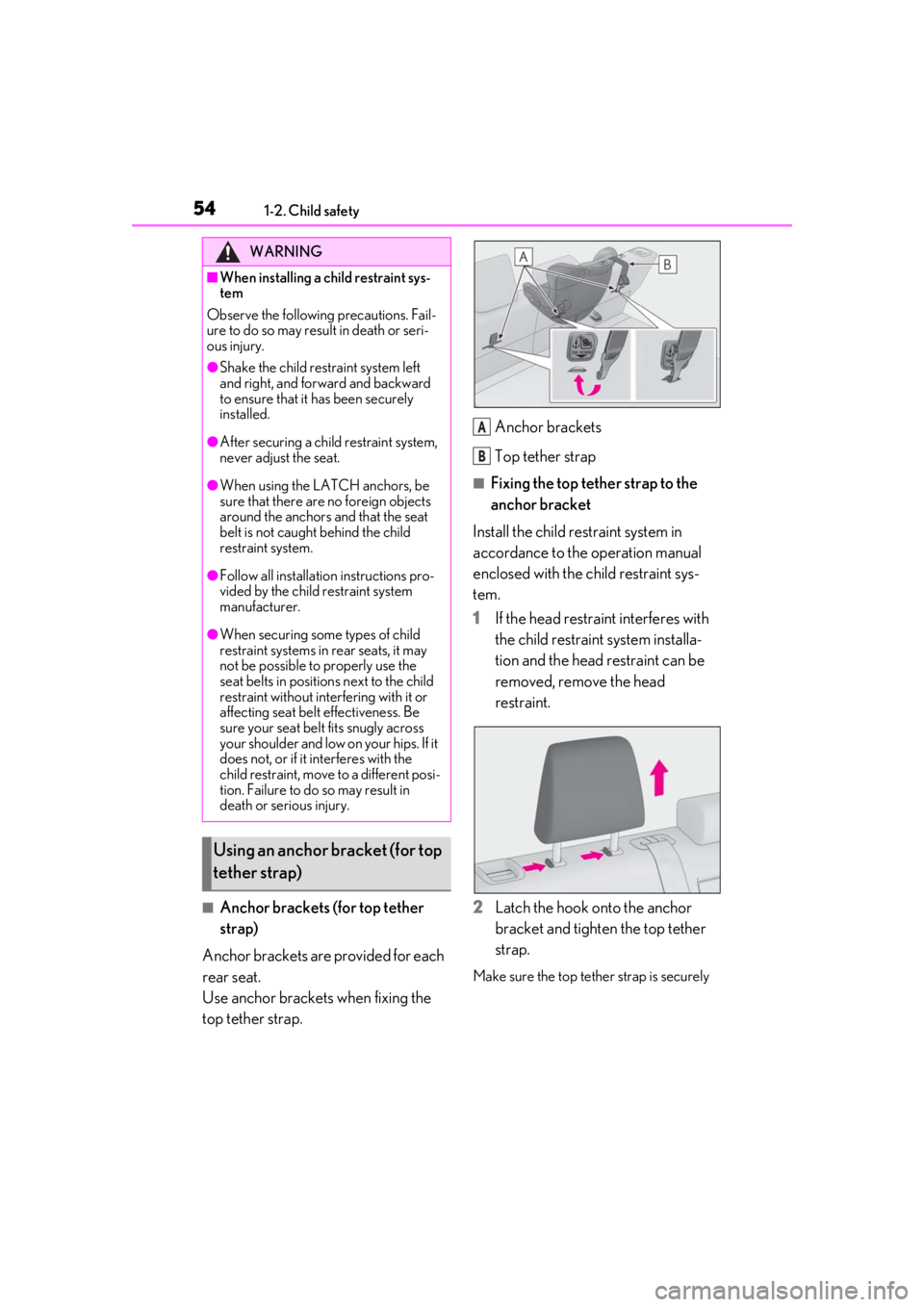
■Anchor brackets (for top tether
strap)
Anchor brackets are provided for each
rear seat.
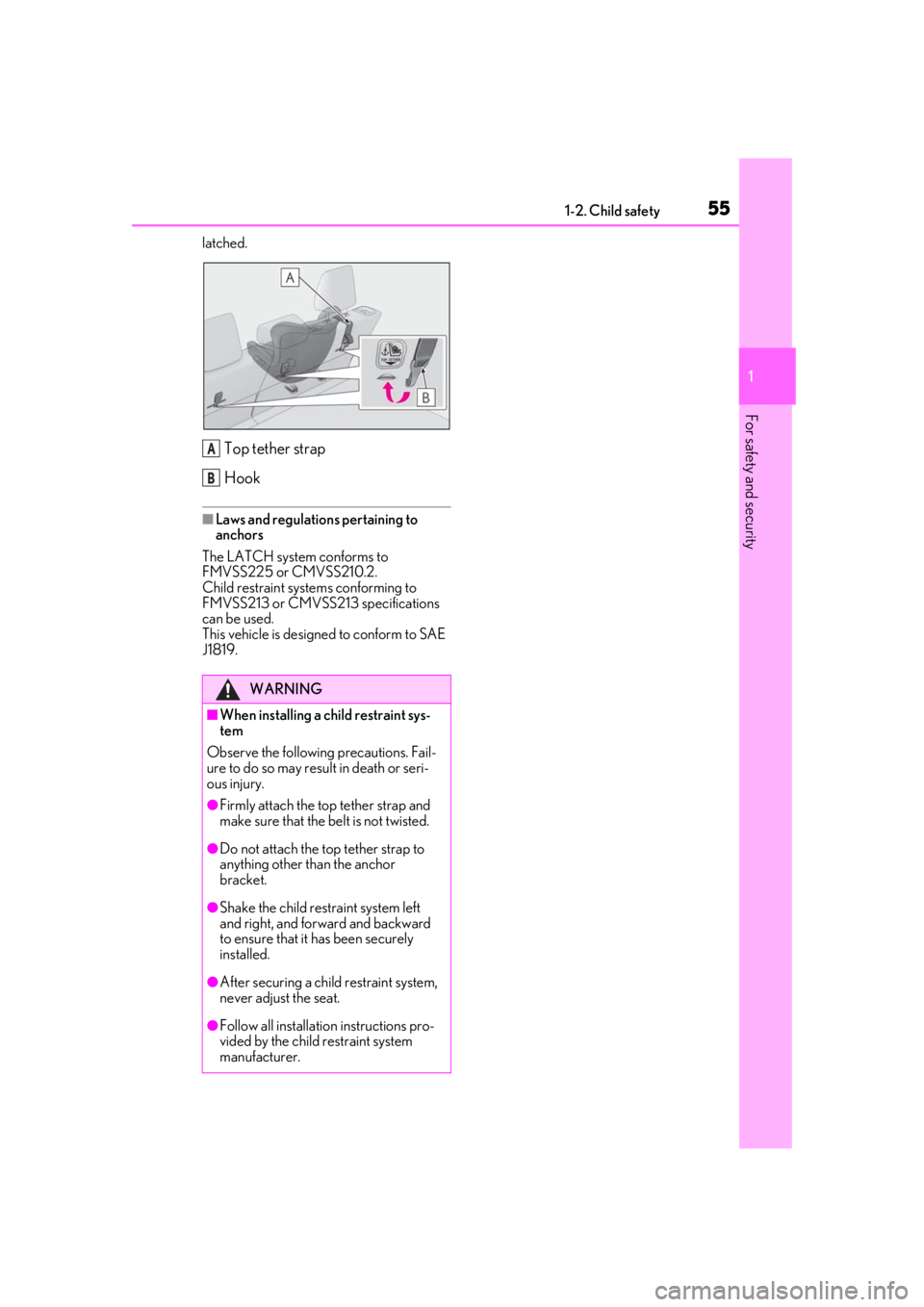
Use anchor brackets when fixing the
top tether strap. Anchor brackets
Top tether strap
■Fixing the top tether strap to the
anchor bracket
Install the child restraint system in
accordance to the operation manual
enclosed with the child restraint sys-
tem.
1
If the head restraint interferes with
the child restraint system installa-
tion and the head restraint can be
removed, remove the head
restraint.
2
Latch the hook onto the anchor
bracket and tighten the top tether
strap.
Make sure the top tether strap is securely
WARNING
■When installing a child restraint sys-
tem
Observe the following precautions. Fail-
ure to do so may result in death or seri-
ous injury.
●Shake the child restraint system left
and right, and forward and backward
to ensure that it has been securely
installed.
●After securing a child restraint system,
never adjust the seat.
●When using the LATCH anchors, be
sure that there are no foreign objects
around the anchors and that the seat
belt is not caught behind the child
restraint system.
●Follow all installation instructions pro-
vided by the child restraint system
manufacturer.
●When securing some types of child
restraint systems in rear seats, it may
not be possible to properly use the
seat belts in positions next to the child
restraint without inte rfering with it or
affecting seat belt effectiveness. Be
sure your seat belt fits snugly across
your shoulder and low on your hips. If it
does not, or if it interferes with the
child restraint, move to a different posi-
tion. Failure to do so may result in
death or serious injury.
Using an anchor bracket (for top
tether strap)
A
B
Page 55 of 476
551-2. Child safety
1
For safety and security
latched.
Top tether strap
Hook
■Laws and regulations pertaining to
anchors
The LATCH system conforms to
FMVSS225 or CMVSS210.2.
Child restraint systems conforming to
FMVSS213 or CMVSS213 specifications
can be used.
This vehicle is designed to conform to SAE
J1819.
WARNING
■When installing a child restraint sys-
tem
Observe the following precautions. Fail-
ure to do so may result in death or seri-
ous injury.
●Firmly attach the top tether strap and
make sure that the belt is not twisted.
●Do not attach the top tether strap to
anything other than the anchor
bracket.
●Shake the child restraint system left
and right, and forward and backward
to ensure that it has been securely
installed.
●After securing a child restraint system,
never adjust the seat.
●Follow all installation instructions pro-
vided by the child restraint system
manufacturer.
A
B
Page 64 of 476
641-4. Hybrid system
■Sounds and vibrations specific to a
hybrid vehicle
There may be no engine sound or vibration
even though the vehicle is able to move with
the “READY” indicator is illuminated. For
safety, apply the parking brake and make
sure to shift the shift lever to P when parked.
The following sounds or vibrations may
occur when the hybrid system is operating
and are not a malfunction:
●Motor sounds may be heard from the
engine compartment.
●Sounds may be heard from the hybrid
battery (traction battery) behind the rear
seats when the hybrid system starts or
stops.
●Relay operating sounds such as a snap or
soft clank will be emitted from the hybrid
battery (traction battery), behind the rear
seats, when the hybrid system is started
or stopped.
●Sounds from the hybrid system may be
heard when the back door is open.
●Sounds may be heard from the hybrid
transmission when the gasoline engine
starts or stops, wh en driving at low
speeds, or during idling.
●Engine sounds may be heard when
accelerating sharply.
●Sounds may be heard due to regenera-
tive braking when the brake pedal is
depressed or as the accelerator pedal is
released.
●Vibration may be felt when the gasoline
engine starts or stops.
●Cooling fan sounds may be heard from
the air intake vent under the right side of
the rear seat.
■Maintenance, repair, recycling, and dis-
posal
Contact your Lexus dealer regarding main-
tenance, repair, recycling and disposal. Do
not dispose of the vehicle yourself.
■Customization
Settings (e.g. on/off operation of the EV
indicator) can be changed.
(Customizable features: P.435)
When driving with the gasoline engine
stopped, a sound, which changes in
accordance with the driving speed, will
be played in order to warn people
nearby of the vehicle’s approach. This
sound may be heard inside the vehicle.
The sound will stop when the vehicle
speed exceeds approximately 15 mph
(25 km/h).
■Vehicle proximity notification system
In the following cases, the vehicle proximity
notification system may be difficult for sur-
rounding people to hear.
●In very noisy areas
●In the wind or the rain
Also, as the vehicle proximity notification
system is installed on the front of the vehicle,
it may be more difficult to hear from the rear
of the vehicle compared to the front.
Vehicle proximity notification
system