ABS LINCOLN AVIATOR 2003 User Guide
[x] Cancel search | Manufacturer: LINCOLN, Model Year: 2003, Model line: AVIATOR, Model: LINCOLN AVIATOR 2003Pages: 288, PDF Size: 3.32 MB
Page 207 of 288
Always disconnect the battery before servicing high current
fuses.
Always replace the cover to the power distribution box before
reconnecting the battery or refilling fluid reservoirs
If the battery has been disconnected and reconnected, refer to the
Batterysection of theMaintenance and specificationschapter.
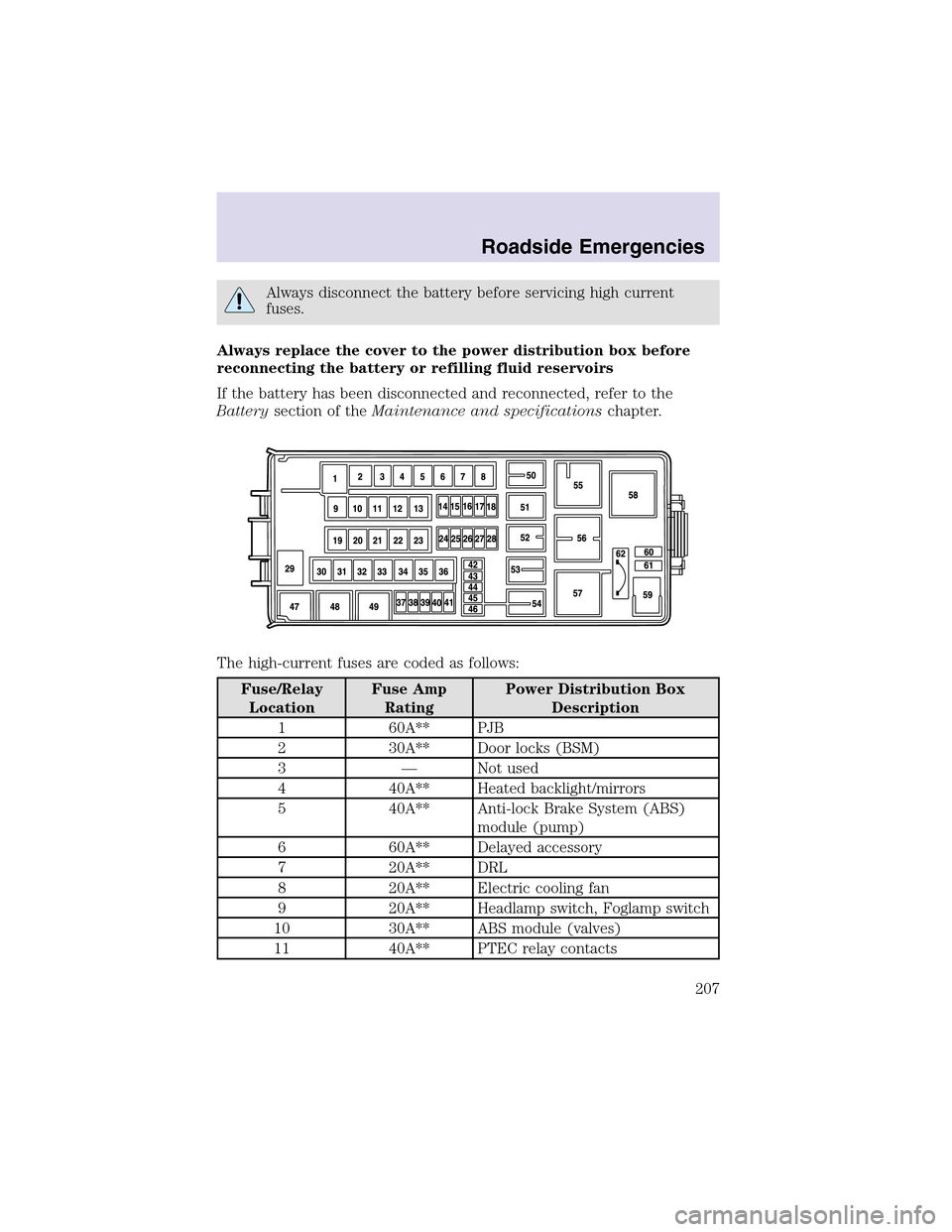
The high-current fuses are coded as follows:
Fuse/Relay
LocationFuse Amp
RatingPower Distribution Box
Description
1 60A** PJB
2 30A** Door locks (BSM)
3 — Not used
4 40A** Heated backlight/mirrors
5 40A** Anti-lock Brake System (ABS)
module (pump)
6 60A** Delayed accessory
7 20A** DRL
8 20A** Electric cooling fan
9 20A** Headlampswitch, Foglampswitch
10 30A** ABS module (valves)
11 40A** PTEC relay contacts
Roadside Emergencies
207
Page 256 of 288
Gasoline may contain benzene, which is a cancer-causing agent.
Observe the following guidelines when handling automotive fuel:
•Extinguish all smoking materials
and any open flames before
fueling your vehicle.
•Always turn off the vehicle before
fueling.
•Automotive fuels can be harmful
or fatal if swallowed. Fuel such as gasoline is highly toxic and if
swallowed can cause death or permanent injury. If fuel is swallowed,
call a physician immediately, even if no symptoms are immediately
apparent. The toxic effects of fuel may not be visible for hours.
•Avoid inhaling fuel vapors. Inhaling too much fuel vapor of any kind
can lead to eye and respiratory tract irritation. In severe cases,
excessive or prolonged breathing of fuel vapor can cause serious
illness and permanent injury.
•Avoid getting fuel liquid in your eyes. If fuel is splashed in the eyes,
remove contact lenses (if worn), flush with water for 15 minutes and
seek medical attention. Failure to seek proper medical attention could
lead to permanent injury.
•Fuels can also be harmful if absorbed through the skin. If fuel is
splashed on the skin and/or clothing, promptly remove contaminated
clothing and wash skin thoroughly with soapand water. Repeated or
prolonged skin contact with fuel liquid or vapor causes skin irritation.
•Be particularly careful if you are taking “Antabuse” or other forms of
disulfiram for the treatment of alcoholism. Breathing gasoline vapors,
or skin contact could cause an adverse reaction. In sensitive
individuals, serious personal injury or sickness may result. If fuel is
splashed on the skin, promptly wash skin thoroughly with soap and
water. Consult a physician immediately if you experience an adverse
reaction.
When refueling always shut the engine off and never allow
sparks or open flames near the filler neck. Never smoke while
refueling. Fuel vapor is extremely hazardous under certain conditions.
Care should be taken to avoid inhaling excess fumes.
Maintenance and Specifications
256
Page 257 of 288
The flow of fuel through a fuel pump nozzle can produce static
electricity, which can cause a fire if fuel is pumped into an
ungrounded fuel container.
Use the following guidelines to avoid static build-upwhen filling an
ungrounded fuel container:
•Place approved fuel container on the ground.
•DO NOT fill a fuel container while it is in the vehicle (including the
cargo area).
•Keepthe fuel pumpnozzle in contact with the fuel container while
filling.
•DO NOT use a device that would hold the fuel pump handle in the fill
position.
Fuel Filler Cap
Your fuel tank filler caphas an indexed design with a 1/8 turn on/off
feature.
When fueling your vehicle:
1. Turn the engine off.
2. Carefully turn the filler capcounterclockwise 1/8 of a turn until it
stops.
3. Pull to remove the cap from the fuel filler pipe.
4. To install the cap, align the tabs on the cap with the notches on the
filler pipe.
5. Turn the filler capclockwise 1/8 of a turn until it stops.
“CHECK/TIGHTEN FUEL CAP” will display in the message center when
the fuel filler cap is not properly installed. Proper fuel filler cap
installation is checked automatically as the vehicle is driven, but not until
after some fuel is used (fuel gauge drops below full). Once the fuel filler
cap is properly secured, “CHECK/TIGHTEN FUEL CAP” will turn off
after a short period of driving.
If you must replace the fuel filler cap, replace it with a fuel filler
cap that is designed for your vehicle. The customer warranty may
be void for any damage to the fuel tank or fuel system if the
correct genuine Ford or Motorcraft fuel filler cap is not used.
Maintenance and Specifications
257
Page 281 of 288
A
ABS (see Brakes) .....................168
Accessory delay ..........................73
Air bag supplemental
restraint system ........143–144, 147
and child safety seats ............145
description ......................144, 147
disposal ....................................151
driver air bag ..................146, 148
indicator light ...................12, 150
operation .........................146, 148
passenger air bag ...........146, 148
side air bag ..............................147
Air cleaner filter .......................270
Air conditioning ..........................41
auxiliary heater and air
conditioner ................................47
All Wheel Drive (AWD),
driving off road .........................181
Ambulance packages ....................7
Antifreeze
(see Engine coolant) ................251
Anti-lock brake system
(see Brakes) ......................168–169
Anti-theft system ......................117
arming the system ..................117
disarming a triggered
system .....................................118
Audio system (see Radio) ...18, 27
Automatic transmission
driving an automatic
overdrive .................................176
fluid, adding ............................265
fluid, checking ........................265
fluid, refill capacities ..............270
fluid, specification ..................275
Auxiliary power point .................69Axle
lubricant
specifications ..................273, 275
refill capacities ........................270
B
Battery .......................................249
acid, treating emergencies .....249
charging system warning
light ............................................12
jumping a disabled battery ....219
maintenance-free ....................249
replacement, specifications ...270
servicing ..................................249
BeltMinder .................................139
Brakes ........................................167
anti-lock ...........................168–169
anti-lock brake system
(ABS) warning light .........12, 169
brake warning light ..................11
fluid, checking and adding ....265
fluid, refill capacities ..............270
fluid, specifications .........273, 275
lubricant
specifications ..................273, 275
parking ....................................169
shift interlock ..........................174
Bulbs ............................................56
C
Calculating load ........................193
Capacities for refilling fluids ....270
Cargo cover ...............................102
CD-single premium .....................18
Cell phone use ............................98
Certification Label ....................276
Changing a tire .........................211
Index
281
Page 284 of 288
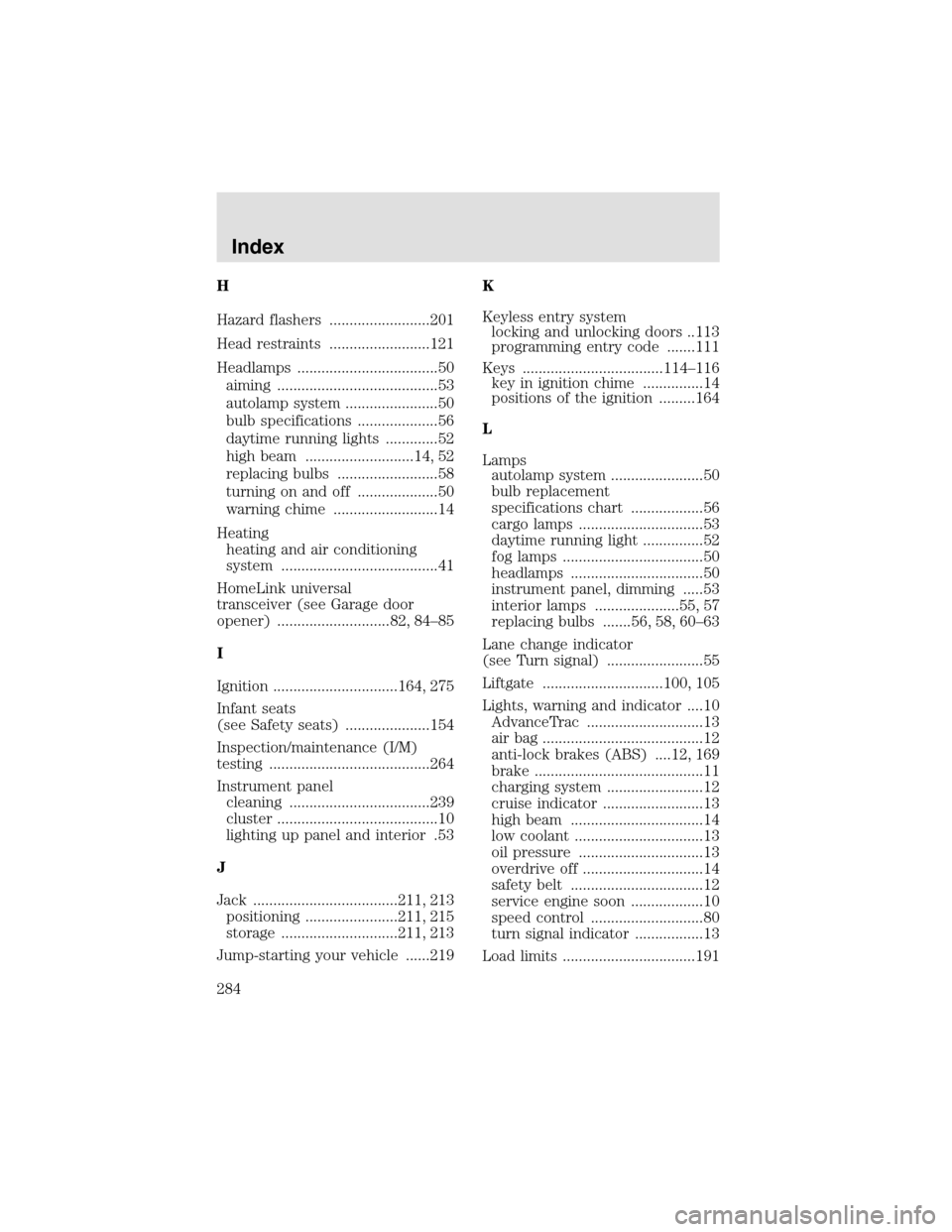
H
Hazard flashers .........................201
Head restraints .........................121
Headlamps ...................................50
aiming ........................................53
autolampsystem .......................50
bulb specifications ....................56
daytime running lights .............52
high beam ...........................14, 52
replacing bulbs .........................58
turning on and off ....................50
warning chime ..........................14
Heating
heating and air conditioning
system .......................................41
HomeLink universal
transceiver (see Garage door
opener) ............................82, 84–85
I
Ignition ...............................164, 275
Infant seats
(see Safety seats) .....................154
Inspection/maintenance (I/M)
testing ........................................264
Instrument panel
cleaning ...................................239
cluster ........................................10
lighting uppanel and interior .53
J
Jack ....................................211, 213
positioning .......................211, 215
storage .............................211, 213
Jump-starting your vehicle ......219K
Keyless entry system
locking and unlocking doors ..113
programming entry code .......111
Keys ...................................114–116
key in ignition chime ...............14
positions of the ignition .........164
L
Lamps
autolampsystem .......................50
bulb replacement
specifications chart ..................56
cargo lamps ...............................53
daytime running light ...............52
fog lamps ...................................50
headlamps .................................50
instrument panel, dimming .....53
interior lamps .....................55, 57
replacing bulbs .......56, 58, 60–63
Lane change indicator
(see Turn signal) ........................55
Liftgate ..............................100, 105
Lights, warning and indicator ....10
AdvanceTrac .............................13
air bag ........................................12
anti-lock brakes (ABS) ....12, 169
brake ..........................................11
charging system ........................12
cruise indicator .........................13
high beam .................................14
low coolant ................................13
oil pressure ...............................13
overdrive off ..............................14
safety belt .................................12
service engine soon ..................10
speed control ............................80
turn signal indicator .................13
Load limits .................................191
Index
284