clock LINCOLN AVIATOR 2003 Owner's Manual
[x] Cancel search | Manufacturer: LINCOLN, Model Year: 2003, Model line: AVIATOR, Model: LINCOLN AVIATOR 2003Pages: 288, PDF Size: 3.32 MB
Page 251 of 288
If the battery has been disconnected or a new battery has been installed,
the clock and the preset radio stations must be reset once the battery is
reconnected.
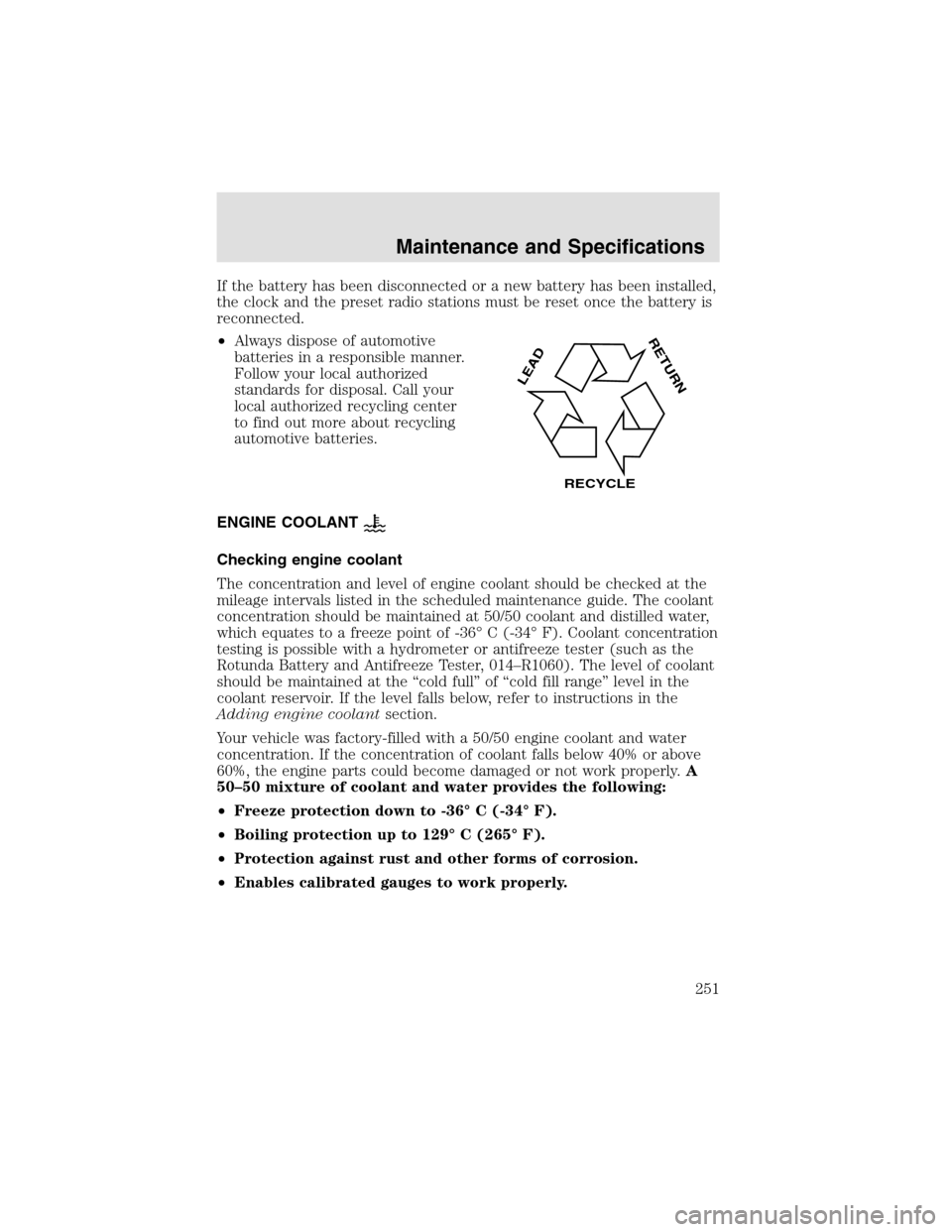
•Always dispose of automotive
batteries in a responsible manner.
Follow your local authorized
standards for disposal. Call your
local authorized recycling center
to find out more about recycling
automotive batteries.
ENGINE COOLANT
Checking engine coolant
The concentration and level of engine coolant should be checked at the
mileage intervals listed in the scheduled maintenance guide. The coolant
concentration should be maintained at 50/50 coolant and distilled water,
which equates to a freeze point of -36° C (-34° F). Coolant concentration
testing is possible with a hydrometer or antifreeze tester (such as the
Rotunda Battery and Antifreeze Tester, 014–R1060). The level of coolant
should be maintained at the “cold full” of “cold fill range” level in the
coolant reservoir. If the level falls below, refer to instructions in the
Adding engine coolantsection.
Your vehicle was factory-filled with a 50/50 engine coolant and water
concentration. If the concentration of coolant falls below 40% or above
60%, the engine parts could become damaged or not work properly.A
50–50 mixture of coolant and water provides the following:
•Freeze protection down to -36° C (-34° F).
•Boiling protection up to 129° C (265° F).
•Protection against rust and other forms of corrosion.
•Enables calibrated gauges to work properly.
LEAD
RETURN
RECYCLE
Maintenance and Specifications
251
Page 257 of 288
The flow of fuel through a fuel pump nozzle can produce static
electricity, which can cause a fire if fuel is pumped into an
ungrounded fuel container.
Use the following guidelines to avoid static build-upwhen filling an
ungrounded fuel container:
•Place approved fuel container on the ground.
•DO NOT fill a fuel container while it is in the vehicle (including the
cargo area).
•Keepthe fuel pumpnozzle in contact with the fuel container while
filling.
•DO NOT use a device that would hold the fuel pump handle in the fill
position.
Fuel Filler Cap
Your fuel tank filler caphas an indexed design with a 1/8 turn on/off
feature.
When fueling your vehicle:
1. Turn the engine off.
2. Carefully turn the filler capcounterclockwise 1/8 of a turn until it
stops.
3. Pull to remove the cap from the fuel filler pipe.
4. To install the cap, align the tabs on the cap with the notches on the
filler pipe.
5. Turn the filler capclockwise 1/8 of a turn until it stops.
“CHECK/TIGHTEN FUEL CAP” will display in the message center when
the fuel filler cap is not properly installed. Proper fuel filler cap
installation is checked automatically as the vehicle is driven, but not until
after some fuel is used (fuel gauge drops below full). Once the fuel filler
cap is properly secured, “CHECK/TIGHTEN FUEL CAP” will turn off
after a short period of driving.
If you must replace the fuel filler cap, replace it with a fuel filler
cap that is designed for your vehicle. The customer warranty may
be void for any damage to the fuel tank or fuel system if the
correct genuine Ford or Motorcraft fuel filler cap is not used.
Maintenance and Specifications
257
Page 282 of 288
Child safety restraints ..............151
child safety belts ....................151
Child safety seats ......................154
attaching with tether straps ..159
in front seat ............................156
in rear seat ..............................156
Cleaning your vehicle
engine compartment ..............237
instrument panel ....................239
interior .............................239–240
interior trim ............................240
plastic parts ............................238
washing ....................................236
waxing .....................................236
wheels ......................................237
wiper blades ............................238
Clock ................................27, 38, 69
Compass, electronic
set zone adjustment .................87
Console ........................................99
overhead ..............................67–68
rear ............................................99
Controls
power seat ...............................123
steering column ........................80
Coolant
checking and adding ..............251
coolant temperature light ........13
refill capacities ................253, 270
specifications ..................273, 275
Cruise control
(see Speed control) ....................76
Customer Assistance ................200
Ford accessories for
your vehicle ....................241, 278
Ford Extended Service
Plan ..........................................228
Getting assistance outside
the U.S. and Canada ..............232Getting roadside assistance ...200
Getting the service
you need .................................226
Ordering additional
owner’s literature ...................233
The Dispute Settlement
Board .......................................229
Utilizing the Mediation/
Arbitration Program ...............232
D
Daytime running lamps
(see Lamps) ................................52
Defrost
rear window ..............................49
Dipstick
automatic transmission
fluid ..........................................265
engine oil .................................245
Doors
door ajar warning .....................14
lubricant specifications ..........273
Driving under special
conditions ..........................184, 187
sand .........................................186
snow and ice ...........................188
through water .................186, 190
Dual automatic temperature
control (DATC) ...........................41
E
Electronic message center .........86
Emergencies, roadside
jump-starting ..........................219
Emission control system ..........263
Engine ........................................275
check engine/service engine
soon light ..................................10
Index
282