light LINCOLN AVIATOR 2021 Owners Manual
[x] Cancel search | Manufacturer: LINCOLN, Model Year: 2021, Model line: AVIATOR, Model: LINCOLN AVIATOR 2021Pages: 667, PDF Size: 7.01 MB
Page 5 of 667

Keys and Remote Controls
General Information on Radio Frequencies
........................................................................\
66
Remote Control ..............................................
67
Replacing a Lost Key or Remote Control ........................................................................\
..
71
Phone as a Key
What Is Phone As a Key ...............................
72
Phone as a Key Limitations .........................
72
Programming Your Phone ..........................
72
Using the Valet Mode ...................................
73
Using the Backup Start Passcode .............
73
Phone as a Key – Troubleshooting ...........
74
MyKey™
Principle of Operation ..................................
76
Creating a MyKey ...........................................
77
Clearing All MyKeys ......................................
78
Checking MyKey System Status ................
78
Using MyKey With Remote Start Systems ........................................................................\
.
79
MyKey – Troubleshooting ............................
79Doors and Locks
Locking and Unlocking
.................................
81
Opening the Doors .......................................
88
Emergency Door Release ...........................
89
Soft Closing Door ..........................................
89
Keyless Entry ..................................................
89
Liftgate
Power Liftgate ................................................
92
Security
Passive Anti-Theft System ...........................
97
Anti-Theft Alarm .............................................
98
Steering Wheel
Adjusting the Steering Wheel - Vehicles With: Manual Adjustable Steering
Column .......................................................
100
Adjusting the Steering Wheel - Vehicles With: Power Adjustable Steering Column
.......................................................................
100
Audio Control ................................................
102
Voice Control ................................................
102Cruise Control - Vehicles With: Adaptive
Cruise Control With Lane Centering
.......................................................................
102
Cruise Control - Vehicles With: Cruise Control ........................................................
103
Information Display Control .......................
104
Heated Steering Wheel ..............................
104
Horn .................................................................
104
Wipers and Washers
Windshield Wipers - Vehicles Without: Heated Wiper Blades .............................
105
Windshield Wipers - Vehicles With: Heated Wiper Blades ............................................
106
Autowipers .....................................................
106
Windshield Washers ....................................
107
Rear Window Wiper and Washers ...........
107
Lighting
General Information ....................................
109
Lighting Control ............................................
109
Autolamps .......................................................
110
Instrument Lighting Dimmer .......................
110
Headlamp Exit Delay .....................................
111
2
Aviator (CTV) Canada/United States of America, enUSA, Edition date: 202007, Second-Printing Table of Contents
Page 6 of 667

Daytime Running Lamps - Vehicles With:
Configurable Daytime Running Lamps
........................................................................\
.111
Daytime Running Lamps - Vehicles With: Daytime Running Lamps (DRL) ...............
111
Front Fog Lamps ............................................
111
Adaptive Headlamps ....................................
112
Direction Indicators .......................................
114
Welcome Lighting .........................................
114
Interior Lamps ................................................
115
Ambient Lighting ...........................................
115
Automatic High Beam Control
What Is Automatic High Beam Control ........................................................................\
117
Switching Automatic High Beam Control On and Off ..................................................
117
Automatic High Beam Control Indicators ........................................................................\
118
Overriding Automatic High Beam Control ........................................................................\
118
Windows and Mirrors
Power Windows .............................................
119
Global Opening and Closing ....................
120Exterior Mirrors
.............................................
120
Interior Mirror ................................................
122
Sun Visors ......................................................
123
Moonroof ........................................................
123
Instrument Cluster
Gauges ...........................................................
126
Warning Lamps and Indicators .................
129
Audible Warnings and Indicators .............
133
Information Displays
General Information .....................................
134
Personalized Settings .................................
138
Information Messages ................................
140
Head Up Display ..........................................
164
Climate Control
Automatic Climate Control ........................
168
Hints on Controlling the Interior Climate ........................................................................\
171
Rear Passenger Climate Controls ............
172
Heated Rear Window ..................................
173
Heated Exterior Mirrors ..............................
173Remote Start
..................................................
174
Interior Air Quality
What Is the Cabin Air Filter ........................
175
Replacing the Cabin Air Filter ...................
175
What Is Auto Air Refresh ............................
175
How Does Auto Air Refresh Work ............
175
Checking the Interior Air Quality ..............
175
Auto Air Refresh Indicators ........................
176
Refreshing the Interior Air ..........................
176
Auto Air Refresh Hints .................................
177
Interior Air Quality – Troubleshooting ........................................................................\
177
Seats
Sitting in the Correct Position ...................
178
Head Restraints ............................................
179
Power Seats ....................................................
181
Memory Function .........................................
186
Rear Seats ......................................................
189
Heated Seats .................................................
193
Ventilated Seats ...........................................
194
3
Aviator (CTV) Canada/United States of America, enUSA, Edition date: 202007, Second-Printing Table of Contents
Page 14 of 667

Windshield defrosting system
Interior luggage compartment
release
Jack
Keep out of reach of children
Lighting control
Low tire pressure warning
Maintain correct fluid level
Note operating instructions
Horn control Panic alarm
Parking aid
Parking brake
Power steering fluid
Power windows front/rear
Power window lockout
Requires registered technician
Safety alert
See Owner's Manual See Service Manual
Service engine soon
Passenger airbag activated
Passenger airbag deactivated
Side airbag
Shield the eyes
Stability control
Hill descent control
Trail control
Windshield wiping system
11
Aviator (CTV) Canada/United States of America, enUSA, Edition date: 202007, Second-Printing Introduction E161353 E270945 E139213 E231159 E231158 E270849 E270850 E167012 E138639 E163957 E272858 E270969
Page 16 of 667
Scheduled Maintenance and
Mechanical Repairs
One of the best ways for you to make sure
that your vehicle provides years of service
is to have it maintained in line with our
recommendations using parts that conform
to the specifications detailed in this Owner’
s
Manual. Genuine Ford, Lincoln and
Motorcraft parts meet or exceed these
specifications.
Collision Repairs
We hope that you never experience a
collision, but accidents do happen. Genuine
Ford, Lincoln replacement collision parts
meet our stringent requirements for fit, finish,
structural integrity, corrosion protection and
dent resistance. During vehicle development
we validate that these parts deliver the
intended level of protection as a whole
system. A great way to know for sure you
are getting this level of protection is to use
genuine Ford, Lincoln replacement collision
parts. Warranty on Replacement Parts
Genuine Ford, Lincoln and Motorcraft
replacement parts are the only replacement
parts that benefit from a Lincoln Warranty.
Damage caused to your vehicle as a result
of the failure of non-Ford, non-Lincoln parts
may not be covered by the Lincoln Warranty.
For additional information, refer to the terms
and conditions of the Lincoln Warranty.
SPECIAL NOTICES
New Vehicle Limited Warranty
For a detailed description of what is covered
by your New Vehicle Limited Warranty, see
your warranty guide that is available online.
For more information, refer to our website
and download your copy of the warranty
guide.
Special Instructions
For your added safety, your vehicle is fitted
with sophisticated electronic controls. WARNING: You risk death or serious
injury to yourself and others if you do not
follow the instruction highlighted by the
warning symbol. Failure to follow the
specific warnings and instructions could
result in personal injury. WARNING: NEVER use a rearward
facing child restraint on a seat protected
by an ACTIVE AIRBAG in front of it, DEATH
or SERIOUS INJURY to the CHILD can
occur.
On Board Diagnostics Data Link
Connector WARNING: Do not connect wireless
plug-in devices to the data link connector.
Unauthorized third parties could gain
access to vehicle data and impair the
performance of safety related systems.
Only allow repair facilities that follow our
service and repair instructions to connect
their equipment to the data link connector.
13
Aviator (CTV) Canada/United States of America, enUSA, Edition date: 202007, Second-Printing Introduction
Page 27 of 667
Cruise control.
T
Lighting control. See Lighting Control (page 109).
U
Power liftgate.
See Power Liftgate (page 92). Fuel door release (Hybrid only). See Refueling (page 229).
V
24
Aviator (CTV) Canada/United States of America, enUSA, Edition date: 202007, Second-Printing At a Glance
Page 31 of 667
WARNING: Depending on where you
secure a child restraint, and depending on
the child restraint design, you may block
access to certain seatbelt buckle
assemblies and LATCH lower anchors,
rendering those features potentially
unusable. To avoid risk of injury, make sure
occupants only use seating positions
where they are able to be properly
restrained.
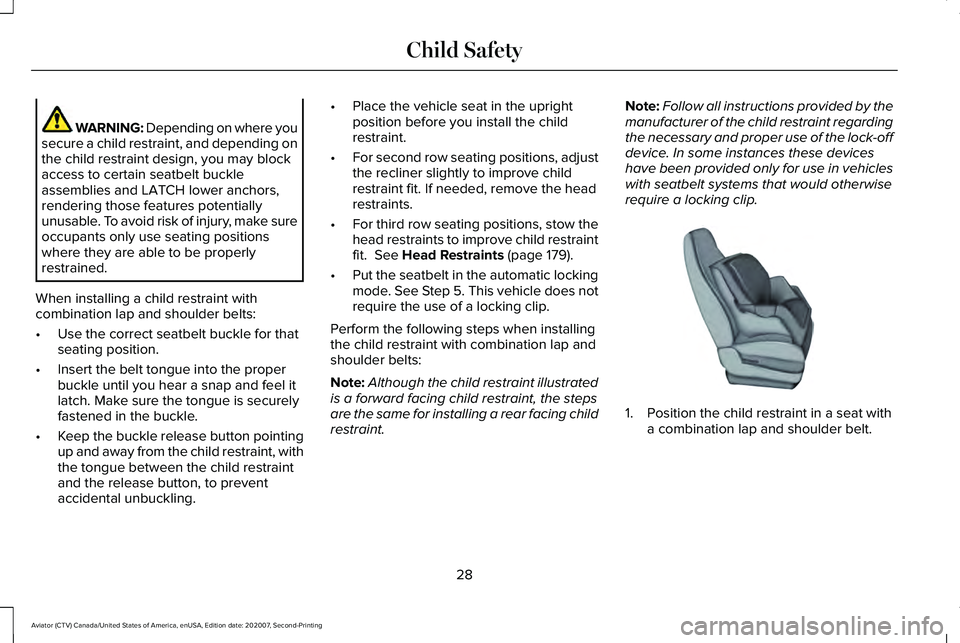
When installing a child restraint with
combination lap and shoulder belts:
• Use the correct seatbelt buckle for that
seating position.
• Insert the belt tongue into the proper
buckle until you hear a snap and feel it
latch. Make sure the tongue is securely
fastened in the buckle.
• Keep the buckle release button pointing
up and away from the child restraint, with
the tongue between the child restraint
and the release button, to prevent
accidental unbuckling. •
Place the vehicle seat in the upright
position before you install the child
restraint.
• For second row seating positions, adjust
the recliner slightly to improve child
restraint fit. If needed, remove the head
restraints.
• For third row seating positions, stow the
head restraints to improve child restraint
fit. See Head Restraints (page 179).
• Put the seatbelt in the automatic locking
mode. See Step 5. This vehicle does not
require the use of a locking clip.
Perform the following steps when installing
the child restraint with combination lap and
shoulder belts:
Note: Although the child restraint illustrated
is a forward facing child restraint, the steps
are the same for installing a rear facing child
restraint. Note:
Follow all instructions provided by the
manufacturer of the child restraint regarding
the necessary and proper use of the lock-off
device. In some instances these devices
have been provided only for use in vehicles
with seatbelt systems that would otherwise
require a locking clip. 1. Position the child restraint in a seat with
a combination lap and shoulder belt.
28
Aviator (CTV) Canada/United States of America, enUSA, Edition date: 202007, Second-Printing Child SafetyE142528
Page 33 of 667
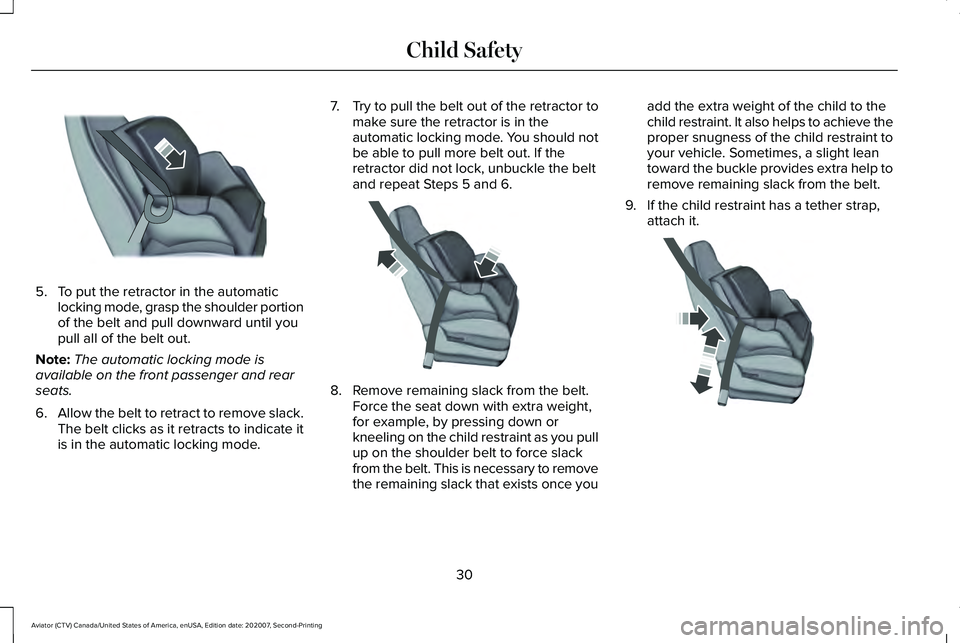
5. To put the retractor in the automatic
locking mode, grasp the shoulder portion
of the belt and pull downward until you
pull all of the belt out.
Note: The automatic locking mode is
available on the front passenger and rear
seats.
6. Allow the belt to retract to remove slack.
The belt clicks as it retracts to indicate it
is in the automatic locking mode. 7.
Try to pull the belt out of the retractor to
make sure the retractor is in the
automatic locking mode. You should not
be able to pull more belt out. If the
retractor did not lock, unbuckle the belt
and repeat Steps 5 and 6. 8. Remove remaining slack from the belt.
Force the seat down with extra weight,
for example, by pressing down or
kneeling on the child restraint as you pull
up on the shoulder belt to force slack
from the belt. This is necessary to remove
the remaining slack that exists once you add the extra weight of the child to the
child restraint. It also helps to achieve the
proper snugness of the child restraint to
your vehicle. Sometimes, a slight lean
toward the buckle provides extra help to
remove remaining slack from the belt.
9. If the child restraint has a tether strap, attach it. 30
Aviator (CTV) Canada/United States of America, enUSA, Edition date: 202007, Second-Printing Child SafetyE142875 E142533 E142534
Page 46 of 667
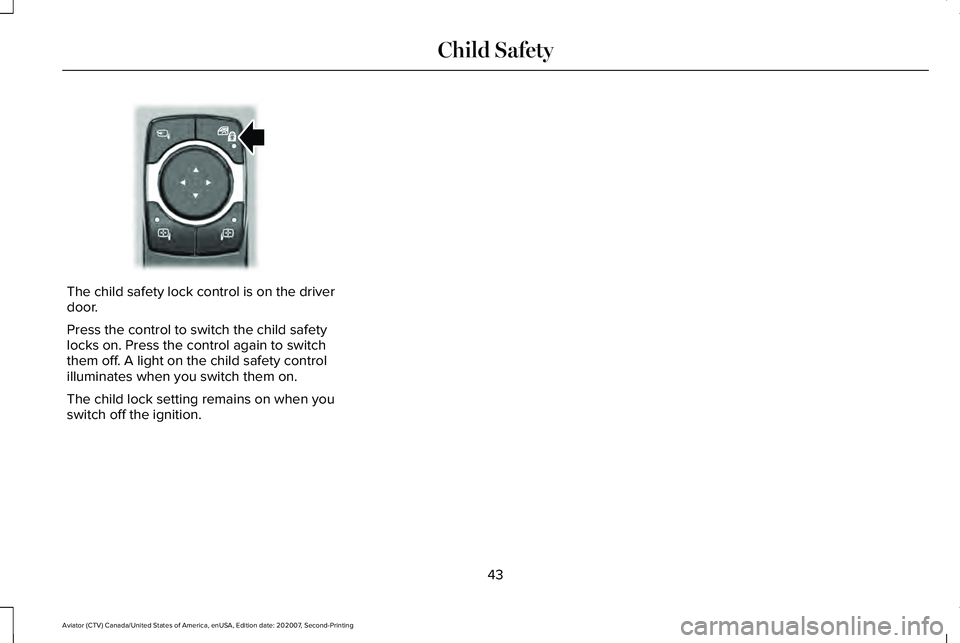
The child safety lock control is on the driver
door.
Press the control to switch the child safety
locks on. Press the control again to switch
them off. A light on the child safety control
illuminates when you switch them on.
The child lock setting remains on when you
switch off the ignition.
43
Aviator (CTV) Canada/United States of America, enUSA, Edition date: 202007, Second-Printing Child SafetyE295318
Page 48 of 667
•
Seatbelt pretensioners at the front
outermost and second row outermost
seating positions.
• Belt tension sensor at the front outermost
passenger seating position. •
Seatbelt warning light and chime. •
Crash sensors and monitoring system
with readiness indicator.
The seatbelt pretensioners are designed to
tighten the seatbelts when activated. In
frontal and near-frontal crashes, the seatbelt
pretensioners may be activated alone or, if
the crash is of sufficient severity, together
with the front airbags. The pretensioners may
also activate when a Safety Canopy airbag
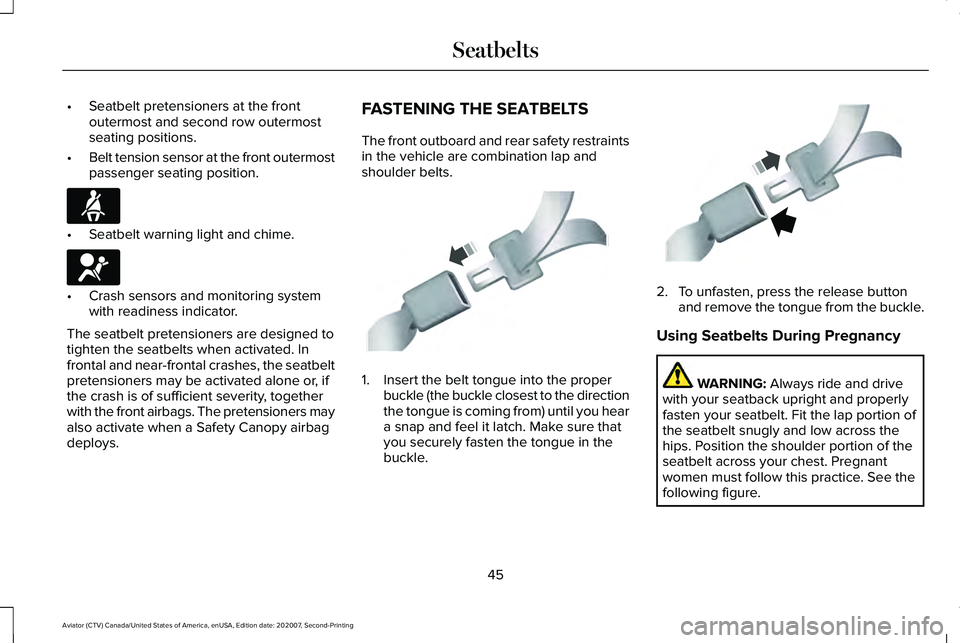
deploys. FASTENING THE SEATBELTS
The front outboard and rear safety restraints
in the vehicle are combination lap and
shoulder belts.
1. Insert the belt tongue into the proper
buckle (the buckle closest to the direction
the tongue is coming from) until you hear
a snap and feel it latch. Make sure that
you securely fasten the tongue in the
buckle. 2. To unfasten, press the release button
and remove the tongue from the buckle.
Using Seatbelts During Pregnancy WARNING: Always ride and drive
with your seatback upright and properly
fasten your seatbelt. Fit the lap portion of
the seatbelt snugly and low across the
hips. Position the shoulder portion of the
seatbelt across your chest. Pregnant
women must follow this practice. See the
following figure.
45
Aviator (CTV) Canada/United States of America, enUSA, Edition date: 202007, Second-Printing SeatbeltsE71880 E67017 E142587 E142588
Page 55 of 667
This system provides an improved overall
level of frontal crash protection to front seat
occupants and is designed to help further
reduce the risk of airbag-related injuries. The
system analyzes different occupant
conditions and crash severity before
activating the appropriate safety devices to
help better protect occupants in a variety of
frontal crash situations.
Your vehicle's Personal Safety System
consists of:
•
Driver and passenger dual-stage airbag
supplemental restraints.
• Front seat outermost seatbelts with
pretensioners, energy management
retractors and seatbelt usage sensors.
• Front passenger sensing system.
• Passenger airbag off and on indicators.
• Front crash severity sensors.
• Restraints control module with impact
and safing sensors. •
Restraint system warning light and tone.
• The electrical wiring for the airbags, crash
sensors, seatbelt pretensioners, front
seatbelt usage sensors, front passenger
sensing system and indicator lights.
How Does the Personal Safety System
Work?
The Personal Safety System can adapt the
deployment strategy of the safety devices
according to crash severity and occupant
conditions. A collection of crash and
occupant sensors provides information to
the restraints control module. During a crash,
the restraints control module may deploy the
seatbelt pretensioners, one or both stages
of the dual-stage airbags based on crash
severity and occupant conditions.
52
Aviator (CTV) Canada/United States of America, enUSA, Edition date: 202007, Second-Printing Personal Safety System
™