brake fluid LINCOLN AVIATOR 2023 Owners Manual
[x] Cancel search | Manufacturer: LINCOLN, Model Year: 2023, Model line: AVIATOR, Model: LINCOLN AVIATOR 2023Pages: 681, PDF Size: 9.33 MB
Page 10 of 681
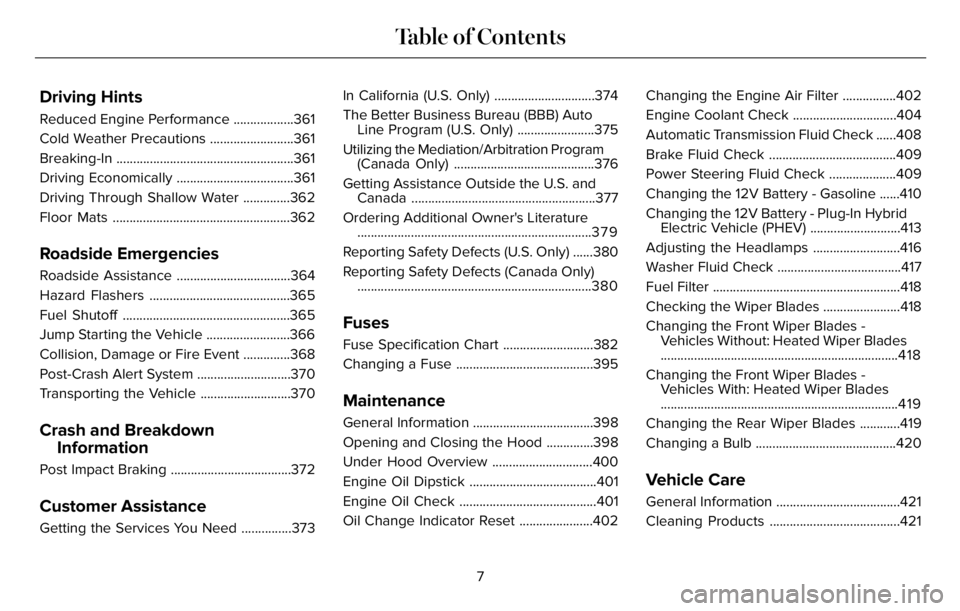
Driving Hints
Reduced Engine Performance ..................361
Cold Weather Precautions .........................361
Breaking-In .....................................................361
Driving Economically ...................................361
Driving Through Shallow Water ..............362
Floor Mats .....................................................362
Roadside Emergencies
Roadside Assistance ..................................364
Hazard Flashers ..........................................365
Fuel Shutoff ..................................................365
Jump Starting the Vehicle .........................366
Collision, Damage or Fire Event ..............368
Post-Crash Alert System ............................370
Transporting the Vehicle ...........................370
Crash and Breakdown
Information
Post Impact Braking ....................................372
Customer Assistance
Getting the Services You Need ...............373In California (U.S. Only) ..............................374
The Better Business Bureau (BBB) Auto
Line Program (U.S. Only) .......................375
Utilizing the Mediation/Arbitration Program
(Canada Only) ..........................................376
Getting Assistance Outside the U.S. and
Canada .......................................................377
Ordering Additional Owner's Literature
......................................................................3 7 9
Reporting Safety Defects (U.S. Only) ......380
Reporting Safety Defects (Canada Only)
......................................................................380
Fuses
Fuse Specification Chart ...........................382
Changing a Fuse .........................................395
Maintenance
General Information ....................................398
Opening and Closing the Hood ..............398
Under Hood Overview ..............................400
Engine Oil Dipstick ......................................401
Engine Oil Check .........................................401
Oil Change Indicator Reset ......................402Changing the Engine Air Filter ................402
Engine Coolant Check ...............................404
Automatic Transmission Fluid Check ......408
Brake Fluid Check ......................................409
Power Steering Fluid Check ....................409
Changing the 12V Battery - Gasoline ......410
Changing the 12V Battery - Plug-In Hybrid
Electric Vehicle (PHEV) ...........................413
Adjusting the Headlamps ..........................416
Washer Fluid Check .....................................417
Fuel Filter ........................................................418
Checking the Wiper Blades .......................418
Changing the Front Wiper Blades -
Vehicles Without: Heated Wiper Blades
.......................................................................418
Changing the Front Wiper Blades -
Vehicles With: Heated Wiper Blades
.......................................................................419
Changing the Rear Wiper Blades ............419
Changing a Bulb ..........................................420
Vehicle Care
General Information .....................................421
Cleaning Products .......................................421
7
Table of Contents
Page 15 of 681
E231157
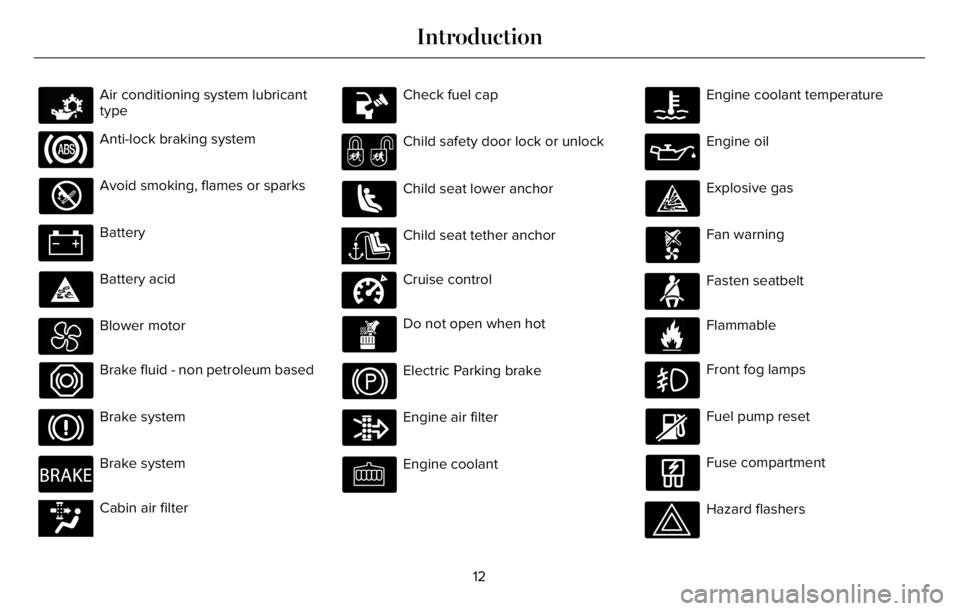
Air conditioning system lubricant
type
Anti-lock braking system
Avoid smoking, flames or sparks
Battery
Battery acid
Blower motor
Brake fluid - non petroleum based
Brake system
E270480
Brake system
E139223E139223Cabin air filter
Check fuel cap
Child safety door lock or unlock
Child seat lower anchor
E141E141128128Child seat tether anchor
E332905
Cruise control
Do not open when hot
Electric Parking brake
Engine air filter
Engine coolant
Engine coolant temperature
Engine oil
Explosive gas
Fan warning
E71880
Fasten seatbelt
E231160
Flammable
Front fog lamps
Fuel pump reset
Fuse compartment
Hazard flashers
12
Introduction
Page 135 of 681
Blind Spot Monitor
E151262
Illuminates when you switch this
feature off or in conjunction with a
message. See Blind Spot
Information System (page 326).
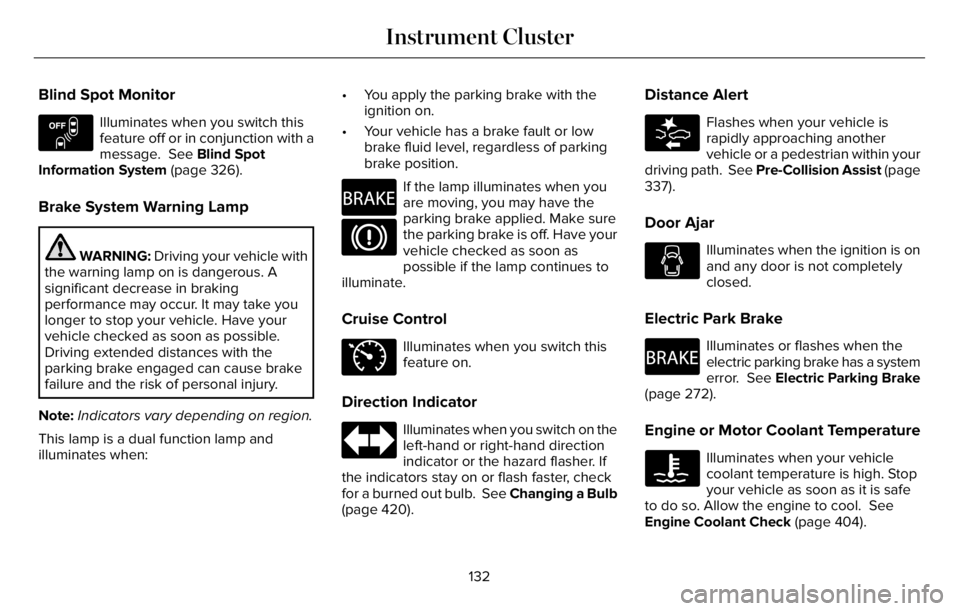
Brake System Warning Lamp
WARNING: Driving your vehicle with
the warning lamp on is dangerous. A
significant decrease in braking
performance may occur. It may take you
longer to stop your vehicle. Have your
vehicle checked as soon as possible.
Driving extended distances with the
parking brake engaged can cause brake
failure and the risk of personal injury.
Note:Indicators vary depending on region.
This lamp is a dual function lamp and
illuminates when:• You apply the parking brake with the
ignition on.
• Your vehicle has a brake fault or low
brake fluid level, regardless of parking
brake position.
E270480
If the lamp illuminates when you
are moving, you may have the
parking brake applied. Make sure
the parking brake is off. Have your
vehicle checked as soon as
possible if the lamp continues to
illuminate.
Cruise Control
E71340
Illuminates when you switch this
feature on.
Direction Indicator
Illuminates when you switch on the
left-hand or right-hand direction
indicator or the hazard flasher. If
the indicators stay on or flash faster, check
for a burned out bulb. See Changing a Bulb
(page 420).
Distance Alert
E281485
Flashes when your vehicle is
rapidly approaching another
vehicle or a pedestrian within your
driving path. See Pre-Collision Assist (page
337).
Door Ajar
Illuminates when the ignition is on
and any door is not completely
closed.
Electric Park Brake
E270480
Illuminates or flashes when the
electric parking brake has a system
error. See Electric Parking Brake
(page 272).
Engine or Motor Coolant Temperature
Illuminates when your vehicle
coolant temperature is high. Stop
your vehicle as soon as it is safe
to do so. Allow the engine to cool. See
Engine Coolant Check (page 404).
132
Instrument Cluster
Page 158 of 681
Action Message
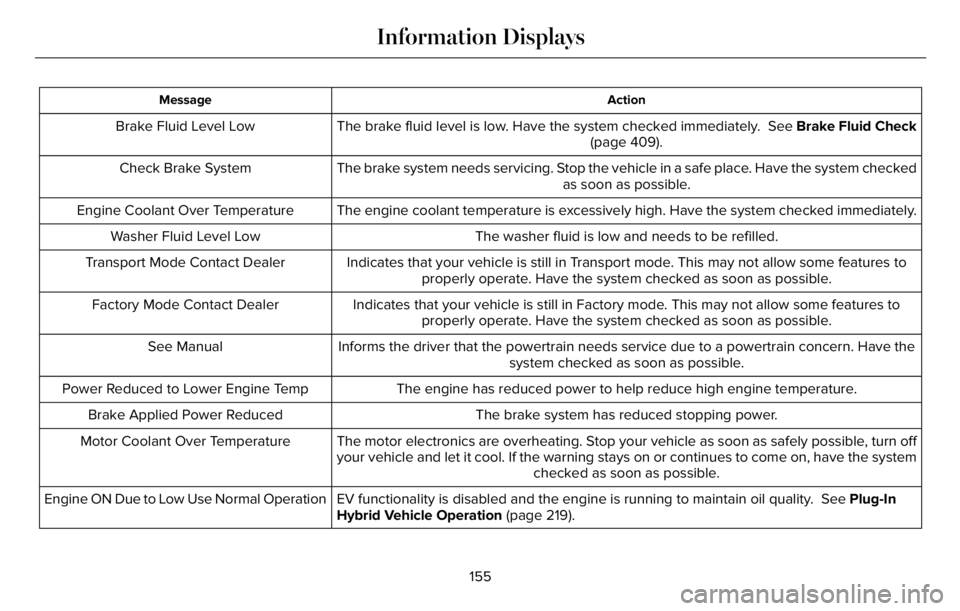
The brake fluid level is low. Have the system checked immediately. See Brake Fluid Check
(page 409). Brake Fluid Level Low
The brake system needs servicing. Stop the vehicle in a safe place. Have the system checked
as soon as possible. Check Brake System
The engine coolant temperature is excessively high. Have the system checked immediately. Engine Coolant Over Temperature
The washer fluid is low and needs to be refilled. Washer Fluid Level Low
Indicates that your vehicle is still in Transport mode. This may not allow some features to
properly operate. Have the system checked as soon as possible. Transport Mode Contact Dealer
Indicates that your vehicle is still in Factory mode. This may not allow some features to
properly operate. Have the system checked as soon as possible. Factory Mode Contact Dealer
Informs the driver that the powertrain needs service due to a powertrain concern. Have the
system checked as soon as possible. See Manual
The engine has reduced power to help reduce high engine temperature. Power Reduced to Lower Engine Temp
The brake system has reduced stopping power. Brake Applied Power Reduced
The motor electronics are overheating. Stop your vehicle as soon as safely possible, turn off
your vehicle and let it cool. If the warning stays on or continues to come on, have the system
checked as soon as possible. Motor Coolant Over Temperature
EV functionality is disabled and the engine is running to maintain oil quality. See Plug-In
Hybrid Vehicle Operation (page 219). Engine ON Due to Low Use Normal Operation
155
Information Displays
Page 372 of 681
Vehicle information and general safety
practices:
• Know the make and model of your
vehicle.
• Review the owner’s manual and become
familiar with your vehicle’s safety
information and recommended safety
practices.
• Do not attempt to repair damaged
electric and hybrid-electric vehicles
yourself.
Contact an authorized dealer.Crashes
A crash or impact significant enough to
require an emergency response for
conventional vehicles would also require the
same response for an electric or
hybrid-electric vehicle.
If possible:
• Move your vehicle to a safe, nearby
location and remain on the scene.
• Roll down the windows before switching
your vehicle off.
• Place your vehicle in park (P), set the
parking brake, switch off the vehicle,
activate the hazard warning flashers and
move your key(s) at least 15 ft (5 m) away
from the vehicle.
Always:
• Call emergency assistance if needed and
advise that an electric or hybrid-electric
vehicle is involved.
• Exposed electrical components, wires,
and high-voltage batteries present
potential high-voltage shock hazards.• Avoid contact with leaking fluids and
gases, and remain out of the way of
oncoming traffic until emergency
responders arrive.
• When emergency responders arrive, tell
them that the vehicle involved is an
electric vehicle or hybrid-electric vehicle.
Fires
As with any vehicle, call emergency
assistance immediately if you see sparks,
smoke or flames coming from the vehicle.
Remain a safe distance from the vehicle and
try to stay clear of the smoke.
• Exit the vehicle immediately.
• Advise emergency assistance that an
electric or hybrid-electric vehicle is
involved.
• As with any vehicle fire, do not inhale
smoke, vapors or gas from the vehicle,
as they may be hazardous.
• Stay out of the roadway and stay out of
the way of any oncoming traffic while
awaiting the arrival of emergency
responders.
369
Roadside Emergencies
Page 401 of 681
GENERAL INFORMATION
Have your vehicle serviced regularly to help
maintain its roadworthiness and resale value.
There is a large network of authorized
dealers that are there to help you with their
professional servicing expertise. We believe
that their specially trained technicians are
best qualified to service your vehicle properly
and expertly. They are supported by a wide
range of highly specialized tools developed
specifically for servicing your vehicle.
If your vehicle requires professional service,
an authorized dealer can provide the
necessary parts and service. Check your
warranty information to find out which parts
and services are covered.
Use only recommended fuels, lubricants,
fluids and service parts conforming to
specifications. Motorcraft® parts are
designed and built to provide the best
performance in your vehicle.
Precautions
• Do not work on a hot engine.
• Make sure that nothing gets caught in
moving parts.
• Do not work on a vehicle with the engine
running in an enclosed space, unless you
are sure you have enough ventilation.
• Keep all open flames and other burning
material (such as cigarettes) away from
the battery and all fuel related parts.
Working with the Engine Off
1. Set the parking brake and shift the
transmission to park (P).
2. Switch off the engine.
3. Block the wheels.
Working with the Engine On
WARNING: To reduce the risk of
vehicle damage and personal burn injuries,
do not start your engine with the air
cleaner removed and do not remove it
while the engine is running.1. Set the parking brake and shift the
transmission to park (P).
2. Block the wheels.
OPENING AND CLOSING THE
HOOD
Opening the Hood
E263274
1. Open the left-hand front door.
2. Fully pull the hood release lever and let
it completely retract.
398
Maintenance
Page 404 of 681
Brake fluid reservoir. See Brake Fluid Check (page 409). D
Engine compartment fuse box. See Fuses (page 382). E
Engine coolant reservoir. See Engine Coolant Check (page 404). F
Air filter assembly. See Changing the Engine Air Filter (page 402). G
Washer fluid reservoir. See Washer Fluid Check (page 417). H
ENGINE OIL DIPSTICK
E250320E250320
Minimum. A
Nominal. B
Maximum. C
ENGINE OIL CHECK
1. Make sure that your vehicle is on level
ground.
2. Check the oil before starting the engine
or switch the engine off and wait 10
minutes for the oil to drain into the oil
pan.
3. Remove the dipstick and wipe it with a
clean, lint-free cloth.
4. Reinstall the dipstick and make sure it is
fully seated. Remove it again to check
the oil level.
5. If the oil level is between the maximum
and minimum marks, the oil level is
acceptable. Do not add oil.6. If the oil level is at the minimum mark,
immediately add oil.
7. Reinstall the dipstick. Make sure it is fully
seated.
Note:The oil consumption of new engines
reaches its normal level after approximately
3,000 mi (5,000 km).
Adding Engine Oil
WARNING: Do not remove the filler
cap when the engine is running.
WARNING: Do not add engine oil
when the engine is hot. Failure to follow
this instruction could result in personal
injury.
401
Maintenance
Page 411 of 681
If you tow a trailer with your vehicle, the
engine may temporarily reach a higher
temperature during severe operating
conditions, for example ascending a long or
steep grade in high ambient temperatures.
At this time, you may notice the coolant
temperature gauge moves toward the red
zone and a message may appear in the
information display.
You may notice a reduction in vehicle speed
caused by reduced engine power in order
to manage the engine coolant temperature.
Your vehicle may enter this mode if certain
high-temperature and high-load conditions
take place. The amount of speed reduction
depends on vehicle loading, grade and
ambient temperature. If this occurs, there is
no need to stop your vehicle. You can
continue to drive.
The air conditioning may automatically turn
on and off during severe operating
conditions to protect the engine from
overheating. When the coolant temperature
decreases to the normal operating
temperature, the air conditioning turns on.If the coolant temperature gauge moves fully
into the red zone, or if the coolant
temperature warning or service engine soon
messages appear in your information display,
do the following:
1. Stop your vehicle as soon as it is safe to
do so. Fully apply the parking brake, shift
into park (P) or neutral (N).
2. Leave the engine running until the
coolant temperature gauge needle
returns to the normal position. If the
temperature does not drop after several
minutes, follow the remaining steps.
3. Switch the engine off and wait for it to
cool. Check the coolant level.
4. If the coolant level is at or below the
minimum mark, add prediluted coolant
immediately.
5. If the coolant level is normal, restart the
engine and continue.AUTOMATIC TRANSMISSION
FLUID CHECK
If required, have an authorized dealer check
and change the transmission fluid at the
correct service interval. See Scheduled
Maintenance (page 579).
The automatic transmission does not have
a transmission fluid dipstick.
Refer to your scheduled maintenance
information for scheduled intervals for fluid
checks and changes. Your transmission does
not consume fluid. However, if the
transmission slips, shifts slowly or if you
notice a sign of leaking fluid, contact an
authorized dealer.
Do not use supplemental transmission fluid
additives, treatments or cleaning agents. The
use of these materials may affect
transmission operation and result in damage
to internal transmission components.
408
Maintenance
Page 412 of 681
BRAKE FLUID CHECK
WARNING: Do not use any fluid other
than the recommended brake fluid as this
will reduce brake efficiency. Use of
incorrect fluid could result in the loss of
vehicle control, serious personal injury or
death.
WARNING: Only use brake fluid from
a sealed container. Contamination with dirt,
water, petroleum products or other
materials may result in brake system
damage or failure. Failure to adhere to this
warning could result in the loss of vehicle
control, serious personal injury or death.
WARNING: Do not allow the fluid to
touch your skin or eyes. If this happens,
rinse the affected areas immediately with
plenty of water and contact your physician.
WARNING: The brake system could
be affected if the brake fluid level is below
the MIN mark or above the MAX mark on
the brake fluid reservoir.
E170684
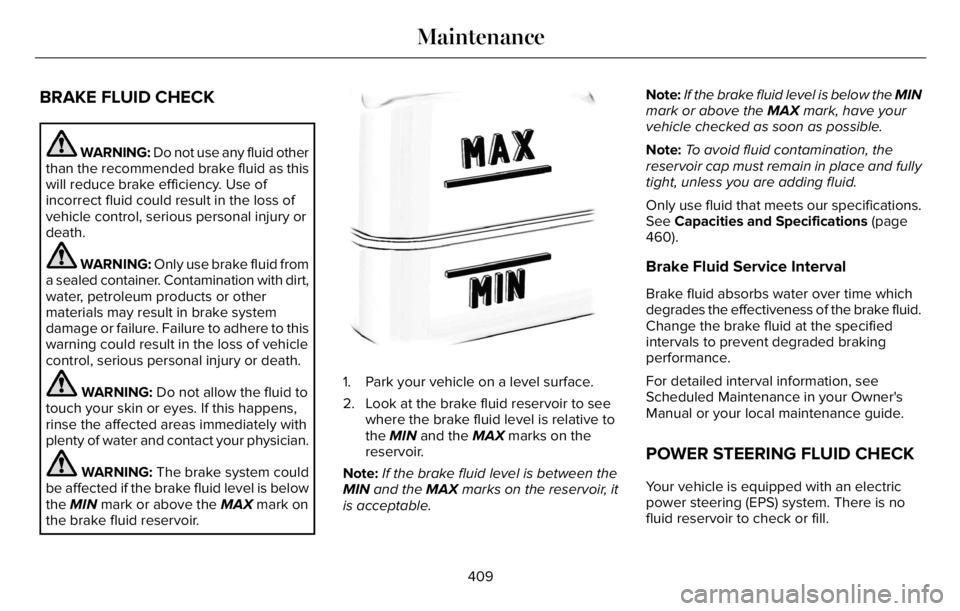
1. Park your vehicle on a level surface.
2. Look at the brake fluid reservoir to see
where the brake fluid level is relative to
the MIN and the MAX marks on the
reservoir.
Note:If the brake fluid level is between the
MIN and the MAX marks on the reservoir, it
is acceptable.Note:If the brake fluid level is below the MIN
mark or above the MAX mark, have your
vehicle checked as soon as possible.
Note:To avoid fluid contamination, the
reservoir cap must remain in place and fully
tight, unless you are adding fluid.
Only use fluid that meets our specifications.
See Capacities and Specifications (page
460).
Brake Fluid Service Interval
Brake fluid absorbs water over time which
degrades the effectiveness of the brake fluid.
Change the brake fluid at the specified
intervals to prevent degraded braking
performance.
For detailed interval information, see
Scheduled Maintenance in your Owner's
Manual or your local maintenance guide.
POWER STEERING FLUID CHECK
Your vehicle is equipped with an electric
power steering (EPS) system. There is no
fluid reservoir to check or fill.
409
Maintenance
Page 431 of 681
Body
• Wash your vehicle thoroughly to remove
dirt, grease, oil, tar or mud from exterior
surfaces, rear-wheel housing and the
underside of front fenders.
• Periodically wash your vehicle if it is
stored in exposed locations.
• Touch-up exposed or primed metal to
prevent rust.
• Cover chrome and stainless steel parts
with a thick coat of auto wax to prevent
discoloration. Re-wax as necessary when
you wash your vehicle.
• Lubricate all hood, door and luggage
compartment hinges and latches with a
light grade oil.
• Cover interior trim to prevent fading.
• Keep all rubber parts free from oil and
solvents.
Engine
• Change the engine oil and filter prior to
storage because used engine oil contains
contaminates which may cause engine
damage.
• Start the engine every 15 days for a
minimum of 15 minutes. Run at fast idle
with the climate controls set to defrost
until the engine reaches normal
operating temperature.
• With your foot on the brake, shift through
all the gears while the engine is running.
• We recommend that you change the
engine oil before you use your vehicle
again.
Fuel system
• Fill the fuel tank with high-quality fuel
until the first automatic shutoff of the fuel
pump nozzle.
Cooling system
• Protect against freezing temperatures.
• When removing your vehicle from
storage, check coolant fluid level.
Confirm that there are no cooling system
leaks and that fluid is at the
recommended level.
Disconnecting Your 12 Volt Battery
• Check and recharge as necessary. Keep
connections clean.
• If storing your vehicle for more than 30
days without recharging the battery, we
recommend that you disconnect the
battery cables to maintain battery charge
for quick starting.
Note:It is necessary to reset memory
features if you disconnect the battery cables.
428
Vehicle Care