parking brake LINCOLN CONTINENTAL 1996 Customer Assistance Guide
[x] Cancel search | Manufacturer: LINCOLN, Model Year: 1996, Model line: CONTINENTAL, Model: LINCOLN CONTINENTAL 1996Pages: 320, PDF Size: 1.8 MB
Page 192 of 320
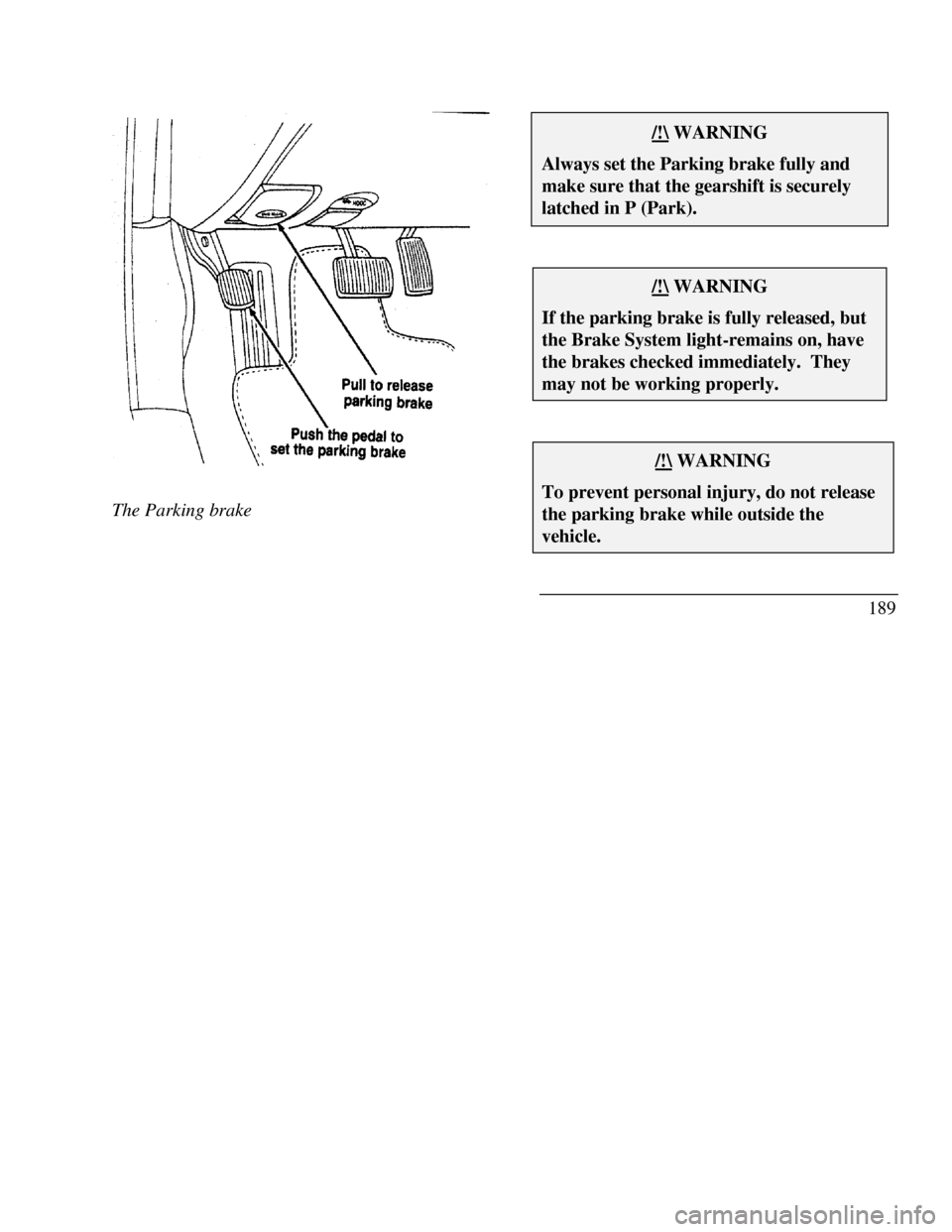
The Parking brake/!\ WARNINGAlways set the Parking brake fully andmake sure that the gearshift is securelylatched in P (Park)./!\ WARNINGIf the parking brake is fully released, butthe Brake System light-remains on, havethe brakes checked immediately. Theymay not be working properly./!\ WARNINGTo prevent personal injury, do not releasethe parking brake while outside thevehicle.189
Page 193 of 320

You have an automatic release for the parking brake.
The parking brake should automatically unlock when
you move the gearshift to any forward gear while the
engine is running. However, the automatic release
does not work when the gearshift is in reverse,
neutral or park.
To manually release the parking brake, pull the
BRAKE RELEASE handle located on the lower left
comer of the instrument panel. The Brake Warning
Light will illuminate if the parking brake is not fully
released when the engine is running.
The parking brake is not designed to stop a moving
vehicle, but you can use the parking brake to stop
your vehicle in an emergency if the normal brakes
fail. However, since the parking brake applies only
the rear brakes, the stopping distance will increase
greatly and the handling of your vehicle will be
adversely affected.
190Always check the Brake Warning light each
time you start your engine. Driving with the
parking brake on will cause the brakes to wear
out quickly and will reduce the fuel economy.
Driving Under Special Conditions
Tips for Safe Driving
As with any new vehicle, yours may drive and
handle differently from your previous vehicle.
Use care until you become accustomed to its
various features and driving characteristics.
Operate your vehicle within reasonable limits.
Sudden acceleration, deceleration, turning, or
combinations of these maneuvers can cause a
vehicle to behave differently than anticipated.
Page 203 of 320

/! WARNINGBatteries contain sulfuric acid which bumsskin, eyes, and clothing.If the acid touches someone's skin, eyes, or clothing,
immediately flush the area with water for at least 15
minutes. If someone swallows the acid, have him or
her drink lots of milk or water first, then Milk of
Magnesia, a beaten egg, or vegetable oil. Call a
doctor immediately.
To avoid damaging your vehicle or your battery, and
to avoid injury to yourself, follow these directions
for preparing your vehicle to jump-start and
connecting the jumper cables in the order they are
given. If in doubt, call for road service.
200Preparing Your Vehicle
1 .Your vehicle has a 12-volt starting system, so
you need to use a 12-volt jumper system. You
will damage your starting motor, ignition system,
and other electrical parts if you connect them to a
24-volt power supply (either two 12-volt
batteries in series,or a 24-volt generator set).
2.Do not disconnect the battery of the disabled
vehicle. You could damage the vehicle's
electrical system.
3.Park the booster vehicle close to the hood of the
disabled vehicle. Make sure the vehicles do not
touch each other. Set the parking brake on both
vehicles and stay clear of the engine cooling fan
and other moving parts.
4.Check all battery terminals and remove any
excessive corrosion before you attach the jumper
cables.
Page 207 of 320
Changing a Tire
if you get a flat tire while you are driving, do not
apply the brake heavily. Instead, gradually decrease
the speed. Hold the steering wheel firmly and
slowly move to a safe place on the side of the road.
Park on a level spot, turn off the ignition, set the
parking brake, and turn on the hazard flashers.
The Temporary Spare Tire
You may have a high pressure temporary spare tire.
This spare tire is smaller than a regular tire and is
designed for emergency use only. Use it only when
you get a flat tire and replace it as soon as you can.
This spare tire is marked with the words
"TEMPORARY USE ONLY" so that you can easily
identify it.
204/! WARNINGIf you use the temporary spare tirecontinuously or do not follow theseprecautions, the tire could fail, causing you tolose control of the vehicle, possibly injuringyourself or others.When you drive with the temporary spare tire,
DO NOT: exceed 50 mph (80 km/h) under any
circumstances. load your vehicle so that it is heavier than the
maximum vehicle load rating listed on the tire
decal. tow a trailer. try to repair the temporary spare tire or remove it
from its wheel. use the wheel for any other type of vehicle.
Page 209 of 320
To remove the spare tire:
1.Remove the spare tire cover.
2.Unscrew the wing-nut holding down the spare
tire.
3. Lift out the spare tire and jack kit.
Preparing to Change the Tire
1.Make sure that your vehicle will not move or
roll. Put the gearshift in P (Park). Set the
parking brake and block the wheel that is
diagonally opposite the tire that you are
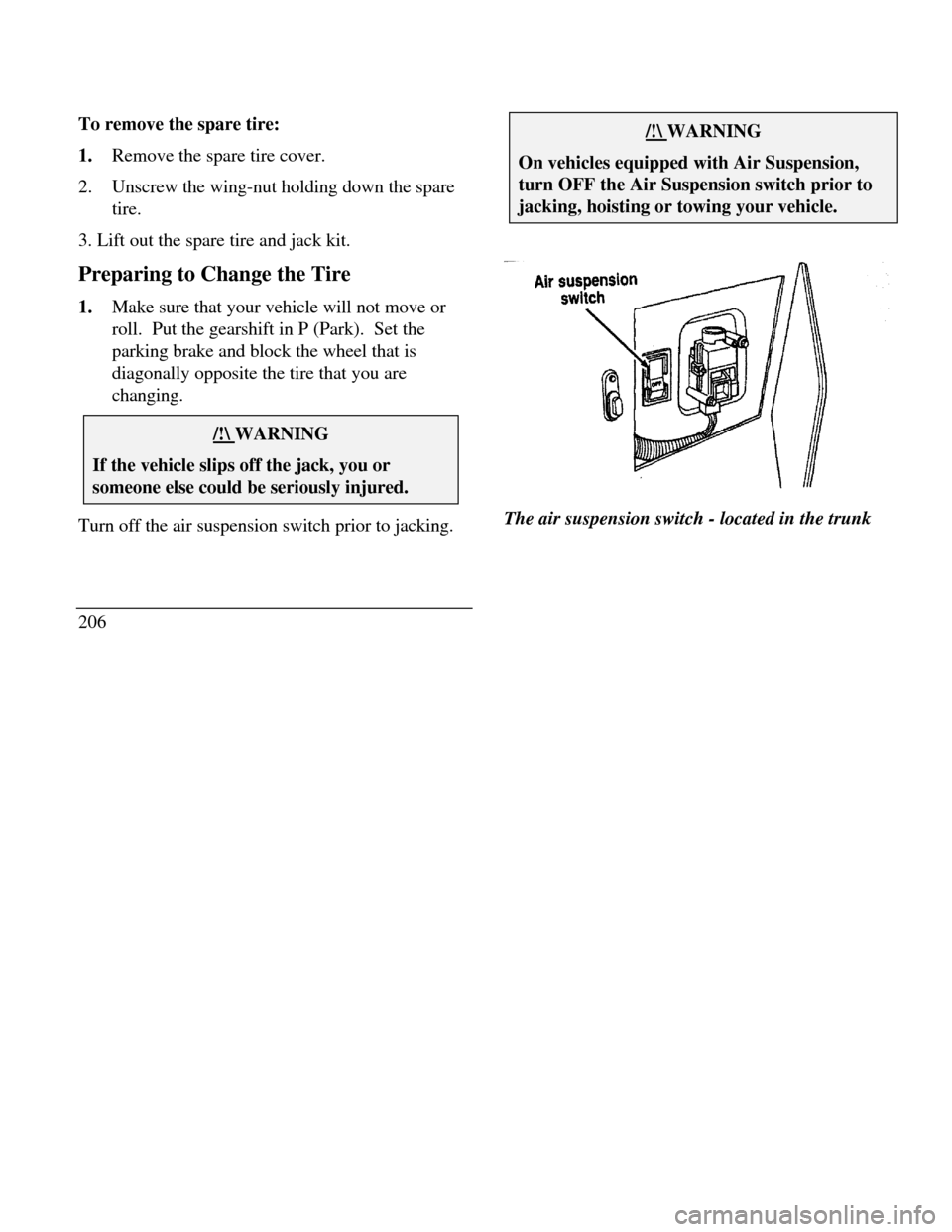
changing./! WARNINGIf the vehicle slips off the jack, you orsomeone else could be seriously injured.Turn off the air suspension switch prior to jacking.
206/! WARNINGOn vehicles equipped with Air Suspension,turn OFF the Air Suspension switch prior tojacking, hoisting or towing your vehicle.Air suspension switchThe air suspension switch - located in the trunk
Page 235 of 320
Precautions When Servicing Your
Vehicle
Be especially careful when inspecting or servicing
your vehicle. Here are some general precautions
for your safety: Do not work on a hot engine. The engine
cooling fan may come on unexpectedly. Always
turn the engine off and let it cool./!\ WARNINGThe cooling fan is automatic and may comeon at any time. Always disconnect thenegative terminal of the battery beforeworking near the fan. If you must work with the engine running,
avoid wearing loose clothing or jewelry that
could get caught in moving parts. Take
appropriate precautions with long hair. Do not work on a vehicle in an enclosed space
with the engine running, unless you are sure you
have enough ventilation. Never get under a vehicle while it is supported by a
jack only. If you must work under a vehicle, use
safety stands. Keep all lit cigarettes and other smoking materials
away from the battery and all fuel-related parts.
If you disconnect the battery, the engine must
“relearn" its idle conditions before your vehicle will
drive properly. To find out how the engine does this,
see Battery in this chapter.
Working with the engine off.
1. Set the parking brake fully and make sure that the
gearshift is securely latched in P (Park).
2.Remove the key from the ignition after you turn
the engine off.
233
Page 236 of 320
3.Block the wheels. This will prevent your
vehicle from moving unexpectedly.
Working with the engine on:
1. Set the parking brake fully and make sure that
the gearshift is securely latched in P (Park).
2.Block the wheels. This will prevent your
vehicle from moving unexpectedly./! WARNINGDo not start your engine with the aircleaner removed and do not remove it whilethe engine is running./! WARNINGThe cooling fan is automatic and may comeon at any time. Always disconnect thenegative terminal of the battery beforeworking near the fan.234If the battery is disconnected' the computer must
releam its idle control. See Battery in the Index.
NOTE: The engine compartment light may be
switched on or off at the light assembly. The light
assembly is located on the hood on the driver's side.
To turn the light on, pull the switch toward you; to
turn it off, push it away from you. The switch may
remain in the on position at all times, as the light will
turn off when the hood is closed.
Opening the Hood
1. Inside the vehicle, pull the hood release handle
located under the bottom left comer of the
instrument panel.
Page 248 of 320
2.Set the parking brake, making sure the gearshift
is securely latched in P (Park).
3.Open the hood. Protect yourself from engine
heat.
4.Locate the engine oil dipstick (highlighted in
yellow) and carefully pull it out of the engine.
5.Wipe the dipstick clean and put it back into
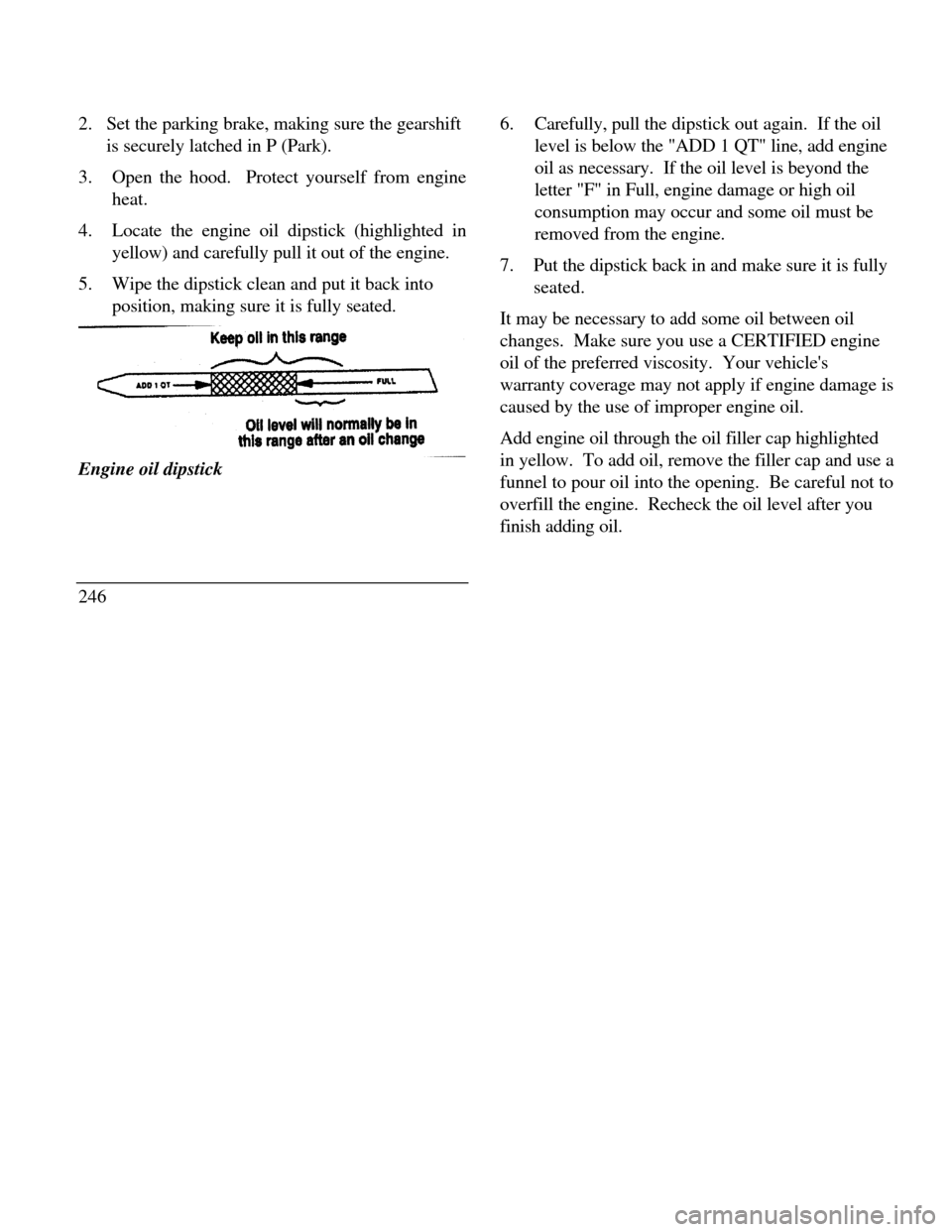
position, making sure it is fully seated.Engine oil dipstick
2466.Carefully, pull the dipstick out again. If the oil
level is below the "ADD 1 QT" line, add engine
oil as necessary. If the oil level is beyond the
letter "F" in Full, engine damage or high oil
consumption may occur and some oil must be
removed from the engine.
7.Put the dipstick back in and make sure it is fully
seated.
It may be necessary to add some oil between oil
changes. Make sure you use a CERTIFIED engine
oil of the preferred viscosity. Your vehicle's
warranty coverage may not apply if engine damage is
caused by the use of improper engine oil.
Add engine oil through the oil filler cap highlighted
in yellow. To add oil, remove the filler cap and use a
funnel to pour oil into the opening. Be careful not to
overfill the engine. Recheck the oil level after you
finish adding oil.
Page 263 of 320

See Securitires in the Features chapter for more
information.
Automatic Transaxle Fluid
Under normal circumstances, you do not need to
check the fluid level of the transaxle, since your
vehicle does not use up transaxle fluid. Refer to the
Maintenance Schedule and Record booklet for
replacement intervals. However, if the transaxle is
not working properly - for instance, the transaxle
may slip or shift slowly, or you may notice some
sign of fluid leakage - the fluid level should be
checked.
NOTE: If the vehicle has been operated for an
extended period at high speeds or in city traffic
during hot weather, or pulling a trailer, the vehicle
should be turned off for about 30 minutes to allow
the fluid to cool before checking.Checking the Automatic Transaxle Fluid
With the vehicle on a level surface and the brake fully
applied, start the engine and move the gear shift
selector through all of the gears allowing sufficient
time for each position to engage. Securely latch the
gear shift selector in the P (Park) position. Fully set
the parking brake and leave the engine running.
Wipe off the dipstick cap and pull the dipstick out.
Wipe the indicator end clean. Put the dipstick back
into the filler tube and make sure it is fully seated.
Pull the dipstick out and read the fluid level.
NOTE: Your vehicle should not be driven until
some fluid has been added if the fluid level is below
the bottom dimple on the dipstick and the outside
temperature is above 50°F (10°C). Add only enough
fluid to bring the level above the bottom hole.
261
Page 294 of 320

Battery Check and recharge as necessary. Keep connections clean and covered with a light
coat of grease. If storing your vehicle for more than 30 days
without recharging the battery, disconnect the
battery cables to ensure battery charge is
maintained for quick starting. NOTE: If battery
cables are disconnected, it will be necessary to
reset any memory features (eg. radio presets).
Brakes Make sure brakes and parking brake are fully
released.
292Tires Maintain recommended air pressures.
Miscellaneous Make sure all linkages, cables, levers and
clevis pins under vehicle are covered with grease to
prevent rust. Move vehicles at least 25 feet (8 m) every 15
days to lubricate working parts and prevent
corrosion.