tires LINCOLN CONTINENTAL 1996 Customer Assistance Guide
[x] Cancel search | Manufacturer: LINCOLN, Model Year: 1996, Model line: CONTINENTAL, Model: LINCOLN CONTINENTAL 1996Pages: 320, PDF Size: 1.8 MB
Page 258 of 320
Keep your tires inflated to the recommended
pressures. Stay within the recommended load limits (see
Load limits in the Index). Make sure the weight of your load is evenly
distributed.
If you do not take these precautions, your tires may
fail or go flat.
Ford Motor Company recommends obeying posted
speed limits./!\ WARNINGDriving too fast for conditions creates thepossibility of loss of vehicle control. Drivingat very high speeds for extended periods oftime may result in damage to vehiclecomponents.256At least once a month, check the pressure in all your
vehicle's tires, including the spare. Use an accurate
tire pressure gauge. Check the tire pressure when
tires are cold, after the vehicle has been parked for at
least one hour or has been driven less than 3 miles (5
km). You can find proper cold pressure and load
limits of recommended size tires on the Safety
Compliance Certification Label./!\ WARNINGImproperly inflated tires can affect vehiclehandling and can fail suddenly, possiblyresulting in loss of vehicle control.Tire Rotation
Because your vehicle's front and rear tires perform
different jobs, they often wear differently. To make
sure your tires wear evenly and last longer, rotate
them as indicated in the following diagram.
Page 259 of 320
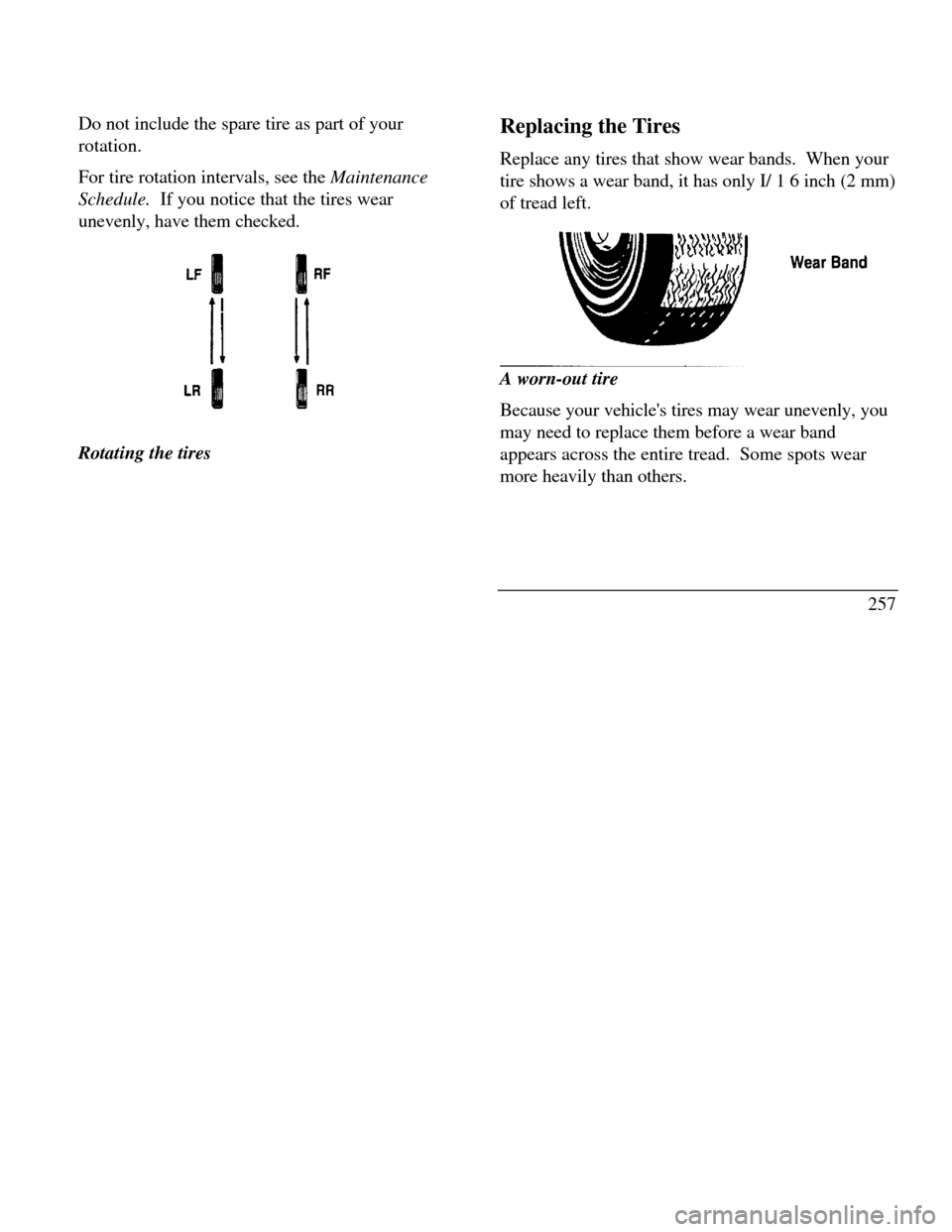
Do not include the spare tire as part of your
rotation.
For tire rotation intervals, see the Maintenance
Schedule. If you notice that the tires wear
unevenly, have them checked.Rotating the tiresReplacing the Tires
Replace any tires that show wear bands. When your
tire shows a wear band, it has only I/ 1 6 inch (2 mm)
of tread left.A worn-out tire Wear Band
Because your vehicle's tires may wear unevenly, you
may need to replace them before a wear band
appears across the entire tread. Some spots wear
more heavily than others.
257
Page 260 of 320

/!\ WARNINGWhen replacing full size tires, never mixradial, bias-belted, or bias-type tires. Use onlythe tire sizes that are listed on the tirepressure decal. Make sure that all tires arethe same size, speed rating, and load-carryingcapacity. Use only the tire combinationsrecommended on the decal. If you do notfollow these precautions, your vehicle may notdrive properly and safely.Tires that are larger or smaller than your vehicle's
original tires may also affect the accuracy of your
speedometer.
258Information About Tire Quality Grades
New vehicles are fitted with tires that have their Tire
Quality Grade (described below) molded into the
tire's sidewall. These Tire Quality Grades are
determined by standards that the United States
Department of Transportation has set.
Tire Quality Grades apply to new pneumatic tires for
use on passenger cars. They do not apply to deep
tread, winter-type snow tires, space-saver or
temporary use spare tires, tires with nominal rim
diameters of 10 to 12 inches or limited production
tires as defined in Title 49 Code of Federal
Regulations Part 575.104(c)(2).
U.S. Department of Transportation - Tire quality
grades: The U.S. Department of Transportation
requires Ford to give you the following information
about tire grades exactly as the government has
written it.
Page 261 of 320

Treadwear
The treadwear grade is a comparative rating based
on the wear rate of the tire when tested under
controlled conditions on a specified government test
course. For example, a tire graded 150 would wear
one and one-half (1 1/2) times as well on the
government course as a tire graded 100. The
relative performance of tires depends upon the
actual conditions of their use, however, and may
depart significantly from the norm due to variations
in driving habits, service practices and differences in
road characteristics and climate.
Traction A B C
The traction grades, from highest to lowest, are A, B,
and C, and they represent the tire's ability to stop on
wet pavement as measured under controlled
conditions on specified government test surfaces of
asphalt and concrete. A tire marked C may have
poor traction performance. Warning: The traction
grade assigned to this tire is based on braking(straightahead) traction tests and does not include
cornering (turning) traction.
Temperature A B C
The temperature grades are A (the highest), B, and
C, representing the tire's resistance to the generation
of heat and its ability to dissipate heat when tested
under controlled conditions on a specified indoor
laboratory test wheel. Sustained high temperature
can cause the material of the tire to degenerate and
reduce tire life, and excessive temperature can lead
to sudden tire failure. The grade C corresponds to a
level of performance which all passenger car tires
must meet under the Federal Motor Vehicle Safety
Standard No. 109. Grades B and A represent higher
levels of performance on the laboratory test wheel
than the minimum required by law. Warning: The
temperature grade for this tire is established for a tire
that is properly inflated and not overloaded.
Excessive speed, underinflation, or excessive
259
Page 262 of 320
loading, either separately or in combination, can
cause heat buildup and possible tire failure.
Snow tires
The tires on your vehicle have all-weather treads
that provide traction in rain or snow. However,
during the winter months in some climates, you may
need to use snow tires.
Use of tire chains is not recommended. The use of
tire chains could result in damage to your vehicle./!\ WARNINGSnow tires must be the same size and gradeas the tires you Currently have on yourvehicle.Cleaning the Wheels
Wash the wheels with the same detergent you use
to wash your vehicle's body. Do not use acid-based
wheel cleaners, steel wool, abrasives, fuel, or strong
260detergents. These substances will damage protective
coatings. Use tar and road oil remover to remove
grease and tar.
NOTE: Before going to a car wash, find out if the
brushes are abrasive.
If you have whitewall tires that are difficult to clean
with regular detergent, use whitewall tire cleaner.
Follow the directions on the container and rinse the
tires with plenty of clean water.
Securitires (If equipped)
Securitires are designed to allow you to continue
driving your Continental a limited number of miles
when one of your vehicle's tires is at low or even
zero air pressure./!\ WARNINGDo not use aerosol tire inflator/sealer withSecuritires. Doing so may damage the tire'spressure sensor.
Page 263 of 320

See Securitires in the Features chapter for more
information.
Automatic Transaxle Fluid
Under normal circumstances, you do not need to
check the fluid level of the transaxle, since your
vehicle does not use up transaxle fluid. Refer to the
Maintenance Schedule and Record booklet for
replacement intervals. However, if the transaxle is
not working properly - for instance, the transaxle
may slip or shift slowly, or you may notice some
sign of fluid leakage - the fluid level should be
checked.
NOTE: If the vehicle has been operated for an
extended period at high speeds or in city traffic
during hot weather, or pulling a trailer, the vehicle
should be turned off for about 30 minutes to allow
the fluid to cool before checking.Checking the Automatic Transaxle Fluid
With the vehicle on a level surface and the brake fully
applied, start the engine and move the gear shift
selector through all of the gears allowing sufficient
time for each position to engage. Securely latch the
gear shift selector in the P (Park) position. Fully set
the parking brake and leave the engine running.
Wipe off the dipstick cap and pull the dipstick out.
Wipe the indicator end clean. Put the dipstick back
into the filler tube and make sure it is fully seated.
Pull the dipstick out and read the fluid level.
NOTE: Your vehicle should not be driven until
some fluid has been added if the fluid level is below
the bottom dimple on the dipstick and the outside
temperature is above 50°F (10°C). Add only enough
fluid to bring the level above the bottom hole.
261
Page 294 of 320

Battery Check and recharge as necessary. Keep connections clean and covered with a light
coat of grease. If storing your vehicle for more than 30 days
without recharging the battery, disconnect the
battery cables to ensure battery charge is
maintained for quick starting. NOTE: If battery
cables are disconnected, it will be necessary to
reset any memory features (eg. radio presets).
Brakes Make sure brakes and parking brake are fully
released.
292Tires Maintain recommended air pressures.
Miscellaneous Make sure all linkages, cables, levers and
clevis pins under vehicle are covered with grease to
prevent rust. Move vehicles at least 25 feet (8 m) every 15
days to lubricate working parts and prevent
corrosion.
Page 297 of 320
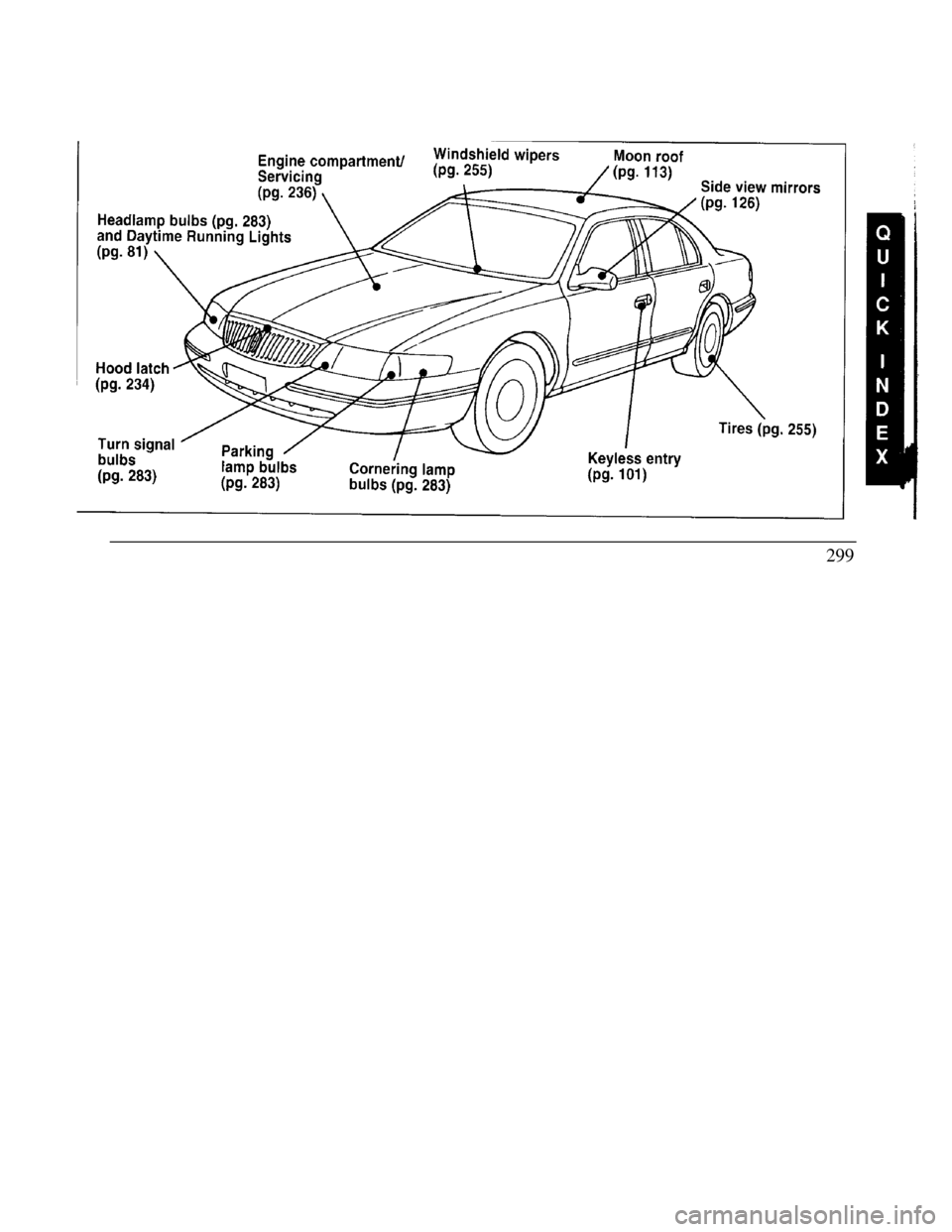
Engine compartment/ Servicing Windshield wipers Headlamp bulbs and Daytime Running Lights Hood latch Turn signal bulbs Parking lamp bulbs
Cornering lamp bulbs Moon roof Keyless entry Side view mirrors Tires299
Page 307 of 320

applying the brakes.........................187
brake warning light...........................52
fluid, checking and adding..............263
fluid, refill capacities.......................287
fluid, specifications.........................289
new brake linings................................6
noise...............................................188
parking...........................................188
trailer.............................................197
when storing your vehicle...............292
Brake-shift interlock.............................180
Break-in period........................................6
Bulbs, replacing....................................277
headlamps........................................278
C
Canada, customer assistance.................219
Canadian Motor Vehicle Arbitration Plan
(CAMVAP).......................................220
Capacities for refilling fluids.................287
Carbon monoxide in exhaust...................49
Car seats for children
(see Child safety seats).........................27Catalytic converter284
CD player (see Electronic sound system) . 169
Chains, tires260
Changing a tire204
Charging system warning light 55
Childproof locks 99
Child safety restraints 25
child safety belts 38
child safety seats 27
Child safety seats
attaching with tether straps 38
tether anchorage hardware 38
Chime
headlamps on 58
key in ignition 42
safety belt 52
Cleaning your vehicle
chrome and aluminum parts 8
exterior 7
exterior lamps 83
fabric118
headlamps 83
309
Page 315 of 320

R
Radio (see Electronic sound systems)...159
Rearview mirror...................................125
Refill capacities for fluids.....................287
Remote entry system
arming and disarming the anti-theft
system...........................................106
locking/unlocking doors...................105
opening the trunk.............................106
panic alarm......................................106
replacement/additional transmitters..107
replacing the batteries......................106
RESCU system....................................144
Restraints, safety (see Safety restraints)
adult....................................................9
child..................................................25
head................................................114
infant.................................................25
Roadside emergencies..........................199
Rotating the tires..................................256S
Safe driving tips....................................190
Safety belts (see Safety restraints)............9
Safety chains, when towing a trailer......196
Safety Compliance Certification Label..192
Safety defects, reporting.......................218
Safety information relating to automotive
fuels................................................241
Safety restraints
adjusting the safety belts................12,16
cleaning the safety belts.....................17
extension assembly............................16
for children.......................................25
for infants.........................................25
lap and shoulder belts........................11
maintenance......................................17
replacement......................................17
warning light and chime....................52
Safety seats for children
and air bags...................................19,27
attaching with tether straps.................38
317