lights LINCOLN CONTINENTAL 1996 Customer Assistance Guide
[x] Cancel search | Manufacturer: LINCOLN, Model Year: 1996, Model line: CONTINENTAL, Model: LINCOLN CONTINENTAL 1996Pages: 320, PDF Size: 1.8 MB
Page 114 of 320
Triggering the alarm system
The armed system will be triggered if: any door is opened without disarming the
system (see previous paragraphs), or the trunk lock cylinder is removed, or
NOTE: You can open the trunk with your key
without setting off the alarm. the hood is opened.
Disarming a triggered system
The alarm can be disarmed by: unlocking a front door with the key using the keyless entry unlock code using the UNLOCK button of the remote entry
transmitterNOTE: The flashing lights and honking horn
will shut off automatically approximately
three minutes after the system is triggered.
It will trigger again if another intrusion
occurs. However, the engine will not be
allowed to start until the system is disarmed.
Windows
Using the Power Windows
Each door has a power control that opens and
closes the window on that door. The driver's
door has a master control panel that operates all
four windows.
Power windows can only be opened or closed
when the ignition is in the ON or ACC position
or during the ten minute delayed accessory
period after the ignition is turned off.
111
Page 128 of 320
NOTE: The combination of FIRM RIDE
CONTROL and LOW STEERING EFFORT is
undesirable and cannot be selected.
Mirrors
Automatic Dimming Inside Rearview
Mirror (If equipped)
Some vehicles are equipped with an inside rearview
mirror and an outside driver's side mirror which have
an Auto-Dimming function. These electronic
day/night mirrors will change from the normal state
to the non-glare state when bright lights (glare)
reach the mirrors. These mirrors function at night,
and have a limited function at dusk or dawn. From
the non-glare state, the mirrors will return to the
normal state after a short delay. The delay starts
when glare goes away. The delay prevents
excessive changing of the mirrors as traffic moves
behind and around the vehicle, or on rolling hills and
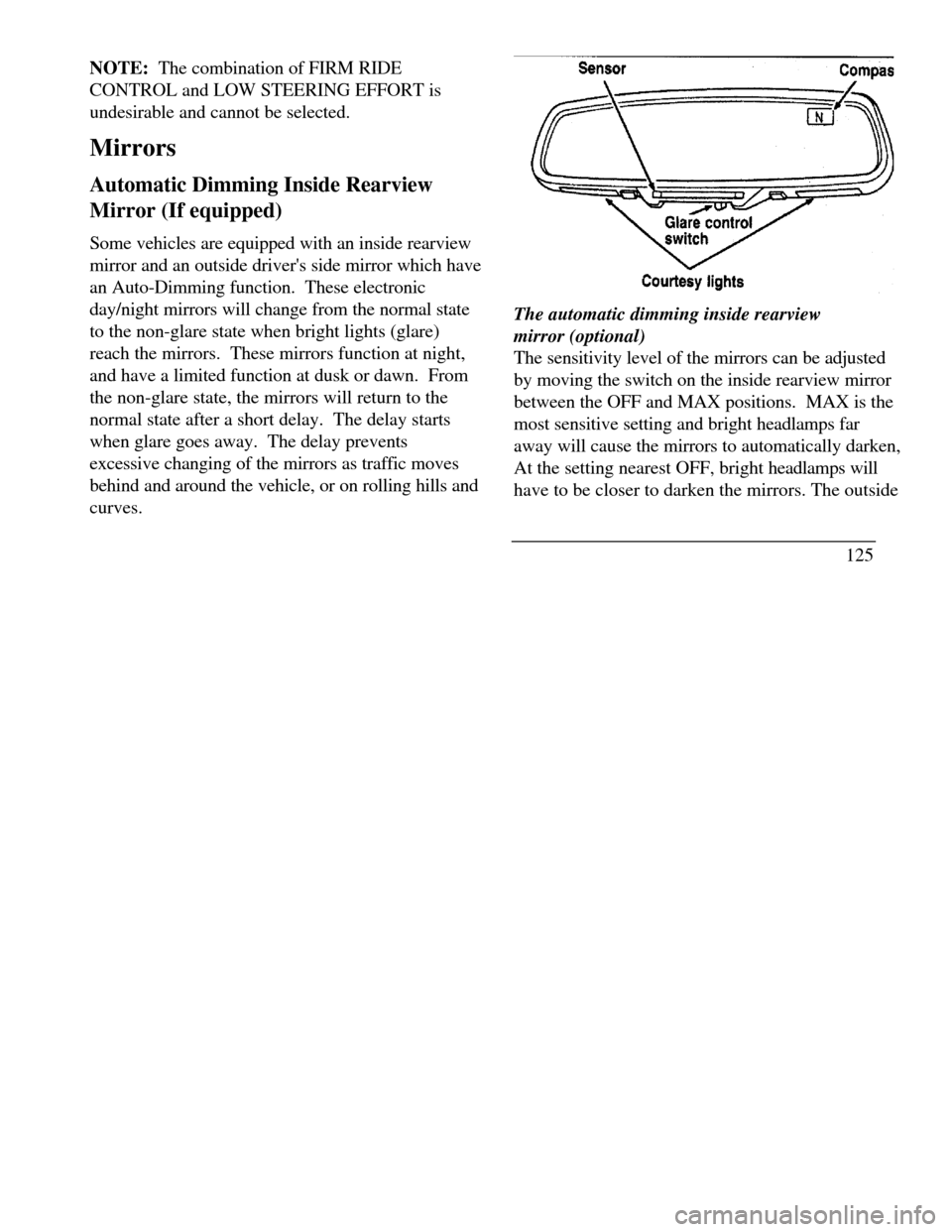
curves.The automatic dimming inside rearview
mirror (optional)
The sensitivity level of the mirrors can be adjusted
by moving the switch on the inside rearview mirror
between the OFF and MAX positions. MAX is the
most sensitive setting and bright headlamps far
away will cause the mirrors to automatically darken,
At the setting nearest OFF, bright headlamps will
have to be closer to darken the mirrors. The outside
125
Page 165 of 320

Manual tuning adjusts your radio to any
allowable broadcast frequency, whether or not a
station is present on that frequency. (See All
About Radio Frequencies in this section.) Using the "SEEK" function
Press the right *) side of the 'SEEK" button to
select the next listenable station up the
frequency band. Press the left (.4) side of the
button to select the next listenable station
down the frequency band. By holding the
button down, listenable stations can be passed
over to reach the desired station. Using the 'SCAN" function
Pressing the "SCAN" button will begin the
scan mode up the frequency band, stopping on
each listenable station for approximately five
seconds.
To stop the scan mode on the presently
sampled station, press the "SCAN" button again.
162 Setting the station MEMORY PRESET buttons
Your radio is equipped with 6 station
memory buttons. These buttons can be used
to select up to 6 preset AM stations and 12
FM stations (6 in FMI and 6 in FM2)
1Select a band, then select a frequency.
2.Press one of the memory buttons and hold
until the sound returns and the lamp above
the memory button lights up. That
memory button is now set.
3.Follow the above steps for each memory
preset button.
NOTE:Custom memory presets
can be recalled using the keyless entry
system. See Memory Profile System in
the Features chapter.
Page 180 of 320

To minimize these conditions, a stereo/mono
blend circuit has been incorporated into this
system. This feature automatically switches a
weak stereo signal to a clearer monaural signal,
which improves the quality of reception.
Several sources of static are normal conditions
on AM frequencies. These can be caused by
power lines, electric fences, traffic lights and
thunderstorms.
Another reception phenomenon is Strong Signal
Capture and Overload. This can occur when
listening to a weak station and when passing
another broadcast tower. The close station may
capture the more distant station, although the
displayed frequency does not change. While
passing the tower, the station may switch back
and forth a few times before returning to the
original station.When several broadcast towers are present
(common in metropolitan areas) several
stations may overload the receiver,
resulting in considerable station changing,
mixing and distortion.
Automatic gain control circuitry for both AM and
FM bands has been incorporated into this system to
reduce strong signal capture and overload.
All About Radio Frequencies
The Federal Communications Commission (FCC)
and the Canadian Radio Telecommunications
Commission (CRTC) establish the frequencies that
AM and FM radio stations may use for their
broadcasts. The allowable frequencies are, AM:
530, 540... 1600, 1610 kHz in 10 kHz steps; FM:
87.9, 88.1... 107.7, 107.9 MHz in 0.2 MHz steps.
Not all frequencies will be assigned to a given area.
This radio will time to each of these frequencies
using manual tune and no fine tuning is necessary as
radio stations may not use other frequencies.
177
Page 200 of 320
To connect the trailer's safety chains:
1. Cross the chains under the trailer tongue and
attach them to your vehicle's frame or hook
retainers. Never attach the safety chains to your
vehicle's bumper. The bumper is not designed to
bear the weight of a trailer.
2. Make sure that you leave enough slack in the
chains to allow you to turn corners.
If you use a rental trailer, follow the instructions that
the rental agency gives you.
Connecting the trailer's brakes
Electric brakes and manual, automatic, or surge-type
hydraulic brakes are safe if you install them properly
and adjust them according to the manufacturer's
instructions. Be sure that your trailer's brakes meet
local and federal regulations.
Separate trailer brakes of adequate size should be
used for trailers weighing over 1.000 lbs. (454 kg)
loaded weight./!\ WARNINGDo not connect a trailer's hydraulicbrake system directly to your vehicle'sbrake system. Your vehicle may nothave enough braking power and yourchances of having a collision greatlyincrease.Connecting the trailer's lights
Do not connect a trailer's fighting system
wiring directly to your vehicle's fighting
system wiring. To get the proper equipment
for hooking up your trailer's lights, see your
local trailer dealer and your Ford dealer. Be
sure to follow their instructions carefully.
If you do not install trailer lights correctly, you
may cause damage to the vehicle's hghting
system.
197
Page 202 of 320
Roadside EmergenciesJump-Starting Your Vehicle
Your vehicle's battery may die if you leave the lights
on or any electrical equipment on after you turn the
engine off. If this happens, you may be able to
jump-start from a booster battery to start your
vehicle./! WARNINGThe gases around the battery can explode ifexposed to flames, sparks, or lit cigarettes.An explosion could result in injury or vehicledamage./! WARNINGTo protect yourself when charging a battery,always shield your face and eyes. Make surethat you can breathe fresh air./! WARNINGApplying too much pressure on the ends whenlifting a battery could cause acid to spill. Liftthe battery with a carrier or with your handson the opposite comers.199
Page 246 of 320
Using speed control in hilly terrain Extended use of the A/C, defroster, rear window
defroster and other accessories Underinflated tires Heavy loads Aftermarket add-ons such as bike, ski or luggage
racks, bug deflectors, etc.
Self-Service Pointers
If you choose to do your own fueling, you should
also perform a few simple maintenance routines.
This extra effort will save you additional money and
contribute to the driving efficiency of your vehicle.
The following procedures require only a tire gauge,
a rag, an oil can spout and windshield washer fluid.Check the engine oil at every refueling stopClean the windshield, outside mirrors and
headlights
244 Check windshield washer fluid Check tires for excessive wear or worn edges Check the tire pressure at least monthly
Engine Oil Recommendations
We recommend using Motorcraft oil or an equivalent
oil meeting Ford Specification ESE-M2C153-E and
displaying the American Petroleum Institute
CERTIFICATION MARK on the front of the
container.
Page 279 of 320
/! WARNINGAlways replace a fuse with one that has thespecified amperage rating. Using a fuse witha higher amperage rating can cause severewire damage and could start a fire.5.Align the edge of the cover with the edge of
the fuse panel and push the cover up until it
latches.
Even after you replace a fuse, it will continue to
blow if you do not find what caused the overload.
If the fuse continues to blow, have your electrical
system checked.
Lights and Bulb Replacement
It is a good idea to check the operation of the
following lights ftequently: headlamps high-mount brakelamp tail lamps brakelamps hazard flasher turn signals side markers license plate lamp
The alignment of your headlamps should be
checked if: oncoming motorists frequently signal you to
turn off your vehicle's high beams when you do
not have the high beams on the headlamps do not seem to give you enough
light to see clearly at night
277
Page 285 of 320

Bulb specifications
FunctionTrade numberExterior illuminationBackup lamp3156Cornering lamp3156Headlamp9007High-mount brakelamp912License plate lamp168Luggage compartment lamp912Side marker - front lamp916NA*Side marker - rear lamp194Turn signal and park lamp - front3457NA*Turn signal, stoplamp and tail lamp
- rear3157Redundant turn - rear3157Decklid reflector168Instrument panel lightsElectronic automatic temperature
control***Air bag readiness light37Anti-lock warning lamp37And-theft warning lamp37Ash receptacle1445Ash ttay - rear doors37Clock***FunctionTradenumberInstrument panel lights (continued)Cluster illumination***Cluster control button37Compact disc player**Glove compartment194Headlamp switch nomenclature37Message center control buttons***“PRN@D I" bulb (floor console)194Rear window defrost switchnomenclature37Radio**Warning lights (cluster)37Interior courtesy lampsCigar lighter (door mounted)1893Door mounted lamp (front and rear)214-2Illuminated visor mirror (passenger)74Overhead console-reading lamps (without
moon roof)211-2Passenger assist handle (rear seat)211-2Under instrument panel906*NA means Natural Amber.
**Refer bulb replacement to a Ford -authorized radio service
center.
***Refer bulb replacement to a Ford or Lincoln-Mercury
dealer.
283
Page 297 of 320
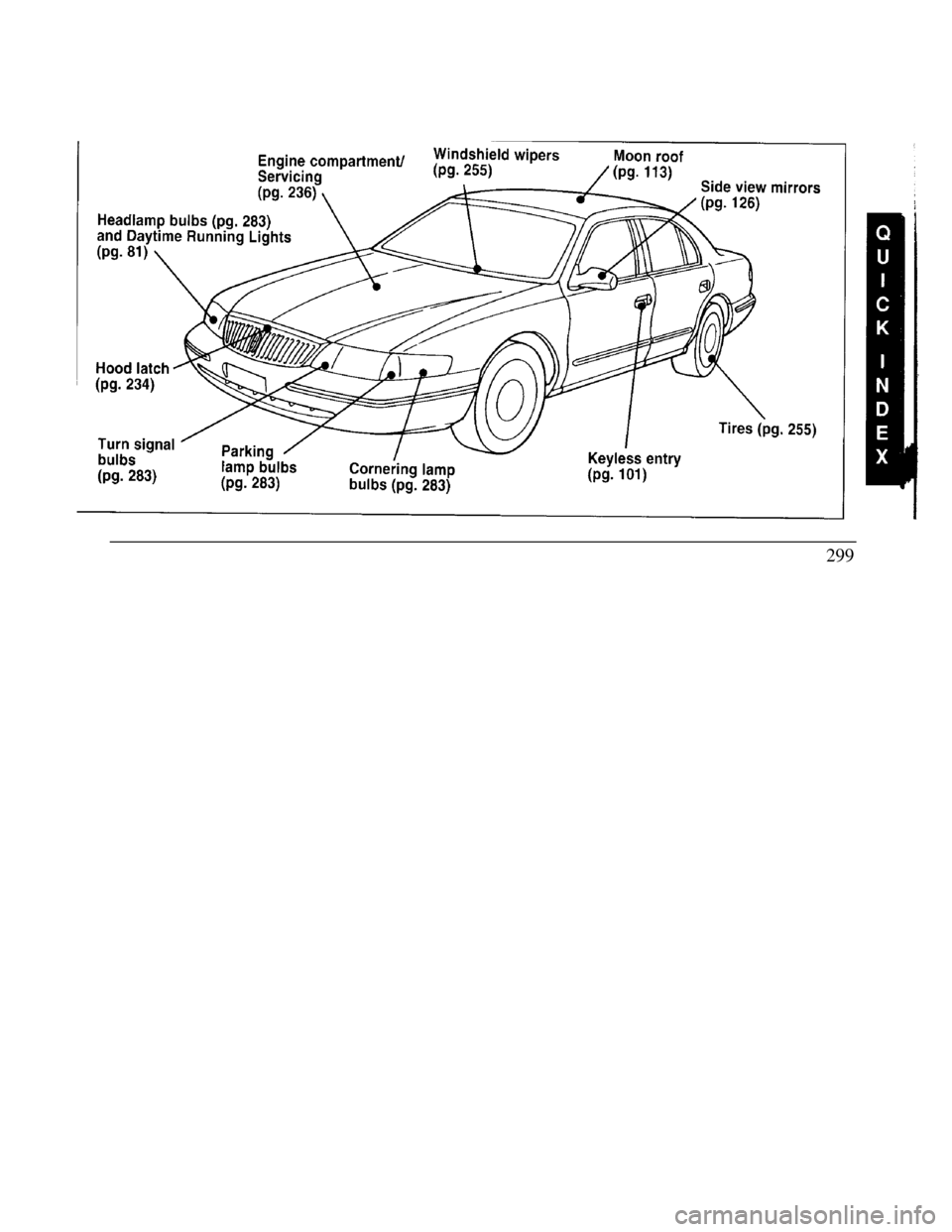
Engine compartment/ Servicing Windshield wipers Headlamp bulbs and Daytime Running Lights Hood latch Turn signal bulbs Parking lamp bulbs
Cornering lamp bulbs Moon roof Keyless entry Side view mirrors Tires299