coolant level LINCOLN CONTINENTAL 1996 Customer Assistance Guide
[x] Cancel search | Manufacturer: LINCOLN, Model Year: 1996, Model line: CONTINENTAL, Model: LINCOLN CONTINENTAL 1996Pages: 320, PDF Size: 1.8 MB
Page 64 of 320
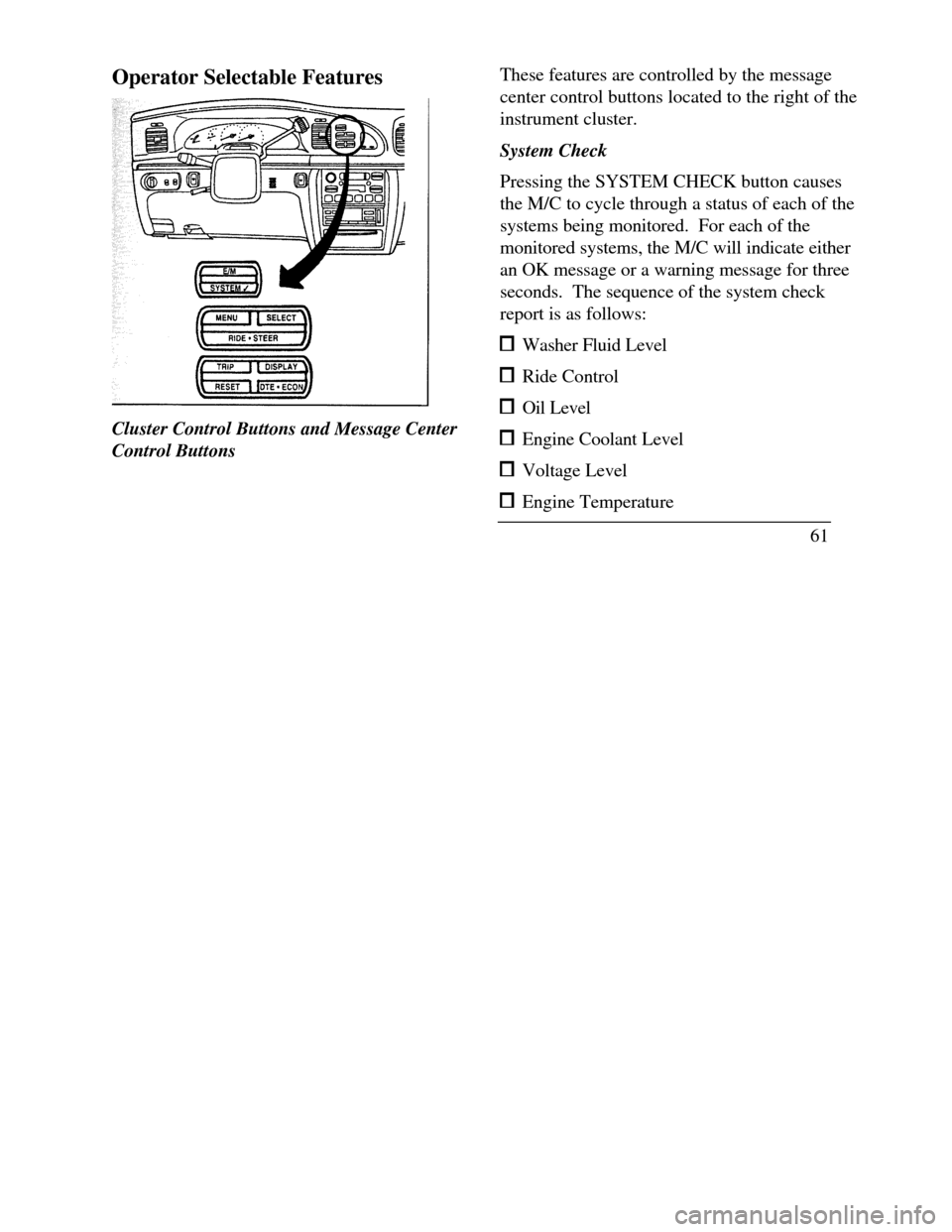
Operator Selectable FeaturesCluster Control Buttons and Message Center
Control ButtonsThese features are controlled by the message
center control buttons located to the right of the
instrument cluster.
System Check
Pressing the SYSTEM CHECK button causes
the M/C to cycle through a status of each of the
systems being monitored. For each of the
monitored systems, the M/C will indicate either
an OK message or a warning message for three
seconds. The sequence of the system check
report is as follows: Washer Fluid Level Ride Control Oil Level Engine Coolant Level Voltage Level Engine Temperature
61
Page 65 of 320
Doors Closed Trunk Closed Trunk Closed Exterior Lamps Distance to Empty Fuel Level TractionControl (if equipped)
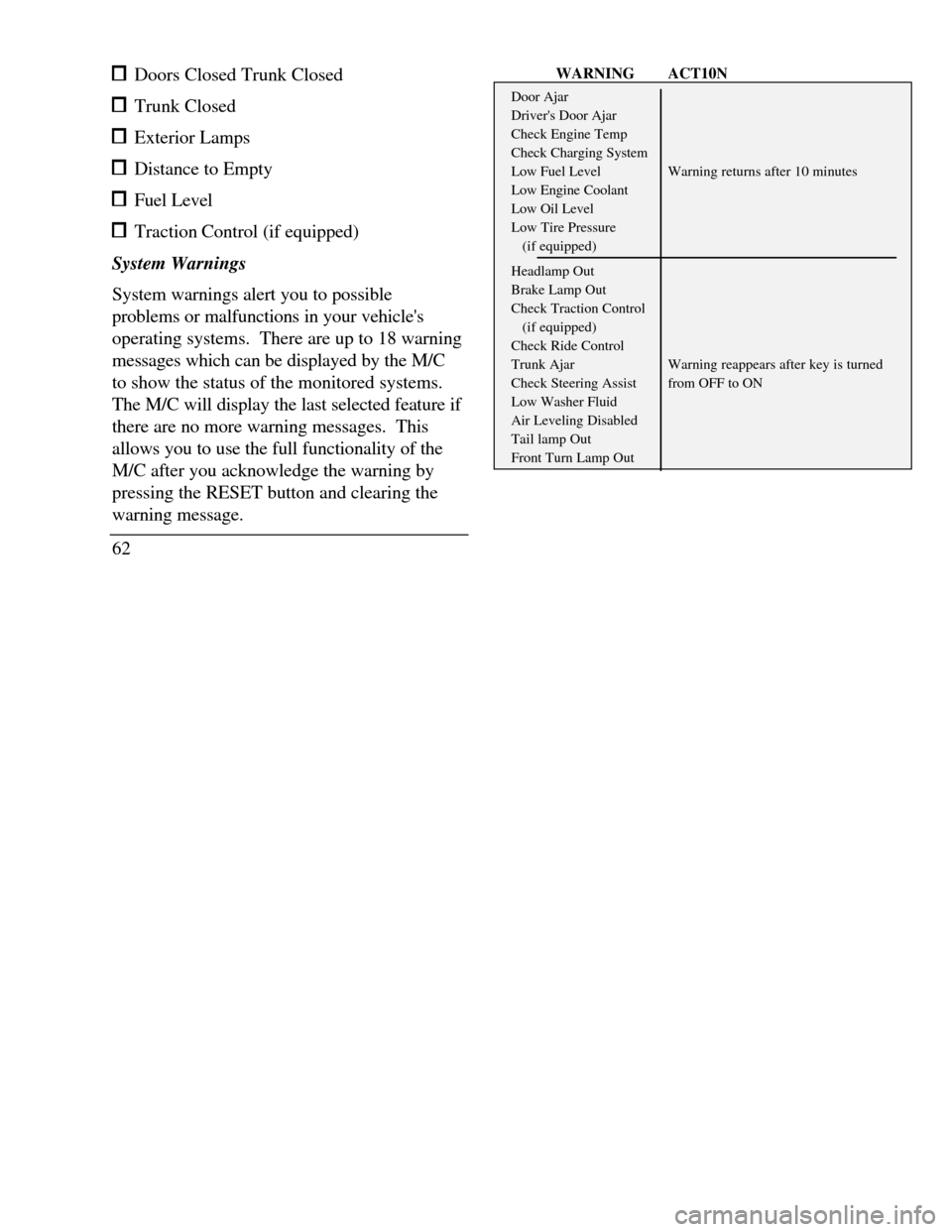
System Warnings
System warnings alert you to possible
problems or malfunctions in your vehicle's
operating systems. There are up to 18 warning
messages which can be displayed by the M/C
to show the status of the monitored systems.
The M/C will display the last selected feature if
there are no more warning messages. This
allows you to use the full functionality of the
M/C after you acknowledge the warning by
pressing the RESET button and clearing the
warning message.
62WARNINGACT10NDoor AjarDriver's Door AjarCheck Engine TempCheck Charging SystemLow Fuel LevelWarning returns after 10 minutesLow Engine CoolantLow Oil LevelLow Tire Pressure(if equipped)Headlamp OutBrake Lamp OutCheck Traction Control(if equipped)Check Ride ControlTrunk AjarWarning reappears after key is turnedCheck Steering Assistfrom OFF to ONLow Washer FluidAir Leveling DisabledTail lamp OutFront Turn Lamp Out
Page 69 of 320

Speedometer
The speedometer tells you how many miles
(kilometers) per hour your vehicle is moving.
Tachometer
The tachometer displays the approximate
engine revolutions per minute (rpm), or how
fast the engine is running.
You can drive your vehicle at most rpm points
on the tachometer but you must stay out of the
red zone.
If you drive with the tachometer in the red
zone, you may damage the engine.
Engine Coolant Temperature Gauge
This gauge indicates the temperature of the
engine coolant, not the coolant level. If the
coolant is not at its proper level or mixture, the
gauge indication will not be accurate.
66The pointer moves from the C (cold) mark into the
NORMAL band as the engine coolant warms up. It
is acceptable for the pointer to fluctuate within the
NORMAL band under normal driving conditions.
Under certain driving conditions such as, heavy stop
and go traffic, or driving up hills in hot weather, the
pointer may indicate at the top of the NORMAL
band.
If, under any circumstances, the pointer moves above
the NORMAL band, the engine coolant is
overheating and continued operation may cause
engine damage.
If your engine coolant overheats:
1.Pull off the road as soon as it is safely possible.
2.Turn off the engine.
3.Let the engine cool. DO NOT REMOVE
COOLANT SYSTEM FILL CAP UNTIL
THE ENGINE IS COOL.
Page 70 of 320
4. Check the coolant level following the
instructions on checking and adding coolant
to your engine, see the Engine Coolant in
the Index. If you do not follow these
instructions, you or others could be injured.
If the coolant continues to overheat, have the
coolant system serviced as soon as possible.
Fuel Gauge
The fuel gauge displays approximately how
much fuel you have in the fuel tank. The
ignition switch must be in the OFF position
while filling the tank with at least three gallons
(I I liters) for the fuel gauge to indicate the
new level. If the ignition is left ON or less than
3 gallons (I 1 liters) of fuel are added the fuel
gauge will not immediately indicate the new
fuel level. The gauge will gradually correct
itself to indicate the true fuel level.Overhead Console Warnings
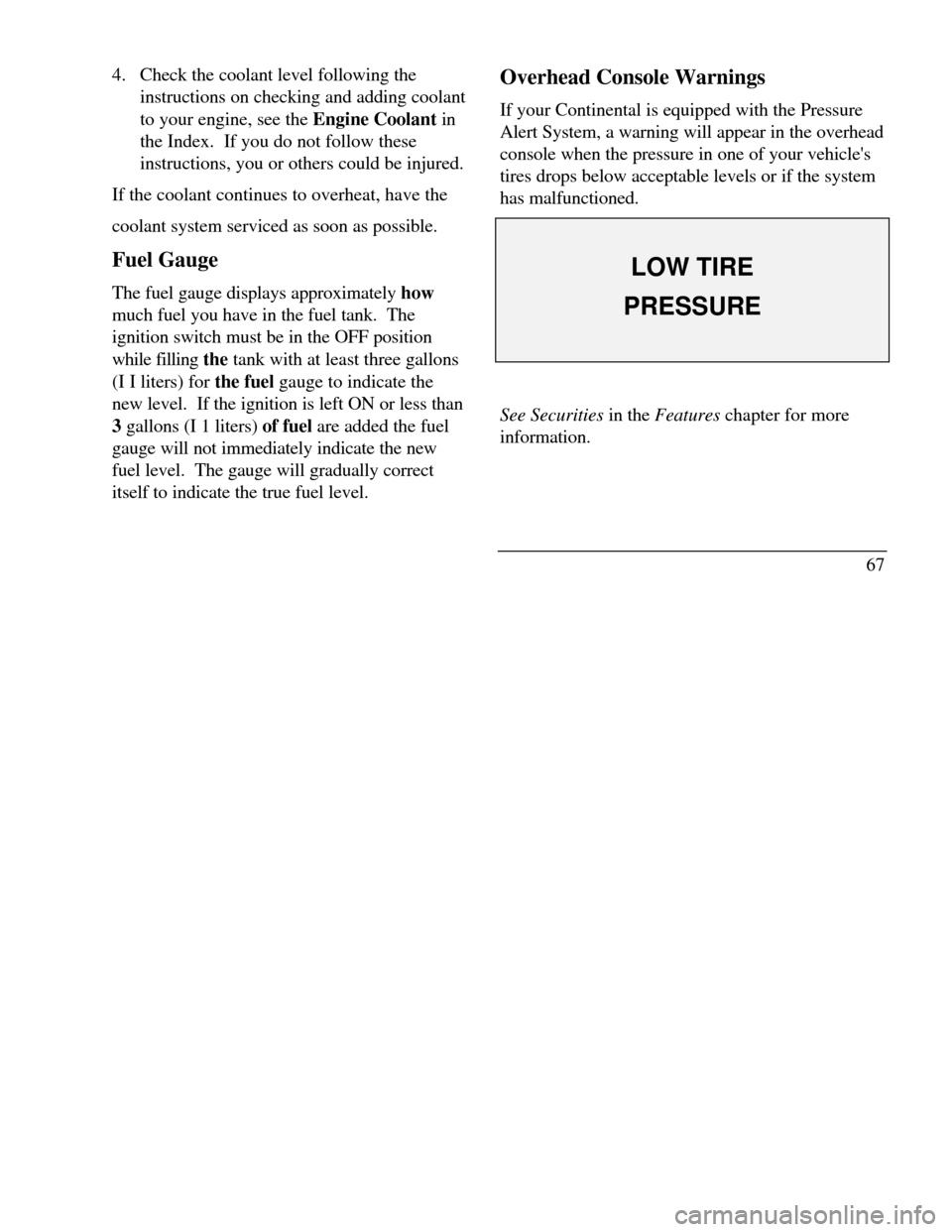
If your Continental is equipped with the Pressure
Alert System, a warning will appear in the overhead
console when the pressure in one of your vehicle's
tires drops below acceptable levels or if the system
has malfunctioned.LOW TIREPRESSURESee Securities in the Features chapter for more
information.
67
Page 249 of 320
Changing the Engine Oil and the Oil
Filter
Refer to the Maintenance Schedule and Record
booklet for recommended intervals./!\ WARNINGContinuous contact with USED motor oilhas caused cancer in laboratory mice.Protect your skin by washing with soap and water.
Engine Coolant
Checking the Engine Coolant
NOTE: Be sure to read and understand
Precautions Men Servicing Your Vehicle at the
beginning of this chapter./!\ WARNINGThe cooling fan is automatic and may comeon at any time. Always disconnect thenegative terminal of the battery beforeworking near the fan.Cold fill levelThe engine coolant reservoir
247
Page 250 of 320
Your vehicle's coolant protects your engine from
overheating in the summer and from freezing in the
winter. Check the level of the coolant at least once
a month. Simply look at the engine coolant
reservoir located in the engine compartment. To
locate the reservoir, see the diagram of your
vehicle's engine under Engine Type, in this chapter.
Check the engine coolant level in the engine coolant
reservoir at least once a month using the following
guidelines.
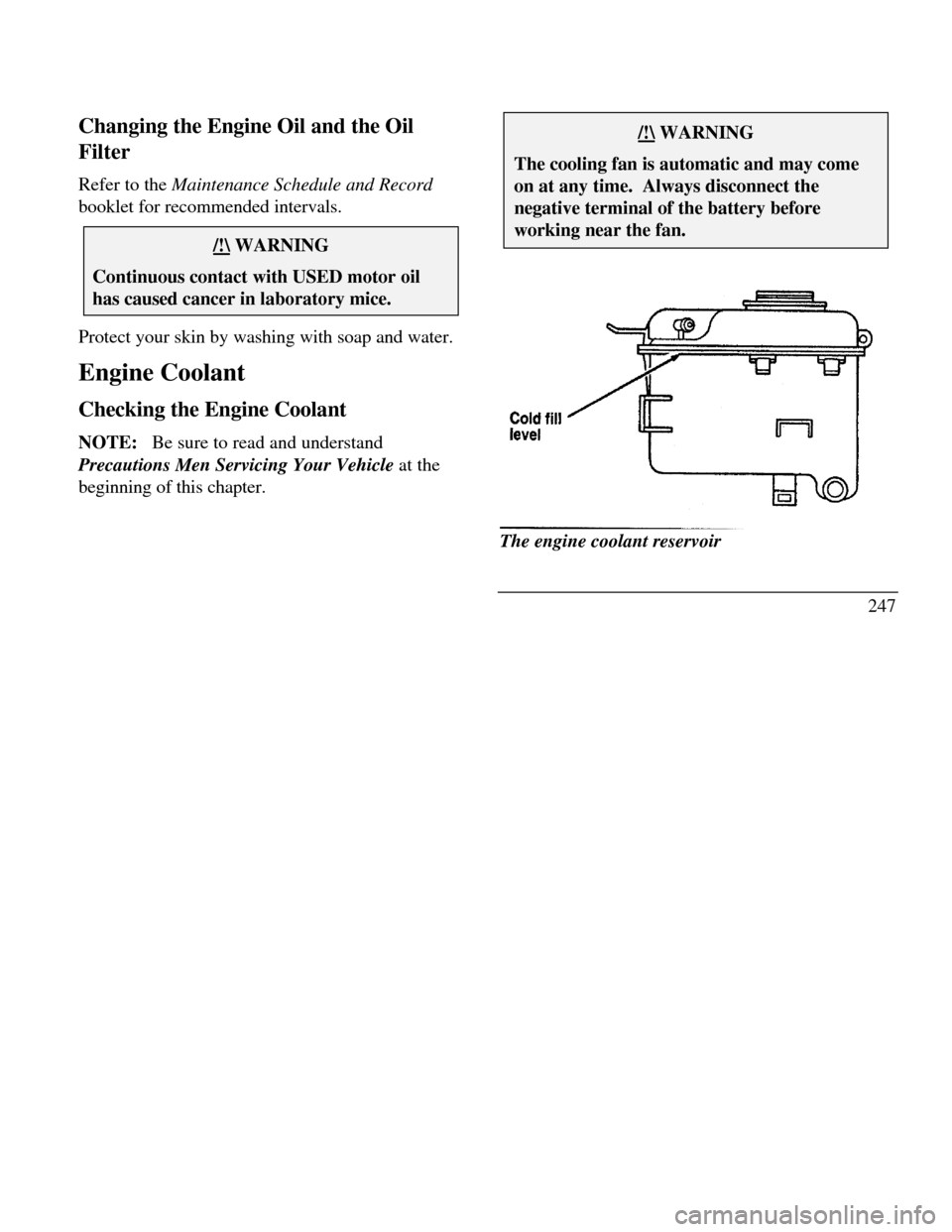
When your vehicle's engine is cool, the coolant level
in the engine coolant reservoir should be at the top
of the clear portion of the reservoir. If the level is
below the cold fill level, coolant may need to be
added.
The coolant additives also protect the entire cooling
system from internal passageway corrosion and
these additives lubricate the water pump. The
coolant should be serviced as noted in the
Maintenance Schedule and Record booklet.
248Adding engine coolant/!\ WARNINGDo not put engine coolant in the containerfor the windshield washer fluid.If sprayed to clean the glass, engine coolant or
antifreeze could make it difficult to see through the
windshield./!\ WARNINGNever remove the pressure cap while theengine is running or hot. Follow these stepsto avoid personal injury that can be causedby escaping steam or engine coolant.1. Before you remove the cap, turn the engine off
and let it cool. Even when the engine is cool, be
careful when you remove the pressure cap.
Page 251 of 320
2.When the engine is cool, wrap a thick cloth
around the cap and turn it slowly counter-
clockwise to relieve pressure.
3.Step back while the pressure releases.
4.When you are sure that all the pressure has
been released, use the cloth to turn and remove
cap.
5. Stand away from the reservoir opening. Hot
steam may blow out or hot engine coolant may
even splash out./!\ WARNINGFailure to follow these instructions couldresult in serious personal injury from hotengine coolant or steam blowout and/ordamage to the engine cooling system orengine.To find out how much engine coolant mixture your
vehicle's coolant system can hold, see Refill
capacities for fluids in the Index.
Add engine coolant only to the coolant reservoir.
If the coolant level is low, add to the reservoir a
50/50 or appropriate mixture of water and the type
of engine coolant that Ford specifies. You may add
water by itself only in an emergency, but you should
replace it with a 50/50 mixture as soon as possible.
Check the engine coolant again the next few times
you drive your vehicle.
Have your dealer check the engine cooling system
for leaks if you have to add more than a quart (liter)
of engine coolant more than once a month.
Ford Premium Cooling System Fluid is an optimized
formula that will protect all metals and rubber
elastomers used in Ford engines for four years or
50,000 miles (80,000 km). It is not necessary and
not recommended to use supplemental coolant
additives in your vehicle. These additives may harm
249
Page 253 of 320
Engine coolant drain and flush
Proper procedures for a complete coolant drain and
flush of the cooling system can be found in the Car
Service Manual. Following these recommended
procedures will ensure that the specified coolant
level and a 50/50 or appropriate mixture of coolant
and water is maintained.
Engine coolant refill procedure
When the entire cooling system is drained and
refilled, the following procedure should be used to
ensure a complete fill:
NOTE: It is imperative the following procedure
be adhered to. Failure to do so could result in
damage to your engine. Remove coolant reservoir pressure cap. Remove the engine coolant outlet tube fill plug
on the engine. With the engine off and cool, add a 50/50 mixture
of recommended cooling system fluid and water
to the coolant outlet tube fill neck until the
reservoir is full.
NOTE: DO NOT FILL COOLANT SYSTEM
THROUGH COOLANT RESERVOIR. COOLANT
WILL NOT ENTER ENGINE, WHICH CAN
LEAD TO ENGINE DAMAGE.
NOTE: Avoid spilling coolant on the front end
accessory drive belt, as this will allow the belt to slip
and become noisy. Reinstall the pressure cap to the coolant
reservoir. Continue filling at the engine coolant tube fill
neck slowly while allowing air to escape. Reinstall the engine coolant tube fill plug when
the system is full.
251
Page 254 of 320

Select maximum heater temperature and fan
speed settings. Position control to discharge air
at A/C vents in instrument panel. Start engine and allow to idle. While engine is
idling, feel for hot air at A/C vents.
NOTE: IF AIR DISCHARGE REMAINS COOL
AND ENGINE TEMPERATURE GAUGE DOES
NOT MOVE, SHUT ENGINE OFF
IMMEDIATELY. This is an indication of low
coolant level and/or air pockets in coolant system.
Allow engine to cool and repeat the previous steps. Allow to idle until normal operating temperature
is reached. Hot air should discharge from A/C
vents. The engine temperature gauge should
maintain a stabilized reading in the middle of the
"NORMAL" range and the lower radiator hose
should feel hot to the touch. Shut off the engine and allow to cool down.
252 After the engine cools down, recheck the engine
coolant level. Fill reservoir to the COLD-FULL
level as required.Check for leaks at the draincock, block plug and
vent plug.Recheck the engine coolant level, using the
recommended procedure, after one or two
occasions of vehicle use. Fill to COLD-FULL
level as required.
Battery
Your vehicle may have a Motorcraft maintenance-
free battery. When the original equipment battery is
replaced under warranty it may be replaced by a low-
maintenance battery. See Motorcraft Parts at the
end of this chapter for the proper replacement
battery.
Page 256 of 320
If you do not let the engine relearn its idle, the idle
quality of your vehicle may be adversely affected
until the idle is relearned. Your vehicle will
eventually relearn its idle while you drive it, but it
takes much longer than if you use the previous
procedure.
Windshield Washer Fluid and
Wipers
Washer Fluid
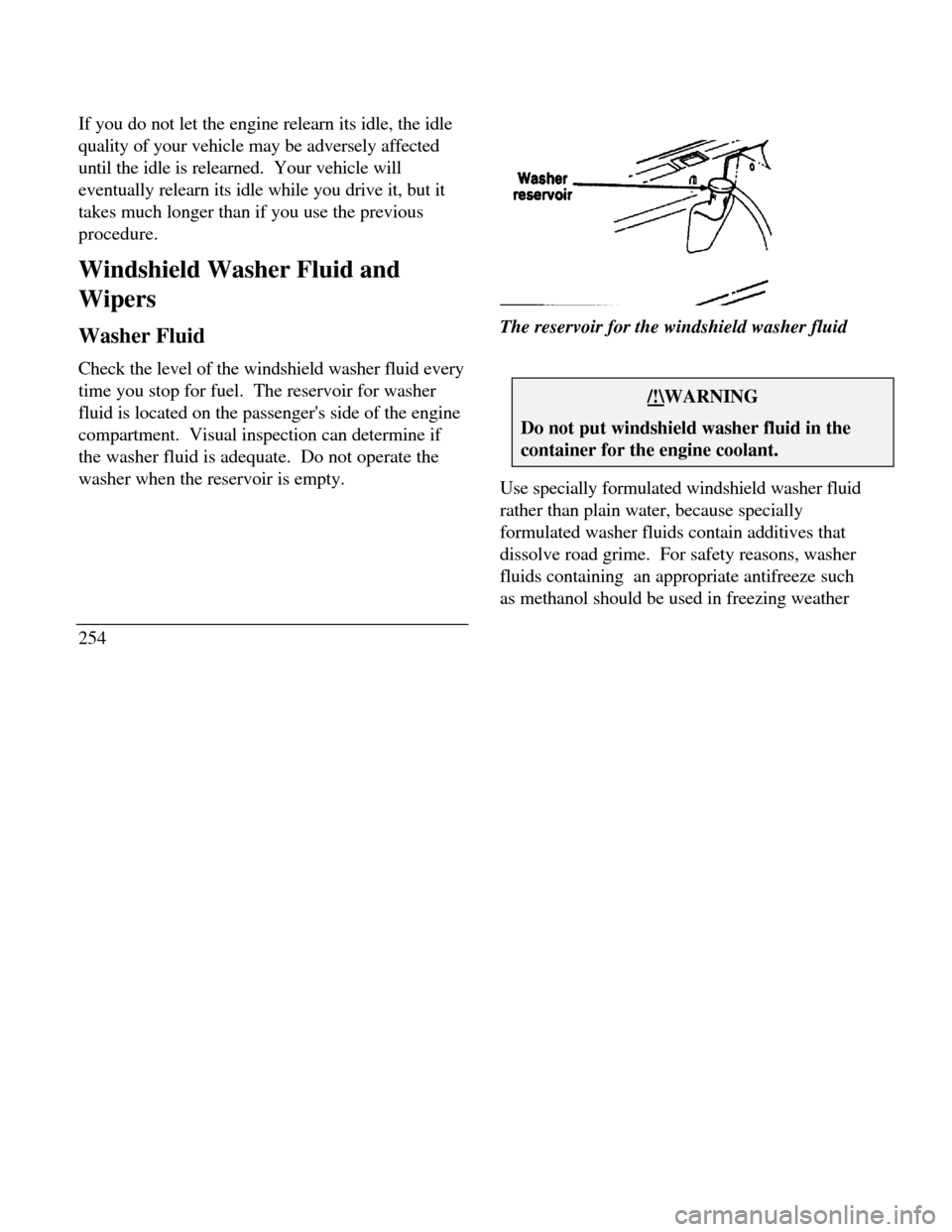
Check the level of the windshield washer fluid every
time you stop for fuel. The reservoir for washer
fluid is located on the passenger's side of the engine
compartment. Visual inspection can determine if
the washer fluid is adequate. Do not operate the
washer when the reservoir is empty.
254Washer reservoirThe reservoir for the windshield washer fluid/!\WARNINGDo not put windshield washer fluid in thecontainer for the engine coolant.Use specially formulated windshield washer fluid
rather than plain water, because specially
formulated washer fluids contain additives that
dissolve road grime. For safety reasons, washer
fluids containing an appropriate antifreeze such
as methanol should be used in freezing weather