steering wheel LINCOLN CONTINENTAL 1998 User Guide
[x] Cancel search | Manufacturer: LINCOLN, Model Year: 1998, Model line: CONTINENTAL, Model: LINCOLN CONTINENTAL 1998Pages: 176, PDF Size: 1.32 MB
Page 110 of 176
Always replace a fuse with one that has the specified amperage
rating. Using a fuse with a higher amperage rating can cause
severe wire damage and could start a fire.
Standard fuse amperage rating and color
Fuse rating Color
5 amp Tan
7.5 amp Brown
10 amp Red
15 amp Light blue
20 amp Yellow
20 amp fuse link Light blue
25 amp Natural
30 amp Light green
30 amp fuse link Pink
40 amp fuse link Green
50 amp fuse link Red
60 amp fuse link Yellow
80 amp fuse link Black
100 amp fuse link Dark blue
Passenger compartment fuse panel
The fuse panel is located below and to the left of the steering wheel by
the brake pedal. Remove the panel cover to access the fuses.
To remove a fuse use the fuse puller tool provided on the fuse panel
cover.
Roadside emergencies
110
Page 119 of 176

Fuse/Relay Location Fuse Amp Rating Description
8 30A* Front Passenger
Window
1 - A/C Diode
2 - PCM Diode
* Mini Fuses ** Maxi Fuses
CHANGING THE TIRES
If you get a flat tire while driving, do not apply the brake heavily.
Instead, gradually decrease your speed. Hold the steering wheel firmly
and slowly move to a safe place on the side of the road.
Tire change procedure
1. Park on a level surface, activate hazard flashers and set parking brake.
2. Place gearshift lever in P (Park).
3. Remove the spare tire, jack and
lug wrench.
4. Remove the center ornament
from the aluminum wheel with the
tapered end of the wheel nut
wrench that came with your vehicle.
Insert and twist the handle, then
pry against the wheel.
Roadside emergencies
119
Page 134 of 176
coolant concentration above 60%. Leave a 50/50 mixture of engine
coolant and water in your vehicle year-round in non-extreme climates.
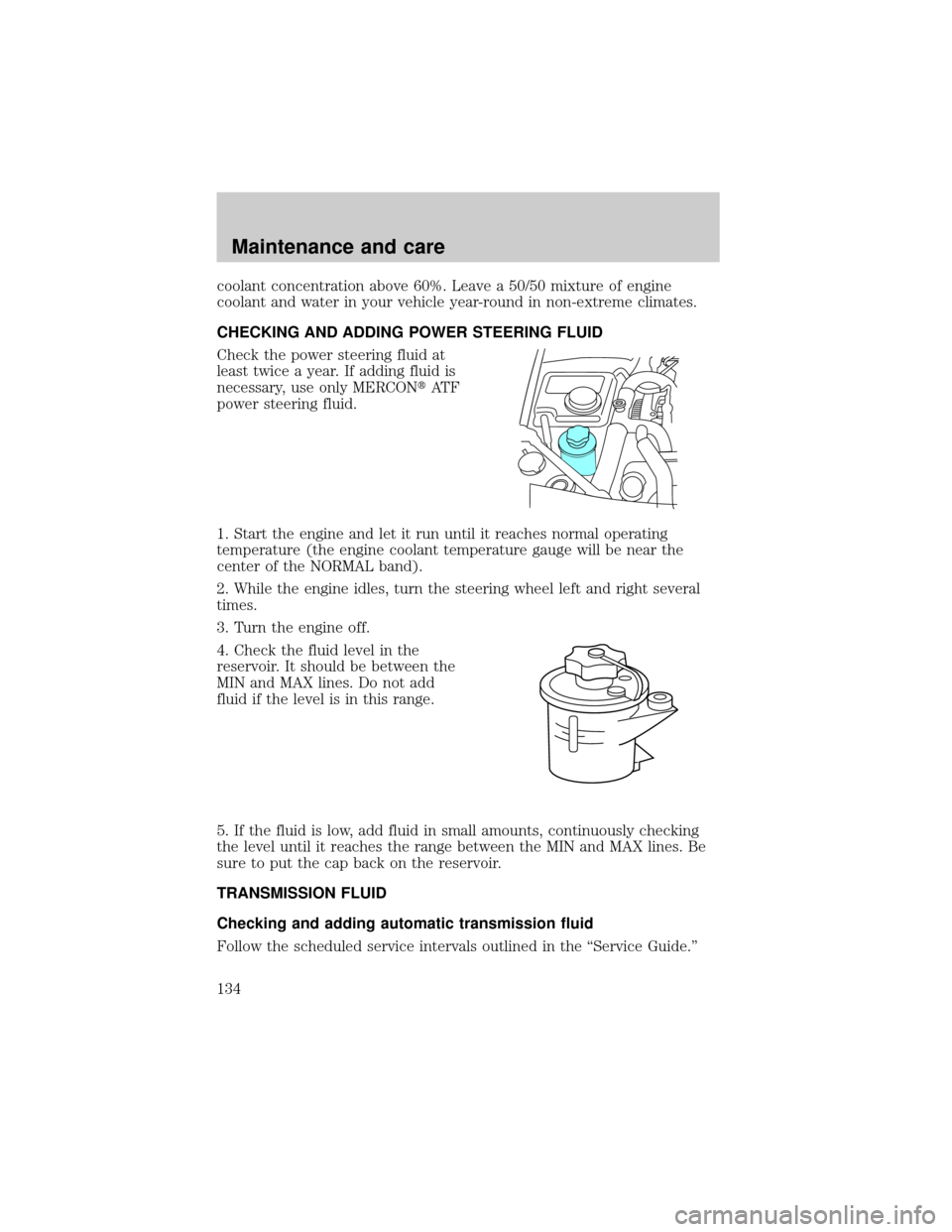
CHECKING AND ADDING POWER STEERING FLUID
Check the power steering fluid at
least twice a year. If adding fluid is
necessary, use only MERCONtAT F
power steering fluid.
1. Start the engine and let it run until it reaches normal operating
temperature (the engine coolant temperature gauge will be near the
center of the NORMAL band).
2. While the engine idles, turn the steering wheel left and right several
times.
3. Turn the engine off.
4. Check the fluid level in the
reservoir. It should be between the
MIN and MAX lines. Do not add
fluid if the level is in this range.
5. If the fluid is low, add fluid in small amounts, continuously checking
the level until it reaches the range between the MIN and MAX lines. Be
sure to put the cap back on the reservoir.
TRANSMISSION FLUID
Checking and adding automatic transmission fluid
Follow the scheduled service intervals outlined in the ªService Guide.º
Maintenance and care
134
Page 169 of 176

Speed control ..............................36
canceling a set speed ...............39
resuming a set speed ...............39
tap up/tap down .......................38
turning off .................................37
Speedometer ...............................10
Starting your vehicle .............90,92
Sunvisor .......................................52
Tachometer
mechanical cluster ...................11
Tilt steering wheel ......................40
Tires ....................................142,144
changing ..................................119
checking the pressure ............144
replacing ..................................145
rotating ....................................144
snow tires and chains ............145
treadwear ................................143
Traction control
off light ........................................9
Trailer towing ............................105
tips ...........................................107
Transaxle .....................................99
automatic operation .......100,101,
102,103
Transmission .............................134
fluid, checking and adding
(automatic) .............................134
Trunk
using the remote entry
system to open .........................66
Turn signal
lever ...........................................35
Universal transmitter ..................52
erasing channels .......................55
operating ...................................54
programming .............................53
Vehicle dimensions ...................163
Vehicle headlamp aiming
device (VHAD) .........................152
Vehicle Identification Number
(VIN) ..........................................165Vehicle loading ..........................104
Ventilating your vehicle .............94
Warning chimes .............................6
Wheels
anti-theft lug nuts ..................121
Windows
accessory delay .........................60
power windows, operating .......59
Windshield washer fluid and
wipers
checking and adding fluid .....131
checking and replacing wiper
blades ......................................139
operation ...................................34
Wrecker towing .........................124
Index
169