seats LINCOLN CONTINENTAL 1999 User Guide
[x] Cancel search | Manufacturer: LINCOLN, Model Year: 1999, Model line: CONTINENTAL, Model: LINCOLN CONTINENTAL 1999Pages: 208, PDF Size: 1.16 MB
Page 108 of 208
SAFETY RESTRAINTS FOR CHILDREN
See the following sections for directions on how to properly use safety
restraints for children. Also seeAir Bag Supplemental Restraint
System (SRS)in this chapter for special instructions about using air
bags.
Important child restraint precautions
You are required by law to use safety restraints for children in the U.S.
and Canada. If small children ride in your vehicle (generally children who
are four years old or younger and who weigh 18 kg [40 lbs] or less), you
must put them in safety seats made especially for children. Check your
local and state or provincial laws for specific requirements regarding the
safety of children in your vehicle.
Never let a passenger hold a child on his or her lap while the
vehicle is moving. The passenger cannot protect the child from
injury in a collision.
Always follow the instructions and warnings that come with any infant or
child restraint you might use.
When possible, place children in the rear seat of your vehicle. Accident
statistics suggest that children are safer when properly restrained in the
rear seating positions than in the front seating position.
Seating and safety restraints
108
Page 109 of 208
Children and safety belts
If the child is the proper size, restrain the child in a safety seat.
Children who are too large for child safety seats (as specified by your
child safety seat manufacturer) should always wear safety belts.
Follow all the important safety restraint and air bag precautions that
apply to adult passengers in your vehicle.
If the shoulder belt portion of a combination lap and shoulder belt can
be positioned so it does not cross or rest in front of the child's face or
neck, the child should wear the lap and shoulder belt. Moving the child
closer to the center of the vehicle may help provide a good shoulder belt
fit.
Do not leave children, unreliable adults, or pets unattended in
your vehicle.
To improve the fit of lap and shoulder belts on children who have
outgrown child safety seats, Ford recommends use of a belt-positioning
booster seat that is labelled as conforming to all Federal motor vehicle
safety standards. Belt-positioning booster seats raise the child and
provide a shorter, firmer seating cushion that encourages safer seating
posture and better fit of lap and shoulder belts on the child.
A belt-positioning booster should be used if the shoulder belt rests in
front of the child's face or neck, or if the lap belt does not fit snugly on
both thighs, or if the thighs are too short to let the child sit all the way
back on the seat cushion when the lower legs hang over the edge of the
seat cushion. You may wish to discuss the special needs of your child
with your pediatrician.
Seating and safety restraints
109
Page 110 of 208
SAFETY SEATS FOR CHILDREN
Child and infant or child safety seats
Use a safety seat that is recommended for the size and weight of the
child. Carefully follow all of the manufacturer's instructions with the
safety seat you put in your vehicle. If you do not install and use the
safety seat properly, the child may be injured in a sudden stop or
collision.
When installing a child safety seat:
²Review and follow the information
presented in theAir Bag
Supplemental Restraint System
section in this chapter.
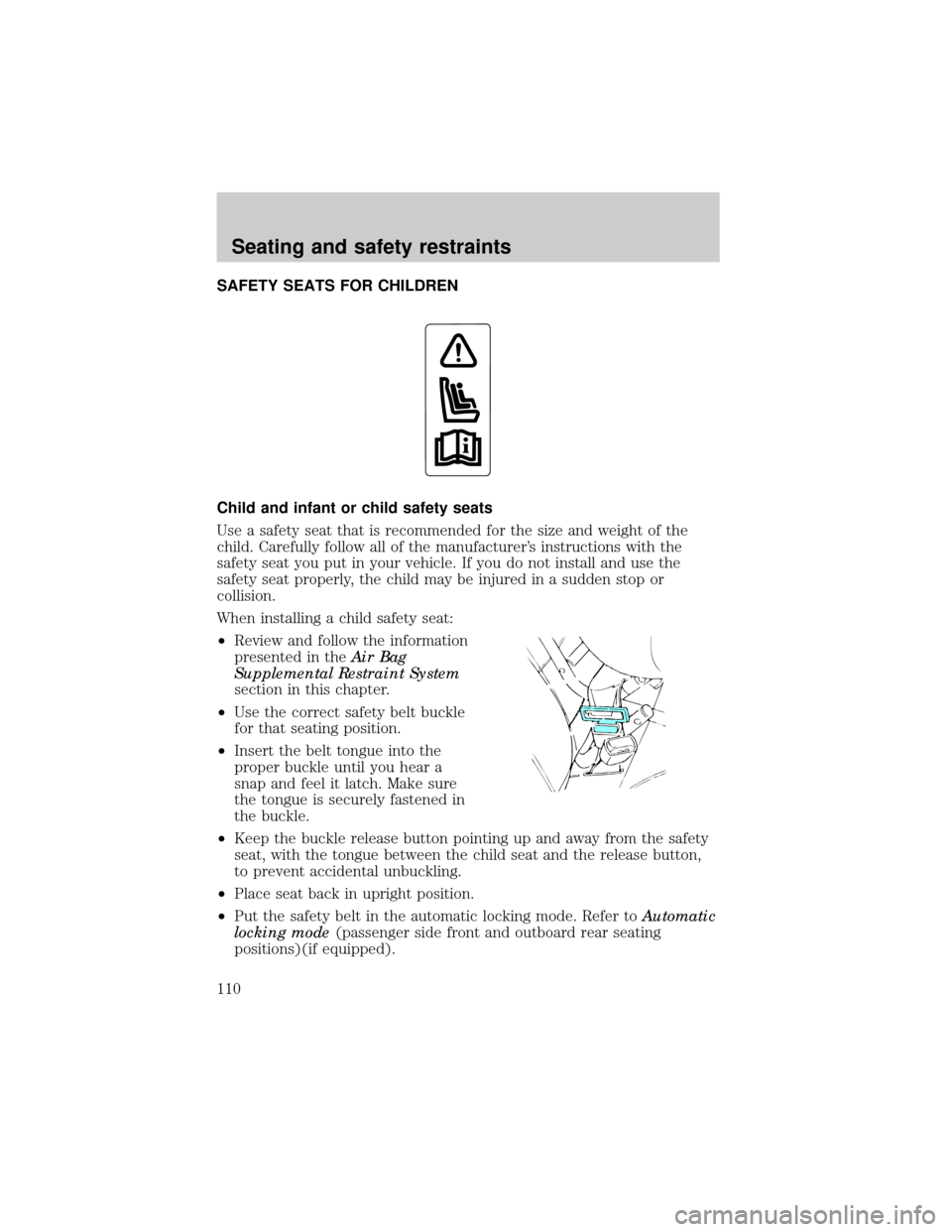
²Use the correct safety belt buckle
for that seating position.
²Insert the belt tongue into the
proper buckle until you hear a
snap and feel it latch. Make sure
the tongue is securely fastened in
the buckle.
²Keep the buckle release button pointing up and away from the safety
seat, with the tongue between the child seat and the release button,
to prevent accidental unbuckling.
²Place seat back in upright position.
²Put the safety belt in the automatic locking mode. Refer toAutomatic
locking mode(passenger side front and outboard rear seating
positions)(if equipped).
Seating and safety restraints
110
Page 111 of 208
Ford recommends the use of a child safety seat having a top tether
strap. Install the child safety seat in a seating position which is capable
of providing a tether anchorage. For more information on top tether
straps, refer toAttaching safety seats with tether straps.
Carefully follow all of the manufacturer's instructions included
with the safety seat you put in your vehicle. If you do not install
and use the safety seat properly, the child may be injured in a sudden
stop or collision.
Installing child safety seats in combination lap and shoulder belt
seating positions
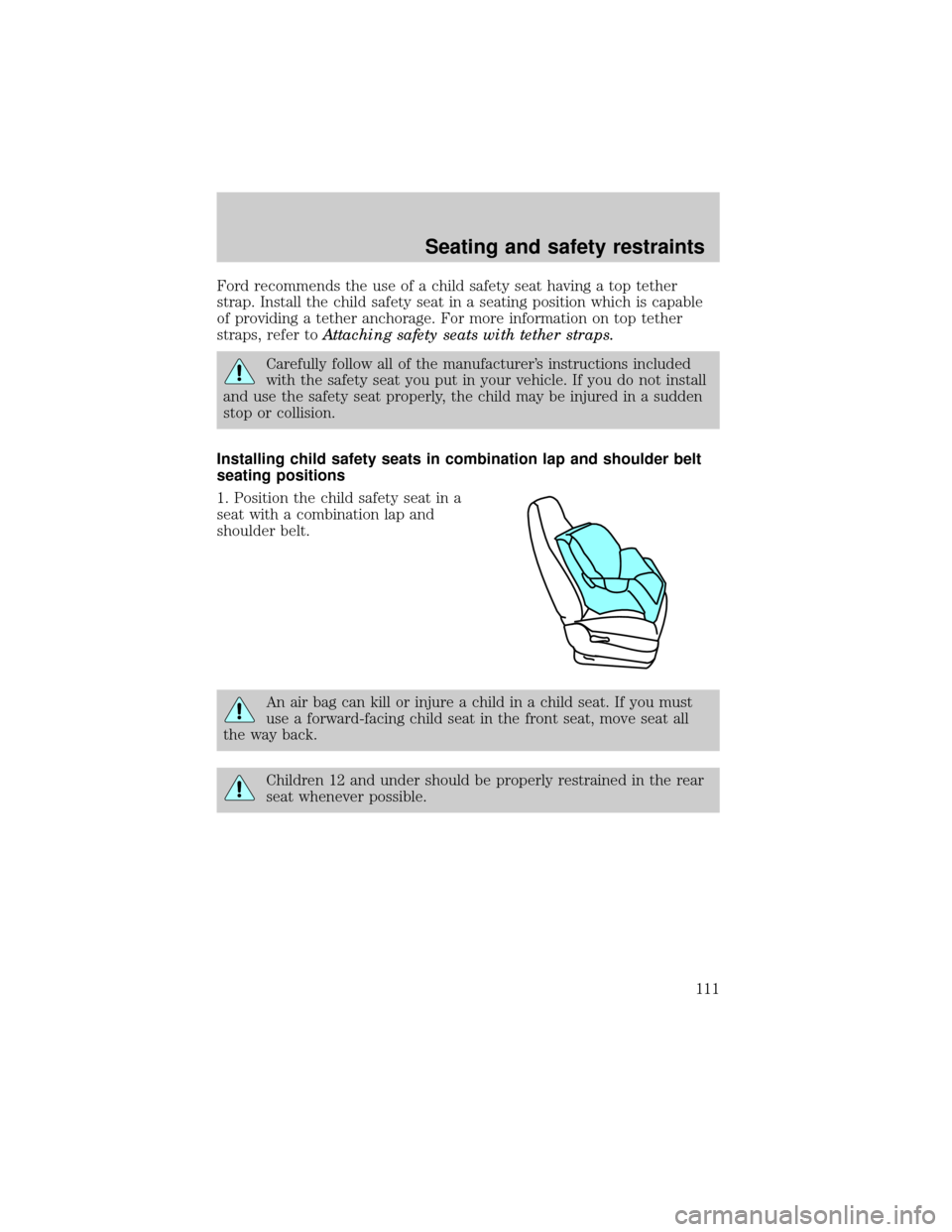
1. Position the child safety seat in a
seat with a combination lap and
shoulder belt.
An air bag can kill or injure a child in a child seat. If you must
use a forward-facing child seat in the front seat, move seat all
the way back.
Children 12 and under should be properly restrained in the rear
seat whenever possible.
Seating and safety restraints
111
Page 114 of 208
Attaching safety seats with tether straps
Some manufacturers make safety seats that include a tether strap that
goes over the back of the vehicle seat and attaches to an anchoring
point. Other manufacturers offer the tether strap as an accessory.
Contact the manufacturer of your child safety seat for information about
ordering a tether strap.
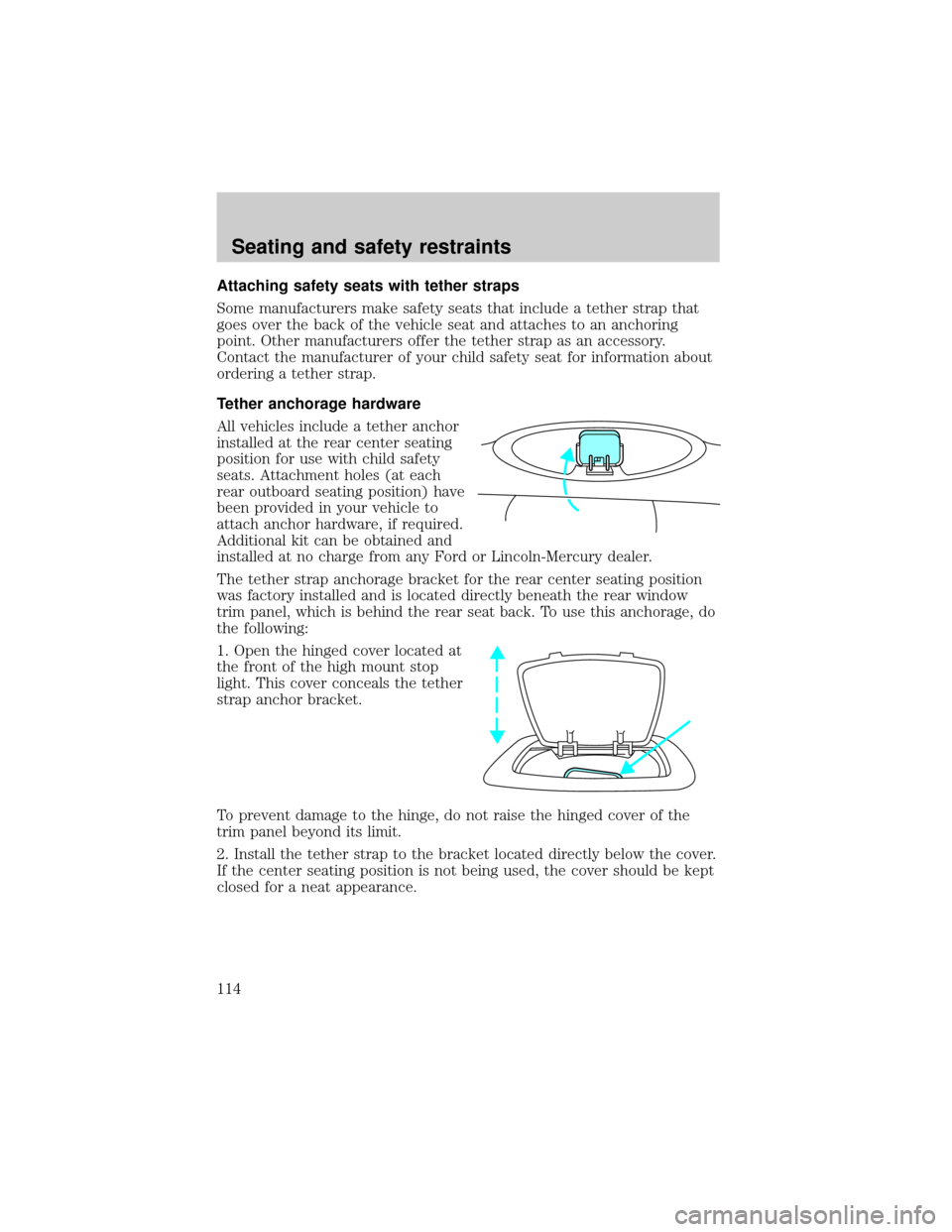
Tether anchorage hardware
All vehicles include a tether anchor
installed at the rear center seating
position for use with child safety
seats. Attachment holes (at each
rear outboard seating position) have
been provided in your vehicle to
attach anchor hardware, if required.
Additional kit can be obtained and
installed at no charge from any Ford or Lincoln-Mercury dealer.
The tether strap anchorage bracket for the rear center seating position
was factory installed and is located directly beneath the rear window
trim panel, which is behind the rear seat back. To use this anchorage, do
the following:
1. Open the hinged cover located at
the front of the high mount stop
light. This cover conceals the tether
strap anchor bracket.
To prevent damage to the hinge, do not raise the hinged cover of the
trim panel beyond its limit.
2. Install the tether strap to the bracket located directly below the cover.
If the center seating position is not being used, the cover should be kept
closed for a neat appearance.
Seating and safety restraints
114
Page 140 of 208
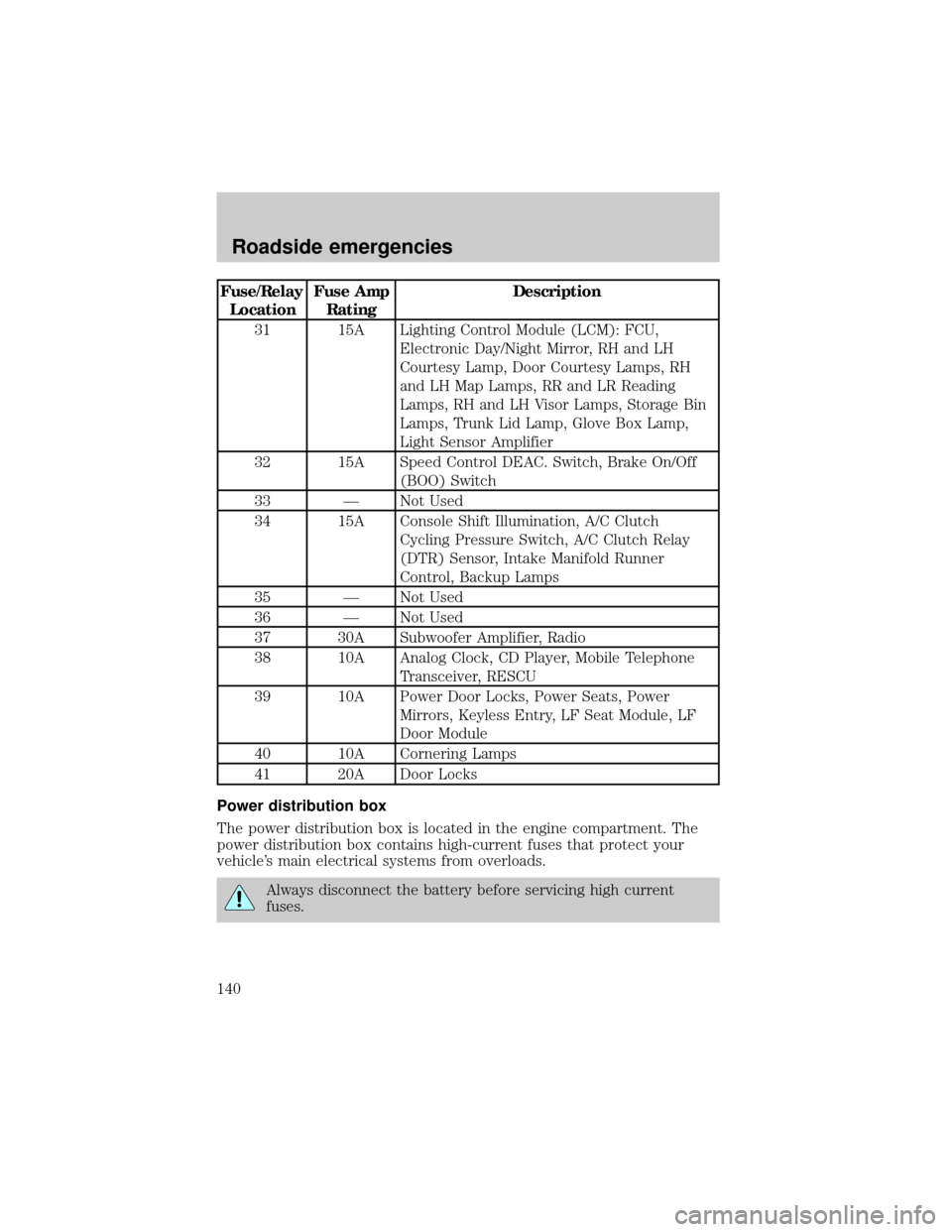
Fuse/Relay
LocationFuse Amp
RatingDescription
31 15A Lighting Control Module (LCM): FCU,
Electronic Day/Night Mirror, RH and LH
Courtesy Lamp, Door Courtesy Lamps, RH
and LH Map Lamps, RR and LR Reading
Lamps, RH and LH Visor Lamps, Storage Bin
Lamps, Trunk Lid Lamp, Glove Box Lamp,
Light Sensor Amplifier
32 15A Speed Control DEAC. Switch, Brake On/Off
(BOO) Switch
33 Ð Not Used
34 15A Console Shift Illumination, A/C Clutch
Cycling Pressure Switch, A/C Clutch Relay
(DTR) Sensor, Intake Manifold Runner
Control, Backup Lamps
35 Ð Not Used
36 Ð Not Used
37 30A Subwoofer Amplifier, Radio
38 10A Analog Clock, CD Player, Mobile Telephone
Transceiver, RESCU
39 10A Power Door Locks, Power Seats, Power
Mirrors, Keyless Entry, LF Seat Module, LF
Door Module
40 10A Cornering Lamps
41 20A Door Locks
Power distribution box
The power distribution box is located in the engine compartment. The
power distribution box contains high-current fuses that protect your
vehicle's main electrical systems from overloads.
Always disconnect the battery before servicing high current
fuses.
Roadside emergencies
140
Page 193 of 208
treatments used by commercial car washes. Clean the outside of the
windshield with a non-abrasive cleanser such as the non-abrasive
Bon-Amitpowder. Rinse thoroughly with clean water.Do notuse
abrasive cleansers on glass as they may cause scratches. The windshield
is clean if beads do not form when you rinse it with water. The
windshield and wiper blades should be cleaned on a regular basis, and
blades or rubber elements replaced when worn.
Cleaning seats equipped with side air bags
Remove dust and loose dirt with a whisk broom or a vacuum cleaner.
Remove fresh spots immediately. Follow the directions that come with
the cleaner. Do not saturate the seat cover with upholstery cleaner.
Do not use chemical solvents or strong detergents when cleaning
the seat mounted side air bag. Such products could contaminate
the side air bag system and affect performance of the side air bag in a
collision.
Cleaning the instrument panel
Clean with a damp cloth, then dry with a dry cloth.
Avoid cleaner or polish that increases the gloss of the upper portion of
the instrument panel. The dull finish in this area helps protect the driver
from undesirable windshield reflection.
Cleaning and maintaining the safety belts
Clean the safety belts with a mild soap solution recommended for
cleaning upholstery or carpets. Do not bleach or dye the belts, because
these actions may weaken the belt webbing.
Check the safety belt system periodically to make sure there are no
nicks, wear or cuts. If your vehicle has been involved in an accident,
refer to theSafety belt maintenancesection in theSeating and safety
restraintschapter.
Underbody
Flush the complete underside of vehicle frequently. Keep body drain
holes unplugged. Inspect for road damage.
Maintenance and care
193
Page 194 of 208

Cleaning leather seats (if equipped)
To clean, simply use a soft cloth dampened with water and a mild soap.
Wipe the leather again with a damp cloth to remove soap residue. Dry
with a soft cloth. For tougher soiling concerns, Ford recommends using
the leather cleaning kit F8AJ-19G253±AA, which is available from your
Ford Dealer. This mild cleaner and special pad, cleans the leather and
maintains its natural beauty. Follow the instructions on the cleaner label.
Regular cleaning of your leather upholstery helps maintain its resiliency
and color.
Do not use household cleaning products, alcohol solutions,
solvents or cleaners intended for rubber, vinyl or plastics.
Woodtone trim
Wipe stains with a soft cloth and a multi-purpose cleaning solution.
Inside windows
Use glass cleaner for the inside windows if they become fogged.
Cleaning mirrors
Do not clean your mirrors with a dry cloth or abrasive materials. Use a
soft cloth and mild detergent and water. Be careful when removing ice
from outside mirrors because you may damage the reflective surface.
Maintenance and care
194
Page 202 of 208

Accessory delay ..........................75
Air bag supplemental restraint
system ........................................101
and child safety seats ............102
description .......................101,105
disposal ....................................107
indicator light ..................105,107
passenger air bag ............103,106
Air conditioning
automatic temperature
control system ...........26,27,28,30
Air filter, cabin ..........................166
Air suspension
warning light ...........................124
Anti-theft system .................79,122
arming the system ....................79
disarming a triggered system ..80
Automatic transaxle .................125
driving with ...............127,128,129
Automatic transmission
fluid, refill capacities ................12
Brakes ........................................120
anti-lock ............................120,121
anti-lock brake system (ABS)
warning light ...........................121
fluid, checking and adding ....157
shift interlock ..........................125
Break-in period .............................3
CD player .....................44,45,46,47
Child safety seats
attaching with tether straps ..114
in rear seat ..............................111
tether anchorage hardware ...114
Cleaning your vehicle ...............190
engine compartment ..............191
exterior .............................191,193
exterior lamps .........................192
plastic parts ............................192
washing ....................................190
waxing .....................................191
wheels ......................................191
windows ..................................194wiper blades ............................192
woodtone trim ........................194
Clock ............................................32
Compass, electronic ....................71
calibration .................................72
set zone adjustment .................71
Console ...................................78,79
overhead ....................................55
Controls
power seat ............................92,94
Coolant ...............................160,161
checking and adding ..............159
refill capacities ........................161
Defrost
rear window ..............................31
Emission control system ..........182
Engine
coolant .....................................158
idle speed control ...................164
service points ..........................153
starting after a collision .........135
Engine block heater .................118
Engine oil
checking and adding ..............155
dipstick ....................................154
specifications ...................154,156
Exhaust fumes ..........................118
Floor mats ...................................79
Fuel
choosing the right fuel ...........176
comparisons with EPA fuel
economy estimates .................181
detergent in fuel .....................178
filling your vehicle
with fuel ...........................174,176
fuel filler door override ............78
fuel filler door release lever ....78
gauge .........................................10
quality ......................................177
running out of fuel .................178
safety information relating to
automotive fuels .....................174
Index
202
Page 203 of 208

Fuses ...................................136,137
Gas mileage (see Fuel
economy) ..............178,179,180,181
Gauges .........................................10
engine coolant temperature
gauge .........................................11
Hazard flashers .........................135
Head restraints ...........................92
Headlamps
aiming ...............................188,189
bulb specifications ..................187
high beam ..............................8,24
turning on and off ......................8
warning chime ..........................10
Heating ........................................26
Hood ..........................................153
Ignition .......................................197
Inspection/maintenance (I/M)
testing ........................................183
Instrument panel
cleaning ...................................193
Keyless entry system
autolock .....................................88
keypad .......................................85
programming entry code ...86,87,
88
Keys
key in ignition chime .................9
positions of the ignition ...........47
Lamps
autolamp system .......................25
daytime running light ...............24
headlamps .................................24
headlamps, flash to pass ..........25
instrument panel, dimming .....25
interior lamps ....................54,187
replacing bulbs ..183,184,186,187
Lane change indicator
(see Turn signal) ........................48
Lights, warning and indicator
air bag ..........................................7
anti-lock brakes (ABS) ..............8brake ............................................7
charging system ..........................9
oil pressure .................................9
safety belt ...................................7
service engine soon ....................6
traction control off .....................9
turn signal indicator ...................8
Locks
childproof ..................................77
Lumbar support, seats ...............94
Message center
date/economy button ..........15,16
menu button .............................17
reset button ..............................16
system check button ................13
warning messages .....................14
Mirrors .........................................67
automatic dimming rearview
mirror ........................................73
cleaning ...................................194
heated ........................................76
programmable memory ............84
side view mirrors (power) .......76
Moon roof ....................................66
Motorcraft parts ........................178
Octane rating ............................177
Odometer .....................................11
Overdrive ...................................126
Panic alarm feature, remote
entry system ................................82
Parking brake ............................121
Power distribution box
(see Fuses) ...............................140
Power door locks ........................74
Power steering ...................123,124
fluid, checking and adding ....161
Radio .............32,33,34,35,36,37,38,
39,40,41,42,43
Relays .................................136,142
Remote entry system .......81,88,90
illuminated entry ......................84
locking/unlocking doors ...........81
Index
203