key LINCOLN CONTINENTAL 2000 Owner's Guide
[x] Cancel search | Manufacturer: LINCOLN, Model Year: 2000, Model line: CONTINENTAL, Model: LINCOLN CONTINENTAL 2000Pages: 232, PDF Size: 1.7 MB
Page 155 of 232
To lessen the risk of personal injury, do not put any part of your
body under the vehicle while changing a tire. Do not start the
engine when your vehicle is on the jack. The jack is only meant for
changing the tire.
7. Remove the lug nuts with the lug wrench. Replace the flat tire with
the spare tire, making sure the valve stem is facing outward. Reinstall lug
nuts until the wheel is snug against the hub. Do not fully tighten the lug
nuts until the wheel has been lowered.
8. Lower the wheel by turning the jack handle counterclockwise.
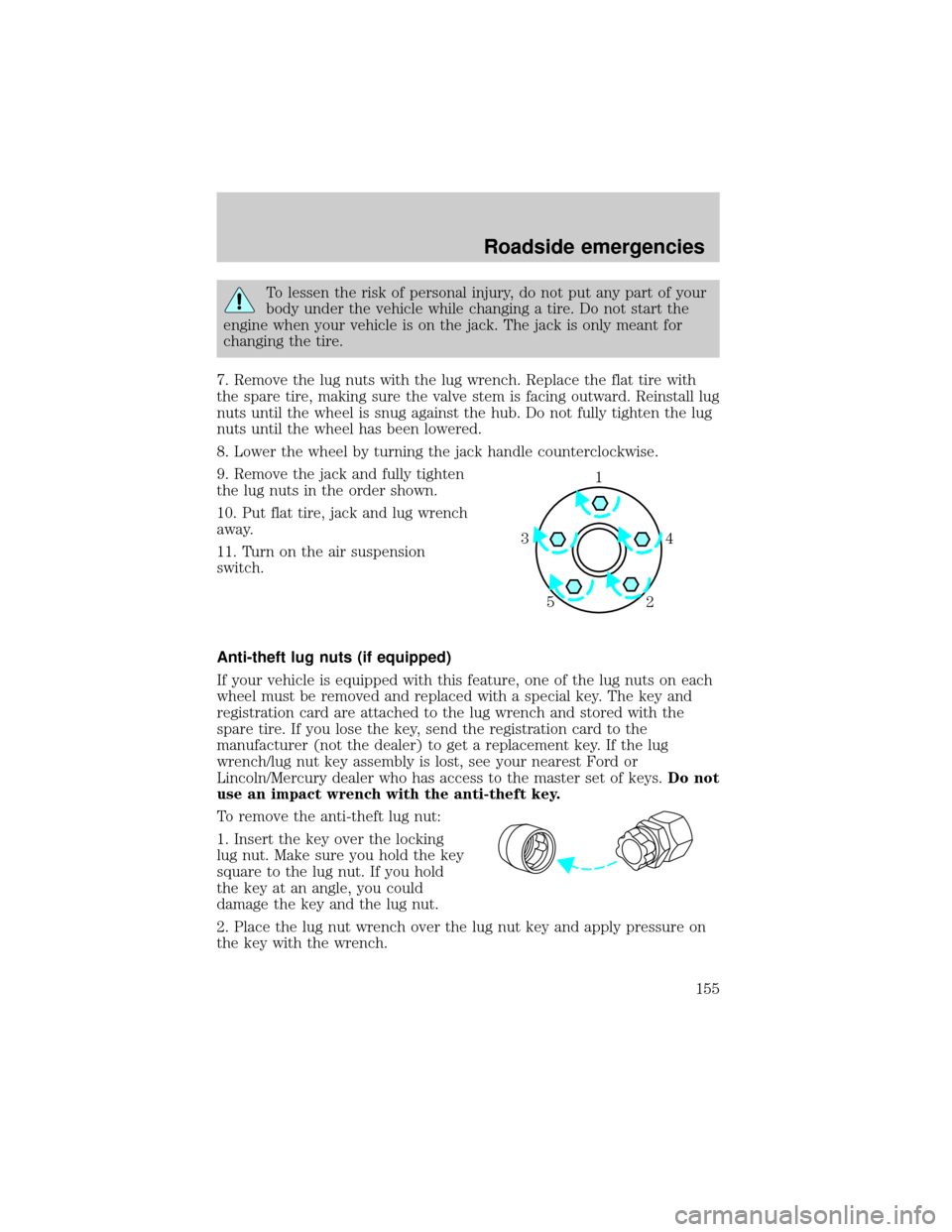
9. Remove the jack and fully tighten
the lug nuts in the order shown.
10. Put flat tire, jack and lug wrench
away.
11. Turn on the air suspension
switch.
Anti-theft lug nuts (if equipped)
If your vehicle is equipped with this feature, one of the lug nuts on each
wheel must be removed and replaced with a special key. The key and
registration card are attached to the lug wrench and stored with the
spare tire. If you lose the key, send the registration card to the
manufacturer (not the dealer) to get a replacement key. If the lug
wrench/lug nut key assembly is lost, see your nearest Ford or
Lincoln/Mercury dealer who has access to the master set of keys.Do not
use an impact wrench with the anti-theft key.
To remove the anti-theft lug nut:
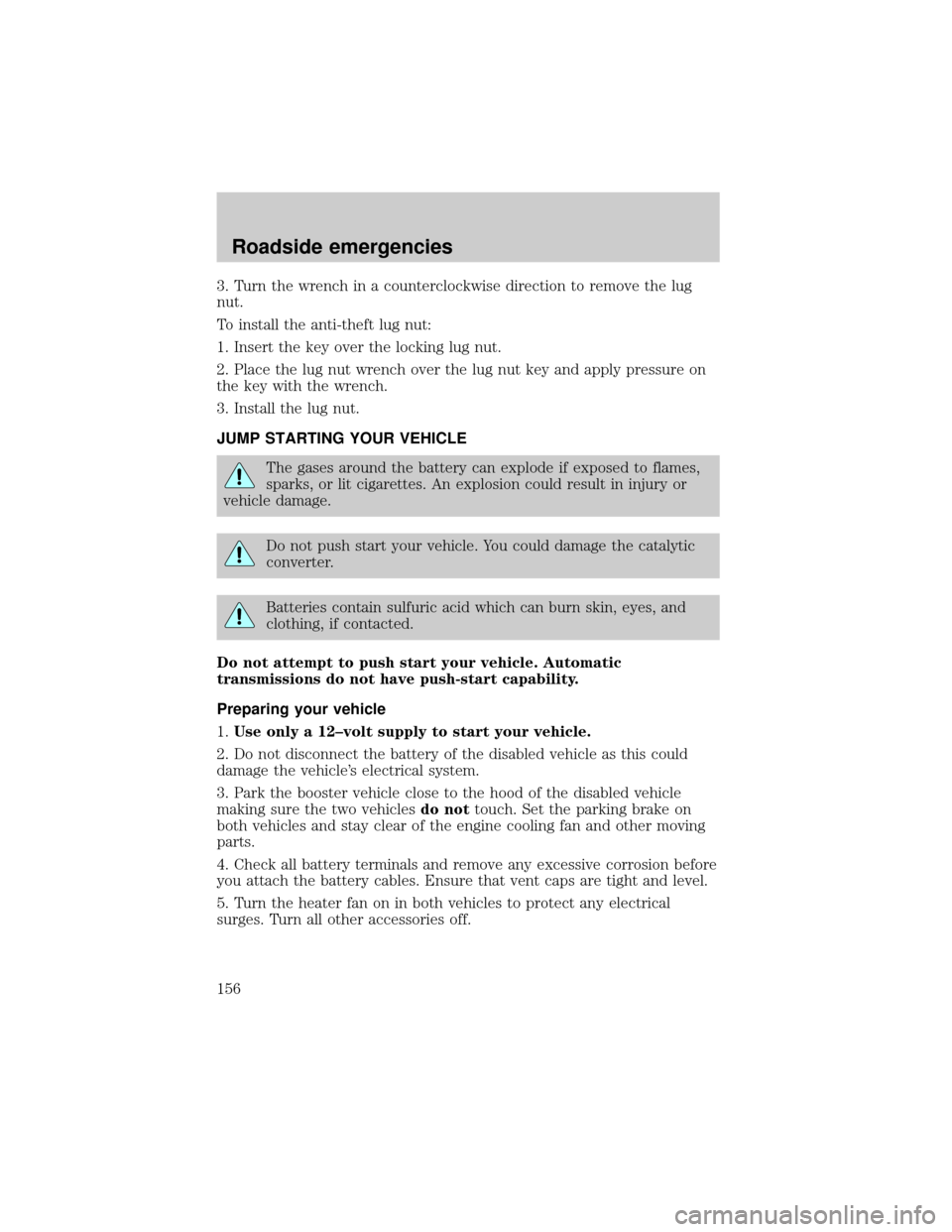
1. Insert the key over the locking
lug nut. Make sure you hold the key
square to the lug nut. If you hold
the key at an angle, you could
damage the key and the lug nut.
2. Place the lug nut wrench over the lug nut key and apply pressure on
the key with the wrench.
1
4 3
2 5
Roadside emergencies
155
Page 156 of 232
3. Turn the wrench in a counterclockwise direction to remove the lug
nut.
To install the anti-theft lug nut:
1. Insert the key over the locking lug nut.
2. Place the lug nut wrench over the lug nut key and apply pressure on
the key with the wrench.
3. Install the lug nut.
JUMP STARTING YOUR VEHICLE
The gases around the battery can explode if exposed to flames,
sparks, or lit cigarettes. An explosion could result in injury or
vehicle damage.
Do not push start your vehicle. You could damage the catalytic
converter.
Batteries contain sulfuric acid which can burn skin, eyes, and
clothing, if contacted.
Do not attempt to push start your vehicle. Automatic
transmissions do not have push-start capability.
Preparing your vehicle
1.Use only a 12±volt supply to start your vehicle.
2. Do not disconnect the battery of the disabled vehicle as this could
damage the vehicle's electrical system.
3. Park the booster vehicle close to the hood of the disabled vehicle
making sure the two vehiclesdo nottouch. Set the parking brake on
both vehicles and stay clear of the engine cooling fan and other moving
parts.
4. Check all battery terminals and remove any excessive corrosion before
you attach the battery cables. Ensure that vent caps are tight and level.
5. Turn the heater fan on in both vehicles to protect any electrical
surges. Turn all other accessories off.
Roadside emergencies
156
Page 162 of 232

SERVICE RECOMMENDATIONS
To help you service your vehicle:
²We highlight do-it-yourself items in the engine compartment for easy
location.
²We provide a Scheduled Maintenance Guide which makes tracking
routine service easy.
If your vehicle requires professional service, your dealership can provide
necessary parts and service. Check your ªWarranty Guideº to find out
which parts and services are covered.
Use only recommended fuels, lubricants, fluids and service parts
conforming to specifications. Motorcraft parts are designed and built to
provide the best performance in your vehicle.
PRECAUTIONS WHEN SERVICING YOUR VEHICLE
Be especially careful when inspecting or servicing your vehicle.
²Do not work on a hot engine.
²When the engine is running, keep loose clothing, jewelry or long hair
away from moving parts.
²Do not work on a vehicle with the engine running in an enclosed
space, unless you are sure you have enough ventilation.
²Keep all lit cigarettes, open flames and other lit material away from
the battery and all fuel related parts.
If you disconnect the battery, the engine must ªrelearnº its idle
conditions before your vehicle will drive properly, as explained in the
Batterysection in this chapter.
Working with the engine off
1. Set the parking brake, and ensure the gearshift is securely latched in
park.
2. Turn off the engine and remove the key.
3. Block the wheels to prevent the vehicle from moving unexpectedly.
Working with the engine on
1. Set the parking brake and ensure the gearshift is securely latched in P
(Park).
2. Block the wheels to prevent the vehicle from moving unexpectedly.
Maintenance and care
162
Page 179 of 232
²If you do not allow the engine to relearn its idle trim, the idle
quality of your vehicle may be adversely affected until the idle
trim is eventually relearned.
If the battery has been disconnected or a new battery has been installed,
the clock must be reset once the battery is reconnected.
²Always dispose of automotive
batteries in a responsible manner.
Follow your local authorized
standards for disposal. Call your
local authorized recycling center
to find out more about recycling
automotive batteries.
CABIN AIR FILTER
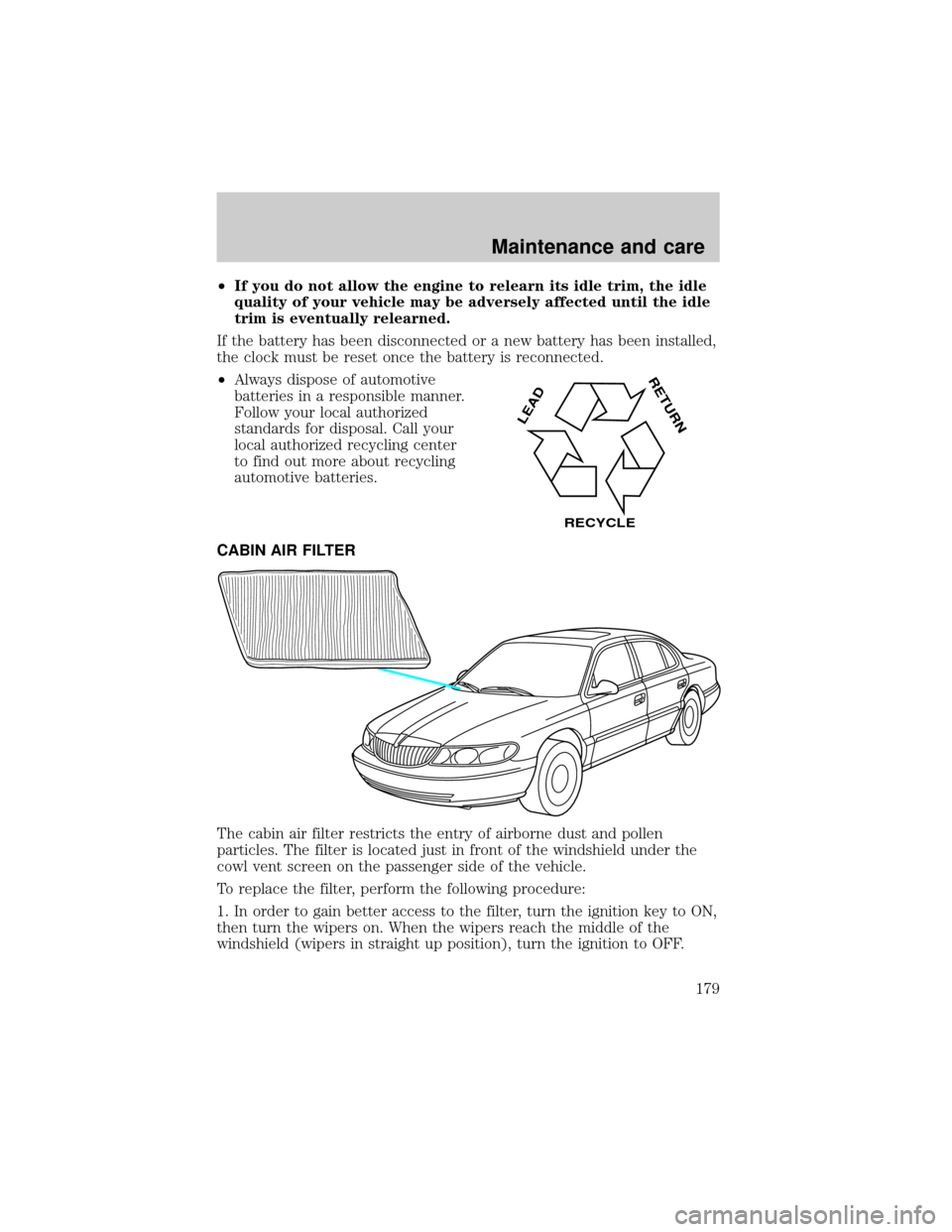
The cabin air filter restricts the entry of airborne dust and pollen
particles. The filter is located just in front of the windshield under the
cowl vent screen on the passenger side of the vehicle.
To replace the filter, perform the following procedure:
1. In order to gain better access to the filter, turn the ignition key to ON,
then turn the wipers on. When the wipers reach the middle of the
windshield (wipers in straight up position), turn the ignition to OFF.
LEAD
RETURN
RECYCLE
Maintenance and care
179
Page 228 of 232

gauge .........................................12
improving fuel economy ........192
octane rating ....................190,211
quality ......................................190
running out of fuel .................191
safety information relating to
automotive fuels .....................187
Fuses ...................................143,144
Garage door opener ....................65
Gas cap (see Fuel cap) ............189
Gas mileage
(see Fuel economy) .................192
Gauges .........................................12
engine coolant
temperature gauge ...................13
fuel gauge ..................................12
odometer ...................................13
speedometer .............................13
tachometer ................................13
GAWR
(Gross Axle Weight Rating) .....135
definition .................................135
driving with a heavy load ......135
location ....................................135
GVWR (Gross
Vehicle Weight Rating) .............135
calculating ...............................135
definition .................................135
driving with a heavy load ......135
location ....................................135
Hazard flashers .........................142
Head restraints ...........................92
Headlamps ...................................22
aiming ........................201,202,203
autolamp system .......................23
bulb specifications ..................201
daytime running lights .............22
flash to pass ..............................23
high beam ............................10,22
replacing bulbs .......................197
turning on and off ...............11,22
warning chime ..........................12Heating ........................................24
HomeLink universal
transceiver (see Garage
door opener) ................65,66,67,68
Hood ..........................................163
Ignition .......................................211
positions of the ignition ...........46
Infant seats
(see Safety seats) .....................113
Inspection/maintenance
(I/M) testing ..............................196
Instrument panel
cleaning ...................................207
cluster ...................................8,207
lighting up
panel and interior .....................23
location of components ..............8
Jump-starting your vehicle ......156
Keyless entry system .................85
autolock .....................................88
keypad .......................................85
programming entry code .........86
Keys .............................................47
key in ignition chime ...............12
positions of the ignition ...........46
Lamps
autolamp system .......................23
bulb replacement
specifications chart ................201
cargo lamps ...............................23
daytime running light ...............22
headlamps .................................22
headlamps, flash to pass ..........23
instrument panel, dimming .....23
interior lamps ...............53,54,200
replacing bulbs ..196,197,199,200
Lane change indicator
(see Turn signal) ........................48
Lights, warning and indicator ......8
air bag ..........................................9
anti-lock brakes (ABS) .....10,126
brake ..........................................10
Index
228