engine coolant LINCOLN CONTINENTAL 2002 User Guide
[x] Cancel search | Manufacturer: LINCOLN, Model Year: 2002, Model line: CONTINENTAL, Model: LINCOLN CONTINENTAL 2002Pages: 240, PDF Size: 1.79 MB
Page 200 of 240
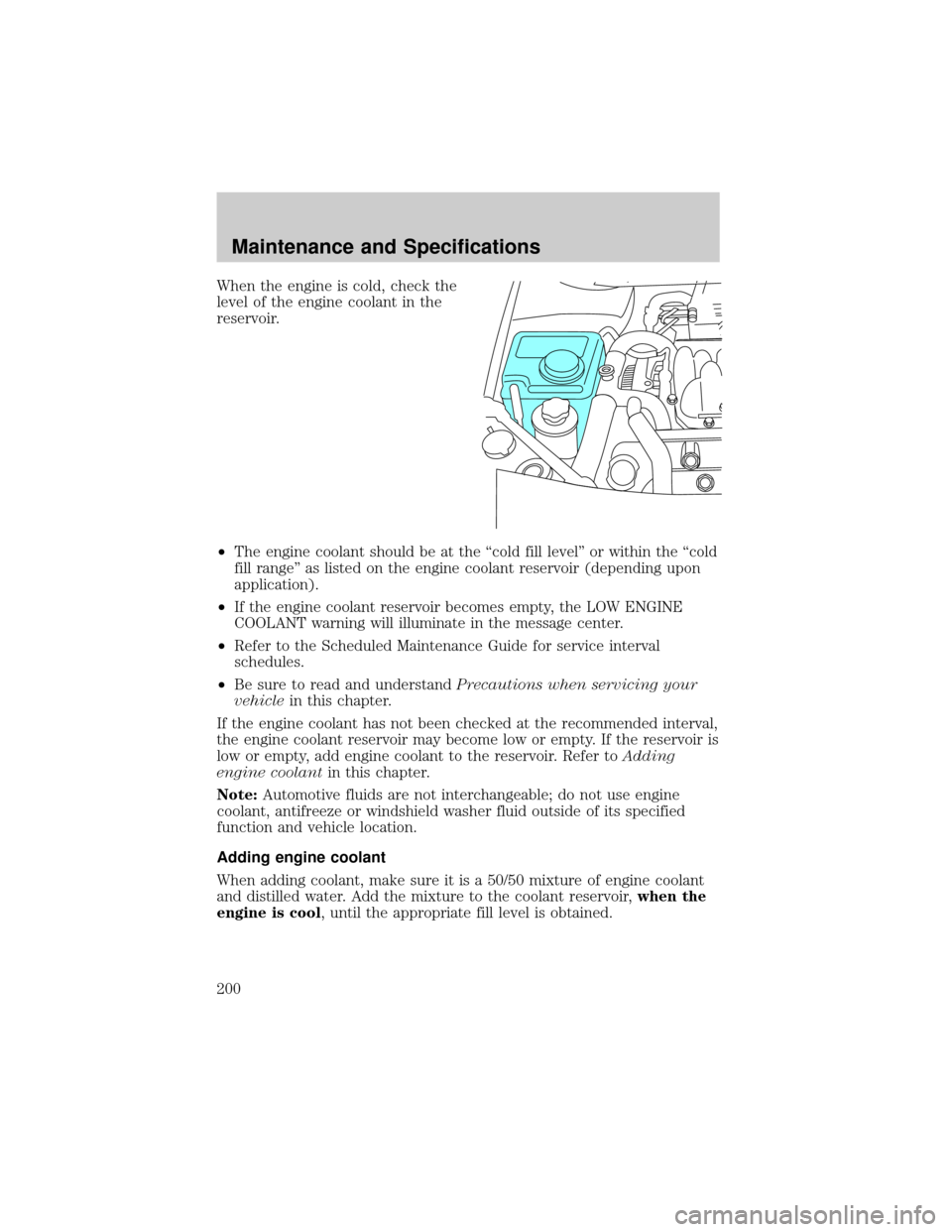
When the engine is cold, check the
level of the engine coolant in the
reservoir.
²The engine coolant should be at the ªcold fill levelº or within the ªcold
fill rangeº as listed on the engine coolant reservoir (depending upon
application).
²If the engine coolant reservoir becomes empty, the LOW ENGINE
COOLANT warning will illuminate in the message center.
²Refer to the Scheduled Maintenance Guide for service interval
schedules.
²Be sure to read and understandPrecautions when servicing your
vehiclein this chapter.
If the engine coolant has not been checked at the recommended interval,
the engine coolant reservoir may become low or empty. If the reservoir is
low or empty, add engine coolant to the reservoir. Refer toAdding
engine coolantin this chapter.
Note:Automotive fluids are not interchangeable; do not use engine
coolant, antifreeze or windshield washer fluid outside of its specified
function and vehicle location.
Adding engine coolant
When adding coolant, make sure it is a 50/50 mixture of engine coolant
and distilled water. Add the mixture to the coolant reservoir,when the
engine is cool, until the appropriate fill level is obtained.
Maintenance and Specifications
200
Page 201 of 240
Do not add engine coolant when the engine is hot. Steam and
scalding liquids released from a hot cooling system can burn you
badly. Also, you can be burned if you spill coolant on hot engine parts.
Do not put engine coolant in the windshield washer fluid
container. If sprayed on the windshield, engine coolant could
make it difficult to see through the windshield.
The cooling system in your vehicle is filled with either green-colored
Motorcraft Premium Engine Coolant meeting Ford specification
ESE-M97B44±A or yellow-colored Motorcraft Premium Gold Engine
Coolant meeting Ford Specification WSS-M97B51±A1. To determine your
vehicle's coolant type (color), check your coolant reservoir.
²Add Motorcraft Premium Engine Coolant (green-colored),
VC-4±A (U.S.) or CXC-10 (Canada) or Motorcraft Premium
Gold Engine Coolant (yellow-colored), VC-7±A, depending on
the type of coolant originally equipped in your vehicle.If you
are unsure which type of coolant your vehicle requires, check your
coolant reservoir or contact your local dealer.
²Do not add/mix an orange-colored, extended life coolant such
as Motorcraft Speciality Orange Engine Coolant, VC-2 (US) or
CXC-209 (Canada), meeting Ford specification WSS-M97B44±D
with the factory-filled coolant.Mixing Motorcraft Speciality Orange
Engine Coolant or any orange-colored extended life product with your
factory filled coolant can result in degraded corrosion protection.
²A large amount of water without engine coolant may be added, in case
of emergency, to reach a vehicle service location. In this instance, the
cooling system must be drained and refilled with a 50/50 mixture of
engine coolant and distilled water as soon as possible. Water alone
(without engine coolant) can cause engine damage from corrosion,
overheating or freezing.
²Do not use alcohol, methanol or brine or any engine coolants
mixed with alcohol or methanol antifreeze (coolant).Alcohol
and other liquids can cause engine damage from overheating or
freezing.
²Do not add extra inhibitors or additives to the coolant.These
can be harmful and compromise the corrosion protection of the engine
coolant.
Maintenance and Specifications
201
Page 202 of 240
²Do not mix with recycled coolant unless from a Ford-approved
recycling process (seeUse of Recycled Engine Coolantsection).
For vehicles with overflow coolant systems with a non-pressurized cap
on the coolant recovery system, add coolant to the coolant recovery
reservoir when the engine is cool. Add the proper mixture of coolant and
water to the ªcold fullº level. For all other vehicles, which have a coolant
degas system with a pressurized cap, or if it is necessary to remove the
coolant pressure relief cap on the radiator of a vehicle with an overflow
system, follow these steps to add engine coolant.
To avoid personal injury, make sure the engine is cool before
unscrewing the coolant pressure relief cap. The cooling system is
under pressure; steam and hot liquid can come out forcefully when the
cap is loosened slightly.
1. Before you begin, turn the engine off and let it cool.
2. When the engine is cool, wrap a thick cloth around the coolant
pressure relief cap on the coolant reservoir (an opaque plastic bottle).
Slowly turn cap counterclockwise (left) until pressure begins to release.
3. Step back while the pressure releases.
4. When you are sure that all the pressure has been released, use the
cloth to turn it counterclockwise and remove the cap.
5. Fill the coolant reservoir slowly with the proper coolant mixture (see
above), to within the ªcold fill rangeº or the ªcold fullº level on the
reservoir. If you removed the radiator cap in an overflow system, fill the
radiator until the coolant is visible and radiator is almost full.
6. Replace the cap. Turn until tightly installed. (Cap must be tightly
installed to prevent coolant loss.)
After any coolant has been added, check the coolant concentration see
Checking Engine Coolant section). If the concentration is not 50/50
(protection to ±34É F/±36É C), drain some coolant and adjust the
concentration. It may take several drains and additions to obtain a 50/50
coolant concentration.
Whenever coolant has been added, the coolant level in the coolant
reservoir should be checked the next few times you drive the vehicle. If
necessary, add enough 50/50 concentration of engine coolant and
distilled water to bring the liquid level to the proper level.
Maintenance and Specifications
202
Page 203 of 240
If you have to add more than 1.0 liter (1.0 quart) of engine coolant per
month, have your dealer check the engine cooling system. Your cooling
system may have a leak. Operating an engine with a low level of coolant
can result in engine overheating and possible engine damage.
Recycled engine coolant
Ford Motor Company recommends the use of a recycled engine coolant
produced by Ford-approved processes in vehicles originally equipped
with Motorcraft Premium Engine Coolant (green-colored). However, not
all coolant recycling processes produce coolant that meets Ford
specification ESE-M97B44±A. Use of such coolant may harm the engine
and cooling system components.
Ford Motor Company does NOT recommend the use of recycled engine
coolant in vehicles originally equipped with Motorcraft Premium Gold
Engine Coolant since a Ford-approved recycling process is not yet
available.
Used engine coolant should be disposed of in an appropriate
manner. Follow your community's regulations and standards for recycling
and disposing of automotive fluids.
Coolant refill capacity
To find out how much fluid your vehicle's cooling system can hold, refer
toRefill capacitiesin this chapter.
Fill your engine coolant reservoir as outlined inAdding engine coolant
in this chapter.
Severe climates
If you drive in extremely cold climates (less than ±36É C [±34É F]):
²It may be necessary to increase the coolant concentration
above 50%.
²NEVER increase the coolant concentration above 60%.
²Increased engine coolant concentrations above 60% will
decrease the overheat protection characteristics of the engine
coolant and may cause engine damage.
²Refer to the chart on the coolant container to ensure the
coolant concentration in your vehicle will provide adequate
freeze protection at the temperatures in which you drive in the
winter months.
Maintenance and Specifications
203
Page 204 of 240
If you drive in extremely hot climates:
²It is still necessary to maintain the coolant concentration
above 40%.
²NEVER decrease the coolant concentration below 40%.
²Decreased engine coolant concentrations below 40% will
decrease the corrosion protection characteristics of the engine
coolant and may cause engine damage.
²Decreased engine coolant concentrations below 40% will
decrease the freeze protection characteristics of the engine
coolant and may cause engine damage.
²Refer to the chart on the coolant container to ensure the
coolant concentration in your vehicle will provide adequate
protection at the temperatures in which you drive.
Vehicles driven year-round in non-extreme climates should use a 50/50
mixture of engine coolant and distilled water for optimum cooling system
and engine protection.
WHAT YOU SHOULD KNOW ABOUT AUTOMOTIVE FUELS
Important safety precautions
Do not overfill the fuel tank. The pressure in an overfilled tank
may cause leakage and lead to fuel spray and fire.
The fuel system may be under pressure. If the fuel filler cap is
venting vapor or if you hear a hissing sound, wait until it stops
before completely removing the fuel filler cap. Otherwise, fuel may
spray out and injure you or others.
If you do not use the proper fuel filler cap, excessive pressure or
vacuum in the fuel tank may damage the fuel system or cause
the fuel cap to disengage in a collision, which may result in possible
personal injury.
Automotive fuels can cause serious injury or death if misused or
mishandled.
Maintenance and Specifications
204
Page 214 of 240
²Next, at least 20 minutes driving in stop-and-go, city-type traffic with
at least four idle periods.
Allow the vehicle to sit for at least eight hours without starting the
engine. Then, start the engine and complete the above driving cycle. The
engine must warm up to its normal operating temperature. Once started,
do not turn off the engine until the above driving cycle is complete.
CHECKING AND ADDING POWER STEERING FLUID
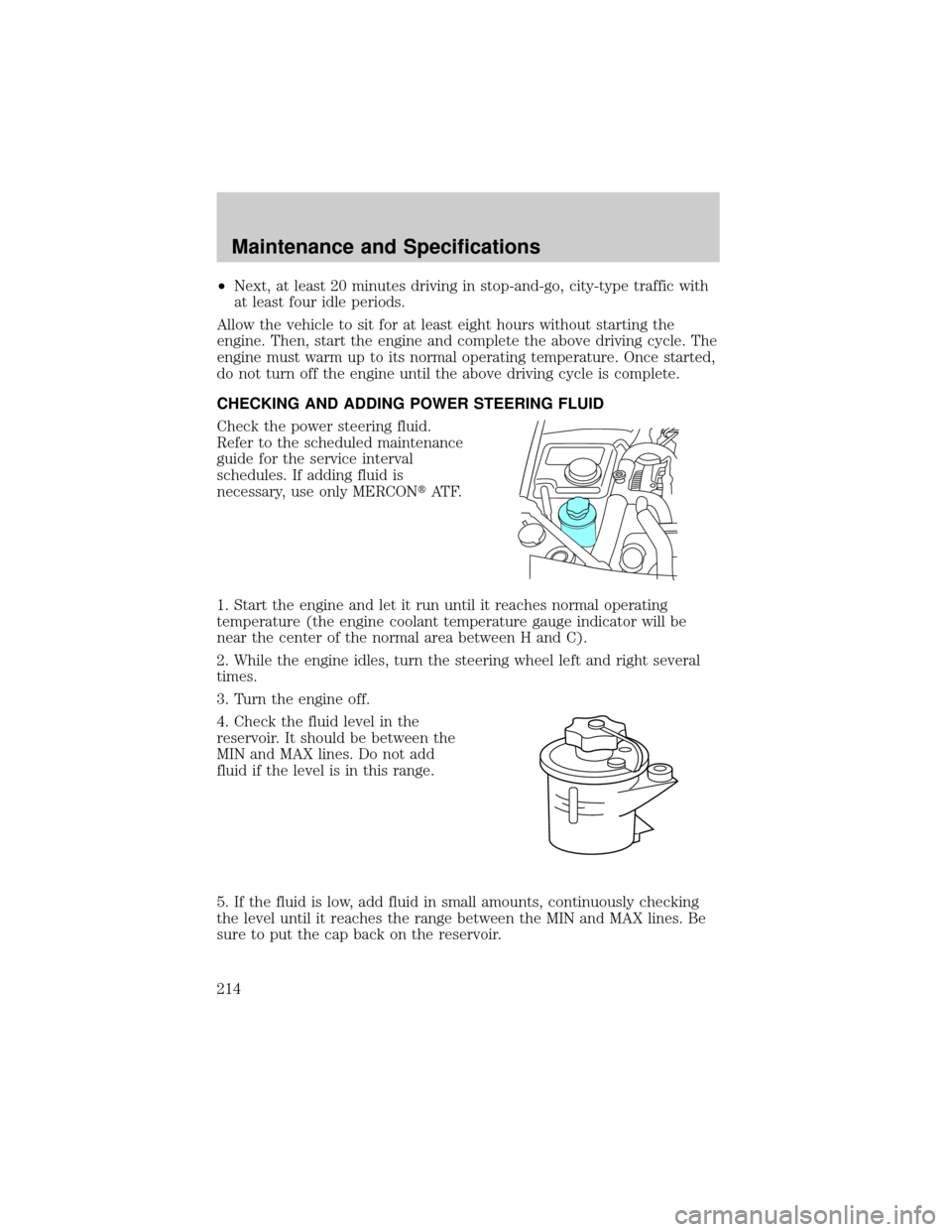
Check the power steering fluid.
Refer to the scheduled maintenance
guide for the service interval
schedules. If adding fluid is
necessary, use only MERCONtAT F.
1. Start the engine and let it run until it reaches normal operating
temperature (the engine coolant temperature gauge indicator will be
near the center of the normal area between H and C).
2. While the engine idles, turn the steering wheel left and right several
times.
3. Turn the engine off.
4. Check the fluid level in the
reservoir. It should be between the
MIN and MAX lines. Do not add
fluid if the level is in this range.
5. If the fluid is low, add fluid in small amounts, continuously checking
the level until it reaches the range between the MIN and MAX lines. Be
sure to put the cap back on the reservoir.
Maintenance and Specifications
214
Page 224 of 240
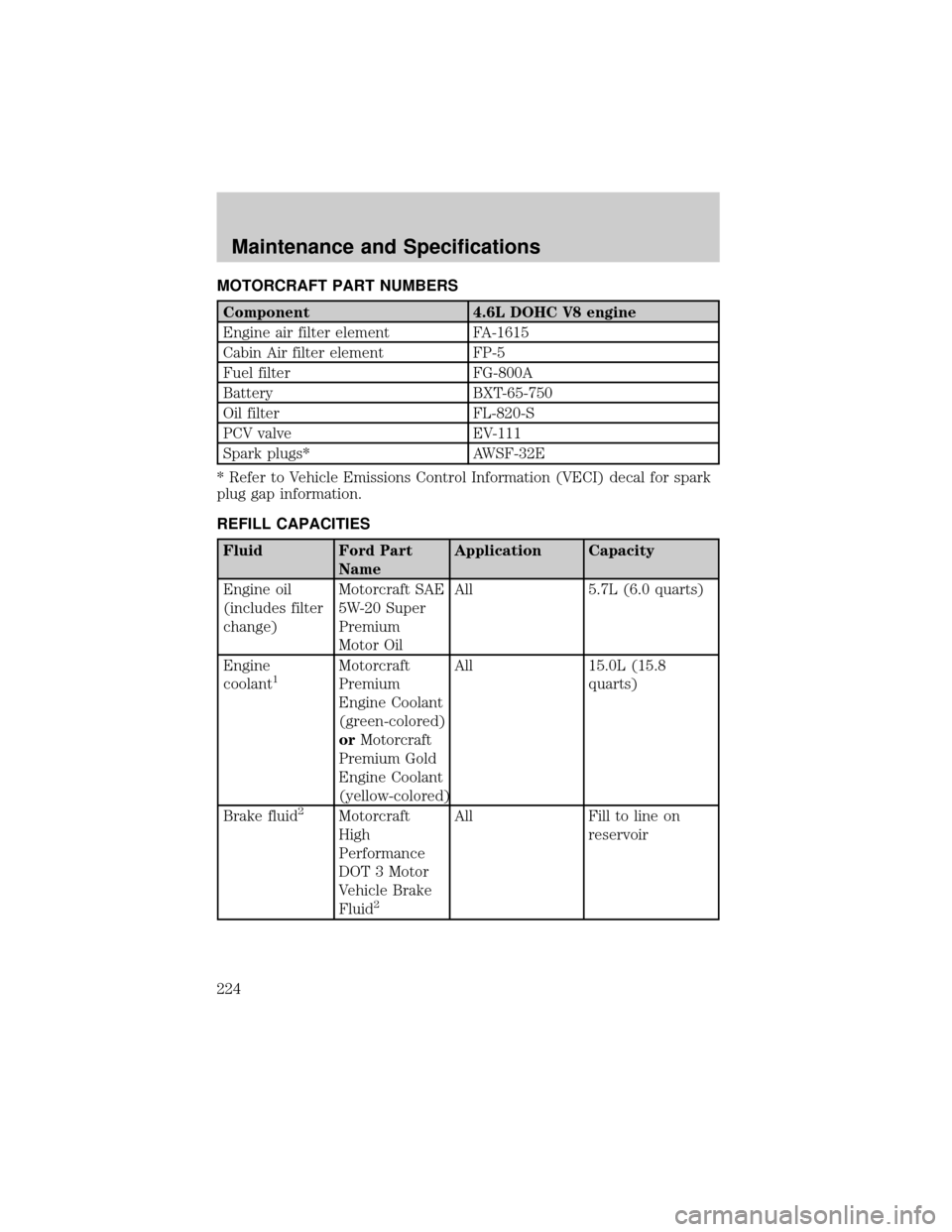
MOTORCRAFT PART NUMBERS
Component 4.6L DOHC V8 engine
Engine air filter element FA-1615
Cabin Air filter element FP-5
Fuel filter FG-800A
Battery BXT-65-750
Oil filter FL-820-S
PCV valve EV-111
Spark plugs* AWSF-32E
* Refer to Vehicle Emissions Control Information (VECI) decal for spark
plug gap information.
REFILL CAPACITIES
Fluid Ford Part
NameApplication Capacity
Engine oil
(includes filter
change)Motorcraft SAE
5W-20 Super
Premium
Motor OilAll 5.7L (6.0 quarts)
Engine
coolant
1Motorcraft
Premium
Engine Coolant
(green-colored)
orMotorcraft
Premium Gold
Engine Coolant
(yellow-colored)All 15.0L (15.8
quarts)
Brake fluid
2Motorcraft
High
Performance
DOT 3 Motor
Vehicle Brake
Fluid
2
All Fill to line on
reservoir
Maintenance and Specifications
224
Page 226 of 240
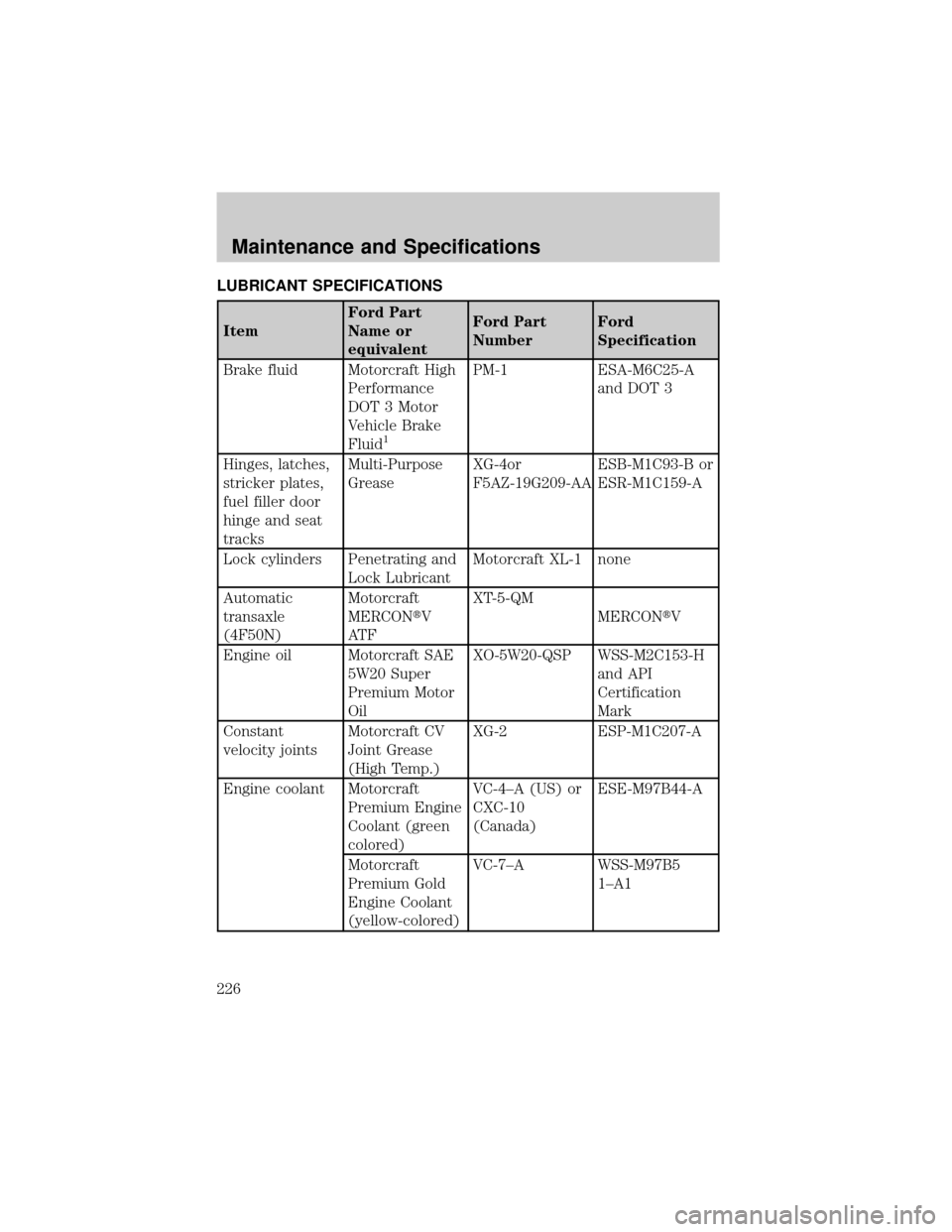
LUBRICANT SPECIFICATIONS
ItemFord Part
Name or
equivalentFord Part
NumberFord
Specification
Brake fluid Motorcraft High
Performance
DOT 3 Motor
Vehicle Brake
Fluid
1
PM-1 ESA-M6C25-A
and DOT 3
Hinges, latches,
stricker plates,
fuel filler door
hinge and seat
tracksMulti-Purpose
GreaseXG-4or
F5AZ-19G209-AAESB-M1C93-B or
ESR-M1C159-A
Lock cylinders Penetrating and
Lock LubricantMotorcraft XL-1 none
Automatic
transaxle
(4F50N)Motorcraft
MERCONtV
AT FXT-5-QM
MERCONtV
Engine oil Motorcraft SAE
5W20 Super
Premium Motor
OilXO-5W20-QSP WSS-M2C153-H
and API
Certification
Mark
Constant
velocity jointsMotorcraft CV
Joint Grease
(High Temp.)XG-2 ESP-M1C207-A
Engine coolant Motorcraft
Premium Engine
Coolant (green
colored)VC-4±A (US) or
CXC-10
(Canada)ESE-M97B44-A
Motorcraft
Premium Gold
Engine Coolant
(yellow-colored)VC-7±A WSS-M97B5
1±A1
Maintenance and Specifications
226
Page 234 of 240

A
Accessory delay ..........................58
Air bag supplemental restraint
system ................................117, 122
and child safety seats ............119
description ......................117, 122
disposal ....................................125
driver air bag ..................120, 123
indicator light ...........12, 121, 124
operation .........................120, 123
passenger air bag ...........120, 123
side air bag ..............................122
Air cleaner filter .......................224
Air conditioning ..........................33
Air filter, cabin ............................39
Air suspension ...........................142
description ..............................142
Antifreeze (see Engine
coolant) .....................................199
Anti-lock brake system (see
Brakes) ..............................138±139
Anti-theft system ......................101
arming the system ..................101
disarming a triggered
system .....................................102
Automatic transaxle .................143
driving with .............................145
fluid, adding ............................216
fluid, checking ........................216
fluid, refill capacities ..............224
fluid, specification ..................227
Auxiliary power point ...........55±56
Axle
lubricant specifications ..........226B
Battery .......................................197
acid, treating emergencies .....197
charging system warning light 12
jumping a disabled battery ....167
maintenance-free ....................197
replacement, specifications ...224
servicing ..................................197
Belt minder ...............................112
Brakes ........................................138
anti-lock ...........................138±139
anti-lock brake system (ABS)
warning light .....................11, 139
brake warning light ..................11
fluid, checking and adding ....215
fluid, refill capacities ..............224
fluid, specifications .........226±227
lubricant specifications ..226±227
shift interlock ..........................143
Break-in period .............................6
C
Capacities for refilling fluids ....224
CD changer .................................28
Certification Label ....................229
Child safety restraints ..............125
child safety belts ....................125
Child safety seats ......................126
attaching with tether straps ..130
in front seat ............................128
in rear seat ..............................128
Cleaning your vehicle
engine compartment ..............186
exterior ....................................189
instrument cluster lens ..........188
instrument panel ....................187
interior .....................................188
Index
234
Page 235 of 240

plastic parts ....................186±187
safety belts ..............................189
washing ....................................184
waxing .....................................184
wheels ......................................185
windows ..................................189
wiper blades ............................187
Clock ............................................55
Compass, electronic ....................60
calibration .................................62
set zone adjustment .................61
Console ........................................56
Controls
power seat ...............................103
steering column ........................67
Coolant
checking and adding ..............199
refill capacities ................203, 224
specifications ..................226±227
Cruise control (see Speed
control) ........................................63
Customer Assistance ................154
Ford accessories for your
vehicle .....................................190
Ford Extended Service
Plan ..........................................176
Getting assistance outside the
U.S. and Canada .....................180
Getting roadside assistance ...154
Getting the service you
need .........................................174
Ordering additional owner's
literature .................................181
The Dispute Settlement
Board .......................................177
Utilizing the
Mediation/Arbitration
Program ...................................180D
Daytime running lamps (see
Lamps) .........................................40
Defrost
rear window ..............................39
Dipstick
automatic transmission
fluid ..........................................216
engine oil .................................194
Doors
lubricant specifications ..........226
Driving under special
conditions
through water .........................148
E
Electronic message center .........76
Emergencies, roadside
jump-starting ..........................167
Emission control system ..........212
Engine ........................................227
check engine/service engine
soon light ..................................10
cleaning ...................................186
coolant .....................................199
idle speed control ...................197
lubrication
specifications ..................226±227
refill capacities ........................224
service points ..........................193
starting after a collision .........155
Engine block heater .................136
Engine oil ..................................194
change oil soon warning,
message center .......................194
checking and adding ..............194
Index
235