child lock LINCOLN CONTINENTAL 2017 User Guide
[x] Cancel search | Manufacturer: LINCOLN, Model Year: 2017, Model line: CONTINENTAL, Model: LINCOLN CONTINENTAL 2017Pages: 584, PDF Size: 6.13 MB
Page 37 of 584
PRINCIPLE OF OPERATION
WARNINGS
Always drive and ride with your
seatback upright and the lap belt snug
and low across the hips. To reduce the risk of injury, make sure
children sit where they can be properly
restrained. Never let a passenger hold a child on
his or her lap while your vehicle is
moving. The passenger cannot protect the
child from injury in a crash. All occupants of your vehicle, including
the driver, should always properly wear
their safety belts, even when an airbag
supplemental restraint system is provided.
Failure to properly wear your safety belt
could seriously increase the risk of injury or
death. WARNINGS
It is extremely dangerous to ride in a
cargo area, inside or outside of a
vehicle. In a crash, people riding in these
areas are more likely to be seriously injured
or killed. Do not allow people to ride in any
area of your vehicle that is not equipped with
seats and safety belts. Be sure everyone in
your vehicle is in a seat and using a safety
belt properly. In a rollover crash, an unbelted person
is significantly more likely to die than
a person wearing a safety belt. Each seating position in your vehicle
has a specific safety belt assembly
which is made up of one buckle and one
tongue that are designed to be used as a
pair. 1) Use the shoulder belt on the outside
shoulder only. Never wear the shoulder belt
under the arm. 2) Never swing the safety belt
around your neck over the inside shoulder.
3) Never use a single belt for more than one
person. WARNINGS
When possible, all children 12 years old
and under should be properly
restrained in a rear seating position. Failure
to follow this could seriously increase the
risk of injury or death. Safety belts and seats can become hot
in a vehicle that has been closed up in
sunny weather; they could burn a small child.
Check seat covers and buckles before you
place a child anywhere near them. Front and rear seat occupants,
including pregnant women, should
wear safety belts for optimum protection in
an accident. All seating positions in your vehicle have lap
and shoulder safety belts. All occupants of
the vehicle should always properly wear their
safety belts, even when an airbag
supplemental restraint system is provided.
The safety belt system consists of:
•
Lap and shoulder safety belts.
• Shoulder safety belt with automatic
locking mode, (except driver safety belt).
34
Continental (CPL) Canada/United States of America, enUSA, First Printing Seatbelts
Page 39 of 584
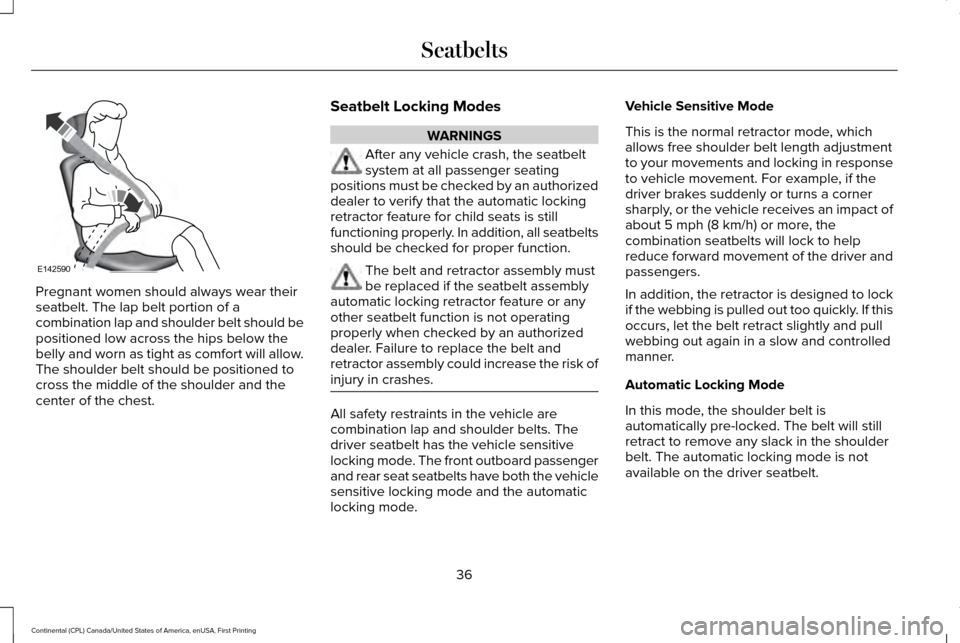
Pregnant women should always wear their
seatbelt. The lap belt portion of a
combination lap and shoulder belt should be
positioned low across the hips below the
belly and worn as tight as comfort will allow.
The shoulder belt should be positioned to
cross the middle of the shoulder and the
center of the chest.
Seatbelt Locking Modes WARNINGS
After any vehicle crash, the seatbelt
system at all passenger seating
positions must be checked by an authorized
dealer to verify that the automatic locking
retractor feature for child seats is still
functioning properly. In addition, all seatbelts
should be checked for proper function. The belt and retractor assembly must
be replaced if the seatbelt assembly
automatic locking retractor feature or any
other seatbelt function is not operating
properly when checked by an authorized
dealer. Failure to replace the belt and
retractor assembly could increase the risk of
injury in crashes. All safety restraints in the vehicle are
combination lap and shoulder belts. The
driver seatbelt has the vehicle sensitive
locking mode. The front outboard passenger
and rear seat seatbelts have both the vehicle
sensitive locking mode and the automatic
locking mode.Vehicle Sensitive Mode
This is the normal retractor mode, which
allows free shoulder belt length adjustment
to your movements and locking in response
to vehicle movement. For example, if the
driver brakes suddenly or turns a corner
sharply, or the vehicle receives an impact of
about 5 mph (8 km/h) or more, the
combination seatbelts will lock to help
reduce forward movement of the driver and
passengers.
In addition, the retractor is designed to lock
if the webbing is pulled out too quickly. If this
occurs, let the belt retract slightly and pull
webbing out again in a slow and controlled
manner.
Automatic Locking Mode
In this mode, the shoulder belt is
automatically pre-locked. The belt will still
retract to remove any slack in the shoulder
belt. The automatic locking mode is not
available on the driver seatbelt.
36
Continental (CPL) Canada/United States of America, enUSA, First Printing SeatbeltsE142590
Page 40 of 584
When to Use the Automatic Locking Mode
This mode should be used any time a child
safety seat, except a booster, is installed in
passenger front or rear seating positions.
Children 12 years old and under should be
properly restrained in a rear seating position
whenever possible. See Child Safety (page
17).
How to Use the Automatic Locking Mode
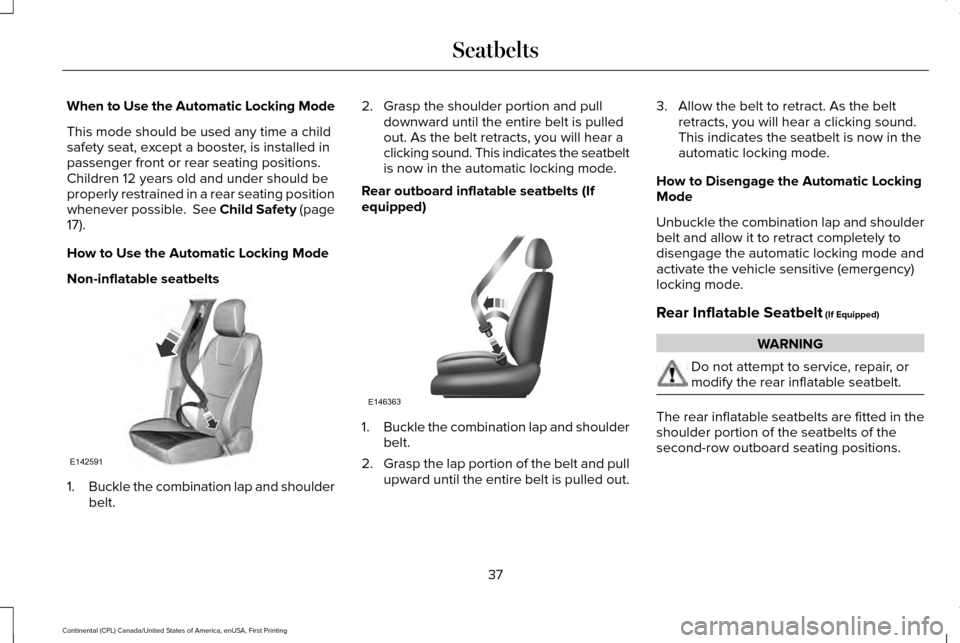
Non-inflatable seatbelts 1.
Buckle the combination lap and shoulder
belt. 2. Grasp the shoulder portion and pull
downward until the entire belt is pulled
out. As the belt retracts, you will hear a
clicking sound. This indicates the seatbelt
is now in the automatic locking mode.
Rear outboard inflatable seatbelts (If
equipped) 1.
Buckle the combination lap and shoulder
belt.
2. Grasp the lap portion of the belt and pull
upward until the entire belt is pulled out. 3. Allow the belt to retract. As the belt
retracts, you will hear a clicking sound.
This indicates the seatbelt is now in the
automatic locking mode.
How to Disengage the Automatic Locking
Mode
Unbuckle the combination lap and shoulder
belt and allow it to retract completely to
disengage the automatic locking mode and
activate the vehicle sensitive (emergency)
locking mode.
Rear Inflatable Seatbelt
(If Equipped) WARNING
Do not attempt to service, repair, or
modify the rear inflatable seatbelt.
The rear inflatable seatbelts are fitted in the
shoulder portion of the seatbelts of the
second-row outboard seating positions.
37
Continental (CPL) Canada/United States of America, enUSA, First Printing SeatbeltsE142591 E146363
Page 41 of 584
Note:
The rear inflatable seatbelts are
compatible with most infant and child safety
car seats and belt positioning booster seats
when properly installed. This is because they
are designed to fill with a cooled gas at a
lower pressure and at a slower rate than
traditional airbags. After inflation, the
shoulder portion of the seatbelt remains cool
to the touch.
The rear inflatable seatbelt consists of the
following:
• An inflatable bag located in the shoulder
seatbelt webbing.
• Lap seatbelt webbing with automatic
locking mode.
• The same warning light, electronic
control and diagnostic unit as used for
the front seatbelts.
• Impact sensors located in various parts
of the vehicle.
How does the rear inflatable seatbelt
system work?
The rear inflatable seatbelts will function like
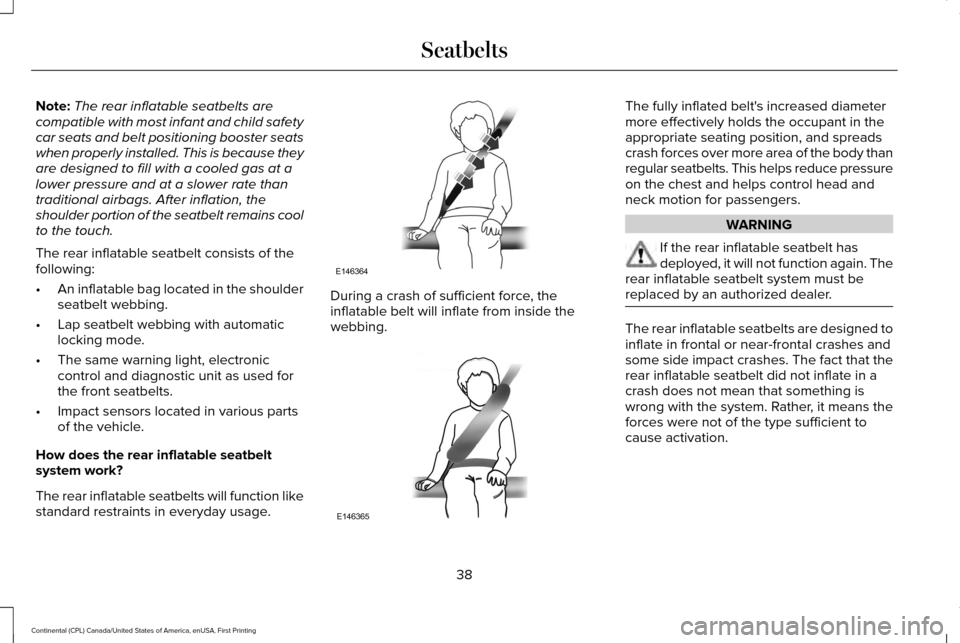
standard restraints in everyday usage. During a crash of sufficient force, the
inflatable belt will inflate from inside the
webbing. The fully inflated belt's increased diameter
more effectively holds the occupant in the
appropriate seating position, and spreads
crash forces over more area of the body than
regular seatbelts. This helps reduce pressure
on the chest and helps control head and
neck motion for passengers.
WARNING
If the rear inflatable seatbelt has
deployed, it will not function again. The
rear inflatable seatbelt system must be
replaced by an authorized dealer. The rear inflatable seatbelts are designed to
inflate in frontal or near-frontal crashes and
some side impact crashes. The fact that the
rear inflatable seatbelt did not inflate in a
crash does not mean that something is
wrong with the system. Rather, it means the
forces were not of the type sufficient to
cause activation.
38
Continental (CPL) Canada/United States of America, enUSA, First Printing SeatbeltsE146364 E146365
Page 75 of 584
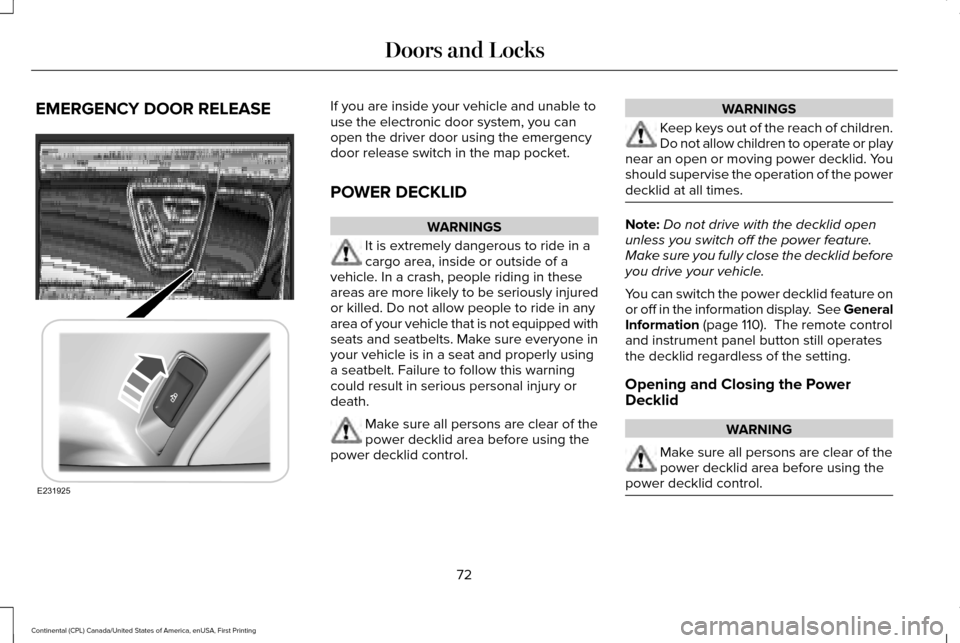
EMERGENCY DOOR RELEASE If you are inside your vehicle and unable to
use the electronic door system, you can
open the driver door using the emergency
door release switch in the map pocket.
POWER DECKLID
WARNINGS
It is extremely dangerous to ride in a
cargo area, inside or outside of a
vehicle. In a crash, people riding in these
areas are more likely to be seriously injured
or killed. Do not allow people to ride in any
area of your vehicle that is not equipped with
seats and seatbelts. Make sure everyone in
your vehicle is in a seat and properly using
a seatbelt. Failure to follow this warning
could result in serious personal injury or
death. Make sure all persons are clear of the
power decklid area before using the
power decklid control. WARNINGS
Keep keys out of the reach of children.
Do not allow children to operate or play
near an open or moving power decklid. You
should supervise the operation of the power
decklid at all times. Note:
Do not drive with the decklid open
unless you switch off the power feature.
Make sure you fully close the decklid before
you drive your vehicle.
You can switch the power decklid feature on
or off in the information display. See General
Information (page 110). The remote control
and instrument panel button still operates
the decklid regardless of the setting.
Opening and Closing the Power
Decklid WARNING
Make sure all persons are clear of the
power decklid area before using the
power decklid control. 72
Continental (CPL) Canada/United States of America, enUSA, First Printing Doors and LocksE231925
Page 80 of 584
3. Press and hold 1·2 for two seconds. You
must do this within five seconds of
completing step 2.
All personal codes erase and only the
factory-set five-digit code works.
Anti-Scan Feature
The keypad goes into an anti-scan mode if
you enter the wrong code seven times. This
mode turns off the keypad for one minute
and the keypad lamp flashes.
The anti-scan feature turns off after any of
the following occur:
• One minute of keypad inactivity.
• You press the unlock button on the
remote control.
• You switch your vehicle on.
• You unlock the vehicle using intelligent
access. Locking and Unlocking the Doors
Locking All Doors
Press and hold
7·8 and 9·0 on the keypad
simultaneously with the driver door closed.
You do not need to enter a code first.
Unlocking All Doors
Enter the factory-set code or your personal
code, then press
3·4 on the keypad within
five seconds.
Unlocking Only the Driver Door
Enter the factory-set or your personal
five-digit code. You must press each number
within five seconds of each other. The
interior lamps illuminate.
Note: All doors unlock if the two-stage
unlocking feature is turned off. See Locking
and Unlocking
(page 65). INTERIOR LUGGAGE
COMPARTMENT RELEASE WARNINGS
Keep vehicle doors and luggage
compartment locked and keep keys
and remote transmitters out of a child’ s
reach. Unsupervised children could lock
themselves in the trunk and risk injury.
Children should be taught not to play in
vehicles. Do not leave children or animals
unattended in the vehicle. On hot days,
the temperature in the trunk or vehicle
interior can rise very quickly. Exposure of
people or animals to these high
temperatures for even a short time can cause
death or serious heat-related injuries,
including brain damage. Small children are
particularly at risk. Your vehicle is equipped with a release
handle that provides a means of escape for
children and adults if they become locked
inside the luggage compartment.
77
Continental (CPL) Canada/United States of America, enUSA, First Printing Doors and Locks
Page 100 of 584
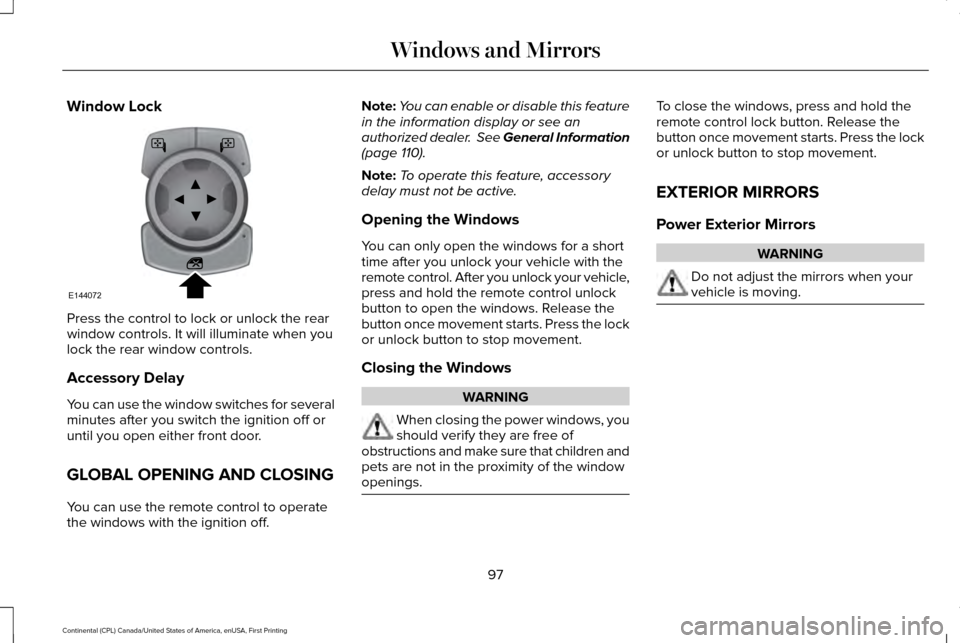
Window Lock
Press the control to lock or unlock the rear
window controls. It will illuminate when you
lock the rear window controls.
Accessory Delay
You can use the window switches for several
minutes after you switch the ignition off or
until you open either front door.
GLOBAL OPENING AND CLOSING
You can use the remote control to operate
the windows with the ignition off. Note:
You can enable or disable this feature
in the information display or see an
authorized dealer. See General Information
(page 110).
Note: To operate this feature, accessory
delay must not be active.
Opening the Windows
You can only open the windows for a short
time after you unlock your vehicle with the
remote control. After you unlock your vehicle,
press and hold the remote control unlock
button to open the windows. Release the
button once movement starts. Press the lock
or unlock button to stop movement.
Closing the Windows WARNING
When closing the power windows, you
should verify they are free of
obstructions and make sure that children and
pets are not in the proximity of the window
openings. To close the windows, press and hold the
remote control lock button. Release the
button once movement starts. Press the lock
or unlock button to stop movement.
EXTERIOR MIRRORS
Power Exterior Mirrors
WARNING
Do not adjust the mirrors when your
vehicle is moving.
97
Continental (CPL) Canada/United States of America, enUSA, First Printing Windows and MirrorsE144072
Page 128 of 584

Action
Message
There is a system malfunction with the child locks. Contact an authorize\
d dealer as soon as possible.
Child Lock Malfunction Service Required
Indicates that the rear seat interior door release switches and power wi\
ndows are switched off,preventing rear seat occupants from opening the doors or windows.
Child Lock ON
Indicates that the rear seat interior door release switches and power wi\
ndows are switched on.
Child Lock OFF
Displays when the door lock turns off.
Door Unlocked
Displays when the door lock is turned on and you attempt to open the doo\
r.
Doors Locked Unlock Before Opening
Indicates a driver door fault that requires manually opening the door by\
the override lever.Contact an authorized dealer.
Driver Door Fault Use Inside Override
Lever In Map Pocket
Indicates a fault with the electronic door system. Contact an authorized\
dealer.
Door Fault Service Required
Displays the factory keypad code after the keypad has been reset. See Keyless Entry (page
75).
Factory Keypad Code {X X X X X}
Driver Alert Action
Message
Stop and rest as soon as it is safe to do so.
Driver Alert Warning Rest Now
Take a rest soon.
Driver Alert Warning Rest Suggested
125
Continental (CPL) Canada/United States of America, enUSA, First Printing Information Displays
Page 575 of 584
Automatic Transmission...............................187
Automatic Transmission Adaptive
Learning.............................................................191
Brake-Shift Interlock Override.........................
190
If Your Vehicle Gets Stuck In Mud or Snow...................................................................191
Push Button Shift Transmission.......................187
SelectShift™ Automatic Transmission.............189
Understanding the Shift Positions of your Automatic Transmission................................
187
Automatic Transmission Fluid Check
.......319
6F50/6F55 Transmission..................................319
Autowipers.......................................................85
Auxiliary Power Points.................................168 110 Volt AC Power Point.....................................168
12 Volt DC Power Point......................................168
Locations...............................................................168
AWD See: All-Wheel Drive...........................................192
B
Battery See: Changing the 12V Battery.......................
324
Blind Spot Information System.................245 Switching the System Off and On..................247
System Errors......................................................247
Using the System...............................................245 Bonnet Lock
See: Opening and Closing the Hood............306
Booster Seats
..................................................28
Types of Booster Seats.......................................29
Brake Fluid Check........................................323
Brakes..............................................................201 General Information............................................201
Breaking-In....................................................269
Bulb Specification Chart
.............................328
C
Cabin Air Filter................................................147
California Proposition 65
...............................12
Capacities and Specifications - 2.7L EcoBoost™....................................................378
Specifications......................................................379
Capacities and Specifications - 3.0L EcoBoost™....................................................384
Specifications......................................................385
Capacities and Specifications - 3.7L........389 Specifications.......................................................391
Capacities and Specifications
...................368
Car Wash See: Cleaning the Exterior...............................333
Center Console
..............................................170
Changing a Bulb...........................................327
Front Direction Indicator...................................328 High-Intensity Discharge Headlamps...........327
LED Lamps...........................................................328
Changing a Fuse..........................................303 Fuses.....................................................................303
Changing a Road Wheel............................360 Dissimilar Spare Wheel and Tire Assembly
Information......................................................360
Stowing the flat tire ...........................................364
Tire Change Procedure....................................362
Changing the 12V Battery
..........................324
Changing the Engine Air Filter - 2.7L EcoBoost™/3.0L EcoBoost™
.....................330
Changing the Engine Air Filter - 3.7L......330
Changing the Wiper Blades
......................325
Changing the Windshield Wiper Blades......326
Checking MyKey System Status.................62 MyKey Distance....................................................62
Number of Admin Keys.......................................63
Number of MyKeys...............................................62
Checking the Wiper Blades.......................325
Child Restraint and Seatbelt Maintenance...................................................41
Child Restraint Positioning
............................31
Child Safety.......................................................17
General Information...............................................17
Child Safety Locks..........................................32
Child Seats........................................................19
Cleaning Leather Seats...............................337
572
Continental (CPL) Canada/United States of America, enUSA, First Printing Index
Page 576 of 584
Cleaning Products........................................332
Cleaning the Engine....................................335
Cleaning the Exterior...................................333
Exterior Chrome Parts.......................................334
Exterior Plastic Parts..........................................334
Stripes or Graphics.............................................334
Underbody...........................................................334
Under Hood.........................................................335
Cleaning the Instrument Panel and Instrument Cluster Lens...........................336
Cleaning the Interior....................................336
Cleaning the Wheels...................................338
Cleaning the Windows and Wiper Blades...........................................................336
Clearing All MyKeys
.......................................62
Climate............................................................443
Climate Control
...............................................141
Climate Controlled Seats.............................161
Ventilated Seats...................................................162
Coolant Check See: Engine Coolant Check..............................314
Crash Sensors and Airbag Indicator
..........52
Creating a MyKey............................................61 Programming or Changing Configurable
Settings...............................................................62
Cross Traffic Alert
.........................................247
False Alerts...........................................................251
Switching the System Off and On...................251 System Errors.......................................................251
System Lights, Messages and Audible
Alerts.................................................................250
System Limitations.............................................250
Using the System................................................247
Cruise Control..................................................83 Principle of Operation.......................................229
Type One................................................................83
Type Two.................................................................84
Cruise control See: Using Cruise Control...............................
229
Customer Assistance..................................279
D
Data Recording
..................................................9
Event Data Recording...........................................10
Service Data Recording.........................................9
Daytime Running Lamps...............................90
Direction Indicators
........................................93
Lane Change..........................................................93
Doors and Locks.............................................65
Drive Control
.................................................256
LINCOLN DRIVE CONTROL............................256
Driver Alert.....................................................239 Using Driver Alert...............................................239
Driver and Passenger Airbags....................45 Children and Airbags...........................................46 Proper Driver and Front Passenger Seating
Adjustment.........................................................46
Driver and Passenger Knee Airbags.........50
Driving Aids
...................................................239
Driving Hints..................................................269
Driving Through Water...............................269
DRL See: Daytime Running Lamps...........................90
E
Economical Driving
......................................269
Electric Parking Brake.................................202 Applying the Electric Parking brake..............202
Battery With No Charge...................................204
Releasing the Electric Parking Brake............203
Emergency Door Release.............................72
Emission Control System
............................183
On-Board Diagnostics (OBD-II)........................184
Readiness for Inspection and Maintenance
(I/M) Testing......................................................185
End User License Agreement
....................541
VEHICLE SOFTWARE END USER LICENSE
AGREEMENT (EULA) .....................................541
Engine Block Heater
.....................................175
Using the Engine Block Heater.......................175
Engine Coolant Check.................................314 Adding Coolant....................................................315
573
Continental (CPL) Canada/United States of America, enUSA, First Printing Index