tow LINCOLN CONTINENTAL 2020 Owners Manual
[x] Cancel search | Manufacturer: LINCOLN, Model Year: 2020, Model line: CONTINENTAL, Model: LINCOLN CONTINENTAL 2020Pages: 609, PDF Size: 6.24 MB
Page 5 of 609

Using MyKey With Remote Start Systems
........................................................................\
.70
MyKey – Troubleshooting ...........................
70
Doors and Locks
Locking and Unlocking .................................
72
Opening the Doors ........................................
78
Emergency Door Release ............................
79
Power Decklid ................................................
79
Soft Closing Door ..........................................
83
Keyless Entry ..................................................
83
Interior Luggage Compartment Release ........................................................................\
85
Security
Passive Anti-Theft System ...........................
87
Anti-Theft Alarm .............................................
89
Steering Wheel
Adjusting the Steering Wheel ....................
90
Audio Control ..................................................
91
Voice Control ...................................................
91
Cruise Control ................................................
92Information Display Control
........................
92
Heated Steering Wheel ...............................
93
Horn ..................................................................
93
Wipers and Washers
Windshield Wipers ........................................
94
Autowipers ......................................................
95
Windshield Washers .....................................
96
Lighting
General Information ......................................
97
Lighting Control ..............................................
97
Autolamps .......................................................
98
Instrument Lighting Dimmer .......................
99
Headlamp Exit Delay ....................................
99
Daytime Running Lamps - Vehicles With: Configurable Daytime Running Lamps
........................................................................\
99
Daytime Running Lamps - Vehicles With: Daytime Running Lamps (DRL) ..............
99
Adaptive Headlamps ..................................
100
Direction Indicators .....................................
100
Welcome Lighting .........................................
101
Interior Lamps ................................................
101Ambient Lighting
..........................................
102
Automatic High Beam Control
What Is Automatic High Beam Control .......................................................................
103
Switching Automatic High Beam Control On and Off .................................................
103
Automatic High Beam Control Indicators .......................................................................
104
Overriding Automatic High Beam Control .......................................................................
104
Windows and Mirrors
Power Windows ............................................
105
Global Opening and Closing ....................
106
Exterior Mirrors .............................................
106
Interior Mirror ................................................
108
Sun Visors ......................................................
109
Sun Shades ...................................................
109
Moonroof .........................................................
110
Instrument Cluster
Gauges ..............................................................
111
Warning Lamps and Indicators ..................
112
2
Continental (CPL) Canada/United States of America, enUSA, Edition date: 201907, Second-Printing Table of Contents
Page 7 of 609
Hill Start Assist
..............................................215
Auto Hold .......................................................
216
Traction Control
Principle of Operation .................................
218
Using Traction Control ................................
218
Stability Control
Principle of Operation .................................
219
Using Stability Control ...............................
220
Parking Aids
Principle of Operation .................................
221
Rear Parking Aid ...........................................
221
Front Parking Aid ........................................
223
Side Sensing System .................................
225
Active Park Assist ........................................
227
Rear View Camera ......................................
235
360 Degree Camera ..................................
238
Cruise Control
Using Adaptive Cruise Control .................
241Driving Aids
Driver Alert
...................................................
250
Lane Keeping System .................................
251
Blind Spot Information System ................
257
Cross Traffic Alert ........................................
259
Steering .........................................................
264
Pre-Collision Assist .....................................
265
Drive Control ................................................
268
Load Carrying
Load Limit .......................................................
271
Towing
Towing a Trailer ............................................
276
Recommended Towing Weights ..............
277
Essential Towing Checks ...........................
278
Towing the Vehicle on Four Wheels ......
280
Driving Hints
Economical Driving ......................................
281
Breaking-In ....................................................
281
Driving Through Water ...............................
281
Floor Mats .....................................................
282Roadside Emergencies
Roadside Assistance
..................................
284
Hazard Flashers ..........................................
285
Fuel Shutoff ..................................................
285
Jump Starting the Vehicle .........................
286
Post-Crash Alert System ...........................
289
Transporting the Vehicle ...........................
289
Customer Assistance
Getting the Services You Need ................
291
In California (U.S. Only) ..............................
292
The Better Business Bureau (BBB) Auto Line Program (U.S. Only) .......................
293
Utilizing the Mediation/Arbitration Program (Canada Only) ..........................................
294
Getting Assistance Outside the U.S. and Canada ......................................................
295
Ordering Additional Owner's Literature ......................................................................
297
Reporting Safety Defects (U.S. Only) ......
298
Reporting Safety Defects (Canada Only) ......................................................................
298
4
Continental (CPL) Canada/United States of America, enUSA, Edition date: 201907, Second-Printing Table of Contents
Page 16 of 609
Vehicles With a Modem (If Equipped)
The modem has a SIM. The
modem was enabled when your
vehicle was built and periodically
sends messages to stay connected to the
cell phone network, receive automatic
software updates and send vehicle-related
information to us, for example, diagnostic
information. These messages could include
information that identifies your vehicle, the
SIM and the electronic serial number of the
modem. Cell phone network service
providers could have access to additional
information, for example, cell phone network
tower identification. For additional
information about our privacy policy, visit
www .ConnectedLincoln. com or refer to your
local Lincoln website.
Note: The modem continues to send this
information unless you disable the modem
or stop the modem from sharing vehicle data
by changing the modem settings.
See
Network Connectivity (page 428). . Note:
The service can be unavailable or
interrupted for a number of reasons, for
example, environmental or topographical
conditions and data plan coverage.
Note: To find out if your vehicle has a
modem, visit
www .ConnectedLincoln. com .
Vehicles With SYNC
Mobile Device Data
If you connect a mobile device to your
vehicle, you can display data from your
device on the touchscreen for example,
music and album art. You can share your
vehicle data with mobile apps on your device
through the system.
See Apps (page 483).
The mobile apps function operates by your
connected device sending data to us in the
United States. The data is encrypted and
includes the vehicle identification number of
your vehicle, the SYNC module serial
number, odometer, enabled apps, usage
statistics and debugging information. We retain it only as long as necessary to provide
the service, to troubleshoot, for continuous
improvement and to offer you products and
services that may be of interest to you
according to your preferences and where
allowed by law.
If you connect a cell phone to the system,
the system creates a profile that links to that
cell phone. The cell phone profile enables
more mobile features and efficient operation.
The profile contains, for example, data from
your phonebook, read and unread text
messages and call history, including history
of calls when your cell phone was not
connected to the system.
If you connect a media device, the system
creates and retains a media device index of
supported media content. The system also
records a short diagnostic log of
approximately 10 minutes of all recent system
activity.
13
Continental (CPL) Canada/United States of America, enUSA, Edition date: 201907, Second-Printing Introduction
Page 21 of 609
PROTECTING THE ENVIRONMENT
You should play your part in protecting the
environment. Correct vehicle usage and the
authorized disposal of waste, cleaning and
lubrication materials are significant steps
toward this aim.
For additional information about our
sustainability progress and initiatives, visit
www
.sustainability . ford. com .
18
Continental (CPL) Canada/United States of America, enUSA, Edition date: 201907, Second-Printing Environment
Page 29 of 609
7.
Try to pull the belt out of the retractor to
make sure the retractor is in the
automatic locking mode (you should not
be able to pull more belt out). If the
retractor is not locked, unbuckle the belt
and repeat Steps 5 and 6. 8. Remove remaining slack from the belt.
Force the seat down with extra weight,
for example, by pressing down or
kneeling on the child restraint while
pulling up on the shoulder belt in order
to force slack from the belt. This is
necessary to remove the remaining slack
that will exist once the extra weight of the child is added to the child restraint.
It also helps to achieve the proper
snugness of the child restraint to your
vehicle. Sometimes, a slight lean toward
the buckle will provide extra help to
remove remaining slack from the belt.
9. Attach the tether strap (if the child restraint is equipped). 10. Before placing the child in the seat,
forcibly move the seat forward and back
to make sure the seat is securely held
in place. To check this, grab the seat at
the belt path and attempt to move it
side to side and forward and back.
There should be no more than 1 in
(2.5 cm) of movement for proper
installation.
We recommend checking with a NHTSA
Certified Child Passenger Safety Technician
to make certain the child restraint is properly
installed. In Canada, check with Transport
Canada for referral to a Child Car Seat Clinic.
26
Continental (CPL) Canada/United States of America, enUSA, Edition date: 201907, Second-Printing Child SafetyE142533 E142534
Page 32 of 609
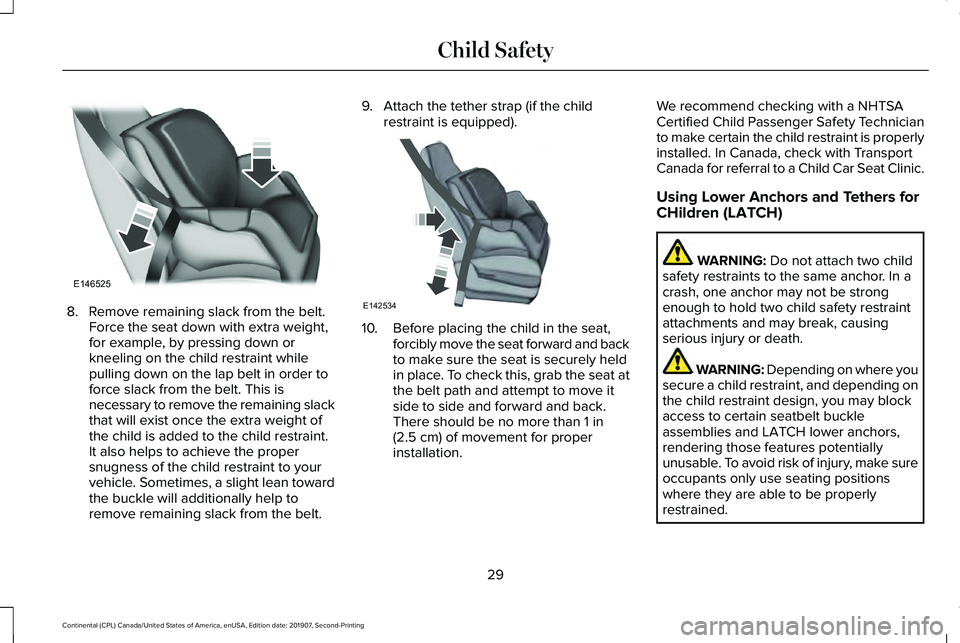
8. Remove remaining slack from the belt.
Force the seat down with extra weight,
for example, by pressing down or
kneeling on the child restraint while
pulling down on the lap belt in order to
force slack from the belt. This is
necessary to remove the remaining slack
that will exist once the extra weight of
the child is added to the child restraint.
It also helps to achieve the proper
snugness of the child restraint to your
vehicle. Sometimes, a slight lean toward
the buckle will additionally help to
remove remaining slack from the belt. 9. Attach the tether strap (if the child
restraint is equipped). 10. Before placing the child in the seat,
forcibly move the seat forward and back
to make sure the seat is securely held
in place. To check this, grab the seat at
the belt path and attempt to move it
side to side and forward and back.
There should be no more than 1 in
(2.5 cm) of movement for proper
installation. We recommend checking with a NHTSA
Certified Child Passenger Safety Technician
to make certain the child restraint is properly
installed. In Canada, check with Transport
Canada for referral to a Child Car Seat Clinic.
Using Lower Anchors and Tethers for
CHildren (LATCH)
WARNING:
Do not attach two child
safety restraints to the same anchor. In a
crash, one anchor may not be strong
enough to hold two child safety restraint
attachments and may break, causing
serious injury or death. WARNING: Depending on where you
secure a child restraint, and depending on
the child restraint design, you may block
access to certain seatbelt buckle
assemblies and LATCH lower anchors,
rendering those features potentially
unusable. To avoid risk of injury, make sure
occupants only use seating positions
where they are able to be properly
restrained.
29
Continental (CPL) Canada/United States of America, enUSA, Edition date: 201907, Second-Printing Child SafetyE146525 E142534
Page 38 of 609
If the booster seat slides on the vehicle seat
upon which it is being used, placing a
rubberized mesh sold as shelf or carpet liner
under the booster seat may improve this
condition. Do not introduce any item thicker
than this under the booster seat. Check with
the booster seat manufacturer's instructions.
CHILD RESTRAINT POSITIONING
WARNING: Do not place a rearward
facing child restraint in front of an active
airbag. Failure to follow this instruction
could result in personal injury or death. WARNING:
Properly secure children
12 years old and under in a rear seating
position whenever possible. If you are
unable to properly secure all children in a
rear seating position, properly secure the
largest child on the front seat. If you must
use a forward facing child restraint on the
front seat, move the seat as far back as
possible. Failure to follow these
instructions could result in personal injury
or death. WARNING:
Always carefully follow
the instructions and warnings provided by
the manufacturer of any child restraint to
determine if the restraint device is
appropriate for your child's size, height,
weight, or age. Follow the child restraint
manufacturer's instructions and warnings
provided for installation and use in
conjunction with the instructions and
warnings provided by your vehicle manufacturer. A safety seat that is
improperly installed or utilized, is
inappropriate for your child's height, age,
or weight or does not properly fit the child
may increase the risk of serious injury or
death.
WARNING: Do not allow a passenger
to hold a child on their lap when your
vehicle is moving. Failure to follow this
instruction could result in personal injury
or death in the event of a sudden stop or
crash. WARNING: Do not use pillows, books
or towels to boost your child's height.
Failure to follow this instruction could result
in personal injury or death. WARNING:
Properly secure child
restraints or booster seats when they are
not in use. They could become projectiles
in a sudden stop or crash. Failure to follow
this instruction could result in personal
injury or death.
35
Continental (CPL) Canada/United States of America, enUSA, Edition date: 201907, Second-Printing Child Safety
Page 43 of 609
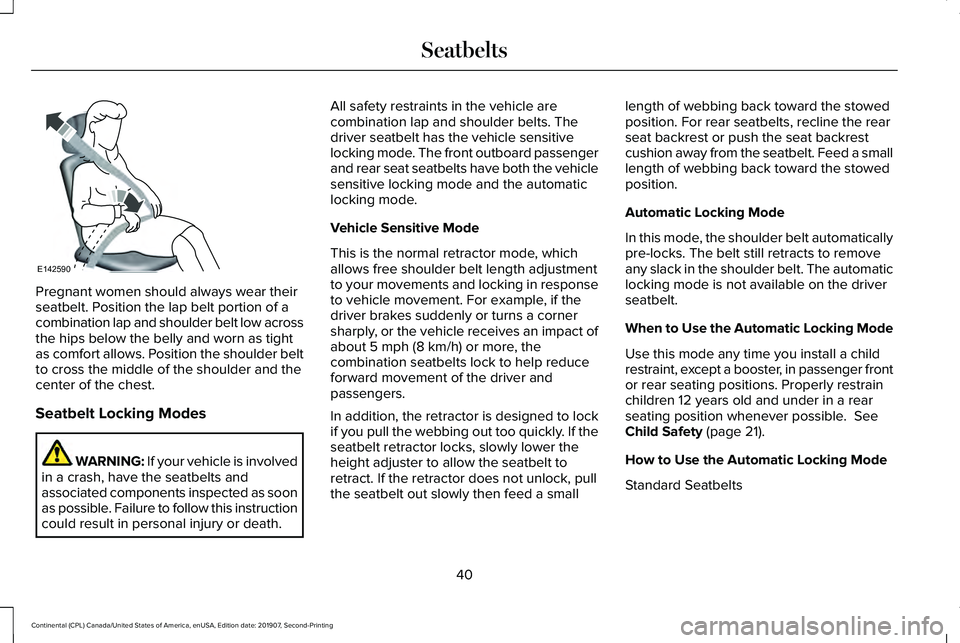
Pregnant women should always wear their
seatbelt. Position the lap belt portion of a
combination lap and shoulder belt low across
the hips below the belly and worn as tight
as comfort allows. Position the shoulder belt
to cross the middle of the shoulder and the
center of the chest.
Seatbelt Locking Modes
WARNING: If your vehicle is involved
in a crash, have the seatbelts and
associated components inspected as soon
as possible. Failure to follow this instruction
could result in personal injury or death. All safety restraints in the vehicle are
combination lap and shoulder belts. The
driver seatbelt has the vehicle sensitive
locking mode. The front outboard passenger
and rear seat seatbelts have both the vehicle
sensitive locking mode and the automatic
locking mode.
Vehicle Sensitive Mode
This is the normal retractor mode, which
allows free shoulder belt length adjustment
to your movements and locking in response
to vehicle movement. For example, if the
driver brakes suddenly or turns a corner
sharply, or the vehicle receives an impact of
about 5 mph (8 km/h) or more, the
combination seatbelts lock to help reduce
forward movement of the driver and
passengers.
In addition, the retractor is designed to lock
if you pull the webbing out too quickly. If the
seatbelt retractor locks, slowly lower the
height adjuster to allow the seatbelt to
retract. If the retractor does not unlock, pull
the seatbelt out slowly then feed a small length of webbing back toward the stowed
position. For rear seatbelts, recline the rear
seat backrest or push the seat backrest
cushion away from the seatbelt. Feed a small
length of webbing back toward the stowed
position.
Automatic Locking Mode
In this mode, the shoulder belt automatically
pre-locks. The belt still retracts to remove
any slack in the shoulder belt. The automatic
locking mode is not available on the driver
seatbelt.
When to Use the Automatic Locking Mode
Use this mode any time you install a child
restraint, except a booster, in passenger front
or rear seating positions. Properly restrain
children 12 years old and under in a rear
seating position whenever possible.
See
Child Safety (page 21).
How to Use the Automatic Locking Mode
Standard Seatbelts
40
Continental (CPL) Canada/United States of America, enUSA, Edition date: 201907, Second-Printing SeatbeltsE142590
Page 56 of 609
•
When the front passenger sensing
system disables (will not inflate) the front
passenger frontal airbag, the passenger
airbag status indicator illuminates the off
lamp and stays lit to remind you that the
front passenger frontal airbag is disabled.
• If you have installed the child restraint
and the passenger airbag status indicator
illuminates the on lamp, then switch your
vehicle off, remove the child restraint
from your vehicle and reinstall the
restraint following the child restraint
manufacturer's instructions.
The front passenger sensing system works
with sensors that are part of the front
passenger seat and seatbelt. The sensors
are designed to detect the presence of a
properly seated occupant and determine if
the front passenger frontal airbag should be
enabled.
• When the front passenger sensing
system enables the front passenger
frontal airbag (may inflate), the passenger
airbag status indicator illuminates the on
lamp and remains illuminated. If a person of adult size is sitting in the front
passenger seat, but the passenger airbag
status indicator off lamp is lit, it is possible
that the person is not sitting properly in the
seat. If this happens:
•
Switch your vehicle off and ask the
person to place the seat backrest in an
upright position.
• Have the person sit upright in the seat,
centered on the seat cushion, with the
person's legs comfortably extended.
• Restart your vehicle and have the person
remain in this position for about two
minutes. This allows the system to detect
that person and enable the passenger
frontal airbag.
• If the indicator off lamp remains lit even
after this, you should advise the person
to ride in the rear seat.
After all occupants have adjusted their seats
and put on seatbelts, it is very important that
they continue to sit properly. A properly
seated occupant sits upright, leaning against
the seatback, and centered on the seat
cushion, with their feet comfortably extended
on the floor. Sitting improperly can increase the chance of injury in a crash event. For
example, if an occupant slouches, lies down,
turns sideways, sits forward, leans forward
or sideways, or puts one or both feet up, the
chance of injury during a crash is greatly
increased.
If you think that the state of the passenger
airbag status indicator lamp is incorrect,
check for the following:
•
Objects lodged underneath the seat.
• Objects between the seat cushion and
the center console.
• Objects hanging off the seat backrest.
• Objects stowed in the seat backrest map
pocket.
• Objects placed on the occupant's lap.
• Cargo interference with the seat
• Other passengers pushing or pulling on
the seat.
• Rear passenger feet and knees resting
or pushing on the seat.
53
Continental (CPL) Canada/United States of America, enUSA, Edition date: 201907, Second-Printing Supplementary Restraints System
Page 60 of 609
· Crash sensors and monitoring
system with a readiness indicator.
See Crash Sensors and Airbag
Indicator (page 57).
Properly restrain children 12 years old and
under in the rear seats. The Safety Canopy
will not interfere with children restrained
using a properly installed child or booster
seat because it is designed to inflate
downward from the headliner above the
doors along the side window opening.
The design and development of the Safety
Canopy included recommended testing
procedures that were developed by a group
of automotive safety experts known as the
Side Airbag Technical Working Group. These
recommended testing procedures help
reduce the risk of injuries related to the
deployment of side airbags (including the
Safety Canopy). CRASH SENSORS AND AIRBAG
INDICATOR WARNING:
Modifying or adding
equipment to the front end of the vehicle
(including frame, bumper, front end body
structure and tow hooks) may affect the
performance of the airbag system,
increasing the risk of injury. Do not modify
the front end of the vehicle.
Your vehicle has a collection of crash and
occupant sensors which provide information
to the restraints control module. The
restraints control module deploys (activates)
the front seatbelt system, the adaptive
collapsible steering column, driver airbag,
passenger airbag, knee airbag(s), seat
mounted side airbags, Safety Canopy and
optional rear inflatable seatbelts. Based on
the type of crash, the restraints control
module will deploy the appropriate safety
devices. The restraints control module also monitors
the readiness of the above safety devices
plus the crash and occupant sensors. The
readiness of the safety system is indicated
by a warning indicator light in the instrument
cluster or a backup tone (if equipped).
Routine maintenance of the airbag is not
required.
A difficulty with the system is indicated by
one or more of the following:
The readiness light will not
illuminate immediately after the
ignition is turned on.
• The readiness light will either flash or
stay lit.
• A series of five beeps will be heard (If
equipped). The tone pattern will repeat
periodically until the problem, the light
or both are repaired.
If any of these things happen, even
intermittently, have the supplemental
restraint system serviced at an authorized
dealer immediately. Unless serviced, the
system may not function properly in the
event of a crash.
57
Continental (CPL) Canada/United States of America, enUSA, Edition date: 201907, Second-Printing Supplementary Restraints SystemE67017 E67017