manual transmission LINCOLN LS 2002 User Guide
[x] Cancel search | Manufacturer: LINCOLN, Model Year: 2002, Model line: LS, Model: LINCOLN LS 2002Pages: 288, PDF Size: 2.44 MB
Page 178 of 288
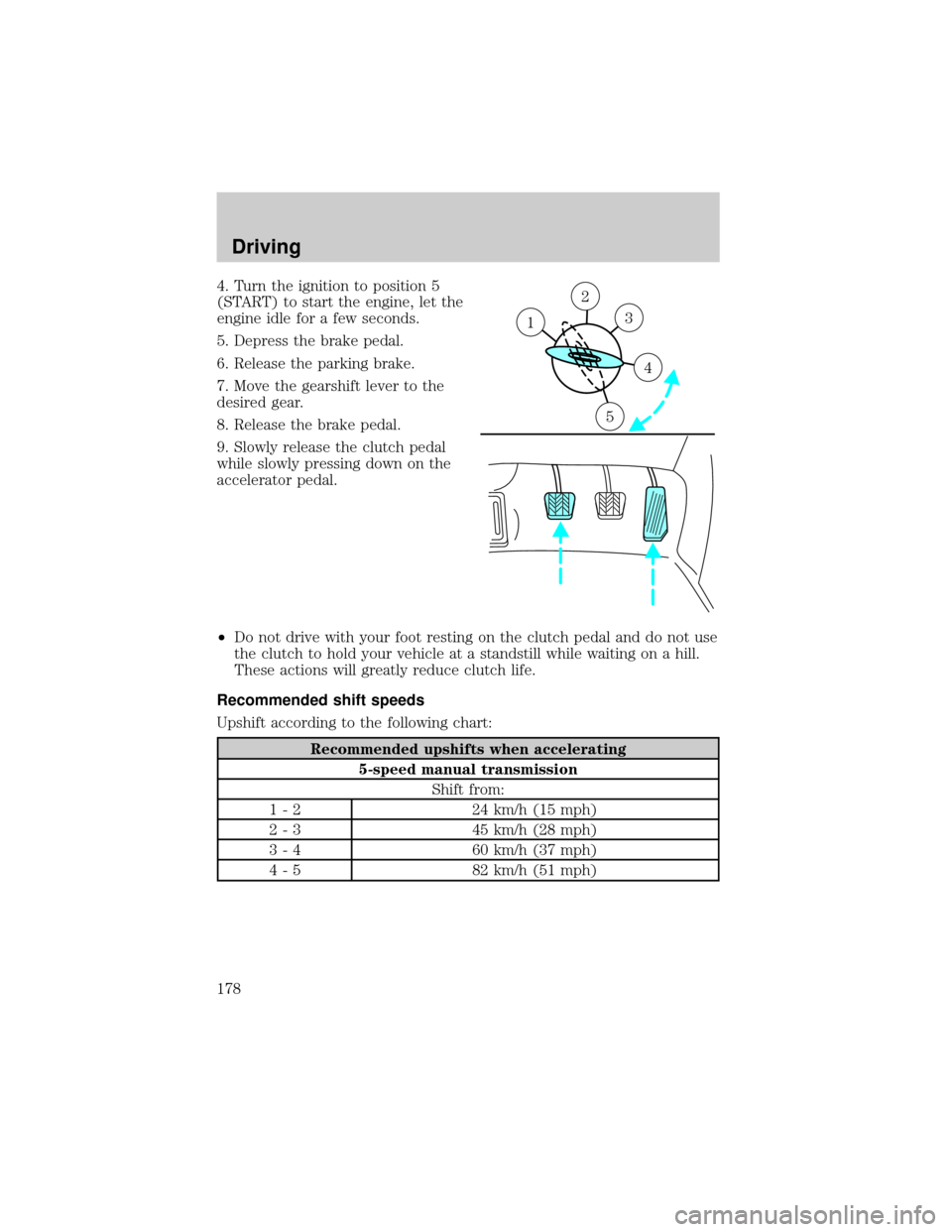
4. Turn the ignition to position 5
(START) to start the engine, let the
engine idle for a few seconds.
5. Depress the brake pedal.
6. Release the parking brake.
7. Move the gearshift lever to the
desired gear.
8. Release the brake pedal.
9. Slowly release the clutch pedal
while slowly pressing down on the
accelerator pedal.
²Do not drive with your foot resting on the clutch pedal and do not use
the clutch to hold your vehicle at a standstill while waiting on a hill.
These actions will greatly reduce clutch life.
Recommended shift speeds
Upshift according to the following chart:
Recommended upshifts when accelerating
5-speed manual transmission
Shift from:
1 - 2 24 km/h (15 mph)
2 - 3 45 km/h (28 mph)
3 - 4 60 km/h (37 mph)
4 - 5 82 km/h (51 mph)
2
3
4
5
1
Driving
178
Page 179 of 288
Recommended upshifts when cruising
5-speed manual transmission
Shift from:
1 - 2 18 km/h (11 mph)
2 - 3 32 km/h (20 mph)
3 - 4 51 km/h (32 mph)
4 - 5 68 km/h (42 mph)
Parking your vehicle
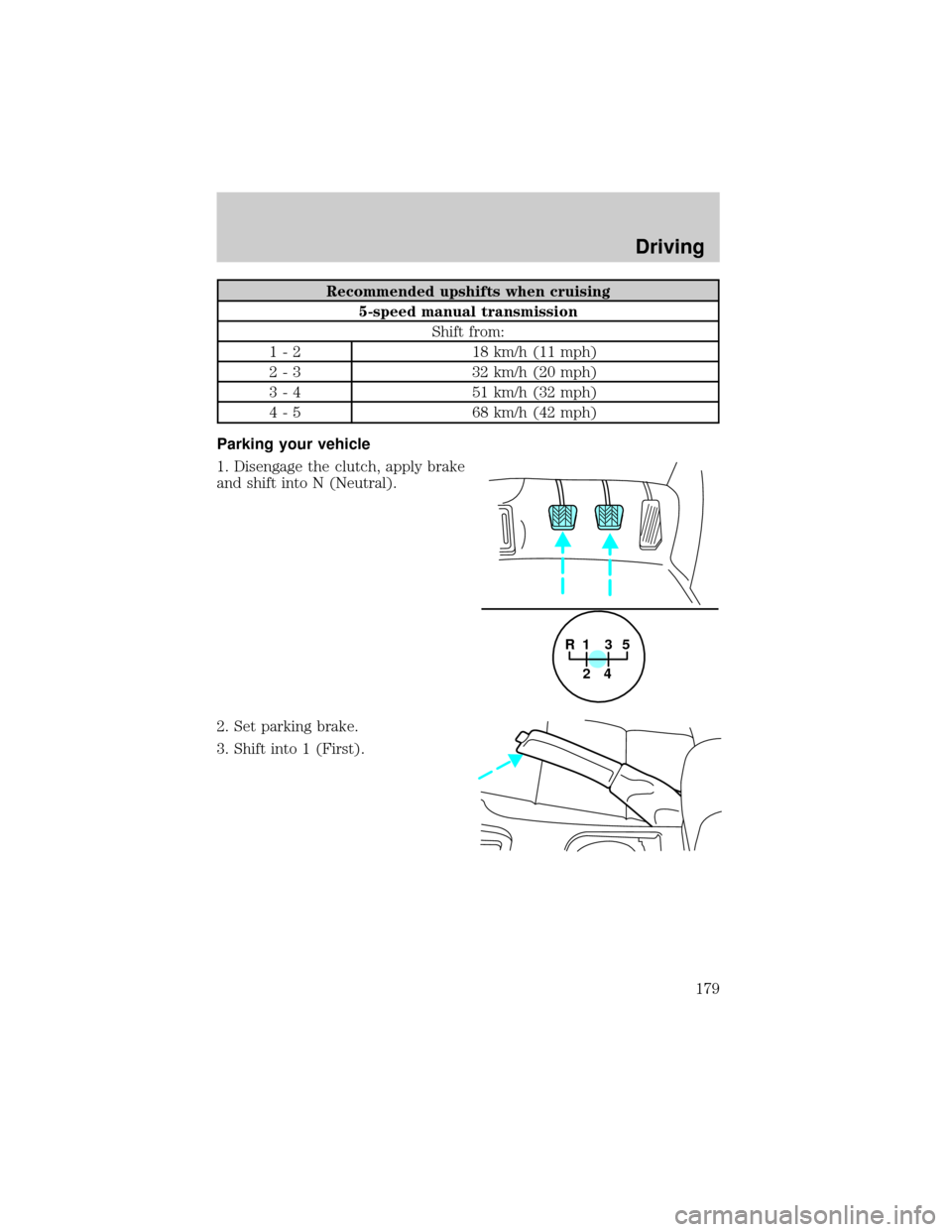
1. Disengage the clutch, apply brake
and shift into N (Neutral).
2. Set parking brake.
3. Shift into 1 (First).
1
2
45
R3
Driving
179
Page 184 of 288
Do not exceed the maximum loads listed on the Certification label. For
load specification terms found on the label, refer toVehicle loadingin
this chapter. Remember to figure in the tongue load of your loaded
trailer when figuring the total weight.
Towing trailers beyond the maximum recommended gross trailer
weight exceeds the limit of the vehicle and could result in
engine damage, transmission damage, structural damage, loss of control
and personal injury.
Preparing to tow
Use the proper equipment for towing a trailer, and make sure it is
properly attached to your vehicle. See your dealer or a reliable trailer
dealer if you require assistance.
Hitches
Do not use hitches that clamp onto the vehicle bumper. Use a load
carrying hitch. You must distribute the load in your trailer so that 10% of
the total weight of the trailer is on the tongue.
Safety chains
Always connect the trailer's safety chains to the frame or hook retainers
of the vehicle hitch. To connect the trailer's safety chains, cross the
chains under the trailer tongue and allow slack for turning corners.
If you use a rental trailer, follow the instructions that the rental agency
gives to you.
Do not attach safety chains to the bumper.
Trailer brakes
Electric brakes and manual, automatic or surge-type trailer brakes are safe if
installed properly and adjusted to the manufacturer's specifications. The
trailer brakes must meet local and Federal regulations.
Do not connect a trailer's hydraulic brake system directly to your
vehicle's brake system. Your vehicle may not have enough
braking power and your chances of having a collision greatly increase.
The braking system of the tow vehicle is rated for operation at the
GVWR not GCWR.
Driving
184
Page 199 of 288
²tow a trailer
²use tire chains
²drive through an automatic car wash, because of the vehicle's reduced
ground clearance
²try to repair the temporary spare tire or remove it from its wheel
²drive for long distances when the temporary-use spare is on
²operate the vehicle with more than one temporary-use spare tire
²improperly inflate the temporary-use spare
²use the wheel for any other type of vehicle
Tire change procedure
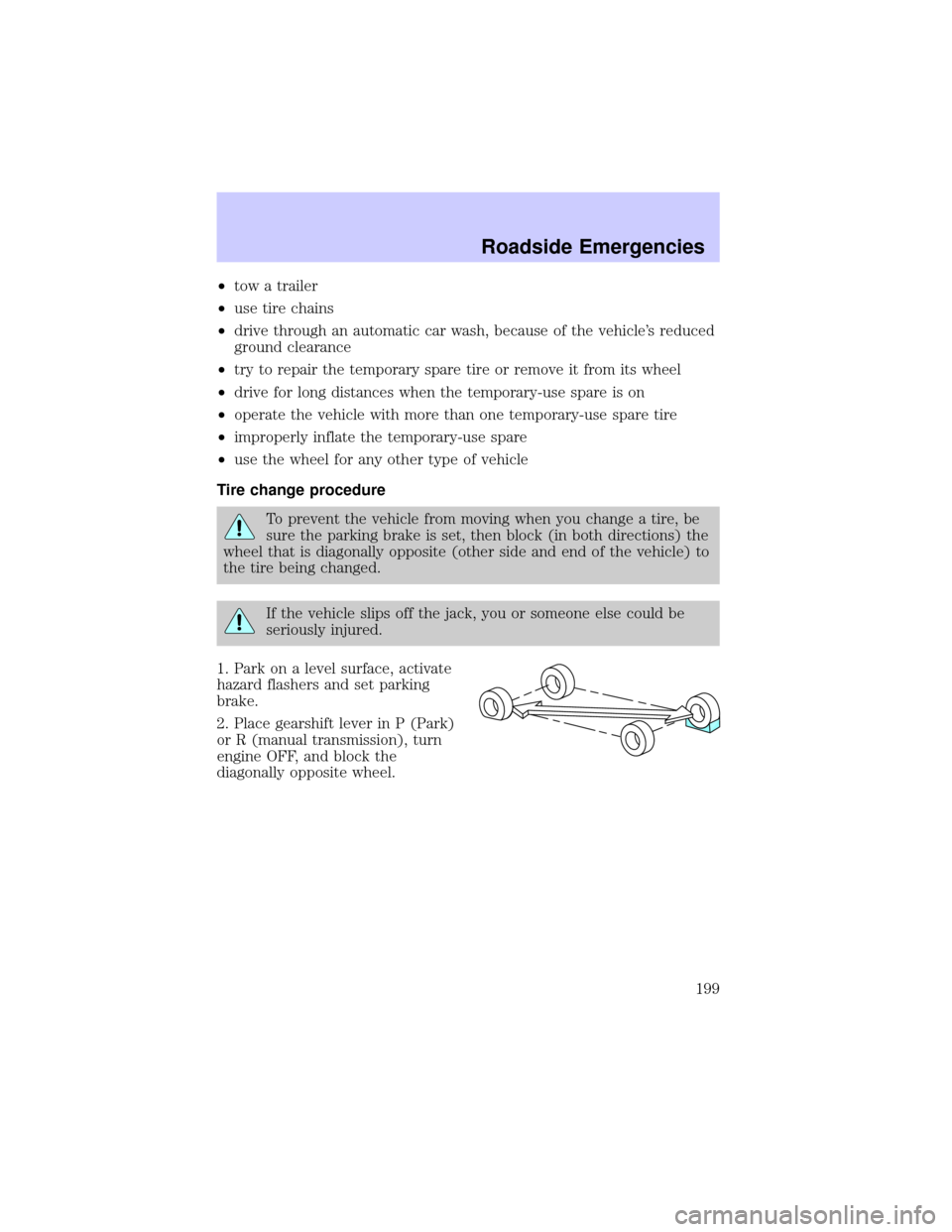
To prevent the vehicle from moving when you change a tire, be
sure the parking brake is set, then block (in both directions) the
wheel that is diagonally opposite (other side and end of the vehicle) to
the tire being changed.
If the vehicle slips off the jack, you or someone else could be
seriously injured.
1. Park on a level surface, activate
hazard flashers and set parking
brake.
2. Place gearshift lever in P (Park)
or R (manual transmission), turn
engine OFF, and block the
diagonally opposite wheel.
Roadside Emergencies
199
Page 228 of 288
SERVICE RECOMMENDATIONS
To help you service your vehicle:
²We highlight do-it-yourself items in the engine compartment for easy
location.
²We provide a scheduled maintenance guide which makes tracking
routine service easy.
If your vehicle requires professional service, your dealership can provide
the necessary parts and service. Check yourWarranty Guideto find out
which parts and services are covered.
Use only recommended fuels, lubricants, fluids and service parts
conforming to specifications. Motorcraft parts are designed and built to
provide the best performance in your vehicle.
PRECAUTIONS WHEN SERVICING YOUR VEHICLE
Be especially careful when inspecting or servicing your vehicle.
²Do not work on a hot engine.
²When the engine is running, keep loose clothing, jewelry or long hair
away from moving parts.
²Do not work on a vehicle with the engine running in an enclosed
space, unless you are sure you have enough ventilation.
²Keep all lit cigarettes, open flames and other lit material away from
the battery and all fuel related parts.
If you disconnect the battery, the engine must ªrelearnº its idle
conditions and the transmission must ªrelearnº its shift schedules before
your vehicle will drive properly, as explained in theBatterysection in
this chapter.
Working with the engine off
²Automatic transmission:
1. Set the parking brake and ensure the gearshift is securely latched in P
(Park).
2. Turn off the engine and remove the key.
3. Block the wheels to prevent the vehicle from moving unexpectedly.
²Manual transmission:
1. Set the parking brake.
Maintenance and Specifications
228
Page 229 of 288
2. Depress the clutch and place the gearshift in 1 (First).
3. Turn off the engine and remove the key.
4. Block the wheels to prevent the vehicle from moving unexpectedly.
Working with the engine on
²Automatic transmission:
1. Set the parking brake and ensure the gearshift is securely latched in P
(Park).
2. Block the wheels to prevent the vehicle from moving unexpectedly.
Note:Do not start your engine with the air cleaner removed and do not
remove it while the engine is running.
²Manual transmission:
1. Set the parking brake, depress the clutch and place the gearshift in
neutral.
2. Block the wheels to prevent the vehicle from moving unexpectedly.
Note:Do not start your engine with the air cleaner removed and do not
remove it while the engine is running.
The cooling fan is automatic and may come on at any time.
Always disconnect the negative terminal of the battery before
working near the fan.
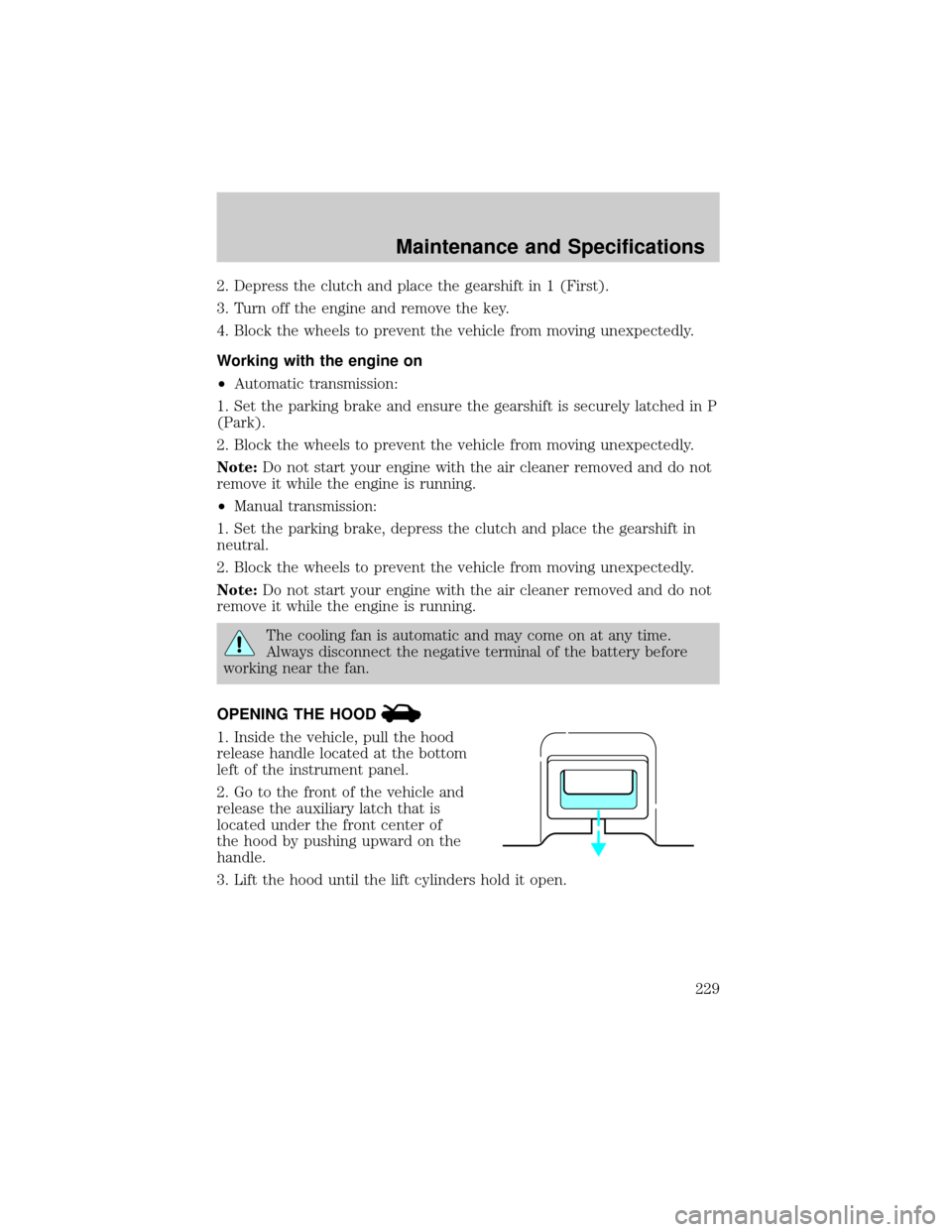
OPENING THE HOOD
1. Inside the vehicle, pull the hood
release handle located at the bottom
left of the instrument panel.
2. Go to the front of the vehicle and
release the auxiliary latch that is
located under the front center of
the hood by pushing upward on the
handle.
3. Lift the hood until the lift cylinders hold it open.
Maintenance and Specifications
229
Page 232 of 288
WASHER FLUID
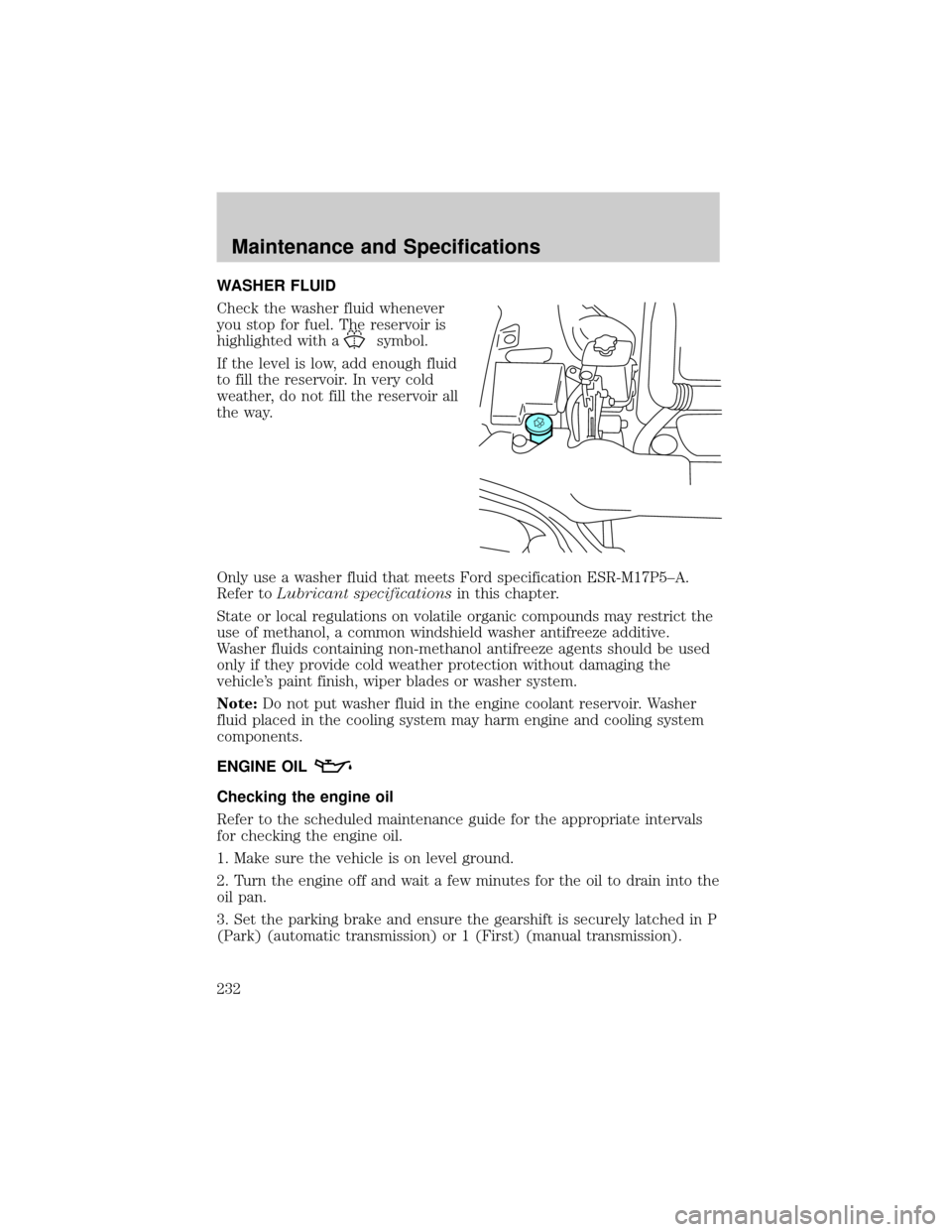
Check the washer fluid whenever
you stop for fuel. The reservoir is
highlighted with a
symbol.
If the level is low, add enough fluid
to fill the reservoir. In very cold
weather, do not fill the reservoir all
the way.
Only use a washer fluid that meets Ford specification ESR-M17P5±A.
Refer toLubricant specificationsin this chapter.
State or local regulations on volatile organic compounds may restrict the
use of methanol, a common windshield washer antifreeze additive.
Washer fluids containing non-methanol antifreeze agents should be used
only if they provide cold weather protection without damaging the
vehicle's paint finish, wiper blades or washer system.
Note:Do not put washer fluid in the engine coolant reservoir. Washer
fluid placed in the cooling system may harm engine and cooling system
components.
ENGINE OIL
Checking the engine oil
Refer to the scheduled maintenance guide for the appropriate intervals
for checking the engine oil.
1. Make sure the vehicle is on level ground.
2. Turn the engine off and wait a few minutes for the oil to drain into the
oil pan.
3. Set the parking brake and ensure the gearshift is securely latched in P
(Park) (automatic transmission) or 1 (First) (manual transmission).
Maintenance and Specifications
232
Page 252 of 288
TRANSMISSION FLUID
Checking automatic transmission fluid
The 5R55N transmission does not have a transmission fluid dipstick.
Refer to your scheduled maintenance guide for scheduled intervals for
fluid checks and changes. Your transmission does not consume fluid.
However, the fluid level should be checked if the transmission is not
working properly, i.e., if the transmission slips or shifts slowly or if you
notice some sign of fluid leakage.
Transmission fluid should be checked and, if required, fluid
should be added by a qualified technician.
Before adding any fluid, make sure the correct type is used. Use only
MERCONtV automatic transmission fluid. The type of fluid used is
indicated on the transmission fluid pan, extension housing and also in
theLubricant specificationssection in this chapter.
Use of a non-approved automatic transmission fluid may cause
internal transmission component damage and void the warranty.
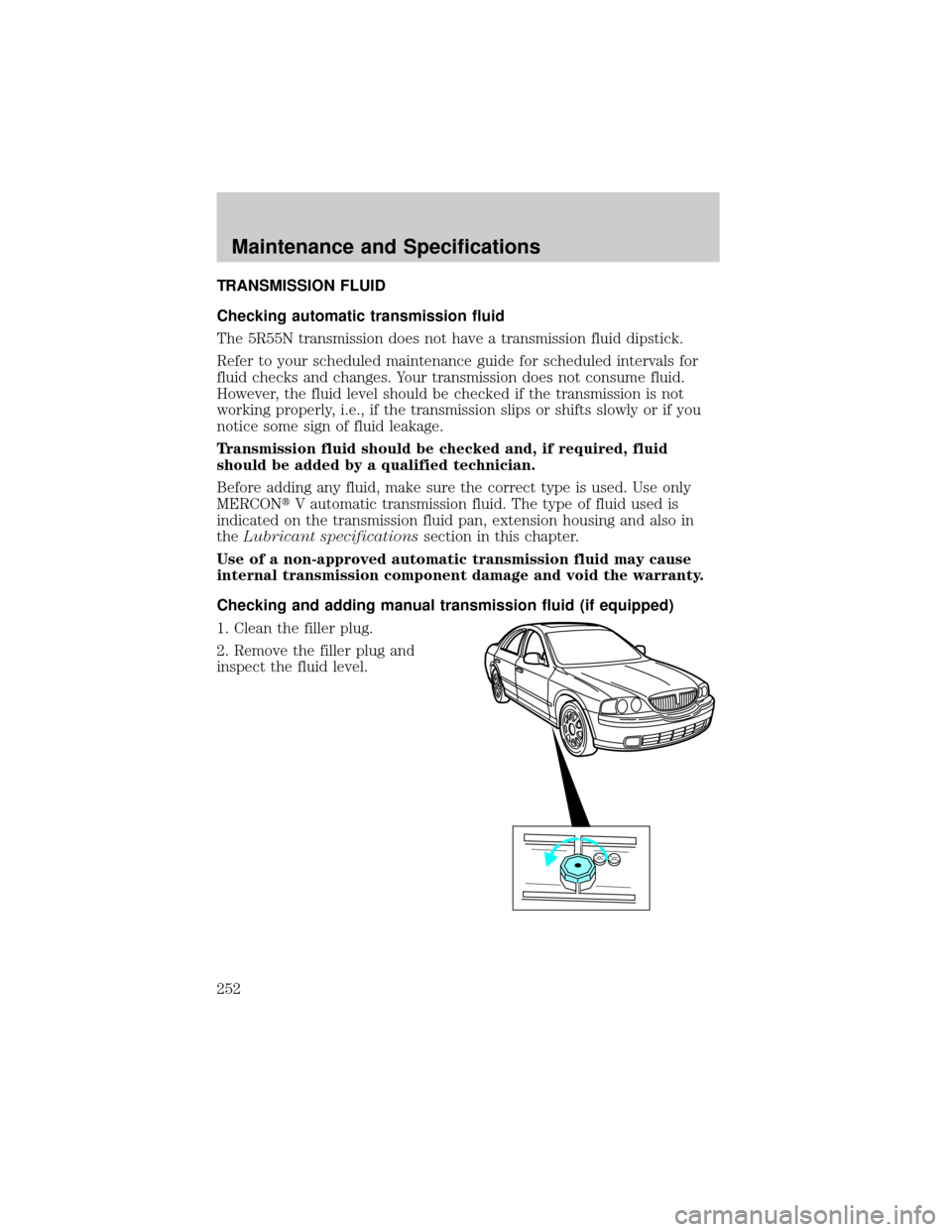
Checking and adding manual transmission fluid (if equipped)
1. Clean the filler plug.
2. Remove the filler plug and
inspect the fluid level.
Maintenance and Specifications
252
Page 262 of 288
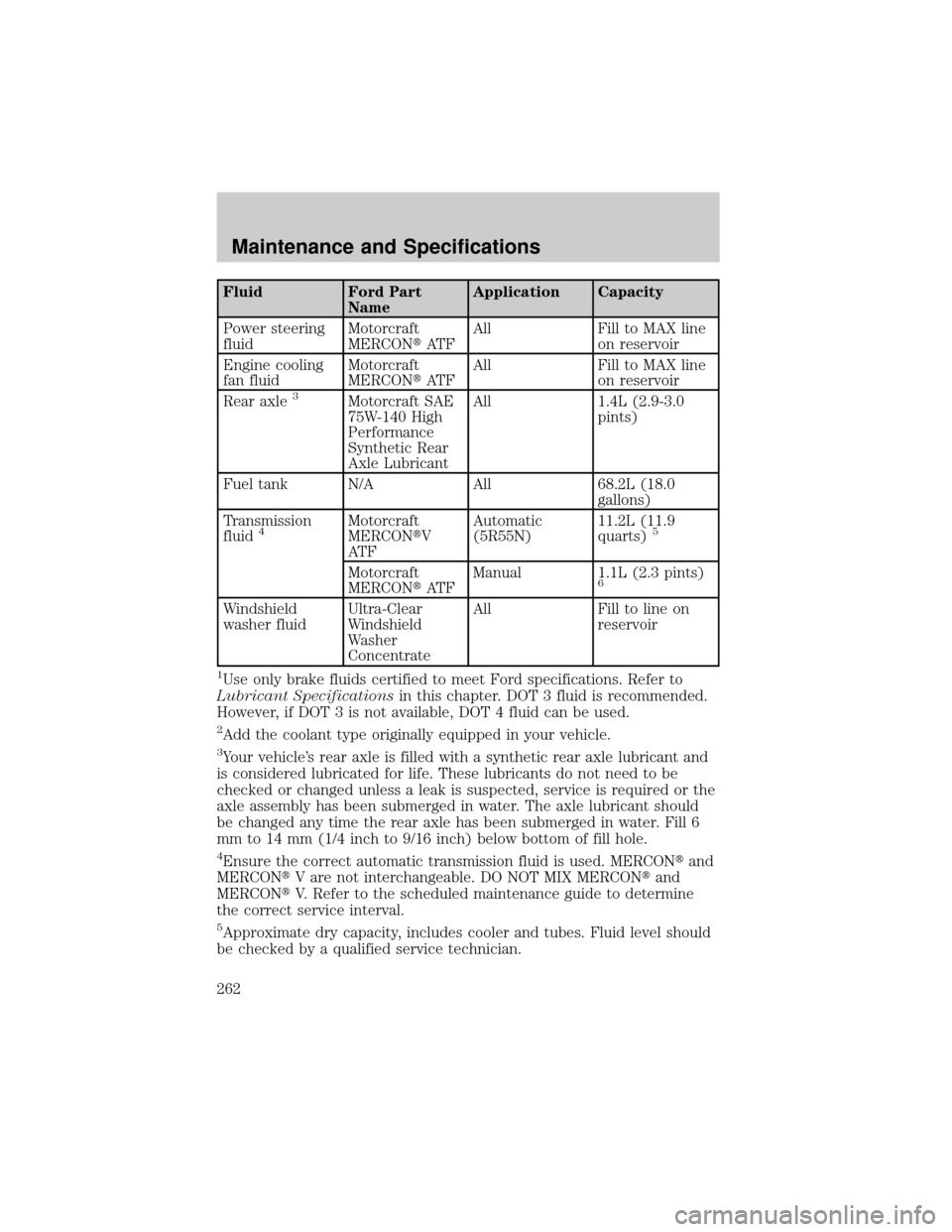
Fluid Ford Part
NameApplication Capacity
Power steering
fluidMotorcraft
MERCONtAT FAll Fill to MAX line
on reservoir
Engine cooling
fan fluidMotorcraft
MERCONtAT FAll Fill to MAX line
on reservoir
Rear axle
3Motorcraft SAE
75W-140 High
Performance
Synthetic Rear
Axle LubricantAll 1.4L (2.9-3.0
pints)
Fuel tank N/A All 68.2L (18.0
gallons)
Transmission
fluid
4Motorcraft
MERCONtV
AT FAutomatic
(5R55N)11.2L (11.9
quarts)5
Motorcraft
MERCONtAT FManual 1.1L (2.3 pints)6
Windshield
washer fluidUltra-Clear
Windshield
Washer
ConcentrateAll Fill to line on
reservoir
1Use only brake fluids certified to meet Ford specifications. Refer to
Lubricant Specificationsin this chapter. DOT 3 fluid is recommended.
However, if DOT 3 is not available, DOT 4 fluid can be used.
2Add the coolant type originally equipped in your vehicle.
3Your vehicle's rear axle is filled with a synthetic rear axle lubricant and
is considered lubricated for life. These lubricants do not need to be
checked or changed unless a leak is suspected, service is required or the
axle assembly has been submerged in water. The axle lubricant should
be changed any time the rear axle has been submerged in water. Fill 6
mm to 14 mm (1/4 inch to 9/16 inch) below bottom of fill hole.
4Ensure the correct automatic transmission fluid is used. MERCONtand
MERCONtV are not interchangeable. DO NOT MIX MERCONtand
MERCONtV. Refer to the scheduled maintenance guide to determine
the correct service interval.
5Approximate dry capacity, includes cooler and tubes. Fluid level should
be checked by a qualified service technician.
Maintenance and Specifications
262
Page 263 of 288
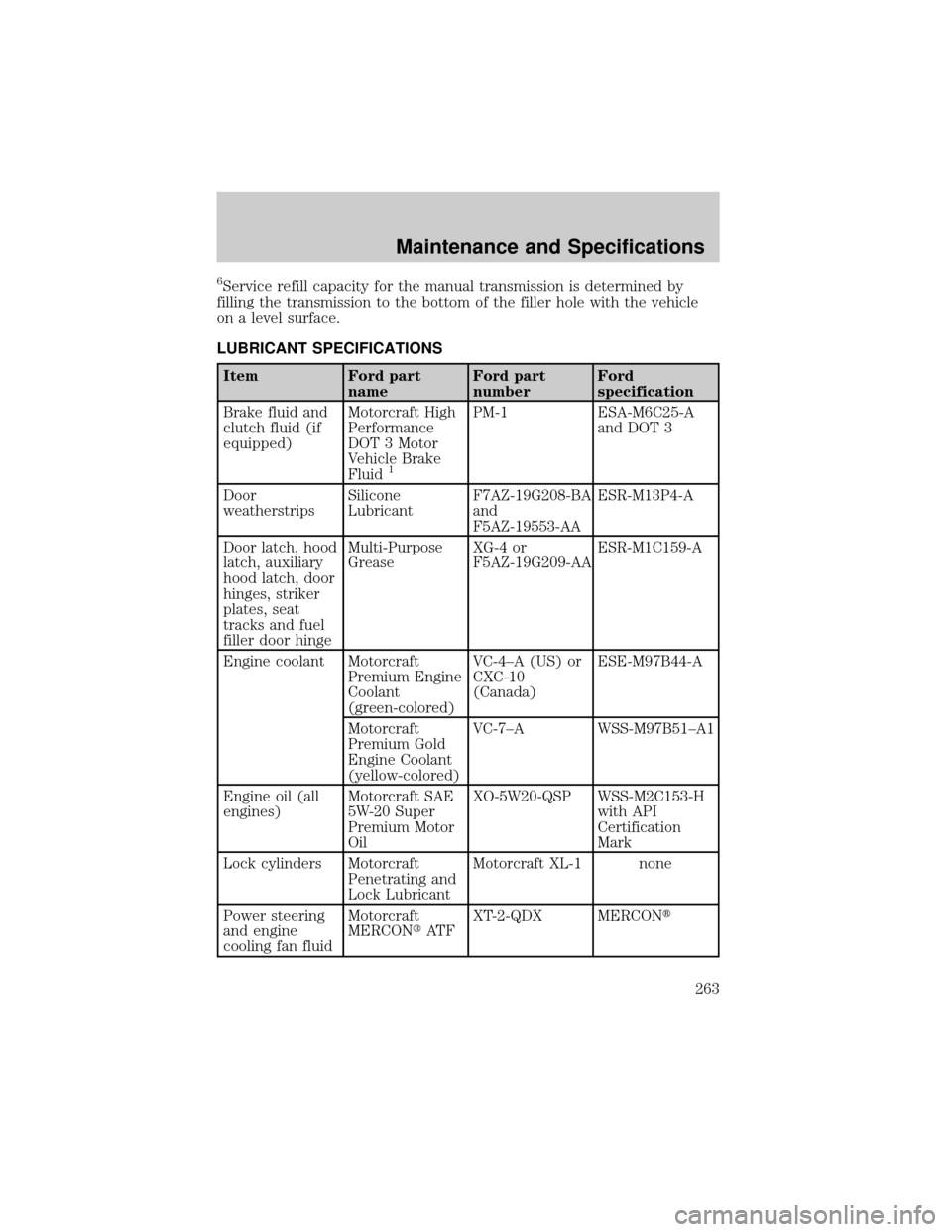
6Service refill capacity for the manual transmission is determined by
filling the transmission to the bottom of the filler hole with the vehicle
on a level surface.
LUBRICANT SPECIFICATIONS
Item Ford part
nameFord part
numberFord
specification
Brake fluid and
clutch fluid (if
equipped)Motorcraft High
Performance
DOT 3 Motor
Vehicle Brake
Fluid
1
PM-1 ESA-M6C25-A
and DOT 3
Door
weatherstripsSilicone
LubricantF7AZ-19G208-BA
and
F5AZ-19553-AAESR-M13P4-A
Door latch, hood
latch, auxiliary
hood latch, door
hinges, striker
plates, seat
tracks and fuel
filler door hingeMulti-Purpose
GreaseXG-4 or
F5AZ-19G209-AAESR-M1C159-A
Engine coolant Motorcraft
Premium Engine
Coolant
(green-colored)VC-4±A (US) or
CXC-10
(Canada)ESE-M97B44-A
Motorcraft
Premium Gold
Engine Coolant
(yellow-colored)VC-7±A WSS-M97B51±A1
Engine oil (all
engines)Motorcraft SAE
5W-20 Super
Premium Motor
OilXO-5W20-QSP WSS-M2C153-H
with API
Certification
Mark
Lock cylinders Motorcraft
Penetrating and
Lock LubricantMotorcraft XL-1 none
Power steering
and engine
cooling fan fluidMotorcraft
MERCONtAT FXT-2-QDX MERCONt
Maintenance and Specifications
263