maintenance LINCOLN LS 2002 Workshop Manual
[x] Cancel search | Manufacturer: LINCOLN, Model Year: 2002, Model line: LS, Model: LINCOLN LS 2002Pages: 288, PDF Size: 2.44 MB
Page 257 of 288
The temperature grade for this tire is established for a tire that
is properly inflated and not overloaded. Excessive speed,
underinflation, or excessive loading, either separately or in
combination, can cause heat buildup and possible tire failure.
SERVICING YOUR TIRES
Checking the tire pressure
²Use an accurate tire pressure gauge.
²Check the tire pressure when tires are cold, after the vehicle has been
parked for at least one hour or has been driven less than 5 km (3
miles).
²Adjust tire pressure to recommended specifications found on the
inflation placard.
Improperly inflated tires can affect vehicle handling and can fail
suddenly, possibly resulting in loss of vehicle control.
Tire rotation
Because your vehicle's tires perform different jobs, they often wear
differently. To make sure your tires wear evenly and last longer, rotate
them as indicated in the scheduled maintenance guide. If you notice that
the tires wear unevenly, have them checked.
Maintenance and Specifications
257
Page 258 of 288
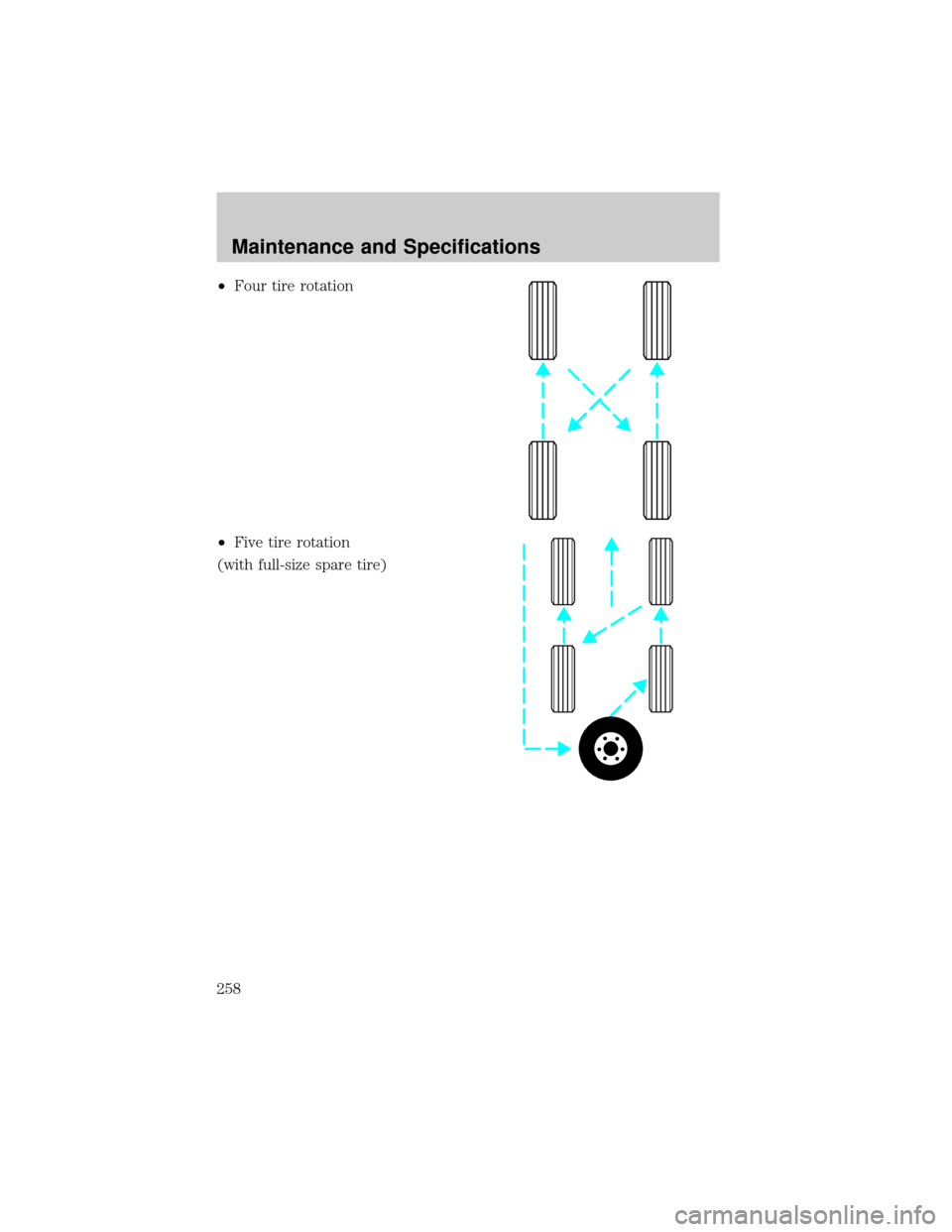
²Four tire rotation
²Five tire rotation
(with full-size spare tire)
Maintenance and Specifications
258
Page 259 of 288
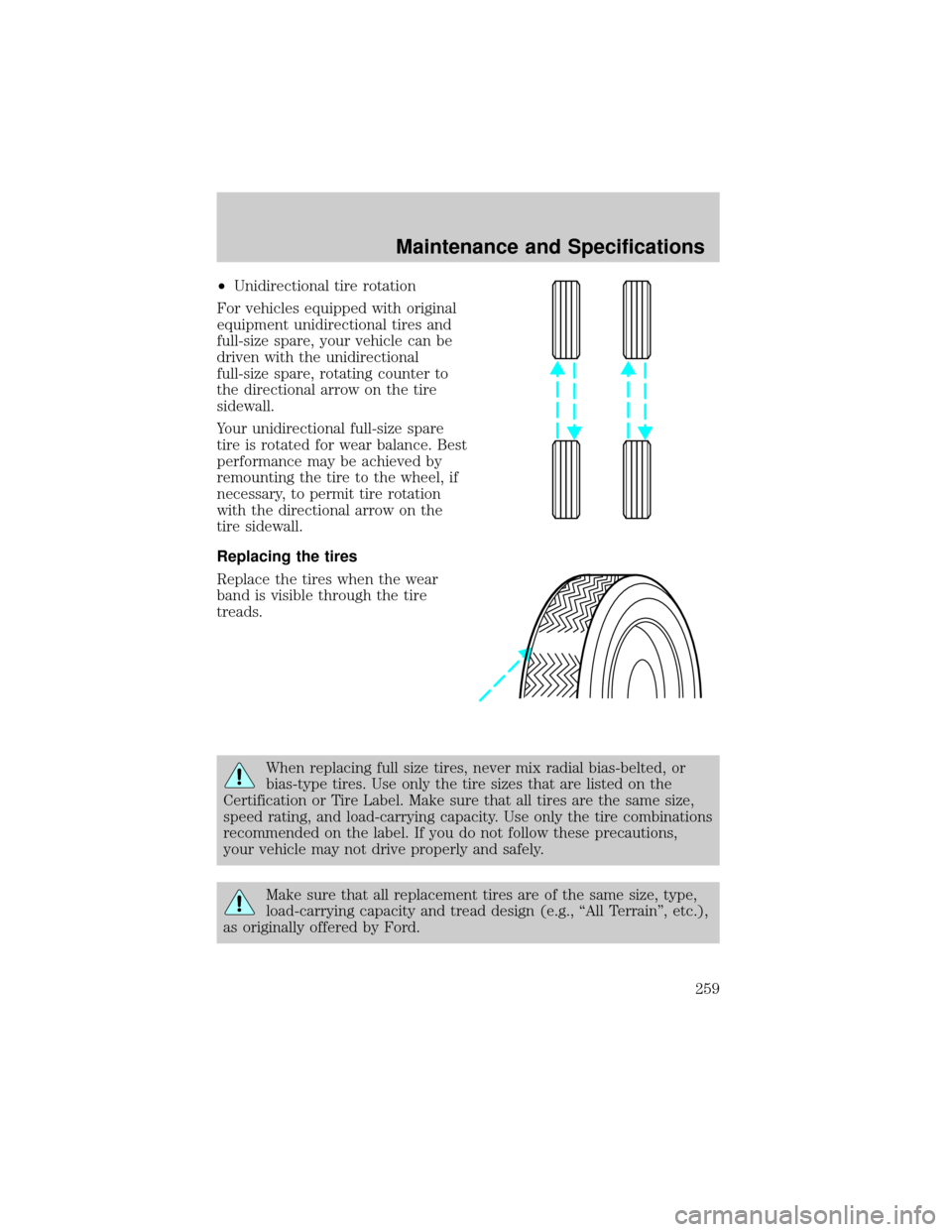
²Unidirectional tire rotation
For vehicles equipped with original
equipment unidirectional tires and
full-size spare, your vehicle can be
driven with the unidirectional
full-size spare, rotating counter to
the directional arrow on the tire
sidewall.
Your unidirectional full-size spare
tire is rotated for wear balance. Best
performance may be achieved by
remounting the tire to the wheel, if
necessary, to permit tire rotation
with the directional arrow on the
tire sidewall.
Replacing the tires
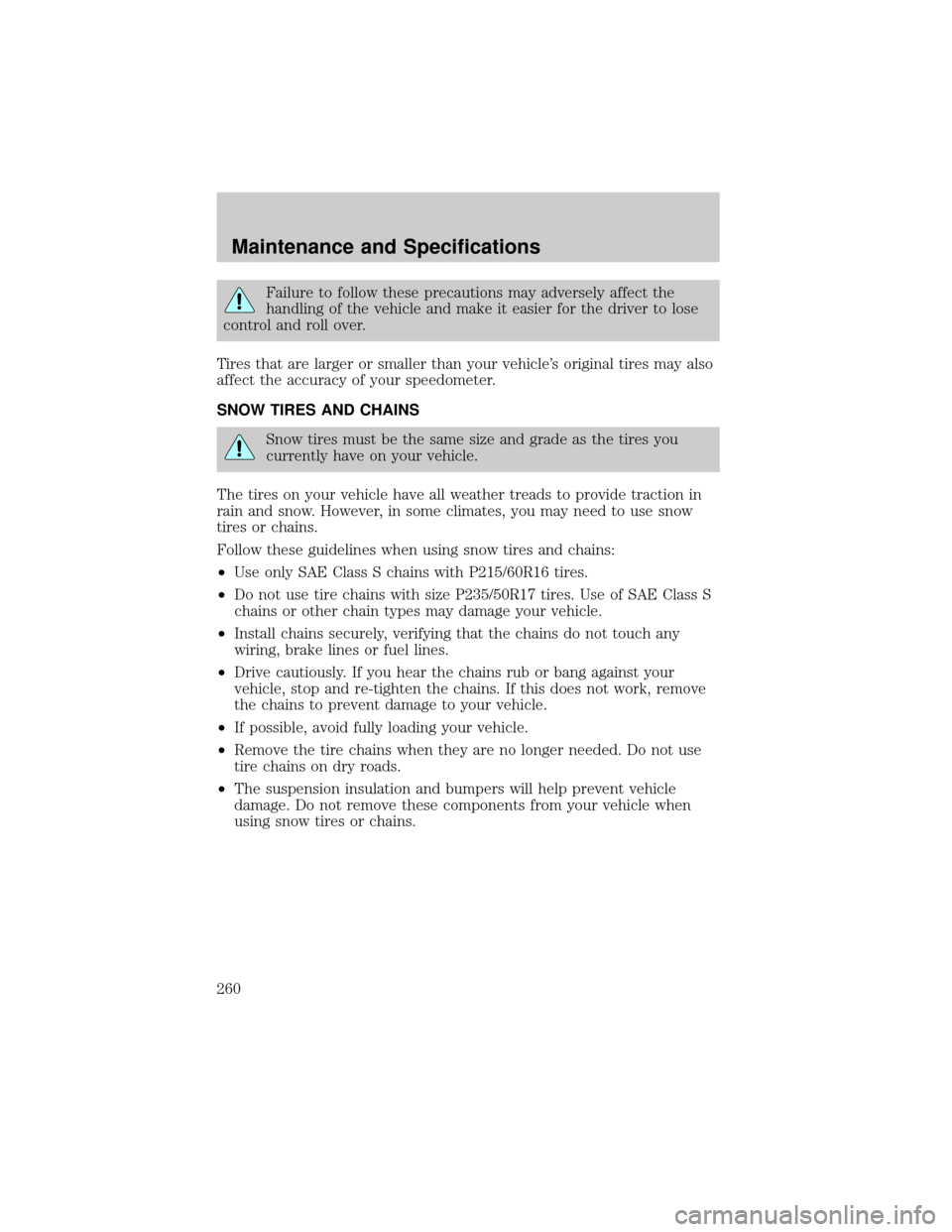
Replace the tires when the wear
band is visible through the tire
treads.
When replacing full size tires, never mix radial bias-belted, or
bias-type tires. Use only the tire sizes that are listed on the
Certification or Tire Label. Make sure that all tires are the same size,
speed rating, and load-carrying capacity. Use only the tire combinations
recommended on the label. If you do not follow these precautions,
your vehicle may not drive properly and safely.
Make sure that all replacement tires are of the same size, type,
load-carrying capacity and tread design (e.g., ªAll Terrainº, etc.),
as originally offered by Ford.
Maintenance and Specifications
259
Page 260 of 288
Failure to follow these precautions may adversely affect the
handling of the vehicle and make it easier for the driver to lose
control and roll over.
Tires that are larger or smaller than your vehicle's original tires may also
affect the accuracy of your speedometer.
SNOW TIRES AND CHAINS
Snow tires must be the same size and grade as the tires you
currently have on your vehicle.
The tires on your vehicle have all weather treads to provide traction in
rain and snow. However, in some climates, you may need to use snow
tires or chains.
Follow these guidelines when using snow tires and chains:
²Use only SAE Class S chains with P215/60R16 tires.
²Do not use tire chains with size P235/50R17 tires. Use of SAE Class S
chains or other chain types may damage your vehicle.
²Install chains securely, verifying that the chains do not touch any
wiring, brake lines or fuel lines.
²Drive cautiously. If you hear the chains rub or bang against your
vehicle, stop and re-tighten the chains. If this does not work, remove
the chains to prevent damage to your vehicle.
²If possible, avoid fully loading your vehicle.
²Remove the tire chains when they are no longer needed. Do not use
tire chains on dry roads.
²The suspension insulation and bumpers will help prevent vehicle
damage. Do not remove these components from your vehicle when
using snow tires or chains.
Maintenance and Specifications
260
Page 261 of 288
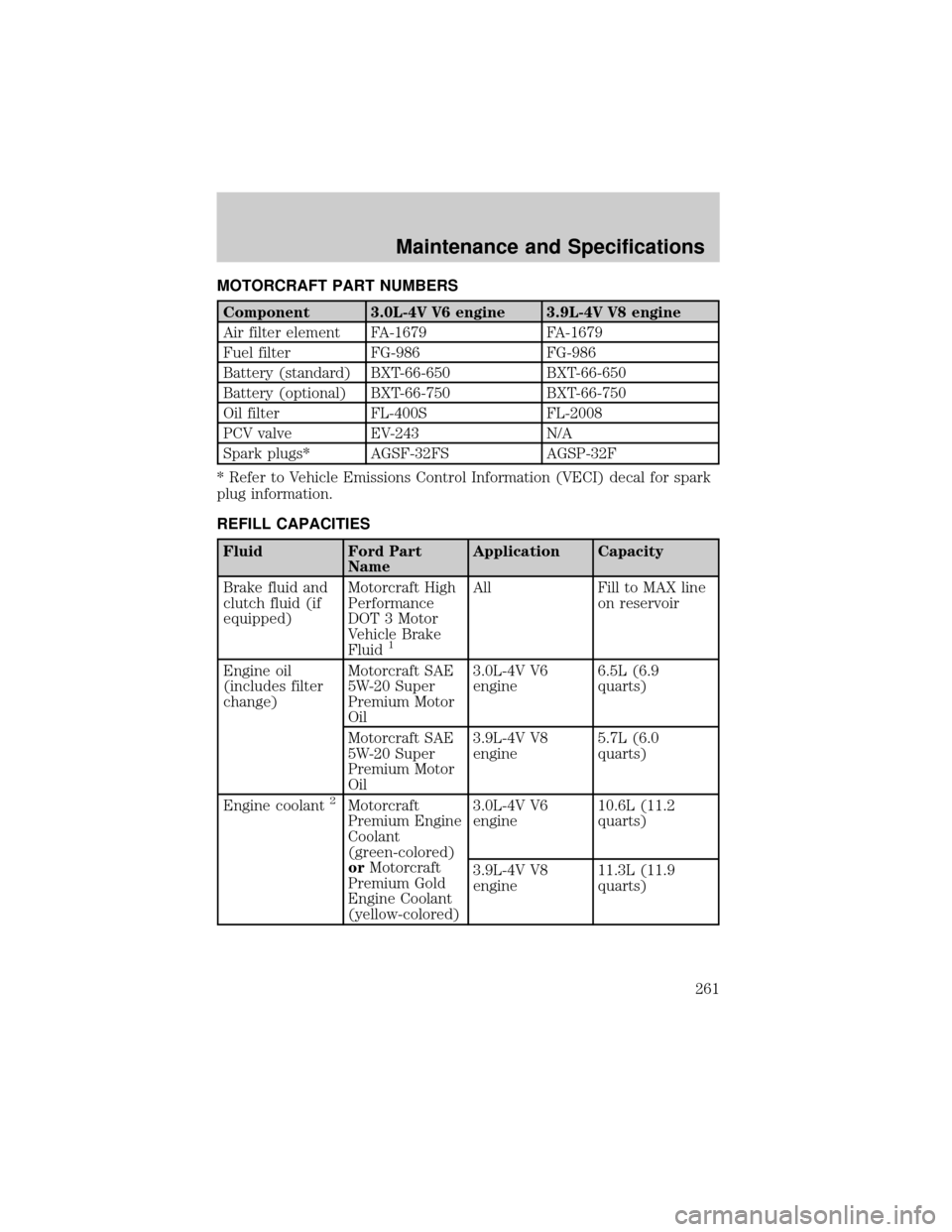
MOTORCRAFT PART NUMBERS
Component 3.0L-4V V6 engine 3.9L-4V V8 engine
Air filter element FA-1679 FA-1679
Fuel filter FG-986 FG-986
Battery (standard) BXT-66-650 BXT-66-650
Battery (optional) BXT-66-750 BXT-66-750
Oil filter FL-400S FL-2008
PCV valve EV-243 N/A
Spark plugs* AGSF-32FS AGSP-32F
* Refer to Vehicle Emissions Control Information (VECI) decal for spark
plug information.
REFILL CAPACITIES
Fluid Ford Part
NameApplication Capacity
Brake fluid and
clutch fluid (if
equipped)Motorcraft High
Performance
DOT 3 Motor
Vehicle Brake
Fluid
1
All Fill to MAX line
on reservoir
Engine oil
(includes filter
change)Motorcraft SAE
5W-20 Super
Premium Motor
Oil3.0L-4V V6
engine6.5L (6.9
quarts)
Motorcraft SAE
5W-20 Super
Premium Motor
Oil3.9L-4V V8
engine5.7L (6.0
quarts)
Engine coolant
2Motorcraft
Premium Engine
Coolant
(green-colored)
orMotorcraft
Premium Gold
Engine Coolant
(yellow-colored)3.0L-4V V6
engine10.6L (11.2
quarts)
3.9L-4V V8
engine11.3L (11.9
quarts)
Maintenance and Specifications
261
Page 262 of 288
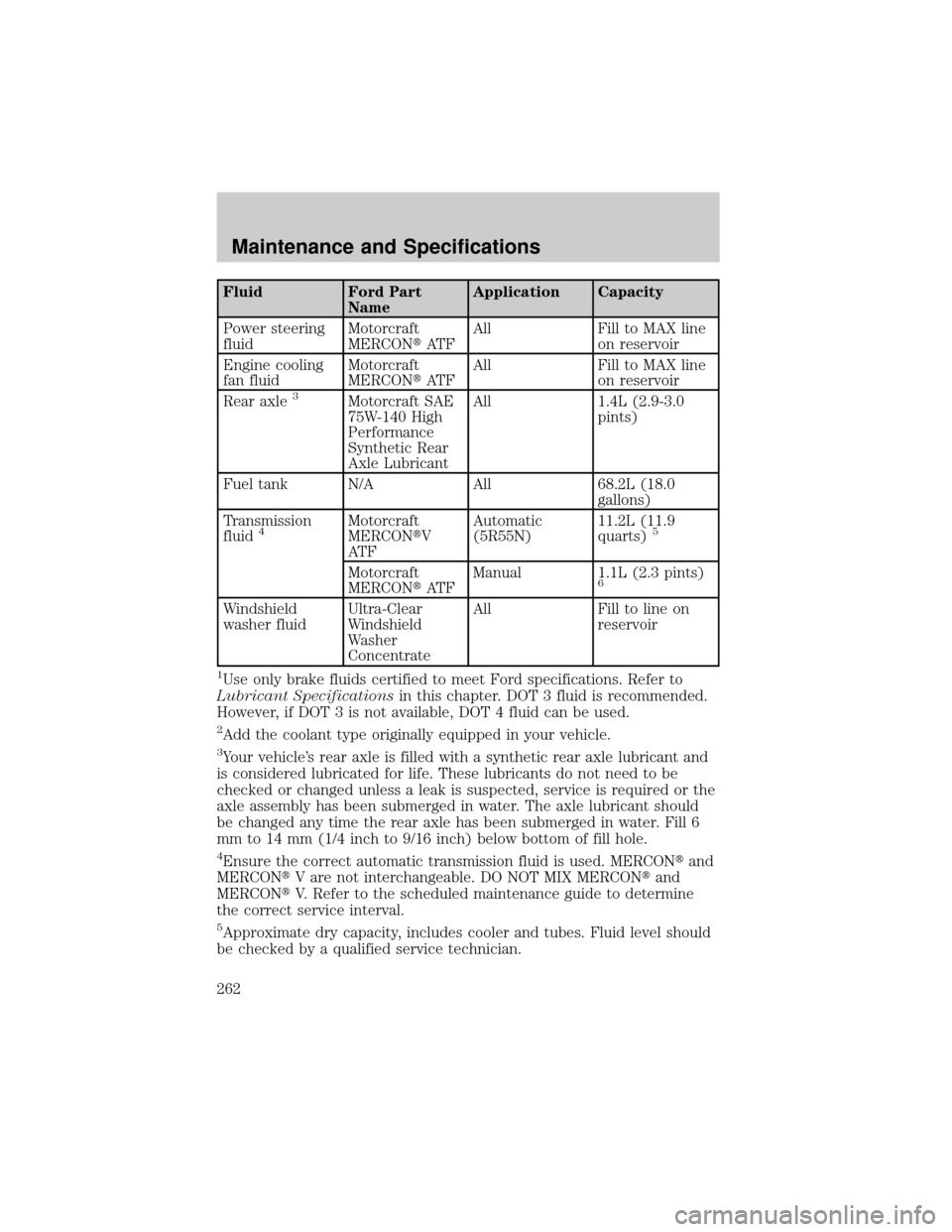
Fluid Ford Part
NameApplication Capacity
Power steering
fluidMotorcraft
MERCONtAT FAll Fill to MAX line
on reservoir
Engine cooling
fan fluidMotorcraft
MERCONtAT FAll Fill to MAX line
on reservoir
Rear axle
3Motorcraft SAE
75W-140 High
Performance
Synthetic Rear
Axle LubricantAll 1.4L (2.9-3.0
pints)
Fuel tank N/A All 68.2L (18.0
gallons)
Transmission
fluid
4Motorcraft
MERCONtV
AT FAutomatic
(5R55N)11.2L (11.9
quarts)5
Motorcraft
MERCONtAT FManual 1.1L (2.3 pints)6
Windshield
washer fluidUltra-Clear
Windshield
Washer
ConcentrateAll Fill to line on
reservoir
1Use only brake fluids certified to meet Ford specifications. Refer to
Lubricant Specificationsin this chapter. DOT 3 fluid is recommended.
However, if DOT 3 is not available, DOT 4 fluid can be used.
2Add the coolant type originally equipped in your vehicle.
3Your vehicle's rear axle is filled with a synthetic rear axle lubricant and
is considered lubricated for life. These lubricants do not need to be
checked or changed unless a leak is suspected, service is required or the
axle assembly has been submerged in water. The axle lubricant should
be changed any time the rear axle has been submerged in water. Fill 6
mm to 14 mm (1/4 inch to 9/16 inch) below bottom of fill hole.
4Ensure the correct automatic transmission fluid is used. MERCONtand
MERCONtV are not interchangeable. DO NOT MIX MERCONtand
MERCONtV. Refer to the scheduled maintenance guide to determine
the correct service interval.
5Approximate dry capacity, includes cooler and tubes. Fluid level should
be checked by a qualified service technician.
Maintenance and Specifications
262
Page 263 of 288
6Service refill capacity for the manual transmission is determined by
filling the transmission to the bottom of the filler hole with the vehicle
on a level surface.
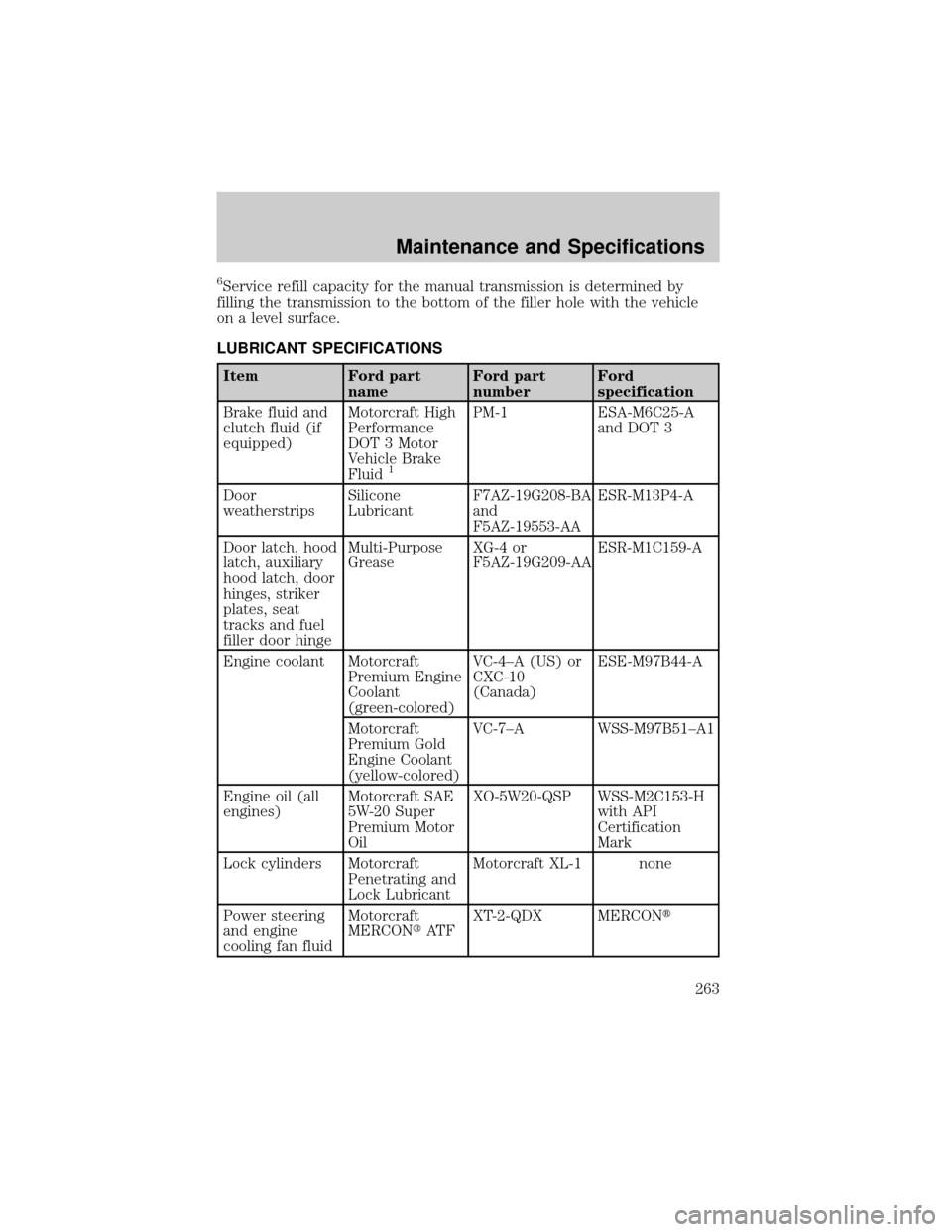
LUBRICANT SPECIFICATIONS
Item Ford part
nameFord part
numberFord
specification
Brake fluid and
clutch fluid (if
equipped)Motorcraft High
Performance
DOT 3 Motor
Vehicle Brake
Fluid
1
PM-1 ESA-M6C25-A
and DOT 3
Door
weatherstripsSilicone
LubricantF7AZ-19G208-BA
and
F5AZ-19553-AAESR-M13P4-A
Door latch, hood
latch, auxiliary
hood latch, door
hinges, striker
plates, seat
tracks and fuel
filler door hingeMulti-Purpose
GreaseXG-4 or
F5AZ-19G209-AAESR-M1C159-A
Engine coolant Motorcraft
Premium Engine
Coolant
(green-colored)VC-4±A (US) or
CXC-10
(Canada)ESE-M97B44-A
Motorcraft
Premium Gold
Engine Coolant
(yellow-colored)VC-7±A WSS-M97B51±A1
Engine oil (all
engines)Motorcraft SAE
5W-20 Super
Premium Motor
OilXO-5W20-QSP WSS-M2C153-H
with API
Certification
Mark
Lock cylinders Motorcraft
Penetrating and
Lock LubricantMotorcraft XL-1 none
Power steering
and engine
cooling fan fluidMotorcraft
MERCONtAT FXT-2-QDX MERCONt
Maintenance and Specifications
263
Page 264 of 288
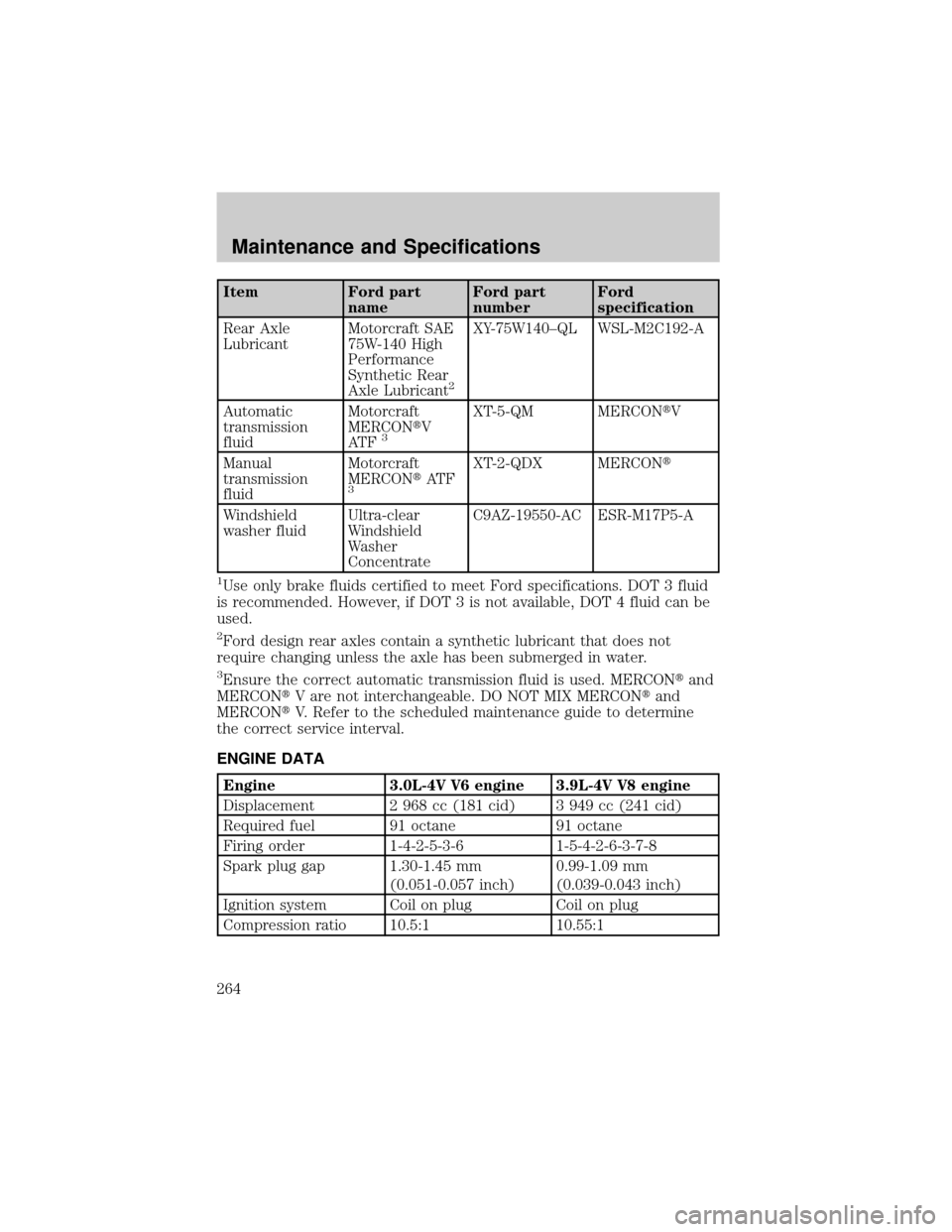
Item Ford part
nameFord part
numberFord
specification
Rear Axle
LubricantMotorcraft SAE
75W-140 High
Performance
Synthetic Rear
Axle Lubricant
2
XY-75W140±QL WSL-M2C192-A
Automatic
transmission
fluidMotorcraft
MERCONtV
AT F
3
XT-5-QM MERCONtV
Manual
transmission
fluidMotorcraft
MERCONtAT F
3
XT-2-QDX MERCONt
Windshield
washer fluidUltra-clear
Windshield
Washer
ConcentrateC9AZ-19550-AC ESR-M17P5-A
1Use only brake fluids certified to meet Ford specifications. DOT 3 fluid
is recommended. However, if DOT 3 is not available, DOT 4 fluid can be
used.
2Ford design rear axles contain a synthetic lubricant that does not
require changing unless the axle has been submerged in water.
3Ensure the correct automatic transmission fluid is used. MERCONtand
MERCONtV are not interchangeable. DO NOT MIX MERCONtand
MERCONtV. Refer to the scheduled maintenance guide to determine
the correct service interval.
ENGINE DATA
Engine 3.0L-4V V6 engine 3.9L-4V V8 engine
Displacement 2 968 cc (181 cid) 3 949 cc (241 cid)
Required fuel 91 octane 91 octane
Firing order 1-4-2-5-3-6 1-5-4-2-6-3-7-8
Spark plug gap 1.30-1.45 mm
(0.051-0.057 inch)0.99-1.09 mm
(0.039-0.043 inch)
Ignition system Coil on plug Coil on plug
Compression ratio 10.5:1 10.55:1
Maintenance and Specifications
264
Page 265 of 288
EMISSION CONTROL SYSTEM
Your vehicle is equipped with various emission control components and a
catalytic converter which will enable your vehicle to comply with
applicable exhaust emission standards. To make sure that the catalytic
converter and other emission control components continue to work
properly:
²Use only the specified fuel listed.
²Avoid running out of fuel.
²Do not turn off the ignition while your vehicle is moving, especially at
high speeds.
²Have the items listed in your scheduled maintenance guide performed
according to the specified schedule.
The scheduled maintenance items listed in the scheduled maintenance
guide are essential to the life and performance of your vehicle and to its
emissions system.
If other than Ford, Motorcraft or Ford-authorized parts are used for
maintenance replacements or for service of components affecting
emission control, such non-Ford parts should be equivalent to genuine
Ford Motor Company parts in performance and durability.
Do not park, idle, or drive your vehicle in dry grass or other dry
ground cover. The emission system heats up the engine
compartment and exhaust system, which can start a fire.
Illumination of the ªCheck Engineº light, charging system warning light
or the temperature warning light, fluid leaks, strange odors, smoke or
loss of engine power, could indicate that the emission control system is
not working properly.
Exhaust leaks may result in entry of harmful and potentially
lethal fumes into the passenger compartment.
Do not make any unauthorized changes to your vehicle or engine. By
law, vehicle owners and anyone who manufactures, repairs, services,
sells, leases, trades vehicles, or supervises a fleet of vehicles are not
permitted to intentionally remove an emission control device or prevent
it from working. Information about your vehicle's emission system is on
the Vehicle Emission Control Information Decal located on or near the
Maintenance and Specifications
265
Page 266 of 288
engine. This decal identifies engine displacement and gives some tune up
specifications.
Please consult yourWarranty Guidefor complete emission warranty
information.
Readiness for Inspection/Maintenance (I/M) testing
In some localities, it may be a legal requirement to pass an I/M test of
the on-board diagnostics system. If your ªCheck Engine/Service Engine
Soonº light is on, refer to the description in theWarning lights and
chimessection of theInstrument Clusterchapter. Your vehicle may not
pass the I/M test with the ªCheck Engine/Service Engine Soonº light on.
If the vehicle's powertrain system or its battery has just been serviced,
the on-board diagnostics system is reset to a ªnot ready for I/M testº
condition. To ready the on-board diagnostics system for I/M testing, a
minimum of 30 minutes of city and highway driving is necessary as
described below:
²First, at least 10 minutes of driving on an expressway or highway.
²Next, at least 20 minutes driving in stop-and-go, city-type traffic with
at least four idle periods.
Allow the vehicle to sit for at least eight hours without starting the
engine. Then, start the engine and complete the above driving cycle. The
engine must warm up to its normal operating temperature. Once started,
do not turn off the engine until the above driving cycle is complete.
ESSENTIALS OF GOOD FUEL ECONOMY
Measuring techniques
Your best source of information about actual fuel economy is you, the
driver. You must gather information as accurately and consistently as
possible. Fuel expense, frequency of fillups or fuel gauge readings are
NOT accurate as a measure of fuel economy. We do not recommend
taking fuel economy measurements during the first 1 600 km (1 000
miles) of driving (engine break-in period). You will get a more accurate
measurement after 3 000 km±5 000 km (2 000 miles-3 000 miles).
Filling the tank
The advertised fuel capacity of the fuel tank on your vehicle is equal to
the rated refill capacity of the fuel tank as listed in theRefill capacities
section of this chapter.
Maintenance and Specifications
266