wiring LINCOLN LS 2003 Owners Manual
[x] Cancel search | Manufacturer: LINCOLN, Model Year: 2003, Model line: LS, Model: LINCOLN LS 2003Pages: 288, PDF Size: 3.19 MB
Page 142 of 288
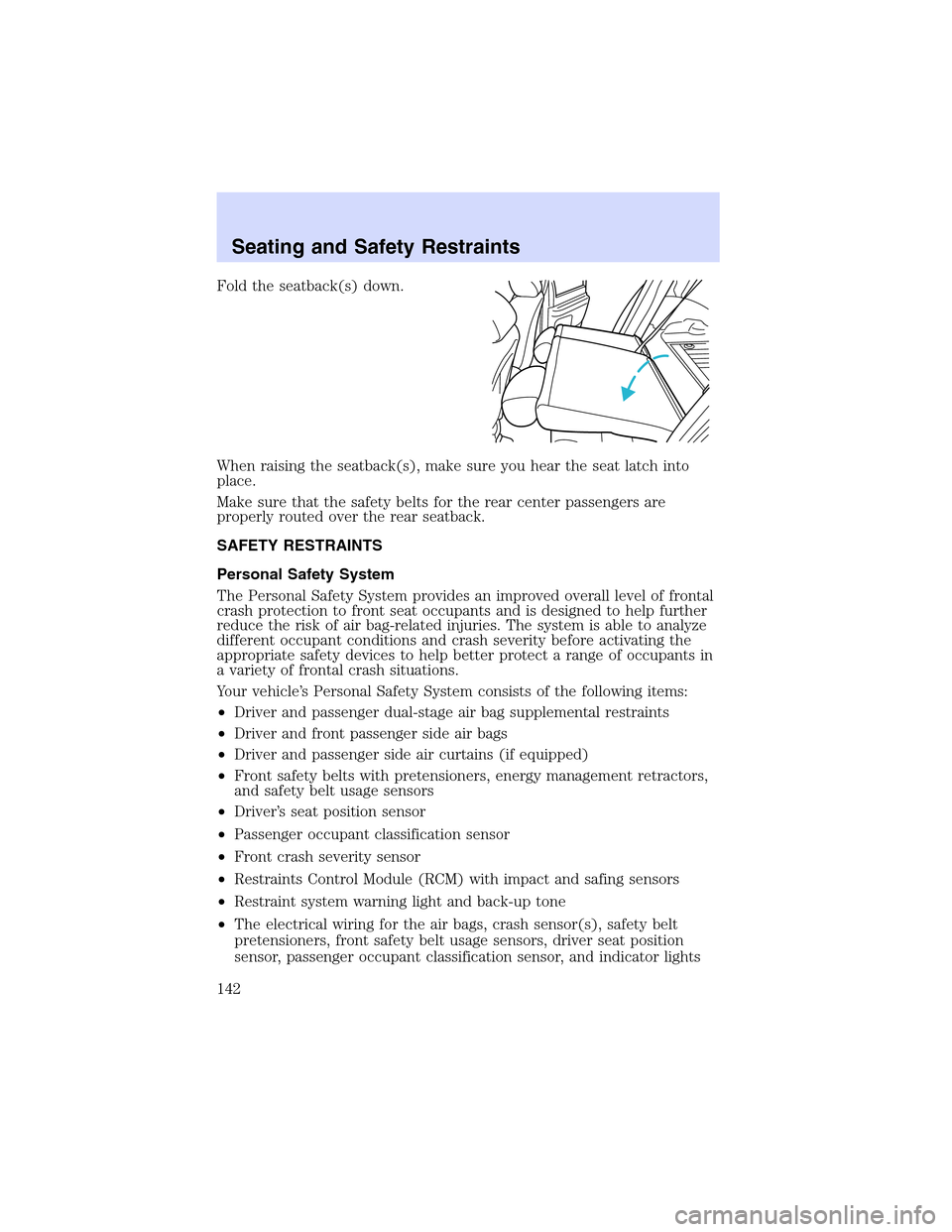
Fold the seatback(s) down.
When raising the seatback(s), make sure you hear the seat latch into
place.
Make sure that the safety belts for the rear center passengers are
properly routed over the rear seatback.
SAFETY RESTRAINTS
Personal Safety System
The Personal Safety System provides an improved overall level of frontal
crash protection to front seat occupants and is designed to help further
reduce the risk of air bag-related injuries. The system is able to analyze
different occupant conditions and crash severity before activating the
appropriate safety devices to help better protect a range of occupants in
a variety of frontal crash situations.
Your vehicle’s Personal Safety System consists of the following items:
•Driver and passenger dual-stage air bag supplemental restraints
•Driver and front passenger side air bags
•Driver and passenger side air curtains (if equipped)
•Front safety belts with pretensioners, energy management retractors,
and safety belt usage sensors
•Driver’s seat position sensor
•Passenger occupant classification sensor
•Front crash severity sensor
•Restraints Control Module (RCM) with impact and safing sensors
•Restraint system warning light and back-up tone
•The electrical wiring for the air bags, crash sensor(s), safety belt
pretensioners, front safety belt usage sensors, driver seat position
sensor, passenger occupant classification sensor, and indicator lights
Seating and Safety Restraints
142
Page 161 of 288
are not properly restrained or are otherwise out of position at the time
of air bag deployment. Thus, it is extremely important that occupants be
properly restrained as far away from the air bag module as possible while
maintaining vehicle control.
Several air bag system components get hot after inflation. Do not
touch them after inflation.
If the air bag has deployed,the air bag will not function
again and must be replaced immediately.If the air bag is not
replaced, the unrepaired area will increase the risk of injury in a
collision.
The SRS consists of:
•driver and passenger air bag modules (which include the inflators and
air bags)
•side air bags. Refer toSide air bag systemlater in this chapter
•safety belt pretensioners
•one or more impact and safing sensors
•a readiness light and tone
•and the electrical wiring which connects the components
The diagnostic module monitors its own internal circuits and the
supplemental air bag electrical system warning (including the impact
sensors), the system wiring, the air bag system readiness light, the air
bag back up power, the air bag ignitors and safety belt pretensioners.
Determining if the system is operational
The SRS uses a readiness light in the instrument cluster or a tone to
indicate the condition of the system. Refer to theAir bag readiness
section in theInstrument clusterchapter. Routine maintenance of the
air bag is not required.
Any difficulty with the system is indicated by one or more of the
following:
•The readiness light will either
flash or stay lit
•The readiness light will not
illuminate immediately after
ignition is turned to the RUN position
Seating and Safety Restraints
161
Page 209 of 288
In-line fuse for electric cooling fan
There is a 60A maxi fuse for the electric cooling fan located in a wiring
harness behind the front passenger side trim panel under the dash panel.
The trim panel must be removed and the carpet on the front passenger
side must be lifted to access this fuse. See a qualified technician to have
this fuse replaced, if necessary.
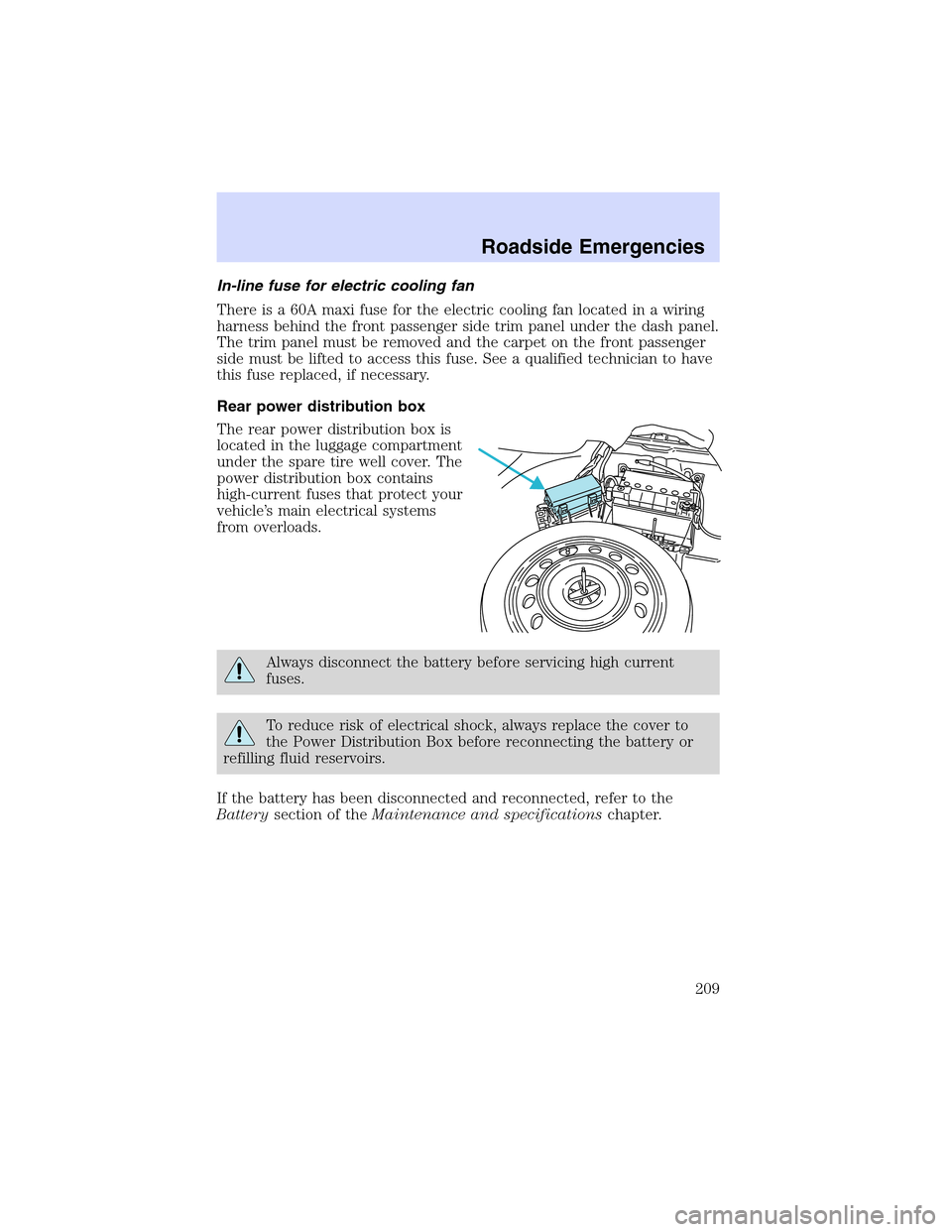
Rear power distribution box
The rear power distribution box is
located in the luggage compartment
under the spare tire well cover. The
power distribution box contains
high-current fuses that protect your
vehicle’s main electrical systems
from overloads.
Always disconnect the battery before servicing high current
fuses.
To reduce risk of electrical shock, always replace the cover to
the Power Distribution Box before reconnecting the battery or
refilling fluid reservoirs.
If the battery has been disconnected and reconnected, refer to the
Batterysection of theMaintenance and specificationschapter.
Roadside Emergencies
209
Page 271 of 288
Tires that are larger or smaller than your vehicle’s original tires may also
affect the accuracy of your speedometer.
SNOW TIRES AND CHAINS
Snow tires must be the same size and grade as the tires you
currently have on your vehicle.
The tires on your vehicle have all weather treads to provide traction in
rain and snow. However, in some climates, you may need to use snow
tires or chains.
Follow these guidelines when using snow tires and chains:
•Use only SAE Class S chains with P225/55R16 tires.
•Do not use tire chains with size P235/50R17 tires. Use of SAE Class S
chains or other chain types may damage your vehicle.
•Install chains securely, verifying that the chains do not touch any
wiring, brake lines or fuel lines.
•Drive cautiously. If you hear the chains rub or bang against your
vehicle, stop and re-tighten the chains. If this does not work, remove
the chains to prevent damage to your vehicle.
•If possible, avoid fully loading your vehicle.
•Remove the tire chains when they are no longer needed. Do not use
tire chains on dry roads.
•The suspension insulation and bumpers will help prevent vehicle
damage. Do not remove these components from your vehicle when
using snow tires or chains.
MOTORCRAFT PART NUMBERS
Component 3.0L-4V V6 engine 3.9L-4V V8 engine
Air filter element FA-1679 FA-1679
Fuel filter FG-1011 FG-1011
Battery (standard) BXT-66-650 BXT-66-650
Battery (optional) BXT-66-750 BXT-66-750
Oil filter FL-400S FL-218
PCV valve EV-257 N/A
Spark plugs* AGSF-22FSM AGSP-32F
* Refer to Vehicle Emissions Control Information (VECI) decal for spark
plug information.
Maintenance and Specifications
271