belt LINCOLN LS 2006 Owner's Manual
[x] Cancel search | Manufacturer: LINCOLN, Model Year: 2006, Model line: LS, Model: LINCOLN LS 2006Pages: 320, PDF Size: 4.38 MB
Page 178 of 320
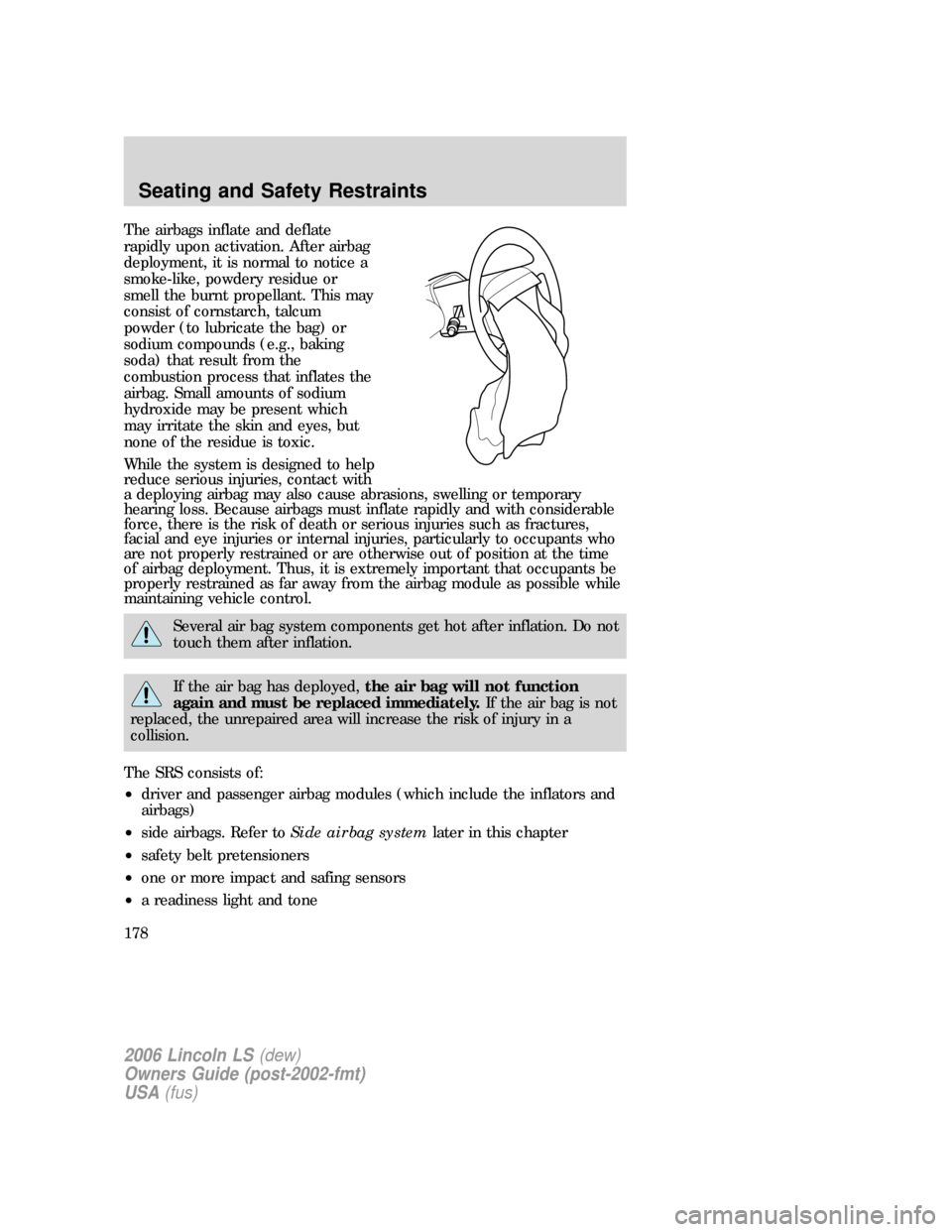
The airbags inflate and deflate
rapidly upon activation. After airbag
deployment, it is normal to notice a
smoke-like, powdery residue or
smell the burnt propellant. This may
consist of cornstarch, talcum
powder (to lubricate the bag) or
sodium compounds (e.g., baking
soda) that result from the
combustion process that inflates the
airbag. Small amounts of sodium
hydroxide may be present which
may irritate the skin and eyes, but
none of the residue is toxic.
While the system is designed to help
reduce serious injuries, contact with
a deploying airbag may also cause abrasions, swelling or temporary
hearing loss. Because airbags must inflate rapidly and with considerable
force, there is the risk of death or serious injuries such as fractures,
facial and eye injuries or internal injuries, particularly to occupants who
are not properly restrained or are otherwise out of position at the time
of airbag deployment. Thus, it is extremely important that occupants be
properly restrained as far away from the airbag module as possible while
maintaining vehicle control.
Several air bag system components get hot after inflation. Do not
touch them after inflation.
If the air bag has deployed,the air bag will not function
again and must be replaced immediately.If the air bag is not
replaced, the unrepaired area will increase the risk of injury in a
collision.
The SRS consists of:
•driver and passenger airbag modules (which include the inflators and
airbags)
•side airbags. Refer toSide airbag systemlater in this chapter
•safety belt pretensioners
•one or more impact and safing sensors
•a readiness light and tone
2006 Lincoln LS(dew)
Owners Guide (post-2002-fmt)
USA(fus)
Seating and Safety Restraints
178
Page 179 of 320
•and the electrical wiring which connects the components
The diagnostic module monitors its own internal circuits and the
supplemental airbag electrical system wiring (including the impact
sensors), the system wiring, the airbag system readiness light, the airbag
back up power, the airbag ignitors and safety belt pretensioners.
Determining if the system is operational
The SRS uses a readiness light in the instrument cluster or a tone to
indicate the condition of the system. Refer to theAirbag readiness
section in theInstrument clusterchapter. Routine maintenance of the
airbag is not required.
Any difficulty with the system is indicated by one or more of the
following:
•The readiness light will either
flash or stay lit
•The readiness light will not
illuminate immediately after
ignition is turned to the RUN position
•A series of five beeps will be heard. The tone pattern will repeat
periodically until the problem and/or light are repaired.
If any of these things happen, even intermittently, have the SRS serviced
at an authorized dealer immediately. Unless serviced, the system may not
function properly in the event of a collision.
Seat-mounted side airbag system (if equipped)
Do not place objects or mount equipment on or near the airbag
cover on the side of the seatbacks of the front seats or in front
seat areas that may come into contact with a deploying airbag. Failure
to follow these instructions may increase the risk of personal injury in
the event of a collision.
Do not use accessory seat covers. The use of accessory seat
covers may prevent the deployment of the side airbags and
increase the risk of injury in an accident.
Do not lean your head on the door. The side airbag could injure
you as it deploys from the side of the seatback.
2006 Lincoln LS(dew)
Owners Guide (post-2002-fmt)
USA(fus)
Seating and Safety Restraints
179
Page 180 of 320
Do not attempt to service, repair, or modify the airbag SRS, its
fuses or the seat cover on a seat containing an airbag. See your
authorized dealer.
All occupants of the vehicle should always wear their safety belts
even when an airbag SRS is provided.
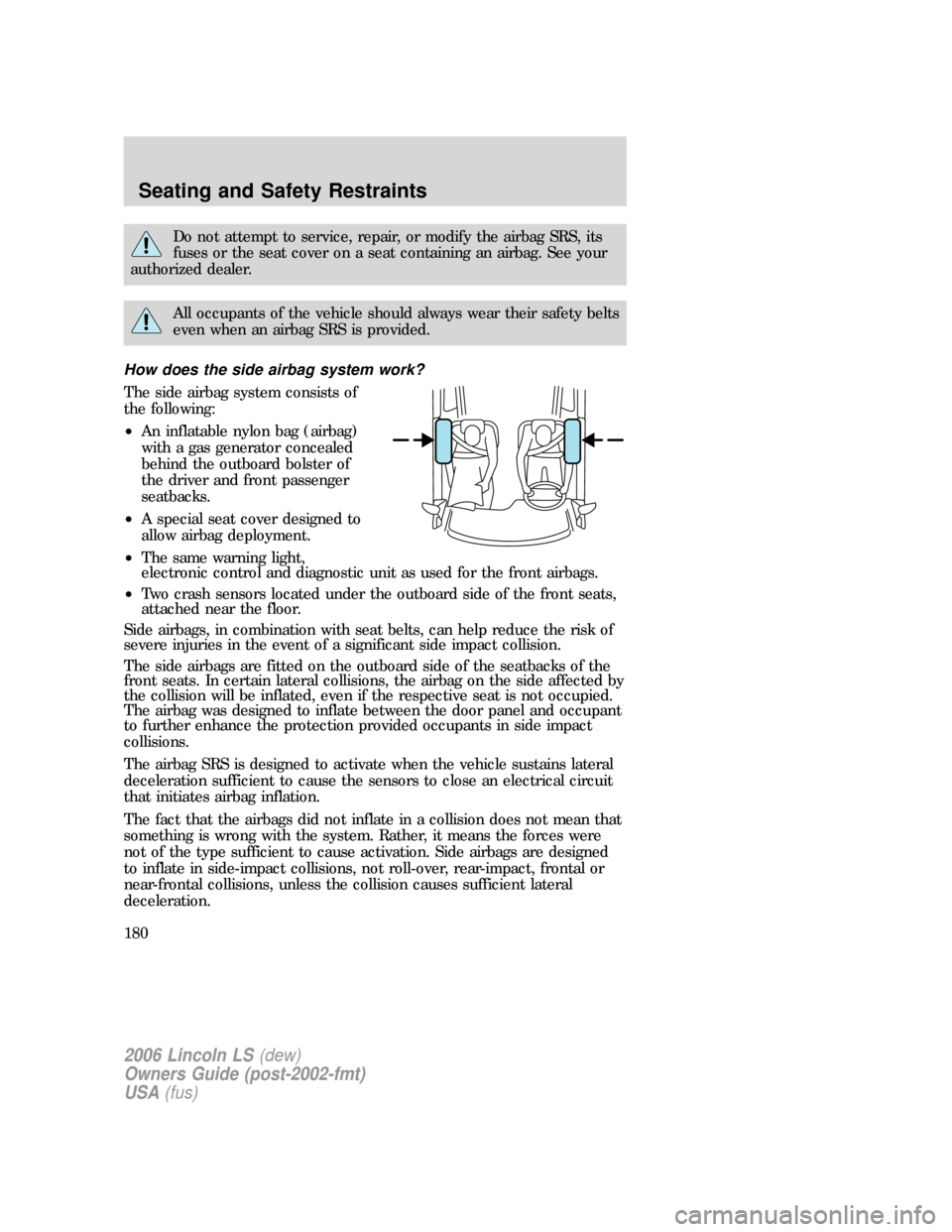
How does the side airbag system work?
The side airbag system consists of
the following:
•An inflatable nylon bag (airbag)
with a gas generator concealed
behind the outboard bolster of
the driver and front passenger
seatbacks.
•A special seat cover designed to
allow airbag deployment.
•The same warning light,
electronic control and diagnostic unit as used for the front airbags.
•Two crash sensors located under the outboard side of the front seats,
attached near the floor.
Side airbags, in combination with seat belts, can help reduce the risk of
severe injuries in the event of a significant side impact collision.
The side airbags are fitted on the outboard side of the seatbacks of the
front seats. In certain lateral collisions, the airbag on the side affected by
the collision will be inflated, even if the respective seat is not occupied.
The airbag was designed to inflate between the door panel and occupant
to further enhance the protection provided occupants in side impact
collisions.
The airbag SRS is designed to activate when the vehicle sustains lateral
deceleration sufficient to cause the sensors to close an electrical circuit
that initiates airbag inflation.
The fact that the airbags did not inflate in a collision does not mean that
something is wrong with the system. Rather, it means the forces were
not of the type sufficient to cause activation. Side airbags are designed
to inflate in side-impact collisions, not roll-over, rear-impact, frontal or
near-frontal collisions, unless the collision causes sufficient lateral
deceleration.
2006 Lincoln LS(dew)
Owners Guide (post-2002-fmt)
USA(fus)
Seating and Safety Restraints
180
Page 183 of 320
Do not attempt to service, repair, or modify the airbag
supplemental restraint system, its fuses, or the seat cover on a
seat containing an airbag. See your authorized dealer.
All occupants of the vehicle, including the driver, should always
wear their safety belts even when an inflatable curtain is
provided.
To reduce the risk of injury, do not obstruct or place objects in
the deployment of the inflatable curtain.
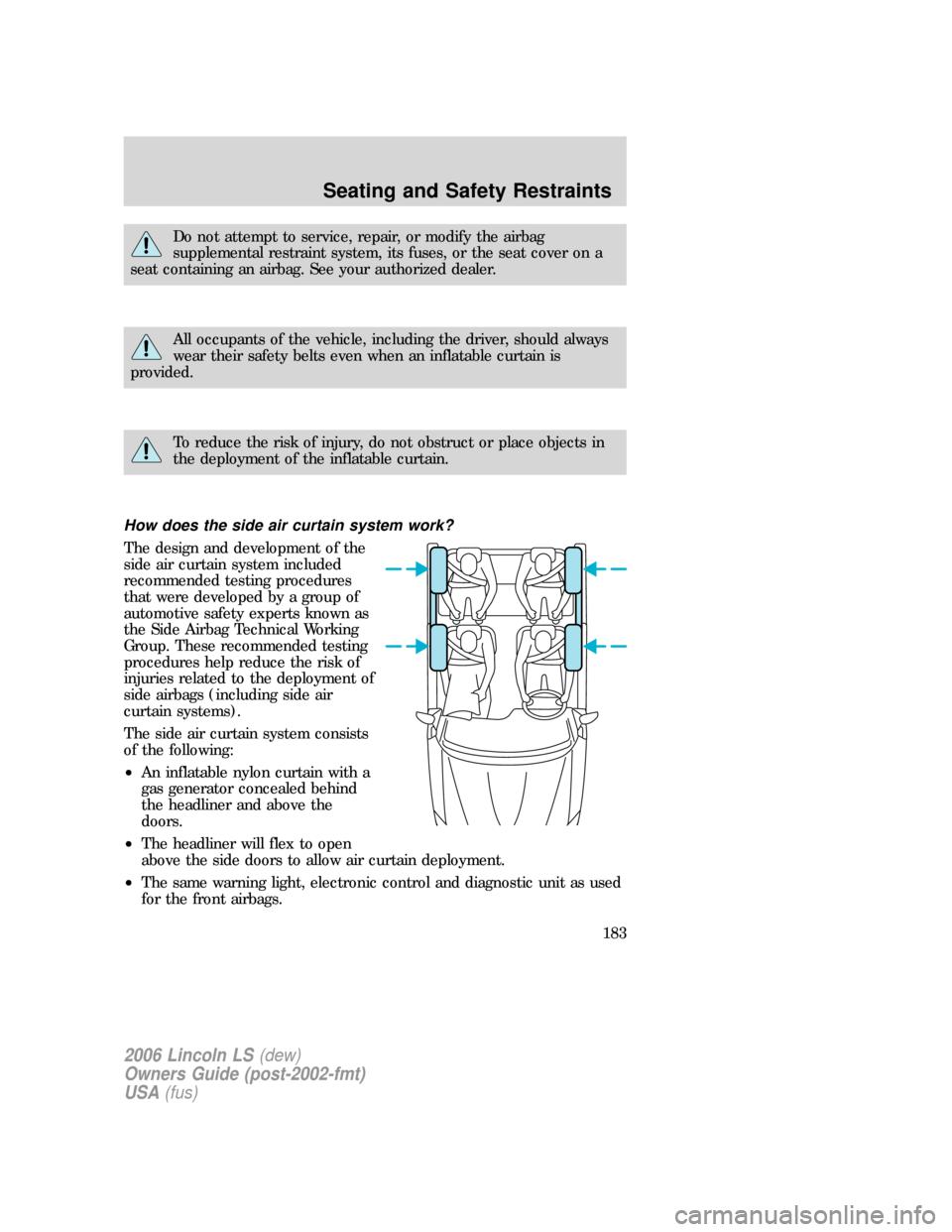
How does the side air curtain system work?
The design and development of the
side air curtain system included
recommended testing procedures
that were developed by a group of
automotive safety experts known as
the Side Airbag Technical Working
Group. These recommended testing
procedures help reduce the risk of
injuries related to the deployment of
side airbags (including side air
curtain systems).
The side air curtain system consists
of the following:
•An inflatable nylon curtain with a
gas generator concealed behind
the headliner and above the
doors.
•The headliner will flex to open
above the side doors to allow air curtain deployment.
•The same warning light, electronic control and diagnostic unit as used
for the front airbags.
2006 Lincoln LS(dew)
Owners Guide (post-2002-fmt)
USA(fus)
Seating and Safety Restraints
183
Page 184 of 320
•Two crash sensors located under the outboard side of the front seats,
attached near the floor.
•Two crash sensors located at the base of the “C” pillars above the
wheel house.
•An inflatable nylon bag (airbag) with a gas generator concealed behind
the outboard bolster of the driver and front passenger seatbacks.
•A special seat cover to allow airbag deployment (front seats only).
Side air curtains and side airbags, in combination with seat belts, can
help reduce the risk of severe injuries in the event of a significant side
impact collision.
The side air curtains are mounted to the sheet metal above the first and
second row seats. In certain lateral collisions, the air curtain and
seat-mounted side airbag on the side affected by the collision will be
inflated, even if the respective seat is not occupied. The air curtain was
designed to inflate between the side window area and occupant to
further enhance the head protection provided to occupants in side
impact collisions. The seat-mounted side airbag was designed to inflate
between the door panel and occupant to further enhance the protection
provided occupants in side impact collision.
The side air curtain system SRS is designed to activate when the vehicle
sustains lateral deceleration sufficient to cause the sensors to close an
electrical circuit that initiates air curtain and seat-mounted side airbag
inflation.
The fact that the side air curtain and seat-mounted side airbag did not
inflate in a collision does not mean that something is wrong with the
system. Rather, it means the forces were not of the type sufficient to
cause activation. The side air curtain system is designed to inflate in side
impact collisions, not roll-over, rear impact, frontal or near-frontal
collisions, unless the collision causes sufficient lateral deceleration.
Several air bag system components get hot after inflation. Do not
touch them after inflation.
2006 Lincoln LS(dew)
Owners Guide (post-2002-fmt)
USA(fus)
Seating and Safety Restraints
184
Page 186 of 320
Important child restraint precautions
You are required by law to use safety restraints for children in the U.S.
and Canada. If small children (generally children who are four years old
or younger and who weigh 40 lb. [18 kg] or less) ride in your vehicle, you
must put them in safety seats made especially for children. Many states
require that children use approved booster seats until they are eight
years old. Check your local and state or provincial laws for specific
requirements regarding the safety of children in your vehicle. When
possible, always place children under age 12 in the rear seat of your
vehicle. Accident statistics suggest that children are safer when properly
restrained in the rear seating positions than in the front seating position.
Never let a passenger hold a child on his or her lap while the
vehicle is moving. The passenger cannot protect the child from
injury in a collision.
Always follow the instructions and warnings that come with any infant or
child restraint you might use.
Children and safety belts
If the child is the proper size, restrain the child in a safety seat. Children
who are too large for child safety seats (as specified by your child safety
seat manufacturer) should always wear safety belts.
Follow all the important safety restraint and airbag precautions that
apply to adult passengers in your vehicle.
If the shoulder belt portion of a combination lap and shoulder belt can
be positioned so it does not cross or rest in front of the child’s face or
neck, the child should wear the lap and shoulder belt. Moving the child
closer to the center of the vehicle may help provide a good shoulder belt
fit.
Do not leave children, unreliable adults, or pets unattended in
your vehicle.
Child booster seats
Children outgrow a typical convertible or toddler seat when they weigh
40 lb. (18 kg) and are around 4 years of age. Although the lap/shoulder
belt will provide some protection, these children are still too small for
lap/shoulder belts to fit properly, which could increase the risk of serious
injury in a crash.
2006 Lincoln LS(dew)
Owners Guide (post-2002-fmt)
USA(fus)
Seating and Safety Restraints
186
Page 187 of 320
To improve the fit of both the lap and shoulder belt on children who
have outgrown child safety seats, Ford Motor Company recommends use
of a belt-positioning booster.
Booster seats position a child so that safety belts fit better. They lift the
child up so that the lap belt rests low across the hips and the knees
bend comfortably. Booster seats may also make the shoulder belt fit
better and more comfortably. Try to keep the belt near the middle of the
shoulder.
When children should use booster seats
Children need to use booster seats from the time they outgrow the
toddler seat until they are big enough for the vehicle seat and
lap/shoulder belt to fit properly. Generally this is when they weigh about
80 lb. (36 kg) (about 8 to 12 years old).
Booster seats should be used until you can answer YES to ALL of these
questions:
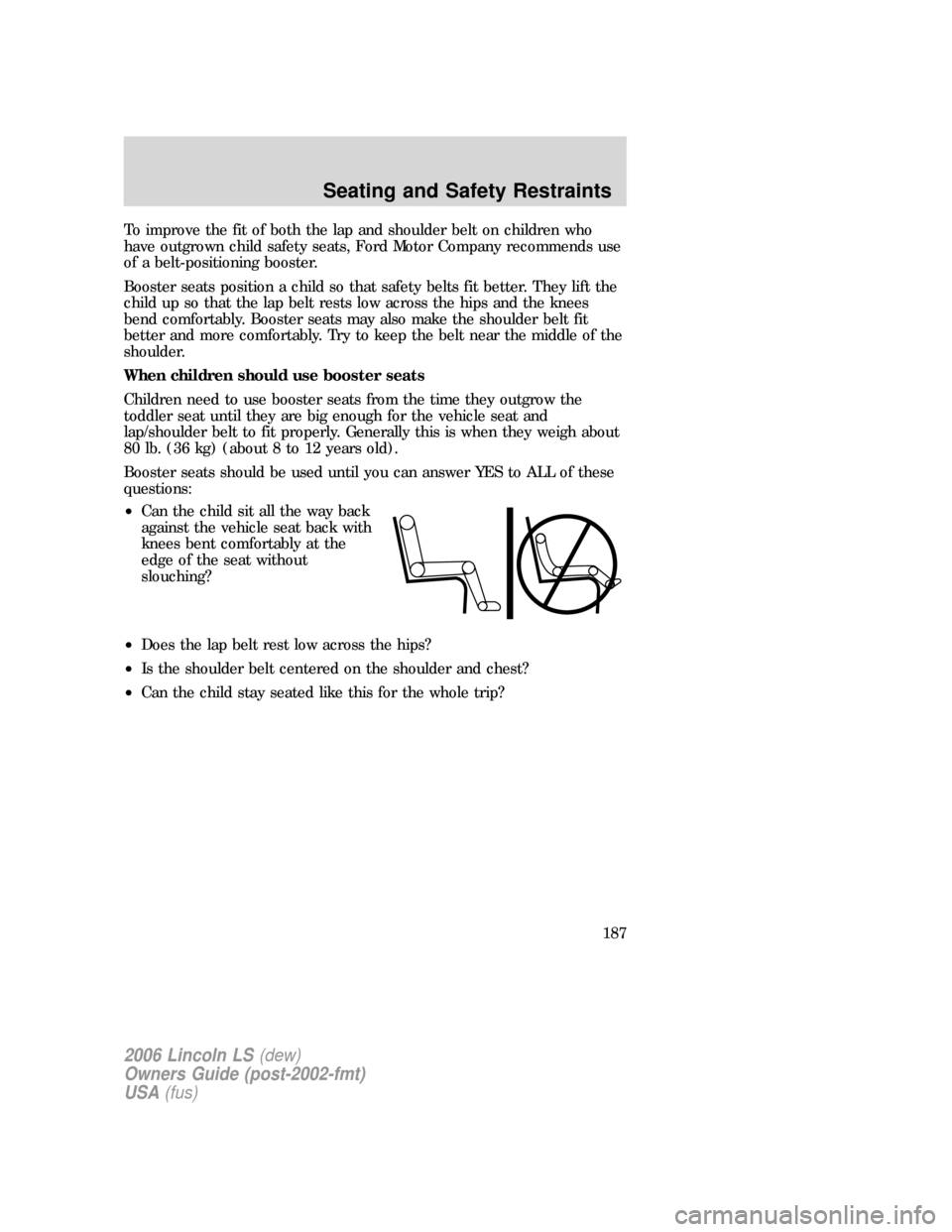
•Can the child sit all the way back
against the vehicle seat back with
knees bent comfortably at the
edge of the seat without
slouching?
•Does the lap belt rest low across the hips?
•Is the shoulder belt centered on the shoulder and chest?
•Can the child stay seated like this for the whole trip?
2006 Lincoln LS(dew)
Owners Guide (post-2002-fmt)
USA(fus)
Seating and Safety Restraints
187
Page 188 of 320
Types of booster seats
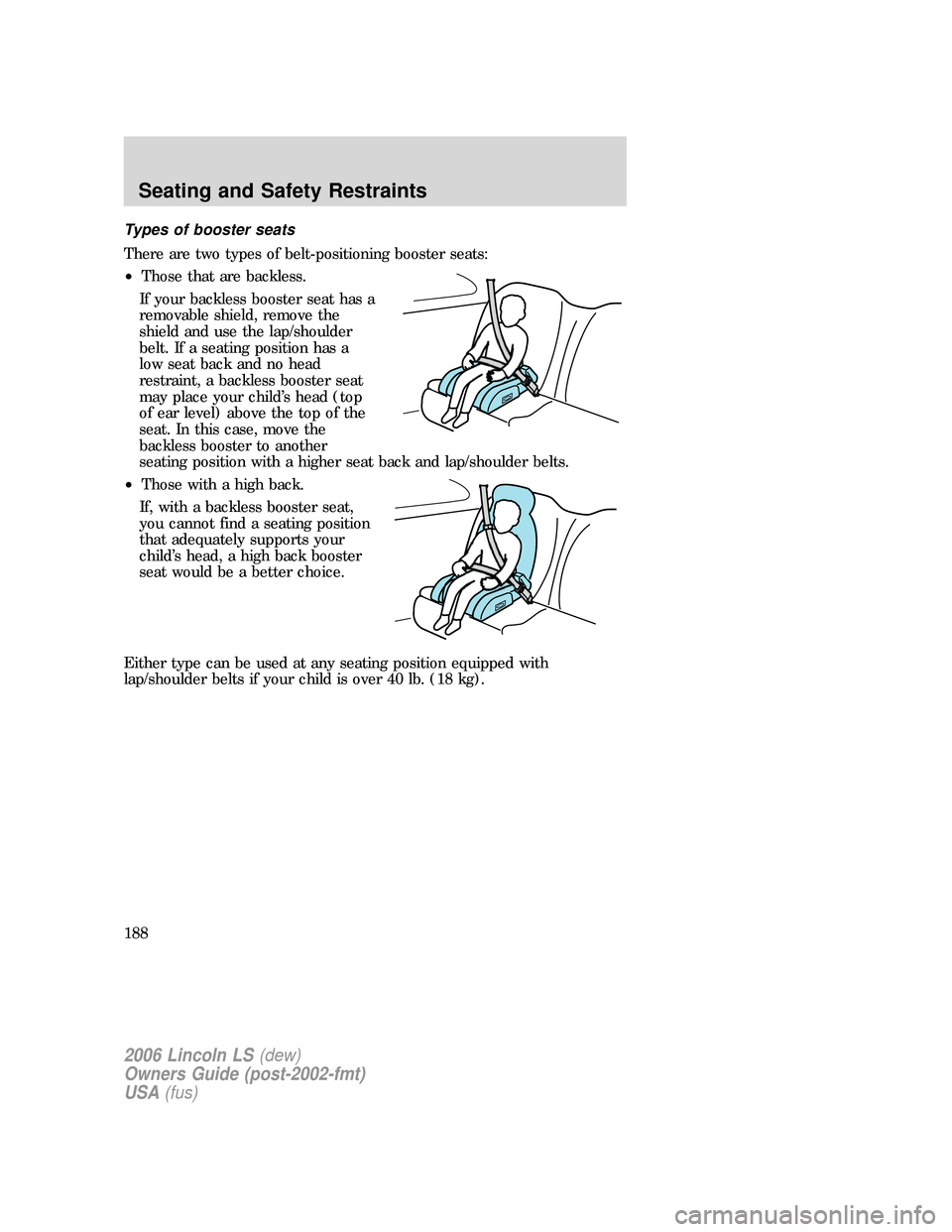
There are two types of belt-positioning booster seats:
•Those that are backless.
If your backless booster seat has a
removable shield, remove the
shield and use the lap/shoulder
belt. If a seating position has a
low seat back and no head
restraint, a backless booster seat
may place your child’s head (top
of ear level) above the top of the
seat. In this case, move the
backless booster to another
seating position with a higher seat back and lap/shoulder belts.
•Those with a high back.
If, with a backless booster seat,
you cannot find a seating position
that adequately supports your
child’s head, a high back booster
seat would be a better choice.
Either type can be used at any seating position equipped with
lap/shoulder belts if your child is over 40 lb. (18 kg).
2006 Lincoln LS(dew)
Owners Guide (post-2002-fmt)
USA(fus)
Seating and Safety Restraints
188
Page 189 of 320
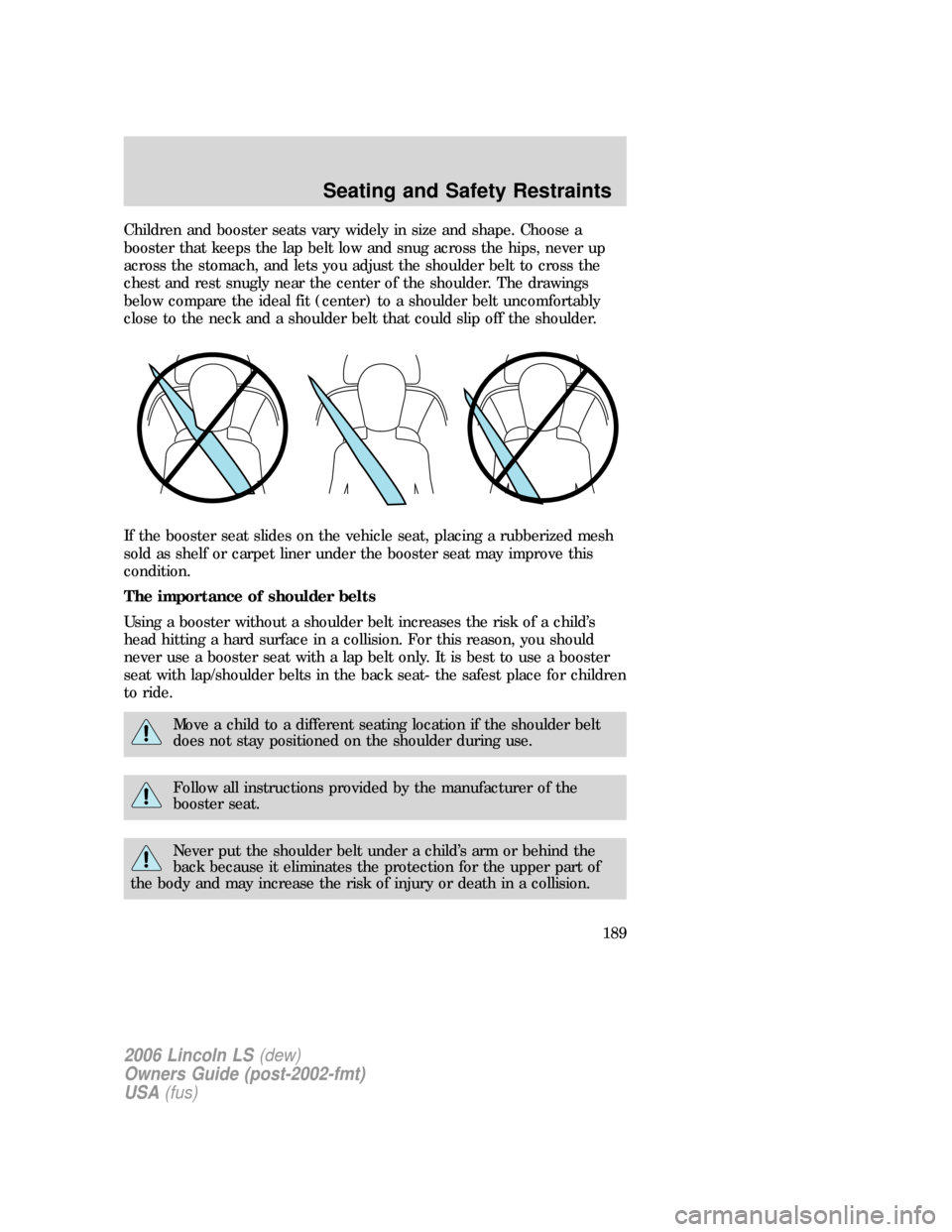
Children and booster seats vary widely in size and shape. Choose a
booster that keeps the lap belt low and snug across the hips, never up
across the stomach, and lets you adjust the shoulder belt to cross the
chest and rest snugly near the center of the shoulder. The drawings
below compare the ideal fit (center) to a shoulder belt uncomfortably
close to the neck and a shoulder belt that could slip off the shoulder.
If the booster seat slides on the vehicle seat, placing a rubberized mesh
sold as shelf or carpet liner under the booster seat may improve this
condition.
The importance of shoulder belts
Using a booster without a shoulder belt increases the risk of a child’s
head hitting a hard surface in a collision. For this reason, you should
never use a booster seat with a lap belt only. It is best to use a booster
seat with lap/shoulder belts in the back seat- the safest place for children
to ride.
Move a child to a different seating location if the shoulder belt
does not stay positioned on the shoulder during use.
Follow all instructions provided by the manufacturer of the
booster seat.
Never put the shoulder belt under a child’s arm or behind the
back because it eliminates the protection for the upper part of
the body and may increase the risk of injury or death in a collision.
2006 Lincoln LS(dew)
Owners Guide (post-2002-fmt)
USA(fus)
Seating and Safety Restraints
189
Page 190 of 320
Never use pillows, books, or towels to boost a child. They can
slide around and increase the likelihood of injury or death in a
collision.
SAFETY SEATS FOR CHILDREN
Child and infant or child safety seats
Use a safety seat that is recommended for the size and weight of the
child. Carefully follow all of the manufacturer’s instructions with the
safety seat you put in your vehicle. If you do not install and use the
safety seat properly, the child may be injured in a sudden stop or
collision.
When installing a child safety seat:
•Review and follow the information
presented in theAirbag
Supplemental Restraint System
section in this chapter.
•Use the correct safety belt buckle
for that seating position.
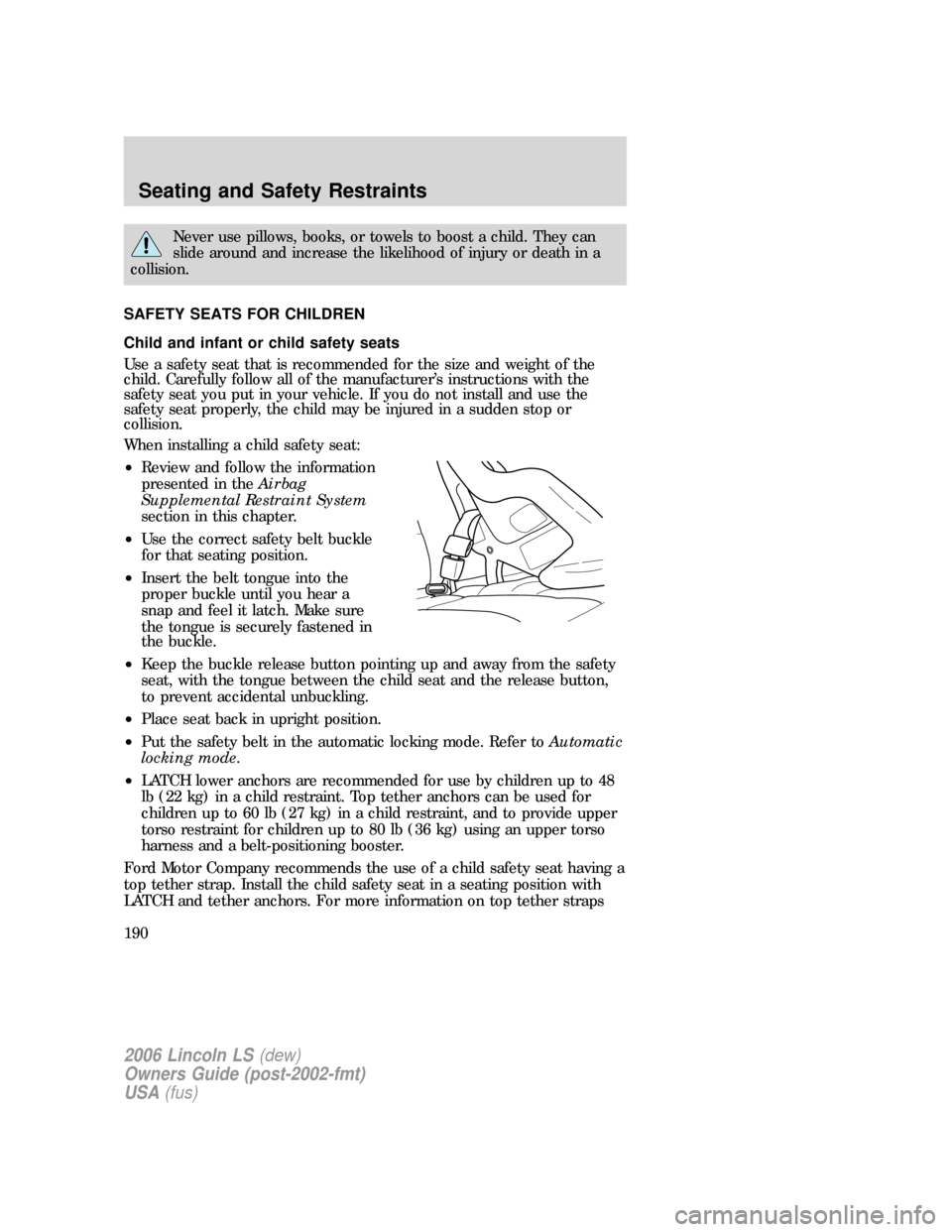
•Insert the belt tongue into the
proper buckle until you hear a
snap and feel it latch. Make sure
the tongue is securely fastened in
the buckle.
•Keep the buckle release button pointing up and away from the safety
seat, with the tongue between the child seat and the release button,
to prevent accidental unbuckling.
•Place seat back in upright position.
•Put the safety belt in the automatic locking mode. Refer toAutomatic
locking mode.
•LATCH lower anchors are recommended for use by children up to 48
lb (22 kg) in a child restraint. Top tether anchors can be used for
children up to 60 lb (27 kg) in a child restraint, and to provide upper
torso restraint for children up to 80 lb (36 kg) using an upper torso
harness and a belt-positioning booster.
Ford Motor Company recommends the use of a child safety seat having a
top tether strap. Install the child safety seat in a seating position with
LATCH and tether anchors. For more information on top tether straps
2006 Lincoln LS(dew)
Owners Guide (post-2002-fmt)
USA(fus)
Seating and Safety Restraints
190