brakes LINCOLN MARK LT 2006 User Guide
[x] Cancel search | Manufacturer: LINCOLN, Model Year: 2006, Model line: MARK LT, Model: LINCOLN MARK LT 2006Pages: 256, PDF Size: 2.81 MB
Page 171 of 256
slopes or hills. A danger lies in losing traction, slipping sideways and
possibly rolling over. Whenever driving on a hill, determine beforehand
the route you will use. Do not drive over the crest of a hill without
seeing what conditions are on the other side. Do not drive in reverse
over a hill without the aid of an observer.
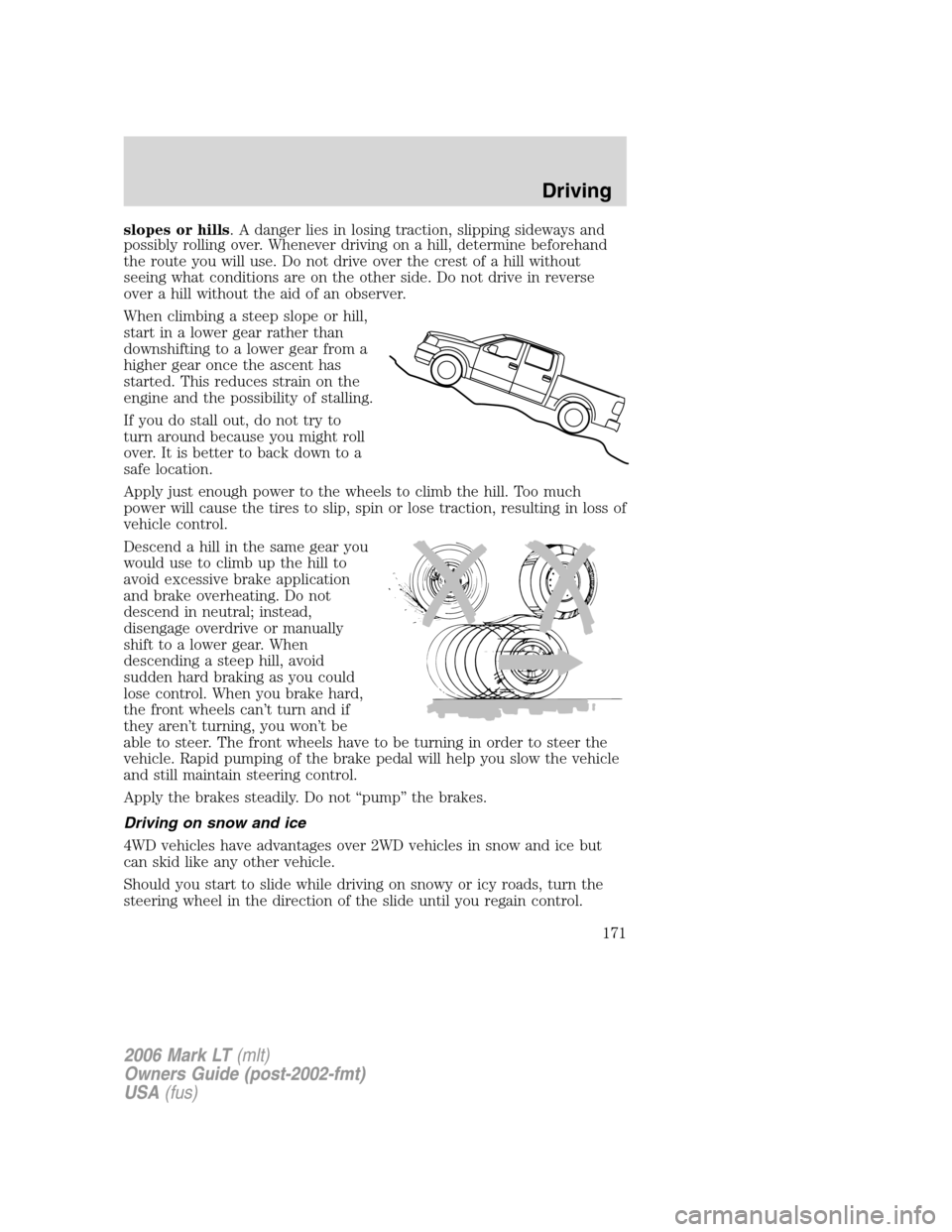
When climbing a steep slope or hill,
start in a lower gear rather than
downshifting to a lower gear from a
higher gear once the ascent has
started. This reduces strain on the
engine and the possibility of stalling.
If you do stall out, do not try to
turn around because you might roll
over. It is better to back down to a
safe location.
Apply just enough power to the wheels to climb the hill. Too much
power will cause the tires to slip, spin or lose traction, resulting in loss of
vehicle control.
Descend a hill in the same gear you
would use to climb up the hill to
avoid excessive brake application
and brake overheating. Do not
descend in neutral; instead,
disengage overdrive or manually
shift to a lower gear. When
descending a steep hill, avoid
sudden hard braking as you could
lose control. When you brake hard,
the front wheels can’t turn and if
they aren’t turning, you won’t be
able to steer. The front wheels have to be turning in order to steer the
vehicle. Rapid pumping of the brake pedal will help you slow the vehicle
and still maintain steering control.
Apply the brakes steadily. Do not “pump” the brakes.
Driving on snow and ice
4WD vehicles have advantages over 2WD vehicles in snow and ice but
can skid like any other vehicle.
Should you start to slide while driving on snowy or icy roads, turn the
steering wheel in the direction of the slide until you regain control.
2006 Mark LT(mlt)
Owners Guide (post-2002-fmt)
USA(fus)
Driving
171
Page 172 of 256
Avoid sudden applications of power and quick changes of direction on
snow and ice. Apply the accelerator slowly and steadily when starting
from a full stop.
Avoid sudden braking as well. Although a 4WD vehicle may accelerate
better than a two-wheel drive vehicle in snow and ice, it won’t stop any
faster, because as in other vehicles, braking occurs at all four wheels. Do
not become overconfident as to road conditions.
Make sure you allow sufficient distance between you and other vehicles
for stopping. Drive slower than usual and consider using one of the lower
gears. In emergency stopping situations, apply the brake steadily. Do not
“pump” the brakes. Refer to theBrakessection of this chapter for
additional information on the operation of the Anti-lock Brake System
(ABS).
Never drive with chains on the front tires of 4WD vehicles without also
putting them on the rear tires. This could cause the rear to slide and
swing around during braking.
Maintenance and Modifications
The suspension and steering systems on your vehicle have been designed
and tested to provide predictable performance whether loaded or empty
and durable load carrying capability. For this reason, Ford Motor
Company strongly recommends that you do not make modifications such
as adding or removing parts (such as lift kits or stabilizer bars) or by
using replacement parts not equivalent to the original factory equipment.
Any modifications to a vehicle that raise the center of gravity can make
it more likely the vehicle will roll over as a result of a loss of control.
Ford Motor Company recommends that caution be used with any vehicle
equipped with a high load or device (such as ladder racks or pickup box
cover).
Failure to maintain your vehicle properly may void the warranty, increase
your repair cost, reduce vehicle performance and operational capabilities
and adversely affect driver and passenger safety. Frequent inspection of
vehicle chassis components is recommended if the vehicle is subjected to
heavy off-road usage.
DRIVING THROUGH WATER
If driving through deep or standing water is unavoidable, proceed very
slowly especially when the depth is not known. Never drive through
water that is higher than the bottom of the hubs (for trucks) or the
bottom of the wheel rims (for cars). When driving through water,
traction or brake capability may be limited. Also, water may enter your
2006 Mark LT(mlt)
Owners Guide (post-2002-fmt)
USA(fus)
Driving
172
Page 173 of 256
engine’s air intake and severely damage your engine or your vehicle may
stall.Driving through deep water where the transmission vent
tube is submerged may allow water into the transmission and
cause internal transmission damage.
Once through the water, always dry the brakes by moving your
vehicle slowly while applying light pressure on the brake pedal.
Wet brakes do not stop the vehicle as quickly as dry brakes.
SNOWPLOWING
Your vehicle is not recommended for snowplowing. Ford makes no
representation as to the suitability of your vehicle for snowplowing, in
particular regarding the potential for exceeding vehicle weight limits,
airbag (SRS) deployment sensitivity, vehicle crash integrity, or
powertrain durability. The Snowplow Package Option is not available.
2006 Mark LT(mlt)
Owners Guide (post-2002-fmt)
USA(fus)
Driving
173
Page 181 of 256
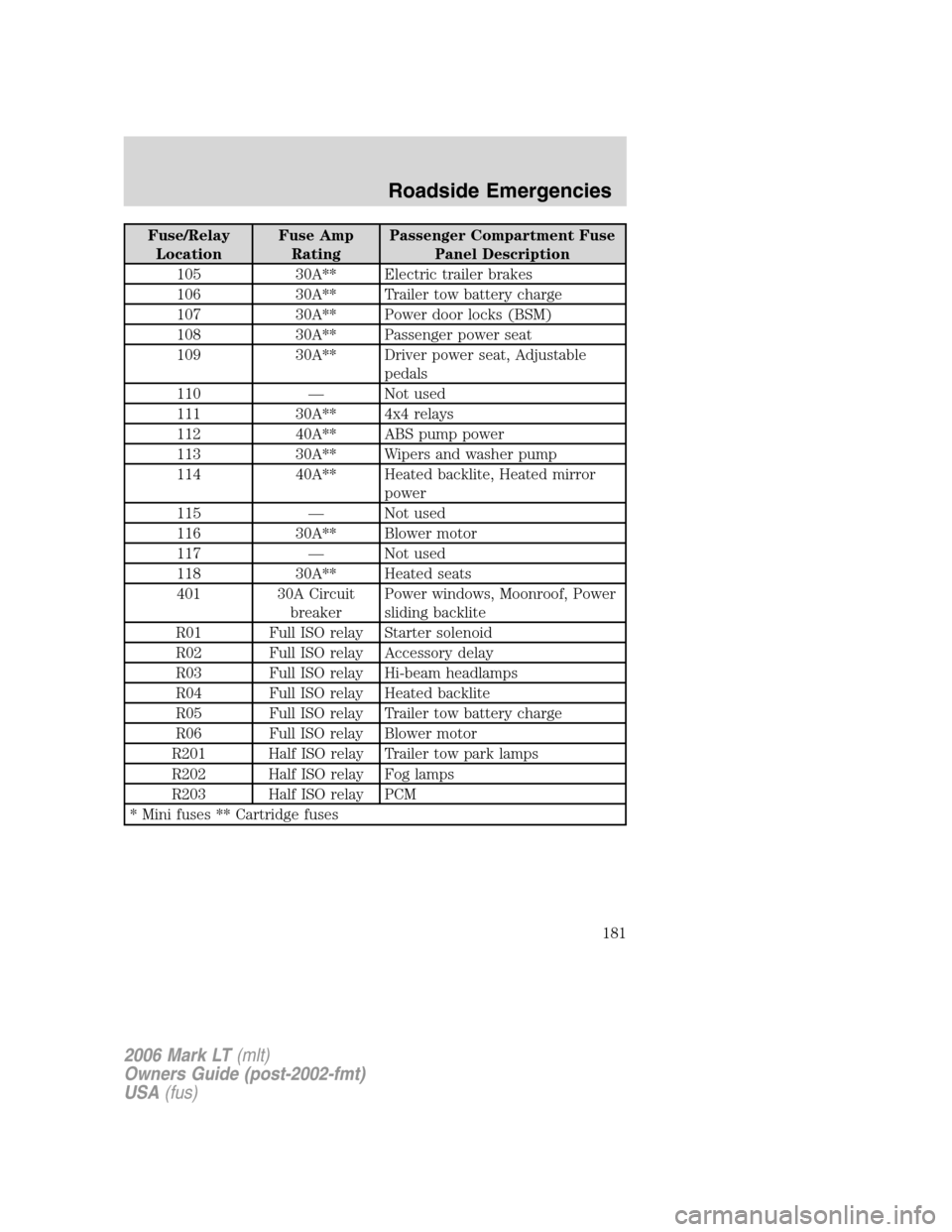
Fuse/Relay
LocationFuse Amp
RatingPassenger Compartment Fuse
Panel Description
105 30A** Electric trailer brakes
106 30A** Trailer tow battery charge
107 30A** Power door locks (BSM)
108 30A** Passenger power seat
109 30A** Driver power seat, Adjustable
pedals
110 — Not used
111 30A** 4x4 relays
112 40A** ABS pump power
113 30A** Wipers and washer pump
114 40A** Heated backlite, Heated mirror
power
115 — Not used
116 30A** Blower motor
117 — Not used
118 30A** Heated seats
401 30A Circuit
breakerPower windows, Moonroof, Power
sliding backlite
R01 Full ISO relay Starter solenoid
R02 Full ISO relay Accessory delay
R03 Full ISO relay Hi-beam headlamps
R04 Full ISO relay Heated backlite
R05 Full ISO relay Trailer tow battery charge
R06 Full ISO relay Blower motor
R201 Half ISO relay Trailer tow park lamps
R202 Half ISO relay Fog lamps
R203 Half ISO relay PCM
* Mini fuses ** Cartridge fuses
2006 Mark LT(mlt)
Owners Guide (post-2002-fmt)
USA(fus)
Roadside Emergencies
181
Page 229 of 256
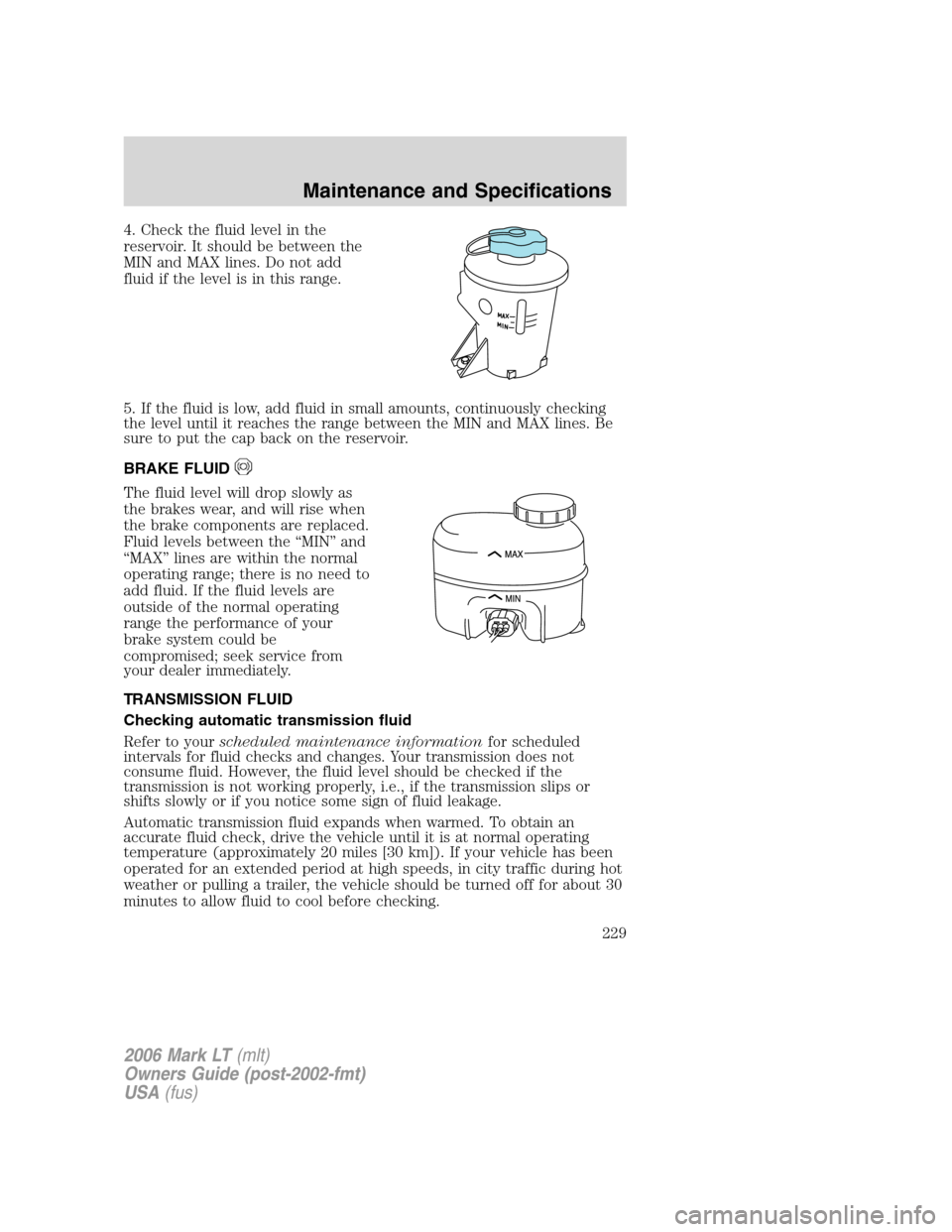
4. Check the fluid level in the
reservoir. It should be between the
MIN and MAX lines. Do not add
fluid if the level is in this range.
5. If the fluid is low, add fluid in small amounts, continuously checking
the level until it reaches the range between the MIN and MAX lines. Be
sure to put the cap back on the reservoir.
BRAKE FLUID
The fluid level will drop slowly as
the brakes wear, and will rise when
the brake components are replaced.
Fluid levels between the “MIN” and
“MAX” lines are within the normal
operating range; there is no need to
add fluid. If the fluid levels are
outside of the normal operating
range the performance of your
brake system could be
compromised; seek service from
your dealer immediately.
TRANSMISSION FLUID
Checking automatic transmission fluid
Refer to yourscheduled maintenance informationfor scheduled
intervals for fluid checks and changes. Your transmission does not
consume fluid. However, the fluid level should be checked if the
transmission is not working properly, i.e., if the transmission slips or
shifts slowly or if you notice some sign of fluid leakage.
Automatic transmission fluid expands when warmed. To obtain an
accurate fluid check, drive the vehicle until it is at normal operating
temperature (approximately 20 miles [30 km]). If your vehicle has been
operated for an extended period at high speeds, in city traffic during hot
weather or pulling a trailer, the vehicle should be turned off for about 30
minutes to allow fluid to cool before checking.
2006 Mark LT(mlt)
Owners Guide (post-2002-fmt)
USA(fus)
Maintenance and Specifications
229
Page 246 of 256
A
Accessory delay ..........................42
Air cleaner filter ...............233–234
Air conditioning ..........................21
Airbag supplemental restraint
system ....................................97–98
and child safety seats ............100
description ................................98
disposal ....................................102
driver airbag ......................98, 100
indicator light .........................101
operation ...........................98, 100
passenger airbag ...............98, 100
Ambulance packages ....................7
Antifreeze
(see Engine coolant) ................212
Anti-lock brake system
(see Brakes) ..............................155
Audio system (see Radio) .........16
Automatic transmission
driving an automatic
overdrive .................................159
fluid, adding ............................229
fluid, checking ........................229
fluid, refill capacities ..............235
fluid, specification ..................239
Axle
lubricant specifications ..237, 239
refill capacities ........................235
traction lok ..............................157
B
Battery .......................................210
acid, treating emergencies .....210
jumping a disabled battery ....183
maintenance-free ....................210
replacement, specifications ...234servicing ..................................210
Bed extender ..............................61
Brakes ........................................155
anti-lock ...................................155
anti-lock brake system (ABS)
warning light ...........................155
fluid, checking and adding ....229
fluid, refill capacities ..............235
fluid, specifications .........237, 239
lubricant specifications ..237, 239
parking ....................................156
shift interlock ..........................157
Bulbs ............................................29
C
Capacities for refilling fluids ....235
Cell phone use ..............................7
Certification Label ....................241
Child safety restraints ..............105
child safety belts ....................105
Child safety seats ......................108
attaching with tether straps ..112
in front seat ............................109
in rear seat ..............................109
Cleaning your vehicle
engine compartment ..............200
instrument panel ....................201
interior .....................................202
interior trim ............................201
plastic parts ............................200
safety belts ..............................202
washing ....................................198
waxing .....................................198
wheels ......................................199
wiper blades ............................201
Climate control (see Air
conditioning or Heating) ............21
2006 Mark LT(mlt)
Owners Guide (post-2002-fmt)
USA(fus)
Index
246
Page 249 of 256
J
Jack
storage .....................................126
Jump-starting your vehicle ......183
K
Keyless entry system .................73
autolock .....................................71
programming entry code .........73
Keys .............................................76
positions of the ignition .........151
L
Lamps
autolamp system .......................24
bulb replacement
specifications chart ..................29
daytime running light ...............25
fog lamps ...................................24
headlamps .................................24
headlamps, flash to pass ..........25
instrument panel, dimming .....26
interior lamps .....................27–28
replacing bulbs ...................29–33
Lane change indicator
(see Turn signal) ........................27
Lights, warning and indicator ....10
anti-lock brakes (ABS) ..........155
Load limits .................................139
Loading instructions .................146
Locks
autolock .....................................71
childproof ..................................64
doors ..........................................63
Lubricant specifications ...237, 239
Lug nuts ....................................130Lumbar support, seats ...............79
M
Message center ...........................52
english/metric button ...............56
system check button ................56
warning messages .....................58
Mirrors .........................................35
automatic dimming rearview
mirror ........................................42
heated ........................................43
programmable memory ......67, 80
side view mirrors (power) .......42
signal .........................................43
Moon roof ....................................47
Motorcraft parts ................222, 234
O
Octane rating ............................221
Oil (see Engine oil) ..................207
P
Parking brake ............................156
Parts (see Motorcraft parts) ....234
Passenger Occupant
Classification Sensor ...................84
Power distribution box
(see Fuses) ...............................177
Power door locks ........................63
Power mirrors .............................42
Power point .................................38
Power steering ..........................156
fluid, checking and adding ....228
fluid, refill capacity ................235
fluid, specifications .........237, 239
2006 Mark LT(mlt)
Owners Guide (post-2002-fmt)
USA(fus)
Index
249