lock LINCOLN MARK LT 2006 Repair Manual
[x] Cancel search | Manufacturer: LINCOLN, Model Year: 2006, Model line: MARK LT, Model: LINCOLN MARK LT 2006Pages: 256, PDF Size: 2.81 MB
Page 169 of 256
4WD Systems
4WD (when you select a 4WD mode) uses all four wheels to power the
vehicle. This increases traction, enabling you to drive over terrain and
road conditions that a conventional two-wheel drive vehicle cannot.
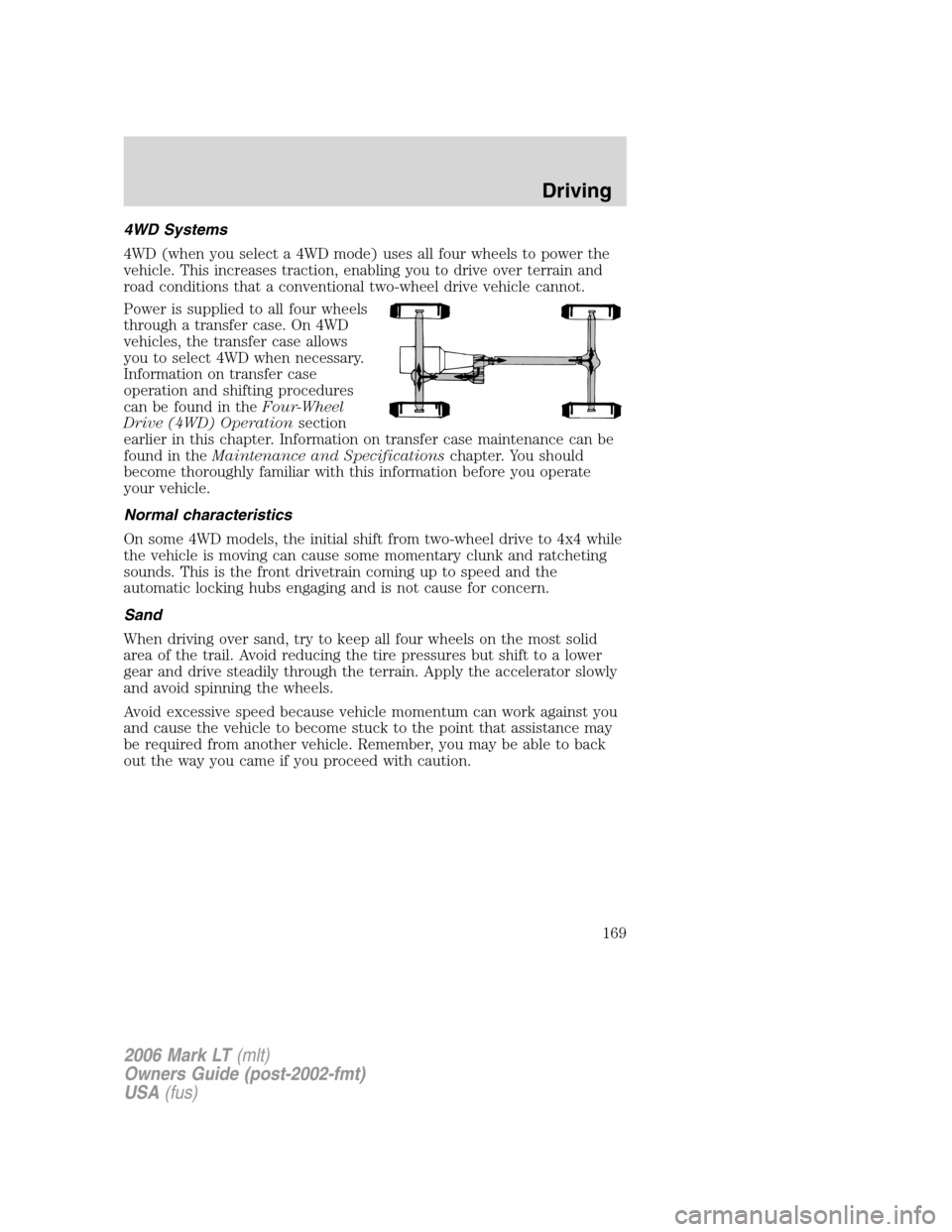
Power is supplied to all four wheels
through a transfer case. On 4WD
vehicles, the transfer case allows
you to select 4WD when necessary.
Information on transfer case
operation and shifting procedures
can be found in theFour-Wheel
Drive (4WD) Operationsection
earlier in this chapter. Information on transfer case maintenance can be
found in theMaintenance and Specificationschapter. You should
become thoroughly familiar with this information before you operate
your vehicle.
Normal characteristics
On some 4WD models, the initial shift from two-wheel drive to 4x4 while
the vehicle is moving can cause some momentary clunk and ratcheting
sounds. This is the front drivetrain coming up to speed and the
automatic locking hubs engaging and is not cause for concern.
Sand
When driving over sand, try to keep all four wheels on the most solid
area of the trail. Avoid reducing the tire pressures but shift to a lower
gear and drive steadily through the terrain. Apply the accelerator slowly
and avoid spinning the wheels.
Avoid excessive speed because vehicle momentum can work against you
and cause the vehicle to become stuck to the point that assistance may
be required from another vehicle. Remember, you may be able to back
out the way you came if you proceed with caution.
2006 Mark LT(mlt)
Owners Guide (post-2002-fmt)
USA(fus)
Driving
169
Page 172 of 256
Avoid sudden applications of power and quick changes of direction on
snow and ice. Apply the accelerator slowly and steadily when starting
from a full stop.
Avoid sudden braking as well. Although a 4WD vehicle may accelerate
better than a two-wheel drive vehicle in snow and ice, it won’t stop any
faster, because as in other vehicles, braking occurs at all four wheels. Do
not become overconfident as to road conditions.
Make sure you allow sufficient distance between you and other vehicles
for stopping. Drive slower than usual and consider using one of the lower
gears. In emergency stopping situations, apply the brake steadily. Do not
“pump” the brakes. Refer to theBrakessection of this chapter for
additional information on the operation of the Anti-lock Brake System
(ABS).
Never drive with chains on the front tires of 4WD vehicles without also
putting them on the rear tires. This could cause the rear to slide and
swing around during braking.
Maintenance and Modifications
The suspension and steering systems on your vehicle have been designed
and tested to provide predictable performance whether loaded or empty
and durable load carrying capability. For this reason, Ford Motor
Company strongly recommends that you do not make modifications such
as adding or removing parts (such as lift kits or stabilizer bars) or by
using replacement parts not equivalent to the original factory equipment.
Any modifications to a vehicle that raise the center of gravity can make
it more likely the vehicle will roll over as a result of a loss of control.
Ford Motor Company recommends that caution be used with any vehicle
equipped with a high load or device (such as ladder racks or pickup box
cover).
Failure to maintain your vehicle properly may void the warranty, increase
your repair cost, reduce vehicle performance and operational capabilities
and adversely affect driver and passenger safety. Frequent inspection of
vehicle chassis components is recommended if the vehicle is subjected to
heavy off-road usage.
DRIVING THROUGH WATER
If driving through deep or standing water is unavoidable, proceed very
slowly especially when the depth is not known. Never drive through
water that is higher than the bottom of the hubs (for trucks) or the
bottom of the wheel rims (for cars). When driving through water,
traction or brake capability may be limited. Also, water may enter your
2006 Mark LT(mlt)
Owners Guide (post-2002-fmt)
USA(fus)
Driving
172
Page 174 of 256
ROADSIDE ASSISTANCE
Getting roadside assistance
To fully assist you should you have a vehicle concern, Ford Motor
Company offers a complimentary roadside assistance program. This
program is separate from the New Vehicle Limited Warranty. The service
is available:
•24–hours, seven days a week
•for the New Vehicle Limited Warranty period of three years or 36,000
miles (60,000 km), whichever occurs first on Ford and Mercury
vehicles, and four years or 50,000 miles (80,000 km) on Lincoln
vehicles.
Roadside assistance will cover:
•a flat tire change with a good spare (except Ford GT which has a tire
inflation kit)
•battery jump start
•lock-out assistance (key replacement cost is the customer’s
responsibility)
•fuel delivery (2.0 gallons [7.5L], maximum two occurrences within 12
month period)
•towing of your disabled vehicle to the nearest Ford Motor Company
dealership, or your selling dealer if within 35 miles (56.3 km) of the
nearest Ford Motor Company dealership (one tow per disablement).
Even non-warranty related tows, like accidents, are covered (some
exclusions apply, such as impound towing or repossession).
Canadian customers refer to your Owner Information Guide for
information on:
•coverage period
•exact fuel amounts
•towing of your disabled vehicle
•emergency travel expense reimbursement
•travel planning benefits
Using roadside assistance
Complete the roadside assistance identification card and place it in your
wallet for quick reference. In the United States, this card is found in the
Owner Guide portfolio in the glove compartment. In Canada, the card is
found in theOwner Information Guidein the glove compartment.
2006 Mark LT(mlt)
Owners Guide (post-2002-fmt)
USA(fus)
Roadside Emergencies
174
Page 179 of 256
Fuse/Relay
LocationFuse Amp
RatingPassenger Compartment Fuse
Panel Description
9 — Not used
10 20A* Trailer tow back-up lamps relay
(PCB1), Trailer tow parklamp
relay (R201)
11 10A* A/C clutch, 4x4 solenoid
12 — Not used
13 10A* Climate control module power,
Flasher relay
14 10A* Back-up lamp and Daytime
Running Lamps (DRL) relay coil,
A/C pressure switch, Redundant
speed control switch, Heated PCV,
Trailer tow back-up lamps relay
coil, ABS, Reverse park aid, EC
mirror
15 5A* Overdrive cancel, Cluster
16 10A* Brake-shift interlock solenoid
17 15A* Fog lamp relay (R202)
18 10A* Run/Start feed - Overhead power
point, Electrochromatic mirror,
Heated seats, BSM, Compass, RSS
(Reverse Sensing System)
19 10A* Restraints (Air bag module)
20 10A* Battery feed for overhead power
point
21 15A* Cluster keep alive power
22 10A* Delayed accessory power for
audio, power door lock switch and
moonroof switch illumination
23 10A* RH low beam headlamp
24 15A* Battery saver power for demand
lamps
2006 Mark LT(mlt)
Owners Guide (post-2002-fmt)
USA(fus)
Roadside Emergencies
179
Page 180 of 256
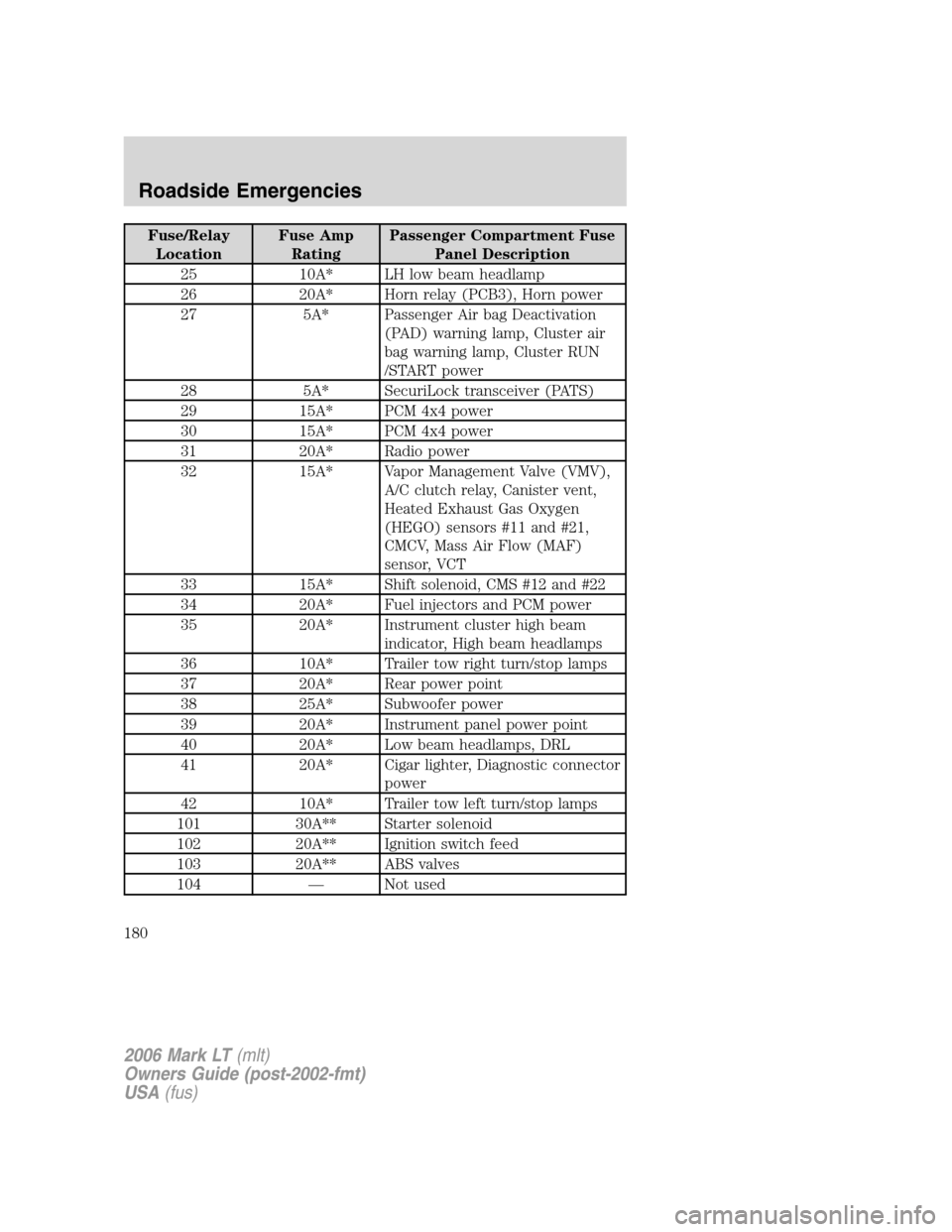
Fuse/Relay
LocationFuse Amp
RatingPassenger Compartment Fuse
Panel Description
25 10A* LH low beam headlamp
26 20A* Horn relay (PCB3), Horn power
27 5A* Passenger Air bag Deactivation
(PAD) warning lamp, Cluster air
bag warning lamp, Cluster RUN
/START power
28 5A* SecuriLock transceiver (PATS)
29 15A* PCM 4x4 power
30 15A* PCM 4x4 power
31 20A* Radio power
32 15A* Vapor Management Valve (VMV),
A/C clutch relay, Canister vent,
Heated Exhaust Gas Oxygen
(HEGO) sensors #11 and #21,
CMCV, Mass Air Flow (MAF)
sensor, VCT
33 15A* Shift solenoid, CMS #12 and #22
34 20A* Fuel injectors and PCM power
35 20A* Instrument cluster high beam
indicator, High beam headlamps
36 10A* Trailer tow right turn/stop lamps
37 20A* Rear power point
38 25A* Subwoofer power
39 20A* Instrument panel power point
40 20A* Low beam headlamps, DRL
41 20A* Cigar lighter, Diagnostic connector
power
42 10A* Trailer tow left turn/stop lamps
101 30A** Starter solenoid
102 20A** Ignition switch feed
103 20A** ABS valves
104 — Not used
2006 Mark LT(mlt)
Owners Guide (post-2002-fmt)
USA(fus)
Roadside Emergencies
180
Page 181 of 256
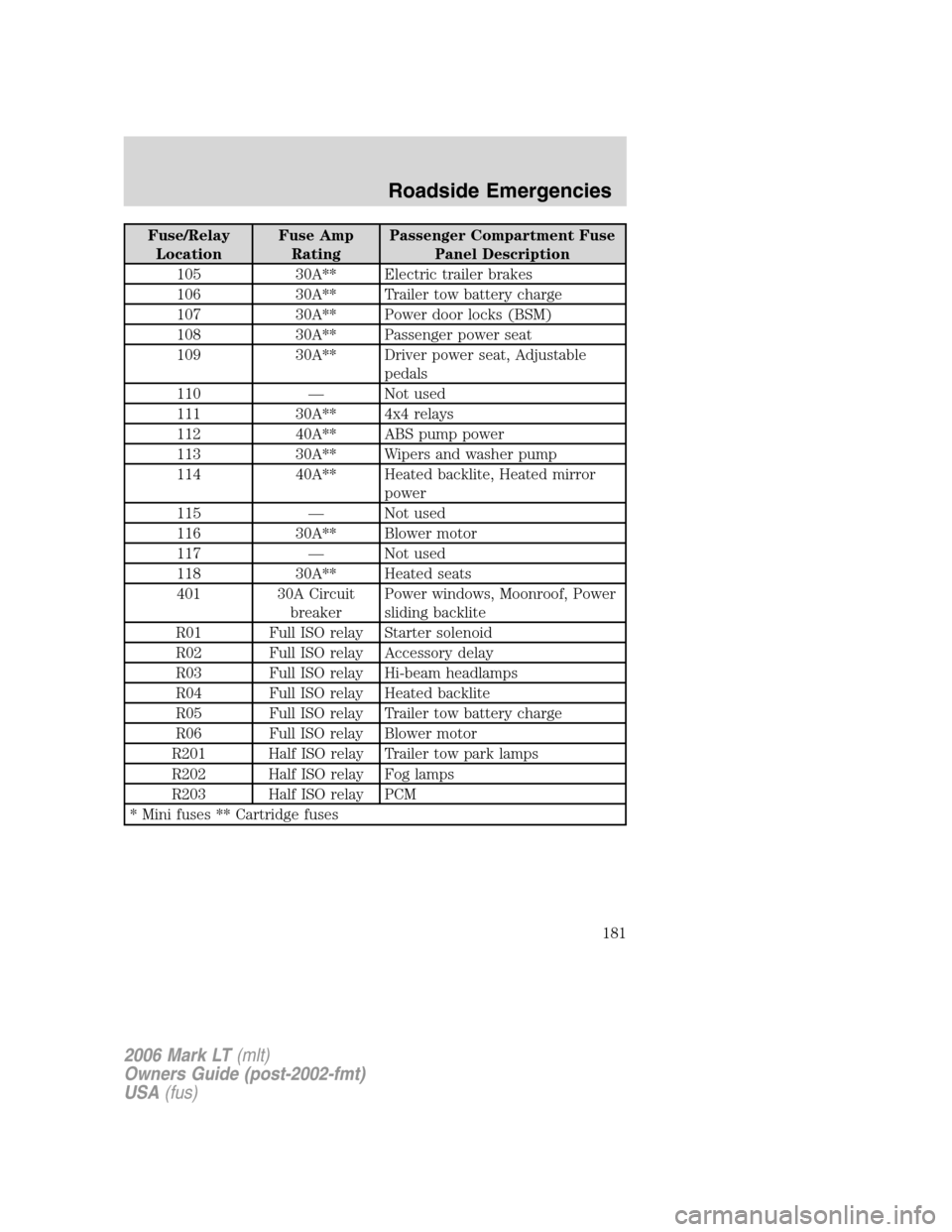
Fuse/Relay
LocationFuse Amp
RatingPassenger Compartment Fuse
Panel Description
105 30A** Electric trailer brakes
106 30A** Trailer tow battery charge
107 30A** Power door locks (BSM)
108 30A** Passenger power seat
109 30A** Driver power seat, Adjustable
pedals
110 — Not used
111 30A** 4x4 relays
112 40A** ABS pump power
113 30A** Wipers and washer pump
114 40A** Heated backlite, Heated mirror
power
115 — Not used
116 30A** Blower motor
117 — Not used
118 30A** Heated seats
401 30A Circuit
breakerPower windows, Moonroof, Power
sliding backlite
R01 Full ISO relay Starter solenoid
R02 Full ISO relay Accessory delay
R03 Full ISO relay Hi-beam headlamps
R04 Full ISO relay Heated backlite
R05 Full ISO relay Trailer tow battery charge
R06 Full ISO relay Blower motor
R201 Half ISO relay Trailer tow park lamps
R202 Half ISO relay Fog lamps
R203 Half ISO relay PCM
* Mini fuses ** Cartridge fuses
2006 Mark LT(mlt)
Owners Guide (post-2002-fmt)
USA(fus)
Roadside Emergencies
181
Page 182 of 256
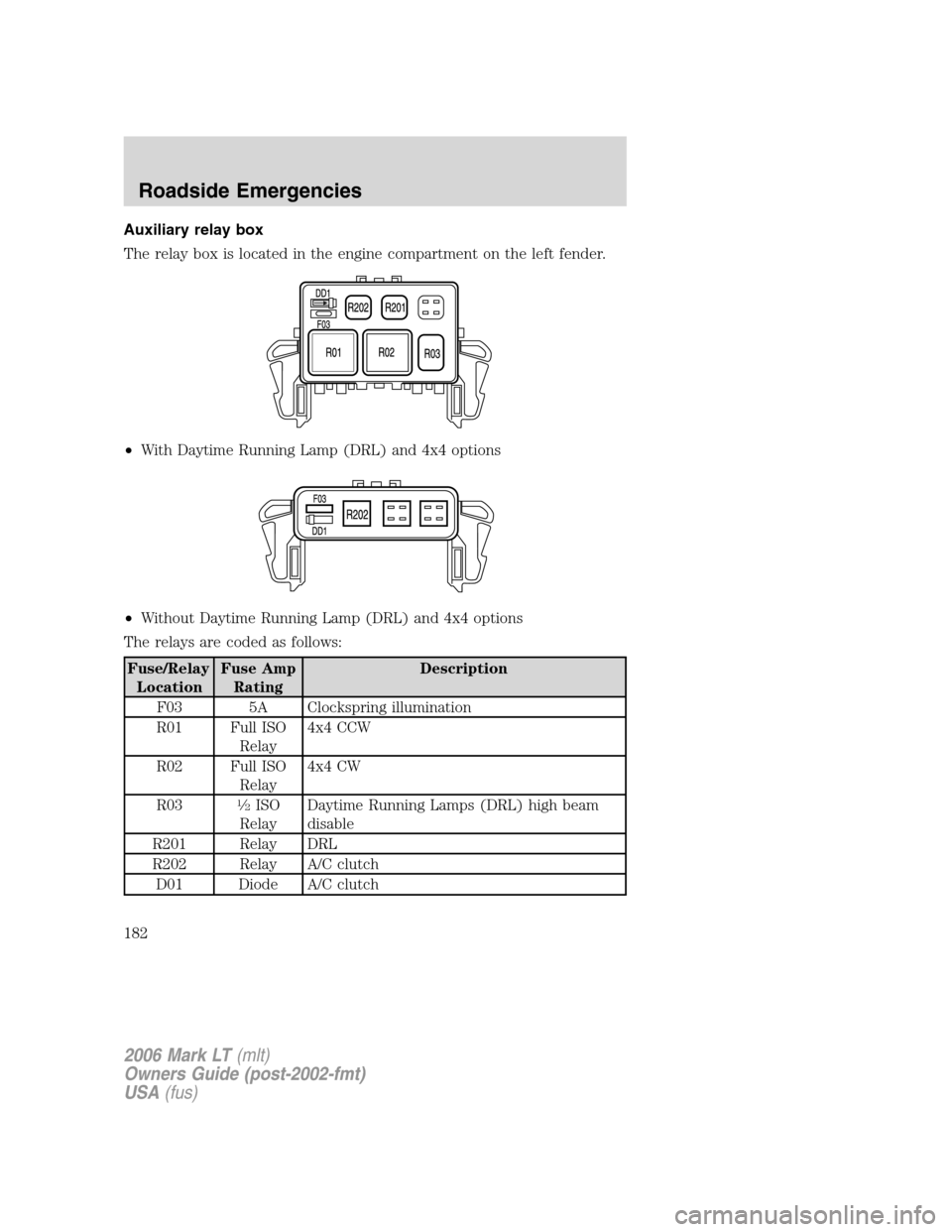
Auxiliary relay box
The relay box is located in the engine compartment on the left fender.
•With Daytime Running Lamp (DRL) and 4x4 options
•Without Daytime Running Lamp (DRL) and 4x4 options
The relays are coded as follows:
Fuse/Relay
LocationFuse Amp
RatingDescription
F03 5A Clockspring illumination
R01 Full ISO
Relay4x4 CCW
R02 Full ISO
Relay4x4 CW
R03
12ISO
RelayDaytime Running Lamps (DRL) high beam
disable
R201 Relay DRL
R202 Relay A/C clutch
D01 Diode A/C clutch
2006 Mark LT(mlt)
Owners Guide (post-2002-fmt)
USA(fus)
Roadside Emergencies
182
Page 200 of 256
ENGINE
Engines are more efficient when they are clean because grease and dirt
buildup keep the engine warmer than normal. When washing:
•Take care when using a power washer to clean the engine. The
high-pressure fluid could penetrate the sealed parts and cause
damage.
•Do not spray a hot engine with cold water to avoid cracking the
engine block or other engine components.
•Spray Motorcraft Engine Shampoo and Degreaser (ZC-20) on all parts
that require cleaning and pressure rinse clean.
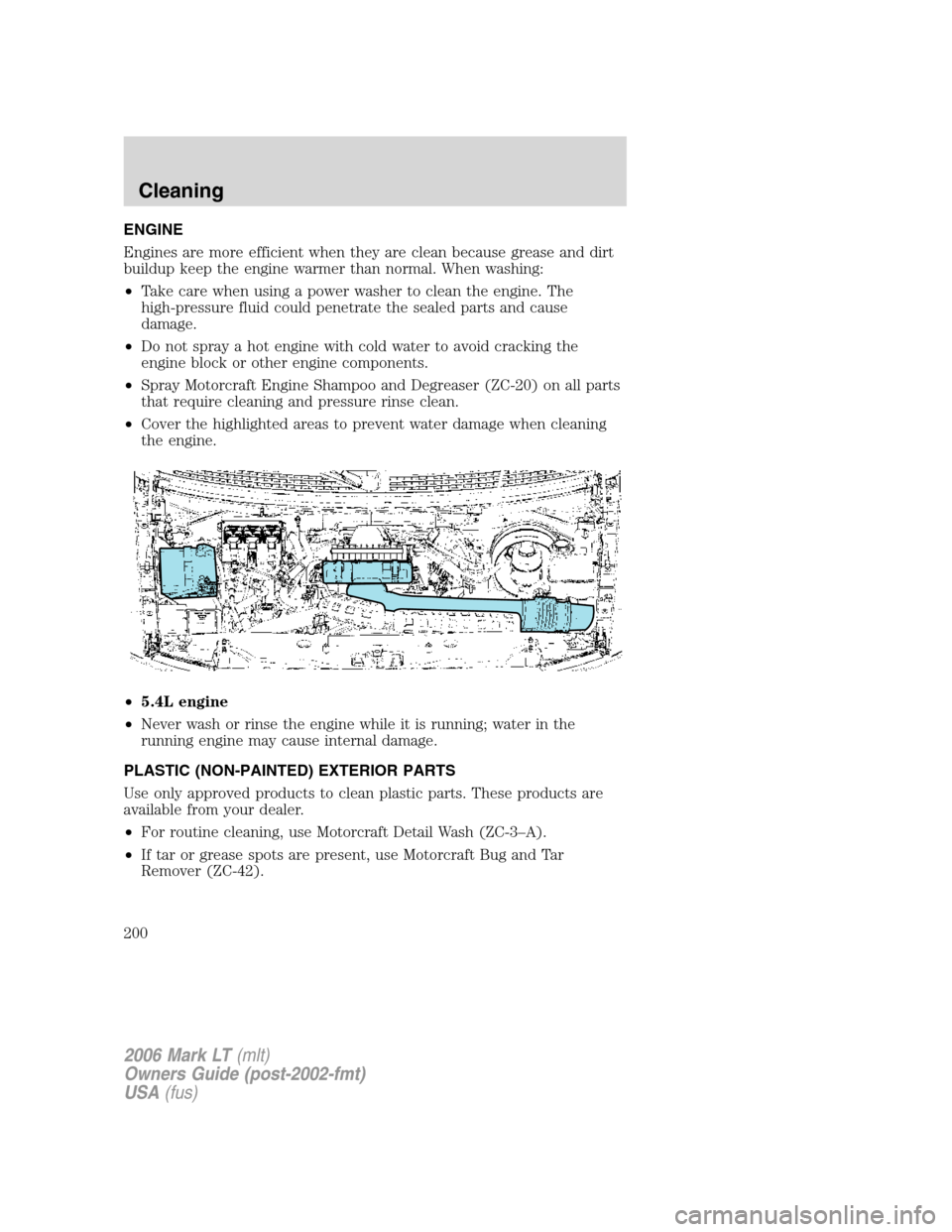
•Cover the highlighted areas to prevent water damage when cleaning
the engine.
•5.4L engine
•Never wash or rinse the engine while it is running; water in the
running engine may cause internal damage.
PLASTIC (NON-PAINTED) EXTERIOR PARTS
Use only approved products to clean plastic parts. These products are
available from your dealer.
•For routine cleaning, use Motorcraft Detail Wash (ZC-3–A).
•If tar or grease spots are present, use Motorcraft Bug and Tar
Remover (ZC-42).
2006 Mark LT(mlt)
Owners Guide (post-2002-fmt)
USA(fus)
Cleaning
200
Page 204 of 256
SERVICE RECOMMENDATIONS
To help you service your vehicle:
•We highlight do-it-yourself items in the engine compartment for easy
location.
•We providescheduled maintenance informationwhich makes
tracking routine service easy.
If your vehicle requires professional service, your dealership can provide
the necessary parts and service. Check yourWarranty Guide/Owner
Information Guideto find out which parts and services are covered.
Use only recommended fuels, lubricants, fluids and service parts
conforming to specifications. Motorcraft parts are designed and built to
provide the best performance in your vehicle.
PRECAUTIONS WHEN SERVICING YOUR VEHICLE
•Do not work on a hot engine.
•Make sure that nothing gets caught in moving parts.
•Do not work on a vehicle with the engine running in an enclosed
space, unless you are sure you have enough ventilation.
•Keep all open flames and other burning (cigarettes) material away
from the battery and all fuel related parts.
Working with the engine off
1. Set the parking brake and shift to P (Park).
2. Turn off the engine and remove the key.
3. Block the wheels.
Working with the engine on
1. Set the parking brake and shift to P (Park).
2. Block the wheels.
Note:Do not start your engine with the air cleaner removed and do not
remove it while the engine is running.
2006 Mark LT(mlt)
Owners Guide (post-2002-fmt)
USA(fus)
Maintenance and Specifications
204
Page 209 of 256
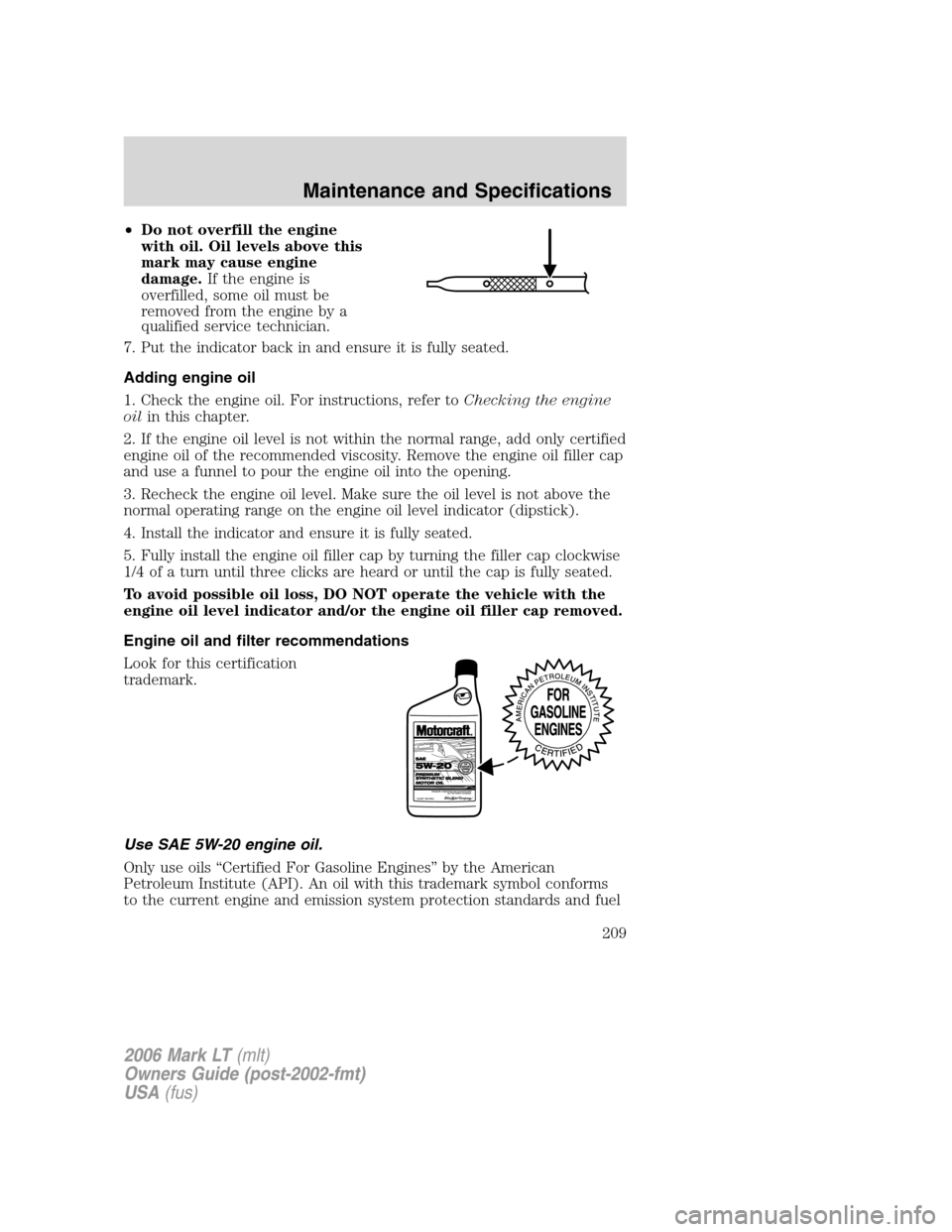
•Do not overfill the engine
with oil. Oil levels above this
mark may cause engine
damage.If the engine is
overfilled, some oil must be
removed from the engine by a
qualified service technician.
7. Put the indicator back in and ensure it is fully seated.
Adding engine oil
1. Check the engine oil. For instructions, refer toChecking the engine
oilin this chapter.
2. If the engine oil level is not within the normal range, add only certified
engine oil of the recommended viscosity. Remove the engine oil filler cap
and use a funnel to pour the engine oil into the opening.
3. Recheck the engine oil level. Make sure the oil level is not above the
normal operating range on the engine oil level indicator (dipstick).
4. Install the indicator and ensure it is fully seated.
5. Fully install the engine oil filler cap by turning the filler cap clockwise
1/4 of a turn until three clicks are heard or until the cap is fully seated.
To avoid possible oil loss, DO NOT operate the vehicle with the
engine oil level indicator and/or the engine oil filler cap removed.
Engine oil and filter recommendations
Look for this certification
trademark.
Use SAE 5W-20 engine oil.
Only use oils “Certified For Gasoline Engines” by the American
Petroleum Institute (API). An oil with this trademark symbol conforms
to the current engine and emission system protection standards and fuel
2006 Mark LT(mlt)
Owners Guide (post-2002-fmt)
USA(fus)
Maintenance and Specifications
209