Shift LINCOLN MARK LT 2008 User Guide
[x] Cancel search | Manufacturer: LINCOLN, Model Year: 2008, Model line: MARK LT, Model: LINCOLN MARK LT 2008Pages: 328, PDF Size: 3.17 MB
Page 211 of 328
Do not start your vehicle in a closed garage or in other enclosed
areas. Exhaust fumes can be toxic. Always open the garage door
before you start the engine. SeeGuarding against exhaust fumesin
this chapter for more instructions.
If you smell exhaust fumes inside your vehicle, have your dealer
inspect your vehicle immediately. Do not drive if you smell
exhaust fumes.
Important safety precautions
A computer system controls the engine’s idle revolutions per minute
(RPM). When the engine starts, the idle RPM runs higher than normal in
order to warm the engine. If the engine idle speed does not slow down
automatically, have the vehicle checked. If the vehicle is operated in a
heavy snow storm or blowing snow conditions, the engine air induction
may become partially clogged with snow and/or ice. If this occurs the
engine may experience a significant reduction in power output. At the
earliest opportunity, clear all snow and/or ice away from the air induction
inlet. Do not allow the vehicle to idle for more than 10 minutes at the
higher engine RPM.
Before starting the vehicle:
1. Make sure all vehicle occupants have buckled their safety belts. For
more information on safety belts and their proper usage, refer to the
Seating and Safety Restraintschapter.
2. Make sure the headlamps and vehicle accessories are off.
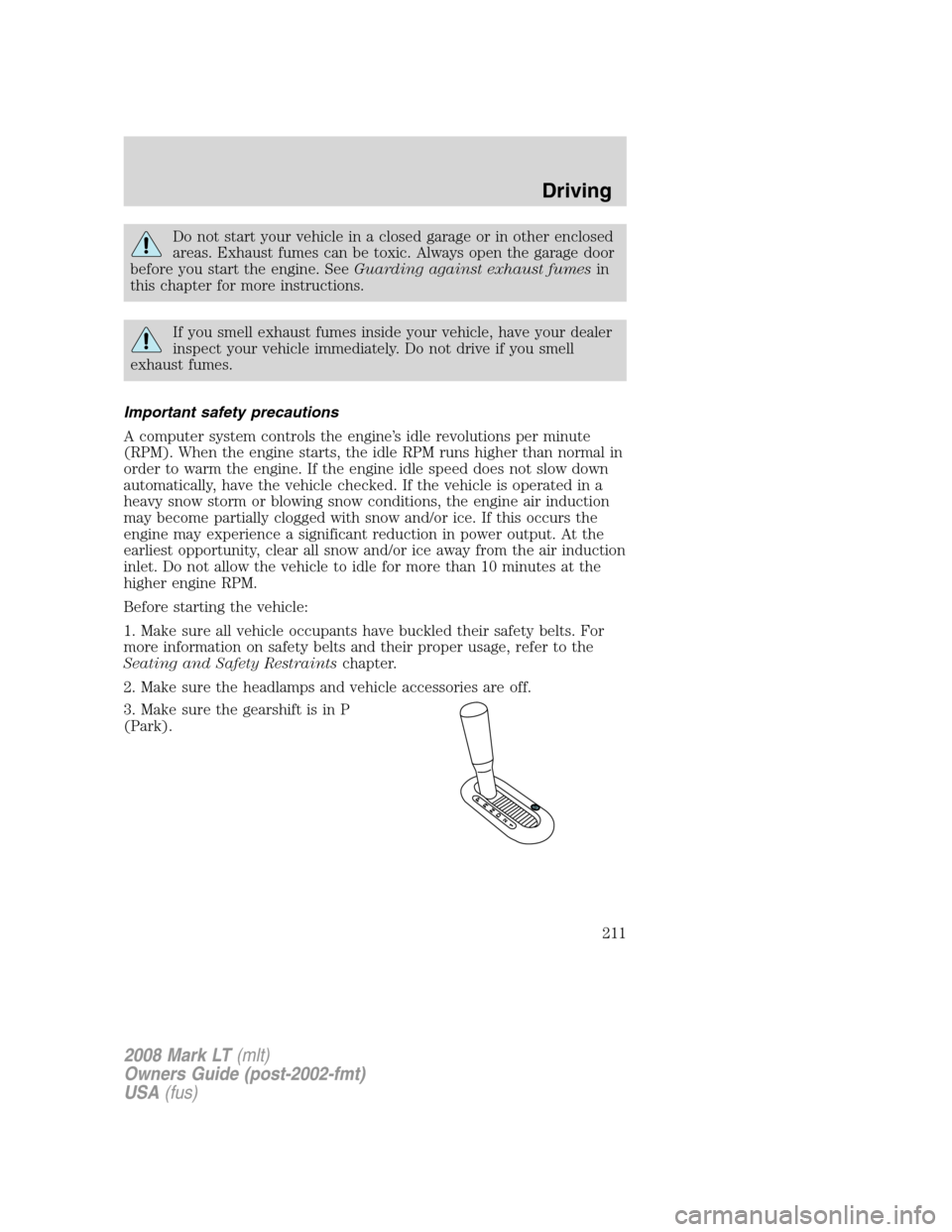
3. Make sure the gearshift is in P
(Park).
2008 Mark LT(mlt)
Owners Guide (post-2002-fmt)
USA(fus)
Driving
211
Page 216 of 328
Parking brake
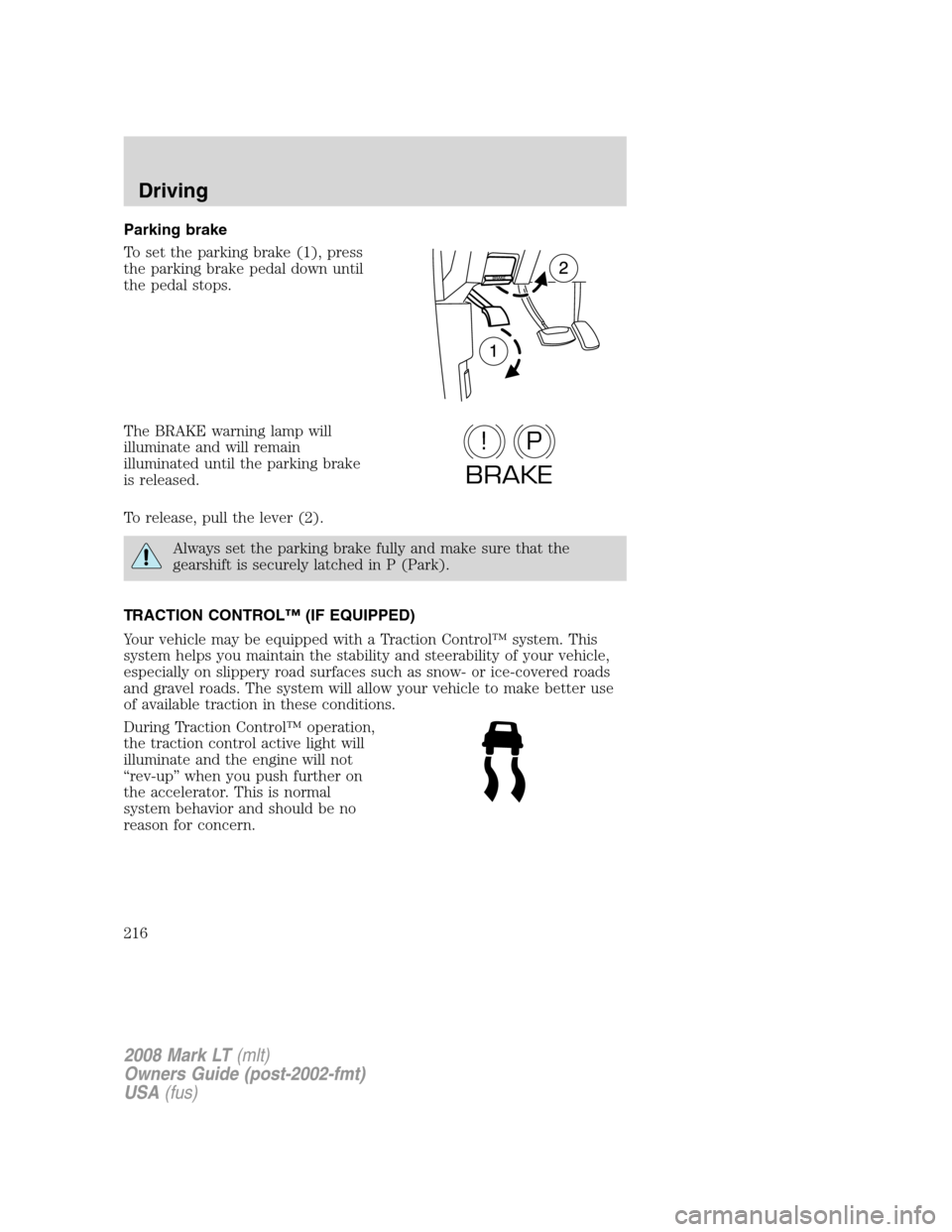
To set the parking brake (1), press
the parking brake pedal down until
the pedal stops.
The BRAKE warning lamp will
illuminate and will remain
illuminated until the parking brake
is released.
To release, pull the lever (2).
Always set the parking brake fully and make sure that the
gearshift is securely latched in P (Park).
TRACTION CONTROL™ (IF EQUIPPED)
Your vehicle may be equipped with a Traction Control™ system. This
system helps you maintain the stability and steerability of your vehicle,
especially on slippery road surfaces such as snow- or ice-covered roads
and gravel roads. The system will allow your vehicle to make better use
of available traction in these conditions.
During Traction Control™ operation,
the traction control active light will
illuminate and the engine will not
“rev-up” when you push further on
the accelerator. This is normal
system behavior and should be no
reason for concern.
P!
BRAKE
2008 Mark LT(mlt)
Owners Guide (post-2002-fmt)
USA(fus)
Driving
216
Page 219 of 328
Loaded vehicles, with a higher center of gravity, may handle
differently than unloaded vehicles. Do not overload your vehicle
and use extra precautions, such as driving at slower speeds, avoiding
abrupt steering changes and allowing for increased stopping distance,
when driving a heavily loaded vehicle. Over-loading or loading the
vehicle improperly can deteriorate handling capability and contribute
to loss of vehicle control and vehicle rollover.
AUTOMATIC TRANSMISSION OPERATION
Brake-shift interlock - floor-shift transmission
This vehicle is equipped with a brake-shift interlock feature that prevents
the gearshift lever from being moved from P (Park) when the ignition is
in the ON position unless the brake pedal is depressed.
If you cannot move the gearshift lever out of P (Park) with ignition in
the ON position and the brake pedal depressed, it is possible that a fuse
has blown or the vehicle’s brakelamps are not operating properly. Refer
toFuses and relaysin theRoadside Emergencieschapter.
If the fuse is not blown, perform the following procedure:
1. Apply the parking brake, turn the ignition to LOCK, then remove the
key.
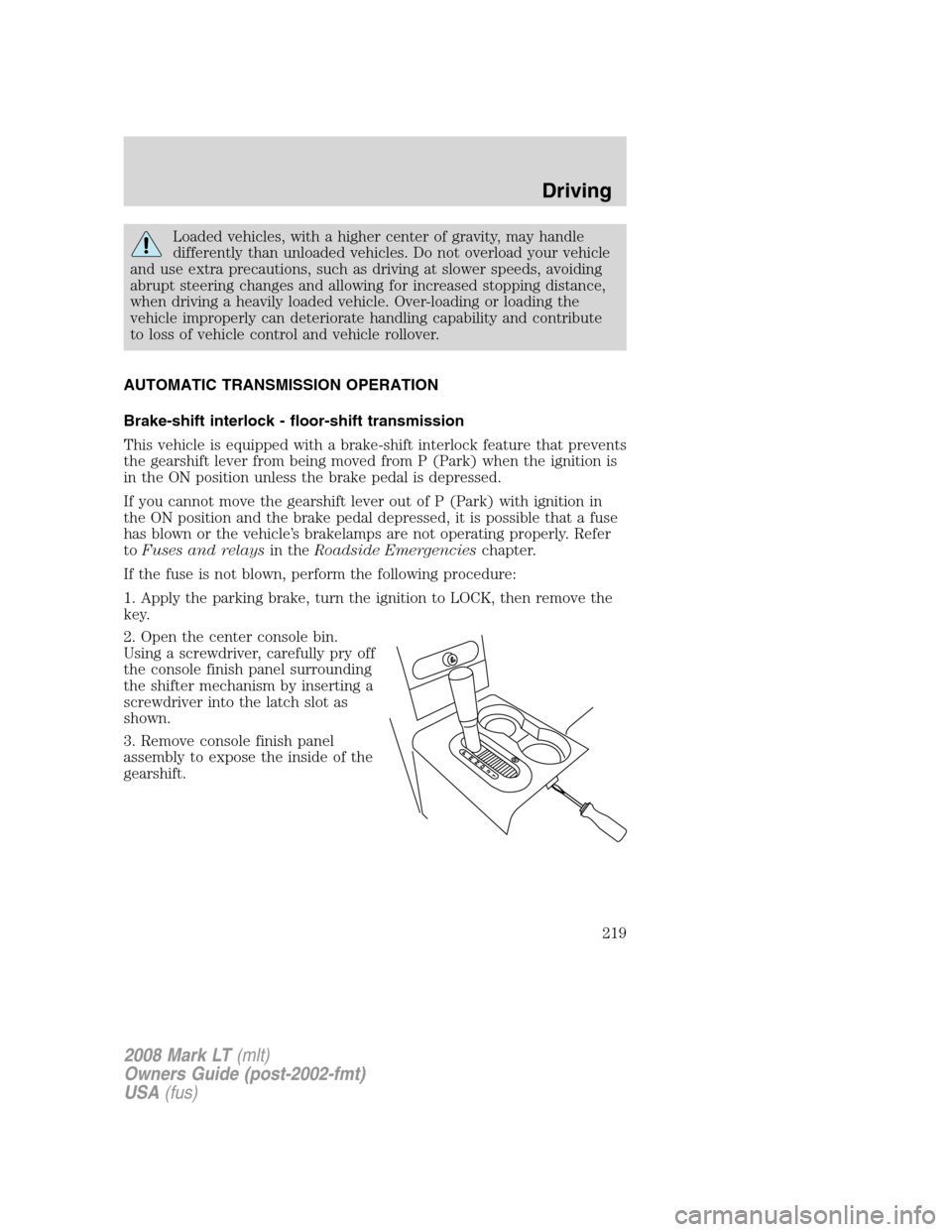
2. Open the center console bin.
Using a screwdriver, carefully pry off
the console finish panel surrounding
the shifter mechanism by inserting a
screwdriver into the latch slot as
shown.
3. Remove console finish panel
assembly to expose the inside of the
gearshift.
2008 Mark LT(mlt)
Owners Guide (post-2002-fmt)
USA(fus)
Driving
219
Page 220 of 328
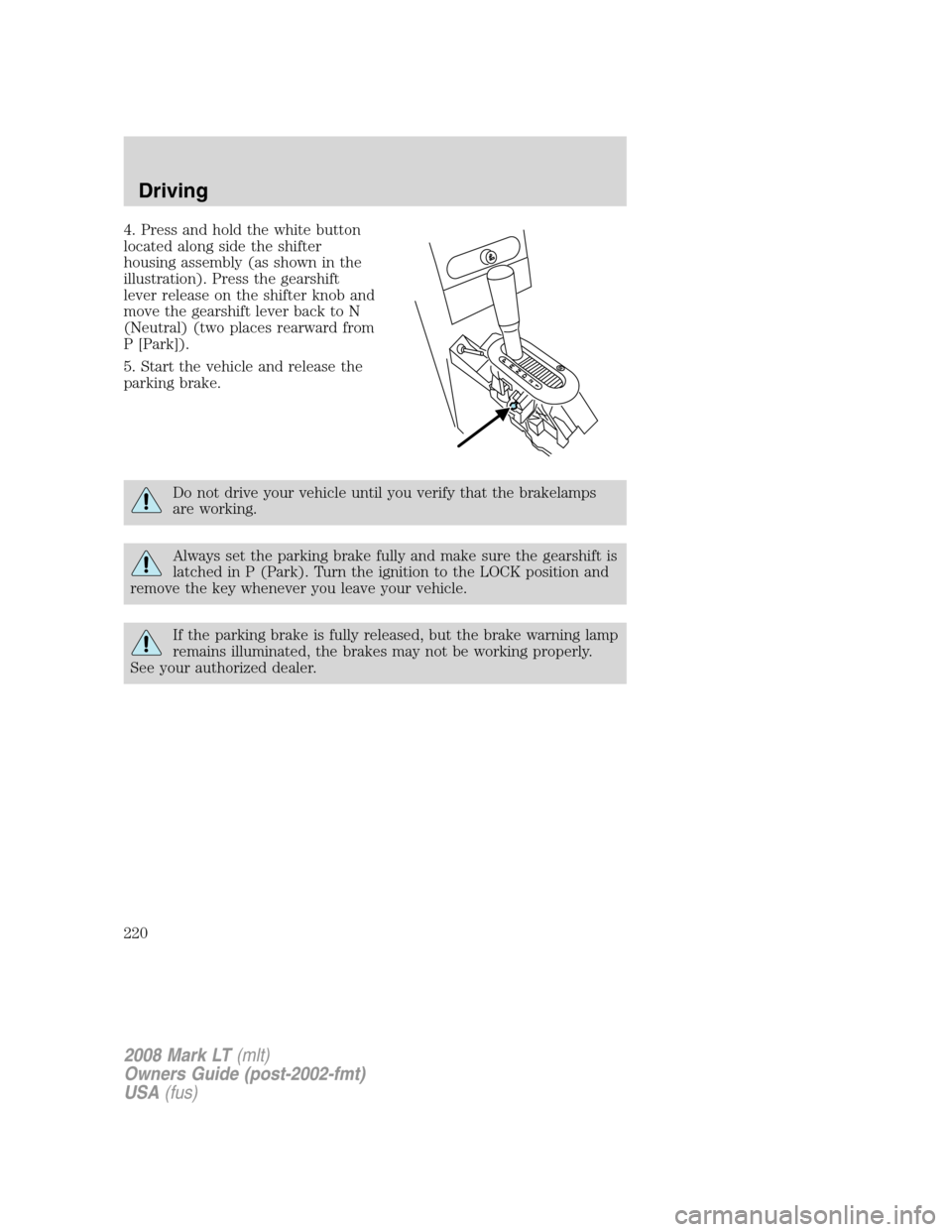
4. Press and hold the white button
located along side the shifter
housing assembly (as shown in the
illustration). Press the gearshift
lever release on the shifter knob and
move the gearshift lever back to N
(Neutral) (two places rearward from
P [Park]).
5. Start the vehicle and release the
parking brake.
Do not drive your vehicle until you verify that the brakelamps
are working.
Always set the parking brake fully and make sure the gearshift is
latched in P (Park). Turn the ignition to the LOCK position and
remove the key whenever you leave your vehicle.
If the parking brake is fully released, but the brake warning lamp
remains illuminated, the brakes may not be working properly.
See your authorized dealer.
2008 Mark LT(mlt)
Owners Guide (post-2002-fmt)
USA(fus)
Driving
220
Page 221 of 328
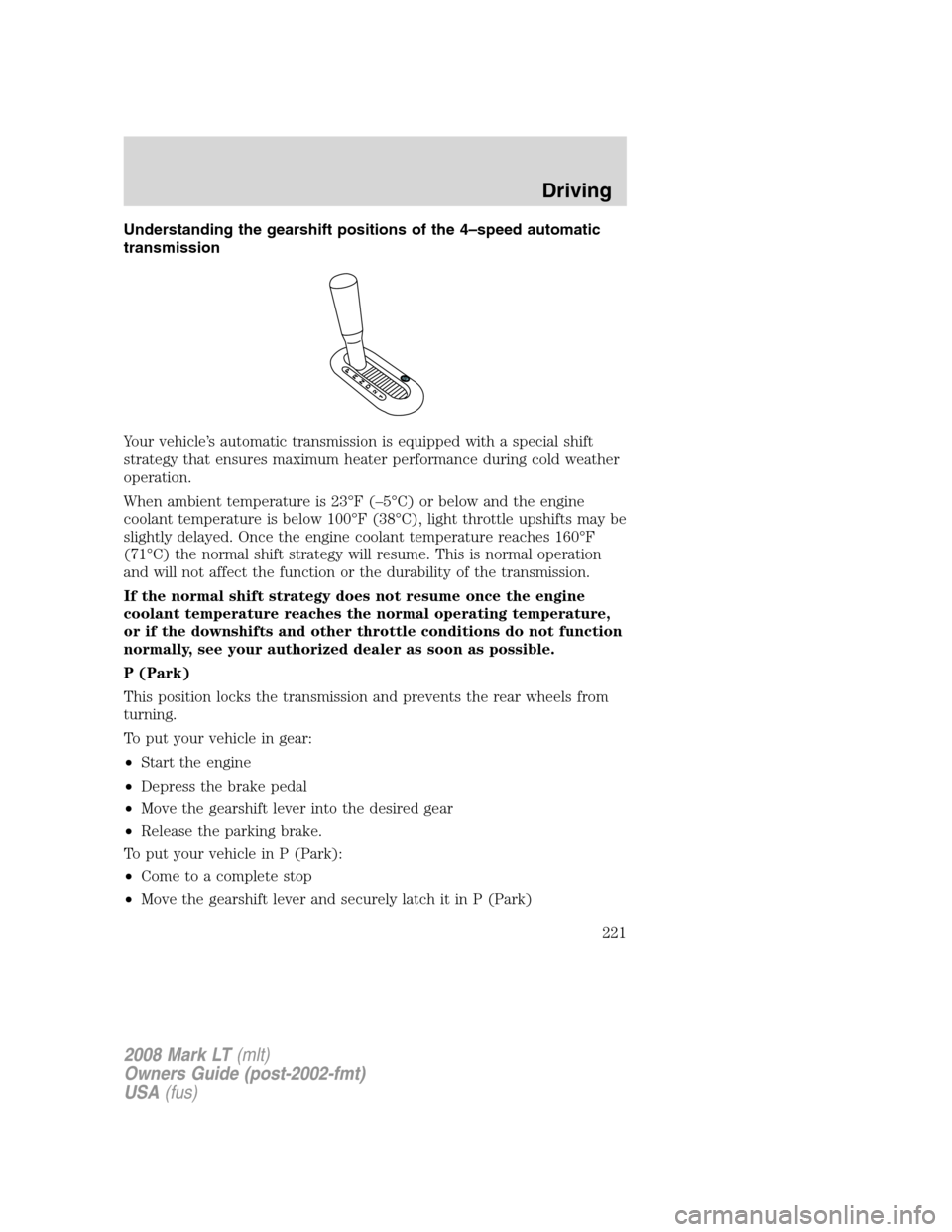
Understanding the gearshift positions of the 4–speed automatic
transmission
Your vehicle’s automatic transmission is equipped with a special shift
strategy that ensures maximum heater performance during cold weather
operation.
When ambient temperature is 23°F (–5°C) or below and the engine
coolant temperature is below 100°F (38°C), light throttle upshifts may be
slightly delayed. Once the engine coolant temperature reaches 160°F
(71°C) the normal shift strategy will resume. This is normal operation
and will not affect the function or the durability of the transmission.
If the normal shift strategy does not resume once the engine
coolant temperature reaches the normal operating temperature,
or if the downshifts and other throttle conditions do not function
normally, see your authorized dealer as soon as possible.
P (Park)
This position locks the transmission and prevents the rear wheels from
turning.
To put your vehicle in gear:
•Start the engine
•Depress the brake pedal
•Move the gearshift lever into the desired gear
•Release the parking brake.
To put your vehicle in P (Park):
•Come to a complete stop
•Move the gearshift lever and securely latch it in P (Park)
2008 Mark LT(mlt)
Owners Guide (post-2002-fmt)
USA(fus)
Driving
221
Page 222 of 328
Always set the parking brake fully and make sure the gearshift is
latched in P (Park). Turn the ignition to the LOCK position and
remove the key whenever you leave your vehicle.
R (Reverse)
With the gearshift lever in R (Reverse), the vehicle will move backward.
Always come to a complete stop before shifting into and out of R
(Reverse).
N (Neutral)
With the gearshift lever in N (Neutral), the vehicle can be started and is
free to roll. Hold the brake pedal down while in this position.
D (Overdrive)
The normal driving position for the best fuel economy. Transmission
operates in gears one through four.
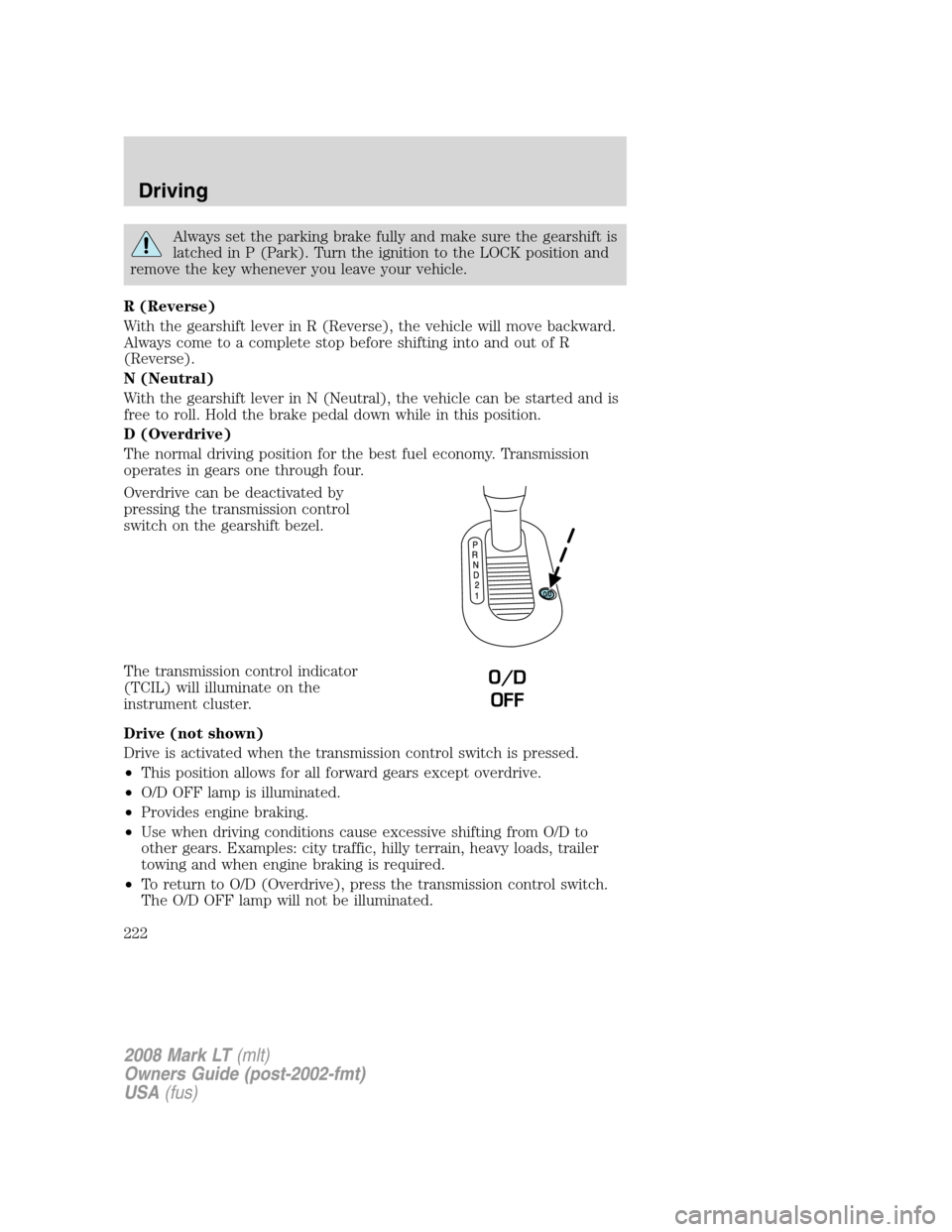
Overdrive can be deactivated by
pressing the transmission control
switch on the gearshift bezel.
The transmission control indicator
(TCIL) will illuminate on the
instrument cluster.
Drive (not shown)
Drive is activated when the transmission control switch is pressed.
•This position allows for all forward gears except overdrive.
•O/D OFF lamp is illuminated.
•Provides engine braking.
•Use when driving conditions cause excessive shifting from O/D to
other gears. Examples: city traffic, hilly terrain, heavy loads, trailer
towing and when engine braking is required.
•To return to O/D (Overdrive), press the transmission control switch.
The O/D OFF lamp will not be illuminated.
O/D
OFF
2008 Mark LT(mlt)
Owners Guide (post-2002-fmt)
USA(fus)
Driving
222
Page 223 of 328
•O/D (Overdrive) is automatically returned each time the key is turned
off.
2 (Second)
This position allows for second gear only.
•Provides engine braking.
•Use to start-up on slippery roads.
•To return to D (Overdrive), move the gearshift lever into the D
(Overdrive) position.
•Selecting 2 (Second) at higher speeds will cause the transmission to
downshift to second gear at the appropriate vehicle speed.
1 (First)
•Provides maximum engine braking.
•Allows upshifts by moving gearshift lever.
•Will not downshift into 1 (First) at high speeds; allows for 1 (First)
when vehicle reaches slower speeds.
Forced downshifts
•Allowed in D (Overdrive) or Drive.
•Depress the accelerator to the floor.
•Allows transmission to select an appropriate gear.
If your vehicle gets stuck in mud or snow
If your vehicle gets stuck in mud or snow, it may be rocked out by
shifting between forward and reverse gears, stopping between shifts in a
steady pattern. Press lightly on the accelerator in each gear.
Do not rock the vehicle if the engine is not at normal operating
temperature or damage to the transmission may occur.
Do not rock the vehicle for more than a minute or damage to the
transmission and tires may occur, or the engine may overheat.
2008 Mark LT(mlt)
Owners Guide (post-2002-fmt)
USA(fus)
Driving
223
Page 225 of 328
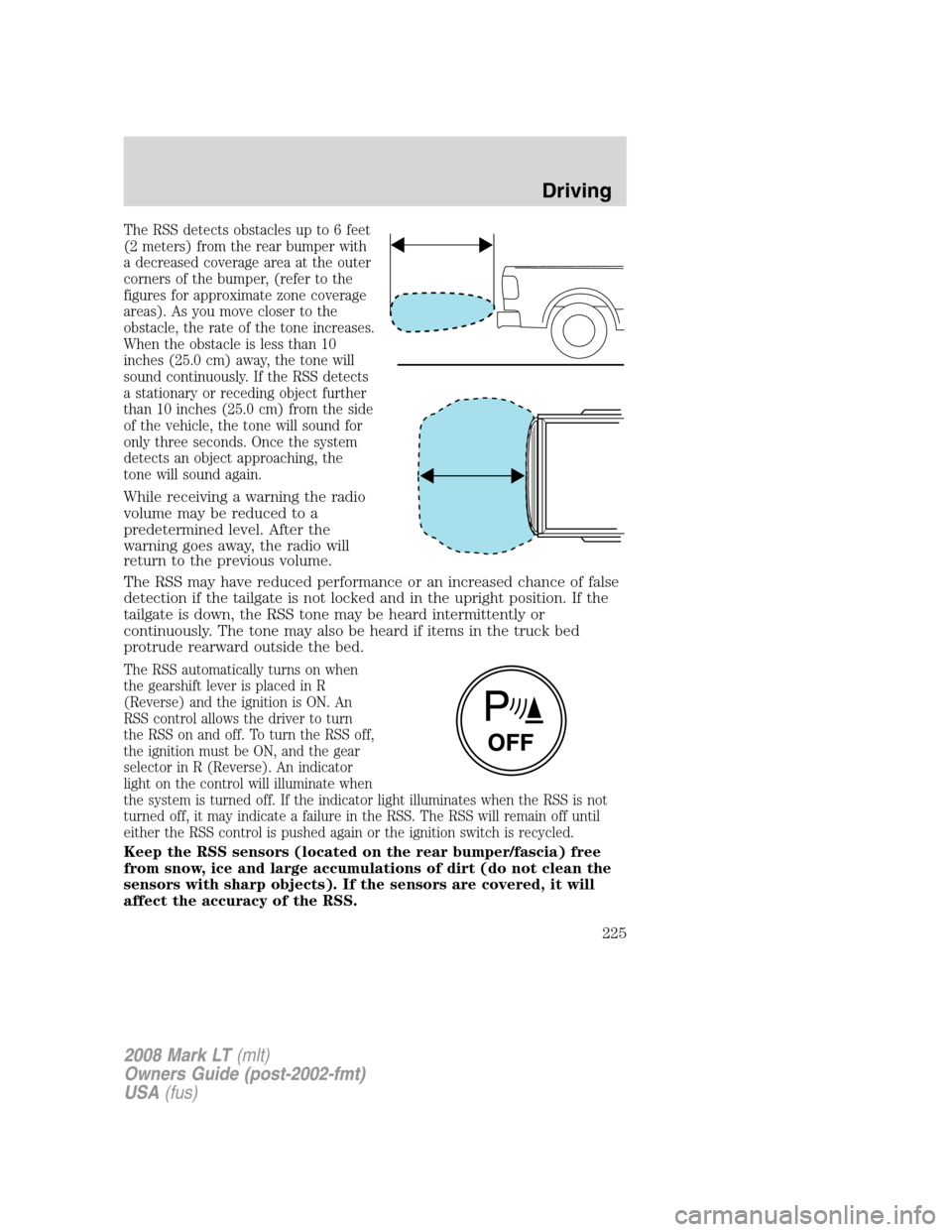
The RSS detects obstacles up to 6 feet
(2 meters) from the rear bumper with
a decreased coverage area at the outer
corners of the bumper, (refer to the
figures for approximate zone coverage
areas). As you move closer to the
obstacle, the rate of the tone increases.
When the obstacle is less than 10
inches (25.0 cm) away, the tone will
sound continuously. If the RSS detects
a stationary or receding object further
than 10 inches (25.0 cm) from the side
of the vehicle, the tone will sound for
only three seconds. Once the system
detects an object approaching, the
tone will sound again.
While receiving a warning the radio
volume may be reduced to a
predetermined level. After the
warning goes away, the radio will
return to the previous volume.
The RSS may have reduced performance or an increased chance of false
detection if the tailgate is not locked and in the upright position. If the
tailgate is down, the RSS tone may be heard intermittently or
continuously. The tone may also be heard if items in the truck bed
protrude rearward outside the bed.
The RSS automatically turns on when
the gearshift lever is placed in R
(Reverse) and the ignition is ON. An
RSS control allows the driver to turn
the RSS on and off. To turn the RSS off,
the ignition must be ON, and the gear
selector in R (Reverse). An indicator
light on the control will illuminate when
the system is turned off. If the indicator light illuminates when the RSS is not
turned off, it may indicate a failure in the RSS. The RSS will remain off until
either the RSS control is pushed again or the ignition switch is recycled.
Keep the RSS sensors (located on the rear bumper/fascia) free
from snow, ice and large accumulations of dirt (do not clean the
sensors with sharp objects). If the sensors are covered, it will
affect the accuracy of the RSS.
2008 Mark LT(mlt)
Owners Guide (post-2002-fmt)
USA(fus)
Driving
225
Page 227 of 328
Objects in the red zone are closest to your vehicle and objects in the
green zone are further away. Objects are getting closer to your vehicle as
they move from the green zone to the yellow or red zones.
Use the side mirrors and rear view mirror to get better coverage on both
sides and rear of the vehicle. When shifting out of reverse and into any
other gear, the image will remain on for a few seconds before it shuts off
to assist in parking or trailer hookup.
When towing, the reverse camera system will only see what is being
towed behind the vehicle; this might not provide adequate coverage as it
usually provides in normal operation and some objects might not be
seen.
The camera lens for the reverse camera system is located on the tailgate,
near the tailgate handle. Keep the lens clean so the video image remains
clear and undistorted. Clean the lens with a soft, lint-free cloth and
non-abrasive cleaner.
Note:If the reverse camera system image is not clear or seems
distorted, it may be covered with water droplets, snow, mud or any other
substance. If this occurs, clean the camera lens before using the reverse
camera system.
The reverse camera system is a reverse aid supplement device
that still requires the driver to use it in conjunction with the rear
view mirror and the side mirrors for maximum coverage.
Objects that are close to either corner of the bumper or under
the bumper, might not be seen on the screen due to the limited
coverage of the reverse camera system.
Backup as slow as possible since higher speeds might limit your
reaction time to stop the vehicle.
Do not use the reverse camera system with the tailgate open.
If the back end of the vehicle is hit or damaged, then check with your
authorized dealer to have your rear video system checked for proper
coverage and operation.
2008 Mark LT(mlt)
Owners Guide (post-2002-fmt)
USA(fus)
Driving
227
Page 228 of 328
Nighttime and dark area use
At night time or in dark areas, the reverse camera system relies on the
reverse lamp lighting to produce an image. Therefore it is necessary that
both reverse lamps are operating in order to get a clear image in the
dark. If either of the lamps are not operating, stop using the reverse
camera system, at least in the dark, until the lamp(s) are replaced and
functioning.
Servicing
•If the vehicle is in R (Reverse) and the screen in the rear view mirror
appears blue for three seconds and turns blank afterwards, the camera
is not working properly; have the system inspected by your authorized
dealer.
•If the image comes on while the vehicle is not in R (Reverse), have
the system inspected by your authorized dealer.
•If the vehicle is in R (Reverse) and the screen is blank and no blue
screen is observed, the mirror is not working properly; have the
system inspected by your authorized dealer.
•If the image is not clear, then check if there is anything covering the
lens such as dirt, mud, ice, snow, etc. If the image is still not clear
after cleaning, have your system inspected by your authorized dealer.
FOUR-WHEEL DRIVE (4WD) OPERATION (IF EQUIPPED)
For important information regarding safe operation of this type
of vehicle, seePreparing to drive your vehiclein this chapter.
Four–wheel drive (4WD) supplies power to all four wheels. 4WD should
not be operated on dry pavement; driveline damage may occur.
If equipped with the Electronic Shift 4WD System, and 4WD Low
is selected while the vehicle is moving above 3 mph (5
km/h), the 4WD system will not engage past 4WD High. This is
normal and should be no reason for concern.Refer toShifting
to/from 4L (4WD Low)for proper operation.
System indicator lights
•4X4 HI- Momentarily illuminates
when the engine is started.
Illuminates when 4H is selected.
4x4 HI
2008 Mark LT(mlt)
Owners Guide (post-2002-fmt)
USA(fus)
Driving
228