transmission LINCOLN MKC 2019 Workshop Manual
[x] Cancel search | Manufacturer: LINCOLN, Model Year: 2019, Model line: MKC, Model: LINCOLN MKC 2019Pages: 581, PDF Size: 5.41 MB
Page 253 of 581
Replace the rear axle lubricant anytime yousubmerge the rear axle in water. Water maycontaminate the rear axle lubricant, which isnot a normal maintenance inspection itemunless there is a possibility of a leak or otheraxle repair is required.
TOWING THE VEHICLE ON FOUR
WHEELS
Emergency Towing
WARNING: If your vehicle has asteering wheel lock make sure the ignitionis in the accessory or on position when beingtowed.
If your vehicle becomes inoperable (withoutaccess to wheel dollies, car-hauling trailer,or flatbed transport vehicle), it can beflat-towed (all wheels on the ground,regardless of the powertrain andtransmission configuration) under thefollowing conditions:
•Your vehicle is facing forward for towingin a forward direction.
•You place your vehicle in Stay in Neutralmode. See Automatic Transmission(page 177).
•Maximum speed is 35 mph (56 km/h).
•Maximum distance is 50 mi (80 km).
Recreational Towing
Note:Put your climate control system inrecirculated air mode to prevent exhaustfumes from entering the vehicle. SeeClimate Control (page 132).
Follow these guidelines if you have a needfor recreational (RV) towing. An example ofrecreational towing would be towing yourvehicle behind a motorhome. We designedthese guidelines to prevent damage to yourtransmission.
Front-wheel drive vehicles CANNOT beflat-towed (all wheels on the ground) asvehicle or transmission damage may occur.You must place the front wheels on atwo-wheel tow dolly. If you are using a towdolly, follow the instructions specified by theequipment provider.
All-wheel drive vehicles CANNOT beflat-towed (all wheels on the ground), asvehicle or transmission damage may occur.It is recommended to tow your vehicle withall four (4) wheels off the ground such aswhen using a car-hauling trailer. Otherwise,you cannot recreational tow your vehicle.
250
MKC (TME) Canada/United States of America, enUSA, Edition date: 201802, Second-Printing
Towing
Page 262 of 581
If you need to tow your vehicle, contact aprofessional towing service or, if you are amember of a roadside assistance program,your roadside assistance service provider.
We recommend the use of a wheel lift anddollies or flatbed equipment to tow yourvehicle. Do not tow with a slingbelt. LincolnMotor Company does not approve a slingbelttowing procedure. If you tow your vehicleincorrectly, or by any other means, vehicledamage may occur.
Lincoln Motor Company produces a towingmanual for all authorized tow truck operators.Have your tow truck operator refer to thismanual for proper hook-up and towingprocedures for your vehicle.
It is acceptable to have your front-wheeldrive vehicle towed from the front if usingproper wheel lift equipment to raise the frontwheels off the ground. When towing in thismanner, the rear wheels can remain on theground.
Front-wheel drive vehicles must have thefront wheels placed on a tow dolly whentowing your vehicle from the rear usingwheel lift equipment. This prevents damageto the transmission.
Towing an all-wheel drive vehicle requiresthat all wheels be off the ground, such asusing a wheel lift and dollies or flatbedequipment. This prevents damage to thetransmission, all-wheel drive system andvehicle.
259
MKC (TME) Canada/United States of America, enUSA, Edition date: 201802, Second-Printing
Roadside Emergencies
Page 274 of 581
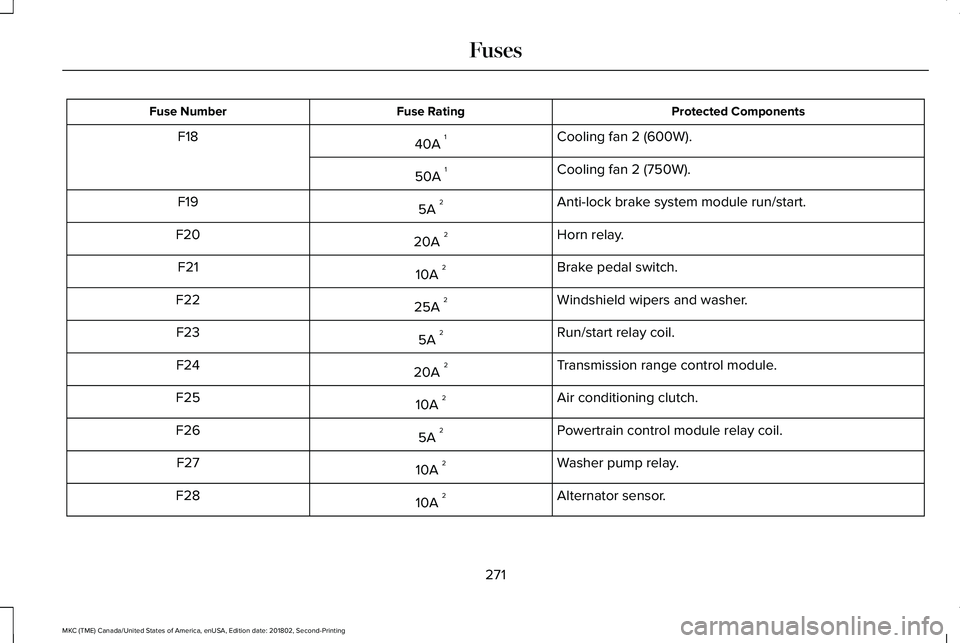
Protected ComponentsFuse RatingFuse Number
Cooling fan 2 (600W).40A 1F18
Cooling fan 2 (750W).50A 1
Anti-lock brake system module run/start.5A 2F19
Horn relay.20A 2F20
Brake pedal switch.10A 2F21
Windshield wipers and washer.25A 2F22
Run/start relay coil.5A 2F23
Transmission range control module.20A 2F24
Air conditioning clutch.10A 2F25
Powertrain control module relay coil.5A 2F26
Washer pump relay.10A 2F27
Alternator sensor.10A 2F28
271
MKC (TME) Canada/United States of America, enUSA, Edition date: 201802, Second-Printing
Fuses
Page 276 of 581
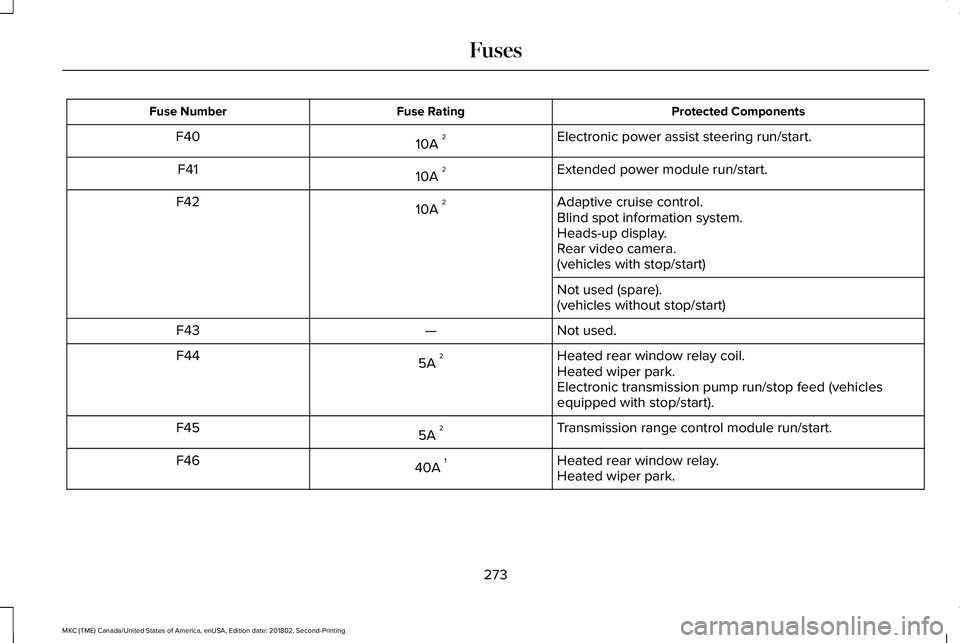
Protected ComponentsFuse RatingFuse Number
Electronic power assist steering run/start.10A 2F40
Extended power module run/start.10A 2F41
Adaptive cruise control.10A 2F42Blind spot information system.Heads-up display.Rear video camera.(vehicles with stop/start)
Not used (spare).(vehicles without stop/start)
Not used.—F43
Heated rear window relay coil.5A 2F44Heated wiper park.Electronic transmission pump run/stop feed (vehiclesequipped with stop/start).
Transmission range control module run/start.5A 2F45
Heated rear window relay.40A 1F46Heated wiper park.
273
MKC (TME) Canada/United States of America, enUSA, Edition date: 201802, Second-Printing
Fuses
Page 277 of 581
Protected ComponentsFuse RatingFuse Number
Electronic transmission pump B+ feed (vehicles equippedwith stop/start).30A 2F47
Not used.—F48
1 J-case fuse.2 Mini fuse.
Circuits switchedRelay
Run start.R1
Horn.R2
Fuel pump.R3
Rear window washer pump.R4
Cooling fan relay 3 (750W).R5
Windshield wipers.R6
Cooling fan relay 1 (600W).R7Cooling fan relay 5 (750W).
Starter.R8
Not used.R9
274
MKC (TME) Canada/United States of America, enUSA, Edition date: 201802, Second-Printing
Fuses
Page 290 of 581
GENERAL INFORMATION
Have your vehicle serviced regularly to helpmaintain its roadworthiness and resale value.There is a large network of authorizeddealers that are there to help you with theirprofessional servicing expertise. We believethat their specially trained technicians arebest qualified to service your vehicle properlyand expertly. They are supported by a widerange of highly specialized tools developedspecifically for servicing your vehicle.
If your vehicle requires professional service,an authorized dealer can provide thenecessary parts and service. Check yourwarranty information to find out which partsand services are covered.
Use only recommended fuels, lubricants,fluids and service parts conforming tospecifications. Motorcraft® parts aredesigned and built to provide the bestperformance in your vehicle.
Precautions
•Do not work on a hot engine.
•Make sure that nothing gets caught inmoving parts.
•Do not work on a vehicle with the enginerunning in an enclosed space, unless youare sure you have enough ventilation.
•Keep all open flames and other burningmaterial (such as cigarettes) away fromthe battery and all fuel related parts.
Working with the Engine Off
1. Set the parking brake and shift thetransmission to park (P).
2. Switch off the engine.
3. Block the wheels.
Working with the Engine On
WARNING: To reduce the risk ofvehicle damage and personal burn injuries,do not start your engine with the air cleanerremoved and do not remove it while theengine is running.
1. Set the parking brake and shift thetransmission to park (P).
2. Block the wheels.
OPENING AND CLOSING THE
HOOD
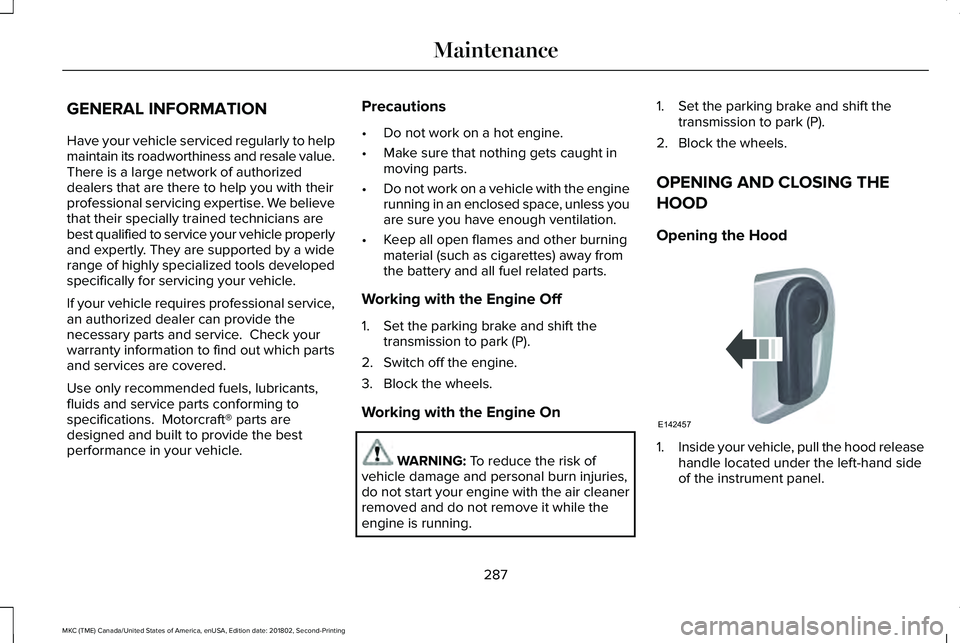
Opening the Hood
1.Inside your vehicle, pull the hood releasehandle located under the left-hand sideof the instrument panel.
287
MKC (TME) Canada/United States of America, enUSA, Edition date: 201802, Second-Printing
MaintenanceE142457
Page 293 of 581
Engine coolant reservoir. SeeEngine Coolant Check (page 292).A
Engine oil dipstick. See Engine OilDipstick (page 290).B
Engine oil filler cap. See EngineOil Check (page 290).C
Brake fluid reservoir. See BrakeFluid Check (page 296).D
Battery. See Changing the 12VBattery (page 297).E
Power distribution box. See Fuses(page 268).F
Air filter assembly. See Changingthe Engine Air Filter (page 302).G
Windshield washer fluid reservoir.See Washer Fluid Check (page296).
H
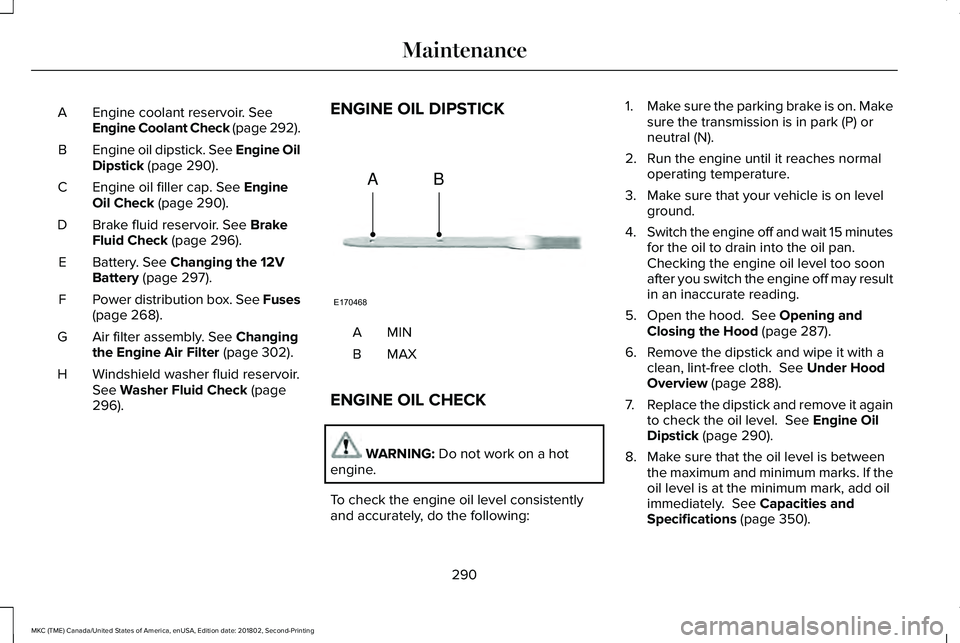
ENGINE OIL DIPSTICK
MINA
MAXB
ENGINE OIL CHECK
WARNING: Do not work on a hotengine.
To check the engine oil level consistentlyand accurately, do the following:
1.Make sure the parking brake is on. Makesure the transmission is in park (P) orneutral (N).
2. Run the engine until it reaches normaloperating temperature.
3. Make sure that your vehicle is on levelground.
4.Switch the engine off and wait 15 minutesfor the oil to drain into the oil pan. Checking the engine oil level too soonafter you switch the engine off may resultin an inaccurate reading.
5. Open the hood. See Opening andClosing the Hood (page 287).
6. Remove the dipstick and wipe it with aclean, lint-free cloth. See Under HoodOverview (page 288).
7.Replace the dipstick and remove it againto check the oil level. See Engine OilDipstick (page 290).
8. Make sure that the oil level is betweenthe maximum and minimum marks. If theoil level is at the minimum mark, add oilimmediately. See Capacities andSpecifications (page 350).
290
MKC (TME) Canada/United States of America, enUSA, Edition date: 201802, Second-Printing
MaintenanceE170468
AB
Page 299 of 581
AUTOMATIC TRANSMISSION
FLUID CHECK
The automatic transmission does not havea transmission fluid dipstick.
The automatic transmission does notconsume fluid. However, the fluid levelshould be checked if the transmission is notworking properly, for example if thetransmission slips or shifts slowly or if younotice some sign of fluid leakage.
Note:Transmission fluid should be checkedby an authorized dealer. If required, fluidshould be added by an authorized dealer.
Do not use supplemental transmission fluidadditives, treatments or cleaning agents. Theuse of these materials may affecttransmission operation and result in damageto internal transmission components.
BRAKE FLUID CHECK
WARNING: Do not use any fluid otherthan the recommended brake fluid as thiswill reduce brake efficiency. Use of incorrectfluid could result in the loss of vehiclecontrol, serious personal injury or death.
WARNING: Only use brake fluid froma sealed container. Contamination with dirt,water, petroleum products or other materialsmay result in brake system damage or failure.Failure to adhere to this warning could resultin the loss of vehicle control, seriouspersonal injury or death.
WARNING: Do not allow the fluid totouch your skin or eyes. If this happens, rinsethe affected areas immediately with plentyof water and contact your physician.
WARNING: A fluid level between theMAX and MIN lines is within the normaloperating range and there is no need to addfluid. A fluid level not in the normal operatingrange could compromise the performanceof the system. Have your vehicle checkedimmediately.
To avoid fluid contamination, the reservoircap must remain in place and fully tight,unless you are adding fluid.
Only use fluid that meets Ford specifications.See Capacities and Specifications (page344).
WASHER FLUID CHECK
WARNING: If you operate your vehiclein temperatures below 41.0°F (5°C), usewasher fluid with antifreeze protection.Failure to use washer fluid with antifreezeprotection in cold weather could result inimpaired windshield vision and increase therisk of injury or accident.
296
MKC (TME) Canada/United States of America, enUSA, Edition date: 201802, Second-Printing
Maintenance
Page 342 of 581
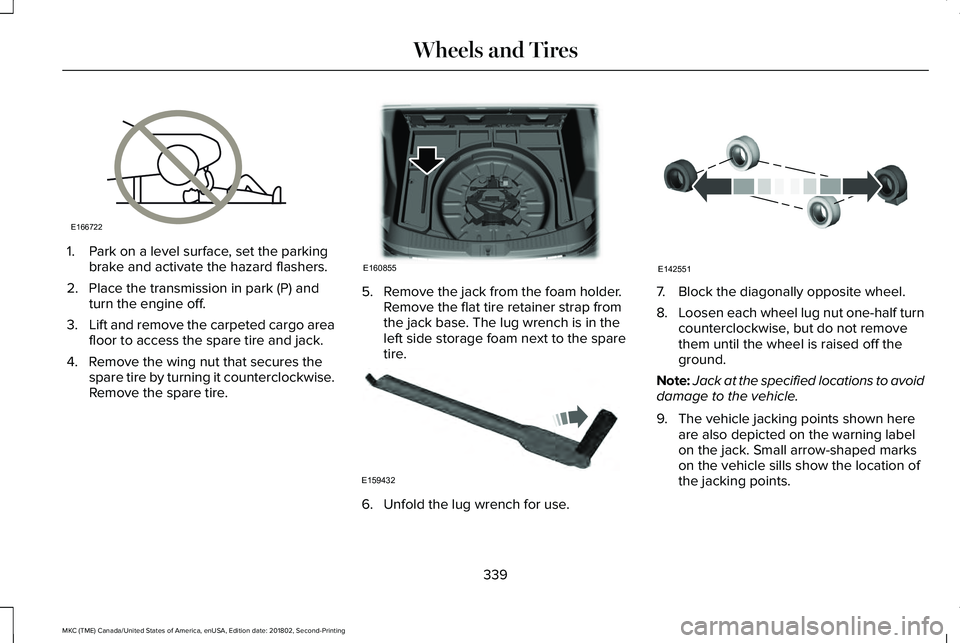
1. Park on a level surface, set the parkingbrake and activate the hazard flashers.
2. Place the transmission in park (P) andturn the engine off.
3.Lift and remove the carpeted cargo areafloor to access the spare tire and jack.
4. Remove the wing nut that secures thespare tire by turning it counterclockwise.Remove the spare tire.
5. Remove the jack from the foam holder.Remove the flat tire retainer strap fromthe jack base. The lug wrench is in theleft side storage foam next to the sparetire.
6. Unfold the lug wrench for use.
7. Block the diagonally opposite wheel.
8.Loosen each wheel lug nut one-half turncounterclockwise, but do not removethem until the wheel is raised off theground.
Note:Jack at the specified locations to avoiddamage to the vehicle.
9. The vehicle jacking points shown hereare also depicted on the warning labelon the jack. Small arrow-shaped markson the vehicle sills show the location ofthe jacking points.
339
MKC (TME) Canada/United States of America, enUSA, Edition date: 201802, Second-Printing
Wheels and TiresE166722 E160855 E159432 E142551
Page 352 of 581
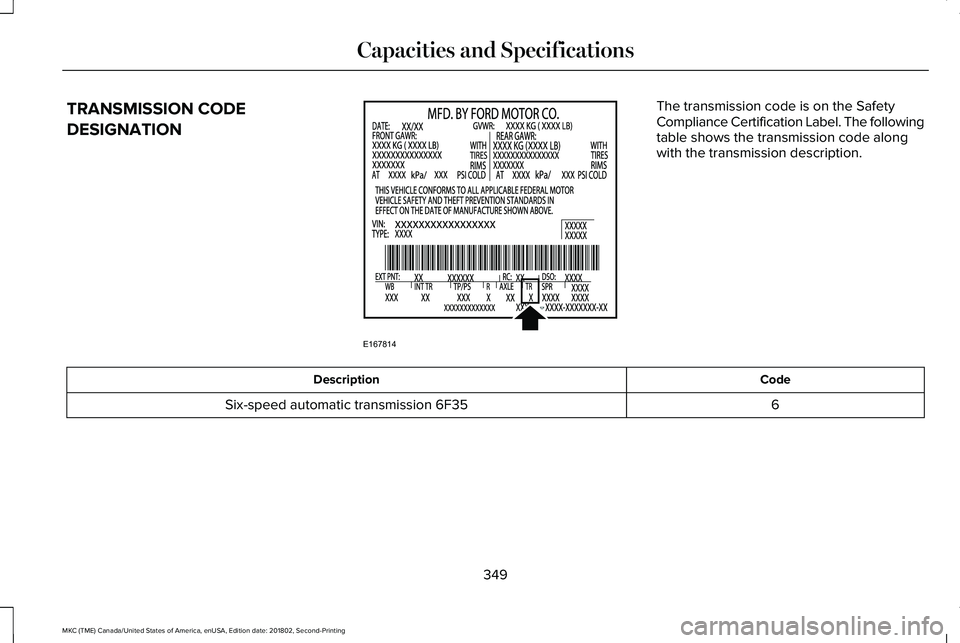
TRANSMISSION CODE
DESIGNATION
The transmission code is on the SafetyCompliance Certification Label. The followingtable shows the transmission code alongwith the transmission description.
CodeDescription
6Six-speed automatic transmission 6F35
349
MKC (TME) Canada/United States of America, enUSA, Edition date: 201802, Second-Printing
Capacities and SpecificationsE167814