spare wheel LINCOLN MKC 2019 Owners Manual
[x] Cancel search | Manufacturer: LINCOLN, Model Year: 2019, Model line: MKC, Model: LINCOLN MKC 2019Pages: 581, PDF Size: 5.41 MB
Page 119 of 581
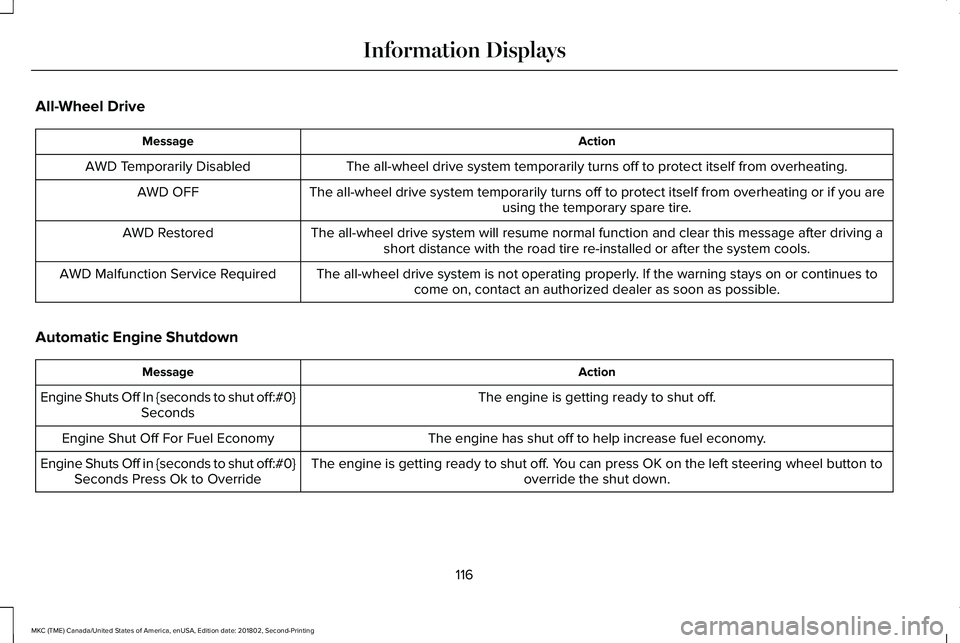
All-Wheel Drive
ActionMessage
The all-wheel drive system temporarily turns off to protect itself from overheating.AWD Temporarily Disabled
The all-wheel drive system temporarily turns off to protect itself from overheating or if you areusing the temporary spare tire.AWD OFF
The all-wheel drive system will resume normal function and clear this message after driving ashort distance with the road tire re-installed or after the system cools.AWD Restored
The all-wheel drive system is not operating properly. If the warning stays on or continues tocome on, contact an authorized dealer as soon as possible.AWD Malfunction Service Required
Automatic Engine Shutdown
ActionMessage
The engine is getting ready to shut off.Engine Shuts Off In {seconds to shut off:#0}Seconds
The engine has shut off to help increase fuel economy.Engine Shut Off For Fuel Economy
The engine is getting ready to shut off. You can press OK on the left steering wheel button tooverride the shut down.Engine Shuts Off in {seconds to shut off:#0}Seconds Press Ok to Override
116
MKC (TME) Canada/United States of America, enUSA, Edition date: 201802, Second-Printing
Information Displays
Page 186 of 581
USING ALL-WHEEL DRIVE
Note:When a system malfunction is present,a warning message appears in theinformation display. See InformationMessages (page 113). This means the systemis not functioning correctly and onlyfront-wheel drive is available. Have yourvehicle checked by an authorized dealer.
Note:When the system overheats andswitches to front-wheel drive, a warningmessage appears in the information display.This may occur if you operate your vehiclein extreme high load conditions or withexcessive wheel spin (for example, deepsand). To resume all-wheel drive function,stop your vehicle in a safe location and turnoff the ignition. When the system cools,normal all-wheel drive function will return.The information display indicates, for aboutfive seconds, this return.
Note:When using the spare tire, a warningmessage may appear in the informationdisplay. This message turns off afterreinstalling the repaired or replaced roadtire and you switch on the ignition.
Note:Re-install the repaired tire or replacethe tire as soon as possible. Different tiresizes between the front and rear axles cancause system damage, or turn off theall-wheel drive.
This system anticipates wheel spin andtransfers power to the rear wheels beforethe spin occurs. Even when wheel spin is notoccurring, the system is continuouslyadjusting power distribution to the wheels,in an attempt to improve straight line andcornering, both on and off road.
The system automatically turns on every timeyou switch on the ignition.
The all-wheel drive system does not requiremaintenance.
The all-wheel drive system gives your vehiclesome limited off-road capabilities. Operatingyour vehicle in conditions other thanmoderate sand, snow, mud or rough roadscould subject it to excessive stress and heat.This could result in system damage. Yourvehicle warranty will not cover this damage.
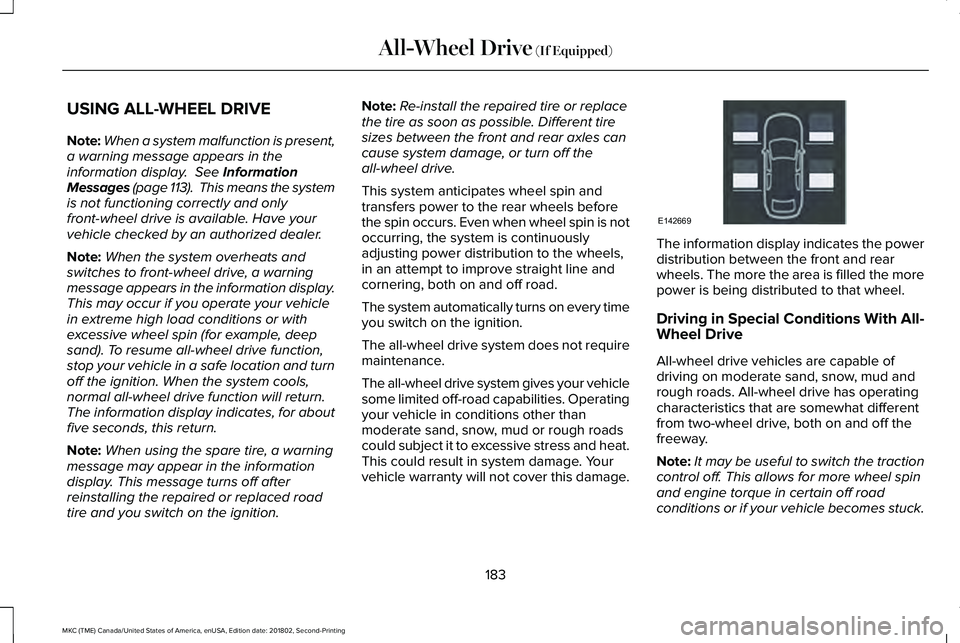
The information display indicates the powerdistribution between the front and rearwheels. The more the area is filled the morepower is being distributed to that wheel.
Driving in Special Conditions With All-Wheel Drive
All-wheel drive vehicles are capable ofdriving on moderate sand, snow, mud andrough roads. All-wheel drive has operatingcharacteristics that are somewhat differentfrom two-wheel drive, both on and off thefreeway.
Note:It may be useful to switch the tractioncontrol off. This allows for more wheel spinand engine torque in certain off roadconditions or if your vehicle becomes stuck.
183
MKC (TME) Canada/United States of America, enUSA, Edition date: 201802, Second-Printing
All-Wheel Drive (If Equipped)E142669
Page 203 of 581
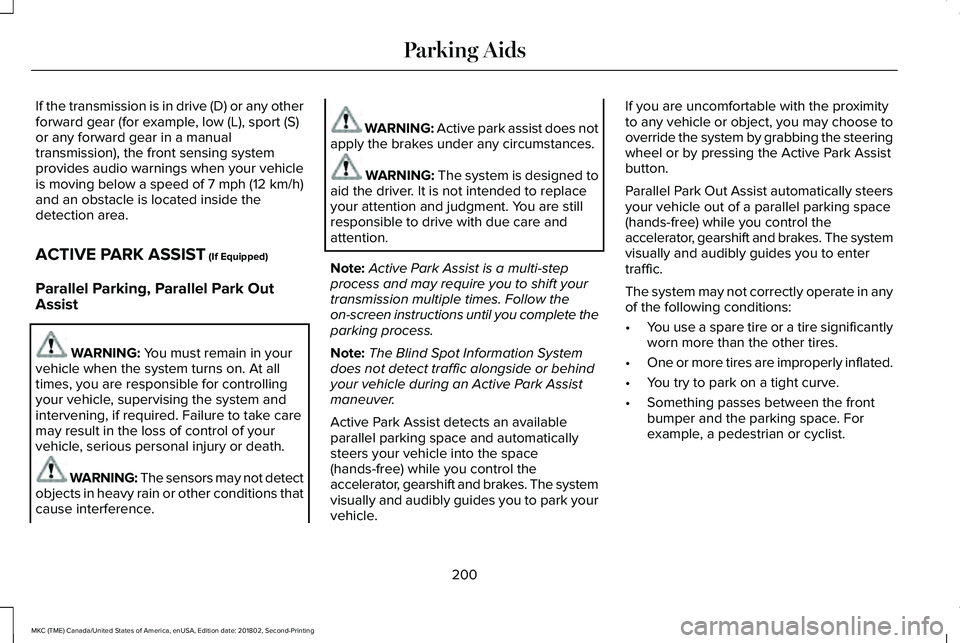
If the transmission is in drive (D) or any otherforward gear (for example, low (L), sport (S)or any forward gear in a manualtransmission), the front sensing systemprovides audio warnings when your vehicleis moving below a speed of 7 mph (12 km/h)and an obstacle is located inside thedetection area.
ACTIVE PARK ASSIST (If Equipped)
Parallel Parking, Parallel Park OutAssist
WARNING: You must remain in yourvehicle when the system turns on. At alltimes, you are responsible for controllingyour vehicle, supervising the system andintervening, if required. Failure to take caremay result in the loss of control of yourvehicle, serious personal injury or death.
WARNING: The sensors may not detectobjects in heavy rain or other conditions thatcause interference.
WARNING: Active park assist does notapply the brakes under any circumstances.
WARNING: The system is designed toaid the driver. It is not intended to replaceyour attention and judgment. You are stillresponsible to drive with due care andattention.
Note:Active Park Assist is a multi-stepprocess and may require you to shift yourtransmission multiple times. Follow theon-screen instructions until you complete theparking process.
Note:The Blind Spot Information Systemdoes not detect traffic alongside or behindyour vehicle during an Active Park Assistmaneuver.
Active Park Assist detects an availableparallel parking space and automaticallysteers your vehicle into the space(hands-free) while you control theaccelerator, gearshift and brakes. The systemvisually and audibly guides you to park yourvehicle.
If you are uncomfortable with the proximityto any vehicle or object, you may choose tooverride the system by grabbing the steeringwheel or by pressing the Active Park Assistbutton.
Parallel Park Out Assist automatically steersyour vehicle out of a parallel parking space(hands-free) while you control theaccelerator, gearshift and brakes. The systemvisually and audibly guides you to entertraffic.
The system may not correctly operate in anyof the following conditions:
•You use a spare tire or a tire significantlyworn more than the other tires.
•One or more tires are improperly inflated.
•You try to park on a tight curve.
•Something passes between the frontbumper and the parking space. Forexample, a pedestrian or cyclist.
200
MKC (TME) Canada/United States of America, enUSA, Edition date: 201802, Second-Printing
Parking Aids
Page 283 of 581
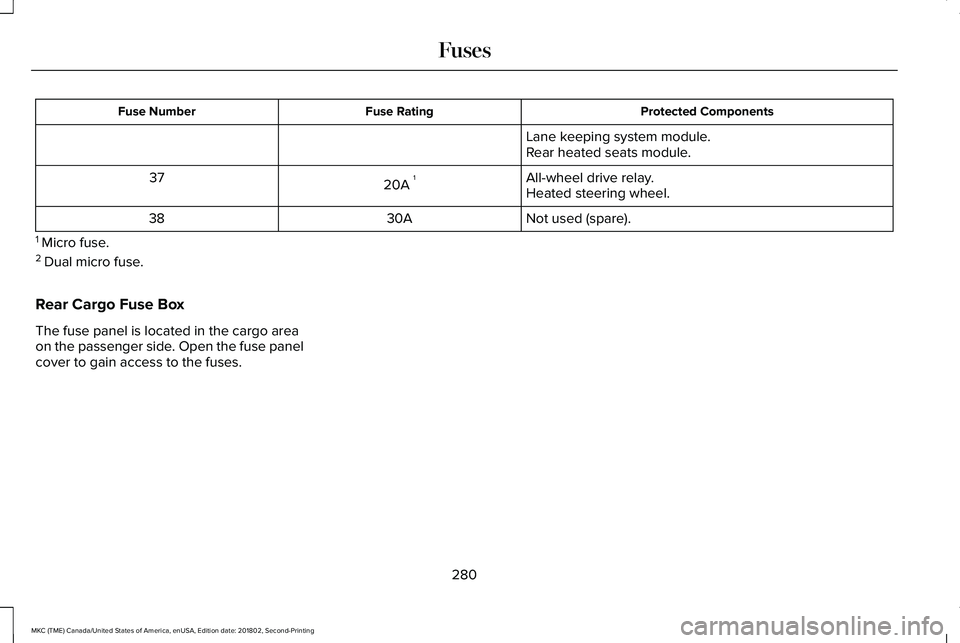
Protected ComponentsFuse RatingFuse Number
Lane keeping system module.Rear heated seats module.
All-wheel drive relay.20A 137Heated steering wheel.
Not used (spare).30A38
1 Micro fuse.2 Dual micro fuse.
Rear Cargo Fuse Box
The fuse panel is located in the cargo areaon the passenger side. Open the fuse panelcover to gain access to the fuses.
280
MKC (TME) Canada/United States of America, enUSA, Edition date: 201802, Second-Printing
Fuses
Page 318 of 581
GENERAL INFORMATION
The recommended tire inflation pressuresare found on the Tire Label which is locatedon the B-pillar or the edge of the driver door.This information can also be found on theSafety Compliance Certification Label, affixedto either the door hinge pillar, door-latchpost, or the door edge that meets thedoor-latch post; next to the driver’s seatingposition.
We strongly recommend maintaining thesetire pressures at all times. Failure to followthe tire pressure recommendations cancause uneven treadwear patterns, reducedfuel economy, and adversely affect the wayyour vehicle handles.
Note:Check and set the tire pressure at theambient temperature in which you areintending to drive your vehicle and when thetires are cold.
Note:Check your tire pressures at least onceper month.
If your vehicle has a spare tire, set thepressure to the highest value given for yourvehicle and tire size combination.
Use only approved wheels and tire sizes,using other sizes could damage your vehicle.
If you change the diameter of the factoryinstalled tires, the speedometer may notdisplay the correct speed. Take your vehicleto an authorized dealer and have the enginemanagement system reprogrammed.
If you intend to change the size of the factoryinstalled tires, check the suitability with anauthorized dealer.
Additional information related to thefunctionality and maintenance of your tirescan be found in the Wheels and Tire section.See Tire Care (page 318).
Notice to utility vehicle and truckowners
WARNING: Vehicles with a highercenter of gravity (utility and four-wheel drivevehicles) handle differently than vehicles witha lower center of gravity (passenger cars).Avoid sharp turns, excessive speed andabrupt steering in these vehicles. Failure todrive cautiously increases the risk of losingcontrol of your vehicle, vehicle rollover,personal injury and death.
WARNING: In a rollover crash, anunbelted person is significantly more likelyto die than a person wearing a seatbelt.
315
MKC (TME) Canada/United States of America, enUSA, Edition date: 201802, Second-Printing
Wheels and Tires
Page 319 of 581
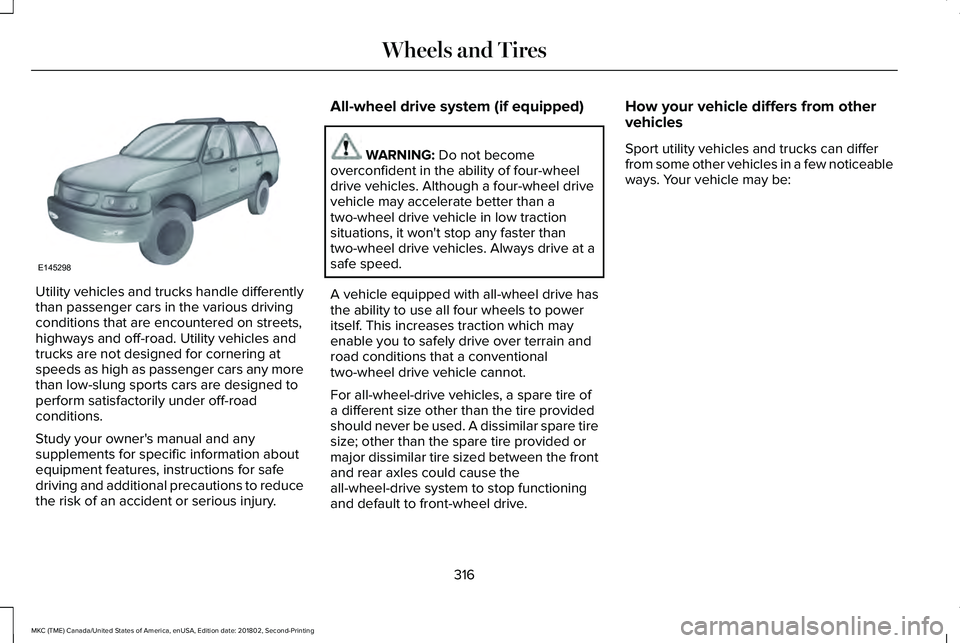
Utility vehicles and trucks handle differentlythan passenger cars in the various drivingconditions that are encountered on streets,highways and off-road. Utility vehicles andtrucks are not designed for cornering atspeeds as high as passenger cars any morethan low-slung sports cars are designed toperform satisfactorily under off-roadconditions.
Study your owner's manual and anysupplements for specific information aboutequipment features, instructions for safedriving and additional precautions to reducethe risk of an accident or serious injury.
All-wheel drive system (if equipped)
WARNING: Do not becomeoverconfident in the ability of four-wheeldrive vehicles. Although a four-wheel drivevehicle may accelerate better than atwo-wheel drive vehicle in low tractionsituations, it won't stop any faster thantwo-wheel drive vehicles. Always drive at asafe speed.
A vehicle equipped with all-wheel drive hasthe ability to use all four wheels to poweritself. This increases traction which mayenable you to safely drive over terrain androad conditions that a conventionaltwo-wheel drive vehicle cannot.
For all-wheel-drive vehicles, a spare tire ofa different size other than the tire providedshould never be used. A dissimilar spare tiresize; other than the spare tire provided ormajor dissimilar tire sized between the frontand rear axles could cause theall-wheel-drive system to stop functioningand default to front-wheel drive.
How your vehicle differs from othervehicles
Sport utility vehicles and trucks can differfrom some other vehicles in a few noticeableways. Your vehicle may be:
316
MKC (TME) Canada/United States of America, enUSA, Edition date: 201802, Second-Printing
Wheels and TiresE145298
Page 321 of 581
As a result of the above dimensionaldifferences, Sport utility vehicles and trucksoften have a higher center of gravity and agreater difference in center of gravitybetween the loaded and unloaded condition.These differences that make your vehicle soversatile also make it handle differently thanan ordinary passenger car.
TIRE CARE
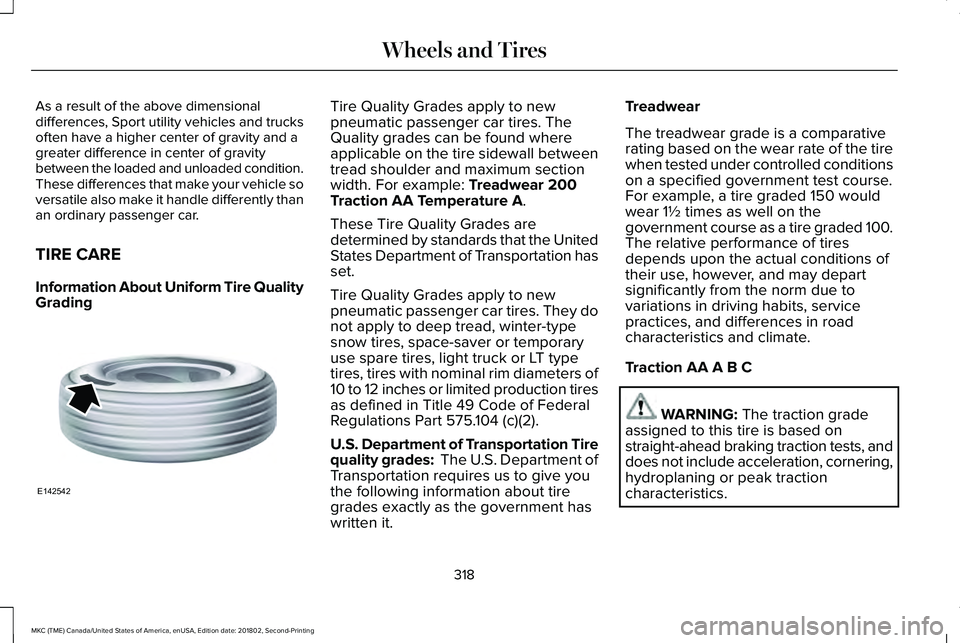
Information About Uniform Tire QualityGrading
Tire Quality Grades apply to newpneumatic passenger car tires. TheQuality grades can be found whereapplicable on the tire sidewall betweentread shoulder and maximum sectionwidth. For example: Treadwear 200Traction AA Temperature A.
These Tire Quality Grades aredetermined by standards that the UnitedStates Department of Transportation hasset.
Tire Quality Grades apply to newpneumatic passenger car tires. They donot apply to deep tread, winter-typesnow tires, space-saver or temporaryuse spare tires, light truck or LT typetires, tires with nominal rim diameters of10 to 12 inches or limited production tires
as defined in Title 49 Code of FederalRegulations Part 575.104 (c)(2).
U.S. Department of Transportation Tirequality grades: The U.S. Department ofTransportation requires us to give youthe following information about tiregrades exactly as the government haswritten it.
Treadwear
The treadwear grade is a comparativerating based on the wear rate of the tirewhen tested under controlled conditionson a specified government test course.For example, a tire graded 150 wouldwear 1½ times as well on thegovernment course as a tire graded 100.The relative performance of tiresdepends upon the actual conditions oftheir use, however, and may departsignificantly from the norm due tovariations in driving habits, servicepractices, and differences in roadcharacteristics and climate.
Traction AA A B C
WARNING: The traction gradeassigned to this tire is based onstraight-ahead braking traction tests, anddoes not include acceleration, cornering,hydroplaning or peak tractioncharacteristics.
318
MKC (TME) Canada/United States of America, enUSA, Edition date: 201802, Second-Printing
Wheels and TiresE142542
Page 328 of 581
Location of the Tire Label
You will find a Tire Label containing tireinflation pressure by tire size and otherimportant information located on theB-Pillar or the edge of the driver door.
Inflating Your Tires
Safe operation of your vehicle requiresthat your tires are properly inflated.Remember that a tire can lose up to halfof its air pressure without appearing flat.
Every day before you drive, check yourtires. If one looks lower than the others,use a tire gauge to check pressure of alltires and adjust if required.
At least once a month and before longtrips, inspect each tire and check the tire
pressure with a tire gauge (includingspare, if equipped). Inflate all tires to theinflation pressure recommended by us.
You are strongly urged to buy a reliabletire pressure gauge, as automaticservice station gauges may beinaccurate. We recommend the use ofa digital or dial-type tire pressure gaugerather than a stick-type tire pressuregauge.
Use the recommended cold inflationpressure for optimum tire performanceand wear. Under-inflation orover-inflation may cause uneventreadwear patterns.
WARNING: Under-inflation is themost common cause of tire failures andmay result in severe tire cracking, treadseparation or blowout, with unexpectedloss of vehicle control and increased riskof injury. Under-inflation increasessidewall flexing and rolling resistance,resulting in heat buildup and internaldamage to the tire. It also may result inunnecessary tire stress, irregular wear,loss of vehicle control and accidents. A
tire can lose up to half of its air pressureand not appear to be flat!
Always inflate your tires to therecommended inflation pressure evenif it is less than the maximum inflationpressure information found on the tire.Our recommended tire inflation pressureis found on the Safety ComplianceCertification Label (affixed to either thedoor hinge pillar, door-latch post, or thedoor edge that meets the door-latchpost, next to the driver's seatingposition), or Tire Label which is locatedon the B-Pillar or the edge of the driver’sdoor. Failure to follow the tire pressurerecommendations can cause uneventreadwear patterns and adversely affectthe way your vehicle handles.
Maximum Inflation Pressure is the tiremanufacturer's maximum permissiblepressure and the pressure at which the
maximum load can be carried by the tire.This pressure is normally higher than themanufacturer’s recommended coldinflation pressure which can be foundon the Safety Compliance CertificationLabel (affixed to either the door hingepillar, door-latch post, or the door edgethat meets the door-latch post, next to
325
MKC (TME) Canada/United States of America, enUSA, Edition date: 201802, Second-Printing
Wheels and Tires
Page 329 of 581
the driver's seating position), or TireLabel which is located on the B-Pillar orthe edge of the driver’s door. The coldinflation pressure should never be setlower than the recommended pressureon the Safety Compliance CertificationLabel or Tire Label.
When weather temperature changesoccur, tire inflation pressures alsochange. A 11°F (6°C) temperature dropcan cause a corresponding drop of 1 psi(7 kPa) in inflation pressure. Check yourtire pressures frequently and adjustthem to the proper pressure which canbe found on the Safety ComplianceCertification Label or Tire Label.
To check the pressure in your tire(s):
1. Make sure the tires are cool,
meaning they are not hot fromdriving even a mile.
Note:If you are checking tire pressurewhen the tire is hot, (for example, drivenmore than 1 mi (1.6 km), never bleed orreduce air pressure. The tires are hotfrom driving and it is normal forpressures to increase aboverecommended cold pressures. A hot tireat or below recommended cold inflationpressure could be significantlyunder-inflated.
Note:If you have to drive a distance toget air for your tire(s), check and recordthe tire pressure first and add theappropriate air pressure when you getto the pump. It is normal for tires to heatup and the air pressure inside to go upas you drive.
2.Remove the cap from the valve on
one tire, then firmly press the tiregauge onto the valve and measurethe pressure.
3. Add enough air to reach therecommended air pressure.
Note:If you overfill the tire, release airby pressing on the metal stem in thecenter of the valve. Then recheck thepressure with your tire gauge.
4. Replace the valve cap.
5.Repeat this procedure for each tire,including the spare.
Note:Some spare tires operate at ahigher inflation pressure than the othertires. For T type mini-spare tires, see theDissimilar spare wheel and tireassembly information for a description.Store and maintain at 60 psi (4.15 bar).For full-size and dissimilar spare tires,see the Dissimilar spare wheel and tireassembly information for a description.Store and maintain at the higher of thefront and rear inflation pressure as
shown on the Tire Label.
6.Visually inspect the tires to makesure there are no nails or otherobjects embedded that could pokea hole in the tire and cause an airleak.
326
MKC (TME) Canada/United States of America, enUSA, Edition date: 201802, Second-Printing
Wheels and Tires
Page 330 of 581

7. Check the sidewalls to make surethere are no gouges, cuts or bulges.
Inspecting Your Tires and Wheel ValveStems
Periodically inspect the tire treads foruneven or excessive wear and removeobjects such as stones, nails or glassthat may be wedged in the treadgrooves. Check the tire and valve stemsfor holes, cracks, or cuts that may permitair leakage and repair or replace the tireand replace the valve stem. Inspect thetire sidewalls for cracking, cuts, bruisesand other signs of damage or excessivewear. If internal damage to the tire issuspected, have the tire demounted andinspected in case it needs to be repairedor replaced. For your safety, tires that
are damaged or show signs of excessivewear should not be used because theyare more likely to blow out or fail.
Improper or inadequate vehiclemaintenance can cause tires to wearabnormally. Inspect all your tires,including the spare, frequently, andreplace them if one or more of thefollowing conditions exist:
Tire Wear
When the tread is worn down to onesixteenth of an inch (2 mm), tires mustbe replaced to help prevent your vehiclefrom skidding and hydroplaning. Built-intreadwear indicators, or wear bars,which look like narrow strips of smoothrubber across the tread will appear onthe tire when the tread is worn down toone sixteenth of an inch (2 mm).
When the tire tread wears down to thesame height as these wear bars, the tireis worn out and must be replaced.
Damage
Periodically inspect the tire treads andsidewalls for damage (such as bulges inthe tread or sidewalls, cracks in thetread groove and separation in the tread
or sidewall). If damage is observed orsuspected, have the tire inspected by atire professional. Tires can be damagedduring off-road use, so inspection afteroff-road use is also recommended.
327
MKC (TME) Canada/United States of America, enUSA, Edition date: 201802, Second-Printing
Wheels and TiresE142546