change time LINCOLN MKS 2009 User Guide
[x] Cancel search | Manufacturer: LINCOLN, Model Year: 2009, Model line: MKS, Model: LINCOLN MKS 2009Pages: 323, PDF Size: 2.58 MB
Page 302 of 323
Driving style — good driving and fuel economy habits
Give consideration to the lists that follow and you may be able to change
a number of variables and improve your fuel economy.
Habits
•Smooth, moderate operation can yield up to 10% savings in fuel.
•Steady speeds without stopping will usually give the best fuel
economy.
•Idling for long periods of time (greater than one minute) may waste
fuel.
•Anticipate stopping; slowing down may eliminate the need to stop.
•Sudden or hard accelerations may reduce fuel economy.
•Slow down gradually.
•Driving at reasonable speeds (traveling at 55 mph [88 km/h] uses 15%
less fuel than traveling at 65 mph [105 km/h]).
•Revving the engine before turning it off may reduce fuel economy.
•Using the air conditioner or defroster may reduce fuel economy.
•You may want to turn off the speed control in hilly terrain if
unnecessary shifting between the top gears occurs. Unnecessary
shifting of this type could result in reduced fuel economy.
•Warming up a vehicle on cold mornings is not required and may
reduce fuel economy.
•Resting your foot on the brake pedal while driving may reduce fuel
economy.
•Combine errands and minimize stop-and-go driving.
Maintenance
•Keep tires properly inflated and use only recommended size.
•Operating a vehicle with the wheels out of alignment will reduce fuel
economy.
•Use recommended engine oil. Refer toMaintenance product
specifications and capacitiesin this chapter.
•Perform all regularly scheduled maintenance items. Follow the
recommended maintenance schedule and owner maintenance checks
found inscheduled maintenance information.
2009 MKS(mks)
Owners Guide (post-2002-fmt)
USA(fus)
Maintenance and Specifications
302
Page 307 of 323
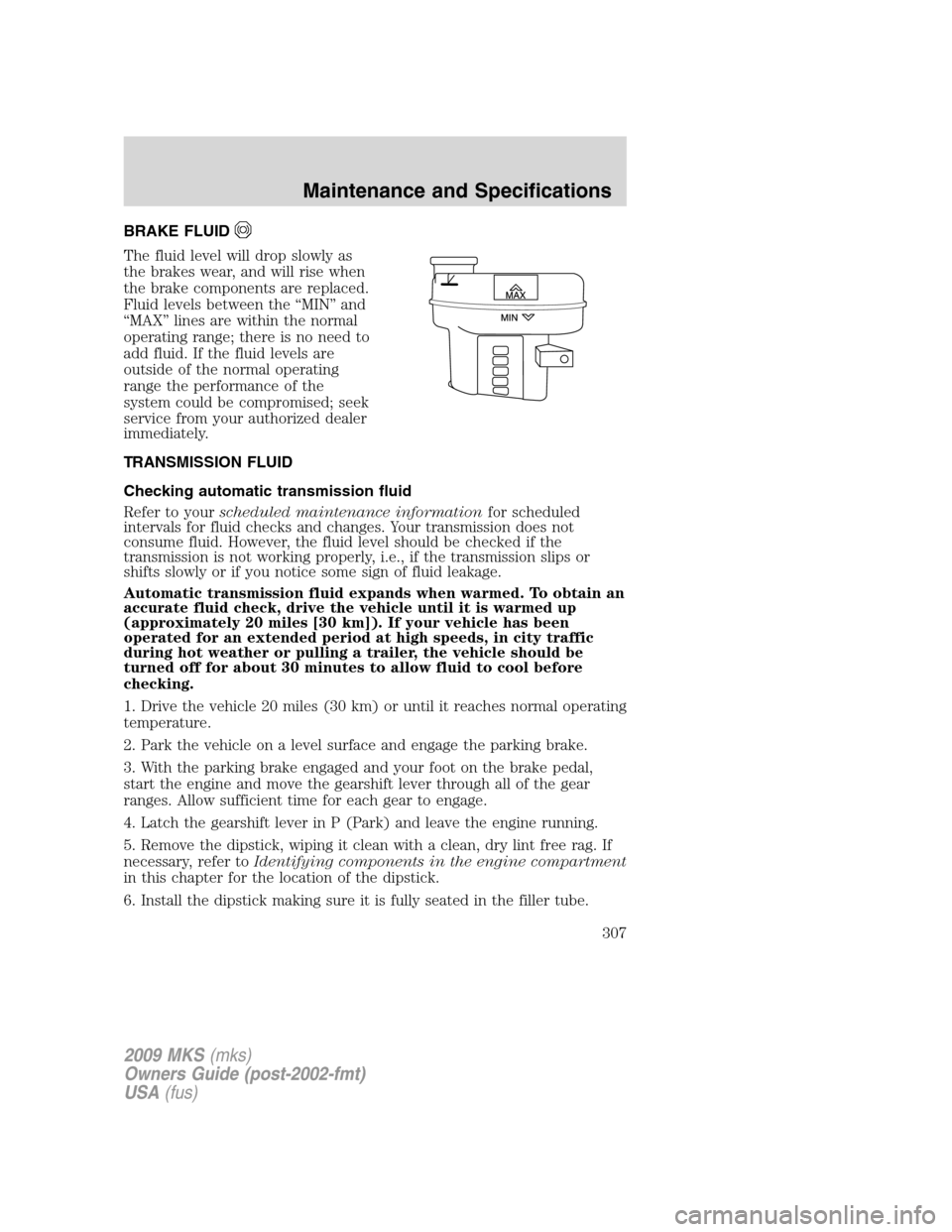
BRAKE FLUID
The fluid level will drop slowly as
the brakes wear, and will rise when
the brake components are replaced.
Fluid levels between the “MIN” and
“MAX” lines are within the normal
operating range; there is no need to
add fluid. If the fluid levels are
outside of the normal operating
range the performance of the
system could be compromised; seek
service from your authorized dealer
immediately.
TRANSMISSION FLUID
Checking automatic transmission fluid
Refer to yourscheduled maintenance informationfor scheduled
intervals for fluid checks and changes. Your transmission does not
consume fluid. However, the fluid level should be checked if the
transmission is not working properly, i.e., if the transmission slips or
shifts slowly or if you notice some sign of fluid leakage.
Automatic transmission fluid expands when warmed. To obtain an
accurate fluid check, drive the vehicle until it is warmed up
(approximately 20 miles [30 km]). If your vehicle has been
operated for an extended period at high speeds, in city traffic
during hot weather or pulling a trailer, the vehicle should be
turned off for about 30 minutes to allow fluid to cool before
checking.
1. Drive the vehicle 20 miles (30 km) or until it reaches normal operating
temperature.
2. Park the vehicle on a level surface and engage the parking brake.
3. With the parking brake engaged and your foot on the brake pedal,
start the engine and move the gearshift lever through all of the gear
ranges. Allow sufficient time for each gear to engage.
4. Latch the gearshift lever in P (Park) and leave the engine running.
5. Remove the dipstick, wiping it clean with a clean, dry lint free rag. If
necessary, refer toIdentifying components in the engine compartment
in this chapter for the location of the dipstick.
6. Install the dipstick making sure it is fully seated in the filler tube.
2009 MKS(mks)
Owners Guide (post-2002-fmt)
USA(fus)
Maintenance and Specifications
307
Page 320 of 323
refill capacities ........................311
service points ..................281–282
Engine block heater .................214
Engine oil ..................................283
change oil soon warning,
message center .......................283
checking and adding ..............283
dipstick ....................................283
filter, specifications ........285, 310
recommendations ...................285
refill capacities ........................311
specifications ..........................311
Event data recording ....................6
Exhaust fumes ..........................213
F
Fail safe cooling ........................293
Fluid capacities .........................311
Foglamps .....................................41
Four-Wheel Drive vehicles
driving off road .......................233
Fuel ............................................294
calculating fuel
economy ............................80, 300
cap ...........................................296
capacity ...................................311
choosing the right fuel ...........297
comparisons with EPA fuel
economy estimates .................303
detergent in fuel .....................298
filler funnel .............................298
filling your vehicle with
fuel ...........................294, 296, 300
filter, specifications ........294, 310
improving fuel economy ........300
octane rating ...................298, 313
quality ......................................298
running out of fuel .........256, 298safety information relating to
automotive fuels .....................294
Fuses ..........................................241
G
Gas cap (see Fuel cap) ............296
Gas mileage
(see Fuel economy) .................300
Gauges .........................................14
H
Hazard flashers .........................240
Headlamps ...................................40
aiming ........................................46
autolamp system .......................40
bulb specifications ....................48
daytime running lights .............45
flash to pass ..............................45
high beam .................................42
turning on and off ....................40
Heated Seats .....................125–126
Heating
heating and air conditioning
system .................................32, 35
Homelink wireless control
system ..........................................75
Hood ..........................................280
I
Ignition ...............................208, 313
Illuminated visor mirror .............53
Infant seats (see Safety seats)...164
Inspection/maintenance (I/M)
testing ........................................305
2009 MKS(mks)
Owners Guide (post-2002-fmt)
USA(fus)
Index
320