fuel LINCOLN MKS 2016 User Guide
[x] Cancel search | Manufacturer: LINCOLN, Model Year: 2016, Model line: MKS, Model: LINCOLN MKS 2016Pages: 382, PDF Size: 3.81 MB
Page 92 of 382
GENERAL INFORMATION
WARNING
Driving while distracted can result in
loss of vehicle control, crash and injury.
We strongly recommend that you use
extreme caution when using any device that
may take your focus off the road. Your
primary responsibility is the safe operation
of your vehicle. We recommend against the
use of any hand-held device while driving and
encourage the use of voice-operated systems
when possible. Make sure you are aware of
all applicable local laws that may affect the
use of electronic devices while driving. Various systems on your vehicle can be
controlled using the information display
controls on the steering wheel.
Corresponding information is displayed in the
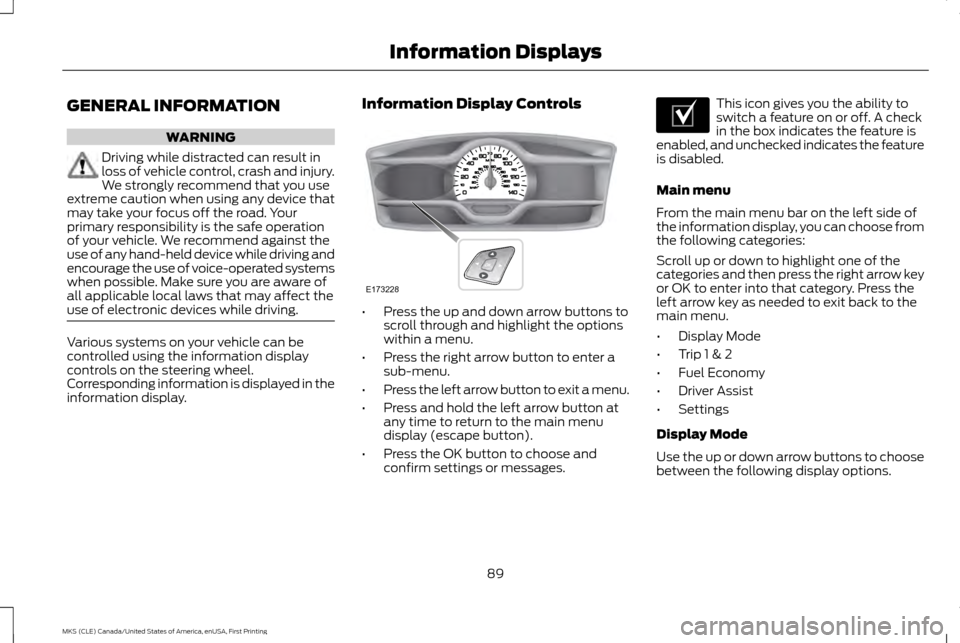
information display. Information Display Controls
•
Press the up and down arrow buttons to
scroll through and highlight the options
within a menu.
• Press the right arrow button to enter a
sub-menu.
• Press the left arrow button to exit a menu.
• Press and hold the left arrow button at
any time to return to the main menu
display (escape button).
• Press the OK button to choose and
confirm settings or messages. This icon gives you the ability to
switch a feature on or off. A check
in the box indicates the feature is
enabled, and unchecked indicates the feature
is disabled.
Main menu
From the main menu bar on the left side of
the information display, you can choose from
the following categories:
Scroll up or down to highlight one of the
categories and then press the right arrow key
or OK to enter into that category. Press the
left arrow key as needed to exit back to the
main menu.
• Display Mode
• Trip 1 & 2
• Fuel Economy
• Driver Assist
• Settings
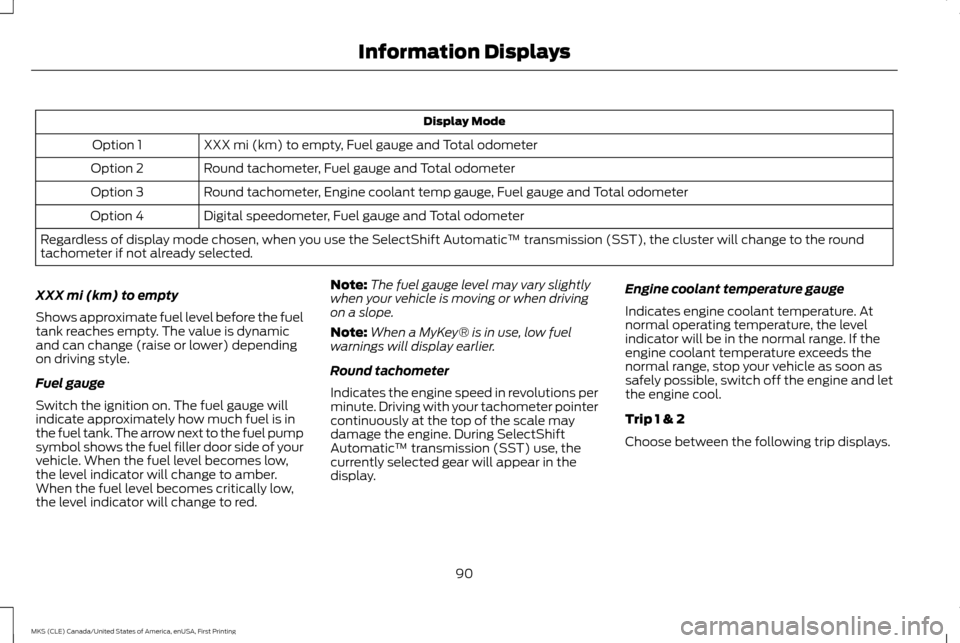
Display Mode
Use the up or down arrow buttons to choose
between the following display options.
89
MKS (CLE) Canada/United States of America, enUSA, First Printing Information DisplaysE173228 E204495
Page 93 of 382
Display Mode
XXX mi (km) to empty, Fuel gauge and Total odometer
Option 1
Round tachometer, Fuel gauge and Total odometer
Option 2
Round tachometer, Engine coolant temp gauge, Fuel gauge and Total odometer
Option 3
Digital speedometer, Fuel gauge and Total odometer
Option 4
Regardless of display mode chosen, when you use the SelectShift Automatic ™ transmission (SST), the cluster will change to the round
tachometer if not already selected.
XXX mi (km) to empty
Shows approximate fuel level before the fuel
tank reaches empty. The value is dynamic
and can change (raise or lower) depending
on driving style.
Fuel gauge
Switch the ignition on. The fuel gauge will
indicate approximately how much fuel is in
the fuel tank. The arrow next to the fuel pump
symbol shows the fuel filler door side of your
vehicle. When the fuel level becomes low,
the level indicator will change to amber.
When the fuel level becomes critically low,
the level indicator will change to red. Note:
The fuel gauge level may vary slightly
when your vehicle is moving or when driving
on a slope.
Note: When a MyKey® is in use, low fuel
warnings will display earlier.
Round tachometer
Indicates the engine speed in revolutions per
minute. Driving with your tachometer pointer
continuously at the top of the scale may
damage the engine. During SelectShift
Automatic ™ transmission (SST) use, the
currently selected gear will appear in the
display. Engine coolant temperature gauge
Indicates engine coolant temperature. At
normal operating temperature, the level
indicator will be in the normal range. If the
engine coolant temperature exceeds the
normal range, stop your vehicle as soon as
safely possible, switch off the engine and let
the engine cool.
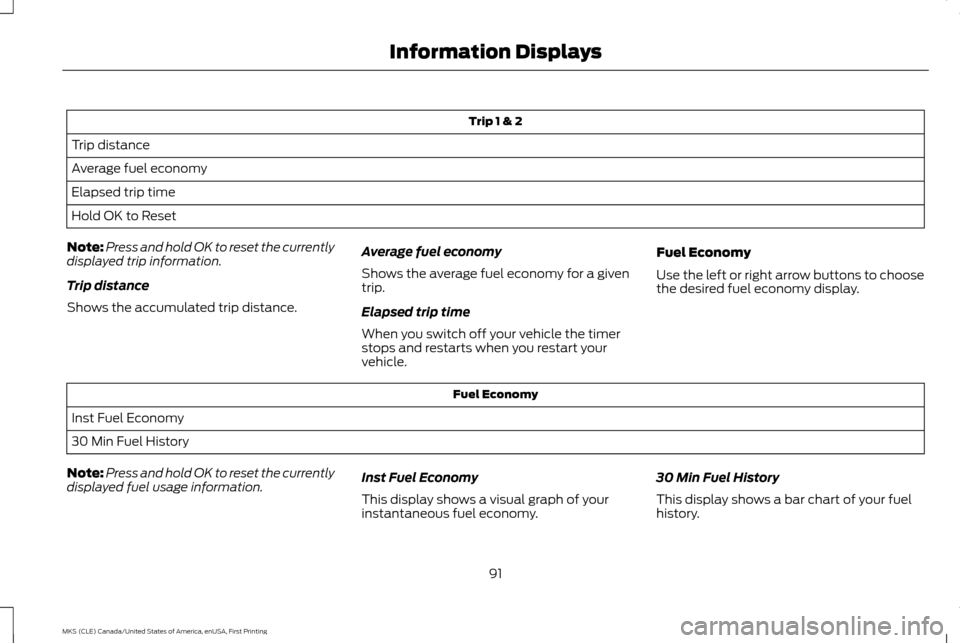
Trip 1 & 2
Choose between the following trip displays.
90
MKS (CLE) Canada/United States of America, enUSA, First Printing Information Displays
Page 94 of 382
Trip 1 & 2
Trip distance
Average fuel economy
Elapsed trip time
Hold OK to Reset
Note: Press and hold OK to reset the currently
displayed trip information.
Trip distance
Shows the accumulated trip distance. Average fuel economy
Shows the average fuel economy for a given
trip.
Elapsed trip time
When you switch off your vehicle the timer
stops and restarts when you restart your
vehicle.Fuel Economy
Use the left or right arrow buttons to choose
the desired fuel economy display. Fuel Economy
Inst Fuel Economy
30 Min Fuel History
Note: Press and hold OK to reset the currently
displayed fuel usage information. Inst Fuel Economy
This display shows a visual graph of your
instantaneous fuel economy.30 Min Fuel History
This display shows a bar chart of your fuel
history.
91
MKS (CLE) Canada/United States of America, enUSA, First Printing Information Displays
Page 97 of 382
Settings
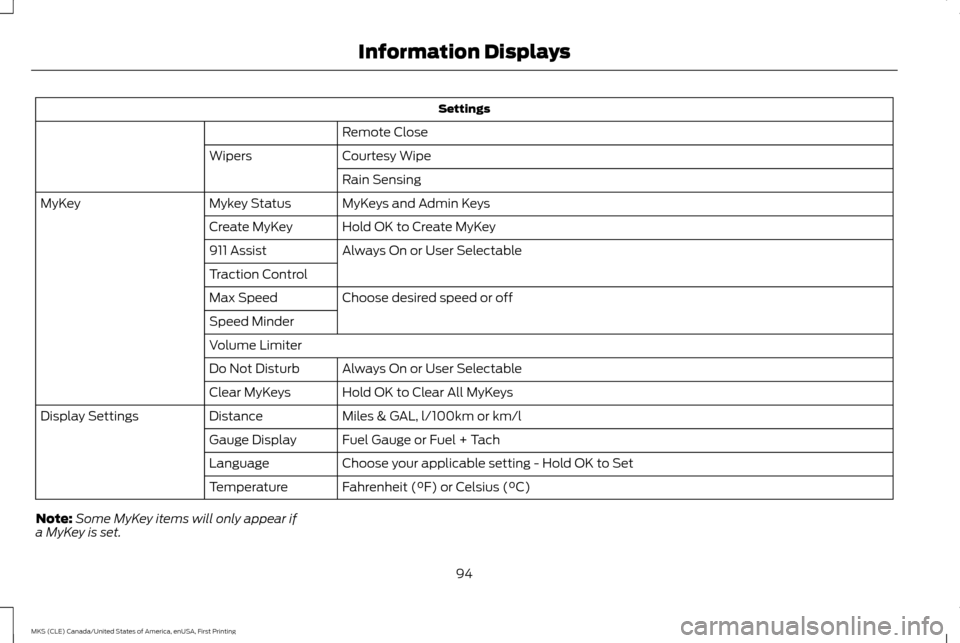
Remote Close
Courtesy Wipe
Wipers
Rain Sensing
MyKeys and Admin Keys
Mykey Status
MyKey
Hold OK to Create MyKey
Create MyKey
Always On or User Selectable
911 Assist
Traction Control
Choose desired speed or off
Max Speed
Speed Minder
Volume Limiter
Always On or User Selectable
Do Not Disturb
Hold OK to Clear All MyKeys
Clear MyKeys
Miles & GAL, l/100km or km/l
Distance
Display Settings
Fuel Gauge or Fuel + Tach
Gauge Display
Choose your applicable setting - Hold OK to Set
Language
Fahrenheit (°F) or Celsius (°C)
Temperature
Note: Some MyKey items will only appear if
a MyKey is set.
94
MKS (CLE) Canada/United States of America, enUSA, First Printing Information Displays
Page 99 of 382
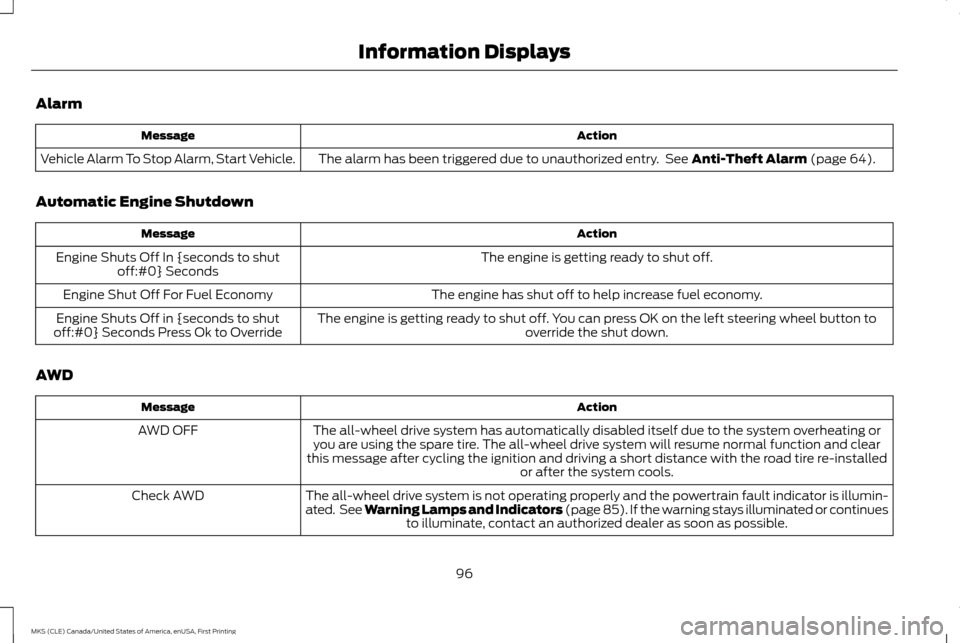
Alarm
Action
Message
The alarm has been triggered due to unauthorized entry. See Anti-Theft Alarm (page 64).
Vehicle Alarm To Stop Alarm, Start Vehicle.
Automatic Engine Shutdown Action
Message
The engine is getting ready to shut off.
Engine Shuts Off In {seconds to shut
off:#0} Seconds
The engine has shut off to help increase fuel economy.
Engine Shut Off For Fuel Economy
The engine is getting ready to shut off. You can press OK on the left steering wheel button tooverride the shut down.
Engine Shuts Off in {seconds to shut
off:#0} Seconds Press Ok to Override
AWD Action
Message
The all-wheel drive system has automatically disabled itself due to the system overheating oryou are using the spare tire. The all-wheel drive system will resume normal function and clear
this message after cycling the ignition and driving a short distance with the road tire re-installed or after the system cools.
AWD OFF
The all-wheel drive system is not operating properly and the powertrain fault indicator is illumin-
ated. See Warning Lamps and Indicators (page 85). If the warning stays illuminated or continuesto illuminate, contact an authorized dealer as soon as possible.
Check AWD
96
MKS (CLE) Canada/United States of America, enUSA, First Printing Information Displays
Page 102 of 382
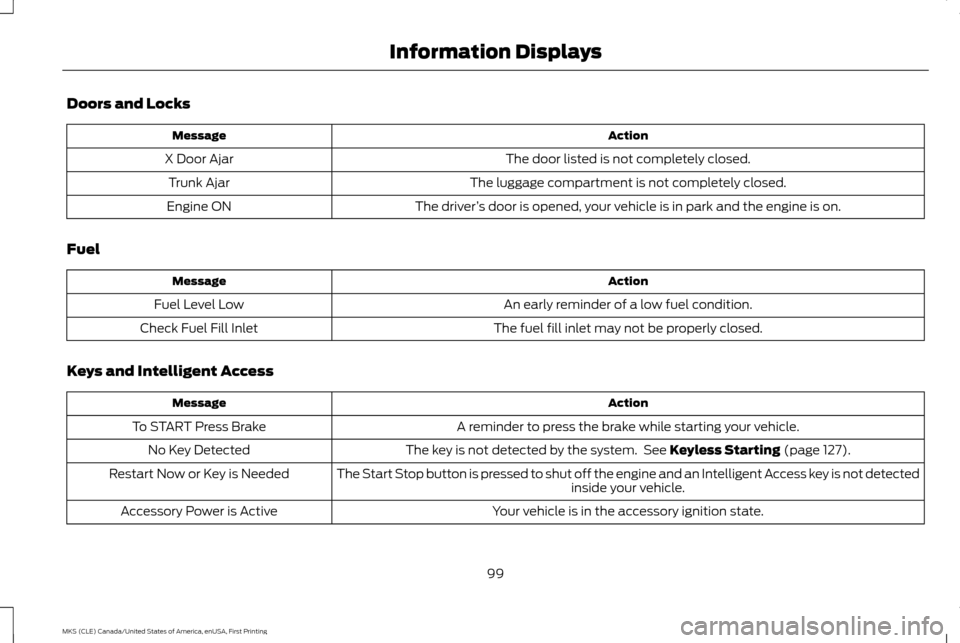
Doors and Locks
Action
Message
The door listed is not completely closed.
X Door Ajar
The luggage compartment is not completely closed.
Trunk Ajar
The driver’s door is opened, your vehicle is in park and the engine is on.
Engine ON
Fuel Action
Message
An early reminder of a low fuel condition.
Fuel Level Low
The fuel fill inlet may not be properly closed.
Check Fuel Fill Inlet
Keys and Intelligent Access Action
Message
A reminder to press the brake while starting your vehicle.
To START Press Brake
The key is not detected by the system. See Keyless Starting (page 127).
No Key Detected
The Start Stop button is pressed to shut off the engine and an Intelligent Access key is not detected inside your vehicle.
Restart Now or Key is Needed
Your vehicle is in the accessory ignition state.
Accessory Power is Active
99
MKS (CLE) Canada/United States of America, enUSA, First Printing Information Displays
Page 110 of 382
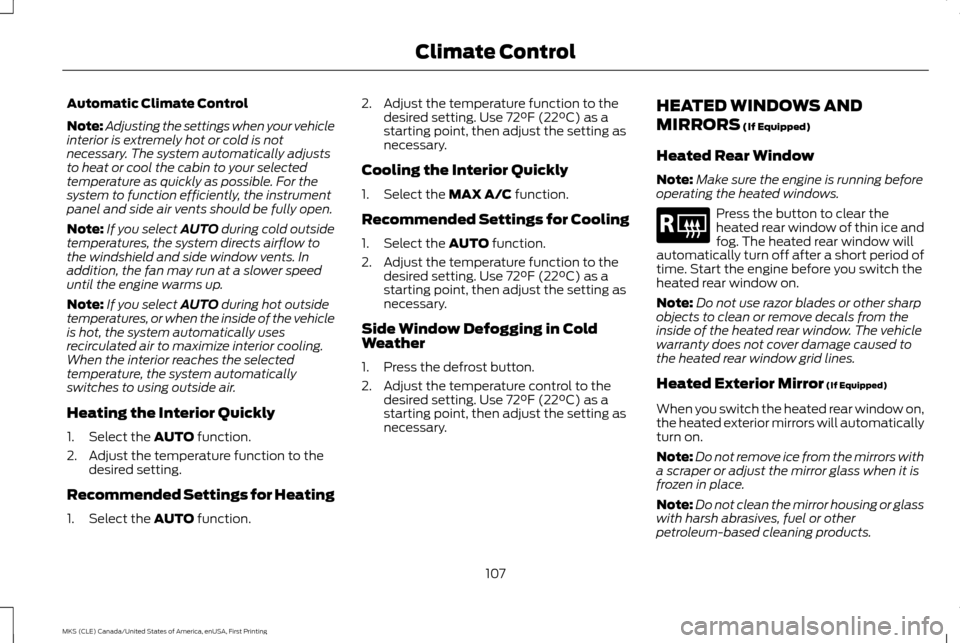
Automatic Climate Control
Note:
Adjusting the settings when your vehicle
interior is extremely hot or cold is not
necessary. The system automatically adjusts
to heat or cool the cabin to your selected
temperature as quickly as possible. For the
system to function efficiently, the instrument
panel and side air vents should be fully open.
Note: If you select AUTO during cold outside
temperatures, the system directs airflow to
the windshield and side window vents. In
addition, the fan may run at a slower speed
until the engine warms up.
Note: If you select
AUTO during hot outside
temperatures, or when the inside of the vehicle
is hot, the system automatically uses
recirculated air to maximize interior cooling.
When the interior reaches the selected
temperature, the system automatically
switches to using outside air.
Heating the Interior Quickly
1. Select the
AUTO function.
2. Adjust the temperature function to the desired setting.
Recommended Settings for Heating
1. Select the
AUTO function. 2. Adjust the temperature function to the
desired setting. Use 72°F (22°C) as a
starting point, then adjust the setting as
necessary.
Cooling the Interior Quickly
1. Select the
MAX A/C function.
Recommended Settings for Cooling
1. Select the
AUTO function.
2. Adjust the temperature function to the desired setting. Use 72°F (22°C) as a
starting point, then adjust the setting as
necessary.
Side Window Defogging in Cold
Weather
1. Press the defrost button.
2. Adjust the temperature control to the desired setting. Use 72°F (22°C) as a
starting point, then adjust the setting as
necessary. HEATED WINDOWS AND
MIRRORS
(If Equipped)
Heated Rear Window
Note: Make sure the engine is running before
operating the heated windows. Press the button to clear the
heated rear window of thin ice and
fog. The heated rear window will
automatically turn off after a short period of
time. Start the engine before you switch the
heated rear window on.
Note: Do not use razor blades or other sharp
objects to clean or remove decals from the
inside of the heated rear window. The vehicle
warranty does not cover damage caused to
the heated rear window grid lines.
Heated Exterior Mirror
(If Equipped)
When you switch the heated rear window on,
the heated exterior mirrors will automatically
turn on.
Note: Do not remove ice from the mirrors with
a scraper or adjust the mirror glass when it is
frozen in place.
Note: Do not clean the mirror housing or glass
with harsh abrasives, fuel or other
petroleum-based cleaning products.
107
MKS (CLE) Canada/United States of America, enUSA, First Printing Climate ControlE184884
Page 132 of 382
Within 20 seconds of switching the engine
off, press the brake pedal and press the
button. After 20 seconds have expired, you
can no longer restart the engine without the
key present inside your vehicle.
Once the engine has started, it remains
running until you press the button, even if the
system does not detect a valid key. If you
open and close a door while the engine is
running, the system searches for a valid key.
You cannot restart the engine if the system
does not detect a valid key within 20
seconds.
Failure to Start
If you cannot start the engine after three
attempts, wait 10 seconds and follow this
procedure:
1. Fully press the brake pedal.
2.
Fully press the accelerator pedal and hold
it there.
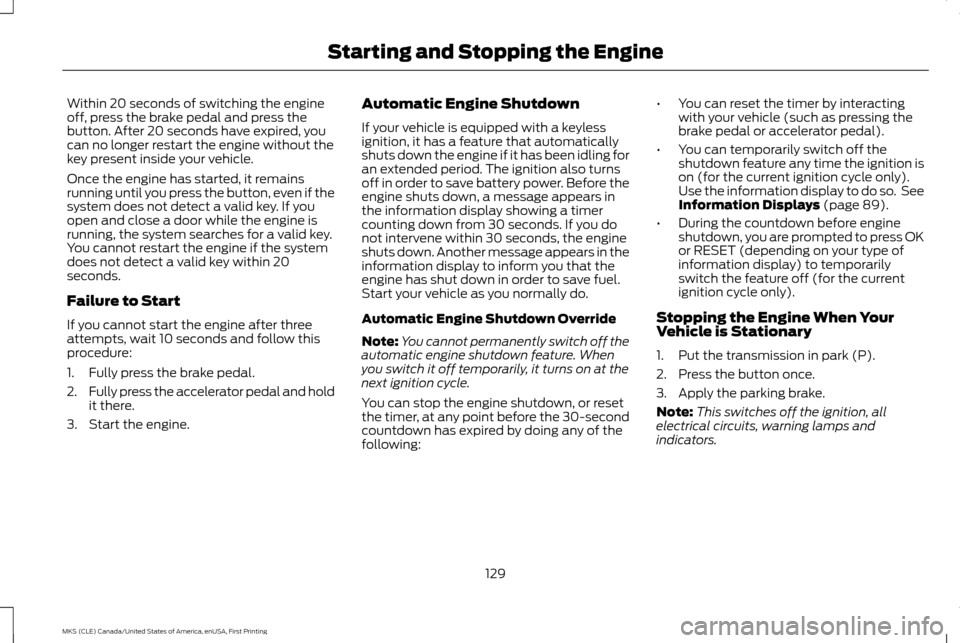
3. Start the engine. Automatic Engine Shutdown
If your vehicle is equipped with a keyless
ignition, it has a feature that automatically
shuts down the engine if it has been idling for
an extended period. The ignition also turns
off in order to save battery power. Before the
engine shuts down, a message appears in
the information display showing a timer
counting down from 30 seconds. If you do
not intervene within 30 seconds, the engine
shuts down. Another message appears in the
information display to inform you that the
engine has shut down in order to save fuel.
Start your vehicle as you normally do.
Automatic Engine Shutdown Override
Note:
You cannot permanently switch off the
automatic engine shutdown feature. When
you switch it off temporarily, it turns on at the
next ignition cycle.
You can stop the engine shutdown, or reset
the timer, at any point before the 30-second
countdown has expired by doing any of the
following: •
You can reset the timer by interacting
with your vehicle (such as pressing the
brake pedal or accelerator pedal).
• You can temporarily switch off the
shutdown feature any time the ignition is
on (for the current ignition cycle only).
Use the information display to do so. See
Information Displays (page 89).
• During the countdown before engine
shutdown, you are prompted to press OK
or RESET (depending on your type of
information display) to temporarily
switch the feature off (for the current
ignition cycle only).
Stopping the Engine When Your
Vehicle is Stationary
1. Put the transmission in park (P).
2. Press the button once.
3. Apply the parking brake.
Note: This switches off the ignition, all
electrical circuits, warning lamps and
indicators.
129
MKS (CLE) Canada/United States of America, enUSA, First Printing Starting and Stopping the Engine
Page 135 of 382
SAFETY PRECAUTIONS
WARNINGS
Do not overfill the fuel tank. The
pressure in an overfilled tank may
cause leakage and lead to fuel spray
and fire. The fuel system may be under pressure.
If you hear a hissing sound near the fuel
filler inlet, do not refuel until the sound
stops. Otherwise, fuel may spray out, which
could cause serious personal injury. Automotive fuels can cause serious
injury or death if misused or
mishandled.
Flow of fuel through a fuel pump nozzle
can produce static electricity. This can
cause a fire if you are filling an
ungrounded fuel container. Gasoline may contain benzene, which
is a cancer-causing agent.
When refueling always shut the engine
off and never allow sparks or open
flames near the fuel tank filler valve.
Never smoke or use a cell phone while
refueling. Fuel vapor is extremely hazardous
under certain conditions. Avoid inhaling
excess fumes. Observe the following guidelines when
handling automotive fuel:
•
Extinguish all smoking materials and any
open flames before refueling your vehicle.
• Always turn off the vehicle before
refueling.
• Automotive fuels can be harmful or fatal
if swallowed. Fuel such as gasoline is
highly toxic and if swallowed can cause
death or permanent injury. If fuel is
swallowed, call a physician immediately,
even if no symptoms are immediately
apparent. The toxic effects of fuel may
not be visible for hours.
• Avoid inhaling fuel vapors. Inhaling too
much fuel vapor of any kind can lead to
eye and respiratory tract irritation. In
severe cases, excessive or prolonged
breathing of fuel vapor can cause serious
illness and permanent injury.
• Avoid getting fuel liquid in your eyes. If
fuel is splashed in the eyes, remove
contact lenses (if worn), flush with water
for 15 minutes and seek medical
attention. Failure to seek proper medical
attention could lead to permanent injury. •
Fuels can also be harmful if absorbed
through the skin. If fuel is splashed on the
skin, clothing or both, promptly remove
contaminated clothing and wash skin
thoroughly with soap and water.
Repeated or prolonged skin contact with
fuel liquid or vapor causes skin irritation.
• Be particularly careful if you are taking
Antabuse or other forms of Disulfiram for
the treatment of alcoholism. Breathing
gasoline vapors could cause an adverse
reaction, serious personal injury or
sickness. If fuel is splashed on the skin,
wash the affected areas immediately
with plenty of soap and water. Consult a
physician immediately if you experience
any adverse reactions.
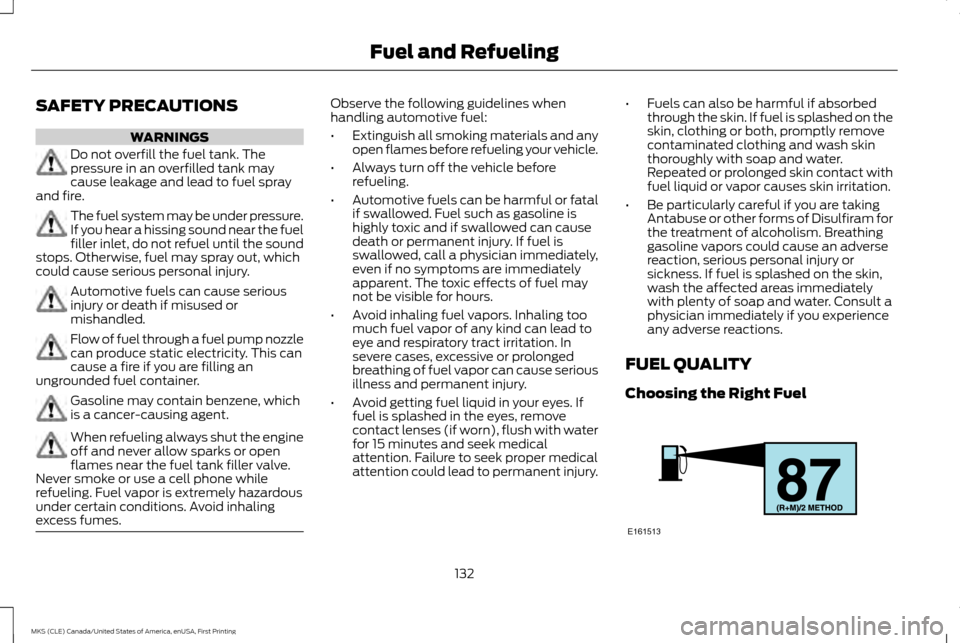
FUEL QUALITY
Choosing the Right Fuel 132
MKS (CLE) Canada/United States of America, enUSA, First Printing Fuel and RefuelingE161513
Page 136 of 382
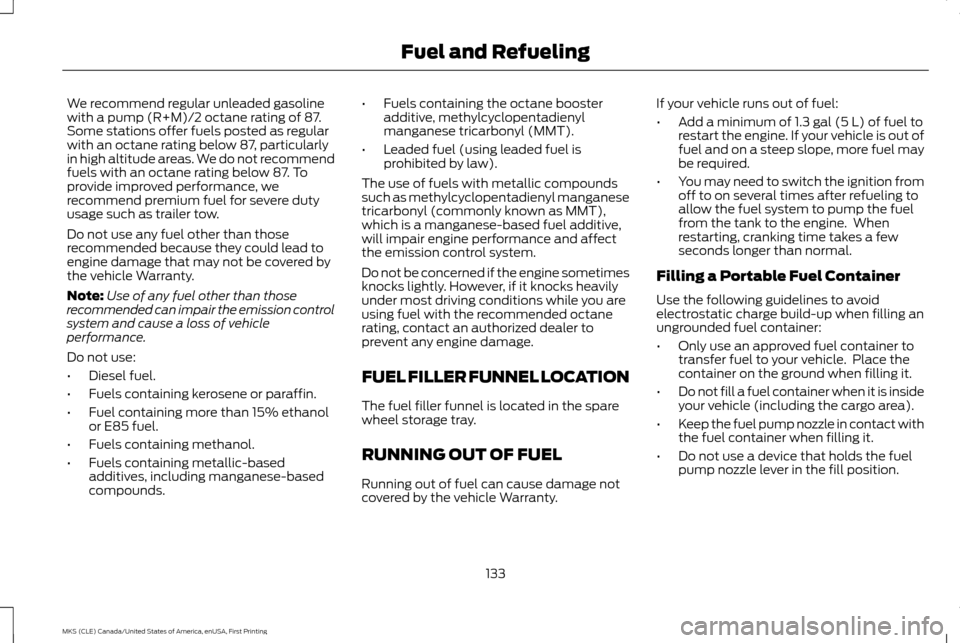
We recommend regular unleaded gasoline
with a pump (R+M)/2 octane rating of 87.
Some stations offer fuels posted as regular
with an octane rating below 87, particularly
in high altitude areas. We do not recommend
fuels with an octane rating below 87. To
provide improved performance, we
recommend premium fuel for severe duty
usage such as trailer tow.
Do not use any fuel other than those
recommended because they could lead to
engine damage that may not be covered by
the vehicle Warranty.
Note:
Use of any fuel other than those
recommended can impair the emission control
system and cause a loss of vehicle
performance.
Do not use:
• Diesel fuel.
• Fuels containing kerosene or paraffin.
• Fuel containing more than 15% ethanol
or E85 fuel.
• Fuels containing methanol.
• Fuels containing metallic-based
additives, including manganese-based
compounds. •
Fuels containing the octane booster
additive, methylcyclopentadienyl
manganese tricarbonyl (MMT).
• Leaded fuel (using leaded fuel is
prohibited by law).
The use of fuels with metallic compounds
such as methylcyclopentadienyl manganese
tricarbonyl (commonly known as MMT),
which is a manganese-based fuel additive,
will impair engine performance and affect
the emission control system.
Do not be concerned if the engine sometimes
knocks lightly. However, if it knocks heavily
under most driving conditions while you are
using fuel with the recommended octane
rating, contact an authorized dealer to
prevent any engine damage.
FUEL FILLER FUNNEL LOCATION
The fuel filler funnel is located in the spare
wheel storage tray.
RUNNING OUT OF FUEL
Running out of fuel can cause damage not
covered by the vehicle Warranty. If your vehicle runs out of fuel:
•
Add a minimum of 1.3 gal (5 L) of fuel to
restart the engine. If your vehicle is out of
fuel and on a steep slope, more fuel may
be required.
• You may need to switch the ignition from
off to on several times after refueling to
allow the fuel system to pump the fuel
from the tank to the engine. When
restarting, cranking time takes a few
seconds longer than normal.
Filling a Portable Fuel Container
Use the following guidelines to avoid
electrostatic charge build-up when filling an
ungrounded fuel container:
• Only use an approved fuel container to
transfer fuel to your vehicle. Place the
container on the ground when filling it.
• Do not fill a fuel container when it is inside
your vehicle (including the cargo area).
• Keep the fuel pump nozzle in contact with
the fuel container when filling it.
• Do not use a device that holds the fuel
pump nozzle lever in the fill position.
133
MKS (CLE) Canada/United States of America, enUSA, First Printing Fuel and Refueling