traction control LINCOLN MKS 2016 User Guide
[x] Cancel search | Manufacturer: LINCOLN, Model Year: 2016, Model line: MKS, Model: LINCOLN MKS 2016Pages: 382, PDF Size: 3.81 MB
Page 163 of 382
Note:
If a maneuver is interrupted before
completion, the system switches off. The
steering wheel position will not indicate the
actualy position of the steering and you have
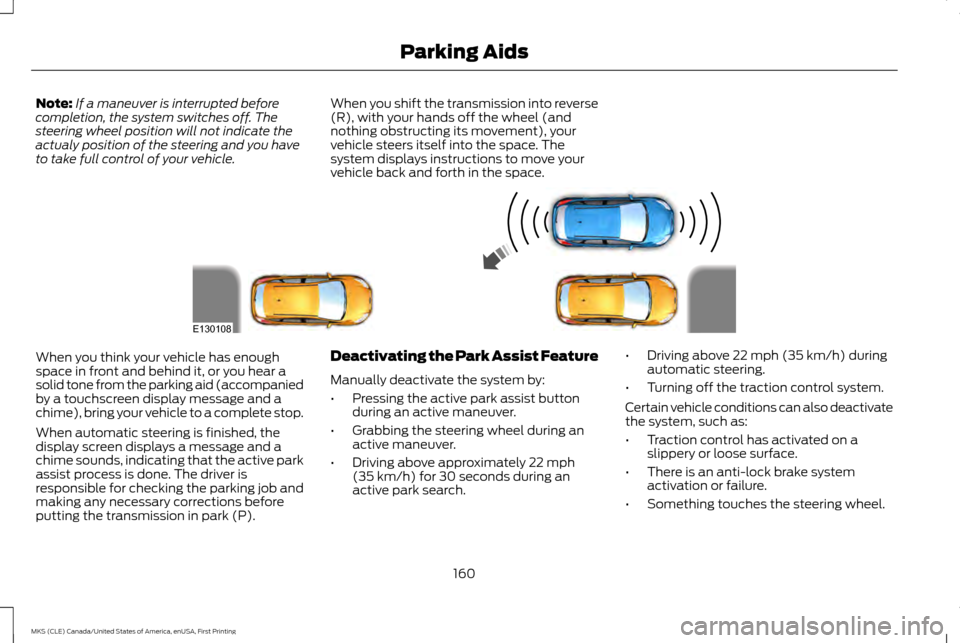
to take full control of your vehicle. When you shift the transmission into reverse
(R), with your hands off the wheel (and
nothing obstructing its movement), your
vehicle steers itself into the space. The
system displays instructions to move your
vehicle back and forth in the space.When you think your vehicle has enough
space in front and behind it, or you hear a
solid tone from the parking aid (accompanied
by a touchscreen display message and a
chime), bring your vehicle to a complete stop.
When automatic steering is finished, the
display screen displays a message and a
chime sounds, indicating that the active park
assist process is done. The driver is
responsible for checking the parking job and
making any necessary corrections before
putting the transmission in park (P).
Deactivating the Park Assist Feature
Manually deactivate the system by:
•
Pressing the active park assist button
during an active maneuver.
• Grabbing the steering wheel during an
active maneuver.
• Driving above approximately 22 mph
(35 km/h) for 30 seconds during an
active park search. •
Driving above
22 mph (35 km/h) during
automatic steering.
• Turning off the traction control system.
Certain vehicle conditions can also deactivate
the system, such as:
• Traction control has activated on a
slippery or loose surface.
• There is an anti-lock brake system
activation or failure.
• Something touches the steering wheel.
160
MKS (CLE) Canada/United States of America, enUSA, First Printing Parking AidsE130108
Page 164 of 382
If a problem occurs with the system, a
warning message is displayed, followed by
a chime. Occasional system messages may
occur in normal operation. For recurring or
frequent system faults, contact an authorized
dealer to have your vehicle serviced.
Troubleshooting the System The system does not look for a space
The traction control system may be off.
The transmission is in reverse (R); your vehicle must be moving forward to detect a parking space. The system does not offer a particular space
The sensors may be covered (for example, snow, ice or dirt buildup). Covered sensors can affect the system's functionality
There is not enough room in the parking space for your vehicle to safely park.
There is not enough space for the parking maneuver on the opposite side of the parking space.
The parking space is farther than 5 ft (1.5 m) or closer than 16 in (40 cm) away.
Your vehicle is going faster than
22 mph (35 km/h).
The transmission is in reverse (R). Your vehicle must be moving forward to be able to detect a parking space.
161
MKS (CLE) Canada/United States of America, enUSA, First Printing Parking Aids
Page 193 of 382
DRIVE CONTROL
LINCOLN DRIVE CONTROL
Lincoln Drive Control delivers the Lincoln
driving experience through a suite of
sophisticated electronic vehicle systems.
These systems continuously monitor your
driving inputs and the road conditions to
optimize ride comfort, steering, handling,
powertrain response and sound. You can
preset your preferences for these systems
within the information display. Lincoln Drive
Control will respond to your preferences
based on what gear position you select. This
provides a single location to control multiple
systems performance settings.
Lincoln Drive Control consists of the following
systems:
•
Continuously controlled damping
dynamically adjusts the shock absorbers
stiffness in real time to match the road
surface and driver inputs. This system
continuously monitors your vehicle ’s
motion (roll, pitch, bounce), suspension
position, load, speed, road conditions, and
steering to adjust the suspension
damping for optimal vehicle control.
• Electronically power-assisted steering
adjusts steering effort and feel based on
your vehicle speed and your inputs. •
Active noise control utilizes your vehicle
electronics to enhance the acoustic
experience.
• Electronic stability control and traction
control maintain your vehicle control in
adverse conditions or high performance
driving.
• Electronic throttle control enhances the
powertrain response to your inputs.
Using Lincoln Drive Control
You can configure which of the Drive Control
modes are active when your vehicle is in drive
(D) or in sport (S). The configuration remains
active until modified from the main menu on
the information display. These systems have a range of modes which
you can choose from in order to customize
your ideal driving experience:
•
Comfort – Provides a more relaxed
driving experience, maximizing comfort.
Your steering effort decreases and the
suspension movement is more fluid.
Comfort mode is ideal when you desire
enhanced traveling comfort.
• Normal – Delivers a balanced
combination of comfortable, controlled
ride and confident handling. This mode
provides an engaging drive experience
and a direct connection to the road
without sacrificing any of the composure
demanded from a luxury vehicle.
• Sport – Provides a sportier driving
experience. The suspension stiffens, with
an emphasis on handling and control. The
engine responds more directly to your
inputs and takes on a more powerful
tone. Sport mode is ideal for use during
more spirited driving.
You can change your vehicle's Drive Control
settings from the menu on the display screen.
See Information Messages (page 95).
Note: Not all settings may be available.
190
MKS (CLE) Canada/United States of America, enUSA, First Printing Driving Aids
Page 212 of 382
When driving through standing water, drive
very slowly and do not stop your vehicle. Your
brake performance and traction may be
limited. After driving through water and as
soon as it is safe to do so:
•
Lightly press the brake pedal to dry the
brakes and to check that they work.
• Check that the horn works.
• Check that the exterior lights work.
• Turn the steering wheel to check that the
steering power assist works. FLOOR MATS WARNINGS
Always use floor mats that are
designed to fit the foot well of your
vehicle. Only use floor mats that leave
the pedal area unobstructed. Only use floor
mats that are firmly secured to retention
posts so that they cannot slip out of position
and interfere with the pedals or impair safe
operation of your vehicle in other ways. Pedals that cannot move freely can
cause loss of vehicle control and
increase the risk of serious personal
injury. Always make sure that the floor mats
are properly attached to the retention
posts in the carpet that are supplied
with your vehicle. Floor mats must be
properly secured to both retention posts to
make sure mats do not shift out of position. Never place floor mats or any other
covering in the vehicle foot well that
cannot be properly secured to prevent
them from moving and interfering with the
pedals or the ability to control the vehicle. WARNINGS
Never place floor mats or any other
covering on top of already installed
floor mats. Floor mats should always
rest on top of vehicle carpeting surface and
not another floor mat or other covering.
Additional floor mats or any other covering
will reduce the pedal clearance and
potentially interfere with pedal operation. Check attachment of floor mats on a
regular basis. Always properly reinstall
and secure floor mats that have been
removed for cleaning or replacement. Always make sure that objects cannot
fall into the driver foot well while the
vehicle is moving. Objects that are
loose can become trapped under the pedals
causing a loss of vehicle control. Failure to properly follow floor mat
installation or attachment instructions
can potentially cause interference with
pedal operation causing a loss of vehicle
control. 209
MKS (CLE) Canada/United States of America, enUSA, First Printing Driving HintsE176360
Page 273 of 382
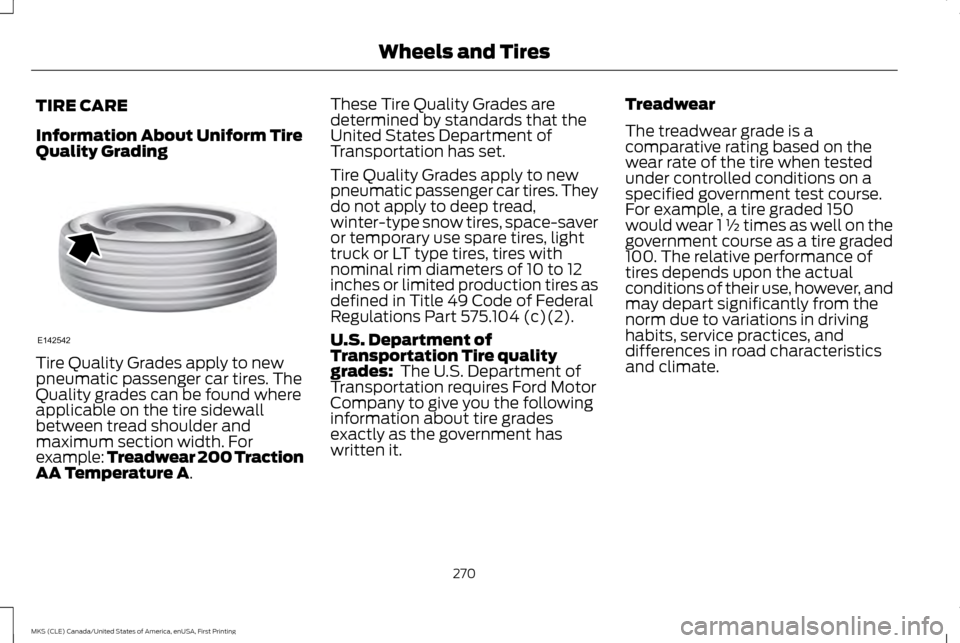
TIRE CARE
Information About Uniform Tire
Quality Grading
Tire Quality Grades apply to new
pneumatic passenger car tires. The
Quality grades can be found where
applicable on the tire sidewall
between tread shoulder and
maximum section width. For
example: Treadwear 200 Traction
AA Temperature A. These Tire Quality Grades are
determined by standards that the
United States Department of
Transportation has set.
Tire Quality Grades apply to new
pneumatic passenger car tires. They
do not apply to deep tread,
winter-type snow tires, space-saver
or temporary use spare tires, light
truck or LT type tires, tires with
nominal rim diameters of 10 to 12
inches or limited production tires as
defined in Title 49 Code of Federal
Regulations Part 575.104 (c)(2).
U.S. Department of
Transportation Tire quality
grades:
The U.S. Department of
Transportation requires Ford Motor
Company to give you the following
information about tire grades
exactly as the government has
written it. Treadwear
The treadwear grade is a
comparative rating based on the
wear rate of the tire when tested
under controlled conditions on a
specified government test course.
For example, a tire graded 150
would wear 1 ½ times as well on the
government course as a tire graded
100. The relative performance of
tires depends upon the actual
conditions of their use, however, and
may depart significantly from the
norm due to variations in driving
habits, service practices, and
differences in road characteristics
and climate.
270
MKS (CLE) Canada/United States of America, enUSA, First Printing Wheels and TiresE142542
Page 274 of 382
Traction AA A B C
WARNING
The traction grade assigned to
this tire is based on
straight-ahead braking traction
tests, and does not include
acceleration, cornering,
hydroplaning or peak traction
characteristics. The traction grades, from highest to
lowest are AA, A, B, and C. The
grades represent the tire
’s ability to
stop on wet pavement as measured
under controlled conditions on
specified government test surfaces
of asphalt and concrete. A tire
marked C may have poor traction
performance. Temperature A B C WARNING
The temperature grade for this
tire is established for a tire that
is properly inflated and not
overloaded. Excessive speed,
underinflation, or excessive loading,
either separately or in combination,
can cause heat buildup and possible
tire failure. The temperature grades are A (the
highest), B and C, representing the
tire
’s resistance to the generation of
heat and its ability to dissipate heat
when tested under controlled
conditions on a specified indoor
laboratory test wheel. Sustained
high temperature can cause the
material of the tire to degenerate
and reduce tire life, and excessive
temperature can lead to sudden tire
failure. The grade C corresponds to
a level of performance which all
passenger car tires must meet under the Federal Motor Vehicle Safety
Standard No. 139. Grades B and A
represent higher levels of
performance on the laboratory test
wheel than the minimum required
by law.
Glossary of Tire Terminology
•
Tire label: A label showing the
original equipment tire sizes,
recommended inflation pressure
and the maximum weight the
vehicle can carry.
• Tire Identification Number:
A
number on the sidewall of each
tire providing information about
the tire brand and manufacturing
plant, tire size and date of
manufacture. Also referred to as
DOT code.
• Inflation pressure:
A measure
of the amount of air in a tire.
271
MKS (CLE) Canada/United States of America, enUSA, First Printing Wheels and Tires
Page 279 of 382
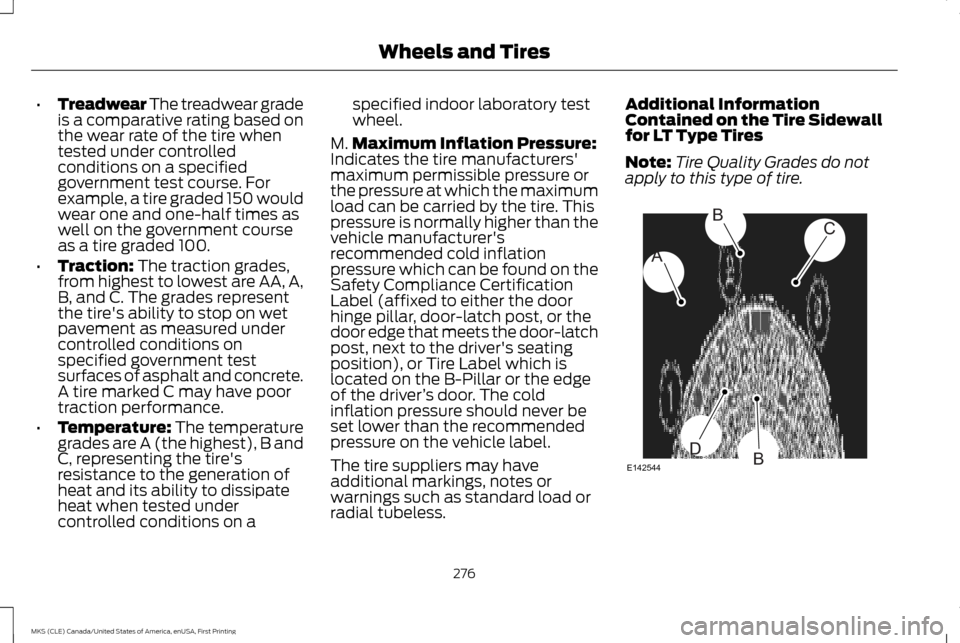
•
Treadwear The treadwear grade
is a comparative rating based on
the wear rate of the tire when
tested under controlled
conditions on a specified
government test course. For
example, a tire graded 150 would
wear one and one-half times as
well on the government course
as a tire graded 100.
• Traction: The traction grades,
from highest to lowest are AA, A,
B, and C. The grades represent
the tire's ability to stop on wet
pavement as measured under
controlled conditions on
specified government test
surfaces of asphalt and concrete.
A tire marked C may have poor
traction performance.
• Temperature:
The temperature
grades are A (the highest), B and
C, representing the tire's
resistance to the generation of
heat and its ability to dissipate
heat when tested under
controlled conditions on a specified indoor laboratory test
wheel.
M. Maximum Inflation Pressure:
Indicates the tire manufacturers'
maximum permissible pressure or
the pressure at which the maximum
load can be carried by the tire. This
pressure is normally higher than the
vehicle manufacturer's
recommended cold inflation
pressure which can be found on the
Safety Compliance Certification
Label (affixed to either the door
hinge pillar, door-latch post, or the
door edge that meets the door-latch
post, next to the driver's seating
position), or Tire Label which is
located on the B-Pillar or the edge
of the driver ’s door. The cold
inflation pressure should never be
set lower than the recommended
pressure on the vehicle label.
The tire suppliers may have
additional markings, notes or
warnings such as standard load or
radial tubeless. Additional Information
Contained on the Tire Sidewall
for LT Type Tires
Note:
Tire Quality Grades do not
apply to this type of tire. 276
MKS (CLE) Canada/United States of America, enUSA, First Printing Wheels and TiresA
BC
BDE142544
Page 289 of 382
WARNINGS
Do not use snow chains or cables on
this vehicle as they may cause damage
to your vehicle which may lead to loss
of vehicle control. Snow chains have not been approved for use
on your vehicle.
The original equipment tires on your vehicle
may have an all-weather tread design to
provide traction, handling, and braking
performance in year-round driving. You may
install snow tires for improved traction when
driving in areas with sustained periods of
snow or icy driving conditions.
TIRE PRESSURE MONITORING
SYSTEM
WARNING
The tire pressure monitoring system is
not a substitute for manually checking
tire pressure. The tire pressure should
be checked periodically (at least monthly)
using a tire gauge, see Inflating your tires in
this chapter. Failure to properly maintain your
tire pressure could increase the risk of tire
failure, loss of control, vehicle rollover and
personal injury. Each tire, including the spare (if
provided), should be checked
monthly when cold and inflated to
the inflation pressure recommended by the
vehicle manufacturer on the vehicle placard
or tire inflation pressure label. (If your vehicle
has tires of a different size than the size
indicated on the vehicle placard or tire
inflation pressure label, you should determine
the proper tire inflation pressure for those
tires.)
As an added safety feature, your vehicle has
been equipped with a Tire Pressure
Monitoring System (TPMS) that illuminates
a low tire pressure telltale when one or more
of your tires is significantly under-inflated.
Accordingly, when the low tire pressure
telltale illuminates, you should stop and
check your tires as soon as possible, and
inflate them to the proper pressure. Driving
on a significantly under-inflated tire causes
the tire to overheat and can lead to tire
failure. Under-inflation also reduces fuel
efficiency and tire tread life, and may affect
the vehicle ’s handling and stopping ability. Please note that the TPMS is not a substitute
for proper tire maintenance, and it is the
driver
’s responsibility to maintain correct tire
pressure, even if under-inflation has not
reached the level to trigger illumination of
the TPMS low tire pressure telltale.
Your vehicle has also been equipped with a
TPMS malfunction indicator to indicate when
the system is not operating properly. The
TPMS malfunction indicator is combined with
the low tire pressure telltale. When the
system detects a malfunction, the telltale
will flash for approximately one minute and
then remain continuously illuminated. This
sequence will continue upon subsequent
vehicle start-ups as long as the malfunction
exists.
When the malfunction indicator is
illuminated, the system may not be able to
detect or signal low tire pressure as intended.
TPMS malfunctions may occur for a variety
of reasons, including the installation of
replacement or alternate tires or wheels on
the vehicle that prevent the TPMS from
functioning properly. Always check the TPMS
malfunction telltale after replacing one or
more tires or wheels on your vehicle to ensure
that the replacement or alternate tires and
wheels allow the TPMS to continue to
function properly.
286
MKS (CLE) Canada/United States of America, enUSA, First Printing Wheels and Tires
Page 358 of 382
PRODUCT SUPPORT: Please refer to FORD
MOTOR COMPANY instructions provided in
the documentation for the DEVICES product
support, such as the vehicle owner guide.
Should you have any questions concerning
this EULA, or if you desire to contact FORD
MOTOR COMPANY for any other reason,
please refer to the address provided in the
documentation for the DEVICES.
No Liability for Certain Damages: EXCEPT
AS PROHIBITED BY LAW, FORD MOTOR
COMPANY, ANY THIRD PARTY SOFTWARE
OR SERVICES SUPPLIERS, AND THEIR
AFFILIATES SHALL HAVE NO LIABILITY FOR
ANY INDIRECT, SPECIAL, CONSEQUENTIAL
OR INCIDENTAL DAMAGES ARISING FROM
OR IN CONNECTION WITH THE USE OR
PERFORMANCE OF THE SOFTWARE. THIS
LIMITATION SHALL APPLY EVEN IF ANY
REMEDY FAILS OF ITS ESSENTIAL
PURPOSE. THERE ARE NO WARRANTIES
OTHER THAN THOSE THAT MAY BE
EXPRESSLY PROVIDED FOR YOUR NEW
VEHICLE.
SYNC® Automotive Important Safety
Information Read and follow
instructions:
•
Before using your SYNC® system, read
and follow all instructions and safety
information provided in this end user
manual ("Owner Guide".) Not following
precautions found in the Owner Guide
can lead to an accident or other serious
injuries.
General Operation
• Voice Command Control: Certain
functions within the SYNC® system may
be accomplished using voice commands.
Using voice commands while driving
helps you to operate the system without
removing your hands from the wheel or
eyes from the road.
• Prolonged Views of Screen:
Do not
access any function requiring a prolonged
view of the screen while you are driving.
Pull over in a safe and legal manner
before attempting to access a function
of the system requiring prolonged
attention. •
Volume Setting:
Do not raise the
volume excessively. Keep the volume at
a level where you can still hear outside
traffic and emergency signals while
driving. Driving while unable to hear these
sounds could cause an accident.
• Navigation Features:
Any navigation
features included in the system are
intended to provide turn by turn
instructions to get you to a desired
destination. Please make certain all
persons using this system carefully read
and follow instructions and safety
information fully.
• Distraction Hazard:
Any navigation
features may require manual
(non-verbal) setup. Attempting to
perform such set-up or insert data while
driving can distract your attention and
could cause an accident or other serious
injury. Stop the vehicle in a safe and legal
manner before attempting these
operations.
355
MKS (CLE) Canada/United States of America, enUSA, First Printing Appendices
Page 380 of 382
S
Safety Canopy
™.................................................42
Safety Precautions............................................132
Scheduled Maintenance Record................332
Scheduled Maintenance
.................................321
Seatbelt Height Adjustment............................31
Seatbelt Reminder
.............................................33
Belt-Minder™............................................................. 33
Seatbelts................................................................28 Principle of Operation.............................................. 28
Seatbelt Warning Lamp and Indicator Chime...................................................................32
Conditions of operation.......................................... 32
Seats
......................................................................109
Security...................................................................63
Side Airbags...........................................................41
Sitting in the Correct Position......................109
Snow Chains See: Using Snow Chains...................................... 285
Special Notices
.....................................................12
New Vehicle Limited Warranty.............................. 12
On-board Diagnostics (OBD-II)............................ 12
Special Instructions................................................... 12
Special Operating Conditions Scheduled Maintenance...................................................328
Exceptions................................................................. 330
Speed Control See: Cruise Control................................................. 166
Stability Control
.................................................154
Principle of Operation............................................ 154Starting a Gasoline Engine
............................128
Automatic Engine Shutdown.............................. 129
Failure to Start.......................................................... 129
Fast Restart................................................................ 128
Guarding Against Exhaust Fumes..................... 130
Important Ventilating Information.................... 130
Stopping the Engine When Your Vehicle is Moving.................................................................... 130
Stopping the Engine When Your Vehicle is Stationary.............................................................. 129
Starting and Stopping the Engine
...............127
General Information................................................ 127
Steering................................................................186 Electric Power Steering......................................... 186
Steering Wheel....................................................65
Storage Compartments
..................................126
Sunroof See: Moonroof............................................................ 82
Sun Shades
............................................................81
Sun Visors...............................................................81
Illuminated Vanity Mirror......................................... 81
Supplementary Restraints System..............37 Principle of Operation.............................................. 37
Symbols Glossary..................................................7
T
Technical Specifications See: Capacities and Specifications.................296
The Better Business Bureau (BBB) Auto Line Program (U.S. Only)............................218 Tire Care...............................................................270
Glossary of Tire Terminology............................... 271
Information About Uniform Tire Quality Grading................................................................... 270
Information Contained on the Tire Sidewall.................................................................. 272
Temperature A B C................................................... 271
Traction AA A B C..................................................... 271
Treadwear.................................................................. 270
Tire Pressure Monitoring System...............286 Changing Tires With a Tire Pressure Monitoring
System................................................................... 287
Understanding Your Tire Pressure Monitoring System .................................................................. 287
Tires See: Wheels and Tires........................................... 270
Towing a Trailer
..................................................201
Load Placement....................................................... 201
Towing the Vehicle on Four Wheels.........206 Emergency Towing................................................. 206
Recreational Towing.............................................. 207
Towing...................................................................201
Traction Control
.................................................153
Principle of Operation............................................ 153
Transmission Code Designation..................301
Transmission......................................................140
Transmission See: Transmission................................................... 140
Transporting the Vehicle...............................206
377
MKS (CLE) Canada/United States of America, enUSA, First Printing Index