tow LINCOLN MKS 2016 Owner's Manual
[x] Cancel search | Manufacturer: LINCOLN, Model Year: 2016, Model line: MKS, Model: LINCOLN MKS 2016Pages: 382, PDF Size: 3.81 MB
Page 129 of 382
CENTER CONSOLE
Stow items in the cupholder carefully as
items may become loose during hard braking,
acceleration or collisions, including hot drinks
which may spill.
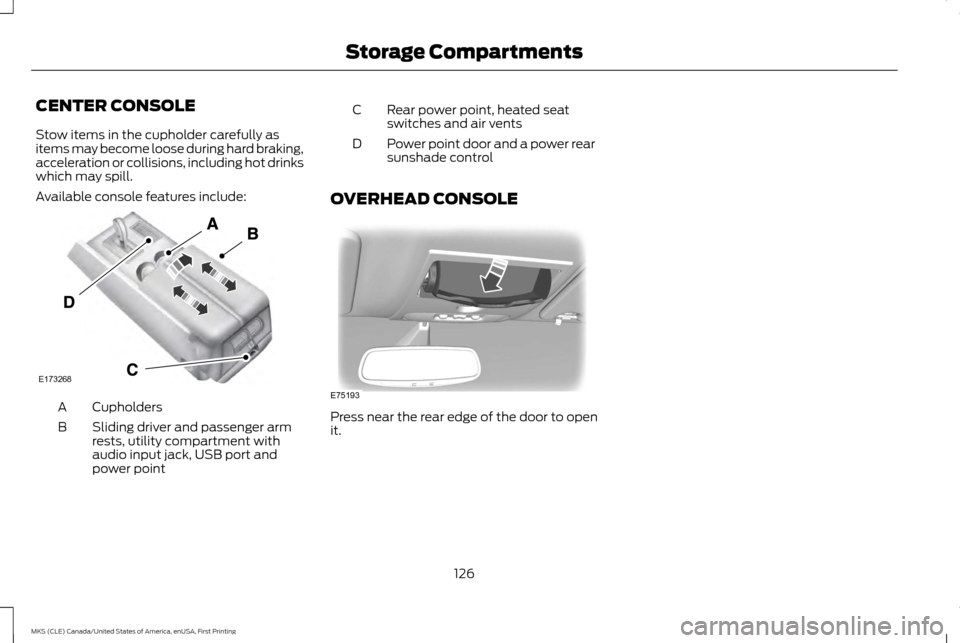
Available console features include:
Cupholders
A
Sliding driver and passenger arm
rests, utility compartment with
audio input jack, USB port and
power point
B Rear power point, heated seat
switches and air vents
C
Power point door and a power rear
sunshade control
D
OVERHEAD CONSOLE Press near the rear edge of the door to open
it.
126
MKS (CLE) Canada/United States of America, enUSA, First Printing Storage CompartmentsE173268 E75193
Page 134 of 382
We recommend that you do the following for
a safe and correct operation:
•
Use a 16-gauge outdoor extension cord
that is product certified by Underwriter ’s
Laboratory (UL) or Canadian Standards
Association (CSA). This extension cord
must be suitable for use outdoors, in cold
temperatures, and be clearly marked
Suitable for Use with Outdoor Appliances.
Do not use an indoor extension cord
outdoors. This could result in an electric
shock or become a fire hazard.
• Use as short an extension cord as
possible.
• Do not use multiple extension cords.
• Make sure that when in operation, the
extension cord plug and heater cord plug
connections are free and clear of water.
This could cause an electric shock or fire.
• Make sure your vehicle is parked in a clean
area, clear of combustibles.
• Make sure the heater, heater cord and
extension cord are firmly connected.
• Check for heat anywhere in the electrical
hookup once the system has been
operating for approximately 30 minutes. •
Make sure the system is unplugged and
properly stowed before starting and
driving your vehicle. Make sure the
protective cover seals the prongs of the
block heater cord plug when not in use.
• Make sure the heater system is checked
for proper operation before winter.
Using the Engine Block Heater
Make sure the receptacle terminals are clean
and dry prior to use. Clean them with a dry
cloth if necessary.
The heater uses 0.4 to 1.0 kilowatt-hours of
energy per hour of use. The system does not
have a thermostat. It achieves maximum
temperature after approximately three hours
of operation. Using the heater longer than
three hours does not improve system
performance and unnecessarily uses
electricity.
131
MKS (CLE) Canada/United States of America, enUSA, First Printing Starting and Stopping the Engine
Page 136 of 382
We recommend regular unleaded gasoline
with a pump (R+M)/2 octane rating of 87.
Some stations offer fuels posted as regular
with an octane rating below 87, particularly
in high altitude areas. We do not recommend
fuels with an octane rating below 87. To
provide improved performance, we
recommend premium fuel for severe duty
usage such as trailer tow.
Do not use any fuel other than those
recommended because they could lead to
engine damage that may not be covered by
the vehicle Warranty.
Note:
Use of any fuel other than those
recommended can impair the emission control
system and cause a loss of vehicle
performance.
Do not use:
• Diesel fuel.
• Fuels containing kerosene or paraffin.
• Fuel containing more than 15% ethanol
or E85 fuel.
• Fuels containing methanol.
• Fuels containing metallic-based
additives, including manganese-based
compounds. •
Fuels containing the octane booster
additive, methylcyclopentadienyl
manganese tricarbonyl (MMT).
• Leaded fuel (using leaded fuel is
prohibited by law).
The use of fuels with metallic compounds
such as methylcyclopentadienyl manganese
tricarbonyl (commonly known as MMT),
which is a manganese-based fuel additive,
will impair engine performance and affect
the emission control system.
Do not be concerned if the engine sometimes
knocks lightly. However, if it knocks heavily
under most driving conditions while you are
using fuel with the recommended octane
rating, contact an authorized dealer to
prevent any engine damage.
FUEL FILLER FUNNEL LOCATION
The fuel filler funnel is located in the spare
wheel storage tray.
RUNNING OUT OF FUEL
Running out of fuel can cause damage not
covered by the vehicle Warranty. If your vehicle runs out of fuel:
•
Add a minimum of 1.3 gal (5 L) of fuel to
restart the engine. If your vehicle is out of
fuel and on a steep slope, more fuel may
be required.
• You may need to switch the ignition from
off to on several times after refueling to
allow the fuel system to pump the fuel
from the tank to the engine. When
restarting, cranking time takes a few
seconds longer than normal.
Filling a Portable Fuel Container
Use the following guidelines to avoid
electrostatic charge build-up when filling an
ungrounded fuel container:
• Only use an approved fuel container to
transfer fuel to your vehicle. Place the
container on the ground when filling it.
• Do not fill a fuel container when it is inside
your vehicle (including the cargo area).
• Keep the fuel pump nozzle in contact with
the fuel container when filling it.
• Do not use a device that holds the fuel
pump nozzle lever in the fill position.
133
MKS (CLE) Canada/United States of America, enUSA, First Printing Fuel and Refueling
Page 153 of 382
GENERAL INFORMATION
Note:
Occasional brake noise is normal. If a
metal-to-metal, continuous grinding or
continuous squeal sound is present, the brake
linings may be worn-out. Have the system
checked by an authorized dealer. If your vehicle
has continuous vibration or shudder in the
steering wheel while braking, have it checked
by an authorized dealer.
Note: Brake dust may accumulate on the
wheels, even under normal driving conditions.
Some dust is inevitable as the brakes wear
and does not contribute to brake noise. See
Cleaning the Alloy Wheels (page 268).
Note: Depending on applicable laws and
regulations in the country for which your
vehicle was originally built, your brake lamps
may flash during heavy braking. Following this,
your hazard lights may also flash when your
vehicle comes to a stop. See
Warning Lamps and
Indicators (page 85).
Wet brakes result in reduced braking
efficiency. Gently press the brake pedal a few
times when driving from a car wash or
standing water to dry the brakes. Brake Over Accelerator
In the event the accelerator pedal becomes
stuck or entrapped, apply steady and firm
pressure to the brake pedal to slow the
vehicle and reduce engine power. If you
experience this condition, apply the brakes
and bring your vehicle to a safe stop. Move
the transmission to park (P), switch the
engine off and apply the parking brake.
Inspect the accelerator pedal for any
interference. If none are found and the
condition persists, have your vehicle towed
to the nearest authorized dealer.
Brake Assist
Brake assist detects when you brake rapidly
by measuring the rate at which you press the
brake pedal. It provides maximum braking
efficiency as long as you press the pedal, and
can reduce stopping distances in critical
situations.
Anti-lock Brake System
This system helps you maintain steering
control during emergency stops by keeping
the brakes from locking. This lamp momentarily illuminates
when you turn the ignition on. If the
light does not illuminate during
start up, remains on or flashes, the system
may be disabled. Have the system checked
by an authorized dealer. If the anti-lock brake
system is disabled, normal braking is still
effective. If the brake warning lamp
illuminates when you release the
parking brake, have the system
checked by an authorized dealer.
HINTS ON DRIVING WITH ANTI-
LOCK BRAKES
Note: When the system is operating, the brake
pedal may pulse and may travel further.
Maintain pressure on the brake pedal. You may
also hear a noise from the system. This is
normal.
The anti-lock braking system will not
eliminate the risks when:
• You drive too closely to the vehicle in
front of you.
• Your vehicle is hydroplaning.
• You take corners too fast.
• The road surface is poor.
150
MKS (CLE) Canada/United States of America, enUSA, First Printing BrakesE144522 E144522
Page 160 of 382
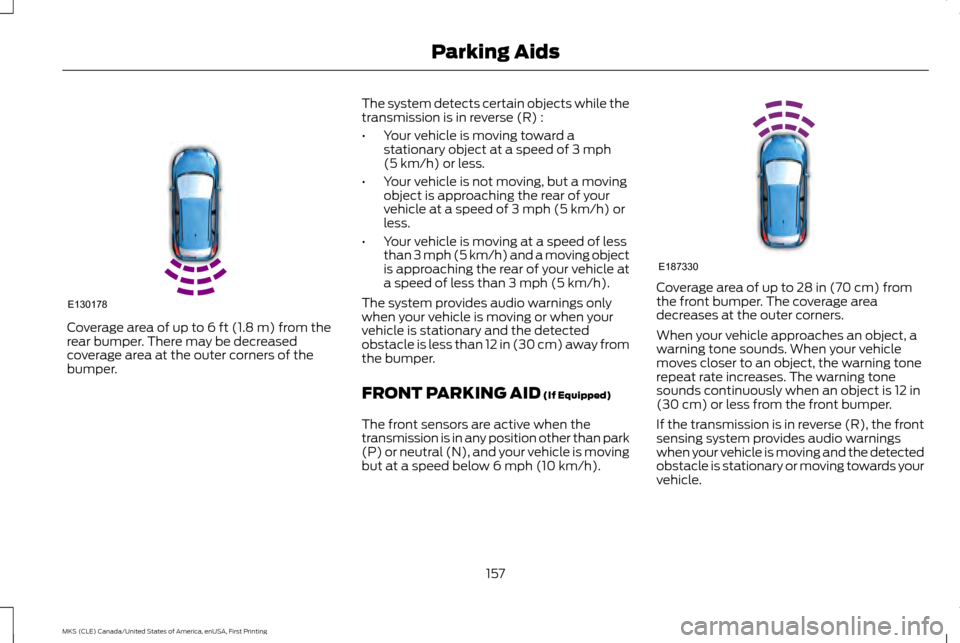
Coverage area of up to 6 ft (1.8 m) from the
rear bumper. There may be decreased
coverage area at the outer corners of the
bumper. The system detects certain objects while the
transmission is in reverse (R) :
•
Your vehicle is moving toward a
stationary object at a speed of
3 mph
(5 km/h) or less.
• Your vehicle is not moving, but a moving
object is approaching the rear of your
vehicle at a speed of
3 mph (5 km/h) or
less.
• Your vehicle is moving at a speed of less
than 3 mph (5 km/h) and a moving object
is approaching the rear of your vehicle at
a speed of less than
3 mph (5 km/h).
The system provides audio warnings only
when your vehicle is moving or when your
vehicle is stationary and the detected
obstacle is less than 12 in (30 cm) away from
the bumper.
FRONT PARKING AID
(If Equipped)
The front sensors are active when the
transmission is in any position other than park
(P) or neutral (N), and your vehicle is moving
but at a speed below
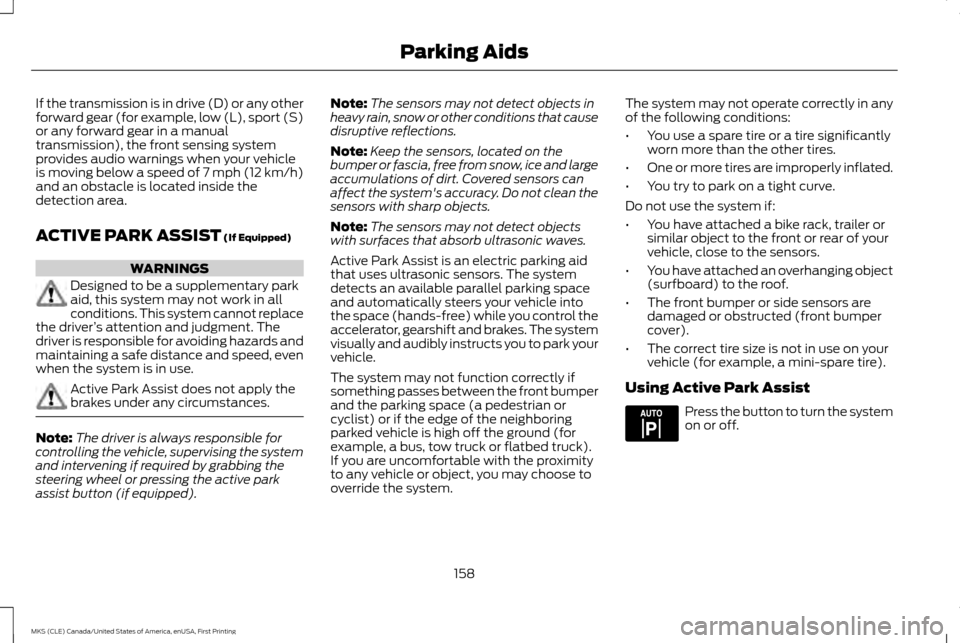
6 mph (10 km/h). Coverage area of up to
28 in (70 cm) from
the front bumper. The coverage area
decreases at the outer corners.
When your vehicle approaches an object, a
warning tone sounds. When your vehicle
moves closer to an object, the warning tone
repeat rate increases. The warning tone
sounds continuously when an object is
12 in
(30 cm) or less from the front bumper.
If the transmission is in reverse (R), the front
sensing system provides audio warnings
when your vehicle is moving and the detected
obstacle is stationary or moving towards your
vehicle.
157
MKS (CLE) Canada/United States of America, enUSA, First Printing Parking AidsE130178 E187330
Page 161 of 382
If the transmission is in drive (D) or any other
forward gear (for example, low (L), sport (S)
or any forward gear in a manual
transmission), the front sensing system
provides audio warnings when your vehicle
is moving below a speed of 7 mph (12 km/h)
and an obstacle is located inside the
detection area.
ACTIVE PARK ASSIST (If Equipped)
WARNINGS
Designed to be a supplementary park
aid, this system may not work in all
conditions. This system cannot replace
the driver ’s attention and judgment. The
driver is responsible for avoiding hazards and
maintaining a safe distance and speed, even
when the system is in use. Active Park Assist does not apply the
brakes under any circumstances.
Note:
The driver is always responsible for
controlling the vehicle, supervising the system
and intervening if required by grabbing the
steering wheel or pressing the active park
assist button (if equipped). Note:
The sensors may not detect objects in
heavy rain, snow or other conditions that cause
disruptive reflections.
Note: Keep the sensors, located on the
bumper or fascia, free from snow, ice and large
accumulations of dirt. Covered sensors can
affect the system's accuracy. Do not clean the
sensors with sharp objects.
Note: The sensors may not detect objects
with surfaces that absorb ultrasonic waves.
Active Park Assist is an electric parking aid
that uses ultrasonic sensors. The system
detects an available parallel parking space
and automatically steers your vehicle into
the space (hands-free) while you control the
accelerator, gearshift and brakes. The system
visually and audibly instructs you to park your
vehicle.
The system may not function correctly if
something passes between the front bumper
and the parking space (a pedestrian or
cyclist) or if the edge of the neighboring
parked vehicle is high off the ground (for
example, a bus, tow truck or flatbed truck).
If you are uncomfortable with the proximity
to any vehicle or object, you may choose to
override the system. The system may not operate correctly in any
of the following conditions:
•
You use a spare tire or a tire significantly
worn more than the other tires.
• One or more tires are improperly inflated.
• You try to park on a tight curve.
Do not use the system if:
• You have attached a bike rack, trailer or
similar object to the front or rear of your
vehicle, close to the sensors.
• You have attached an overhanging object
(surfboard) to the roof.
• The front bumper or side sensors are
damaged or obstructed (front bumper
cover).
• The correct tire size is not in use on your
vehicle (for example, a mini-spare tire).
Using Active Park Assist Press the button to turn the system
on or off.
158
MKS (CLE) Canada/United States of America, enUSA, First Printing Parking AidsE144525
Page 166 of 382
WARNINGS
Use caution when turning camera
features on or off while in R (Reverse).
Make sure the vehicle is not moving.
The rear view camera system provides a
video image of the area behind your vehicle.
The image will display in either the rear view
mirror or the display in the center of the
instrument panel.
During operation, lines will appear in the
display that represent your vehicle
’s path and
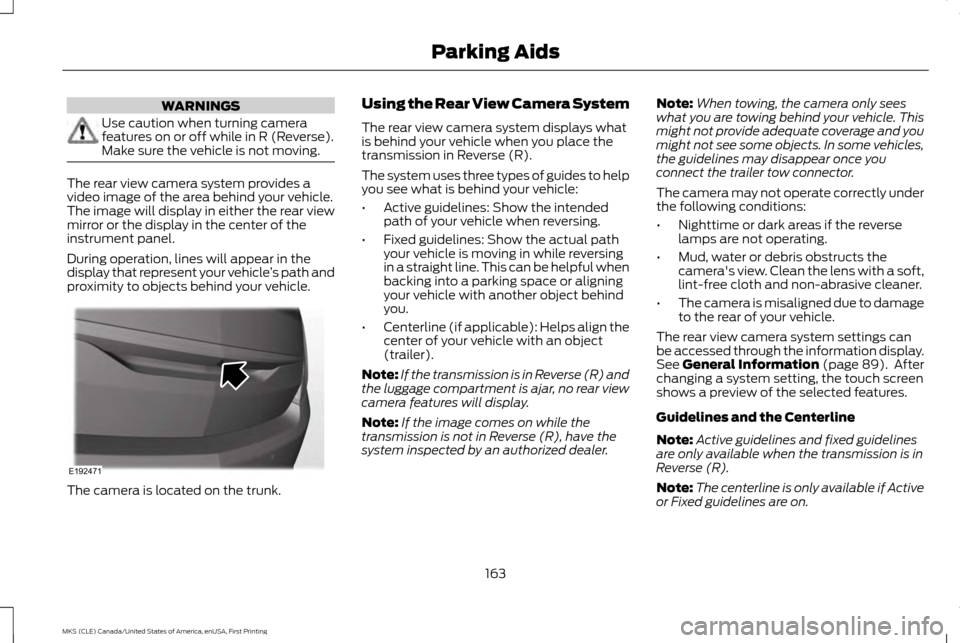
proximity to objects behind your vehicle. The camera is located on the trunk. Using the Rear View Camera System
The rear view camera system displays what
is behind your vehicle when you place the
transmission in Reverse (R).
The system uses three types of guides to help
you see what is behind your vehicle:
•
Active guidelines: Show the intended
path of your vehicle when reversing.
• Fixed guidelines: Show the actual path
your vehicle is moving in while reversing
in a straight line. This can be helpful when
backing into a parking space or aligning
your vehicle with another object behind
you.
• Centerline (if applicable): Helps align the
center of your vehicle with an object
(trailer).
Note: If the transmission is in Reverse (R) and
the luggage compartment is ajar, no rear view
camera features will display.
Note: If the image comes on while the
transmission is not in Reverse (R), have the
system inspected by an authorized dealer. Note:
When towing, the camera only sees
what you are towing behind your vehicle. This
might not provide adequate coverage and you
might not see some objects. In some vehicles,
the guidelines may disappear once you
connect the trailer tow connector.
The camera may not operate correctly under
the following conditions:
• Nighttime or dark areas if the reverse
lamps are not operating.
• Mud, water or debris obstructs the
camera's view. Clean the lens with a soft,
lint-free cloth and non-abrasive cleaner.
• The camera is misaligned due to damage
to the rear of your vehicle.
The rear view camera system settings can
be accessed through the information display.
See General Information (page 89). After
changing a system setting, the touch screen
shows a preview of the selected features.
Guidelines and the Centerline
Note: Active guidelines and fixed guidelines
are only available when the transmission is in
Reverse (R).
Note: The centerline is only available if Active
or Fixed guidelines are on.
163
MKS (CLE) Canada/United States of America, enUSA, First Printing Parking AidsE192471
Page 167 of 382
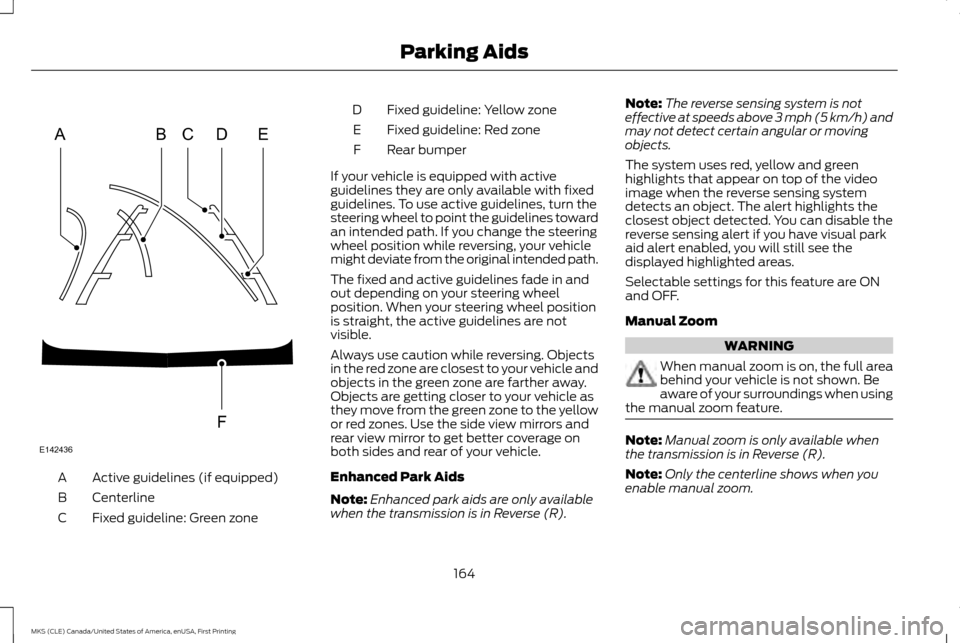
Active guidelines (if equipped)
A
Centerline
B
Fixed guideline: Green zone
C Fixed guideline: Yellow zone
D
Fixed guideline: Red zone
E
Rear bumper
F
If your vehicle is equipped with active
guidelines they are only available with fixed
guidelines. To use active guidelines, turn the
steering wheel to point the guidelines toward
an intended path. If you change the steering
wheel position while reversing, your vehicle
might deviate from the original intended path.
The fixed and active guidelines fade in and
out depending on your steering wheel
position. When your steering wheel position
is straight, the active guidelines are not
visible.
Always use caution while reversing. Objects
in the red zone are closest to your vehicle and
objects in the green zone are farther away.
Objects are getting closer to your vehicle as
they move from the green zone to the yellow
or red zones. Use the side view mirrors and
rear view mirror to get better coverage on
both sides and rear of your vehicle.
Enhanced Park Aids
Note: Enhanced park aids are only available
when the transmission is in Reverse (R). Note:
The reverse sensing system is not
effective at speeds above 3 mph (5 km/h) and
may not detect certain angular or moving
objects.
The system uses red, yellow and green
highlights that appear on top of the video
image when the reverse sensing system
detects an object. The alert highlights the
closest object detected. You can disable the
reverse sensing alert if you have visual park
aid alert enabled, you will still see the
displayed highlighted areas.
Selectable settings for this feature are ON
and OFF.
Manual Zoom WARNING
When manual zoom is on, the full area
behind your vehicle is not shown. Be
aware of your surroundings when using
the manual zoom feature. Note:
Manual zoom is only available when
the transmission is in Reverse (R).
Note: Only the centerline shows when you
enable manual zoom.
164
MKS (CLE) Canada/United States of America, enUSA, First Printing Parking AidsABCD
F
E
E142436
Page 170 of 382
Switching Cruise Control Off
Press and release OFF when the system is
in stand by mode or switch the ignition off.
Note: You erase the set speed when you
switch the system off.
USING ADAPTIVE CRUISE
CONTROL
(If Equipped) WARNINGS
Always pay close attention to changing
road conditions when using adaptive
cruise control. The system does not
replace attentive driving. Failing to pay
attention to the road may result in a crash,
serious injury or death. Adaptive cruise control is not a crash
warning or avoidance system.
Adaptive cruise control will not detect
stationary or slow moving vehicles
below 6 mph (10 km/h).
Adaptive cruise control does not detect
pedestrians or objects in the road.
Adaptive cruise control does not detect
oncoming vehicles in the same lane. WARNINGS
Do not use the adaptive cruise control
when entering or leaving a highway, in
heavy traffic or on roads that are
winding, slippery or unpaved. Do not use the system in poor visibility,
for example fog, heavy rain, spray or
snow.
Do not use adaptive cruise control
when towing a trailer that has trailer
brakes. The auto-brake component of
the adaptive cruise control system does not
operate the trailer brakes. Using adaptive
cruise control when towing a trailer that has
trailer brakes may result in the loss of vehicle
control, which could result in serious injury. Do not use tire sizes other than those
recommended because this can affect
the normal operation of the system.
Failing to do so may result in a loss of vehicle
control, which could result in serious injury. Note:
It is your responsibility to stay alert, drive
safely and be in control of the vehicle at all
times.
The system adjusts your speed to maintain
a proper distance between you and the
vehicle in front of you in the same lane. You
can select from one of four gap settings. The adaptive cruise controls are on the
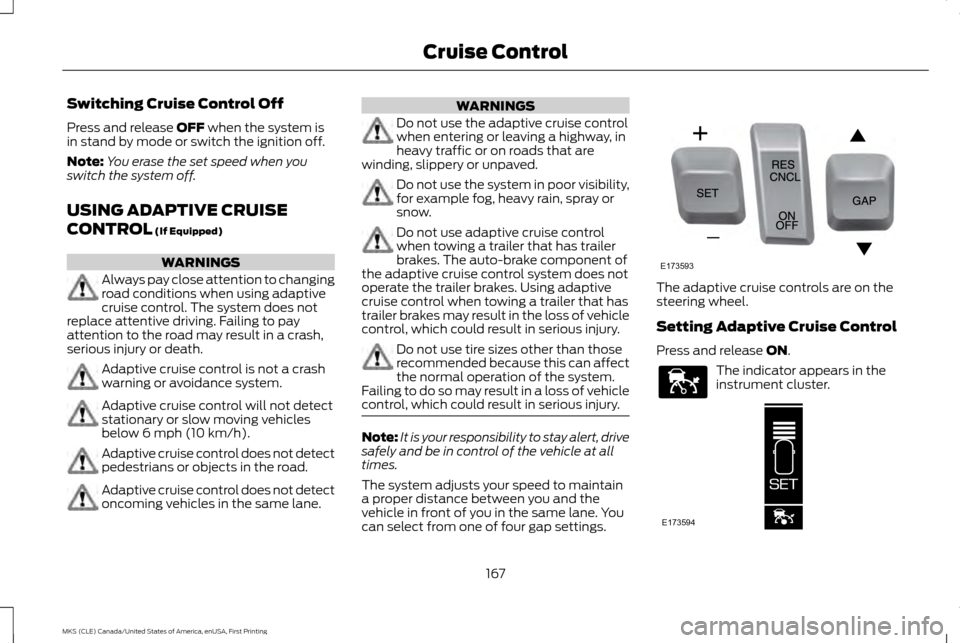
steering wheel.
Setting Adaptive Cruise Control
Press and release
ON.
The indicator appears in the
instrument cluster.
167
MKS (CLE) Canada/United States of America, enUSA, First Printing Cruise ControlE173593 E144529 E173594
Page 179 of 382
System Settings
The system has one standard feature setting
and one optional setting menu available. To
view or adjust the settings, See General
Information (page 89). The system stores
the last known selection for each of these
settings. You do not need to readjust your
settings each time you turn on the system.
Mode: This setting allows you to select which
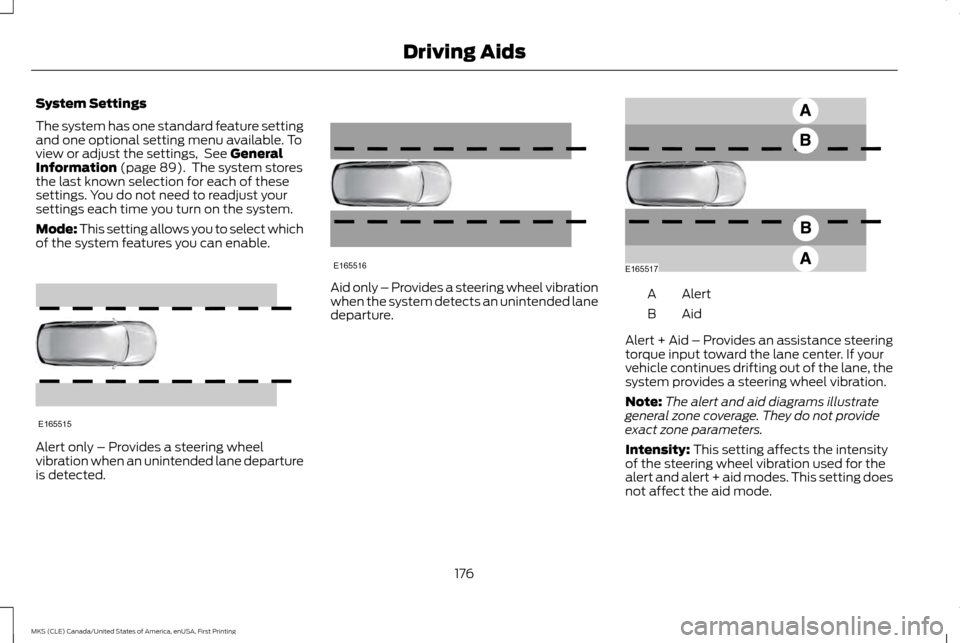
of the system features you can enable. Alert only – Provides a steering wheel
vibration when an unintended lane departure
is detected. Aid only – Provides a steering wheel vibration
when the system detects an unintended lane
departure.
Alert
A
AidB
Alert + Aid – Provides an assistance steering
torque input toward the lane center. If your
vehicle continues drifting out of the lane, the
system provides a steering wheel vibration.
Note: The alert and aid diagrams illustrate
general zone coverage. They do not provide
exact zone parameters.
Intensity:
This setting affects the intensity
of the steering wheel vibration used for the
alert and alert + aid modes. This setting does
not affect the aid mode.
176
MKS (CLE) Canada/United States of America, enUSA, First Printing Driving AidsE165515 E165516 E165517