tires LINCOLN MKS 2016 Service Manual
[x] Cancel search | Manufacturer: LINCOLN, Model Year: 2016, Model line: MKS, Model: LINCOLN MKS 2016Pages: 382, PDF Size: 3.81 MB
Page 295 of 382
5.
Remove the second wing nut that secures
the jack retention bracket by turning it
counterclockwise. Then remove the jack
kit from your vehicle.
6. Remove the jack and the wrench from the felt bag. Fold down the wrench socket
used to loosen the lug nuts and to
operate the jack.
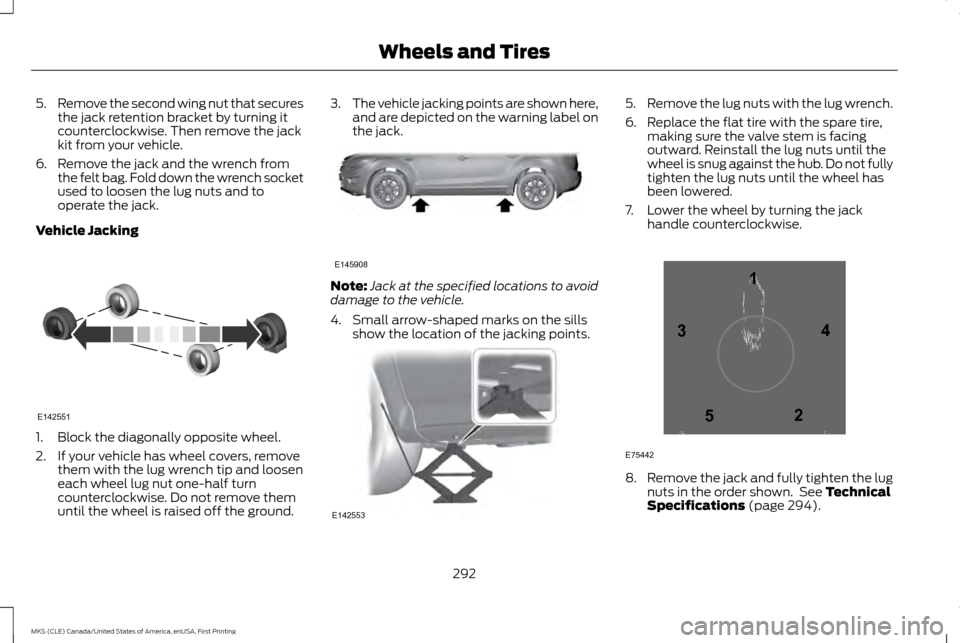
Vehicle Jacking 1. Block the diagonally opposite wheel.
2. If your vehicle has wheel covers, remove
them with the lug wrench tip and loosen
each wheel lug nut one-half turn
counterclockwise. Do not remove them
until the wheel is raised off the ground. 3.
The vehicle jacking points are shown here,
and are depicted on the warning label on
the jack. Note:
Jack at the specified locations to avoid
damage to the vehicle.
4. Small arrow-shaped marks on the sills show the location of the jacking points. 5.
Remove the lug nuts with the lug wrench.
6. Replace the flat tire with the spare tire, making sure the valve stem is facing
outward. Reinstall the lug nuts until the
wheel is snug against the hub. Do not fully
tighten the lug nuts until the wheel has
been lowered.
7. Lower the wheel by turning the jack handle counterclockwise. 8.
Remove the jack and fully tighten the lug
nuts in the order shown. See Technical
Specifications (page 294).
292
MKS (CLE) Canada/United States of America, enUSA, First Printing Wheels and TiresE142551 E145908 E142553 12
3
4
5
E75442
Page 296 of 382
9. Put the flat tire, jack and lug wrench
away. Make sure the jack is fastened so
it does not rattle when you drive. Unblock
the wheels.
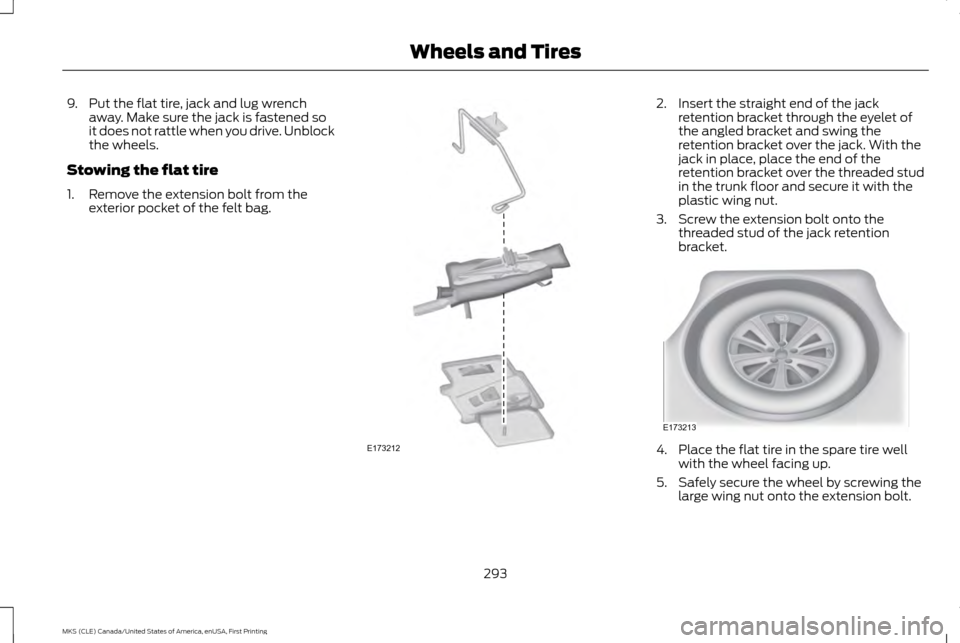
Stowing the flat tire
1. Remove the extension bolt from the exterior pocket of the felt bag. 2. Insert the straight end of the jack
retention bracket through the eyelet of
the angled bracket and swing the
retention bracket over the jack. With the
jack in place, place the end of the
retention bracket over the threaded stud
in the trunk floor and secure it with the
plastic wing nut.
3. Screw the extension bolt onto the threaded stud of the jack retention
bracket. 4. Place the flat tire in the spare tire well
with the wheel facing up.
5. Safely secure the wheel by screwing the large wing nut onto the extension bolt.
293
MKS (CLE) Canada/United States of America, enUSA, First Printing Wheels and TiresE173212 E173213
Page 297 of 382
Note:
If you are stowing the temporary spare
tire, place the tire over the jack and secure it
with the large wing nut.
TECHNICAL SPECIFICATIONS
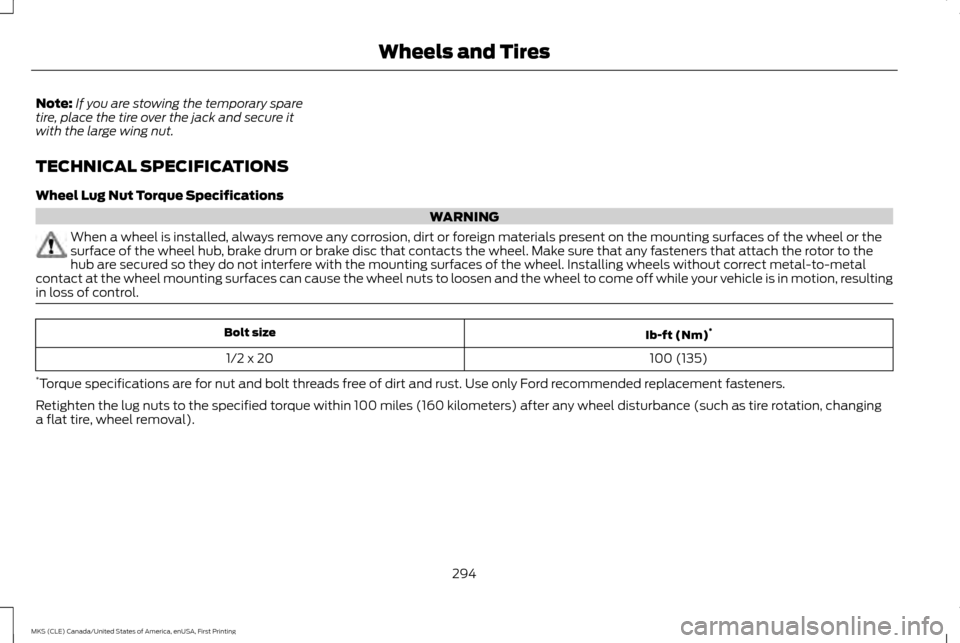
Wheel Lug Nut Torque Specifications WARNING
When a wheel is installed, always remove any corrosion, dirt or foreign materials present on the mounting surfaces of the wheel or the
surface of the wheel hub, brake drum or brake disc that contacts the wheel. Make sure that any fasteners that attach the rotor to the
hub are secured so they do not interfere with the mounting surfaces of the wheel. Installing wheels without correct metal-to-metal
contact at the wheel mounting surfaces can cause the wheel nuts to loosen and the wheel to come off while your vehicle is in motion, resulting
in loss of control. Ib-ft (Nm)
*
Bolt size
100 (135)
1/2 x 20
* Torque specifications are for nut and bolt threads free of dirt and rust. Use only Ford recommended replacement fasteners.
Retighten the lug nuts to the specified torque within 100 miles (160 kilometers) after any wheel disturbance (such as tire rotation, changing
a flat tire, wheel removal).
294
MKS (CLE) Canada/United States of America, enUSA, First Printing Wheels and Tires
Page 298 of 382
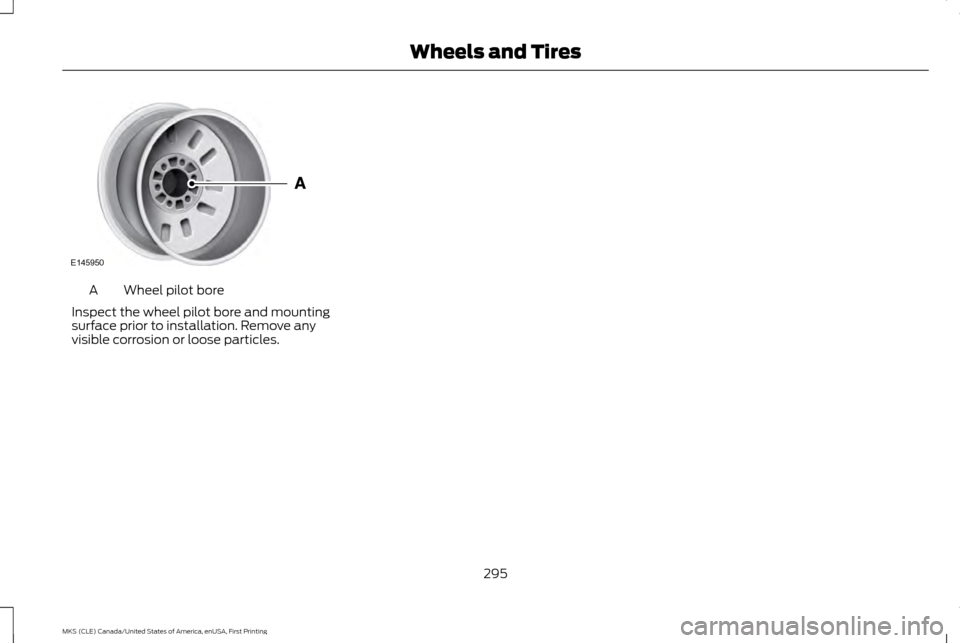
Wheel pilot bore
A
Inspect the wheel pilot bore and mounting
surface prior to installation. Remove any
visible corrosion or loose particles.
295
MKS (CLE) Canada/United States of America, enUSA, First Printing Wheels and TiresE145950
Page 326 of 382
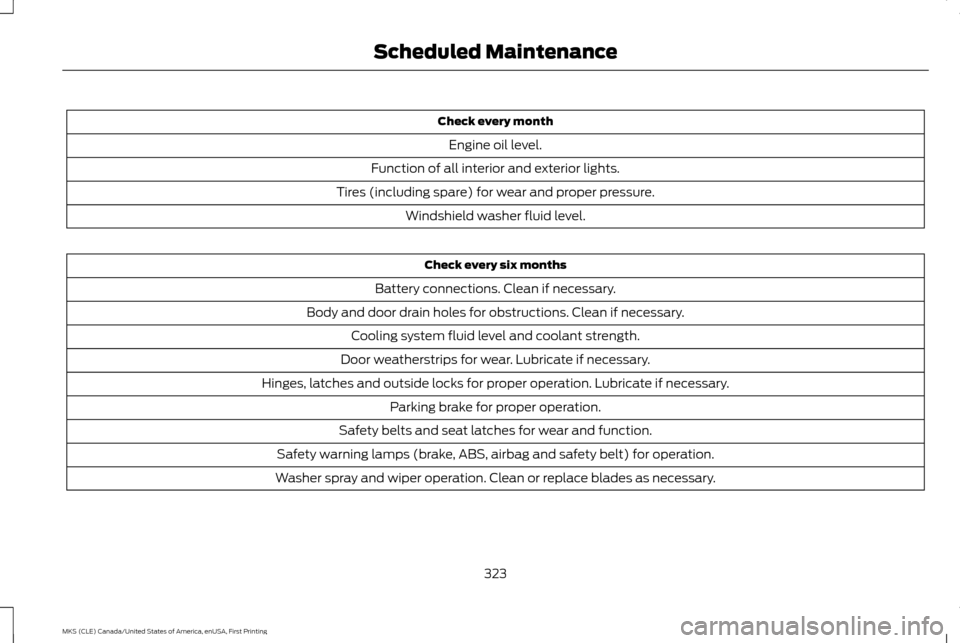
Check every month
Engine oil level.
Function of all interior and exterior lights.
Tires (including spare) for wear and proper pressure. Windshield washer fluid level. Check every six months
Battery connections. Clean if necessary.
Body and door drain holes for obstructions. Clean if necessary. Cooling system fluid level and coolant strength.
Door weatherstrips for wear. Lubricate if necessary.
Hinges, latches and outside locks for proper operation. Lubricate if necessary. Parking brake for proper operation.
Safety belts and seat latches for wear and function.
Safety warning lamps (brake, ABS, airbag and safety belt) for operation.
Washer spray and wiper operation. Clean or replace blades as necessary.
323
MKS (CLE) Canada/United States of America, enUSA, First Printing Scheduled Maintenance
Page 327 of 382
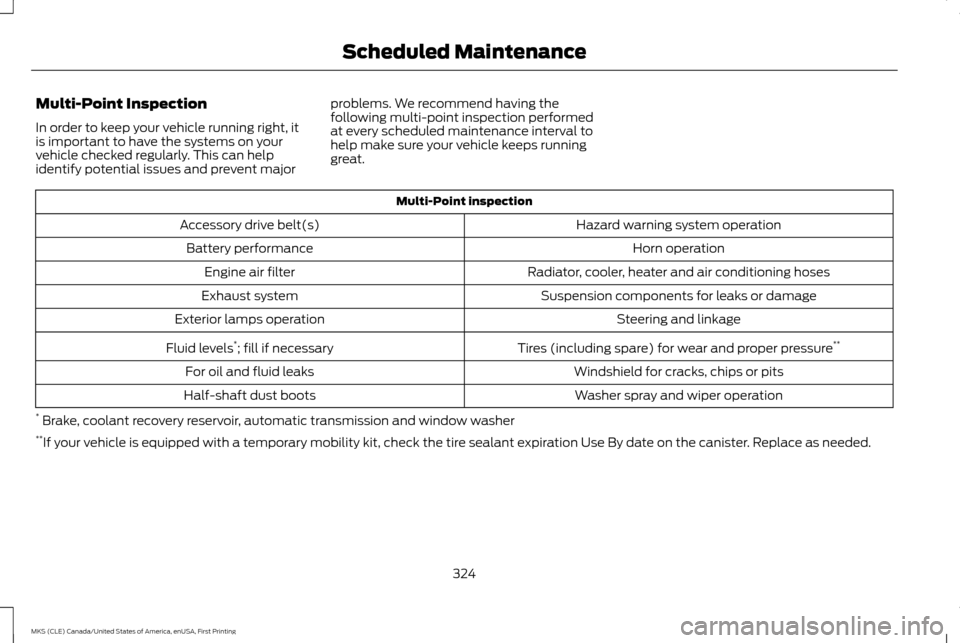
Multi-Point Inspection
In order to keep your vehicle running right, it
is important to have the systems on your
vehicle checked regularly. This can help
identify potential issues and prevent major
problems. We recommend having the
following multi-point inspection performed
at every scheduled maintenance interval to
help make sure your vehicle keeps running
great. Multi-Point inspection
Hazard warning system operation
Accessory drive belt(s)
Horn operation
Battery performance
Radiator, cooler, heater and air conditioning hoses
Engine air filter
Suspension components for leaks or damage
Exhaust system
Steering and linkage
Exterior lamps operation
Tires (including spare) for wear and proper pressure**
Fluid levels *
; fill if necessary
Windshield for cracks, chips or pits
For oil and fluid leaks
Washer spray and wiper operation
Half-shaft dust boots
* Brake, coolant recovery reservoir, automatic transmission and window washer
** If your vehicle is equipped with a temporary mobility kit, check the tire sealant expiration Use By date on the canister. Replace as needed.
324
MKS (CLE) Canada/United States of America, enUSA, First Printing Scheduled Maintenance
Page 329 of 382
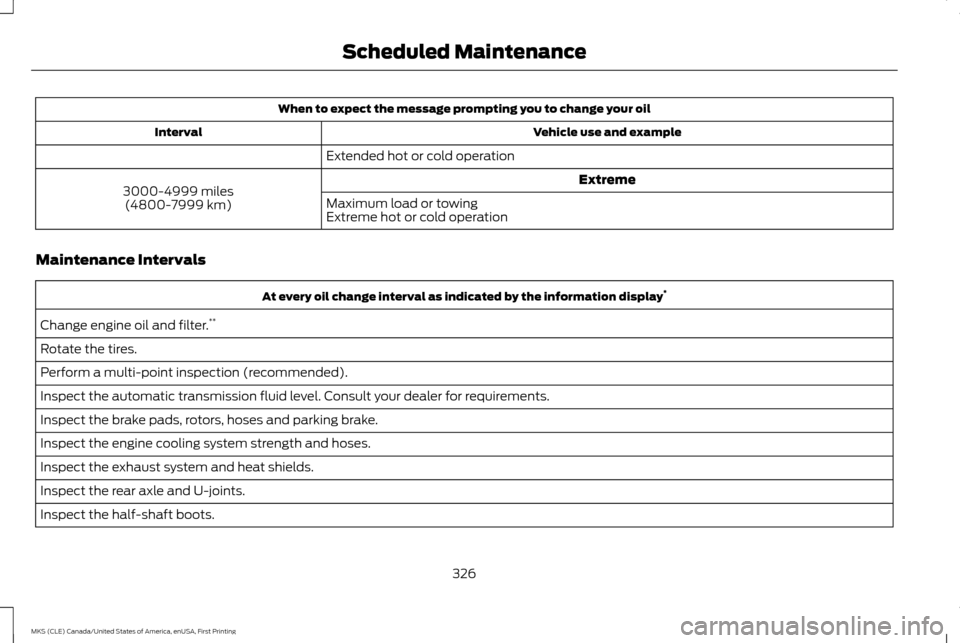
When to expect the message prompting you to change your oil
Vehicle use and example
Interval
Extended hot or cold operation Extreme
3000-4999 miles
(4800-7999 km) Maximum load or towing
Extreme hot or cold operation
Maintenance Intervals At every oil change interval as indicated by the information display
*
Change engine oil and filter. **
Rotate the tires.
Perform a multi-point inspection (recommended).
Inspect the automatic transmission fluid level. Consult your dealer for requirements.
Inspect the brake pads, rotors, hoses and parking brake.
Inspect the engine cooling system strength and hoses.
Inspect the exhaust system and heat shields.
Inspect the rear axle and U-joints.
Inspect the half-shaft boots.
326
MKS (CLE) Canada/United States of America, enUSA, First Printing Scheduled Maintenance
Page 330 of 382
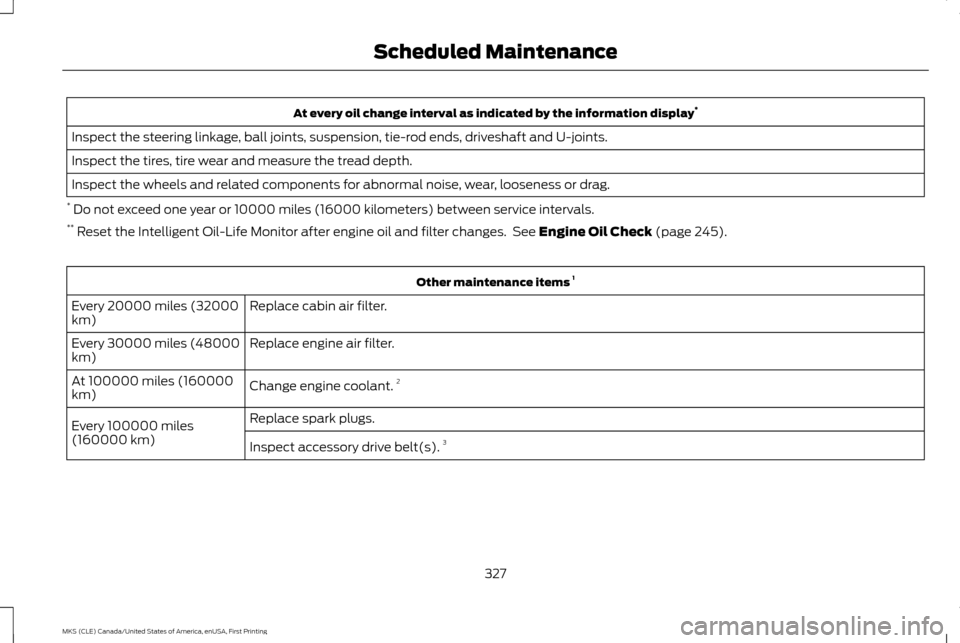
At every oil change interval as indicated by the information display
*
Inspect the steering linkage, ball joints, suspension, tie-rod ends, driveshaft and U-joints.
Inspect the tires, tire wear and measure the tread depth.
Inspect the wheels and related components for abnormal noise, wear, looseness or drag.
* Do not exceed one year or 10000 miles (16000 kilometers) between service intervals.
** Reset the Intelligent Oil-Life Monitor after engine oil and filter changes. See Engine Oil Check (page 245). Other maintenance items
1
Replace cabin air filter.
Every 20000 miles (32000
km)
Replace engine air filter.
Every 30000 miles (48000
km)
Change engine coolant.2
At 100000 miles (160000
km)
Replace spark plugs.
Every 100000 miles
(160000 km) Inspect accessory drive belt(s). 3
327
MKS (CLE) Canada/United States of America, enUSA, First Printing Scheduled Maintenance
Page 333 of 382
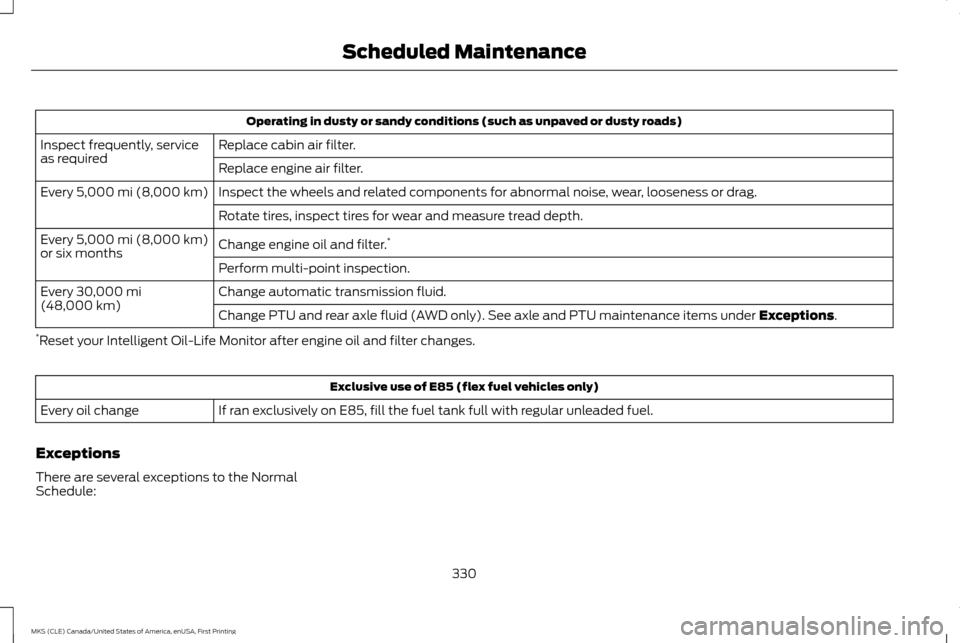
Operating in dusty or sandy conditions (such as unpaved or dusty roads)
Replace cabin air filter.
Inspect frequently, service
as required
Replace engine air filter.
Inspect the wheels and related components for abnormal noise, wear, looseness or drag.
Every 5,000 mi (8,000 km)
Rotate tires, inspect tires for wear and measure tread depth.
Change engine oil and filter. *
Every
5,000 mi (8,000 km)
or six months
Perform multi-point inspection.
Change automatic transmission fluid.
Every
30,000 mi
(48,000 km) Change PTU and rear axle fluid (AWD only). See axle and PTU maintenance items under
Exceptions.
* Reset your Intelligent Oil-Life Monitor after engine oil and filter changes. Exclusive use of E85 (flex fuel vehicles only)
If ran exclusively on E85, fill the fuel tank full with regular unleaded fuel.
Every oil change
Exceptions
There are several exceptions to the Normal
Schedule:
330
MKS (CLE) Canada/United States of America, enUSA, First Printing Scheduled Maintenance
Page 380 of 382
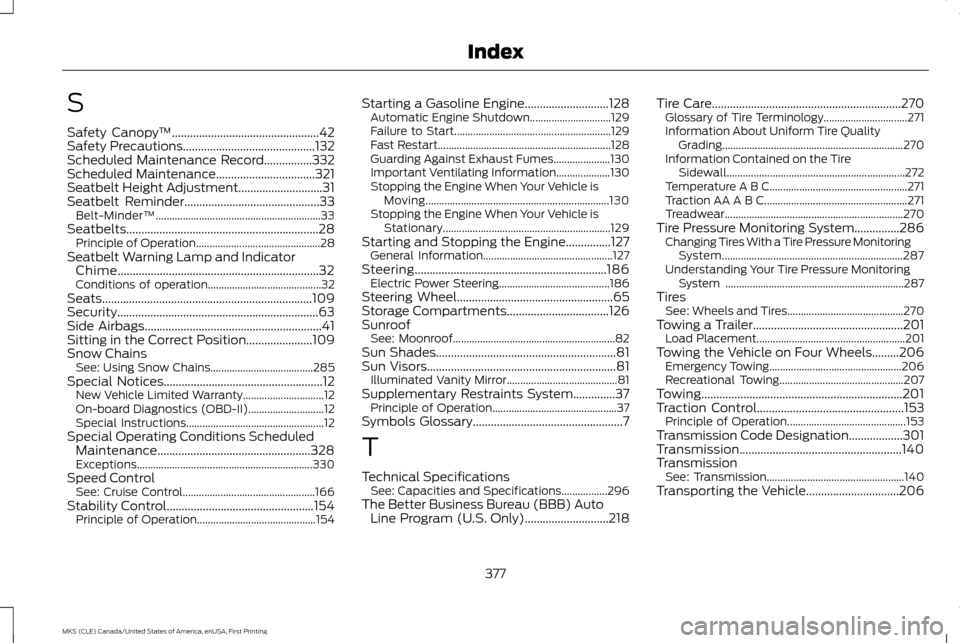
S
Safety Canopy
™.................................................42
Safety Precautions............................................132
Scheduled Maintenance Record................332
Scheduled Maintenance
.................................321
Seatbelt Height Adjustment............................31
Seatbelt Reminder
.............................................33
Belt-Minder™............................................................. 33
Seatbelts................................................................28 Principle of Operation.............................................. 28
Seatbelt Warning Lamp and Indicator Chime...................................................................32
Conditions of operation.......................................... 32
Seats
......................................................................109
Security...................................................................63
Side Airbags...........................................................41
Sitting in the Correct Position......................109
Snow Chains See: Using Snow Chains...................................... 285
Special Notices
.....................................................12
New Vehicle Limited Warranty.............................. 12
On-board Diagnostics (OBD-II)............................ 12
Special Instructions................................................... 12
Special Operating Conditions Scheduled Maintenance...................................................328
Exceptions................................................................. 330
Speed Control See: Cruise Control................................................. 166
Stability Control
.................................................154
Principle of Operation............................................ 154Starting a Gasoline Engine
............................128
Automatic Engine Shutdown.............................. 129
Failure to Start.......................................................... 129
Fast Restart................................................................ 128
Guarding Against Exhaust Fumes..................... 130
Important Ventilating Information.................... 130
Stopping the Engine When Your Vehicle is Moving.................................................................... 130
Stopping the Engine When Your Vehicle is Stationary.............................................................. 129
Starting and Stopping the Engine
...............127
General Information................................................ 127
Steering................................................................186 Electric Power Steering......................................... 186
Steering Wheel....................................................65
Storage Compartments
..................................126
Sunroof See: Moonroof............................................................ 82
Sun Shades
............................................................81
Sun Visors...............................................................81
Illuminated Vanity Mirror......................................... 81
Supplementary Restraints System..............37 Principle of Operation.............................................. 37
Symbols Glossary..................................................7
T
Technical Specifications See: Capacities and Specifications.................296
The Better Business Bureau (BBB) Auto Line Program (U.S. Only)............................218 Tire Care...............................................................270
Glossary of Tire Terminology............................... 271
Information About Uniform Tire Quality Grading................................................................... 270
Information Contained on the Tire Sidewall.................................................................. 272
Temperature A B C................................................... 271
Traction AA A B C..................................................... 271
Treadwear.................................................................. 270
Tire Pressure Monitoring System...............286 Changing Tires With a Tire Pressure Monitoring
System................................................................... 287
Understanding Your Tire Pressure Monitoring System .................................................................. 287
Tires See: Wheels and Tires........................................... 270
Towing a Trailer
..................................................201
Load Placement....................................................... 201
Towing the Vehicle on Four Wheels.........206 Emergency Towing................................................. 206
Recreational Towing.............................................. 207
Towing...................................................................201
Traction Control
.................................................153
Principle of Operation............................................ 153
Transmission Code Designation..................301
Transmission......................................................140
Transmission See: Transmission................................................... 140
Transporting the Vehicle...............................206
377
MKS (CLE) Canada/United States of America, enUSA, First Printing Index