change time LINCOLN MKS 2016 Owners Manual
[x] Cancel search | Manufacturer: LINCOLN, Model Year: 2016, Model line: MKS, Model: LINCOLN MKS 2016Pages: 382, PDF Size: 3.81 MB
Page 2 of 382

The information contained in this publication was correct at the time of going to print. In the interest of continuous development, we reserve the right to change specifications, design
or equipment at any time without notice or obligation. No part of this publication may be reproduced, transmitted, stored in a retrieval system or translated into any language in any
form by any means without our written permission. Errors and omissions excepted.
© Ford Motor Company 2015
All rights reserved.
Part Number: 20151009202856
Page 34 of 382
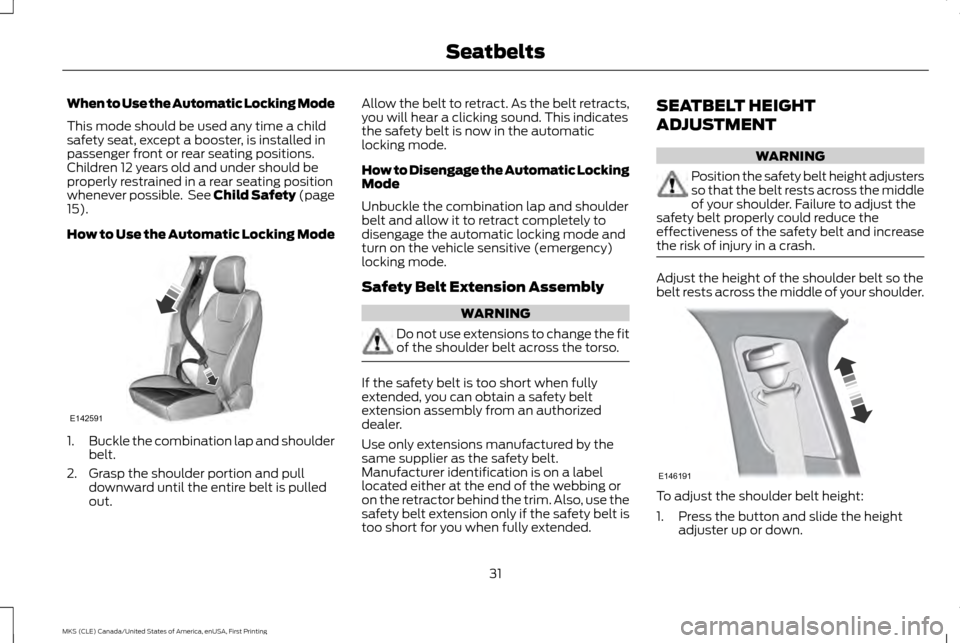
When to Use the Automatic Locking Mode
This mode should be used any time a child
safety seat, except a booster, is installed in
passenger front or rear seating positions.
Children 12 years old and under should be
properly restrained in a rear seating position
whenever possible. See Child Safety (page
15).
How to Use the Automatic Locking Mode 1.
Buckle the combination lap and shoulder
belt.
2. Grasp the shoulder portion and pull downward until the entire belt is pulled
out. Allow the belt to retract. As the belt retracts,
you will hear a clicking sound. This indicates
the safety belt is now in the automatic
locking mode.
How to Disengage the Automatic Locking
Mode
Unbuckle the combination lap and shoulder
belt and allow it to retract completely to
disengage the automatic locking mode and
turn on the vehicle sensitive (emergency)
locking mode.
Safety Belt Extension Assembly
WARNING
Do not use extensions to change the fit
of the shoulder belt across the torso.
If the safety belt is too short when fully
extended, you can obtain a safety belt
extension assembly from an authorized
dealer.
Use only extensions manufactured by the
same supplier as the safety belt.
Manufacturer identification is on a label
located either at the end of the webbing or
on the retractor behind the trim. Also, use the
safety belt extension only if the safety belt is
too short for you when fully extended.SEATBELT HEIGHT
ADJUSTMENT WARNING
Position the safety belt height adjusters
so that the belt rests across the middle
of your shoulder. Failure to adjust the
safety belt properly could reduce the
effectiveness of the safety belt and increase
the risk of injury in a crash. Adjust the height of the shoulder belt so the
belt rests across the middle of your shoulder.
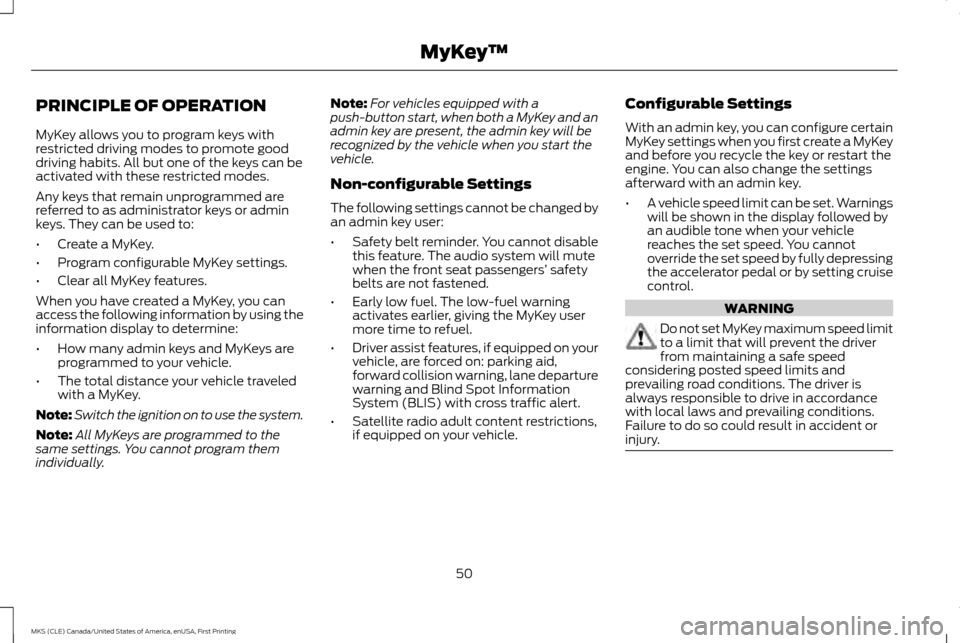
To adjust the shoulder belt height:
1. Press the button and slide the height
adjuster up or down.
31
MKS (CLE) Canada/United States of America, enUSA, First Printing SeatbeltsE142591 E146191
Page 53 of 382
PRINCIPLE OF OPERATION
MyKey allows you to program keys with
restricted driving modes to promote good
driving habits. All but one of the keys can be
activated with these restricted modes.
Any keys that remain unprogrammed are
referred to as administrator keys or admin
keys. They can be used to:
•
Create a MyKey.
• Program configurable MyKey settings.
• Clear all MyKey features.
When you have created a MyKey, you can
access the following information by using the
information display to determine:
• How many admin keys and MyKeys are
programmed to your vehicle.
• The total distance your vehicle traveled
with a MyKey.
Note: Switch the ignition on to use the system.
Note: All MyKeys are programmed to the
same settings. You cannot program them
individually. Note:
For vehicles equipped with a
push-button start, when both a MyKey and an
admin key are present, the admin key will be
recognized by the vehicle when you start the
vehicle.
Non-configurable Settings
The following settings cannot be changed by
an admin key user:
• Safety belt reminder. You cannot disable
this feature. The audio system will mute
when the front seat passengers’ safety
belts are not fastened.
• Early low fuel. The low-fuel warning
activates earlier, giving the MyKey user
more time to refuel.
• Driver assist features, if equipped on your
vehicle, are forced on: parking aid,
forward collision warning, lane departure
warning and Blind Spot Information
System (BLIS) with cross traffic alert.
• Satellite radio adult content restrictions,
if equipped on your vehicle. Configurable Settings
With an admin key, you can configure certain
MyKey settings when you first create a MyKey
and before you recycle the key or restart the
engine. You can also change the settings
afterward with an admin key.
•
A vehicle speed limit can be set. Warnings
will be shown in the display followed by
an audible tone when your vehicle
reaches the set speed. You cannot
override the set speed by fully depressing
the accelerator pedal or by setting cruise
control. WARNING
Do not set MyKey maximum speed limit
to a limit that will prevent the driver
from maintaining a safe speed
considering posted speed limits and
prevailing road conditions. The driver is
always responsible to drive in accordance
with local laws and prevailing conditions.
Failure to do so could result in accident or
injury. 50
MKS (CLE) Canada/United States of America, enUSA, First Printing MyKey
™
Page 55 of 382
Action and Description
Message
Press the OK button or the right arrow key.
Settings
Press the
OK button or the right arrow key.
MyKey
Note: You can clear or change your MyKey
settings at any time during the same key cycle
as you created the MyKey. Once you have
switched the vehicle off, however, you will
need an admin key to change or clear your
MyKey settings. CLEARING ALL MYKEYS
You can clear or change your MyKey settings
using the information display control on the
steering wheel. See
Information Displays
(page 89). Switch the ignition on using an admin key or
remote control.
To clear all MyKeys of all MyKey settings, press the left arrow button to access the main menu and scroll to: Action and Description
Message
Press the
OK button.
Settings
Press the
OK button.
MyKey
Press and hold the
OK button until the following message displays.
Clear MyKey
All MyKeys
Cleared
Note: When you clear your MyKeys, you remove all restrictions and return all MyKeys to their original admin key status.
52
MKS (CLE) Canada/United States of America, enUSA, First Printing MyKey
™
Page 59 of 382
LOCKING AND UNLOCKING
You can use the power door lock control or
the remote control to lock and unlock your
vehicle.
Power Door Locks
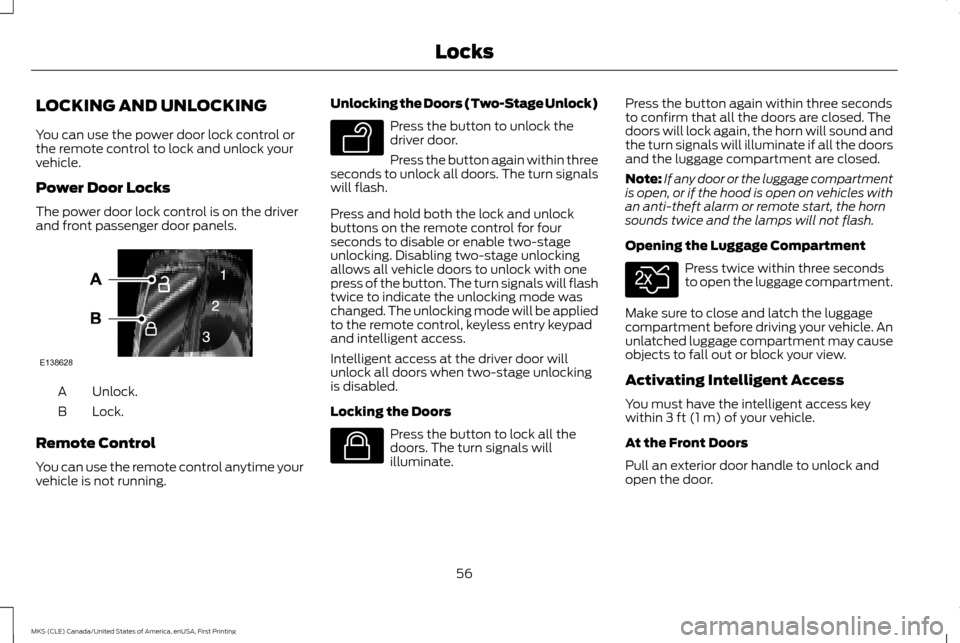
The power door lock control is on the driver
and front passenger door panels.
Unlock.
A
Lock.
B
Remote Control
You can use the remote control anytime your
vehicle is not running. Unlocking the Doors (Two-Stage Unlock) Press the button to unlock the
driver door.
Press the button again within three
seconds to unlock all doors. The turn signals
will flash.
Press and hold both the lock and unlock
buttons on the remote control for four
seconds to disable or enable two-stage
unlocking. Disabling two-stage unlocking
allows all vehicle doors to unlock with one
press of the button. The turn signals will flash
twice to indicate the unlocking mode was
changed. The unlocking mode will be applied
to the remote control, keyless entry keypad
and intelligent access.
Intelligent access at the driver door will
unlock all doors when two-stage unlocking
is disabled.
Locking the Doors Press the button to lock all the
doors. The turn signals will
illuminate.Press the button again within three seconds
to confirm that all the doors are closed. The
doors will lock again, the horn will sound and
the turn signals will illuminate if all the doors
and the luggage compartment are closed.
Note:
If any door or the luggage compartment
is open, or if the hood is open on vehicles with
an anti-theft alarm or remote start, the horn
sounds twice and the lamps will not flash.
Opening the Luggage Compartment Press twice within three seconds
to open the luggage compartment.
Make sure to close and latch the luggage
compartment before driving your vehicle. An
unlatched luggage compartment may cause
objects to fall out or block your view.
Activating Intelligent Access
You must have the intelligent access key
within 3 ft (1 m) of your vehicle.
At the Front Doors
Pull an exterior door handle to unlock and
open the door.
56
MKS (CLE) Canada/United States of America, enUSA, First Printing LocksE138628 E138629 E138623 E138630
Page 74 of 382
GENERAL INFORMATION
Condensation in Lamp Assemblies
Exterior lamps have vents to accommodate
normal changes in air pressure.
Condensation can be a natural by-product
of this design. When moist air enters the lamp
assembly through the vents, there is a
possibility that condensation can occur when
the temperature is cold. When normal
condensation occurs, a fine mist can form on
the interior of the lens. The fine mist
eventually clears and exits through the vents
during normal operation.
Clearing time may take as long as 48 hours
under dry weather conditions.
Examples of acceptable condensation are:
•
The presence of a fine mist (no streaks,
drip marks or large droplets).
• A fine mist covers less than 50% of the
lens.
Examples of unacceptable condensation are:
• A water puddle inside the lamp.
• Streaks, drip marks or large droplets
present on the interior of the lens. If you see any unacceptable condensation,
have your vehicle checked by an authorized
dealer.
LIGHTING CONTROL
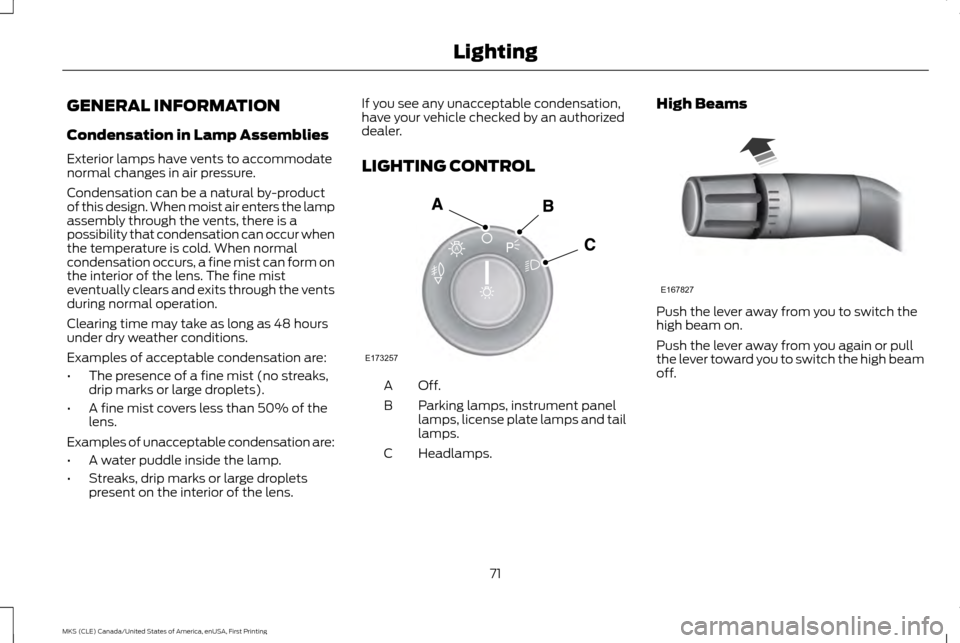
Off.A
Parking lamps, instrument panel
lamps, license plate lamps and tail
lamps.
B
Headlamps.
C High Beams
Push the lever away from you to switch the
high beam on.
Push the lever away from you again or pull
the lever toward you to switch the high beam
off.
71
MKS (CLE) Canada/United States of America, enUSA, First Printing LightingE173257
A E167827
Page 79 of 382
Note:
The system is only active at speeds
above 3 mph (5 km/h).
The system has a power-up movement check
feature. When your start your vehicle, the
lamps track left to right, then back to center
to alert the driver that the system is working
properly.
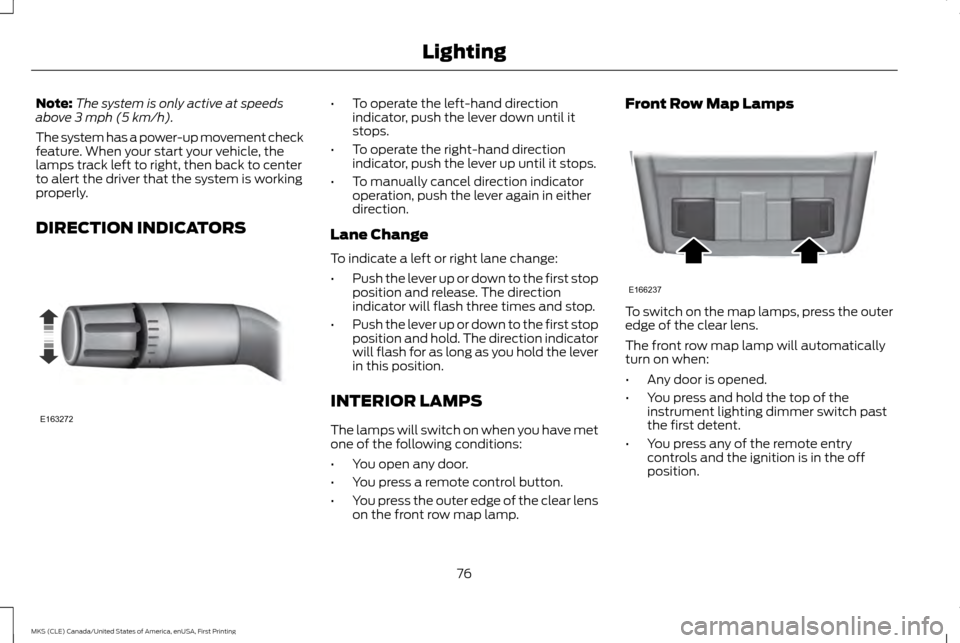
DIRECTION INDICATORS •
To operate the left-hand direction
indicator, push the lever down until it
stops.
• To operate the right-hand direction
indicator, push the lever up until it stops.
• To manually cancel direction indicator
operation, push the lever again in either
direction.
Lane Change
To indicate a left or right lane change:
• Push the lever up or down to the first stop
position and release. The direction
indicator will flash three times and stop.
• Push the lever up or down to the first stop
position and hold. The direction indicator
will flash for as long as you hold the lever
in this position.
INTERIOR LAMPS
The lamps will switch on when you have met
one of the following conditions:
• You open any door.
• You press a remote control button.
• You press the outer edge of the clear lens
on the front row map lamp. Front Row Map Lamps
To switch on the map lamps, press the outer
edge of the clear lens.
The front row map lamp will automatically
turn on when:
•
Any door is opened.
• You press and hold the top of the
instrument lighting dimmer switch past
the first detent.
• You press any of the remote entry
controls and the ignition is in the off
position.
76
MKS (CLE) Canada/United States of America, enUSA, First Printing LightingE163272 E166237
Page 124 of 382
1. Press and hold the HomeLink button
while you press and release, every two
seconds, your hand-held transmitter
until the HomeLink indicator light
changes from a slow to a rapidly blinking
light.
2. Release both the HomeLink and hand-held transmitter buttons.
3. Continue programing HomeLink. See In-Vehicle Programming
.
Erasing the Function Button Codes
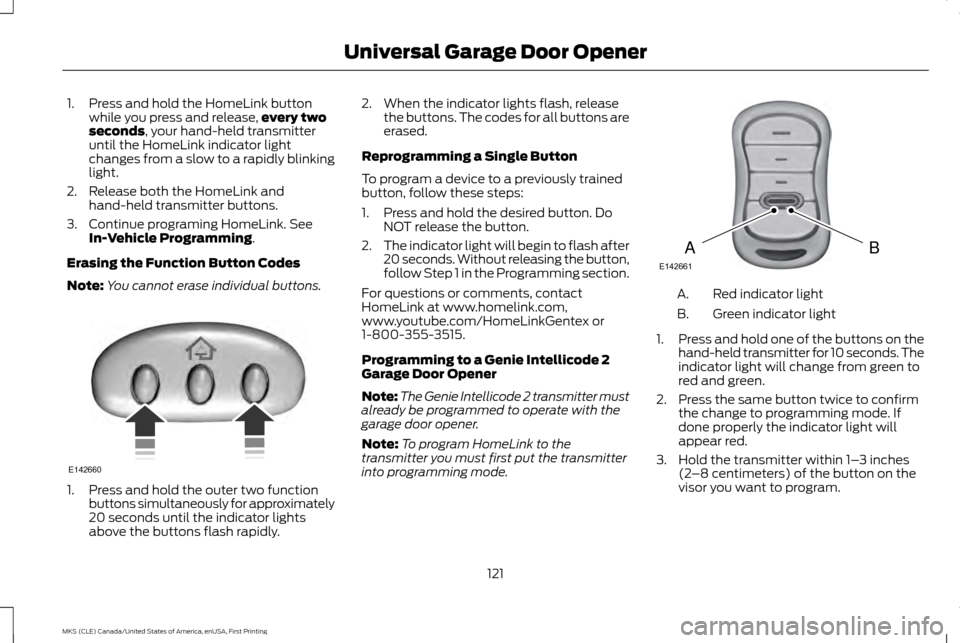
Note: You cannot erase individual buttons. 1. Press and hold the outer two function
buttons simultaneously for approximately
20 seconds until the indicator lights
above the buttons flash rapidly. 2. When the indicator lights flash, release
the buttons. The codes for all buttons are
erased.
Reprogramming a Single Button
To program a device to a previously trained
button, follow these steps:
1. Press and hold the desired button. Do NOT release the button.
2. The indicator light will begin to flash after
20 seconds. Without releasing the button,
follow Step 1 in the Programming section.
For questions or comments, contact
HomeLink at www.homelink.com,
www.youtube.com/HomeLinkGentex or
1-800-355-3515.
Programming to a Genie Intellicode 2
Garage Door Opener
Note: The Genie Intellicode 2 transmitter must
already be programmed to operate with the
garage door opener.
Note: To program HomeLink to the
transmitter you must first put the transmitter
into programming mode. Red indicator light
A.
Green indicator light
B.
1. Press and hold one of the buttons on the
hand-held transmitter for 10 seconds. The
indicator light will change from green to
red and green.
2. Press the same button twice to confirm the change to programming mode. If
done properly the indicator light will
appear red.
3. Hold the transmitter within 1– 3 inches
(2 –8 centimeters) of the button on the
visor you want to program.
121
MKS (CLE) Canada/United States of America, enUSA, First Printing Universal Garage Door OpenerE142660 BAE142661
Page 125 of 382
4. Press and hold both the programmed
Genie button on the hand-held
transmitter and the button you want to
program. The indicator light on the visor
will flash rapidly when the programming
is successful.
Note: The Genie transmitter will transmit for
up to 30 seconds. If HomeLink does not
program within 30 seconds the Genie
transmitter will need to be pressed again. If
the Genie transmitter indicator light displays
green and red, release the button until the
indicator light turns off before pressing the
button again.
Once HomeLink has been programmed
successfully, the Genie transmitter must be
changed out of program mode. To do this:
1. Press and hold the previously programmed Genie button on the
hand-held transmitter for 10 seconds. The
indicator light will change from red to red
and green.
2. Press the same button twice to confirm the change. If done correctly the indicator
light will turn green.
Programming HomeLink to the Genie
Intellicode Garage Door Opener Motor
Note: You may need a ladder to access the
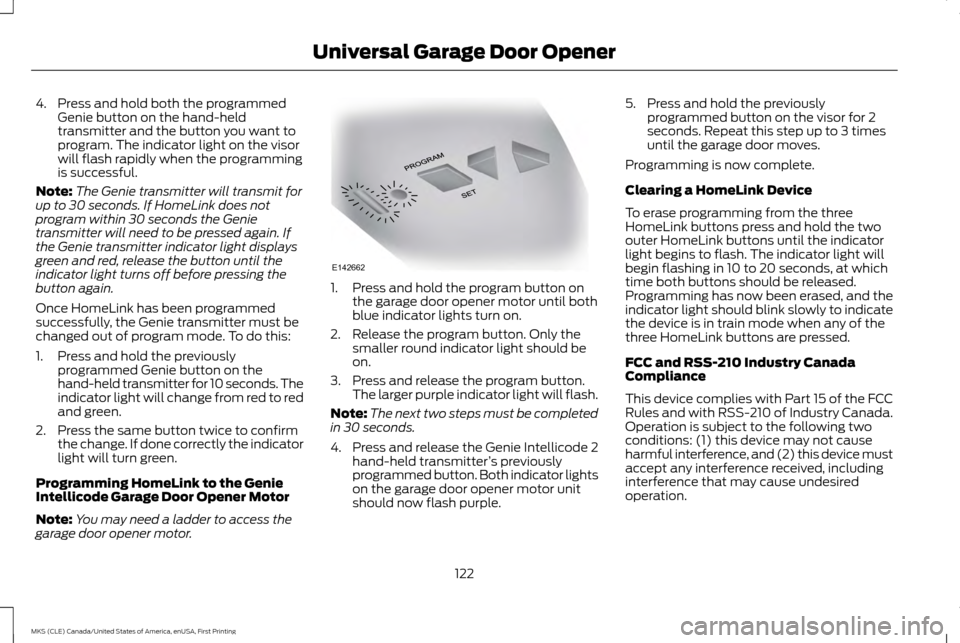
garage door opener motor. 1. Press and hold the program button on
the garage door opener motor until both
blue indicator lights turn on.
2. Release the program button. Only the smaller round indicator light should be
on.
3. Press and release the program button. The larger purple indicator light will flash.
Note: The next two steps must be completed
in 30 seconds.
4. Press and release the Genie Intellicode 2 hand-held transmitter ’s previously
programmed button. Both indicator lights
on the garage door opener motor unit
should now flash purple. 5. Press and hold the previously
programmed button on the visor for 2
seconds. Repeat this step up to 3 times
until the garage door moves.
Programming is now complete.
Clearing a HomeLink Device
To erase programming from the three
HomeLink buttons press and hold the two
outer HomeLink buttons until the indicator
light begins to flash. The indicator light will
begin flashing in 10 to 20 seconds, at which
time both buttons should be released.
Programming has now been erased, and the
indicator light should blink slowly to indicate
the device is in train mode when any of the
three HomeLink buttons are pressed.
FCC and RSS-210 Industry Canada
Compliance
This device complies with Part 15 of the FCC
Rules and with RSS-210 of Industry Canada.
Operation is subject to the following two
conditions: (1) this device may not cause
harmful interference, and (2) this device must
accept any interference received, including
interference that may cause undesired
operation.
122
MKS (CLE) Canada/United States of America, enUSA, First Printing Universal Garage Door OpenerE142662
Page 141 of 382
Do not make any unauthorized changes to
your vehicle or engine. By law, vehicle owners
and anyone who manufactures, repairs,
services, sells, leases, trades vehicles, or
supervises a fleet of vehicles are not
permitted to intentionally remove an
emission control device or prevent it from
working. Information about your vehicle
’s
emission system is on the Vehicle Emission
Control Information Decal located on or near
the engine. This decal also lists engine
displacement.
Please consult your warranty information for
complete details.
On-Board Diagnostics (OBD-II)
Your vehicle has a computer known as the
on-board diagnostics system (OBD-II) that
monitors the engine ’s emission control
system. The system protects the
environment by making sure that your vehicle
continues to meet government emission
standards. The OBD-II system also assists a
service technician in properly servicing your
vehicle. When the service engine soon
indicator illuminates, the OBD-II
system has detected a
malfunction. Temporary malfunctions may
cause the service engine soon indicator to
illuminate. Examples are:
1. Your vehicle has run out of fuel —the
engine may misfire or run poorly.
2. Poor fuel quality or water in the fuel —the
engine may misfire or run poorly.
3. The fuel fill inlet may not have closed properly. See Refueling (page 134).
4. Driving through deep water —the electrical
system may be wet.
You can correct these temporary
malfunctions by filling the fuel tank with good
quality fuel, properly closing the fuel fill inlet
or letting the electrical system dry out. After
three driving cycles without these or any
other temporary malfunctions present, the
service engine soon indicator should stay off
the next time you start the engine. A driving
cycle consists of a cold engine startup
followed by mixed city and highway driving.
No additional vehicle service is required. If the service engine soon indicator remains
on, have your vehicle serviced at the first
available opportunity. Although some
malfunctions detected by the OBD-II may
not have symptoms that are apparent,
continued driving with the service engine
soon indicator on can result in increased
emissions, lower fuel economy, reduced
engine and transmission smoothness and
lead to more costly repairs.
Readiness for Inspection and
Maintenance (I/M) Testing
Some state and provincial and local
governments may have
Inspection/Maintenance (I/M) programs to
inspect the emission control equipment on
your vehicle. Failure to pass this inspection
could prevent you from getting a vehicle
registration.
If the service engine soon indicator
is on or the bulb does not work,
your vehicle may need service. See
On-Board Diagnostics.
138
MKS (CLE) Canada/United States of America, enUSA, First Printing Fuel and Refueling