battery LINCOLN MKT 2016 Owner's Guide
[x] Cancel search | Manufacturer: LINCOLN, Model Year: 2016, Model line: MKT, Model: LINCOLN MKT 2016Pages: 452, PDF Size: 4.69 MB
Page 273 of 452
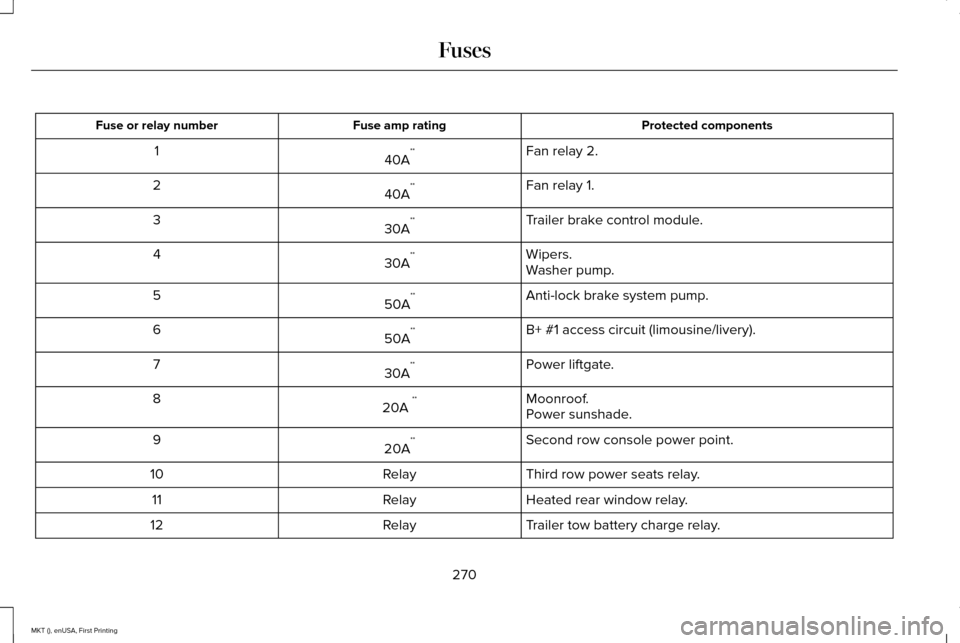
Protected components
Fuse amp rating
Fuse or relay number
Fan relay 2.
40A **
1
Fan relay 1.
40A **
2
Trailer brake control module.
30A **
3
Wipers.
30A **
4
Washer pump.
Anti-lock brake system pump.
50A **
5
B+ #1 access circuit (limousine/livery).
50A **
6
Power liftgate.
30A **
7
Moonroof.
20A **
8
Power sunshade.
Second row console power point.
20A **
9
Third row power seats relay.
Relay
10
Heated rear window relay.
Relay
11
Trailer tow battery charge relay.
Relay
12
270
MKT (), enUSA, First Printing Fuses
Page 274 of 452
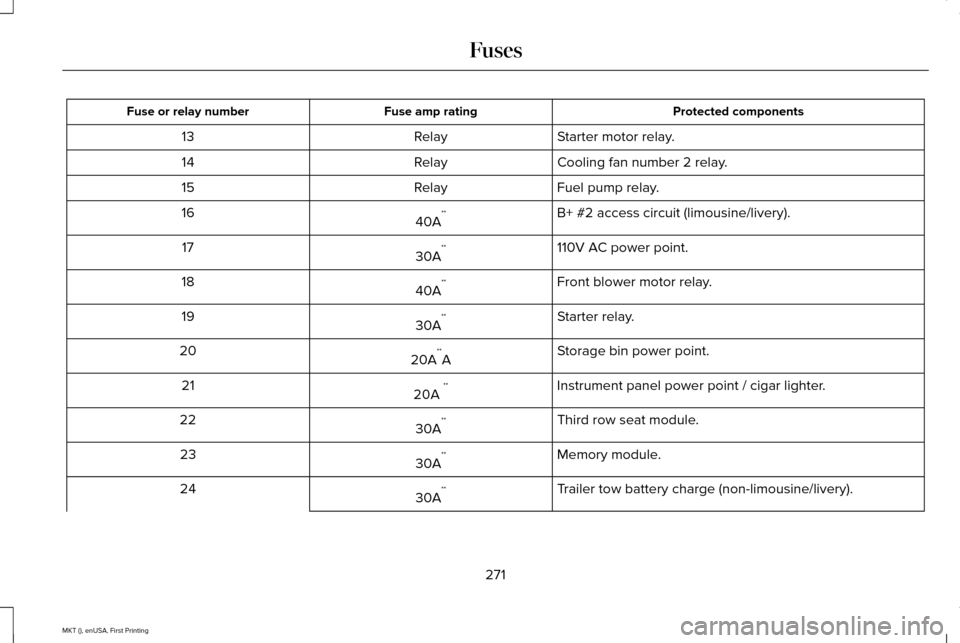
Protected components
Fuse amp rating
Fuse or relay number
Starter motor relay.
Relay
13
Cooling fan number 2 relay.
Relay
14
Fuel pump relay.
Relay
15
B+ #2 access circuit (limousine/livery).
40A **
16
110V AC power point.
30A **
17
Front blower motor relay.
40A **
18
Starter relay.
30A **
19
Storage bin power point.
20A **
A
20
Instrument panel power point / cigar lighter.
20A **
21
Third row seat module.
30A **
22
Memory module.
30A **
23
Trailer tow battery charge (non-limousine/livery).
30A **
24
271
MKT (), enUSA, First Printing Fuses
Page 279 of 452
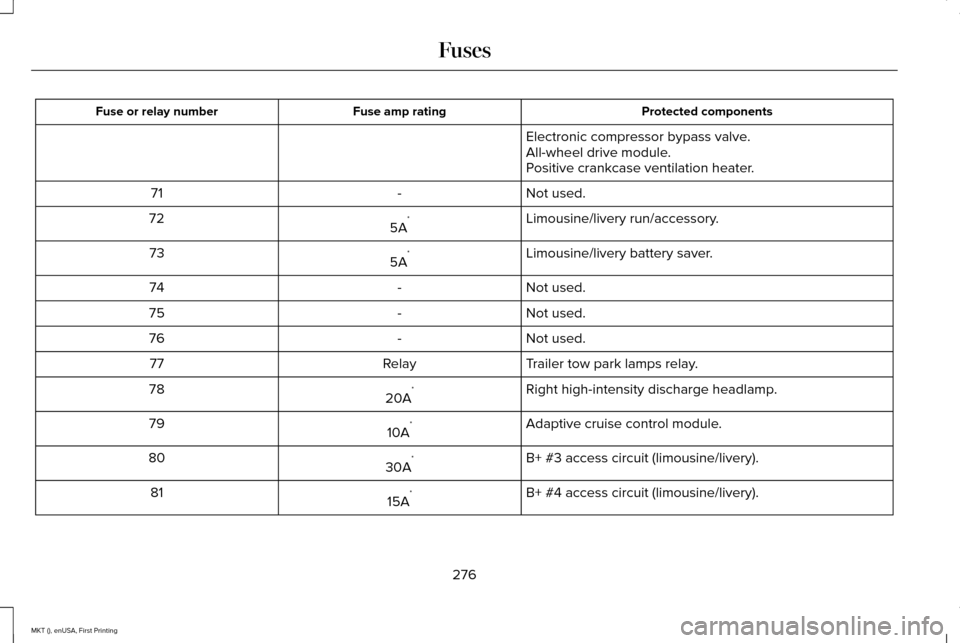
Protected components
Fuse amp rating
Fuse or relay number
Electronic compressor bypass valve.
All-wheel drive module.
Positive crankcase ventilation heater.
Not used.
-
71
Limousine/livery run/accessory.
5A *
72
Limousine/livery battery saver.
5A *
73
Not used.
-
74
Not used.
-
75
Not used.
-
76
Trailer tow park lamps relay.
Relay
77
Right high-intensity discharge headlamp.
20A *
78
Adaptive cruise control module.
10A *
79
B+ #3 access circuit (limousine/livery).
30A *
80
B+ #4 access circuit (limousine/livery).
15A *
81
276
MKT (), enUSA, First Printing Fuses
Page 281 of 452
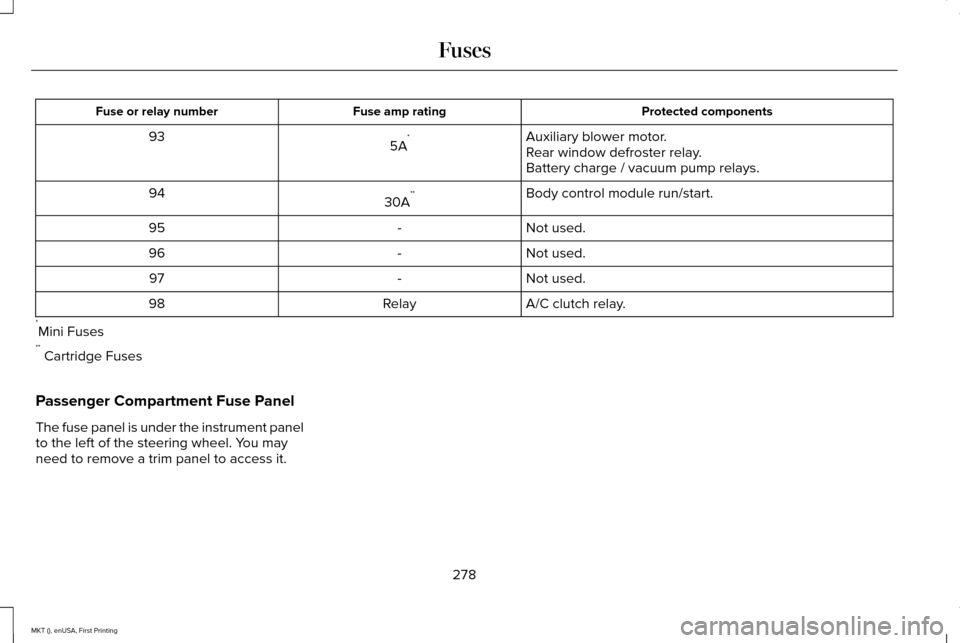
Protected components
Fuse amp rating
Fuse or relay number
Auxiliary blower motor.
5A *
93
Rear window defroster relay.
Battery charge / vacuum pump relays.
Body control module run/start.
30A **
94
Not used.
-
95
Not used.
-
96
Not used.
-
97
A/C clutch relay.
Relay
98
* Mini Fuses
** Cartridge Fuses
Passenger Compartment Fuse Panel
The fuse panel is under the instrument panel
to the left of the steering wheel. You may
need to remove a trim panel to access it.
278
MKT (), enUSA, First Printing Fuses
Page 283 of 452
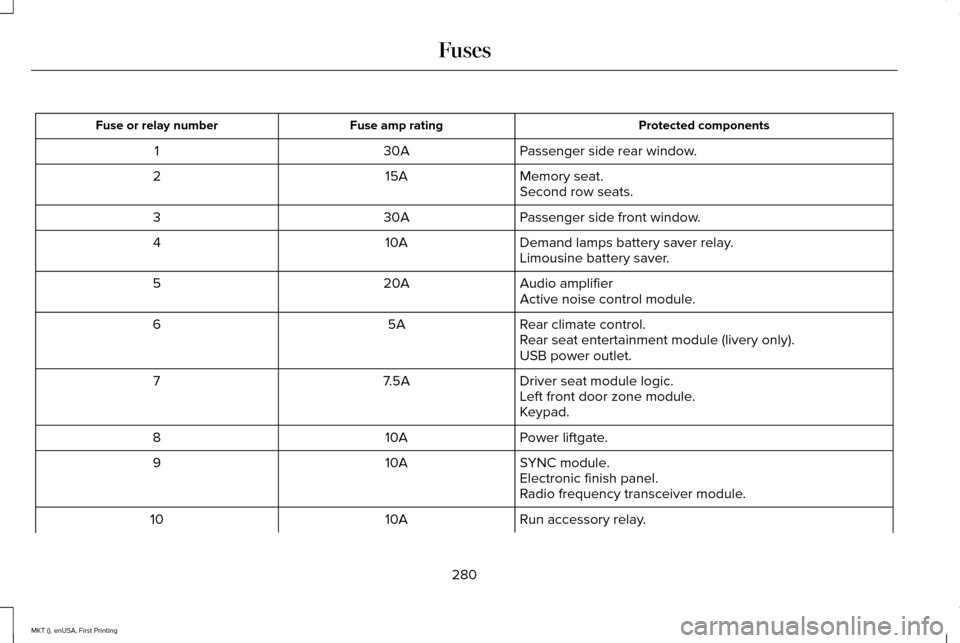
Protected components
Fuse amp rating
Fuse or relay number
Passenger side rear window.
30A
1
Memory seat.
15A
2
Second row seats.
Passenger side front window.
30A
3
Demand lamps battery saver relay.
10A
4
Limousine battery saver.
Audio amplifier
20A
5
Active noise control module.
Rear climate control.
5A
6
Rear seat entertainment module (livery only).
USB power outlet.
Driver seat module logic.
7.5A
7
Left front door zone module.
Keypad.
Power liftgate.
10A
8
SYNC module.
10A
9
Electronic finish panel.
Radio frequency transceiver module.
Run accessory relay.
10A
10
280
MKT (), enUSA, First Printing Fuses
Page 289 of 452
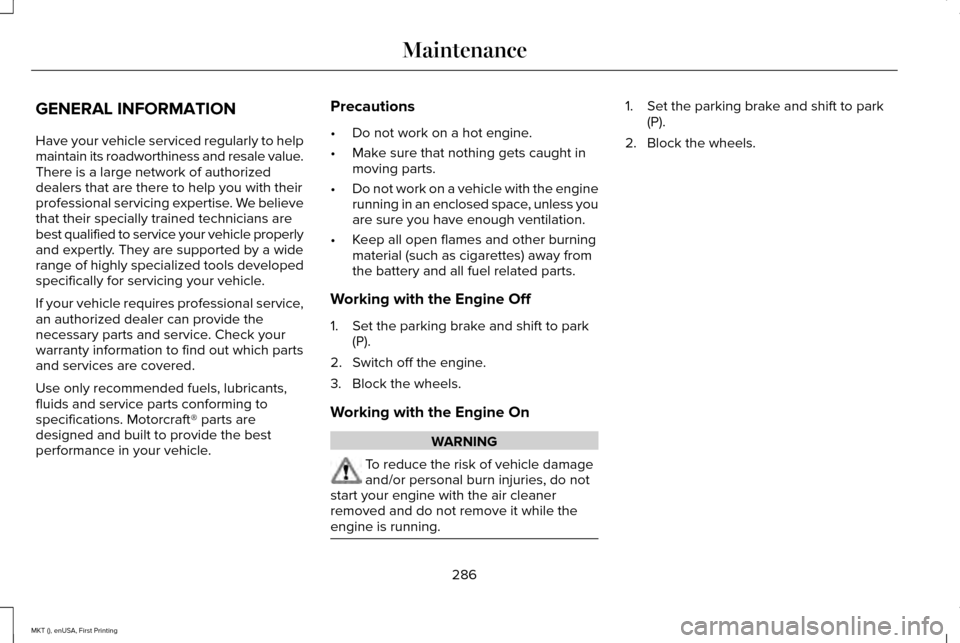
GENERAL INFORMATION
Have your vehicle serviced regularly to help
maintain its roadworthiness and resale value.
There is a large network of authorized
dealers that are there to help you with their
professional servicing expertise. We believe
that their specially trained technicians are
best qualified to service your vehicle properly
and expertly. They are supported by a wide
range of highly specialized tools developed
specifically for servicing your vehicle.
If your vehicle requires professional service,
an authorized dealer can provide the
necessary parts and service. Check your
warranty information to find out which parts
and services are covered.
Use only recommended fuels, lubricants,
fluids and service parts conforming to
specifications. Motorcraft® parts are
designed and built to provide the best
performance in your vehicle.
Precautions
•
Do not work on a hot engine.
• Make sure that nothing gets caught in
moving parts.
• Do not work on a vehicle with the engine
running in an enclosed space, unless you
are sure you have enough ventilation.
• Keep all open flames and other burning
material (such as cigarettes) away from
the battery and all fuel related parts.
Working with the Engine Off
1. Set the parking brake and shift to park (P).
2. Switch off the engine.
3. Block the wheels.
Working with the Engine On WARNING
To reduce the risk of vehicle damage
and/or personal burn injuries, do not
start your engine with the air cleaner
removed and do not remove it while the
engine is running. 1. Set the parking brake and shift to park
(P).
2. Block the wheels.
286
MKT (), enUSA, First Printing Maintenance
Page 292 of 452
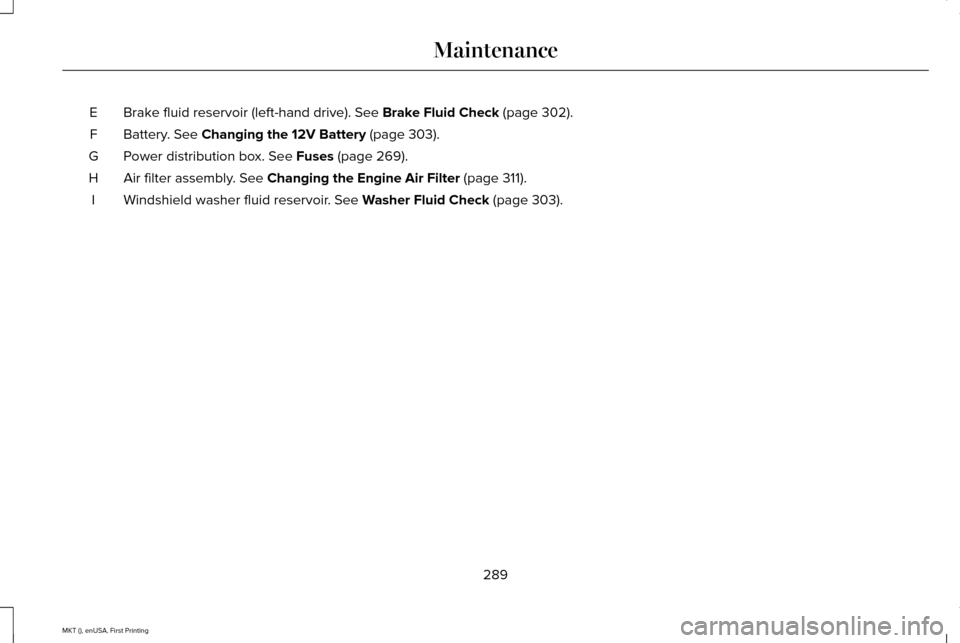
Brake fluid reservoir (left-hand drive). See Brake Fluid Check (page 302).
E
Battery.
See Changing the 12V Battery (page 303).
F
Power distribution box.
See Fuses (page 269).
G
Air filter assembly.
See Changing the Engine Air Filter (page 311).
H
Windshield washer fluid reservoir.
See Washer Fluid Check (page 303).
I
289
MKT (), enUSA, First Printing Maintenance
Page 294 of 452
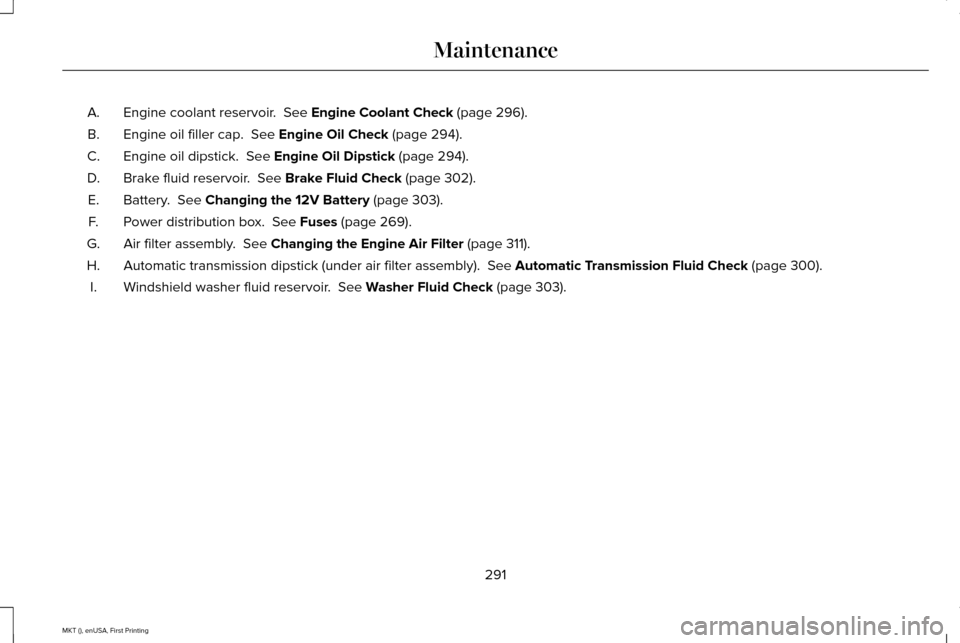
Engine coolant reservoir. See Engine Coolant Check (page 296).
A.
Engine oil filler cap.
See Engine Oil Check (page 294).
B.
Engine oil dipstick.
See Engine Oil Dipstick (page 294).
C.
Brake fluid reservoir.
See Brake Fluid Check (page 302).
D.
Battery.
See Changing the 12V Battery (page 303).
E.
Power distribution box.
See Fuses (page 269).
F.
Air filter assembly.
See Changing the Engine Air Filter (page 311).
G.
Automatic transmission dipstick (under air filter assembly).
See Automatic Transmission Fluid Check (page 300).
H.
Windshield washer fluid reservoir.
See Washer Fluid Check (page 303).
I.
291
MKT (), enUSA, First Printing Maintenance
Page 296 of 452
Brake fluid reservoir. See Brake Fluid Check (page 302).
D.
Battery.
See Changing the 12V Battery (page 303).
E.
Power distribution box.
See Fuses (page 269).
F.
Air filter assembly.
See Changing the Engine Air Filter (page 311).
G.
Automatic transmission dipstick (under air filter assembly).
See Automatic Transmission Fluid Check (page 300).
H.
Windshield washer fluid reservoir.
See Washer Fluid Check (page 303).
I.
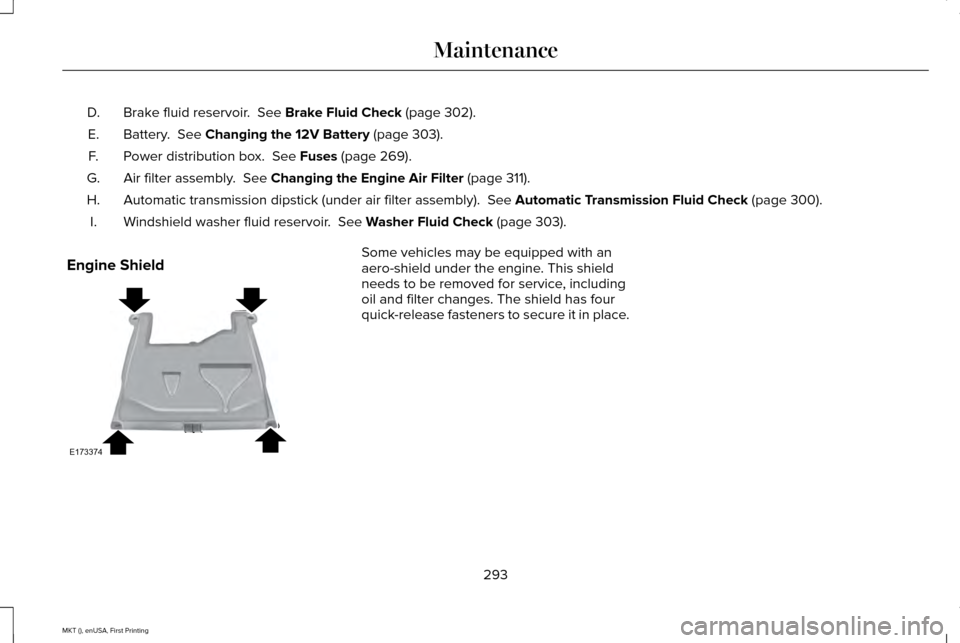
Engine Shield Some vehicles may be equipped with an
aero-shield under the engine. This shield
needs to be removed for service, including
oil and filter changes. The shield has four
quick-release fasteners to secure it in place.
293
MKT (), enUSA, First Printing MaintenanceE173374
Page 299 of 452
ENGINE COOLANT CHECK
WARNINGS
Do not add engine coolant when the
engine is hot. Steam and scalding
liquids released from a hot cooling system
can burn you badly. Also, spilling coolant on
hot engine parts can burn you. Do not put engine coolant in the
windshield washer fluid container. If
sprayed on the windshield, engine coolant
could make it difficult to see through the
windshield. To reduce the risk of personal injury,
make sure the engine is cool before
unscrewing the coolant pressure relief cap.
The cooling system is under pressure. Steam
and hot liquid can come out forcefully when
you loosen the cap slightly. Do not add coolant further than the
MAX mark. Checking the Engine Coolant
When the engine is cold, check the
concentration and level of the engine coolant
at the intervals listed in the scheduled
maintenance information.
See Scheduled
Maintenance (page 387).
Note: Make sure that the coolant level is
between the
MIN and MAX marks on the
coolant reservoir.
Note: Coolant expands when it is hot. The
level may extend beyond the
MAX mark.
Note: If the level is at the MIN mark, below
the MIN mark, or empty, add coolant
immediately.
Maintain coolant concentration within 48%
to 50%, which equates to a freeze point
between -30°F (-34°C) and -34°F (-37°C).
Note: For best results, coolant concentration
should be tested with a refractometer such
as Robinair® Coolant and Battery
Refractometer 75240. We do not
recommend the use of hydrometers or
coolant test strips for measuring coolant
concentrations. Note:
Automotive fluids are not
interchangeable. Do not use engine coolant,
antifreeze or windshield washer fluid outside
of its specified function and vehicle location.
Adding Engine Coolant
Note: Do not use stop leak pellets, cooling
system sealants or additives as they can
cause damage to the engine cooling or
heating systems. Your warranty may not
cover these damages.
Note: During normal vehicle operation, the
coolant may change color from orange to
pink or light red. As long as the coolant is
clear and uncontaminated, this color change
does not indicate the coolant has degraded
nor does it require the coolant to be drained,
the system to be flushed, or the coolant to
be replaced.
296
MKT (), enUSA, First Printing Maintenance