height LINCOLN MKT 2017 User Guide
[x] Cancel search | Manufacturer: LINCOLN, Model Year: 2017, Model line: MKT, Model: LINCOLN MKT 2017Pages: 558, PDF Size: 4.59 MB
Page 98 of 558
Note:
In cold or inclement weather
conditions, you will notice a decrease in the
availability of the high beam system,
especially at start up. If you want to change
the beam state independently of the
automatic control, you may switch the high
beams on or off using the lever. Automatic
control will resume when conditions are
correct.
Note: Modification of the vehicle ride height
such as using much larger tires, may
degrade feature performance.
A camera sensor, centrally mounted behind
the windshield of your vehicle, continuously
monitors conditions to decide when to turn
the high beams off and on.
Once the system is active, the high beams
will turn on if:
• The ambient light level is low enough.
• There is no traffic in front of the vehicle.
• The vehicle speed is greater than 32 mph
(52 km/h). The high beams will turn off if:
•
The system detects the headlamps of an
approaching vehicle or the tail lamps of
a preceding vehicle.
• Vehicle speed falls below
27 mph
(44 km/h).
• The ambient light level is high enough
that high beams are not required.
• The system detects severe rain, snow or
fog.
• The camera is blocked.
Activating the System
Switch on the system using the information
display and autolamps.
See Information
Displays (page 110).
Switch the lighting control to the autolamps
position.
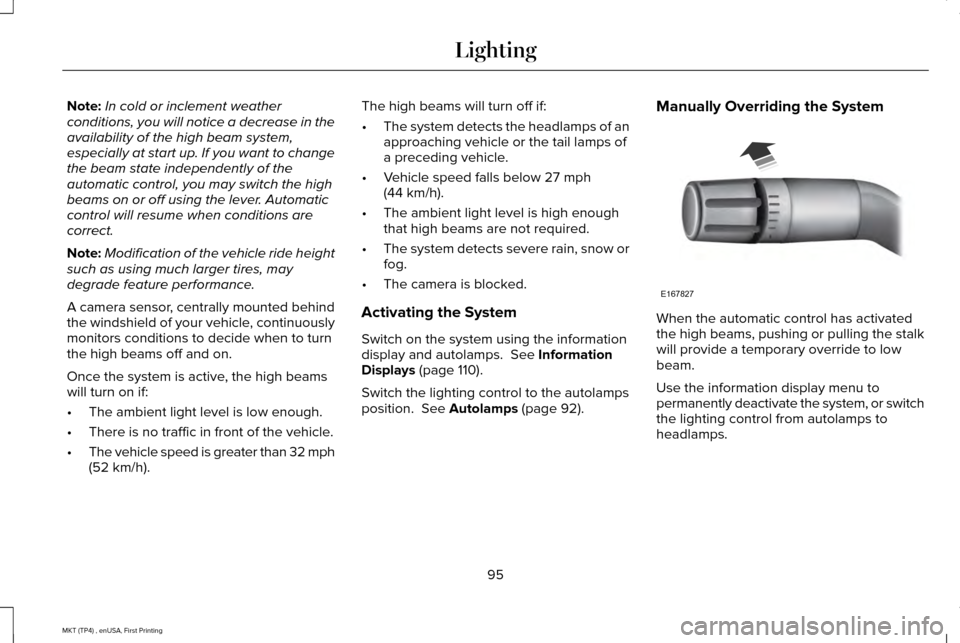
See Autolamps (page 92). Manually Overriding the System
When the automatic control has activated
the high beams, pushing or pulling the stalk
will provide a temporary override to low
beam.
Use the information display menu to
permanently deactivate the system, or switch
the lighting control from autolamps to
headlamps.
95
MKT (TP4) , enUSA, First Printing LightingE167827
Page 144 of 558
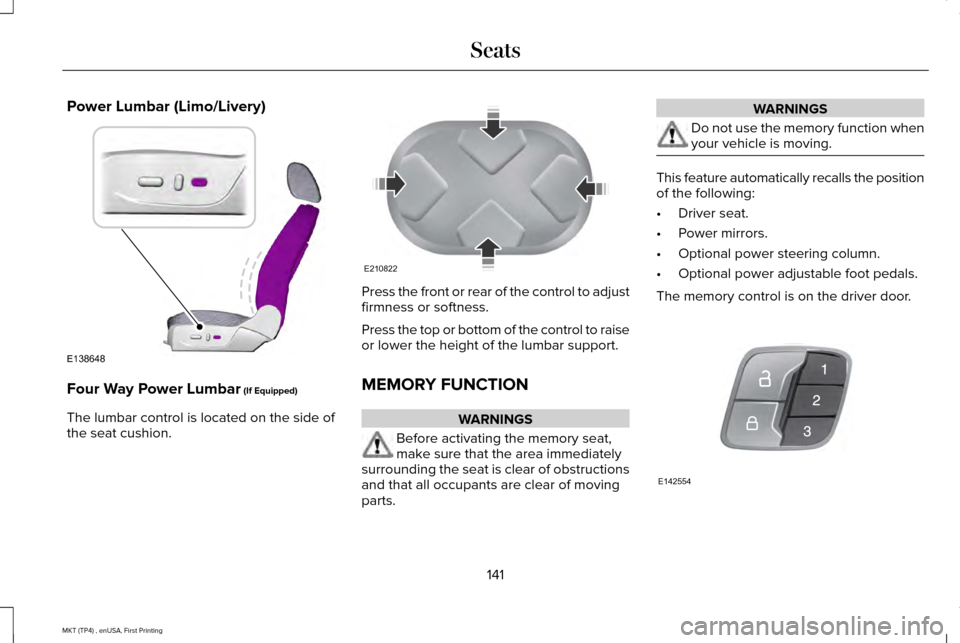
Power Lumbar (Limo/Livery)
Four Way Power Lumbar (If Equipped)
The lumbar control is located on the side of
the seat cushion. Press the front or rear of the control to adjust
firmness or softness.
Press the top or bottom of the control to raise
or lower the height of the lumbar support.
MEMORY FUNCTION
WARNINGS
Before activating the memory seat,
make sure that the area immediately
surrounding the seat is clear of obstructions
and that all occupants are clear of moving
parts. WARNINGS
Do not use the memory function when
your vehicle is moving.
This feature automatically recalls the position
of the following:
•
Driver seat.
• Power mirrors.
• Optional power steering column.
• Optional power adjustable foot pedals.
The memory control is on the driver door. 141
MKT (TP4) , enUSA, First Printing SeatsE138648 E210822 E142554
Page 249 of 558
Distribute the trailer load so 10-15% of the
total trailer weight is on the tongue.
Weight-Distributing Hitch
WARNING
Do not adjust a weight-distributing
hitch to any position where the rear
bumper of the vehicle is higher than it was
before attaching the trailer. Doing so will
defeat the function of the weight-distributing
hitch, which may cause unpredictable
handling, and could result in serious personal
injury. When hooking-up a trailer using a
weight-distributing hitch, always use the
following procedure:
1. Park your vehicle, without the trailer, on
a level surface.
2. Measure the height of the top of your vehicle ’s front wheel opening on the
fender. This is H1.
3. Attach the trailer to your vehicle without
the weight-distributing bars connected. 4. Measure the height of the top of your
vehicle ’s front wheel opening on the
fender a second time. This is H2.
5. Install and adjust the tension in the weight distributing bars so that the height
of the front fender is approximately
halfway between H1 and H2.
6. Check that the trailer is level. If not level,
adjust the ball height accordingly and
repeat Steps 3–6.
Safety Chains
Note: Never attach safety chains to the
bumper.
Always connect the safety chains to the hook
retainers of your vehicle hitch.
To connect the safety chains, cross them
under the trailer tongue and allow enough
slack for turning tight corners. Do not allow
the chains to drag on the ground. Trailer Brakes WARNING
Do not connect a trailer's hydraulic
brake system directly to your vehicle's
brake system. Your vehicle may not have
enough braking power and your chances of
having a collision greatly increase. Electric brakes and manual, automatic or
surge-type trailer brakes are safe if you install
them properly and adjust them to the
manufacturer's specifications. The trailer
brakes must meet local and federal
regulations.
The rating for the tow vehicle's braking
system operation is at the gross vehicle
weight rating, not the gross combined
weight rating.
Separate functioning brake systems are
required for safe control of towed vehicles
and trailers weighing more than 1500
pounds (680 kilograms) when loaded.
246
MKT (TP4) , enUSA, First Printing Towing
Page 307 of 558
Rear Window Wiper Blade
1. Lift the wiper arm.
Note:
Do not hold the wiper blade when
lifting the wiper arm.
Note: Make sure that the wiper arm does
not spring back against the glass when the
wiper blade is not attached.
2. Remove the wiper blade. Note:
Make sure that the wiper blade locks
into place.
ADJUSTING THE HEADLAMPS
Vertical Aim Adjustment
The assembly plant properly aims the
headlamps on your vehicle. If your vehicle
has been in an accident, have the alignment
of your headlamps checked by your
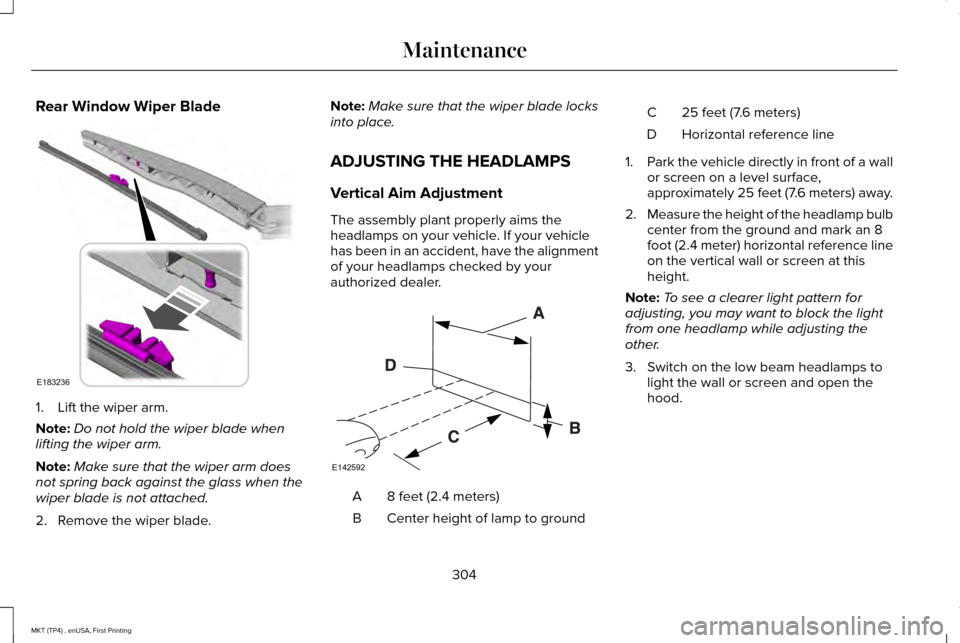
authorized dealer. 8 feet (2.4 meters)
A
Center height of lamp to ground
B 25 feet (7.6 meters)
C
Horizontal reference line
D
1. Park the vehicle directly in front of a wall
or screen on a level surface,
approximately 25 feet (7.6 meters) away.
2. Measure the height of the headlamp bulb
center from the ground and mark an 8
foot (2.4 meter) horizontal reference line
on the vertical wall or screen at this
height.
Note: To see a clearer light pattern for
adjusting, you may want to block the light
from one headlamp while adjusting the
other.
3. Switch on the low beam headlamps to light the wall or screen and open the
hood.
304
MKT (TP4) , enUSA, First Printing MaintenanceE183236 E142592
Page 329 of 558
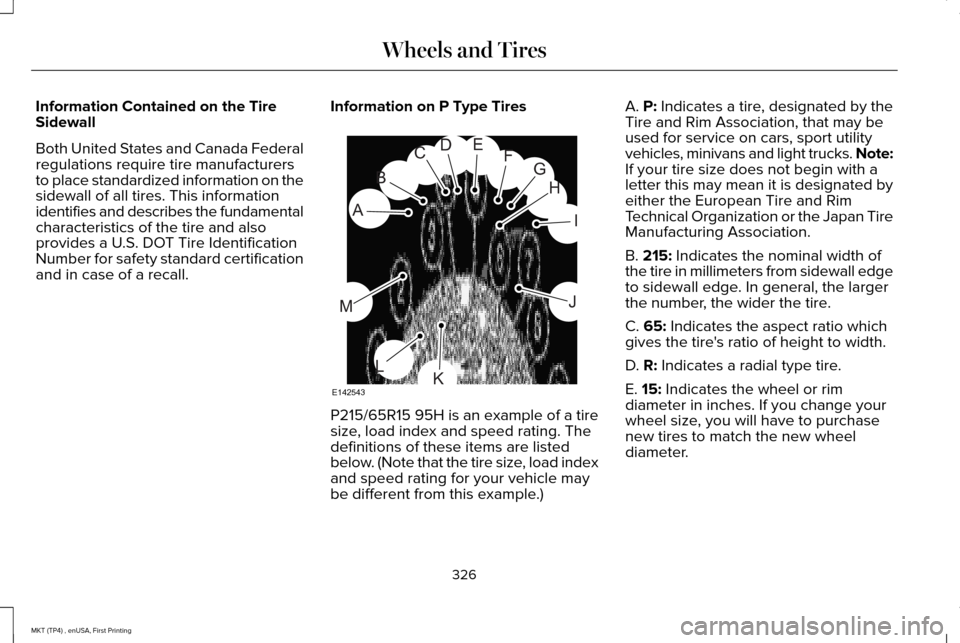
Information Contained on the Tire
Sidewall
Both United States and Canada Federal
regulations require tire manufacturers
to place standardized information on the
sidewall of all tires. This information
identifies and describes the fundamental
characteristics of the tire and also
provides a U.S. DOT Tire Identification
Number for safety standard certification
and in case of a recall.
Information on P Type Tires P215/65R15 95H is an example of a tire
size, load index and speed rating. The
definitions of these items are listed
below. (Note that the tire size, load index
and speed rating for your vehicle may
be different from this example.)A. P: Indicates a tire, designated by the
Tire and Rim Association, that may be
used for service on cars, sport utility
vehicles, minivans and light trucks.
Note:
If your tire size does not begin with a
letter this may mean it is designated by
either the European Tire and Rim
Technical Organization or the Japan Tire
Manufacturing Association.
B.
215: Indicates the nominal width of
the tire in millimeters from sidewall edge
to sidewall edge. In general, the larger
the number, the wider the tire.
C.
65: Indicates the aspect ratio which
gives the tire's ratio of height to width.
D.
R: Indicates a radial type tire.
E.
15: Indicates the wheel or rim
diameter in inches. If you change your
wheel size, you will have to purchase
new tires to match the new wheel
diameter.
326
MKT (TP4) , enUSA, First Printing Wheels and TiresH
I
J
KL
M
A
B
CDEFG
E142543
Page 333 of 558
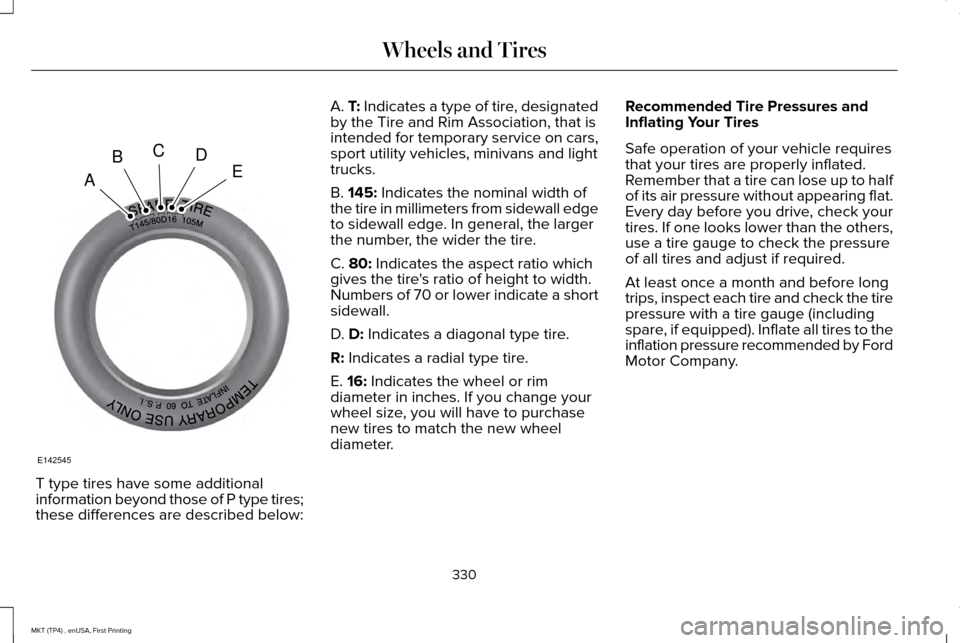
T type tires have some additional
information beyond those of P type tires;
these differences are described below: A. T: Indicates a type of tire, designated
by the Tire and Rim Association, that is
intended for temporary service on cars,
sport utility vehicles, minivans and light
trucks.
B.
145: Indicates the nominal width of
the tire in millimeters from sidewall edge
to sidewall edge. In general, the larger
the number, the wider the tire.
C.
80: Indicates the aspect ratio which
gives the tire's ratio of height to width.
Numbers of 70 or lower indicate a short
sidewall.
D.
D: Indicates a diagonal type tire.
R:
Indicates a radial type tire.
E.
16: Indicates the wheel or rim
diameter in inches. If you change your
wheel size, you will have to purchase
new tires to match the new wheel
diameter. Recommended Tire Pressures and
Inflating Your Tires
Safe operation of your vehicle requires
that your tires are properly inflated.
Remember that a tire can lose up to half
of its air pressure without appearing flat.
Every day before you drive, check your
tires. If one looks lower than the others,
use a tire gauge to check the pressure
of all tires and adjust if required.
At least once a month and before long
trips, inspect each tire and check the tire
pressure with a tire gauge (including
spare, if equipped). Inflate all tires to the
inflation pressure recommended by Ford
Motor Company.
330
MKT (TP4) , enUSA, First Printing Wheels and TiresA
BCDE
E142545
Page 335 of 558
Tire Wear
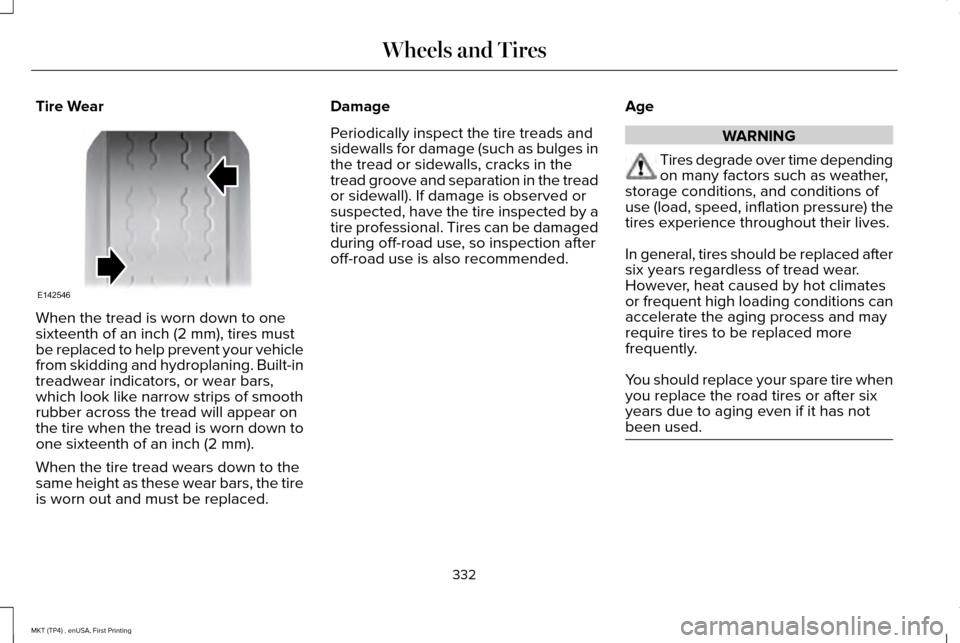
When the tread is worn down to one
sixteenth of an inch (2 mm), tires must
be replaced to help prevent your vehicle
from skidding and hydroplaning. Built-in
treadwear indicators, or wear bars,
which look like narrow strips of smooth
rubber across the tread will appear on
the tire when the tread is worn down to
one sixteenth of an inch (2 mm).
When the tire tread wears down to the
same height as these wear bars, the tire
is worn out and must be replaced. Damage
Periodically inspect the tire treads and
sidewalls for damage (such as bulges in
the tread or sidewalls, cracks in the
tread groove and separation in the tread
or sidewall). If damage is observed or
suspected, have the tire inspected by a
tire professional. Tires can be damaged
during off-road use, so inspection after
off-road use is also recommended.
Age WARNING
Tires degrade over time depending
on many factors such as weather,
storage conditions, and conditions of
use (load, speed, inflation pressure) the
tires experience throughout their lives.
In general, tires should be replaced after
six years regardless of tread wear.
However, heat caused by hot climates
or frequent high loading conditions can
accelerate the aging process and may
require tires to be replaced more
frequently.
You should replace your spare tire when
you replace the road tires or after six
years due to aging even if it has not
been used. 332
MKT (TP4) , enUSA, First Printing Wheels and TiresE142546
Page 554 of 558
Memory Function...........................................141
Easy Entry and Exit Feature..............................142
Linking a PreSet Position to your Remote
Control or Intelligent Access Key Fob
........................................................................\
.....142
Saving a PreSet Position...................................142
Message Center See: Information Displays..................................110
Mirrors See: Heated Windows and Mirrors.................134
See: Windows and Mirrors.................................99
Mobile Communications Equipment...........14
Moonroof.........................................................103 Closing the Moonroof and Sunshades..........104
Opening the Sunshade and Moonroof..........103
Venting the Moonroof........................................104
Motorcraft Parts - 3.5L Ecoboost™............353
Motorcraft Parts - 3.7L.................................354
MyKey Troubleshooting
................................70
MyKey™..............................................................65 Principle of Operation.........................................65
N
Navigation......................................................430 cityseeker.............................................................439
Destination Mode................................................431
Map Mode............................................................430 Navigation Map Updates..................................440
Navigation Menu................................................436
SiriusXM Traffic and Travel Link......................440
Waypoints.............................................................438
Normal Scheduled Maintenance.............486 Intelligent Oil-Life Monitor™..............................486
Normal Maintenance Intervals........................
488
O
Oil Change Indicator Reset
.......................293
Oil Check See: Engine Oil Check......................................292
Opening and Closing the Hood...............287 Closing the Hood...............................................287
Opening the Hood.............................................287
Ordering Additional Owner's Literature.....................................................265
Obtaining a French Owner’ s Manual............265
Overhead Console
........................................163
P
Parking Aids
....................................................198
Principle of Operation........................................198
Parking Brake.................................................193
Passive Anti-Theft System.............................81 SecuriLock®.............................................................81 PATS
See: Passive Anti-Theft System.........................
81
Pedals................................................................87
Perchlorate........................................................12
Personal Safety System ™
..............................49
How Does the Personal Safety System
Work?...................................................................49
Phone
..............................................................422
During a Phone Call...........................................427
Making Calls........................................................426
Pairing Your Cell Phone for the First
Time...................................................................422
Phone Menu........................................................423
Receiving Calls....................................................427
Smartphone Connectivity................................429
Text Messaging...................................................428
Power Door Locks See: Locking and Unlocking..............................
72
Power Liftgate
..................................................75
Obstacle Detection...............................................78
Opening and Closing the Liftgate....................76
Setting the Liftgate Open Height......................78
Stopping the Liftgate Movement......................78
Power Seats
....................................................139
Four Way Power Lumbar....................................141
Power Lumbar (Limo/Livery)..............................141
Power Steering Fluid Check.......................301
551
MKT (TP4) , enUSA, First Printing Index
Page 555 of 558
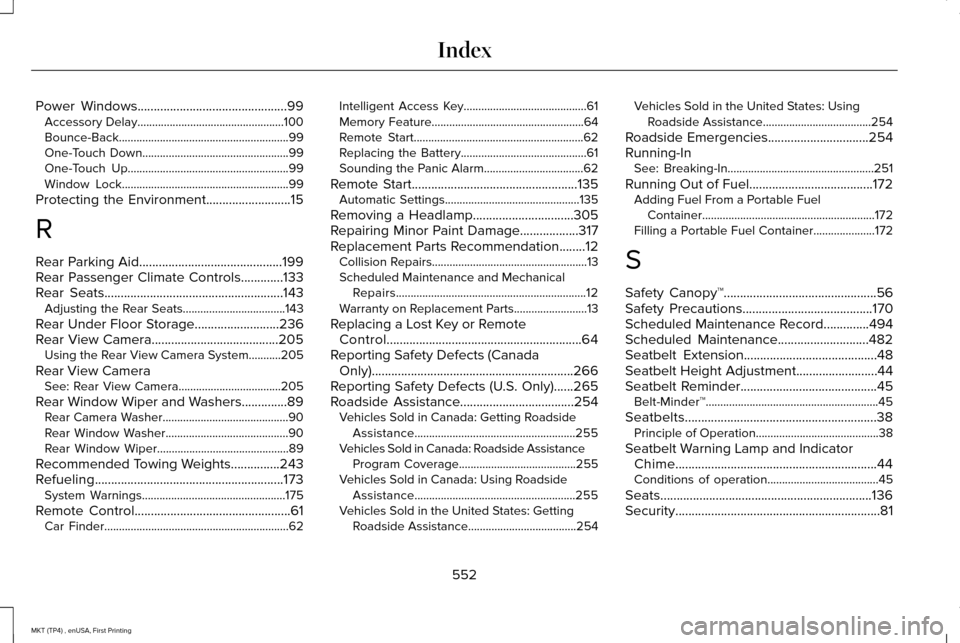
Power Windows..............................................99
Accessory Delay..................................................100
Bounce-Back..........................................................99
One-Touch Down..................................................99
One-Touch Up.......................................................99
Window Lock.........................................................99
Protecting the Environment
..........................15
R
Rear Parking Aid............................................199
Rear Passenger Climate Controls.............133
Rear Seats.......................................................143 Adjusting the Rear Seats...................................143
Rear Under Floor Storage
..........................236
Rear View Camera.......................................205 Using the Rear View Camera System...........205
Rear View Camera See: Rear View Camera...................................205
Rear Window Wiper and Washers..............89 Rear Camera Washer...........................................90
Rear Window Washer..........................................90
Rear Window Wiper.............................................89
Recommended Towing Weights...............243
Refueling..........................................................173 System Warnings.................................................175
Remote Control
................................................61
Car Finder...............................................................62 Intelligent Access Key..........................................61
Memory Feature....................................................64
Remote Start..........................................................62
Replacing the Battery...........................................61
Sounding the Panic Alarm..................................
62
Remote Start
...................................................135
Automatic Settings..............................................135
Removing a Headlamp
...............................305
Repairing Minor Paint Damage..................317
Replacement Parts Recommendation........12 Collision Repairs.....................................................13
Scheduled Maintenance and Mechanical
Repairs.................................................................12
Warranty on Replacement Parts.........................
13
Replacing a Lost Key or Remote Control............................................................64
Reporting Safety Defects (Canada Only)..............................................................266
Reporting Safety Defects (U.S. Only)......265
Roadside Assistance
...................................254
Vehicles Sold in Canada: Getting Roadside
Assistance.......................................................255
Vehicles Sold in Canada: Roadside Assistance Program Coverage........................................255
Vehicles Sold in Canada: Using Roadside Assistance.......................................................255
Vehicles Sold in the United States: Getting Roadside Assistance.....................................254 Vehicles Sold in the United States: Using
Roadside Assistance.....................................254
Roadside Emergencies
...............................254
Running-In See: Breaking-In..................................................251
Running Out of Fuel......................................172 Adding Fuel From a Portable Fuel
Container...........................................................172
Filling a Portable Fuel Container.....................172
S
Safety Canopy™
...............................................56
Safety Precautions........................................170
Scheduled Maintenance Record..............494
Scheduled Maintenance............................482
Seatbelt Extension
.........................................48
Seatbelt Height Adjustment.........................44
Seatbelt Reminder..........................................45 Belt-Minder™...........................................................45
Seatbelts...........................................................38 Principle of Operation..........................................38
Seatbelt Warning Lamp and Indicator Chime..............................................................44
Conditions of operation......................................45
Seats.................................................................136
Security ...............................................................
81
552
MKT (TP4) , enUSA, First Printing Index