brake fluid LINCOLN MKT 2017 Owners Manual
[x] Cancel search | Manufacturer: LINCOLN, Model Year: 2017, Model line: MKT, Model: LINCOLN MKT 2017Pages: 558, PDF Size: 4.59 MB
Page 7 of 558
Load Carrying
Rear Under Floor Storage..........................236
Cargo Nets
.....................................................236
Luggage Covers
...........................................236
Load Limit
.......................................................237
Towing
Towing a Trailer.............................................242
Trailer Sway Control....................................243
Recommended Towing Weights...............243
Essential Towing Checks
............................245
Towing the Vehicle on Four Wheels - 3.5L Ecoboost™/3.7L.........................................248
Driving Hints
Breaking-In......................................................251
Economical Driving
.......................................251
Driving Through Water
................................251
Floor Mats
......................................................252
Roadside Emergencies
Roadside Assistance
...................................254
Hazard Warning Flashers
...........................255 Fuel Shutoff...................................................255
Jump Starting the Vehicle
..........................256
Customer Assistance
Getting the Services You Need................259
In California (U.S. Only)...............................260
The Better Business Bureau (BBB) Auto Line Program (U.S. Only)
.........................261
Utilizing the Mediation/Arbitration Program (Canada Only)
...........................................262
Getting Assistance Outside the U.S. and Canada.......................................................263
Ordering Additional Owner's Literature....................................................265
Reporting Safety Defects (U.S. Only)......265
Reporting Safety Defects (Canada Only)............................................................266
Fuses
Fuse Specification Chart............................267
Changing a Fuse..........................................283
Maintenance
General Information
.....................................286 Opening and Closing the Hood...............287
Under Hood Overview - 3.5L
Ecoboost™..................................................288
Under Hood Overview - 3.7L....................290
Engine Oil Dipstick - 3.5L Ecoboost™/ 3.7L..............................................................292
Engine Oil Check.........................................292
Oil Change Indicator Reset
.......................293
Engine Coolant Check................................294
Automatic Transmission Fluid Check - 3.5L Ecoboost™/3.7L.........................................298
Brake Fluid Check.......................................300
Power Steering Fluid Check.......................301
Washer Fluid Check.....................................301
Changing the 12V Battery...........................301
Checking the Wiper Blades.......................303
Changing the Wiper Blades......................303
Adjusting the Headlamps...........................304
Removing a Headlamp
...............................305
Changing a Bulb...........................................305
Bulb Specification Chart.............................307
Changing the Engine Air Filter
..................310
4
MKT (TP4) , enUSA, First Printing Table of Contents
Page 11 of 558
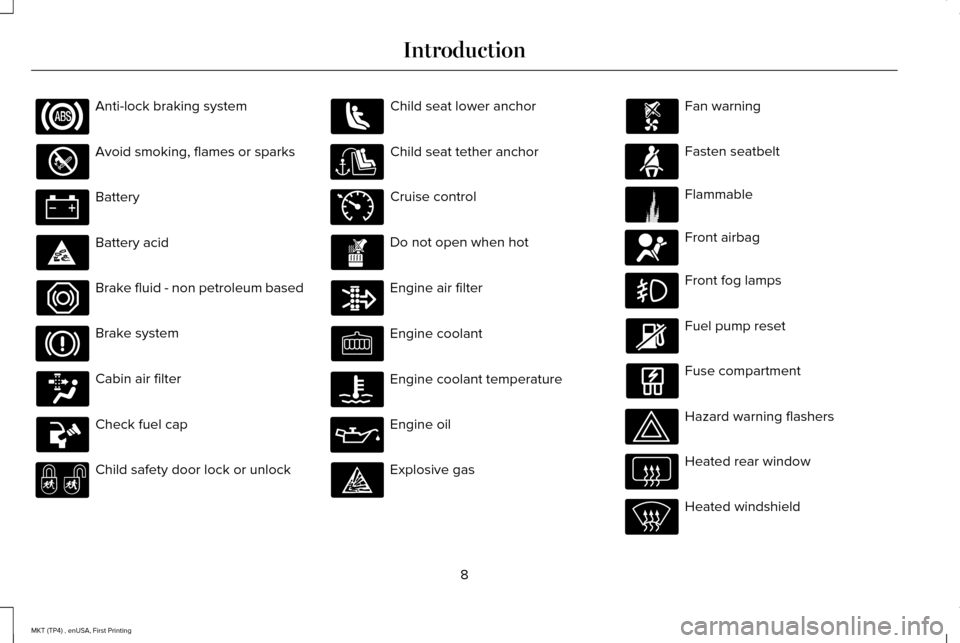
Anti-lock braking system
Avoid smoking, flames or sparks
Battery
Battery acid
Brake fluid - non petroleum based
Brake system
Cabin air filter
Check fuel cap
Child safety door lock or unlock Child seat lower anchor
Child seat tether anchor
Cruise control
Do not open when hot
Engine air filter
Engine coolant
Engine coolant temperature
Engine oil
Explosive gas Fan warning
Fasten seatbelt
Flammable
Front airbag
Front fog lamps
Fuel pump reset
Fuse compartment
Hazard warning flashers
Heated rear window
Heated windshield
8
MKT (TP4) , enUSA, First Printing Introduction E71340 E71880 E231160 E67017
Page 12 of 558
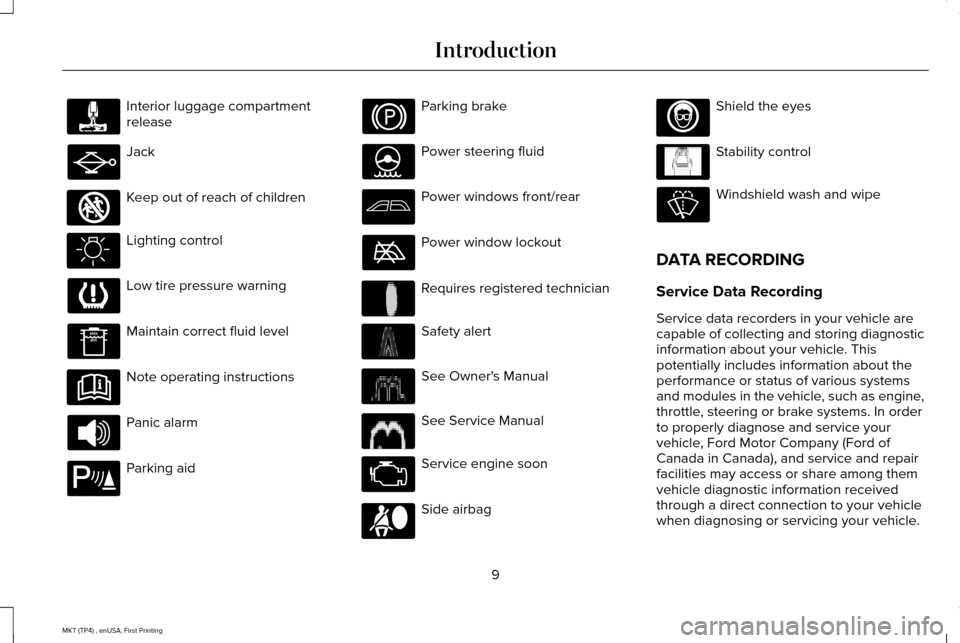
Interior luggage compartment
release
Jack
Keep out of reach of children
Lighting control
Low tire pressure warning
Maintain correct fluid level
Note operating instructions
Panic alarm
Parking aid Parking brake
Power steering fluid
Power windows front/rear
Power window lockout
Requires registered technician
Safety alert
See Owner's Manual
See Service Manual
Service engine soon
Side airbag Shield the eyes
Stability control
Windshield wash and wipe
DATA RECORDING
Service Data Recording
Service data recorders in your vehicle are
capable of collecting and storing diagnostic
information about your vehicle. This
potentially includes information about the
performance or status of various systems
and modules in the vehicle, such as engine,
throttle, steering or brake systems. In order
to properly diagnose and service your
vehicle, Ford Motor Company (Ford of
Canada in Canada), and service and repair
facilities may access or share among them
vehicle diagnostic information received
through a direct connection to your vehicle
when diagnosing or servicing your vehicle.
9
MKT (TP4) , enUSA, First Printing Introduction E161353 E139213 E231159 E231158 E167012 E138639
Page 109 of 558
WARNING LAMPS AND
INDICATORS
The following warning lamps and indicators
will alert you to a vehicle condition that may
become serious. Some lamps will illuminate
when you start your vehicle to make sure
they work. If any lamps remain on after
starting your vehicle, refer to the respective
system warning lamp for further information.
Note:
Some warning indicators appear in
the information display and function the
same as a warning lamp, but do not display
when you start your vehicle.
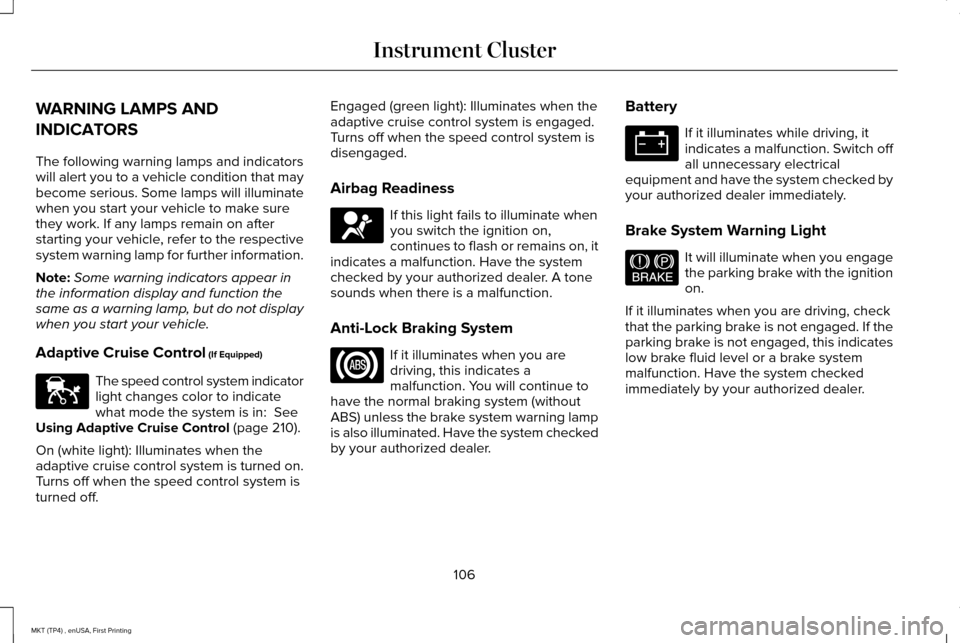
Adaptive Cruise Control (If Equipped) The speed control system indicator
light changes color to indicate
what mode the system is in:
See
Using Adaptive Cruise Control (page 210).
On (white light): Illuminates when the
adaptive cruise control system is turned on.
Turns off when the speed control system is
turned off. Engaged (green light): Illuminates when the
adaptive cruise control system is engaged.
Turns off when the speed control system is
disengaged.
Airbag Readiness
If this light fails to illuminate when
you switch the ignition on,
continues to flash or remains on, it
indicates a malfunction. Have the system
checked by your authorized dealer. A tone
sounds when there is a malfunction.
Anti-Lock Braking System If it illuminates when you are
driving, this indicates a
malfunction. You will continue to
have the normal braking system (without
ABS) unless the brake system warning lamp
is also illuminated. Have the system checked
by your authorized dealer. Battery If it illuminates while driving, it
indicates a malfunction. Switch off
all unnecessary electrical
equipment and have the system checked by
your authorized dealer immediately.
Brake System Warning Light It will illuminate when you engage
the parking brake with the ignition
on.
If it illuminates when you are driving, check
that the parking brake is not engaged. If the
parking brake is not engaged, this indicates
low brake fluid level or a brake system
malfunction. Have the system checked
immediately by your authorized dealer.
106
MKT (TP4) , enUSA, First Printing Instrument ClusterE144524 E67017 E144522
Page 125 of 558

Blind Spot Information and Cross Traffic Alert System
Action
Message
A fault with the system has occurred. Contact an authorized dealer as so\
on as possible.
Blindspot System Fault
The system sensors are blocked. Contact an authorized dealer as soon as possible. See Blind
Spot Information System (page 224).
Blindspot Not Available Sensor Blocked
See Manual
The system detects a vehicle.
See Blind Spot Information System (page 224).
Vehicle Coming From X
The blind spot information system and cross traffic alert system sensors\
are blocked. See BlindSpot Information System
(page 224).
Cross Traffic Not Available Sensor Blocked
See Manual
A fault with the system has occurred. Contact an authorized dealer as so\
on as possible.
Cross Traffic System Fault
Brake System Action
Message
The brake fluid level is low and the brake system should be inspected immediately.
See Brake
Fluid Check (page 300).
Brake Fluid Level Low
The brake system needs servicing. Stop the vehicle in a safe place. Contact an authorized dealer.
Check Brake System
The parking brake is set, the engine is running and you drive your vehicle more than 3 m\
ph (5
km/h). If the warning stays on after the parking brake is released, contact an authorized dealer as soon as possible.
Park Brake Engaged
122
MKT (TP4) , enUSA, First Printing Information Displays
Page 289 of 558
GENERAL INFORMATION
Have your vehicle serviced regularly to help
maintain its roadworthiness and resale value.
There is a large network of authorized
dealers that are there to help you with their
professional servicing expertise. We believe
that their specially trained technicians are
best qualified to service your vehicle properly
and expertly. They are supported by a wide
range of highly specialized tools developed
specifically for servicing your vehicle.
If your vehicle requires professional service,
an authorized dealer can provide the
necessary parts and service. Check your
warranty information to find out which parts
and services are covered.
Use only recommended fuels, lubricants,
fluids and service parts conforming to
specifications. Motorcraft® parts are
designed and built to provide the best
performance in your vehicle.
Precautions
•
Do not work on a hot engine.
• Make sure that nothing gets caught in
moving parts.
• Do not work on a vehicle with the engine
running in an enclosed space, unless you
are sure you have enough ventilation.
• Keep all open flames and other burning
material (such as cigarettes) away from
the battery and all fuel related parts.
Working with the Engine Off
1. Set the parking brake and shift to park (P).
2. Switch off the engine.
3. Block the wheels.
Working with the Engine On WARNING
To reduce the risk of vehicle damage
and/or personal burn injuries, do not
start your engine with the air cleaner
removed and do not remove it while the
engine is running. 1. Set the parking brake and shift to park
(P).
2. Block the wheels.
286
MKT (TP4) , enUSA, First Printing Maintenance
Page 292 of 558
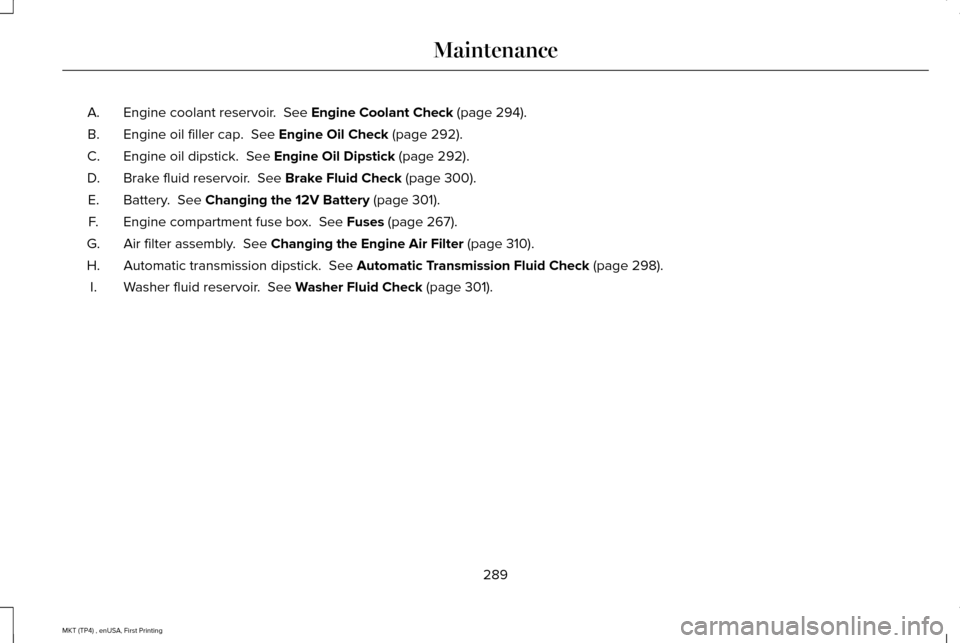
Engine coolant reservoir. See Engine Coolant Check (page 294).
A.
Engine oil filler cap.
See Engine Oil Check (page 292).
B.
Engine oil dipstick.
See Engine Oil Dipstick (page 292).
C.
Brake fluid reservoir.
See Brake Fluid Check (page 300).
D.
Battery.
See Changing the 12V Battery (page 301).
E.
Engine compartment fuse box.
See Fuses (page 267).
F.
Air filter assembly.
See Changing the Engine Air Filter (page 310).
G.
Automatic transmission dipstick.
See Automatic Transmission Fluid Check (page 298).
H.
Washer fluid reservoir.
See Washer Fluid Check (page 301).
I.
289
MKT (TP4) , enUSA, First Printing Maintenance
Page 294 of 558
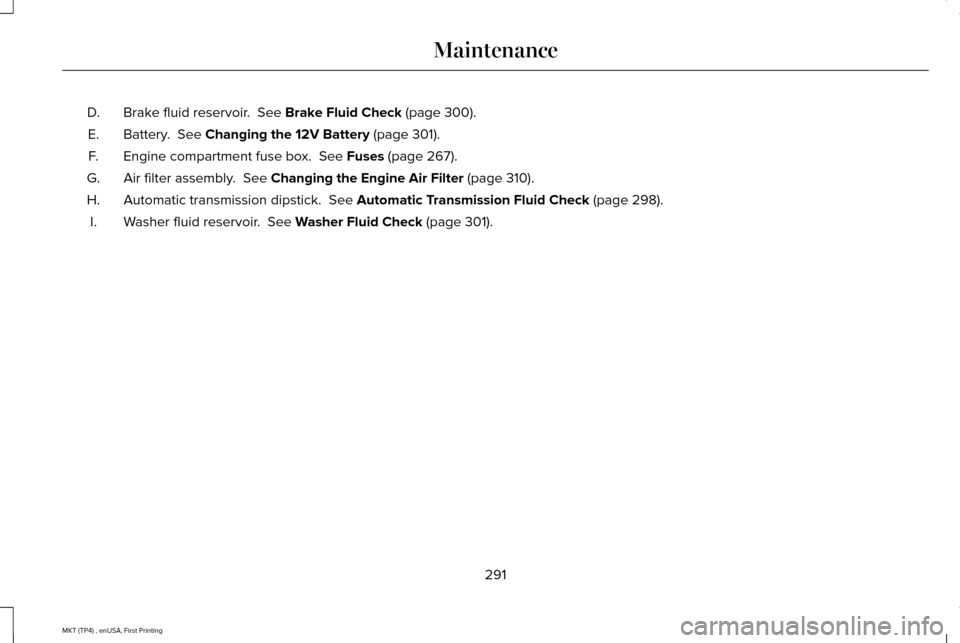
Brake fluid reservoir. See Brake Fluid Check (page 300).
D.
Battery.
See Changing the 12V Battery (page 301).
E.
Engine compartment fuse box.
See Fuses (page 267).
F.
Air filter assembly.
See Changing the Engine Air Filter (page 310).
G.
Automatic transmission dipstick.
See Automatic Transmission Fluid Check (page 298).
H.
Washer fluid reservoir.
See Washer Fluid Check (page 301).
I.
291
MKT (TP4) , enUSA, First Printing Maintenance
Page 303 of 558
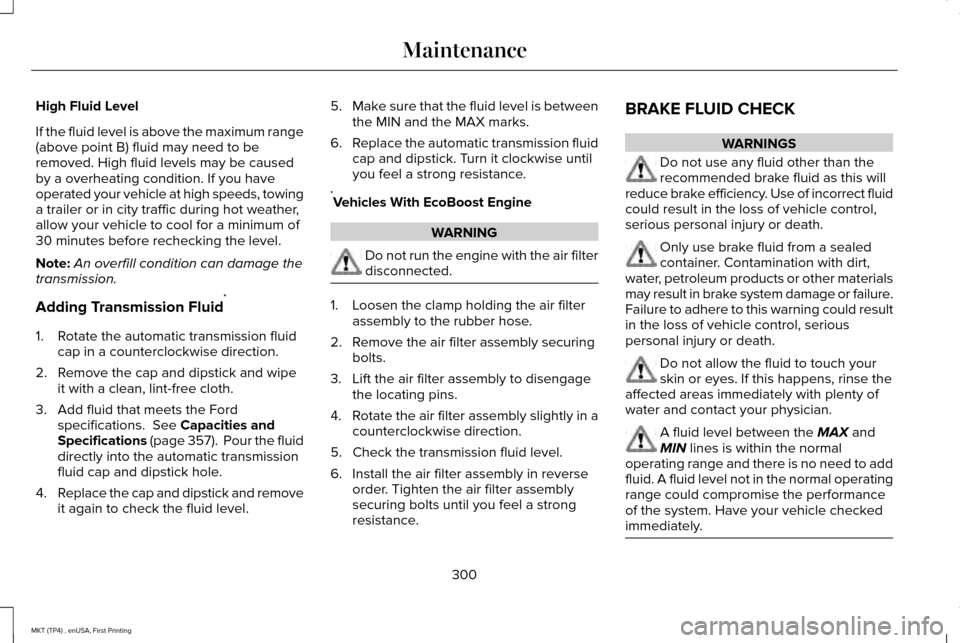
High Fluid Level
If the fluid level is above the maximum range
(above point B) fluid may need to be
removed. High fluid levels may be caused
by a overheating condition. If you have
operated your vehicle at high speeds, towing
a trailer or in city traffic during hot weather,
allow your vehicle to cool for a minimum of
30 minutes before rechecking the level.
Note:
An overfill condition can damage the
transmission.
Adding Transmission Fluid *
1. Rotate the automatic transmission fluid cap in a counterclockwise direction.
2. Remove the cap and dipstick and wipe it with a clean, lint-free cloth.
3. Add fluid that meets the Ford specifications. See Capacities and
Specifications (page 357). Pour the fluid
directly into the automatic transmission
fluid cap and dipstick hole.
4. Replace the cap and dipstick and remove
it again to check the fluid level. 5.
Make sure that the fluid level is between
the MIN and the MAX marks.
6. Replace the automatic transmission fluid
cap and dipstick. Turn it clockwise until
you feel a strong resistance.
* Vehicles With EcoBoost Engine WARNING
Do not run the engine with the air filter
disconnected.
1. Loosen the clamp holding the air filter
assembly to the rubber hose.
2. Remove the air filter assembly securing bolts.
3. Lift the air filter assembly to disengage the locating pins.
4. Rotate the air filter assembly slightly in a
counterclockwise direction.
5. Check the transmission fluid level.
6. Install the air filter assembly in reverse order. Tighten the air filter assembly
securing bolts until you feel a strong
resistance. BRAKE FLUID CHECK WARNINGS
Do not use any fluid other than the
recommended brake fluid as this will
reduce brake efficiency. Use of incorrect fluid
could result in the loss of vehicle control,
serious personal injury or death. Only use brake fluid from a sealed
container. Contamination with dirt,
water, petroleum products or other materials
may result in brake system damage or failure.
Failure to adhere to this warning could result
in the loss of vehicle control, serious
personal injury or death. Do not allow the fluid to touch your
skin or eyes. If this happens, rinse the
affected areas immediately with plenty of
water and contact your physician. A fluid level between the MAX and
MIN lines is within the normal
operating range and there is no need to add
fluid. A fluid level not in the normal operating
range could compromise the performance
of the system. Have your vehicle checked
immediately. 300
MKT (TP4) , enUSA, First Printing Maintenance
Page 322 of 558
•
Cover interior trim to prevent fading.
• Keep all rubber parts free from oil and
solvents.
Engine
• Change the engine oil and filter prior to
storage because used engine oil contains
contaminates which may cause engine
damage.
• Start the engine every 15 days for a
minimum of 15 minutes. Run at fast idle
with the climate controls set to defrost
until the engine reaches normal
operating temperature.
• With your foot on the brake, shift through
all the gears while the engine is running.
• We recommend that you change the
engine oil before you use your vehicle
again.
Fuel system
• Fill the fuel tank with high-quality fuel
until the first automatic shutoff of the fuel
pump nozzle. Cooling system
•
Protect against freezing temperatures.
• When removing your vehicle from
storage, check coolant fluid level.
Confirm that there are no cooling system
leaks and that fluid is at the
recommended level.
Battery
• Check and recharge as necessary. Keep
connections clean.
• If storing your vehicle for more than 30
days without recharging the battery, we
recommend that you disconnect the
battery cables to maintain battery charge
for quick starting.
Note: It is necessary to reset memory
features if battery cables are disconnected.
Brakes
• Make sure the brakes and parking brake
release fully.
Tires
• Maintain recommended air pressure. Miscellaneous
•
Make sure all linkages, cables, levers and
pins under your vehicle are covered with
grease to prevent rust.
• Move vehicles at least 25 ft (7.5 m) every
15 days to lubricate working parts and
prevent corrosion.
Removing Vehicle From Storage
When your vehicle is ready to come out of
storage, do the following:
• Wash your vehicle to remove any dirt or
grease film build-up on window surfaces.
• Check windshield wipers for any
deterioration.
• Check under the hood for any foreign
material that may have collected during
storage such as mice or squirrel nests.
• Check the exhaust for any foreign
material that may have collected during
storage.
• Check tire pressures and set tire inflation
per the Tire Label.
319
MKT (TP4) , enUSA, First Printing Vehicle Care