turn LINCOLN MKT 2017 Owners Manual
[x] Cancel search | Manufacturer: LINCOLN, Model Year: 2017, Model line: MKT, Model: LINCOLN MKT 2017Pages: 558, PDF Size: 4.59 MB
Page 33 of 558
Placement of the tether strap
•
Second row outboard seat positions:
Route the child safety seat tether strap
over the seatback, under the head
restraint and between the head restraint
posts. If needed, remove the head
restraint to improve the fit of the child
safety seat or tether strap.
• Second row center seat positions: Route
the child safety seat tether strap over the
top of the head restraint. If needed,
remove the head restraint to improve the
fit of the child safety seat or tether strap.
See Head Restraints (page 136).
• Third row seat position: Route the child
safety seat tether strap over the
seatback, under the head restraint and
between the head restraint posts. If
needed, fold the head restraint down to
improve the fit of the child safety seat or
tether strap. See Head Restraints (page
136
). 1. Route the tether strap.
2. Locate the correct anchor for the
selected seating position.
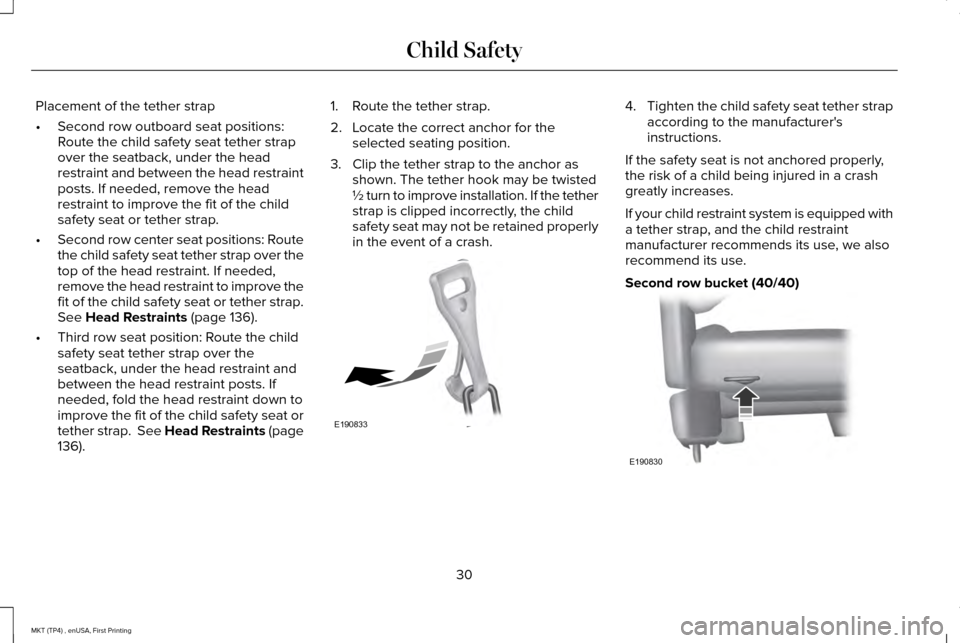
3. Clip the tether strap to the anchor as shown. The tether hook may be twisted
½ turn to improve installation. If the tether
strap is clipped incorrectly, the child
safety seat may not be retained properly
in the event of a crash. 4.
Tighten the child safety seat tether strap
according to the manufacturer's
instructions.
If the safety seat is not anchored properly,
the risk of a child being injured in a crash
greatly increases.
If your child restraint system is equipped with
a tether strap, and the child restraint
manufacturer recommends its use, we also
recommend its use.
Second row bucket (40/40) 30
MKT (TP4) , enUSA, First Printing Child SafetyE190833 E190830
Page 40 of 558
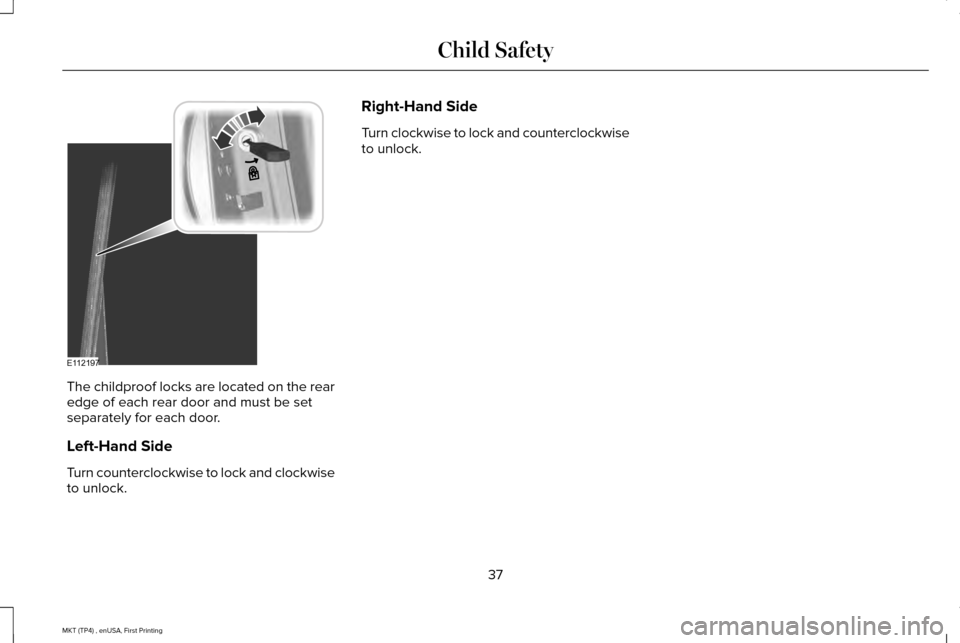
The childproof locks are located on the rear
edge of each rear door and must be set
separately for each door.
Left-Hand Side
Turn counterclockwise to lock and clockwise
to unlock. Right-Hand Side
Turn clockwise to lock and counterclockwise
to unlock.
37
MKT (TP4) , enUSA, First Printing Child SafetyE112197
Page 44 of 558
Keep the outer and inner shoulder belts
together in the stowage clip to prevent the
potential of wrinkling the cargo shade.
Seatbelt Locking Modes
WARNINGS
After a crash, have a qualified
technician check all the seatbelts to
make sure the seatbelts including the
automatic locking retractor feature for child
restraints operate properly. We recommend
replacing any system that has damage or
does not operate properly. Failure to do so
can result in personal injury or death in the
event of a sudden stop or another crash. You must replace the seatbelt if the
automatic locking retractor or any other
seatbelt function is not operating correctly.
Failure to replace the seatbelt and retractor
assembly could increase the risk of injury in
a crash. All safety restraints in the vehicle are
combination lap and shoulder belts. The
driver seatbelt has the vehicle sensitive
locking mode. The front outboard passenger
and rear seatbelts have both the vehicle
sensitive locking mode and the automatic
locking mode.
Vehicle Sensitive Mode
This is the normal retractor mode, which
allows free shoulder belt length adjustment
to your movements and locking in response
to vehicle movement. For example, if the
driver brakes suddenly or turns a corner
sharply, or the vehicle receives an impact of
about 5 mph (8 km/h) or more, the
combination seatbelts lock to help reduce
forward movement of the driver and
passengers.
In addition, the retractor is designed to lock
if you pull the webbing out too quickly. If this
occurs, let the belt retract slightly and pull
the webbing out again in a slow and
controlled manner. Automatic Locking Mode
In this mode, the shoulder belt automatically
pre-locks. The belt retracts to remove any
slack in the shoulder belt. The automatic
locking mode is not available on the driver
seatbelt.
When to Use the Automatic Locking Mode
Use this mode any time a child safety seat,
except a booster, is installed in passenger
front or rear seating positions. Properly
restrain children 12 years old and under in a
rear seating position whenever possible.
See
Child Safety (page 18).
How to Use the Automatic Locking Mode
Non-inflatable seatbelts
41
MKT (TP4) , enUSA, First Printing Seatbelts
Page 47 of 558
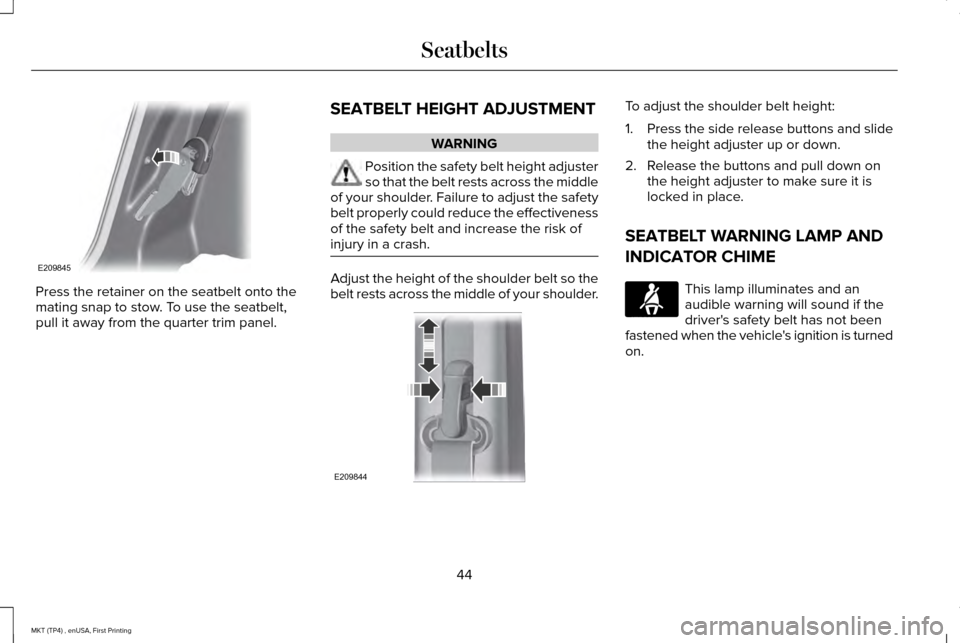
Press the retainer on the seatbelt onto the
mating snap to stow. To use the seatbelt,
pull it away from the quarter trim panel.
SEATBELT HEIGHT ADJUSTMENT WARNING
Position the safety belt height adjuster
so that the belt rests across the middle
of your shoulder. Failure to adjust the safety
belt properly could reduce the effectiveness
of the safety belt and increase the risk of
injury in a crash. Adjust the height of the shoulder belt so the
belt rests across the middle of your shoulder. To adjust the shoulder belt height:
1.
Press the side release buttons and slide
the height adjuster up or down.
2. Release the buttons and pull down on the height adjuster to make sure it is
locked in place.
SEATBELT WARNING LAMP AND
INDICATOR CHIME This lamp illuminates and an
audible warning will sound if the
driver's safety belt has not been
fastened when the vehicle's ignition is turned
on.
44
MKT (TP4) , enUSA, First Printing SeatbeltsE209845 E209844 E71880
Page 48 of 558
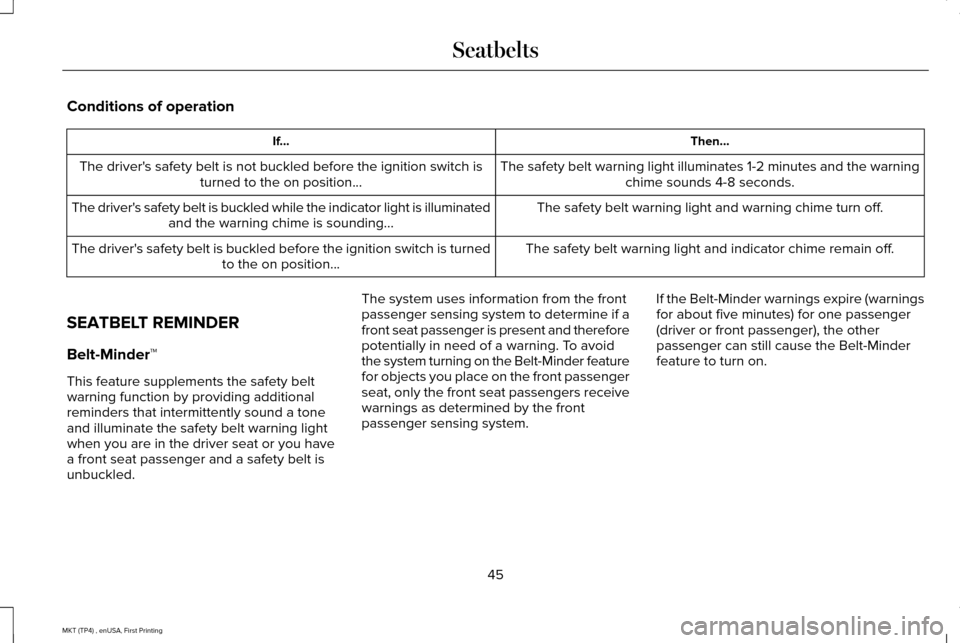
Conditions of operation
Then...
If...
The safety belt warning light illuminates 1-2 minutes and the warningchime sounds 4-8 seconds.
The driver's safety belt is not buckled before the ignition switch is
turned to the on position...
The safety belt warning light and warning chime turn off.
The driver's safety belt is buckled while the indicator light is illuminated
and the warning chime is sounding...
The safety belt warning light and indicator chime remain off.
The driver's safety belt is buckled before the ignition switch is turned
to the on position...
SEATBELT REMINDER
Belt-Minder™
This feature supplements the safety belt
warning function by providing additional
reminders that intermittently sound a tone
and illuminate the safety belt warning light
when you are in the driver seat or you have
a front seat passenger and a safety belt is
unbuckled. The system uses information from the front
passenger sensing system to determine if a
front seat passenger is present and therefore
potentially in need of a warning. To avoid
the system turning on the Belt-Minder feature
for objects you place on the front passenger
seat, only the front seat passengers receive
warnings as determined by the front
passenger sensing system.
If the Belt-Minder warnings expire (warnings
for about five minutes) for one passenger
(driver or front passenger), the other
passenger can still cause the Belt-Minder
feature to turn on.
45
MKT (TP4) , enUSA, First Printing Seatbelts
Page 50 of 558
Deactivating and Activating the Belt-Minder
Feature
WARNING
While the system allows you to switch
this feature off, the intent of the system
is to remind you to wear your safety belt to
improve your chance to survive an accident.
We recommend you leave the system
switched on for yourself and others who may
use the vehicle. Note:
The driver and front passenger
warnings switch on and off independently.
When you perform this procedure for one
seating position, do not buckle the other
position as this will terminate the process.
Note: If you are using MyKey, you cannot
disable the Belt-Minder. Also, if you have
previously disabled the Belt-Minder, it will
be re-enabled during the use of MyKey. See
MyKey™ (page 65). .
Read Steps 1–4 thoroughly before
proceeding with the programming
procedure. Before following the procedure, make sure
that:
•
The parking brake is set.
• The transmission is in park (P).
• The ignition is off.
• The driver and front passenger safety
belts are unbuckled.
1. Switch the ignition on. Do not start the vehicle.
2. Wait until the safety belt warning light turns off (about 1 minute). After Step 2,
wait an additional 5 seconds before
proceeding with Step 3. Once you start
Step 3, you must complete the procedure
within 20 seconds.
3. For the seating position you are switching
off, buckle then unbuckle the safety belt
three times at a moderate speed, ending
in the unbuckled state. After Step 3, the
safety belt warning light turns on.
4. While the safety belt warning light is on, buckle and then unbuckle the safety belt.
After Step 4, the safety belt warning light
flashes for confirmation. •
This will switch the feature off for that
seating position if it is currently on.
• This will switch the feature on for that
seating position if it is currently off.
CHILD RESTRAINT AND SEATBELT
MAINTENANCE
Inspect the vehicle safety belts and child
safety seat systems periodically to make sure
they work properly and are not damaged.
Inspect the vehicle and child seat safety belts
to make sure there are no nicks, tears or
cuts. Replace if necessary. All vehicle safety
belt assemblies, including retractors, buckles,
front safety belt buckle assemblies, buckle
support assemblies (slide bar-if equipped),
shoulder belt height adjusters (if equipped),
shoulder belt guide on seat back (if
equipped), child safety seat LATCH and
tether anchors, and attaching hardware,
should be inspected after a crash. Read the
child restraint manufacturer's instructions for
additional inspection and maintenance
information specific to the child restraint.
47
MKT (TP4) , enUSA, First Printing Seatbelts
Page 55 of 558
Proper Driver and Front Passenger
Seating Adjustment
WARNING
National Highway Traffic Safety
Administration (NHTSA) recommends
a minimum distance of at least 10 inches (25
centimeters) between an occupant’ s chest
and the driver airbag module. To properly position yourself away from the
airbag:
•
Move your seat to the rear as far as you
can while still reaching the pedals
comfortably.
• Recline the seat slightly (one or two
degrees) from the upright position.
After all occupants have adjusted their seats
and put on safety belts, it is very important
that they continue to sit properly. A properly
seated occupant sits upright, leaning against
the seat back, and centered on the seat
cushion, with their feet comfortably extended
on the floor. Sitting improperly can increase the chance of injury in a crash event. For
example, if an occupant slouches, lies down,
turns sideways, sits forward, leans forward
or sideways, or puts one or both feet up, the
chance of injury during a crash is greatly
increased.
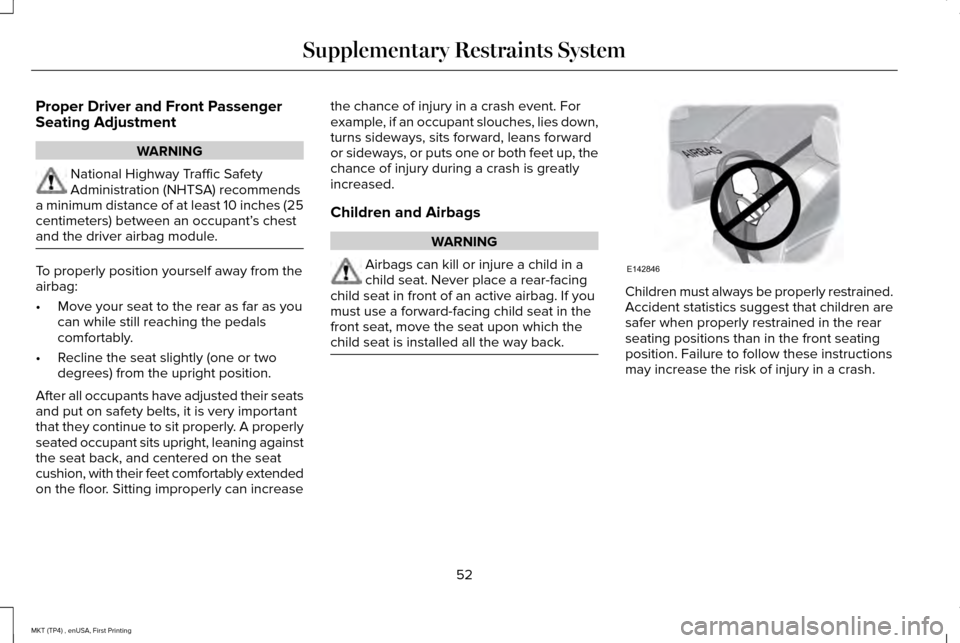
Children and Airbags
WARNING
Airbags can kill or injure a child in a
child seat. Never place a rear-facing
child seat in front of an active airbag. If you
must use a forward-facing child seat in the
front seat, move the seat upon which the
child seat is installed all the way back. Children must always be properly restrained.
Accident statistics suggest that children are
safer when properly restrained in the rear
seating positions than in the front seating
position. Failure to follow these instructions
may increase the risk of injury in a crash.
52
MKT (TP4) , enUSA, First Printing Supplementary Restraints SystemE142846
Page 56 of 558
FRONT PASSENGER SENSING
SYSTEM
WARNINGS
Even with Advanced Restraints
Systems, children 12 and under should
be properly restrained in a rear seating
position. Failure to follow this could seriously
increase the risk of injury or death. Sitting improperly out of position or
with the seatback reclined too far can
take off weight from the seat cushion and
affect the decision of the front passenger
sensing system, resulting in serious injury or
death in a crash. Always sit upright against
your seatback, with your feet on the floor. Any alteration or modification to the
front passenger seat may affect the
performance of the front passenger sensing
system which could seriously increase the
risk of injury or death. This system works with sensors that are part
of the front passenger seat and seatbelt to
detect the presence of a properly-seated
occupant and determine if the front
passenger frontal airbag should be enabled
(may inflate) or not.
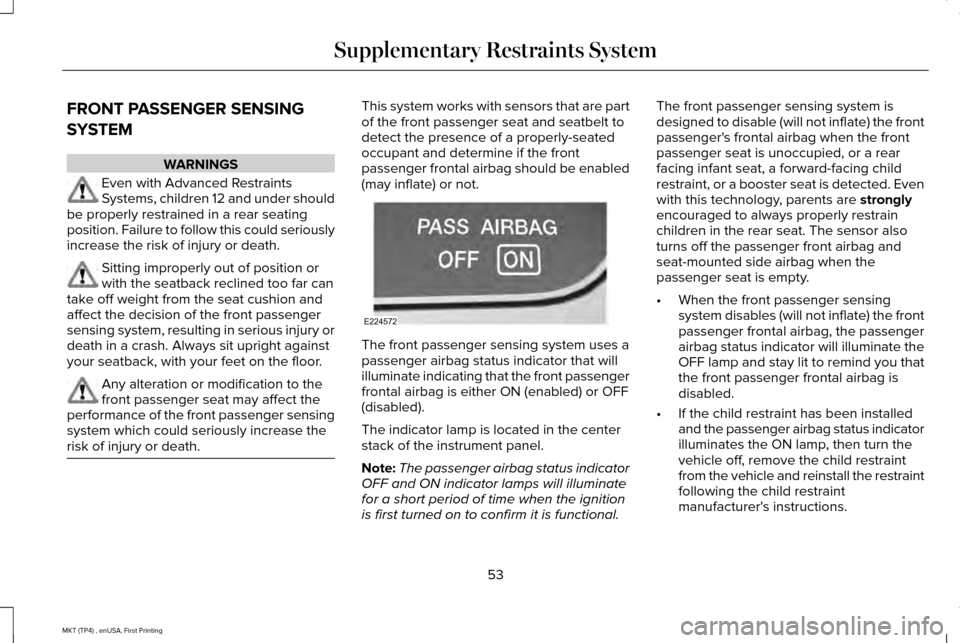
The front passenger sensing system uses a
passenger airbag status indicator that will
illuminate indicating that the front passenger
frontal airbag is either ON (enabled) or OFF
(disabled).
The indicator lamp is located in the center
stack of the instrument panel.
Note:
The passenger airbag status indicator
OFF and ON indicator lamps will illuminate
for a short period of time when the ignition
is first turned on to confirm it is functional. The front passenger sensing system is
designed to disable (will not inflate) the front
passenger's frontal airbag when the front
passenger seat is unoccupied, or a rear
facing infant seat, a forward-facing child
restraint, or a booster seat is detected. Even
with this technology, parents are strongly
encouraged to always properly restrain
children in the rear seat. The sensor also
turns off the passenger front airbag and
seat-mounted side airbag when the
passenger seat is empty.
• When the front passenger sensing
system disables (will not inflate) the front
passenger frontal airbag, the passenger
airbag status indicator will illuminate the
OFF lamp and stay lit to remind you that
the front passenger frontal airbag is
disabled.
• If the child restraint has been installed
and the passenger airbag status indicator
illuminates the ON lamp, then turn the
vehicle off, remove the child restraint
from the vehicle and reinstall the restraint
following the child restraint
manufacturer's instructions.
53
MKT (TP4) , enUSA, First Printing Supplementary Restraints SystemE224572
Page 57 of 558
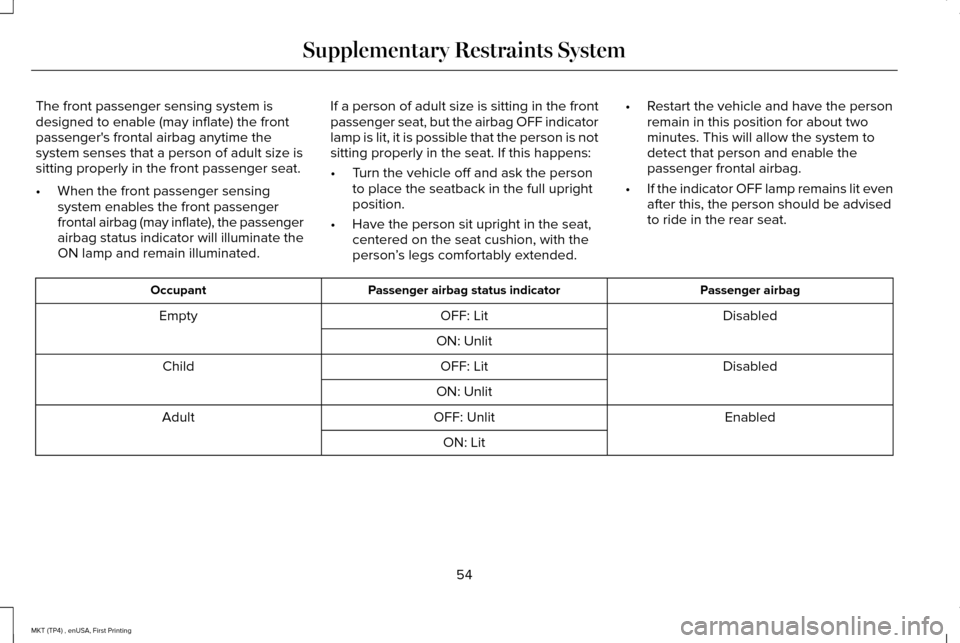
The front passenger sensing system is
designed to enable (may inflate) the front
passenger's frontal airbag anytime the
system senses that a person of adult size is
sitting properly in the front passenger seat.
•
When the front passenger sensing
system enables the front passenger
frontal airbag (may inflate), the passenger
airbag status indicator will illuminate the
ON lamp and remain illuminated. If a person of adult size is sitting in the front
passenger seat, but the airbag OFF indicator
lamp is lit, it is possible that the person is not
sitting properly in the seat. If this happens:
•
Turn the vehicle off and ask the person
to place the seatback in the full upright
position.
• Have the person sit upright in the seat,
centered on the seat cushion, with the
person ’s legs comfortably extended. •
Restart the vehicle and have the person
remain in this position for about two
minutes. This will allow the system to
detect that person and enable the
passenger frontal airbag.
• If the indicator OFF lamp remains lit even
after this, the person should be advised
to ride in the rear seat. Passenger airbag
Passenger airbag status indicator
Occupant
Disabled
OFF: Lit
Empty
ON: Unlit Disabled
OFF: Lit
Child
ON: Unlit Enabled
OFF: Unlit
Adult
ON: Lit
54
MKT (TP4) , enUSA, First Printing Supplementary Restraints System
Page 58 of 558
Note:
When the passenger airbag status
indicator OFF light is illuminated, the
passenger (seat mounted) side airbag may
be disabled to avoid the risk of airbag
deployment injuries.
After all occupants have adjusted their seats
and put on seatbelts, it is very important that
they continue to sit properly. A properly
seated occupant sits upright, leaning against
the seatback, and centered on the seat
cushion, with their feet comfortably extended
on the floor. Sitting improperly can increase
the chance of injury in a crash event. For
example, if an occupant slouches, lies down,
turns sideways, sits forward, leans forward
or sideways, or puts one or both feet up, the
chance of injury during a crash is greatly
increased. Make sure the front passenger
sensing system is operating
properly. See Crash Sensors and
Airbag Indicator (page 57).
Do not attempt to repair or service the
system. Take your vehicle immediately to an
authorized dealer. If it is necessary to modify an advanced front
airbag system to accommodate a person
with disabilities, contact the Ford Customer
Relationship Center.
See Getting the
Services You Need (page 259).
SIDE AIRBAGS WARNINGS
Do not place objects or mount
equipment on or near the airbag cover,
on the side of the seatbacks (of the front
seats), or in front seat areas that may come
into contact with a deploying airbag. Failure
to follow these instructions may increase the
risk of personal injury in the event of a crash. Do not use accessory seat covers. The
use of accessory seat covers may
prevent the deployment of the side airbags
and increase the risk of injury in an accident. Do not lean your head on the door. The
side airbag could injure you as it
deploys from the side of the seatback. WARNINGS
Do not attempt to service, repair, or
modify the airbag, its fuses or the seat
cover on a seat containing an airbag as you
could be seriously injured or killed. Contact
your authorized dealer as soon as possible. If the side airbag has deployed, the
airbag will not function again. The side
airbag system (including the seat) must be
inspected and serviced by an authorized
dealer. If the airbag is not replaced, the
unrepaired area will increase the risk of injury
in a crash. The side airbags are located on the outboard
side of the seatbacks of the front seats. In
certain sideways crashes, the airbag on the
side affected by the crash will be inflated.
The airbag was designed to inflate between
the door panel and occupant to further
enhance the protection provided occupants
in side impact crashes.
55
MKT (TP4) , enUSA, First Printing Supplementary Restraints SystemE67017