tow LINCOLN MKT 2019 Repair Manual
[x] Cancel search | Manufacturer: LINCOLN, Model Year: 2019, Model line: MKT, Model: LINCOLN MKT 2019Pages: 575, PDF Size: 4.66 MB
Page 267 of 575
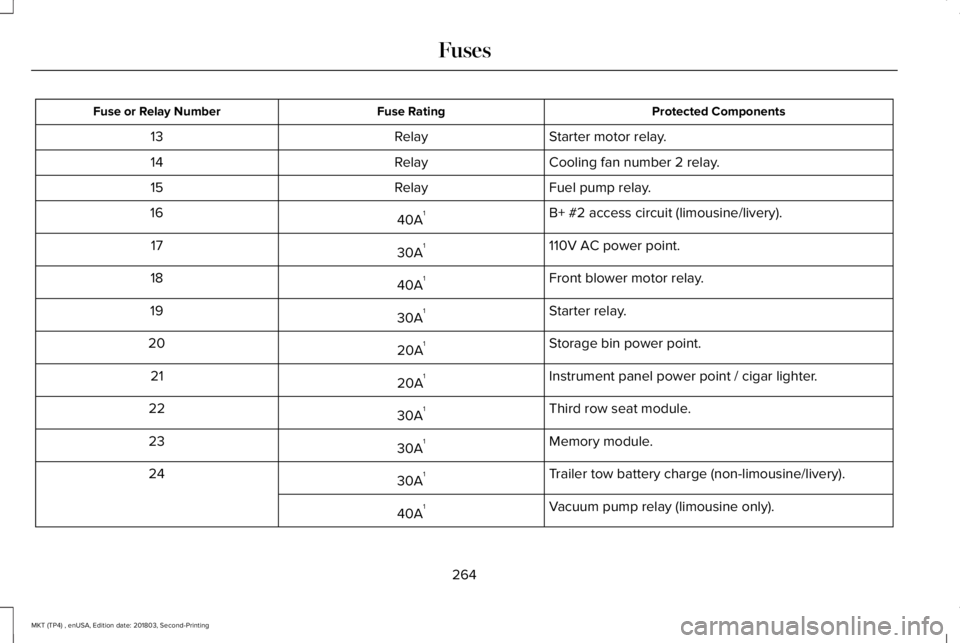
Protected ComponentsFuse RatingFuse or Relay Number
Starter motor relay.Relay13
Cooling fan number 2 relay.Relay14
Fuel pump relay.Relay15
B+ #2 access circuit (limousine/livery).40A116
110V AC power point.30A117
Front blower motor relay.40A118
Starter relay.30A119
Storage bin power point.20A120
Instrument panel power point / cigar lighter.20A121
Third row seat module.30A122
Memory module.30A123
Trailer tow battery charge (non-limousine/livery).30A124
Vacuum pump relay (limousine only).40A1
264
MKT (TP4) , enUSA, Edition date: 201803, Second-Printing
Fuses
Page 268 of 575
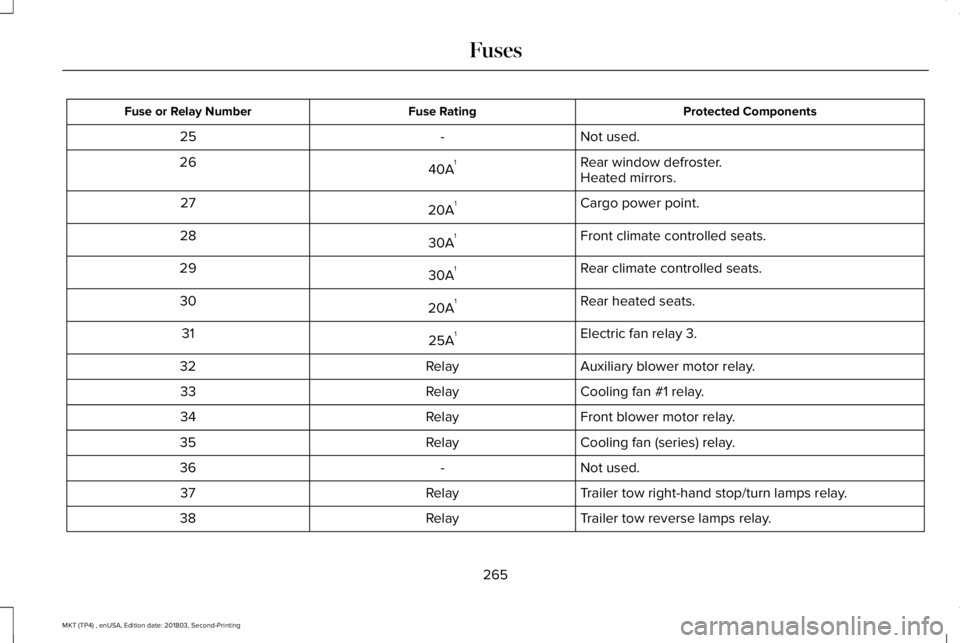
Protected ComponentsFuse RatingFuse or Relay Number
Not used.-25
Rear window defroster.40A126Heated mirrors.
Cargo power point.20A127
Front climate controlled seats.30A128
Rear climate controlled seats.30A129
Rear heated seats.20A130
Electric fan relay 3.25A131
Auxiliary blower motor relay.Relay32
Cooling fan #1 relay.Relay33
Front blower motor relay.Relay34
Cooling fan (series) relay.Relay35
Not used.-36
Trailer tow right-hand stop/turn lamps relay.Relay37
Trailer tow reverse lamps relay.Relay38
265
MKT (TP4) , enUSA, Edition date: 201803, Second-Printing
Fuses
Page 270 of 575
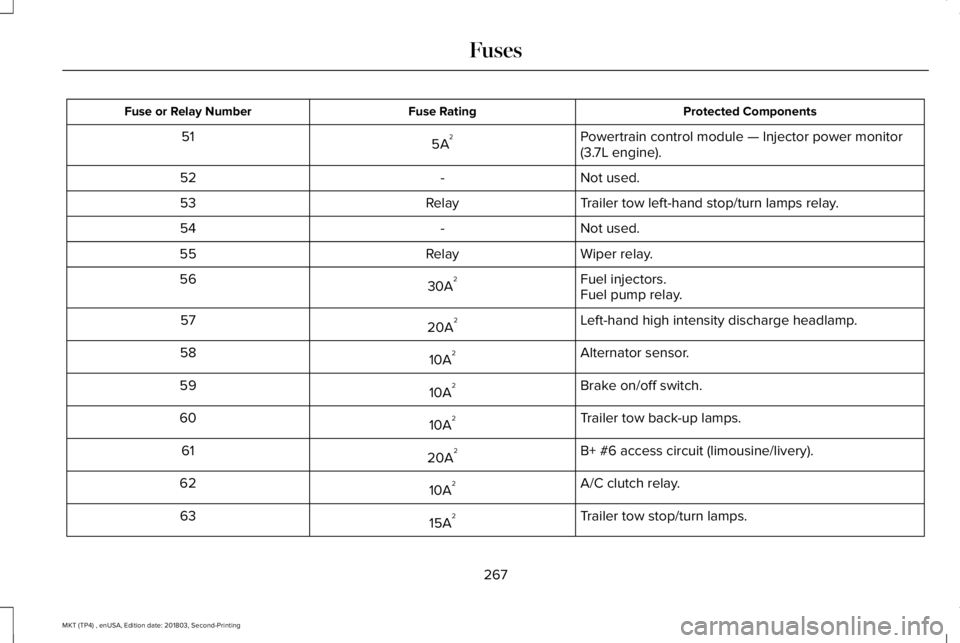
Protected ComponentsFuse RatingFuse or Relay Number
Powertrain control module — Injector power monitor(3.7L engine).5A251
Not used.-52
Trailer tow left-hand stop/turn lamps relay.Relay53
Not used.-54
Wiper relay.Relay55
Fuel injectors.30A256Fuel pump relay.
Left-hand high intensity discharge headlamp.20A257
Alternator sensor.10A258
Brake on/off switch.10A259
Trailer tow back-up lamps.10A260
B+ #6 access circuit (limousine/livery).20A261
A/C clutch relay.10A262
Trailer tow stop/turn lamps.15A263
267
MKT (TP4) , enUSA, Edition date: 201803, Second-Printing
Fuses
Page 272 of 575
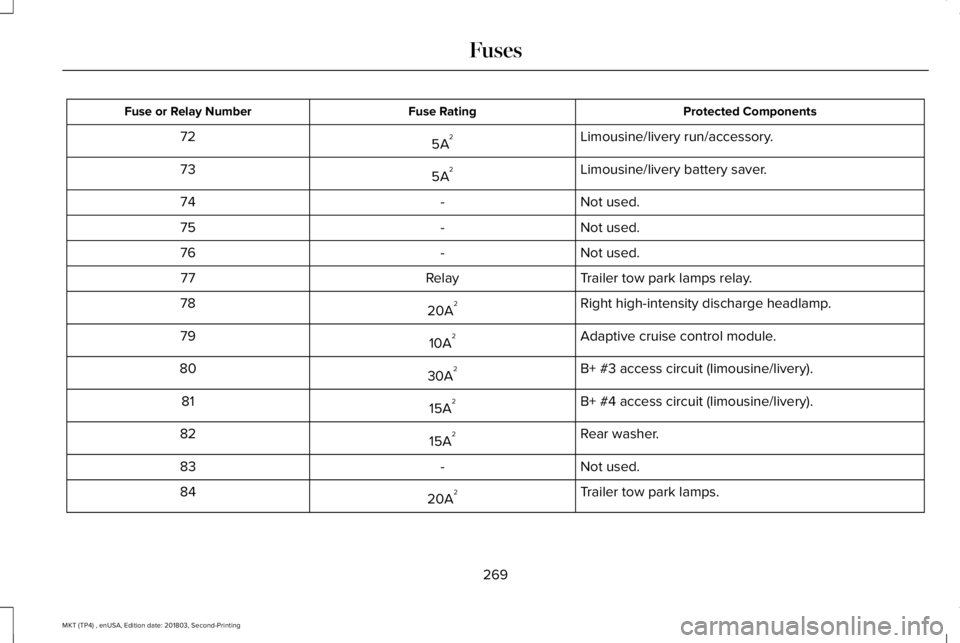
Protected ComponentsFuse RatingFuse or Relay Number
Limousine/livery run/accessory.5A272
Limousine/livery battery saver.5A273
Not used.-74
Not used.-75
Not used.-76
Trailer tow park lamps relay.Relay77
Right high-intensity discharge headlamp.20A278
Adaptive cruise control module.10A279
B+ #3 access circuit (limousine/livery).30A280
B+ #4 access circuit (limousine/livery).15A281
Rear washer.15A282
Not used.-83
Trailer tow park lamps.20A284
269
MKT (TP4) , enUSA, Edition date: 201803, Second-Printing
Fuses
Page 278 of 575
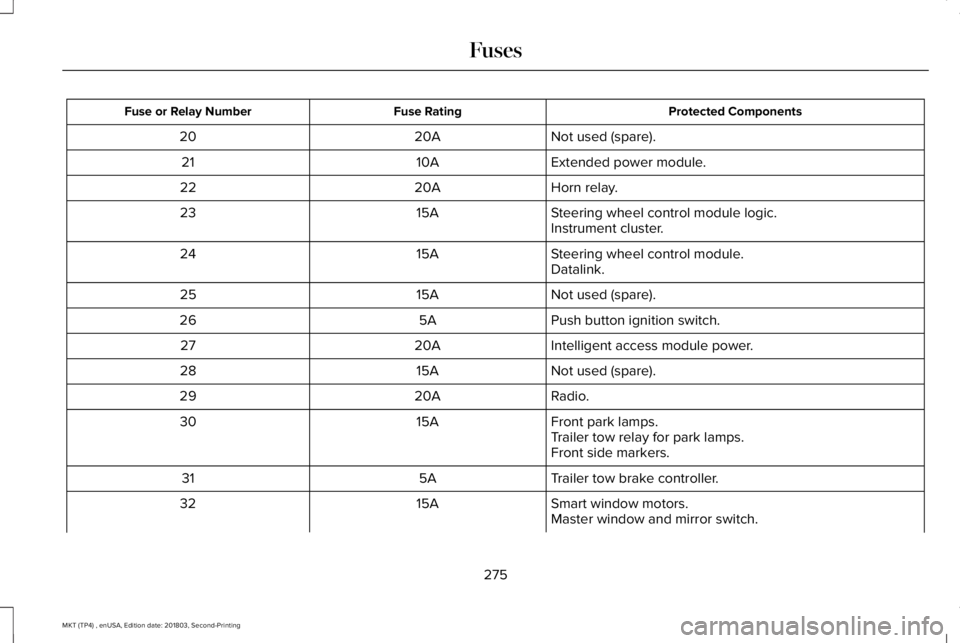
Protected ComponentsFuse RatingFuse or Relay Number
Not used (spare).20A20
Extended power module.10A21
Horn relay.20A22
Steering wheel control module logic.15A23Instrument cluster.
Steering wheel control module.15A24Datalink.
Not used (spare).15A25
Push button ignition switch.5A26
Intelligent access module power.20A27
Not used (spare).15A28
Radio.20A29
Front park lamps.15A30Trailer tow relay for park lamps.Front side markers.
Trailer tow brake controller.5A31
Smart window motors.15A32Master window and mirror switch.
275
MKT (TP4) , enUSA, Edition date: 201803, Second-Printing
Fuses
Page 294 of 575
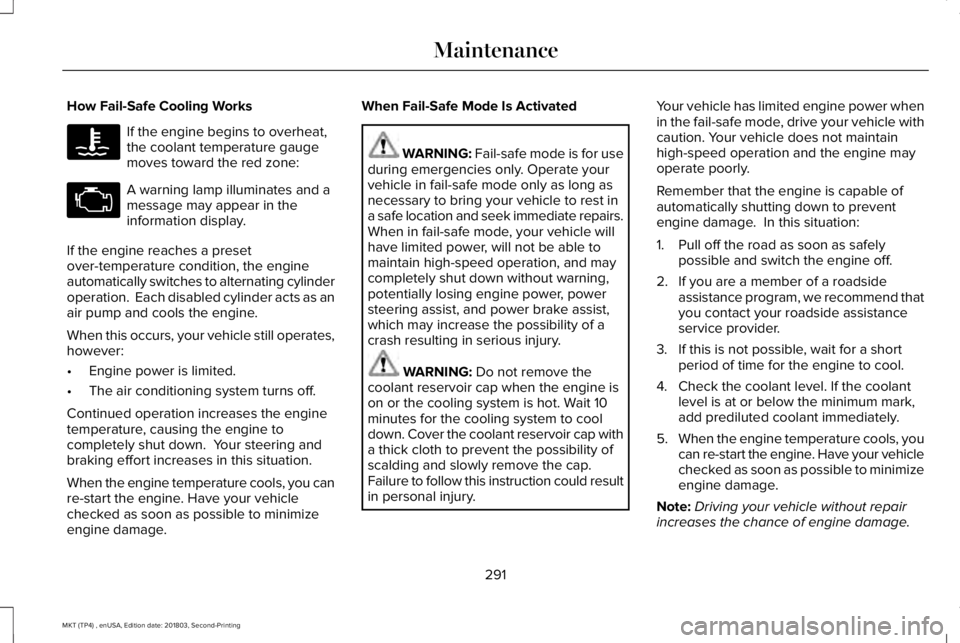
How Fail-Safe Cooling Works
If the engine begins to overheat,the coolant temperature gaugemoves toward the red zone:
A warning lamp illuminates and amessage may appear in theinformation display.
If the engine reaches a presetover-temperature condition, the engineautomatically switches to alternating cylinderoperation. Each disabled cylinder acts as anair pump and cools the engine.
When this occurs, your vehicle still operates,however:
•Engine power is limited.
•The air conditioning system turns off.
Continued operation increases the enginetemperature, causing the engine tocompletely shut down. Your steering andbraking effort increases in this situation.
When the engine temperature cools, you canre-start the engine. Have your vehiclechecked as soon as possible to minimizeengine damage.
When Fail-Safe Mode Is Activated
WARNING: Fail-safe mode is for useduring emergencies only. Operate yourvehicle in fail-safe mode only as long asnecessary to bring your vehicle to rest ina safe location and seek immediate repairs.When in fail-safe mode, your vehicle willhave limited power, will not be able tomaintain high-speed operation, and maycompletely shut down without warning,potentially losing engine power, powersteering assist, and power brake assist,which may increase the possibility of acrash resulting in serious injury.
WARNING: Do not remove thecoolant reservoir cap when the engine ison or the cooling system is hot. Wait 10minutes for the cooling system to cooldown. Cover the coolant reservoir cap witha thick cloth to prevent the possibility ofscalding and slowly remove the cap.Failure to follow this instruction could resultin personal injury.
Your vehicle has limited engine power whenin the fail-safe mode, drive your vehicle withcaution. Your vehicle does not maintainhigh-speed operation and the engine mayoperate poorly.
Remember that the engine is capable ofautomatically shutting down to preventengine damage. In this situation:
1. Pull off the road as soon as safelypossible and switch the engine off.
2. If you are a member of a roadsideassistance program, we recommend thatyou contact your roadside assistanceservice provider.
3. If this is not possible, wait for a shortperiod of time for the engine to cool.
4. Check the coolant level. If the coolantlevel is at or below the minimum mark,add prediluted coolant immediately.
5.When the engine temperature cools, youcan re-start the engine. Have your vehiclechecked as soon as possible to minimizeengine damage.
Note:Driving your vehicle without repairincreases the chance of engine damage.
291
MKT (TP4) , enUSA, Edition date: 201803, Second-Printing
Maintenance
Page 295 of 575
Engine Coolant TemperatureManagement (If Equipped)
WARNING: To reduce the risk ofcrash and injury, be prepared that thevehicle speed may reduce and the vehiclemay not be able to accelerate with fullpower until the coolant temperaturereduces.
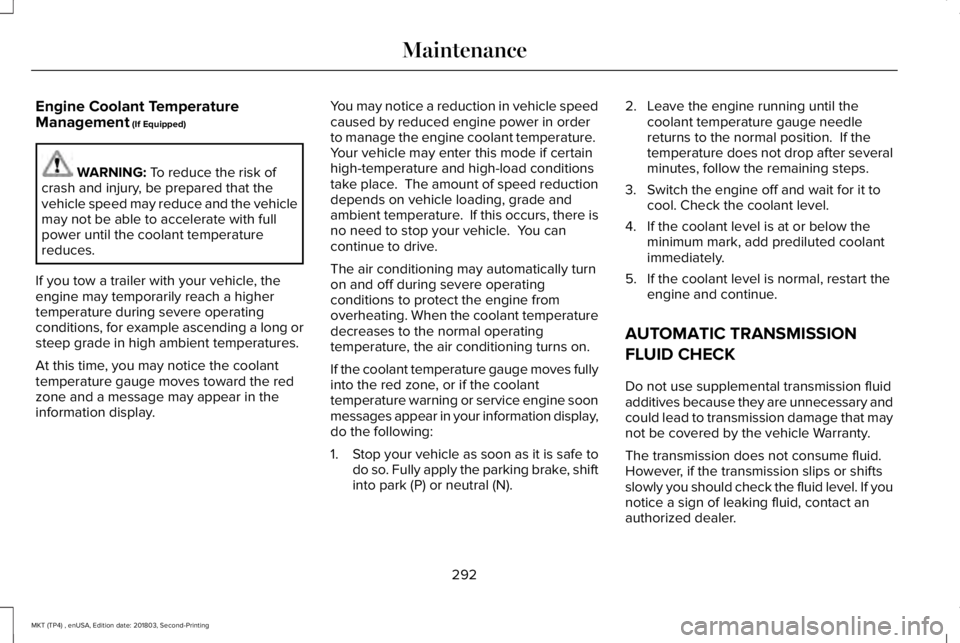
If you tow a trailer with your vehicle, theengine may temporarily reach a highertemperature during severe operatingconditions, for example ascending a long orsteep grade in high ambient temperatures.
At this time, you may notice the coolanttemperature gauge moves toward the redzone and a message may appear in theinformation display.
You may notice a reduction in vehicle speedcaused by reduced engine power in orderto manage the engine coolant temperature. Your vehicle may enter this mode if certainhigh-temperature and high-load conditionstake place. The amount of speed reductiondepends on vehicle loading, grade andambient temperature. If this occurs, there isno need to stop your vehicle. You cancontinue to drive.
The air conditioning may automatically turnon and off during severe operatingconditions to protect the engine fromoverheating. When the coolant temperaturedecreases to the normal operatingtemperature, the air conditioning turns on.
If the coolant temperature gauge moves fullyinto the red zone, or if the coolanttemperature warning or service engine soonmessages appear in your information display,do the following:
1.Stop your vehicle as soon as it is safe todo so. Fully apply the parking brake, shiftinto park (P) or neutral (N).
2. Leave the engine running until thecoolant temperature gauge needlereturns to the normal position. If thetemperature does not drop after severalminutes, follow the remaining steps.
3. Switch the engine off and wait for it tocool. Check the coolant level.
4. If the coolant level is at or below theminimum mark, add prediluted coolantimmediately.
5. If the coolant level is normal, restart theengine and continue.
AUTOMATIC TRANSMISSION
FLUID CHECK
Do not use supplemental transmission fluidadditives because they are unnecessary andcould lead to transmission damage that maynot be covered by the vehicle Warranty.
The transmission does not consume fluid.However, if the transmission slips or shiftsslowly you should check the fluid level. If younotice a sign of leaking fluid, contact anauthorized dealer.
292
MKT (TP4) , enUSA, Edition date: 201803, Second-Printing
Maintenance
Page 296 of 575
Checking the Transmission Fluid Level
WARNING: The dipstick andsurrounding components are hot. Usegloves when moving components andchecking the transmission fluid level.Failure to follow this warning could resultin serious personal injury.
Only check the transmission fluid level whenthe engine is at normal operatingtemperature 179°F (82°C)-199°F (93°C).Normal operating temperature is reachedafter driving approximately 20 mi (30 km).
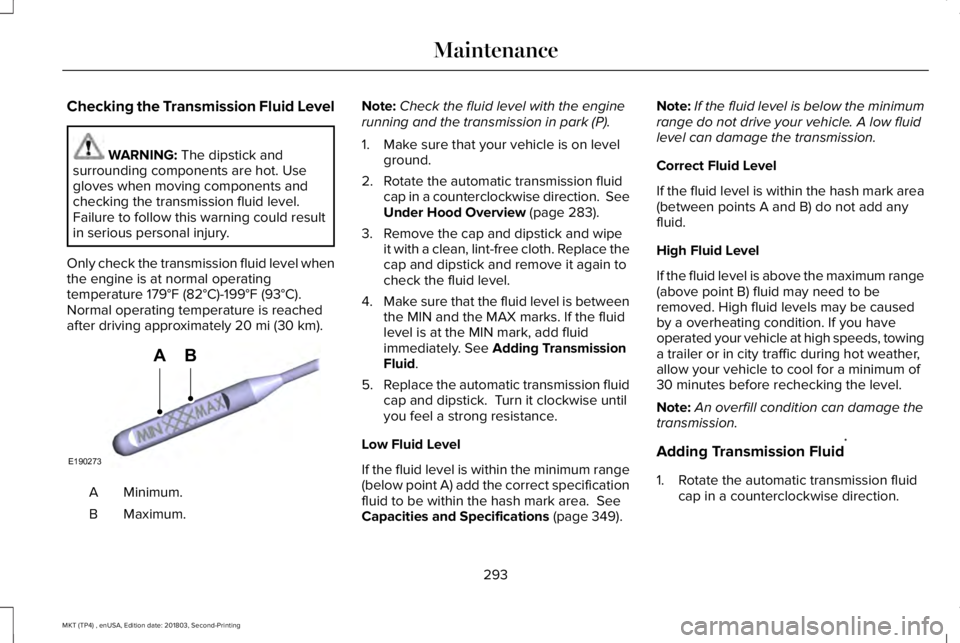
Minimum.A
Maximum.B
Note:Check the fluid level with the enginerunning and the transmission in park (P).
1. Make sure that your vehicle is on levelground.
2. Rotate the automatic transmission fluidcap in a counterclockwise direction. SeeUnder Hood Overview (page 283).
3. Remove the cap and dipstick and wipeit with a clean, lint-free cloth. Replace thecap and dipstick and remove it again tocheck the fluid level.
4.Make sure that the fluid level is betweenthe MIN and the MAX marks. If the fluidlevel is at the MIN mark, add fluidimmediately. See Adding TransmissionFluid.
5.Replace the automatic transmission fluidcap and dipstick. Turn it clockwise untilyou feel a strong resistance.
Low Fluid Level
If the fluid level is within the minimum range(below point A) add the correct specificationfluid to be within the hash mark area. SeeCapacities and Specifications (page 349).
Note:If the fluid level is below the minimumrange do not drive your vehicle. A low fluidlevel can damage the transmission.
Correct Fluid Level
If the fluid level is within the hash mark area(between points A and B) do not add anyfluid.
High Fluid Level
If the fluid level is above the maximum range(above point B) fluid may need to beremoved. High fluid levels may be causedby a overheating condition. If you haveoperated your vehicle at high speeds, towinga trailer or in city traffic during hot weather,allow your vehicle to cool for a minimum of30 minutes before rechecking the level.
Note:An overfill condition can damage thetransmission.
Adding Transmission Fluid*
1. Rotate the automatic transmission fluidcap in a counterclockwise direction.
293
MKT (TP4) , enUSA, Edition date: 201803, Second-Printing
MaintenanceE190273
AB
Page 307 of 575
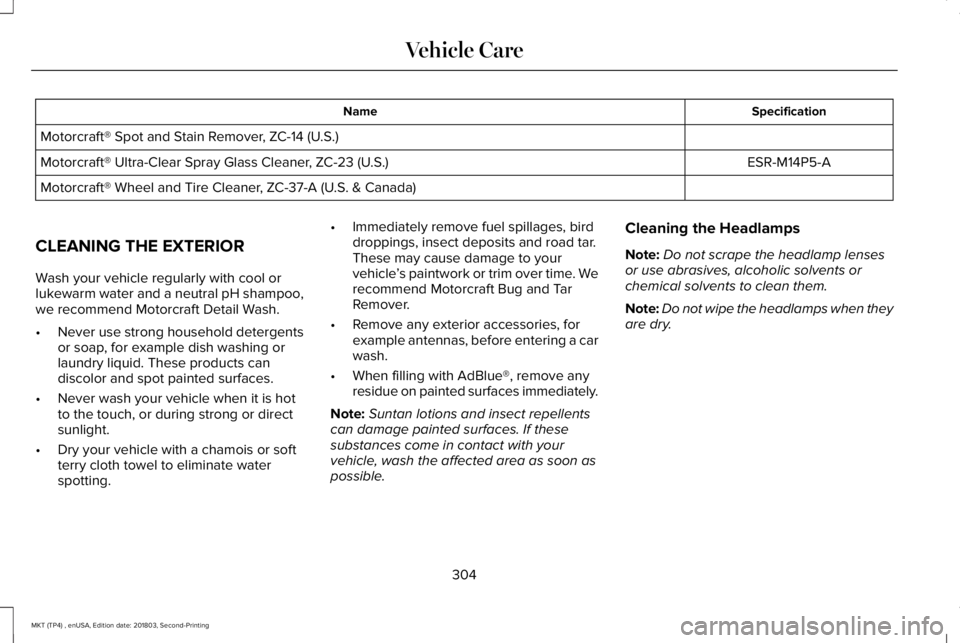
SpecificationName
Motorcraft® Spot and Stain Remover, ZC-14 (U.S.)
ESR-M14P5-AMotorcraft® Ultra-Clear Spray Glass Cleaner, ZC-23 (U.S.)
Motorcraft® Wheel and Tire Cleaner, ZC-37-A (U.S. & Canada)
CLEANING THE EXTERIOR
Wash your vehicle regularly with cool orlukewarm water and a neutral pH shampoo,we recommend Motorcraft Detail Wash.
•Never use strong household detergentsor soap, for example dish washing orlaundry liquid. These products candiscolor and spot painted surfaces.
•Never wash your vehicle when it is hotto the touch, or during strong or directsunlight.
•Dry your vehicle with a chamois or softterry cloth towel to eliminate waterspotting.
•Immediately remove fuel spillages, birddroppings, insect deposits and road tar.These may cause damage to yourvehicle’s paintwork or trim over time. Werecommend Motorcraft Bug and TarRemover.
•Remove any exterior accessories, forexample antennas, before entering a carwash.
•When filling with AdBlue®, remove anyresidue on painted surfaces immediately.
Note:Suntan lotions and insect repellentscan damage painted surfaces. If thesesubstances come in contact with yourvehicle, wash the affected area as soon aspossible.
Cleaning the Headlamps
Note:Do not scrape the headlamp lensesor use abrasives, alcoholic solvents orchemical solvents to clean them.
Note:Do not wipe the headlamps when theyare dry.
304
MKT (TP4) , enUSA, Edition date: 201803, Second-Printing
Vehicle Care
Page 329 of 575
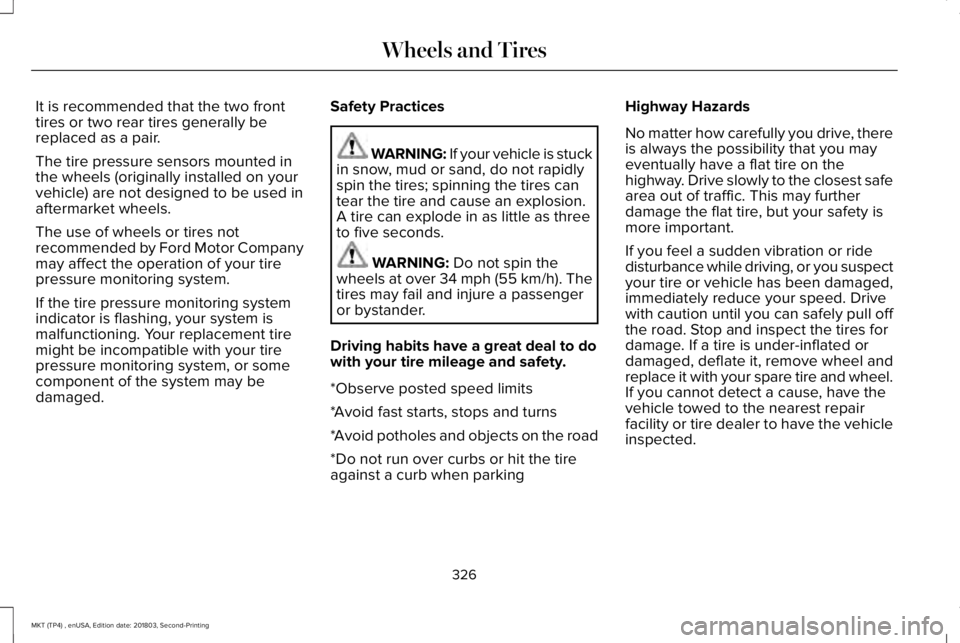
It is recommended that the two fronttires or two rear tires generally bereplaced as a pair.
The tire pressure sensors mounted inthe wheels (originally installed on yourvehicle) are not designed to be used inaftermarket wheels.
The use of wheels or tires notrecommended by Ford Motor Companymay affect the operation of your tirepressure monitoring system.
If the tire pressure monitoring systemindicator is flashing, your system ismalfunctioning. Your replacement tiremight be incompatible with your tirepressure monitoring system, or somecomponent of the system may bedamaged.
Safety Practices
WARNING: If your vehicle is stuckin snow, mud or sand, do not rapidlyspin the tires; spinning the tires cantear the tire and cause an explosion.A tire can explode in as little as threeto five seconds.
WARNING: Do not spin thewheels at over 34 mph (55 km/h). Thetires may fail and injure a passengeror bystander.
Driving habits have a great deal to dowith your tire mileage and safety.
*Observe posted speed limits
*Avoid fast starts, stops and turns
*Avoid potholes and objects on the road
*Do not run over curbs or hit the tireagainst a curb when parking
Highway Hazards
No matter how carefully you drive, thereis always the possibility that you mayeventually have a flat tire on thehighway. Drive slowly to the closest safearea out of traffic. This may furtherdamage the flat tire, but your safety ismore important.
If you feel a sudden vibration or ridedisturbance while driving, or you suspectyour tire or vehicle has been damaged,immediately reduce your speed. Drivewith caution until you can safely pull offthe road. Stop and inspect the tires fordamage. If a tire is under-inflated ordamaged, deflate it, remove wheel andreplace it with your spare tire and wheel.If you cannot detect a cause, have the
vehicle towed to the nearest repairfacility or tire dealer to have the vehicleinspected.
326
MKT (TP4) , enUSA, Edition date: 201803, Second-Printing
Wheels and Tires