cooling LINCOLN MKX 2013 User Guide
[x] Cancel search | Manufacturer: LINCOLN, Model Year: 2013, Model line: MKX, Model: LINCOLN MKX 2013Pages: 453, PDF Size: 4.87 MB
Page 256 of 453
Severe climates
If you drive in extremely cold climates:
Note:It may be necessary to have a Ford authorized dealer increase the
coolant concentration above 50%.
Note:A coolant concentration of 60% will provide improved freeze point
protection. Increased engine coolant concentrations above 60% will
decrease the overheat protection characteristics of the engine coolant
and may cause engine damage.
If you drive in extremely hot climates:
Note:It may be necessary to have a Ford authorized dealer decrease the
coolant concentration to 40%.
Note:A coolant concentration of 40% will provide improved overheat
protection. Decreased engine coolant concentrations below 40% will
decrease the corrosion/freeze protection characteristics of the engine
coolant and may cause engine damage.
Vehicles driven year-round in non-extreme climates should use prediluted
engine coolant for optimum cooling system and engine protection.
What you should know about fail-safe cooling
If the engine coolant supply is depleted, this feature allows the vehicle to
be driven temporarily before incremental component damage is incurred.
The “fail-safe” distance depends on ambient temperatures, vehicle load
and terrain.
How fail-safe cooling works
If the engine begins to overheat, the engine coolant temperature gauge
will move to the red (hot) area and:
The coolant temperature warning light will illuminate.
The service engine soon indicator will illuminate.
If the engine reaches a preset over-temperature condition, the engine will
automatically switch to alternating cylinder operation. Each disabled
cylinder acts as an air pump and cools the engine.
When this occurs the vehicle will still operate. However:
•The engine power will be limited.
•The air conditioning system will be disabled.
256Maintenance
2013 MKX(mkx)
Owners Guide gf, 1st Printing
USA(fus)
Page 258 of 453
![LINCOLN MKX 2013 User Guide TRANSMISSION FLUID CHECK
Note:Automatic transmission fluid expands when warmed. To obtain an
accurate fluid check, drive the vehicle until it is warmed up
(approximately 20 miles [30 km]). If your veh](/img/15/6954/w960_6954-257.png "LINCOLN MKX 2013 User Guide TRANSMISSION FLUID CHECK
Note:Automatic transmission fluid expands when warmed. To obtain an
accurate fluid check, drive the vehicle until it is warmed up
(approximately 20 miles [30 km]). If your veh")
TRANSMISSION FLUID CHECK
Note:Automatic transmission fluid expands when warmed. To obtain an
accurate fluid check, drive the vehicle until it is warmed up
(approximately 20 miles [30 km]). If your vehicle has been operated for
an extended period at high speeds, in city traffic during hot weather or
pulling a trailer, the vehicle should be turned off until normal operating
temperatures are reached to allow the fluid to cool before checking.
Depending on vehicle use, cooling times could take up to 30 minutes or
longer.
Refer to yourscheduled maintenance informationfor scheduled
intervals for fluid checks and changes. Your transmission does not
consume fluid. However, the fluid level should be checked if the
transmission is not working properly, i.e., if the transmission slips or
shifts slowly or if you notice some sign of fluid leakage.
WARNING:The dipstick cap and surrounding components may
be hot; gloves are recommended.
1. Drive the vehicle 20 miles (30 km) or until it reaches normal operating
temperature.
2. Park the vehicle on a level surface and engage the parking brake.
3. With the parking brake engaged and your foot on the brake pedal,
start the engine and move the gearshift lever through all of the gear
ranges. Allow a minimum of 10 seconds for each gear to engage.
4. Latch the gearshift lever in P (Park) and leave the engine running.
5. Remove the dipstick, wiping it clean with a clean, dry lint free rag. If
necessary, refer toUnder hood overviewin this chapter for the location
of the dipstick.
6. Install the dipstick making sure it is fully seated in the filler tube by
turning it to the locked position.
7. Remove the dipstick and inspect the fluid level. The fluid should be in
the designated areas for normal operating temperature.
Low fluid level
If the fluid level is below the MIN
range of the dipstick, add fluid to
reach the hash mark level.Note:If
the fluid level is below the MIN level,
do not drive the vehicle. An underfill condition may cause shift and/or
engagement concerns and/or possible damage.
MAX MIN
258Maintenance
2013 MKX(mkx)
Owners Guide gf, 1st Printing
USA(fus)
Page 259 of 453
Correct fluid level
The transmission fluid should be checked at normal operating
temperature 180°F-200°F (82°C-93°C) on a level surface. The normal
operating temperature can be reached after approximately 20 miles
(30 km) of driving.
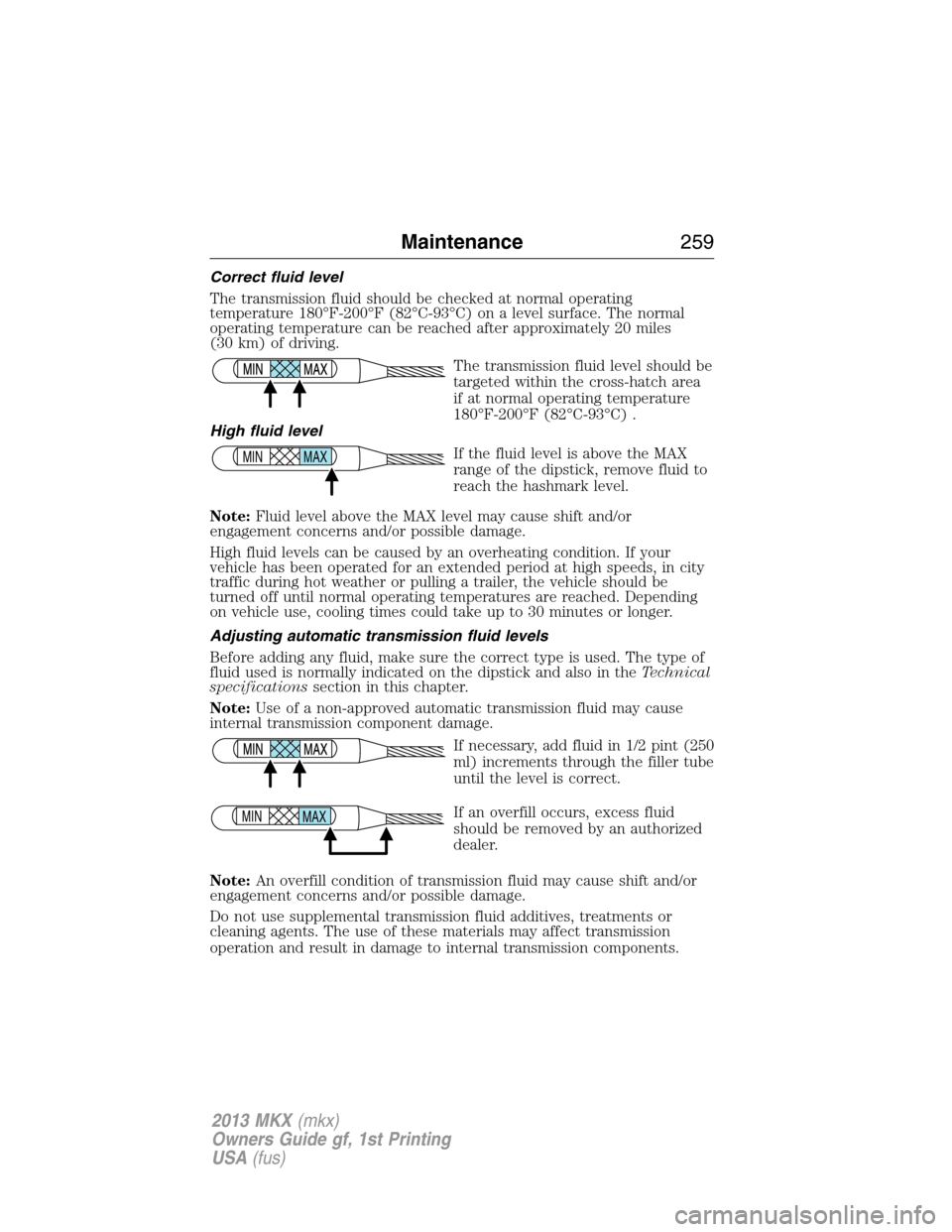
The transmission fluid level should be
targeted within the cross-hatch area
if at normal operating temperature
180°F-200°F (82°C-93°C) .
High fluid level
If the fluid level is above the MAX
range of the dipstick, remove fluid to
reach the hashmark level.
Note:Fluid level above the MAX level may cause shift and/or
engagement concerns and/or possible damage.
High fluid levels can be caused by an overheating condition. If your
vehicle has been operated for an extended period at high speeds, in city
traffic during hot weather or pulling a trailer, the vehicle should be
turned off until normal operating temperatures are reached. Depending
on vehicle use, cooling times could take up to 30 minutes or longer.
Adjusting automatic transmission fluid levels
Before adding any fluid, make sure the correct type is used. The type of
fluid used is normally indicated on the dipstick and also in theTechnical
specificationssection in this chapter.
Note:Use of a non-approved automatic transmission fluid may cause
internal transmission component damage.
If necessary, add fluid in 1/2 pint (250
ml) increments through the filler tube
until the level is correct.
If an overfill occurs, excess fluid
should be removed by an authorized
dealer.
Note:An overfill condition of transmission fluid may cause shift and/or
engagement concerns and/or possible damage.
Do not use supplemental transmission fluid additives, treatments or
cleaning agents. The use of these materials may affect transmission
operation and result in damage to internal transmission components.
MAX MIN
MAX MIN
Maintenance259
2013 MKX(mkx)
Owners Guide gf, 1st Printing
USA(fus)
Page 280 of 453
Engine
•The engine oil and filter should be changed prior to storage, as used
engine oil contain contaminates that may cause engine damage.
•Start the engine every 15 days. Run at fast idle until it reaches normal
operating temperature.
•With your foot on the brake, shift through all the gears while the
engine is running.
Fuel system
•Fill the fuel tank with high-quality fuel until the first automatic shutoff
of the fuel pump nozzle.
Note:During extended periods of vehicle storage (30 days or more), fuel
may deteriorate due to oxidation. Add a quality gas stabilizer product to
the vehicle fuel system whenever actual or expected storage periods
exceed 30 days. Follow the instructions on the additive label. The vehicle
should then be operated at idle speed to circulate the additive
throughout the fuel system.
Cooling system
•Protect against freezing temperatures.
•When removing vehicle from storage, check coolant fluid level.
Confirm there are no cooling system leaks, and fluid is at the
recommended level.
Battery
•Check and recharge as necessary. Keep connections clean.
•If storing your vehicle for more than 30 days without recharging the
battery, it may be advisable to disconnect the battery cables to ensure
battery charge is maintained for quick starting.
Note:If battery cables are disconnected, it will be necessary to reset
memory features.
280Vehicle Care
2013 MKX(mkx)
Owners Guide gf, 1st Printing
USA(fus)
Page 328 of 453
Additives and Chemicals
Ford Motor Company recommended additives and chemicals are listed in
this book and in theWorkshop Manual.Additional chemicals or
additives not approved by Ford and are not recommended as part of
normal maintenance. Please consult yourWarranty Manualfor
complete warranty information.
Oils, Fluids and Flushing
In many cases, fluid discoloration is a normal operating characteristic and,
by itself, does not necessarily indicate a concern or that the fluid needs to
be changed. However, discolored fluids that also show signs of overheating
and/or foreign material contamination should be inspected immediately by a
qualified expert such as the factory-trained technicians at your dealership.
Your vehicle’s oils and fluids should be changed at the specified intervals or
in conjunction with a repair. Flushing is a viable way to change fluid for
many vehicle sub-systems during scheduled maintenance. It is critical that
systems are flushed only with new fluid that is the same as that required to
fill and operate the system, or using a Ford-approved flushing chemical.
Owner Checks and Services
Certain basic maintenance checks and inspections should be performed
every month or at six months intervals.
Check every month
Engine oil level
Function of all interior and exterior lights
Tires for wear and proper pressure, including spare
Windshield washer fluid level
Check every six months
Battery connections; clean if necessary
Body and door drain holes for obstructions; clean if necessary
Cooling system fluid level and coolant strength
Door weatherstrips for wear; lubricate if necessary
Hinges/latches/outside locks for proper operation; lubricate if necessary
Parking brake for proper operation
Safety belts and seat latches for wear and function
Safety warning lamps (brake, ABS, airbag, safety belt) for operation
Washer spray/wiper operation; clean or replace blades as necessary
328Scheduled Maintenance
2013 MKX(mkx)
Owners Guide gf, 1st Printing
USA(fus)
Page 332 of 453
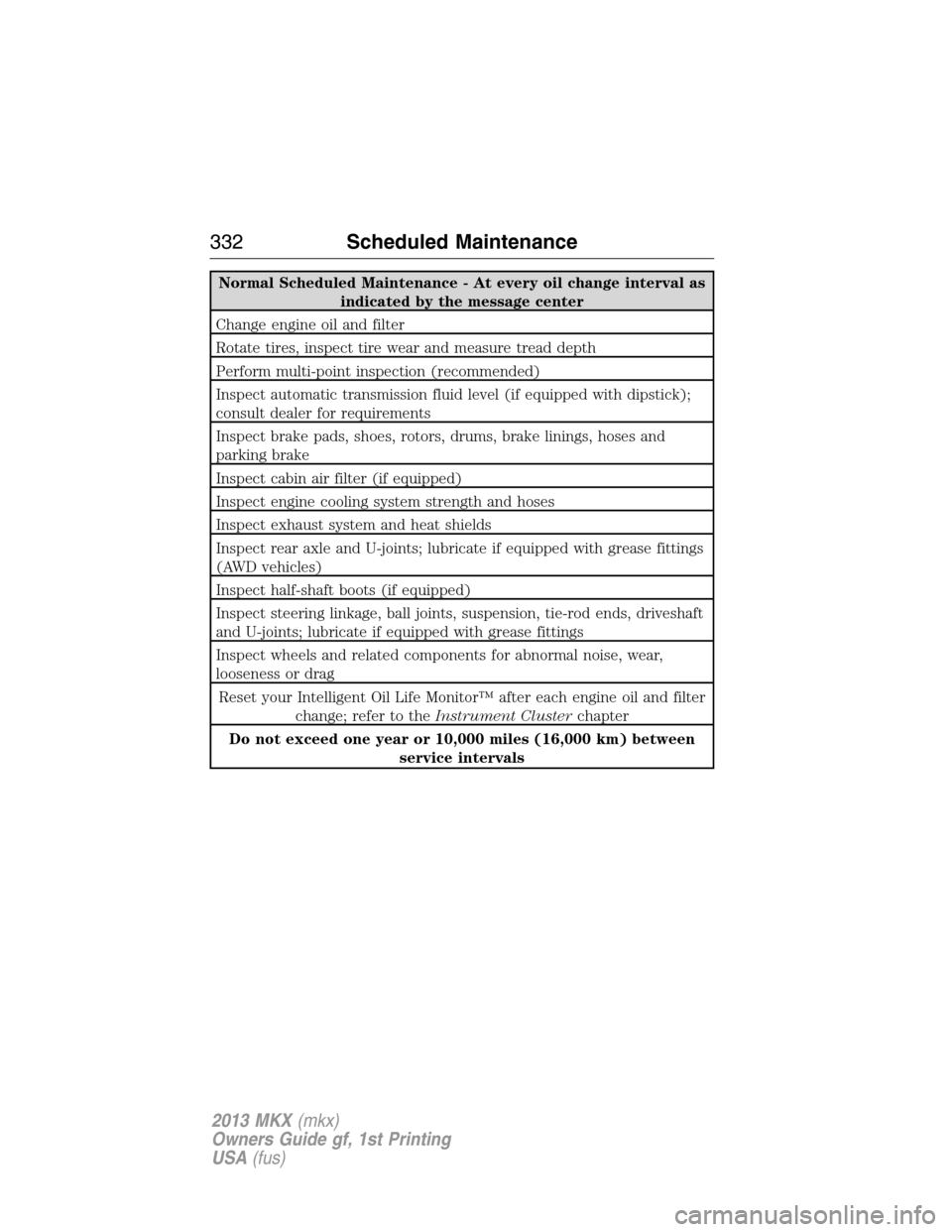
Normal Scheduled Maintenance - At every oil change interval as
indicated by the message center
Change engine oil and filter
Rotate tires, inspect tire wear and measure tread depth
Perform multi-point inspection (recommended)
Inspect automatic transmission fluid level (if equipped with dipstick);
consult dealer for requirements
Inspect brake pads, shoes, rotors, drums, brake linings, hoses and
parking brake
Inspect cabin air filter (if equipped)
Inspect engine cooling system strength and hoses
Inspect exhaust system and heat shields
Inspect rear axle and U-joints; lubricate if equipped with grease fittings
(AWD vehicles)
Inspect half-shaft boots (if equipped)
Inspect steering linkage, ball joints, suspension, tie-rod ends, driveshaft
and U-joints; lubricate if equipped with grease fittings
Inspect wheels and related components for abnormal noise, wear,
looseness or drag
Reset your Intelligent Oil Life Monitor™ after each engine oil and filter
change; refer to theInstrument Clusterchapter
Do not exceed one year or 10,000 miles (16,000 km) between
service intervals
332Scheduled Maintenance
2013 MKX(mkx)
Owners Guide gf, 1st Printing
USA(fus)
Page 415 of 453
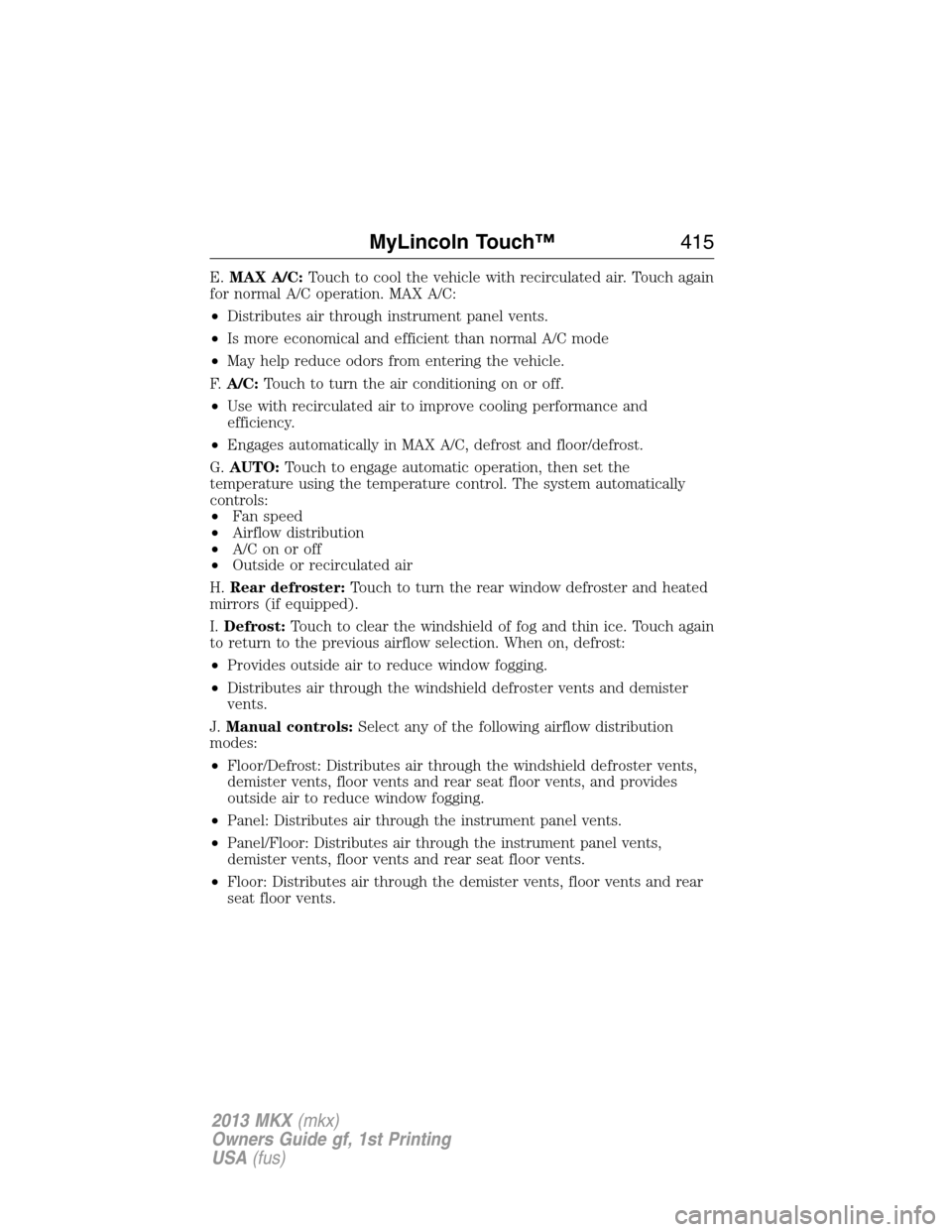
E.MAX A/C:Touch to cool the vehicle with recirculated air. Touch again
for normal A/C operation. MAX A/C:
•Distributes air through instrument panel vents.
•Is more economical and efficient than normal A/C mode
•May help reduce odors from entering the vehicle.
F.A/C:Touch to turn the air conditioning on or off.
•Use with recirculated air to improve cooling performance and
efficiency.
•Engages automatically in MAX A/C, defrost and floor/defrost.
G.AUTO:Touch to engage automatic operation, then set the
temperature using the temperature control. The system automatically
controls:
•Fan speed
•Airflow distribution
•A/Conoroff
•Outside or recirculated air
H.Rear defroster:Touch to turn the rear window defroster and heated
mirrors (if equipped).
I.Defrost:Touch to clear the windshield of fog and thin ice. Touch again
to return to the previous airflow selection. When on, defrost:
•Provides outside air to reduce window fogging.
•Distributes air through the windshield defroster vents and demister
vents.
J.Manual controls:Select any of the following airflow distribution
modes:
•Floor/Defrost: Distributes air through the windshield defroster vents,
demister vents, floor vents and rear seat floor vents, and provides
outside air to reduce window fogging.
•Panel: Distributes air through the instrument panel vents.
•Panel/Floor: Distributes air through the instrument panel vents,
demister vents, floor vents and rear seat floor vents.
•Floor: Distributes air through the demister vents, floor vents and rear
seat floor vents.
MyLincoln Touch™415
2013 MKX(mkx)
Owners Guide gf, 1st Printing
USA(fus)
Page 449 of 453
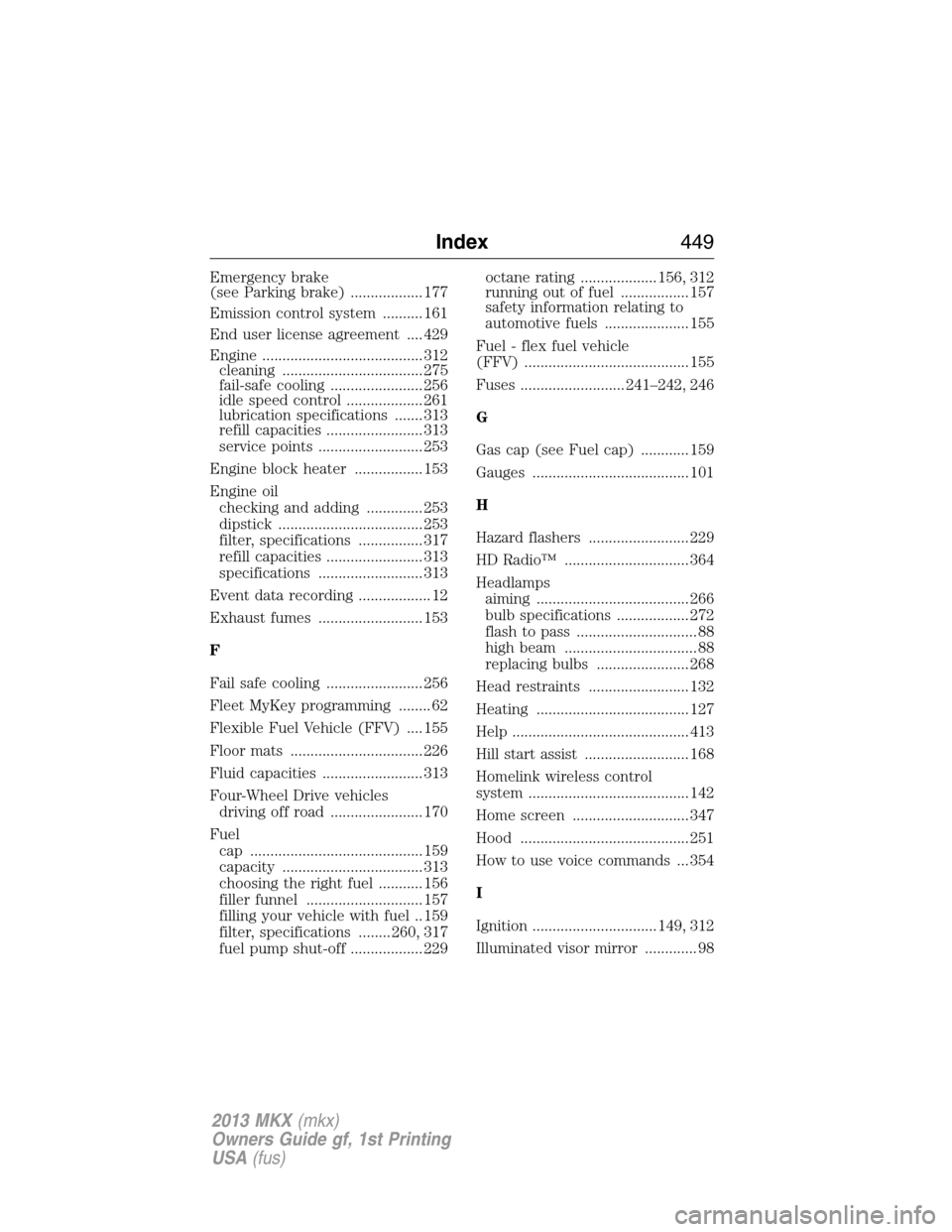
Emergency brake
(see Parking brake) .................. 177
Emission control system .......... 161
End user license agreement .... 429
Engine ........................................ 312
cleaning ................................... 275
fail-safe cooling ....................... 256
idle speed control ................... 261
lubrication specifications ....... 313
refill capacities ........................ 313
service points .......................... 253
Engine block heater ................. 153
Engine oil
checking and adding .............. 253
dipstick .................................... 253
filter, specifications ................ 317
refill capacities ........................ 313
specifications .......................... 313
Event data recording .................. 12
Exhaust fumes .......................... 153
F
Fail safe cooling ........................ 256
Fleet MyKey programming ........ 62
Flexible Fuel Vehicle (FFV) .... 155
Floor mats ................................. 226
Fluid capacities ......................... 313
Four-Wheel Drive vehicles
driving off road ....................... 170
Fuel
cap ........................................... 159
capacity ................................... 313
choosing the right fuel ........... 156
filler funnel ............................. 157
filling your vehicle with fuel .. 159
filter, specifications ........ 260, 317
fuel pump shut-off .................. 229octane rating ................... 156, 312
running out of fuel ................. 157
safety information relating to
automotive fuels ..................... 155
Fuel - flex fuel vehicle
(FFV) ......................................... 155
Fuses .......................... 241–242, 246
G
Gas cap (see Fuel cap) ............ 159
Gauges ....................................... 101
H
Hazard flashers ......................... 229
HD Radio™ ............................... 364
Headlamps
aiming ...................................... 266
bulb specifications .................. 272
flash to pass .............................. 88
high beam ................................. 88
replacing bulbs ....................... 268
Head restraints ......................... 132
Heating ...................................... 127
Help ............................................ 413
Hill start assist .......................... 168
Homelink wireless control
system ........................................ 142
Home screen ............................. 347
Hood .......................................... 251
How to use voice commands ... 354
I
Ignition ............................... 149, 312
Illuminated visor mirror ............. 98
Index449
2013 MKX(mkx)
Owners Guide gf, 1st Printing
USA(fus)