engine overheat LINCOLN MKX 2013 User Guide
[x] Cancel search | Manufacturer: LINCOLN, Model Year: 2013, Model line: MKX, Model: LINCOLN MKX 2013Pages: 453, PDF Size: 4.87 MB
Page 256 of 453
Severe climates
If you drive in extremely cold climates:
Note:It may be necessary to have a Ford authorized dealer increase the
coolant concentration above 50%.
Note:A coolant concentration of 60% will provide improved freeze point
protection. Increased engine coolant concentrations above 60% will
decrease the overheat protection characteristics of the engine coolant
and may cause engine damage.
If you drive in extremely hot climates:
Note:It may be necessary to have a Ford authorized dealer decrease the
coolant concentration to 40%.
Note:A coolant concentration of 40% will provide improved overheat
protection. Decreased engine coolant concentrations below 40% will
decrease the corrosion/freeze protection characteristics of the engine
coolant and may cause engine damage.
Vehicles driven year-round in non-extreme climates should use prediluted
engine coolant for optimum cooling system and engine protection.
What you should know about fail-safe cooling
If the engine coolant supply is depleted, this feature allows the vehicle to
be driven temporarily before incremental component damage is incurred.
The “fail-safe” distance depends on ambient temperatures, vehicle load
and terrain.
How fail-safe cooling works
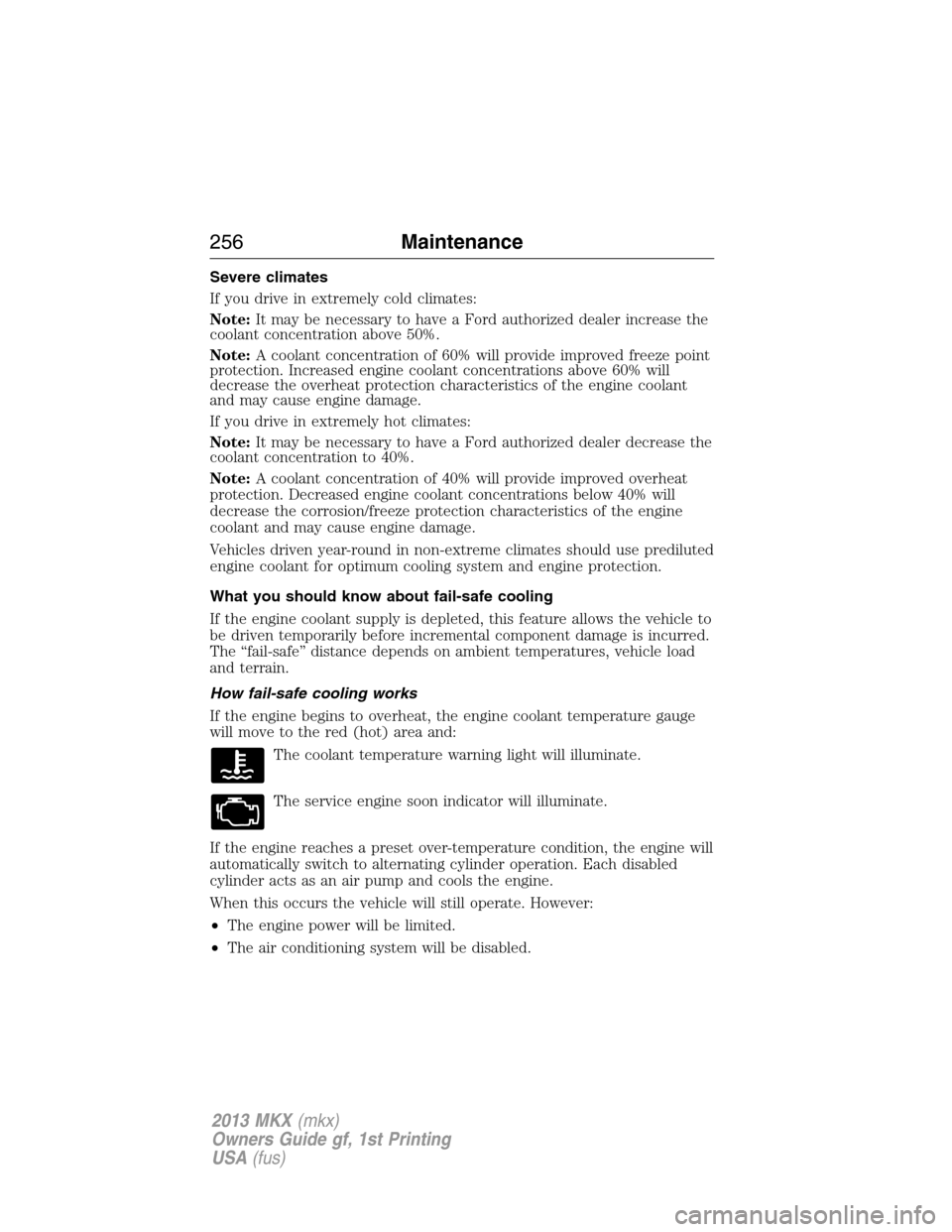
If the engine begins to overheat, the engine coolant temperature gauge
will move to the red (hot) area and:
The coolant temperature warning light will illuminate.
The service engine soon indicator will illuminate.
If the engine reaches a preset over-temperature condition, the engine will
automatically switch to alternating cylinder operation. Each disabled
cylinder acts as an air pump and cools the engine.
When this occurs the vehicle will still operate. However:
•The engine power will be limited.
•The air conditioning system will be disabled.
256Maintenance
2013 MKX(mkx)
Owners Guide gf, 1st Printing
USA(fus)
Page 328 of 453
Additives and Chemicals
Ford Motor Company recommended additives and chemicals are listed in
this book and in theWorkshop Manual.Additional chemicals or
additives not approved by Ford and are not recommended as part of
normal maintenance. Please consult yourWarranty Manualfor
complete warranty information.
Oils, Fluids and Flushing
In many cases, fluid discoloration is a normal operating characteristic and,
by itself, does not necessarily indicate a concern or that the fluid needs to
be changed. However, discolored fluids that also show signs of overheating
and/or foreign material contamination should be inspected immediately by a
qualified expert such as the factory-trained technicians at your dealership.
Your vehicle’s oils and fluids should be changed at the specified intervals or
in conjunction with a repair. Flushing is a viable way to change fluid for
many vehicle sub-systems during scheduled maintenance. It is critical that
systems are flushed only with new fluid that is the same as that required to
fill and operate the system, or using a Ford-approved flushing chemical.
Owner Checks and Services
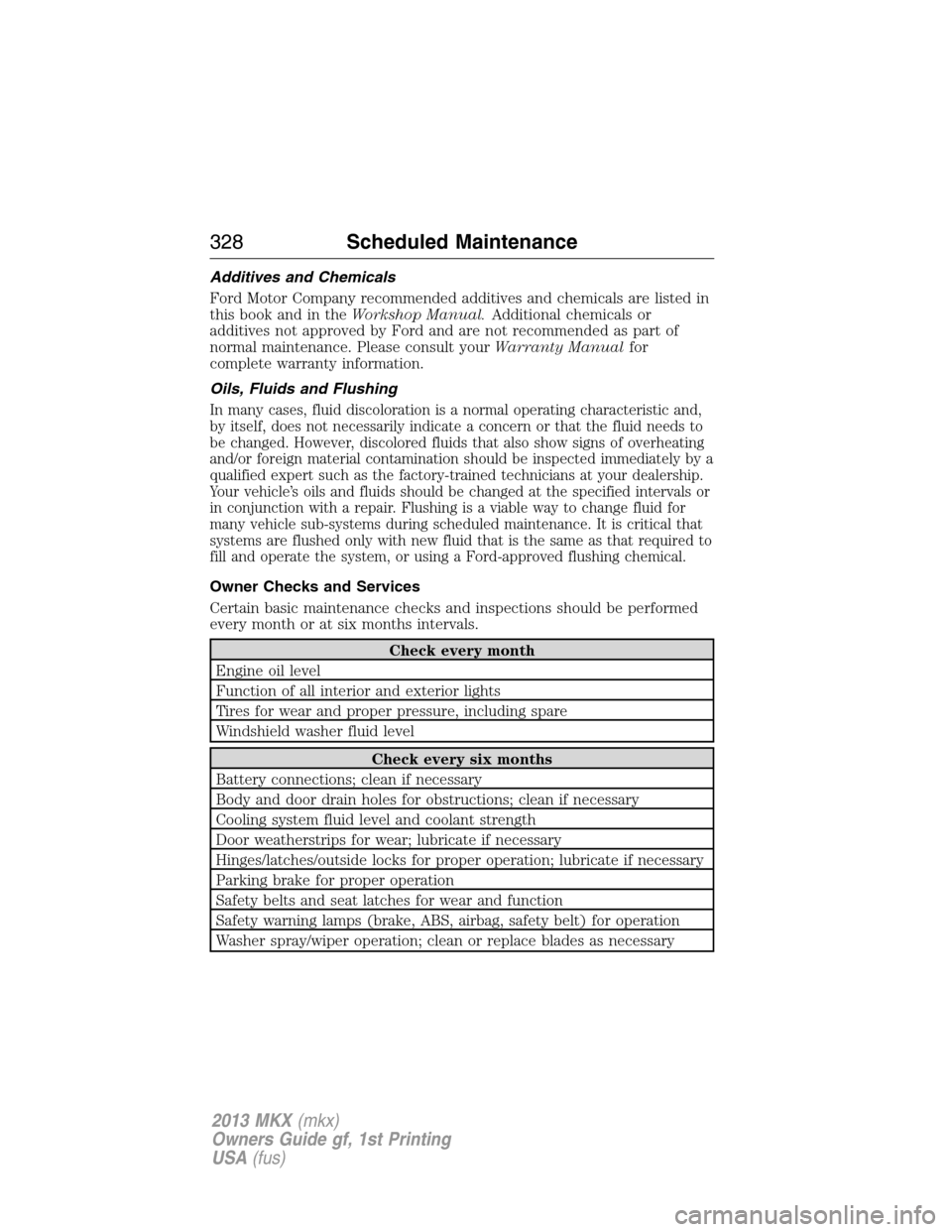
Certain basic maintenance checks and inspections should be performed
every month or at six months intervals.
Check every month
Engine oil level
Function of all interior and exterior lights
Tires for wear and proper pressure, including spare
Windshield washer fluid level
Check every six months
Battery connections; clean if necessary
Body and door drain holes for obstructions; clean if necessary
Cooling system fluid level and coolant strength
Door weatherstrips for wear; lubricate if necessary
Hinges/latches/outside locks for proper operation; lubricate if necessary
Parking brake for proper operation
Safety belts and seat latches for wear and function
Safety warning lamps (brake, ABS, airbag, safety belt) for operation
Washer spray/wiper operation; clean or replace blades as necessary
328Scheduled Maintenance
2013 MKX(mkx)
Owners Guide gf, 1st Printing
USA(fus)