child restraint LINCOLN MKX 2016 Owner's Manual
[x] Cancel search | Manufacturer: LINCOLN, Model Year: 2016, Model line: MKX, Model: LINCOLN MKX 2016Pages: 563, PDF Size: 4.96 MB
Page 50 of 563
WARNINGS
Any alteration or modification to the
front passenger seat may affect the
performance of the front passenger sensing
system which could seriously increase the
risk of injury or death. This system works with sensors that are part
of the front passenger seat and safety belt
to detect the presence of a properly-seated
occupant and determine if the front
passenger frontal airbag should be enabled
(may inflate) or not.
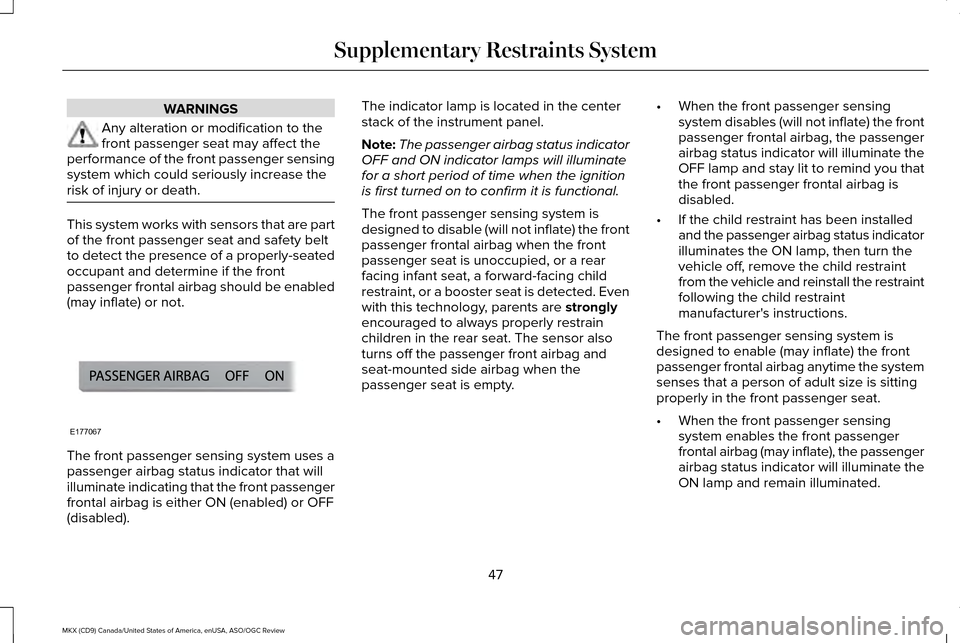
The front passenger sensing system uses a
passenger airbag status indicator that will
illuminate indicating that the front passenger
frontal airbag is either ON (enabled) or OFF
(disabled). The indicator lamp is located in the center
stack of the instrument panel.
Note:
The passenger airbag status indicator
OFF and ON indicator lamps will illuminate
for a short period of time when the ignition
is first turned on to confirm it is functional.
The front passenger sensing system is
designed to disable (will not inflate) the front
passenger frontal airbag when the front
passenger seat is unoccupied, or a rear
facing infant seat, a forward-facing child
restraint, or a booster seat is detected. Even
with this technology, parents are strongly
encouraged to always properly restrain
children in the rear seat. The sensor also
turns off the passenger front airbag and
seat-mounted side airbag when the
passenger seat is empty. •
When the front passenger sensing
system disables (will not inflate) the front
passenger frontal airbag, the passenger
airbag status indicator will illuminate the
OFF lamp and stay lit to remind you that
the front passenger frontal airbag is
disabled.
• If the child restraint has been installed
and the passenger airbag status indicator
illuminates the ON lamp, then turn the
vehicle off, remove the child restraint
from the vehicle and reinstall the restraint
following the child restraint
manufacturer's instructions.
The front passenger sensing system is
designed to enable (may inflate) the front
passenger frontal airbag anytime the system
senses that a person of adult size is sitting
properly in the front passenger seat.
• When the front passenger sensing
system enables the front passenger
frontal airbag (may inflate), the passenger
airbag status indicator will illuminate the
ON lamp and remain illuminated.
47
MKX (CD9) Canada/United States of America, enUSA, ASO/OGC Review Supplementary Restraints SystemE177067
Page 51 of 563
If a person of adult size is sitting in the front
passenger seat, but the airbag off indicator
lamp is lit, it is possible that the person is not
sitting properly in the seat. If this happens:
•
Turn the vehicle off and ask the person
to place the seatback in the full upright
position. •
Have the person sit upright in the seat,
centered on the seat cushion, with the
person ’s legs comfortably extended. •
Restart the vehicle and have the person
remain in this position for about two
minutes. This will allow the system to
detect that person and enable the
passenger frontal airbag.
• If the indicator OFF lamp remains lit even
after this, the person should be advised
to ride in the rear seat. Passenger airbag
Passenger airbag status indicator
Occupant
Disabled
OFF: Lit
Empty
ON: Unlit Disabled
OFF: Lit
Child
ON: Unlit Enabled
OFF: Unlit
Adult
ON: Lit
Note: When the passenger airbag status
indicator OFF light is illuminated, the
passenger (seat mounted) side airbag may
be disabled to avoid the risk of airbag
deployment injuries. After all occupants have adjusted their seats
and put on safety belts, it is very important
that they continue to sit properly. A properly
seated occupant sits upright, leaning against
the seatback, and centered on the seat
cushion, with their feet comfortably extended
48
MKX (CD9) Canada/United States of America, enUSA, ASO/OGC Review Supplementary Restraints System
Page 55 of 563
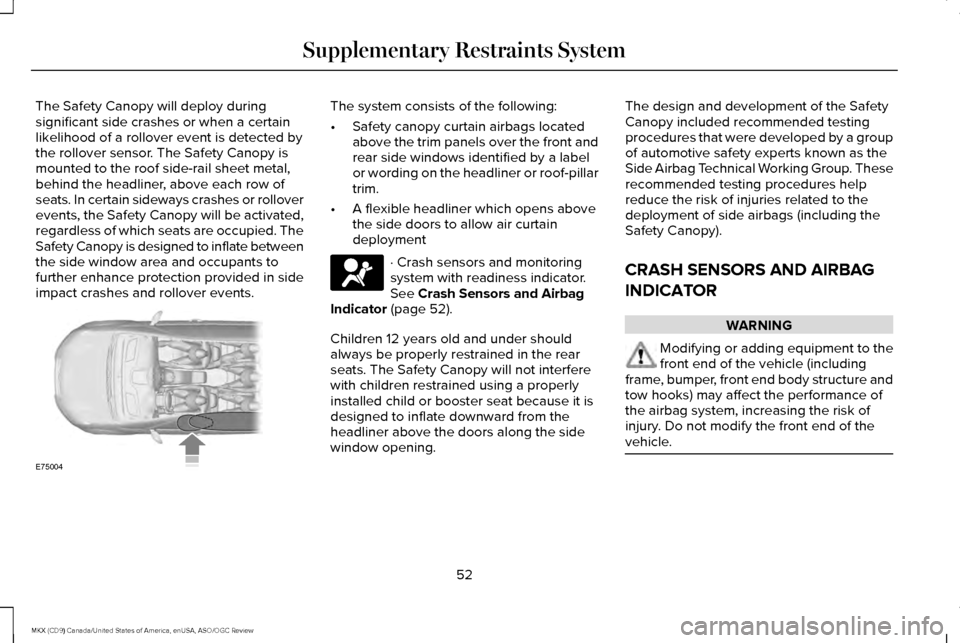
The Safety Canopy will deploy during
significant side crashes or when a certain
likelihood of a rollover event is detected by
the rollover sensor. The Safety Canopy is
mounted to the roof side-rail sheet metal,
behind the headliner, above each row of
seats. In certain sideways crashes or rollover
events, the Safety Canopy will be activated,
regardless of which seats are occupied. The
Safety Canopy is designed to inflate between
the side window area and occupants to
further enhance protection provided in side
impact crashes and rollover events. The system consists of the following:
•
Safety canopy curtain airbags located
above the trim panels over the front and
rear side windows identified by a label
or wording on the headliner or roof-pillar
trim.
• A flexible headliner which opens above
the side doors to allow air curtain
deployment · Crash sensors and monitoring
system with readiness indicator.
See Crash Sensors and Airbag
Indicator (page 52).
Children 12 years old and under should
always be properly restrained in the rear
seats. The Safety Canopy will not interfere
with children restrained using a properly
installed child or booster seat because it is
designed to inflate downward from the
headliner above the doors along the side
window opening. The design and development of the Safety
Canopy included recommended testing
procedures that were developed by a group
of automotive safety experts known as the
Side Airbag Technical Working Group. These
recommended testing procedures help
reduce the risk of injuries related to the
deployment of side airbags (including the
Safety Canopy).
CRASH SENSORS AND AIRBAG
INDICATOR
WARNING
Modifying or adding equipment to the
front end of the vehicle (including
frame, bumper, front end body structure and
tow hooks) may affect the performance of
the airbag system, increasing the risk of
injury. Do not modify the front end of the
vehicle. 52
MKX (CD9) Canada/United States of America, enUSA, ASO/OGC Review Supplementary Restraints SystemE75004
Page 337 of 563
GENERAL INFORMATION
Notice to utility vehicle and truck
owners
WARNINGS
Utility vehicles have a significantly
higher rollover rate than other types of
vehicles. To reduce the risk of serious injury
or death from a rollover or other crash you
must avoid sharp turns and abrupt
maneuvers, drive at safe speeds for the
conditions, keep tires properly inflated, never
overload or improperly load your vehicle,
and make sure every passenger is properly
restrained. In a rollover crash, an unbelted person
is significantly more likely to die than
a person wearing a seat belt. All occupants
must wear seat belts, and children and
infants must use appropriate restraints to
minimize the risk of injury or ejection. Utility vehicles and trucks handle differently
than passenger cars in the various driving
conditions that are encountered on streets,
highways and off-road. Utility vehicles and
trucks are not designed for cornering at
speeds as high as passenger cars any more
than low-slung sports cars are designed to
perform satisfactorily under off-road
conditions.
Study your owner's manual and any
supplements for specific information about
equipment features, instructions for safe
driving and additional precautions to reduce
the risk of an accident or serious injury.All-wheel drive system (if equipped) WARNING
Do not become overconfident in the
ability of all-wheel-drive vehicles.
Although an all-wheel-drive vehicle may
accelerate better than a two-wheel drive
vehicle in low traction situations, it will not
stop any faster than two-wheel drive
vehicles. Always drive at a safe speed. A vehicle equipped with all-wheel drive has
the ability to use all four wheels to power
itself. This increases traction which may
enable you to safely drive over terrain and
road conditions that a conventional
two-wheel drive vehicle cannot.
For all-wheel-drive vehicles, a spare tire of
a different size other than the tire provided
should never be used. A dissimilar spare tire
size (other than the spare tire provided) or
major dissimilar tire sized between the front
and rear axles could cause the
all-wheel-drive system to stop functioning
and default to front-wheel drive.
334
MKX (CD9) Canada/United States of America, enUSA, ASO/OGC Review Wheels and TiresE145298
Page 347 of 563
Crossover vehicles have a significantly
higher rollover rate than other types of
vehicles. To reduce this risk of serious
injury or death from a rollover or other
crash you must:
•
Avoid sharp turns and abrupt
maneuvers.
• Drive at safe speeds for the
conditions.
• Keep tires properly inflated.
• Never overload or improperly load
your vehicle.
• Make sure every passenger is
properly restrained. WARNING
In a rollover crash, an unbelted
person is significantly more likely
to die than a person wearing a seat belt.
All occupants must wear seat belts.
Children and infants must use
appropriate restraints to minimize the
risk of injury or ejection. Information About Uniform Tire Quality
Grading
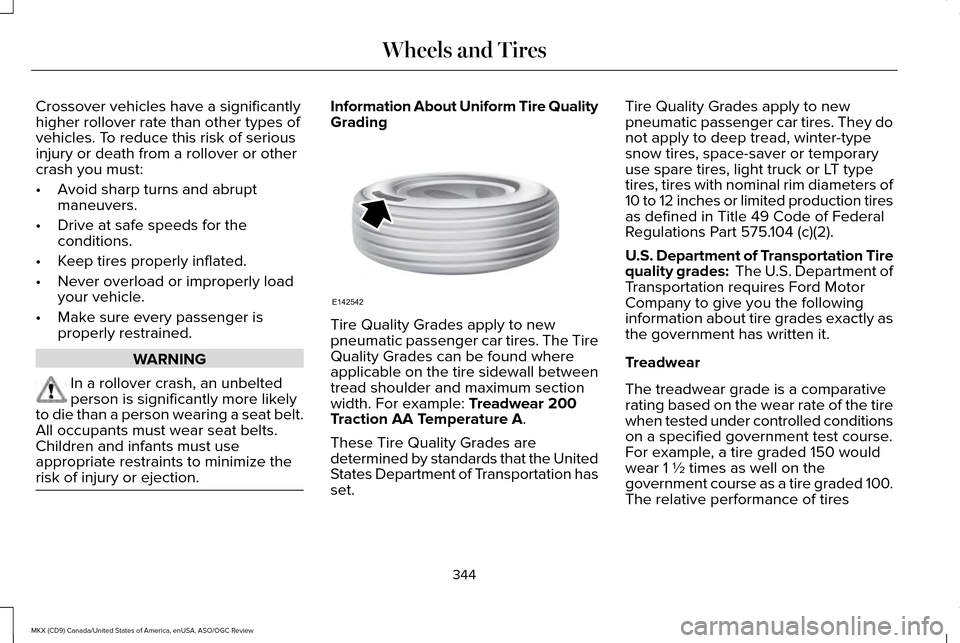
Tire Quality Grades apply to new
pneumatic passenger car tires. The Tire
Quality Grades can be found where
applicable on the tire sidewall between
tread shoulder and maximum section
width. For example: Treadwear 200
Traction AA Temperature A.
These Tire Quality Grades are
determined by standards that the United
States Department of Transportation has
set. Tire Quality Grades apply to new
pneumatic passenger car tires. They do
not apply to deep tread, winter-type
snow tires, space-saver or temporary
use spare tires, light truck or LT type
tires, tires with nominal rim diameters of
10 to 12 inches or limited production tires
as defined in Title 49 Code of Federal
Regulations Part 575.104 (c)(2).
U.S. Department of Transportation Tire
quality grades: The U.S. Department of
Transportation requires Ford Motor
Company to give you the following
information about tire grades exactly as
the government has written it.
Treadwear
The treadwear grade is a comparative
rating based on the wear rate of the tire
when tested under controlled conditions
on a specified government test course.
For example, a tire graded 150 would
wear 1 ½ times as well on the
government course as a tire graded 100.
The relative performance of tires
344
MKX (CD9) Canada/United States of America, enUSA, ASO/OGC Review Wheels and TiresE142542
Page 553 of 563
Automatic Transmission..............................182
Automatic Transmission Adaptive
Learning............................................................186
Brake-Shift Interlock Override.........................185
If Your Vehicle Gets Stuck In Mud or Snow...................................................................187
Push Button Shift Transmission.......................182
SelectShift Automatic ™ Transmission.............184
Automatic Transmission Fluid Check.......313 Adding Transmission Fluid ...............................314
Checking the Transmission Fluid Level ........313
Autowipers.......................................................88
Auxiliary Power Points.................................163 110 Volt AC Power Point.....................................163
12 Volt DC Power Point......................................163
Locations...............................................................163
AWD See: All-Wheel Drive...........................................188
B
Blind Spot Information System..................237 Blind Spot Information System (BLIS™) with
Cross Traffic Alert...........................................237
Bonnet Lock See: Opening and Closing the Hood............302
Booster Seats
...................................................27
Types of Booster Seats.......................................27 Brake Fluid Check
.........................................315
Brakes..............................................................194 General Information............................................194
Breaking-In....................................................269
Bulb Specification Chart
.............................322
C
Cabin Air Filter
...............................................143
California Proposition 65................................11
Capacities and Specifications - 2.7L EcoBoost™....................................................376
Specifications.......................................................377
Capacities and Specifications - 3.7L.........381 Specifications......................................................383
Capacities and Specifications...................370
Cargo Nets
.....................................................249
Car Wash See: Cleaning the Exterior...............................325
Center Console
.............................................165
Changing a Bulb............................................321
Headlamp..............................................................321
LED Lamps............................................................321
Changing a Fuse...........................................301 Fuses......................................................................301 Changing a Road Wheel.............................363
Dissimilar Spare Wheel and Tire Assembly
Information.......................................................364
Stowing the flat tire ...........................................367
Tire Change Procedure....................................365
Changing the 12V Battery...........................316
Changing the Engine Air Filter..................324
Changing the Wiper Blades
.......................318
Changing the Rear Window Wiper
Blade..................................................................319
Changing the Windshield Wiper Blades.......318
Checking MyKey System Status.................64
Checking the Wiper Blades........................318
Child Restraint and Safety Belt Maintenance...................................................41
Child Safety
.......................................................16
General Information..............................................16
Child Safety Locks...........................................31 Left-Hand Side.......................................................32
Right-Hand Side....................................................32
Child Seat Positioning...................................29
Cleaning Leather Seats..............................330
Cleaning Products........................................325
Cleaning the Alloy Wheels..........................331
Cleaning the Engine....................................327
550
MKX (CD9) Canada/United States of America, enUSA, ASO/OGC Review Index