fuel pressure LINCOLN MKX 2017 Owners Manual
[x] Cancel search | Manufacturer: LINCOLN, Model Year: 2017, Model line: MKX, Model: LINCOLN MKX 2017Pages: 587, PDF Size: 5.4 MB
Page 8 of 587
Automatic Transmission Fluid Check - 2.7L
EcoBoost™/3.7L..........................................319
Brake Fluid Check.........................................321
Washer Fluid Check....................................322
Fuel Filter
........................................................322
Changing the 12V Battery..........................322
Checking the Wiper Blades.......................324
Changing the Wiper Blades......................324
Adjusting the Headlamps..........................325
Changing a Bulb
...........................................326
Bulb Specification Chart.............................327
Changing the Engine Air Filter.................330
Vehicle Care
General Information......................................331
Cleaning Products
.........................................331
Cleaning the Exterior...................................332
Waxing.............................................................333
Cleaning the Engine
....................................333
Cleaning the Windows and Wiper Blades.........................................................334
Cleaning the Interior....................................334
Cleaning the Instrument Panel and Instrument Cluster Lens
.........................336 Cleaning Leather Seats...............................337
Repairing Minor Paint Damage
.................337
Cleaning the Wheels...................................337
Vehicle Storage
.............................................338
Body Styling Kits...........................................340
Wheels and Tires
General Information
......................................341
Tire Sealant and Inflator Kit.......................343
Tire Care
.........................................................350
Using Summer Tires
....................................365
Using Snow Chains
......................................366
Tire Pressure Monitoring System
.............367
Changing a Road Wheel..............................371
Technical Specifications
..............................377
Capacities and Specifications
Engine Specifications - 2.7L EcoBoost™..................................................379
Engine Specifications - 3.7L......................380
Motorcraft Parts - 2.7L EcoBoost™
.............381
Motorcraft Parts - 3.7L.................................382
Vehicle Identification Number
..................383 Vehicle Certification Label
.........................383
Transmission Code Designation
..............384
Capacities and Specifications - 2.7L EcoBoost™..................................................385
Capacities and Specifications - 3.7L........392
Audio System
General Information.....................................399
Audio Unit
......................................................400
Media Hub
.....................................................402
SYNC™ 3
General Information
.....................................403
Home Screen.................................................421
Using Voice Recognition............................422
Entertainment
................................................433
Climate............................................................446
Phone..............................................................450
Navigation......................................................458
Apps .................................................................
468
Settings...........................................................472
SYNC™ 3 Troubleshooting..........................488
5
MKX (CD9) Canada/United States of America, enUSA, First Printing Table of Contents
Page 115 of 587
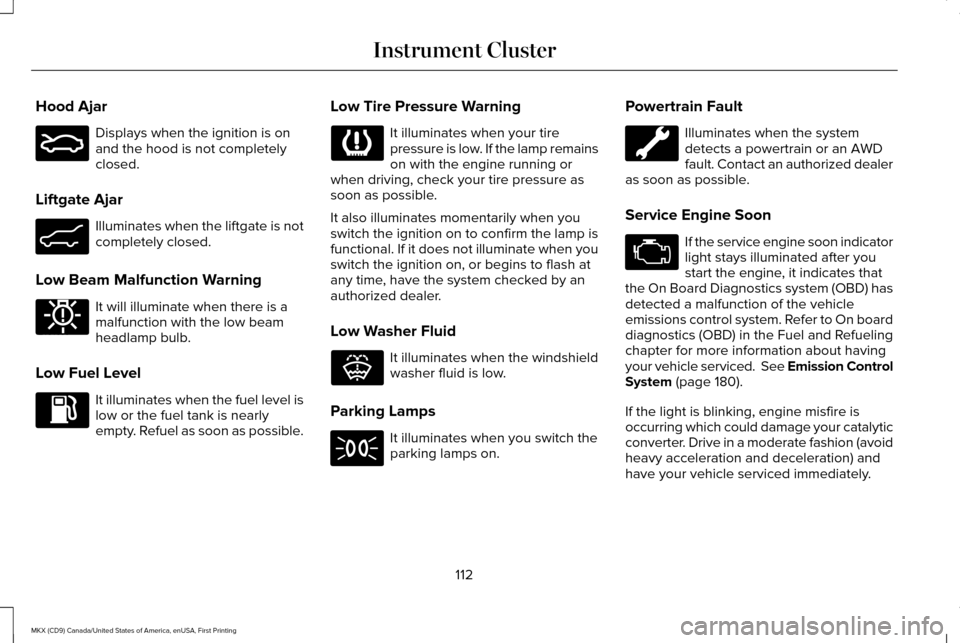
Hood Ajar
Displays when the ignition is on
and the hood is not completely
closed.
Liftgate Ajar Illuminates when the liftgate is not
completely closed.
Low Beam Malfunction Warning It will illuminate when there is a
malfunction with the low beam
headlamp bulb.
Low Fuel Level It illuminates when the fuel level is
low or the fuel tank is nearly
empty. Refuel as soon as possible. Low Tire Pressure Warning It illuminates when your tire
pressure is low. If the lamp remains
on with the engine running or
when driving, check your tire pressure as
soon as possible.
It also illuminates momentarily when you
switch the ignition on to confirm the lamp is
functional. If it does not illuminate when you
switch the ignition on, or begins to flash at
any time, have the system checked by an
authorized dealer.
Low Washer Fluid It illuminates when the windshield
washer fluid is low.
Parking Lamps It illuminates when you switch the
parking lamps on.Powertrain Fault Illuminates when the system
detects a powertrain or an AWD
fault. Contact an authorized dealer
as soon as possible.
Service Engine Soon If the service engine soon indicator
light stays illuminated after you
start the engine, it indicates that
the On Board Diagnostics system (OBD) has
detected a malfunction of the vehicle
emissions control system. Refer to On board
diagnostics (OBD) in the Fuel and Refueling
chapter for more information about having
your vehicle serviced. See Emission Control
System (page 180).
If the light is blinking, engine misfire is
occurring which could damage your catalytic
converter. Drive in a moderate fashion (avoid
heavy acceleration and deceleration) and
have your vehicle serviced immediately.
112
MKX (CD9) Canada/United States of America, enUSA, First Printing Instrument ClusterE159324 E162453 E181350 E132353
Page 176 of 587
SAFETY PRECAUTIONS
WARNINGS
Do not overfill the fuel tank. The
pressure in an overfilled tank may
cause leakage and lead to fuel spray and
fire. The fuel system may be under
pressure. If you hear a hissing sound
near the fuel filler inlet, do not refuel until the
sound stops. Otherwise, fuel may spray out,
which could cause serious personal injury. Fuels can cause serious injury or death
if misused or mishandled.
Flow of fuel through a fuel pump nozzle
can produce static electricity. This can
cause a fire if you are filling an ungrounded
fuel container. Fuel may contain benzene, which is a
cancer-causing agent. WARNINGS
When refueling always shut the engine
off and never allow sparks or open
flames near the fuel tank filler valve. Never
smoke or use a cell phone while refueling.
Fuel vapor is extremely hazardous under
certain conditions. Avoid inhaling excess
fumes. Observe the following guidelines when
handling automotive fuel:
•
Extinguish all smoking materials and any
open flames before refueling your
vehicle.
• Always turn off the vehicle before
refueling.
• Automotive fuels can be harmful or fatal
if swallowed. Fuel such as gasoline is
highly toxic and if swallowed can cause
death or permanent injury. If fuel is
swallowed, call a physician immediately,
even if no symptoms are immediately
apparent. The toxic effects of fuel may
not be visible for hours. •
Avoid inhaling fuel vapors. Inhaling too
much fuel vapor of any kind can lead to
eye and respiratory tract irritation. In
severe cases, excessive or prolonged
breathing of fuel vapor can cause serious
illness and permanent injury.
• Avoid getting fuel liquid in your eyes. If
fuel is splashed in the eyes, remove
contact lenses (if worn), flush with water
for 15 minutes and seek medical
attention. Failure to seek proper medical
attention could lead to permanent injury.
173
MKX (CD9) Canada/United States of America, enUSA, First Printing Fuel and Refueling
Page 179 of 587
Note:
Do not use aftermarket funnels as they
will not work with the capless fuel system
and can damage it.
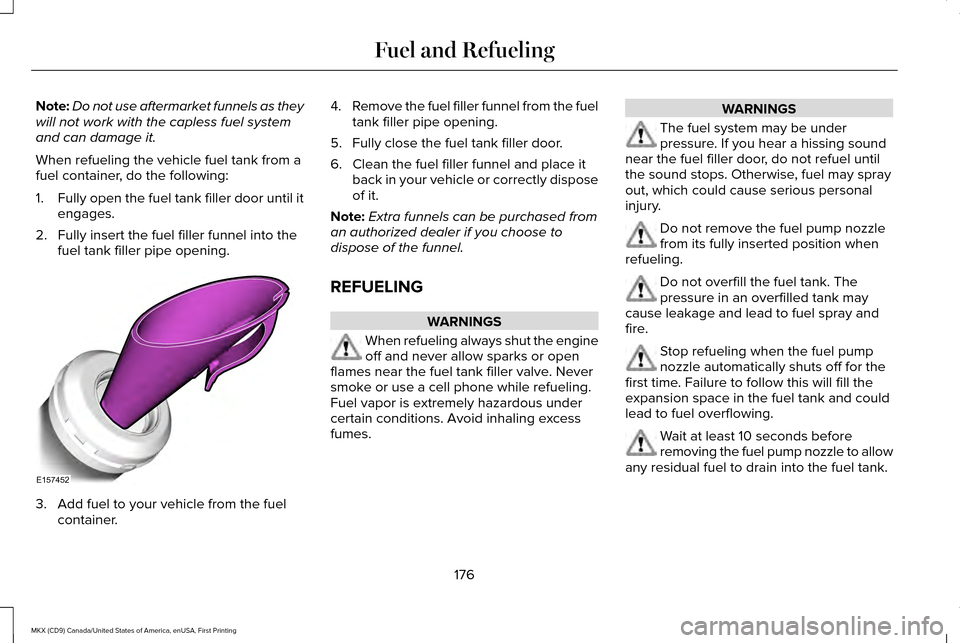
When refueling the vehicle fuel tank from a
fuel container, do the following:
1. Fully open the fuel tank filler door until it
engages.
2. Fully insert the fuel filler funnel into the fuel tank filler pipe opening. 3. Add fuel to your vehicle from the fuel
container. 4.
Remove the fuel filler funnel from the fuel
tank filler pipe opening.
5. Fully close the fuel tank filler door.
6. Clean the fuel filler funnel and place it back in your vehicle or correctly dispose
of it.
Note: Extra funnels can be purchased from
an authorized dealer if you choose to
dispose of the funnel.
REFUELING WARNINGS
When refueling always shut the engine
off and never allow sparks or open
flames near the fuel tank filler valve. Never
smoke or use a cell phone while refueling.
Fuel vapor is extremely hazardous under
certain conditions. Avoid inhaling excess
fumes. WARNINGS
The fuel system may be under
pressure. If you hear a hissing sound
near the fuel filler door, do not refuel until
the sound stops. Otherwise, fuel may spray
out, which could cause serious personal
injury. Do not remove the fuel pump nozzle
from its fully inserted position when
refueling. Do not overfill the fuel tank. The
pressure in an overfilled tank may
cause leakage and lead to fuel spray and
fire. Stop refueling when the fuel pump
nozzle automatically shuts off for the
first time. Failure to follow this will fill the
expansion space in the fuel tank and could
lead to fuel overflowing. Wait at least 10 seconds before
removing the fuel pump nozzle to allow
any residual fuel to drain into the fuel tank.
176
MKX (CD9) Canada/United States of America, enUSA, First Printing Fuel and RefuelingE157452
Page 325 of 587
WASHER FLUID CHECK
WARNING
If you operate your vehicle in
temperatures below 40°F (5°C), use
washer fluid with antifreeze protection.
Failure to use washer fluid with antifreeze
protection in cold weather could result in
impaired windshield vision and increase the
risk of injury or accident. Note:
The front and rear washer systems
are supplied from the same reservoir.
Add fluid to fill the reservoir if the level is low.
Only use a washer fluid that meets Ford
specifications. See Capacities and
Specifications (page 379).
State or local regulations on volatile organic
compounds may restrict the use of methanol,
a common windshield washer antifreeze
additive. Washer fluids containing
non-methanol antifreeze agents should be
used only if they provide cold weather
protection without damaging the vehicle ’s
paint finish, wiper blades or washer system. FUEL FILTER
Your vehicle is equipped with a lifetime fuel
filter that is integrated with the fuel tank.
Regular maintenance or replacement is not
needed.
CHANGING THE 12V BATTERY
WARNINGS
Batteries normally produce explosive
gases which can cause personal injury.
Therefore, do not allow flames, sparks or
lighted substances to come near the battery.
When working near the battery, always shield
your face and protect your eyes. Always
provide correct ventilation. When lifting a plastic-cased battery,
excessive pressure on the end walls
could cause acid to flow through the vent
caps, resulting in personal injury and damage
to the vehicle or battery. Lift the battery with
a battery carrier or with your hands on
opposite corners. WARNINGS
Keep batteries out of reach of children.
Batteries contain sulfuric acid. Avoid
contact with skin, eyes or clothing. Shield
your eyes when working near the battery to
protect against possible splashing of acid
solution. In case of acid contact with skin or
eyes, flush immediately with water for a
minimum of 15 minutes and get prompt
medical attention. If acid is swallowed, call a
physician immediately. Battery posts, terminals and related
accessories contain lead and lead
compounds. Wash hands after handling. Your vehicle is fitted with a Motorcraft
maintenance-free battery which normally
does not require additional water.
When a battery replacement is required, you
must use a recommended replacement
battery that matches the electrical
requirements of the vehicle.
Note:
If your vehicle has a battery cover,
after cleaning or replacing the battery, make
sure you reinstall it.
322
MKX (CD9) Canada/United States of America, enUSA, First Printing Maintenance
Page 342 of 587
•
Cover interior trim to prevent fading.
• Keep all rubber parts free from oil and
solvents.
Engine
• Change the engine oil and filter prior to
storage because used engine oil contains
contaminates which may cause engine
damage.
• Start the engine every 15 days for a
minimum of 15 minutes. Run at fast idle
with the climate controls set to defrost
until the engine reaches normal
operating temperature.
• With your foot on the brake, shift through
all the gears while the engine is running.
• We recommend that you change the
engine oil before you use your vehicle
again.
Fuel system
• Fill the fuel tank with high-quality fuel
until the first automatic shutoff of the fuel
pump nozzle. Cooling system
•
Protect against freezing temperatures.
• When removing your vehicle from
storage, check coolant fluid level.
Confirm that there are no cooling system
leaks and that fluid is at the
recommended level.
Battery
• Check and recharge as necessary. Keep
connections clean.
• If storing your vehicle for more than 30
days without recharging the battery, we
recommend that you disconnect the
battery cables to maintain battery charge
for quick starting.
Note: It is necessary to reset memory
features if battery cables are disconnected.
Brakes
• Make sure the brakes and parking brake
release fully.
Tires
• Maintain recommended air pressure. Miscellaneous
•
Make sure all linkages, cables, levers and
pins under your vehicle are covered with
grease to prevent rust.
• Move vehicles at least 25 ft (7.5 m) every
15 days to lubricate working parts and
prevent corrosion.
Removing Vehicle From Storage
When your vehicle is ready to come out of
storage, do the following:
• Wash your vehicle to remove any dirt or
grease film build-up on window surfaces.
• Check windshield wipers for any
deterioration.
• Check under the hood for any foreign
material that may have collected during
storage such as mice or squirrel nests.
• Check the exhaust for any foreign
material that may have collected during
storage.
• Check tire pressures and set tire inflation
per the Tire Label.
339
MKX (CD9) Canada/United States of America, enUSA, First Printing Vehicle Care
Page 370 of 587
TIRE PRESSURE MONITORING
SYSTEM
WARNING
The tire pressure monitoring system is
not a substitute for manually checking
tire pressures. You should periodically check
tire pressures using a pressure gauge.
Failure to correctly maintain tire pressures
could increase the risk of tire failure, loss of
control, vehicle rollover and personal injury. Each tire, including the spare (if
provided), should be checked
monthly when cold and inflated to
the inflation pressure recommended by the
vehicle manufacturer on the vehicle placard
or tire inflation pressure label. (If your vehicle
has tires of a different size than the size
indicated on the vehicle placard or tire
inflation pressure label, you should
determine the proper tire inflation pressure
for those tires.) As an added safety feature, your vehicle has
been equipped with a Tire Pressure
Monitoring System (TPMS) that illuminates a
low tire pressure telltale when one or more
of your tires is significantly under-inflated.
Accordingly, when the low tire pressure
telltale illuminates, you should stop and
check your tires as soon as possible, and
inflate them to the proper pressure. Driving
on a significantly under-inflated tire causes
the tire to overheat and can lead to tire
failure. Under-inflation also reduces fuel
efficiency and tire tread life, and may affect
the vehicle
’s handling and stopping ability.
Please note that the TPMS is not a substitute
for proper tire maintenance, and it is the
driver’ s responsibility to maintain correct tire
pressure, even if under-inflation has not
reached the level to trigger illumination of
the TPMS low tire pressure telltale. Your vehicle has also been equipped with a
TPMS malfunction indicator to indicate when
the system is not operating properly. The
TPMS malfunction indicator is combined with
the low tire pressure telltale. When the
system detects a malfunction, the telltale will
flash for approximately one minute and then
remain continuously illuminated. This
sequence will continue upon subsequent
vehicle start-ups as long as the malfunction
exists.
When the malfunction indicator is illuminated,
the system may not be able to detect or
signal low tire pressure as intended. TPMS
malfunctions may occur for a variety of
reasons, including the installation of
replacement or alternate tires or wheels on
the vehicle that prevent the TPMS from
functioning properly. Always check the TPMS
malfunction telltale after replacing one or
more tires or wheels on your vehicle to
ensure that the replacement or alternate tires
and wheels allow the TPMS to continue to
function properly.
367
MKX (CD9) Canada/United States of America, enUSA, First Printing Wheels and Tires
Page 388 of 587

CAPACITIES AND SPECIFICATIONS - 2.7L ECOBOOST™
Capacities
WARNING
The air conditioning refrigerant system contains refrigerant under high \
pressure. Only qualified personnel should service the air
conditioning refrigerant system. Opening the air conditioning refrigeran\
t system can cause personal injury.
Capacity
Item
6.0 qt (5.7 L)
Engine oil (with oil filter)
10.6 qt (10 L)
Engine coolant
Between MIN/MAX on brake fluid reservoir
Brake fluid
2.4 pt (1.15L)
Rear differential fluid (All Wheel Drive)
11.8 fl oz (0.35 L)
Power Transfer Unit (PTU) fluid (All Wheel Drive)
11.0 qt (10.4 L)*
Automatic transmission fluid
Fill as required
Windshield washer fluid
18.4 gal (69.5 L)
Fuel tank (Front Wheel Drive)
18.5 gal (70 L)
Fuel tank (All Wheel Drive)
385
MKX (CD9) Canada/United States of America, enUSA, First Printing Capacities and Specifications
Page 395 of 587

CAPACITIES AND SPECIFICATIONS - 3.7L
Capacities
WARNING
The air conditioning refrigerant system contains refrigerant under high \
pressure. Only qualified personnel should service the air
conditioning refrigerant system. Opening the air conditioning refrigeran\
t system can cause personal injury.
Capacity
Item
6.0 qt (5.7 L)
Engine oil (with oil filter)
11.7 qt (11.1 L)
Engine coolant
Between MIN/MAX on brake fluid reservoir
Brake fluid
2.4 pt (1.15L)
Rear differential fluid (All Wheel Drive)
11.8 fl oz (0.35 L)
Power Transfer Unit (PTU) fluid (All Wheel Drive)
11.0 qt (10.4 L)*
Automatic transmission fluid
Fill as required
Windshield washer fluid
18.4 gal (69.5 L)
Fuel tank (Front wheel drive)
18.5 gal (70 L)
Fuel tank (All wheel drive)
392
MKX (CD9) Canada/United States of America, enUSA, First Printing Capacities and Specifications
Page 581 of 587
Alarm......................................................................124
Automatic Engine Shutdown............................124
AWD........................................................................\
125
Battery and Charging System..........................126
Blind Spot Information and Cross Traffic Alert System...............................................................127
Collision Warning System.................................128
Doors and Locks..................................................128
Driver Alert............................................................129
Fuel........................................................................\
.129
Hill Start Assist.....................................................130
Keys and Intelligent Access.............................130
Lane Keeping System.........................................131
Maintenance.........................................................132
MyKey.....................................................................133
Park Aid..................................................................134
Park Brake.............................................................134
Power Steering....................................................135
Remote Start.........................................................136
Seats.......................................................................136
Starting System ...................................................136
Tire Pressure Monitoring System....................
137
Traction Control....................................................137
Transmission.........................................................138
Installing Child Restraints
..............................19
Child Seats..............................................................19
Using Lap and Shoulder Belts............................19 Using Lower Anchors and Tethers for
CHildren (LATCH).............................................25
Using Tether Straps..............................................27
Instrument Cluster.........................................107
Instrument Lighting Dimmer........................93
Interior Lamps
..................................................98
Front Interior Lamp...............................................98
Rear Interior Lamp................................................99
Interior Mirror
.................................................104
Auto-Dimming Mirror..........................................104
Introduction
.........................................................7
J
Jump Starting the Vehicle..........................273 Connecting the Jumper Cables......................
274
Jump Starting......................................................275
Preparing Your Vehicle......................................274
Removing the Jumper Cables.........................
275
K
Keyless Entry
....................................................77
SECURICODE™ Keyless Entry Keypad.............77
Keyless Starting.............................................167 Ignition Modes......................................................167
Keys and Remote Controls..........................56 L
Lane Keeping System.................................235
Switching the System On and Off..................235
Lighting Control
................................................91
Headlamp Flasher................................................92
High Beams............................................................92
Lighting...............................................................91 General Information..............................................91
Lincoln Automotive Financial Services......12
Lincoln Protect..............................................507 Lincoln Protect (CANADA ONLY)...................508
Lincoln Protect Extended Service Plans (U.S.
Only)..................................................................507
Load Carriers See: Roof Racks and Load Carriers...............
256
Load Carrying
................................................254
Load Limit.......................................................256
Special Loading Instructions for Owners of
Pick-up Trucks and Utility-type
Vehicles............................................................260
Vehicle Loading - with and without a Trailer................................................................256
Locking and Unlocking
.................................68
Activating Intelligent Access..............................70
Autolock...................................................................71
Auto Relock.............................................................71
Autounlock...............................................................71
578
MKX (CD9) Canada/United States of America, enUSA, First Printing Index