height LINCOLN MKX 2017 Owners Manual
[x] Cancel search | Manufacturer: LINCOLN, Model Year: 2017, Model line: MKX, Model: LINCOLN MKX 2017Pages: 587, PDF Size: 5.4 MB
Page 4 of 587
Introduction
About This Manual............................................7
Symbols Glossary
..............................................7
Data Recording
..................................................9
California Proposition 65
...............................12
Perchlorate........................................................12
Lincoln Automotive Financial Services
.........................................................12
Replacement Parts Recommendation........13
Special Notices
.................................................13
Mobile Communications Equipment
...........14
Export Unique Options...................................14
Environment
Protecting the Environment..........................16
Child Safety
General Information
........................................17
Installing Child Restraints
..............................19
Booster Seats
..................................................28
Child Restraint Positioning
............................31
Child Safety Locks..........................................32 Seatbelts
Principle of Operation....................................34
Fastening the Seatbelts................................35
Seatbelt Height Adjustment.........................39
Seatbelt Warning Lamp and Indicator
Chime
............................................................39
Seatbelt Reminder..........................................40
Child Restraint and Seatbelt Maintenance................................................42
Seatbelt Extension
..........................................43
Personal Safety System ™
Personal Safety System ™
..............................44
Supplementary Restraints System
Principle of Operation...................................45
Driver and Passenger Airbags....................46
Front Passenger Sensing System..............48
Side Airbags
......................................................51
Driver and Passenger Knee Airbags.........52
Safety Canopy™
...............................................52
Crash Sensors and Airbag Indicator
..........53 Airbag Disposal
...............................................55
Keys and Remote Controls
General Information on Radio Frequencies.................................................56
Remote Control
...............................................57
Replacing a Lost Key or Remote Control..........................................................60
MyKey™
Principle of Operation....................................61
Creating a MyKey...........................................62
Clearing All MyKeys.......................................63
Checking MyKey System Status
.................65
Using MyKey With Remote Start Systems........................................................66
MyKey Troubleshooting
................................66
Doors and Locks
Locking and Unlocking
.................................68
Manual Liftgate
................................................72
Power Liftgate..................................................74
Keyless Entry
....................................................77
1
MKX (CD9) Canada/United States of America, enUSA, First Printing Table of Contents
Page 20 of 587
GENERAL INFORMATION
See the following sections for directions on
how to properly use safety restraints for
children.
WARNINGS
Always make sure your child is secured
properly in a device that is appropriate
for their height, age and weight. Child safety
restraints must be bought separately from
your vehicle. Failure to follow these
instructions and guidelines may result in an
increased risk of serious injury or death to
your child. WARNINGS
All children are shaped differently. The
National Highway Traffic Safety
Administration and other safety
organizations, base their recommendations
for child restraints on probable child height,
age and weight thresholds, or on the
minimum requirements of the law. We
recommend that you check with a NHTSA
Certified Child Passenger Safety Technician
(CPST) to make sure that you properly install
the child restraint in your vehicle and that
you consult your pediatrician to make sure
you have a child restraint appropriate for
your child. To locate a child restraint fitting
station and CPST, contact NHTSA toll free
at 1-888-327-4236 or go to WARNINGS
www.nhtsa.dot.gov. In Canada, contact
Transport Canada toll free at 1-800-333-0371
or go to www.tc.gc.ca to find a Child Car Seat
Clinic in your area. Failure to properly restrain
children in child restraints made especially
for their height, age and weight, may result
in an increased risk of serious injury or death
to your child. On hot days, the temperature inside
the vehicle can rise very quickly.
Exposure of people or animals to these high
temperatures for even a short time can cause
death or serious heat related injuries,
including brain damage. Small children are
particularly at risk. 17
MKX (CD9) Canada/United States of America, enUSA, First Printing Child Safety
Page 21 of 587

Recommendations for Safety Restraints for Children
Recommended restraint type
Child size, height, weight, or age
Child
Use a child safety seat (sometimes called aninfant carrier, convertible seat, or toddler seat).
Children weighing 40 lb (18 kg) or less (generally age four or
younger).
Infants or toddlers
Use a belt-positioning booster seat.
Children who have outgrown or no longer properly fit in a child
safety seat (generally children who are less than 4 ft. 9 in. (1.45 m)\
tall, are greater than age four and less than age 12, and between 40 lb (18 kg)
and 80 lb (36 kg) and upward to 100 lb (45 kg) if
recommended by your child restraint manufacturer).
Small children
Use a vehicle safety belt having the lap beltsnug and low across the hips, shoulder belt
centered across the shoulder and chest, and seatback upright.
Children who have outgrown or no longer properly fit in a belt-
positioning booster seat (generally children who are at least 4 ft. 9 in. (1.45 m) tall or greater than
80 lb (36 kg) or 100 lb (45 kg) if
recommended by child restraint manufacturer).
Larger children
18
MKX (CD9) Canada/United States of America, enUSA, First Printing Child Safety
Page 22 of 587
•
You are required by law to properly use
safety seats for infants and toddlers in
the United States and Canada.
• Many states and provinces require that
small children use approved booster
seats until they reach age eight, a height
of 4 feet 9 inches (1.45 meters) tall, or
80 lb (36 kg). Check your local and state
or provincial laws for specific
requirements about the safety of children
in your vehicle.
• When possible, always properly restrain
children 12 years of age and under in a
rear seating position of your vehicle.
Accident statistics suggest that children
are safer when properly restrained in the
rear seating positions than in a front
seating position.
See Front Passenger
Sensing System (page 48). INSTALLING CHILD RESTRAINTS
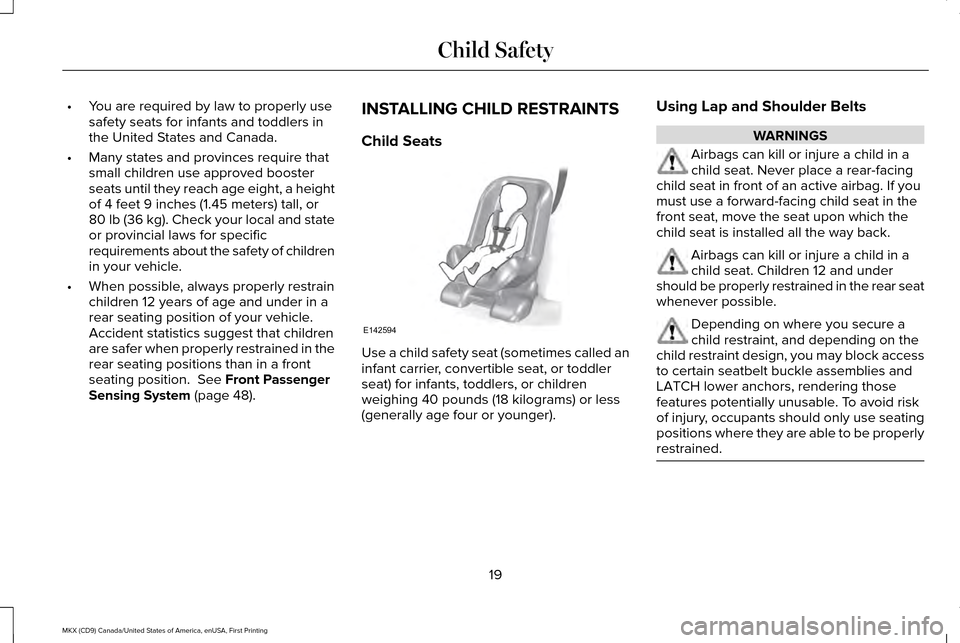
Child Seats
Use a child safety seat (sometimes called an
infant carrier, convertible seat, or toddler
seat) for infants, toddlers, or children
weighing 40 pounds (18 kilograms) or less
(generally age four or younger).Using Lap and Shoulder Belts WARNINGS
Airbags can kill or injure a child in a
child seat. Never place a rear-facing
child seat in front of an active airbag. If you
must use a forward-facing child seat in the
front seat, move the seat upon which the
child seat is installed all the way back. Airbags can kill or injure a child in a
child seat. Children 12 and under
should be properly restrained in the rear seat
whenever possible. Depending on where you secure a
child restraint, and depending on the
child restraint design, you may block access
to certain seatbelt buckle assemblies and
LATCH lower anchors, rendering those
features potentially unusable. To avoid risk
of injury, occupants should only use seating
positions where they are able to be properly
restrained. 19
MKX (CD9) Canada/United States of America, enUSA, First Printing Child SafetyE142594
Page 31 of 587
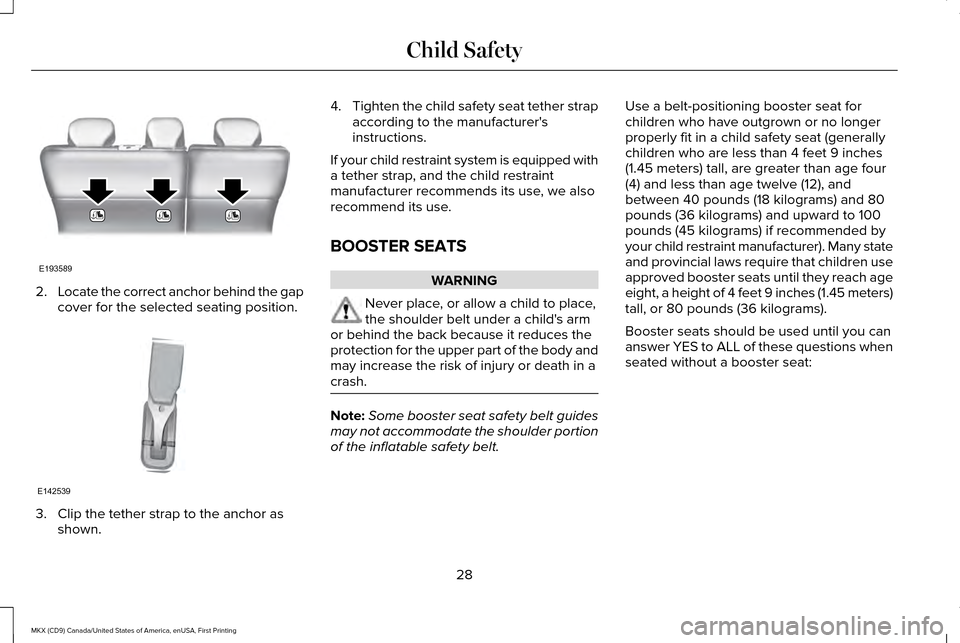
2.
Locate the correct anchor behind the gap
cover for the selected seating position. 3. Clip the tether strap to the anchor as
shown. 4.
Tighten the child safety seat tether strap
according to the manufacturer's
instructions.
If your child restraint system is equipped with
a tether strap, and the child restraint
manufacturer recommends its use, we also
recommend its use.
BOOSTER SEATS WARNING
Never place, or allow a child to place,
the shoulder belt under a child's arm
or behind the back because it reduces the
protection for the upper part of the body and
may increase the risk of injury or death in a
crash. Note:
Some booster seat safety belt guides
may not accommodate the shoulder portion
of the inflatable safety belt. Use a belt-positioning booster seat for
children who have outgrown or no longer
properly fit in a child safety seat (generally
children who are less than 4 feet 9 inches
(1.45 meters) tall, are greater than age four
(4) and less than age twelve (12), and
between 40 pounds (18 kilograms) and 80
pounds (36 kilograms) and upward to 100
pounds (45 kilograms) if recommended by
your child restraint manufacturer). Many state
and provincial laws require that children use
approved booster seats until they reach age
eight, a height of 4 feet 9 inches (1.45 meters)
tall, or 80 pounds (36 kilograms).
Booster seats should be used until you can
answer YES to ALL of these questions when
seated without a booster seat:
28
MKX (CD9) Canada/United States of America, enUSA, First Printing Child SafetyE193589 E142539
Page 34 of 587
If the booster seat slides on the vehicle seat
upon which it is being used, placing a
rubberized mesh sold as shelf or carpet liner
under the booster seat may improve this
condition. Do not introduce any item thicker
than this under the booster seat. Check with
the booster seat manufacturer's instructions.
CHILD RESTRAINT POSITIONING
WARNINGS
Airbags can kill or injure a child in a
child seat. Never place a rear-facing
child seat in front of an active airbag. If you
must use a forward-facing child seat in the
front seat, move the vehicle seat upon which
the child seat is installed all the way back.
When possible, all children age 12 and under
should be properly restrained in a rear
seating position. If all children cannot be
seated and restrained properly in a rear
seating position, properly restrain the largest
child in the front seat. WARNINGS
Always carefully follow the instructions
and warnings provided by the
manufacturer of any child restraint to
determine if the restraint device is
appropriate for your child's size, height,
weight, or age. Follow the child restraint
manufacturer's instructions and warnings
provided for installation and use in
conjunction with the instructions and
warnings provided by your vehicle
manufacturer. A safety seat that is improperly
installed or utilized, is inappropriate for your
child's height, age, or weight or does not
properly fit the child may increase the risk of
serious injury or death. Never let a passenger hold a child on
his or her lap while your vehicle is
moving. The passenger cannot protect the
child from injury in a crash, which may result
in serious injury or death. WARNINGS
Never use pillows, books, or towels to
boost a child. They can slide around
and increase the likelihood of injury or death
in a crash. Always restrain an unoccupied child
seat or booster seat. These objects
may become projectiles in a crash or sudden
stop, which may increase the risk of serious
injury. Never place, or allow a child to place,
the shoulder belt under a child's arm
or behind the back because it reduces the
protection for the upper part of the body and
may increase the risk of injury or death in a
crash. To avoid risk of injury, do not leave
children or pets unattended in your
vehicle. 31
MKX (CD9) Canada/United States of America, enUSA, First Printing Child Safety
Page 38 of 587
•
Height adjuster at the front outboard
seating positions.
• Safety belt pretensioner at the front
outboard seating positions.
• Belt tension sensor at the front outboard
passenger seating position. •
Safety belt warning light and chime. •
Crash sensors and monitoring system
with readiness indicator.
The safety belt pretensioners at the front
seating positions are designed to tighten the
safety belts when activated. In frontal and
near-frontal crashes, the safety belt
pretensioners may be activated alone or, if
the crash is of sufficient severity, together
with the front airbags. The pretensioners may
also activate when a Safety Canopy airbag
is deployed. FASTENING THE SEATBELTS
Standard belts shown, inflatable belts
similar
The front outboard and rear safety restraints
in the vehicle are combination lap and
shoulder belts.
1. Insert the belt tongue into the proper
buckle (the buckle closest to the direction
the tongue is coming from) until you hear
a snap and feel it latch. Make sure you
securely fasten the tongue in the buckle. 2. To unfasten, press the release button
and remove the tongue from the buckle.
Using a Sliding Clip (If Equipped) 35
MKX (CD9) Canada/United States of America, enUSA, First Printing SeatbeltsE71880 E67017 E142587 E142588 E200788
Page 42 of 587
The fully inflated belt's increased diameter
more effectively holds the occupant in the
appropriate seating position, and spreads
crash forces over more area of the body than
regular seatbelts. This helps reduce pressure
on the chest and helps control head and
neck motion for passengers.
The rear inflatable seatbelts are designed to
inflate in frontal or near-frontal crashes and
some side impact and rollover crashes. The
fact that the rear inflatable seatbelt did not
inflate in a crash does not mean that
something is wrong with the system. Rather,
it means the forces were not of the type
sufficient to cause activation. SEATBELT HEIGHT ADJUSTMENT WARNING
Position the safety belt height adjuster
so that the belt rests across the middle
of your shoulder. Failure to adjust the safety
belt properly could reduce the effectiveness
of the safety belt and increase the risk of
injury in a crash. Adjust the height of the shoulder belt so the
belt rests across the middle of your shoulder.
To adjust the shoulder belt height:1. Press the button and slide the height
adjuster up or down.
2. Release the button and pull down on the
height adjuster to make sure it is locked
in place.
SEATBELT WARNING LAMP AND
INDICATOR CHIME This lamp illuminates and an
audible warning will sound if the
driver's safety belt has not been
fastened when the vehicle's ignition is turned
on.
39
MKX (CD9) Canada/United States of America, enUSA, First Printing SeatbeltsE146365 E200161 E71880
Page 45 of 587
Deactivating and Activating the Belt-Minder
Feature
WARNING
While the system allows you to switch
this feature off, the intent of the system
is to remind you to wear your safety belt to
improve your chance to survive an accident.
We recommend you leave the system
switched on for yourself and others who may
use the vehicle. Note:
The driver and front passenger
warnings switch on and off independently.
When you perform this procedure for one
seating position, do not buckle the other
position as this will terminate the process.
Read Steps 1–4 thoroughly before
proceeding with the programming
procedure.
Before following the procedure, make sure
that:
• The parking brake is set.
• The transmission is in park (P) or neutral
(N). •
The ignition is off.
• The driver and front passenger safety
belts are unbuckled.
1. Switch the ignition on. Do not start the vehicle.
2. Wait until the safety belt warning light turns off (about 1 minute). After Step 2,
wait an additional 5 seconds before
proceeding with Step 3. Once you start
Step 3, you must complete the procedure
within 30 seconds.
3. For the seating position you are switching
off, buckle then unbuckle the safety belt
three times at a moderate speed, ending
in the unbuckled state. After Step 3, the
safety belt warning light turns on.
4. While the safety belt warning light is on, buckle and then unbuckle the safety belt.
After Step 4, the safety belt warning light
flashes for confirmation.
• This will switch the feature off for that
seating position if it is currently on.
• This will switch the feature on for that
seating position if it is currently off. CHILD RESTRAINT AND SEATBELT
MAINTENANCE
Inspect the vehicle safety belts and child
safety seat systems periodically to make sure
they work properly and are not damaged.
Inspect the vehicle and child seat safety belts
to make sure there are no nicks, tears or
cuts. Replace if necessary. All vehicle safety
belt assemblies, including retractors, buckles,
front safety belt buckle assemblies, buckle
support assemblies (slide bar-if equipped),
shoulder belt height adjusters (if equipped),
shoulder belt guide on seat back (if
equipped), child safety seat LATCH and
tether anchors, and attaching hardware,
should be inspected after a crash. Read the
child restraint manufacturer's instructions for
additional inspection and maintenance
information specific to the child restraint.
42
MKX (CD9) Canada/United States of America, enUSA, First Printing Seatbelts
Page 79 of 587
Note:
Allow the power system to open the
liftgate. Manually pushing or pulling the
liftgate may activate the system’ s obstacle
detection feature and stop the power
operation or reverse its direction. Manually
interfering with the liftgate motion may also
replicate a strut failure.
Closing the Liftgate WARNING
Keep clear of the liftgate when
activating the rear switch.
Press and release the liftgate control button. Stopping the Liftgate Movement
Note:
Do not apply sudden excessive force
to the liftgate while it is in motion. This could
damage the power liftgate and its
components.
You can stop the liftgate movement by doing
any of the following:
• Pressing the liftgate control button.
• Pressing the liftgate button on the remote
control twice.
• Pressing the liftgate button on the
instrument panel.
• Moving your foot under and away from
the center rear bumper in a single-kick
motion. *
* This method only works for vehicles with the
hands-free liftgate feature.
Setting the Liftgate Open Height
1. Open the liftgate.
2. Stop the liftgate movement by pressing the control button on the liftgate when it
reaches the desired height. Note:
Once the liftgate has stopped moving,
you can also manually move it to the desired
height.
3. Press and hold the liftgate control button
on the liftgate until a tone sounds,
indicating programming is complete.
Note: You can only use the liftgate control
button to program the height.
Note: You cannot program the height if the
liftgate position is too low.
The new open liftgate height is recalled
when the power liftgate is opened. To
change the programmed height, repeat the
above procedure. Once you open the power
liftgate, you can manually move it to a
different height.
Note: The system recalls the new
programmed height, even if you disconnect
the battery.
When operating the power liftgate after you
have programmed a lower height than fully
open, you can fully open the liftgate by
manually pushing it upward to the maximum
open position.
76
MKX (CD9) Canada/United States of America, enUSA, First Printing Doors and LocksE138636