child restraint LINCOLN MKX 2018 User Guide
[x] Cancel search | Manufacturer: LINCOLN, Model Year: 2018, Model line: MKX, Model: LINCOLN MKX 2018Pages: 603, PDF Size: 4.94 MB
Page 33 of 603
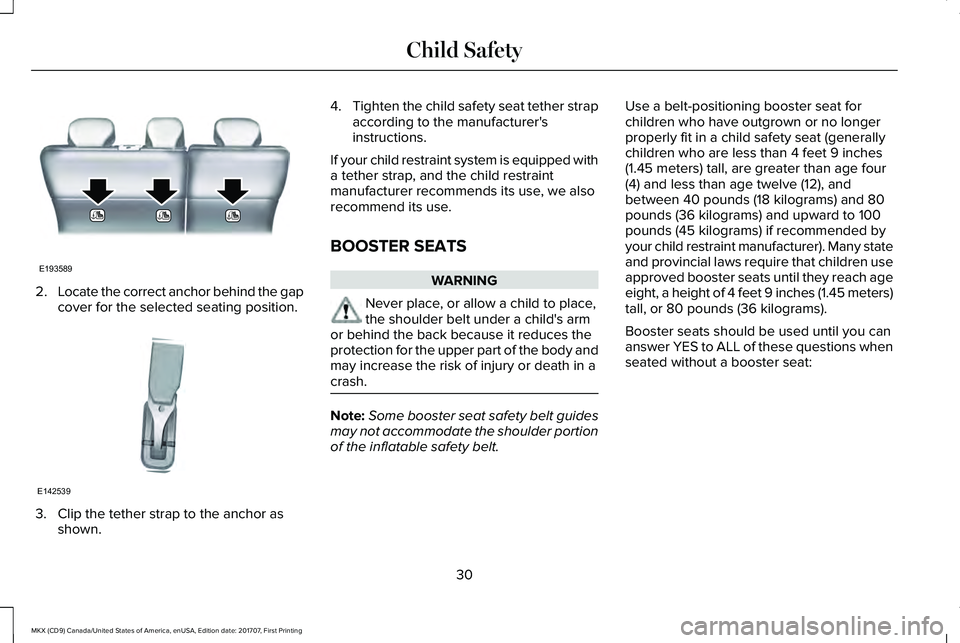
2.Locate the correct anchor behind the gapcover for the selected seating position.
3. Clip the tether strap to the anchor asshown.
4.Tighten the child safety seat tether strapaccording to the manufacturer'sinstructions.
If your child restraint system is equipped witha tether strap, and the child restraintmanufacturer recommends its use, we alsorecommend its use.
BOOSTER SEATS
WARNING
Never place, or allow a child to place,the shoulder belt under a child's armor behind the back because it reduces theprotection for the upper part of the body andmay increase the risk of injury or death in acrash.
Note:Some booster seat safety belt guidesmay not accommodate the shoulder portionof the inflatable safety belt.
Use a belt-positioning booster seat forchildren who have outgrown or no longerproperly fit in a child safety seat (generallychildren who are less than 4 feet 9 inches(1.45 meters) tall, are greater than age four(4) and less than age twelve (12), andbetween 40 pounds (18 kilograms) and 80pounds (36 kilograms) and upward to 100pounds (45 kilograms) if recommended byyour child restraint manufacturer). Many stateand provincial laws require that children useapproved booster seats until they reach ageeight, a height of 4 feet 9 inches (1.45 meters)tall, or 80 pounds (36 kilograms).
Booster seats should be used until you cananswer YES to ALL of these questions whenseated without a booster seat:
30
MKX (CD9) Canada/United States of America, enUSA, Edition date: 201707, First Printing
Child SafetyE193589 E142539
Page 34 of 603
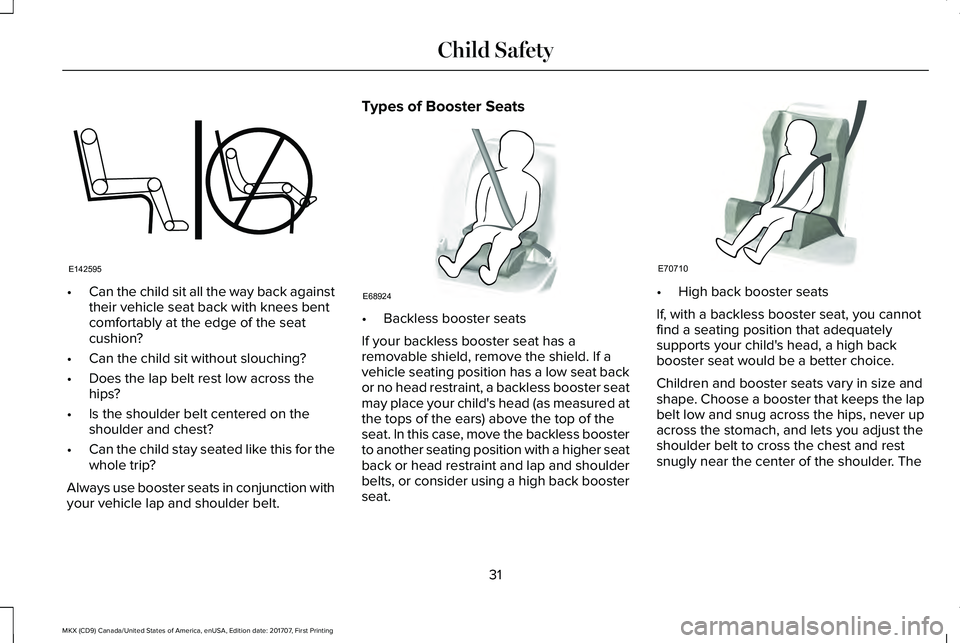
•Can the child sit all the way back againsttheir vehicle seat back with knees bentcomfortably at the edge of the seatcushion?
•Can the child sit without slouching?
•Does the lap belt rest low across thehips?
•Is the shoulder belt centered on theshoulder and chest?
•Can the child stay seated like this for thewhole trip?
Always use booster seats in conjunction withyour vehicle lap and shoulder belt.
Types of Booster Seats
•Backless booster seats
If your backless booster seat has aremovable shield, remove the shield. If avehicle seating position has a low seat backor no head restraint, a backless booster seatmay place your child's head (as measured atthe tops of the ears) above the top of theseat. In this case, move the backless boosterto another seating position with a higher seatback or head restraint and lap and shoulderbelts, or consider using a high back boosterseat.
•High back booster seats
If, with a backless booster seat, you cannotfind a seating position that adequatelysupports your child's head, a high backbooster seat would be a better choice.
Children and booster seats vary in size andshape. Choose a booster that keeps the lapbelt low and snug across the hips, never upacross the stomach, and lets you adjust theshoulder belt to cross the chest and restsnugly near the center of the shoulder. The
31
MKX (CD9) Canada/United States of America, enUSA, Edition date: 201707, First Printing
Child SafetyE142595 E68924 E70710
Page 36 of 603
If the booster seat slides on the vehicle seatupon which it is being used, placing arubberized mesh sold as shelf or carpet linerunder the booster seat may improve thiscondition. Do not introduce any item thickerthan this under the booster seat. Check withthe booster seat manufacturer's instructions.
CHILD RESTRAINT POSITIONING
WARNINGS
Airbags can kill or injure a child in achild seat. Never place a rear-facingchild seat in front of an active airbag. If youmust use a forward-facing child seat in thefront seat, move the vehicle seat upon whichthe child seat is installed all the way back.When possible, all children age 12 and undershould be properly restrained in a rearseating position. If all children cannot beseated and restrained properly in a rearseating position, properly restrain the largestchild in the front seat.
WARNINGS
Always carefully follow the instructionsand warnings provided by themanufacturer of any child restraint todetermine if the restraint device isappropriate for your child's size, height,weight, or age. Follow the child restraintmanufacturer's instructions and warningsprovided for installation and use inconjunction with the instructions andwarnings provided by your vehiclemanufacturer. A safety seat that is improperlyinstalled or utilized, is inappropriate for yourchild's height, age, or weight or does notproperly fit the child may increase the risk ofserious injury or death.
Never let a passenger hold a child onhis or her lap while your vehicle ismoving. The passenger cannot protect thechild from injury in a crash, which may resultin serious injury or death.
WARNINGS
Never use pillows, books, or towels toboost a child. They can slide aroundand increase the likelihood of injury or deathin a crash.
Always restrain an unoccupied childseat or booster seat. These objectsmay become projectiles in a crash or suddenstop, which may increase the risk of seriousinjury.
Never place, or allow a child to place,the shoulder belt under a child's armor behind the back because it reduces theprotection for the upper part of the body andmay increase the risk of injury or death in acrash.
To avoid risk of injury, do not leavechildren or pets unattended in yourvehicle.
33
MKX (CD9) Canada/United States of America, enUSA, Edition date: 201707, First Printing
Child Safety
Page 37 of 603
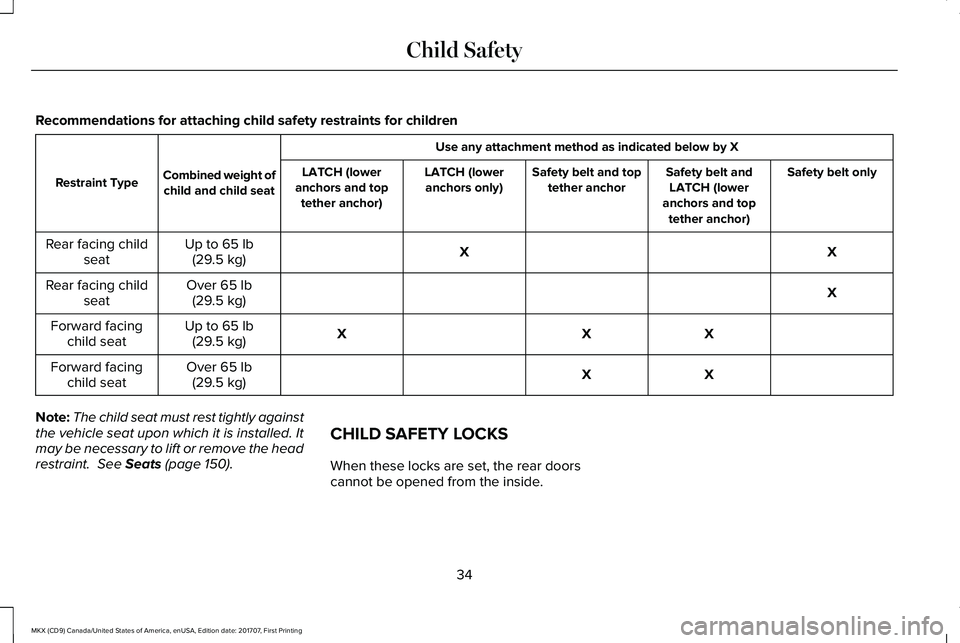
Recommendations for attaching child safety restraints for children
Use any attachment method as indicated below by X
Combined weight ofchild and child seatRestraint TypeSafety belt onlySafety belt andLATCH (loweranchors and toptether anchor)
Safety belt and toptether anchorLATCH (loweranchors only)LATCH (loweranchors and toptether anchor)
XXUp to 65 lb(29.5 kg)Rear facing childseat
XOver 65 lb(29.5 kg)Rear facing childseat
XXXUp to 65 lb(29.5 kg)Forward facingchild seat
XXOver 65 lb(29.5 kg)Forward facingchild seat
Note:The child seat must rest tightly againstthe vehicle seat upon which it is installed. Itmay be necessary to lift or remove the headrestraint. See Seats (page 150).
CHILD SAFETY LOCKS
When these locks are set, the rear doorscannot be opened from the inside.
34
MKX (CD9) Canada/United States of America, enUSA, Edition date: 201707, First Printing
Child Safety
Page 39 of 603
PRINCIPLE OF OPERATION
WARNINGS
Always drive and ride with yourseatback upright and the lap belt snugand low across the hips.
To reduce the risk of injury, make surechildren sit where they can be properlyrestrained.
Never let a passenger hold a child onhis or her lap while your vehicle ismoving. The passenger cannot protect thechild from injury in a crash.
All occupants of your vehicle, includingthe driver, should always properly weartheir safety belts, even when an airbagsupplemental restraint system is provided.Failure to properly wear your safety beltcould seriously increase the risk of injury ordeath.
WARNINGS
It is extremely dangerous to ride in acargo area, inside or outside of avehicle. In a crash, people riding in theseareas are more likely to be seriously injuredor killed. Do not allow people to ride in anyarea of your vehicle that is not equipped withseats and safety belts. Be sure everyone inyour vehicle is in a seat and using a safetybelt properly.
In a rollover crash, an unbelted personis significantly more likely to die thana person wearing a safety belt.
Each seating position in your vehiclehas a specific safety belt assemblywhich is made up of one buckle and onetongue that are designed to be used as apair. 1) Use the shoulder belt on the outsideshoulder only. Never wear the shoulder beltunder the arm. 2) Never swing the safety beltaround your neck over the inside shoulder.3) Never use a single belt for more than oneperson.
WARNINGS
When possible, all children 12 years oldand under should be properlyrestrained in a rear seating position. Failureto follow this could seriously increase therisk of injury or death.
Safety belts and seats can become hotin a vehicle that has been closed up insunny weather; they could burn a small child.Check seat covers and buckles before youplace a child anywhere near them.
Front and rear seat occupants,including pregnant women, shouldwear safety belts for optimum protection inan accident.
All seating positions in your vehicle have lapand shoulder safety belts. All occupants ofthe vehicle should always properly wear theirsafety belts, even when an airbagsupplemental restraint system is provided.
The safety belt system consists of:
•Lap and shoulder safety belts.
•Shoulder safety belt with automaticlocking mode, (except driver safety belt).
36
MKX (CD9) Canada/United States of America, enUSA, Edition date: 201707, First Printing
Seatbelts
Page 41 of 603
Slide the clip away from the tongue so thereis no loose webbing when an occupant orchild seat is buckled up. You can also usethe sliding clip to raise the tongue andprevent it from rattling or to ease access tothe tongue.
Using Seatbelts During Pregnancy
WARNING
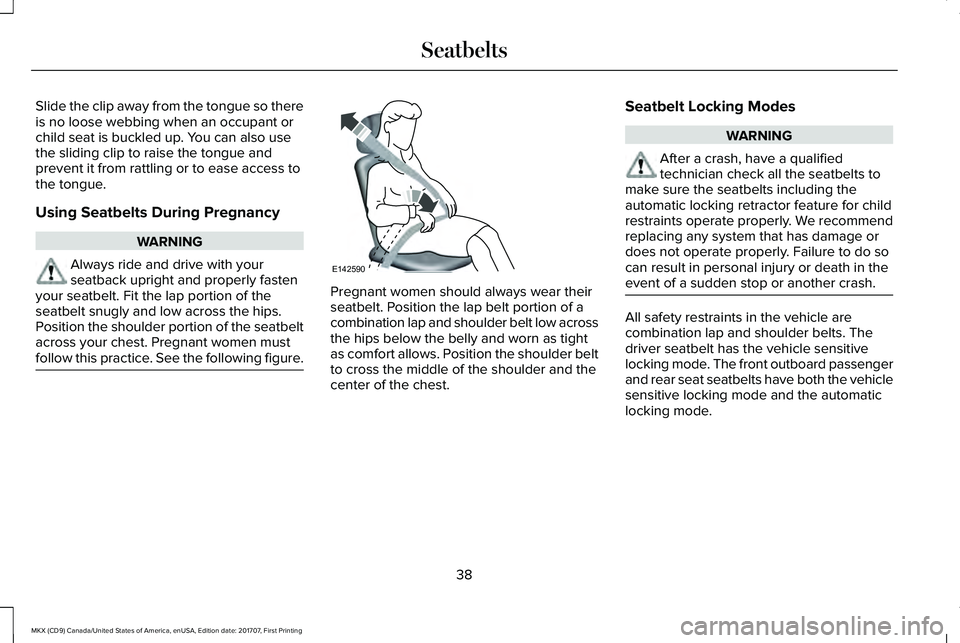
Always ride and drive with yourseatback upright and properly fastenyour seatbelt. Fit the lap portion of theseatbelt snugly and low across the hips.Position the shoulder portion of the seatbeltacross your chest. Pregnant women mustfollow this practice. See the following figure.
Pregnant women should always wear theirseatbelt. Position the lap belt portion of acombination lap and shoulder belt low acrossthe hips below the belly and worn as tightas comfort allows. Position the shoulder beltto cross the middle of the shoulder and thecenter of the chest.
Seatbelt Locking Modes
WARNING
After a crash, have a qualifiedtechnician check all the seatbelts tomake sure the seatbelts including theautomatic locking retractor feature for childrestraints operate properly. We recommendreplacing any system that has damage ordoes not operate properly. Failure to do socan result in personal injury or death in theevent of a sudden stop or another crash.
All safety restraints in the vehicle arecombination lap and shoulder belts. Thedriver seatbelt has the vehicle sensitivelocking mode. The front outboard passengerand rear seat seatbelts have both the vehiclesensitive locking mode and the automaticlocking mode.
38
MKX (CD9) Canada/United States of America, enUSA, Edition date: 201707, First Printing
SeatbeltsE142590
Page 43 of 603
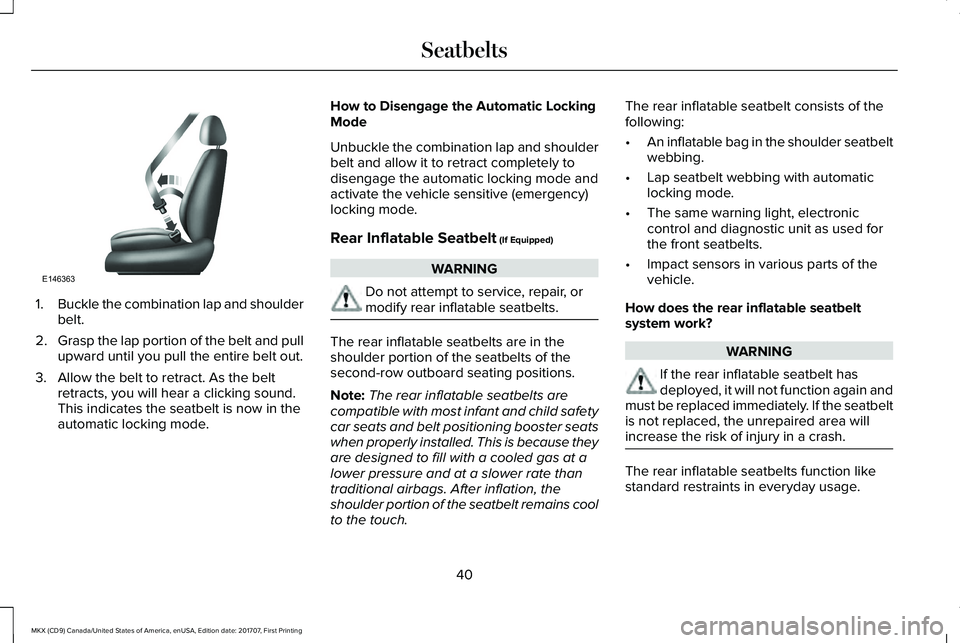
1.Buckle the combination lap and shoulderbelt.
2.Grasp the lap portion of the belt and pullupward until you pull the entire belt out.
3. Allow the belt to retract. As the beltretracts, you will hear a clicking sound.This indicates the seatbelt is now in theautomatic locking mode.
How to Disengage the Automatic LockingMode
Unbuckle the combination lap and shoulderbelt and allow it to retract completely todisengage the automatic locking mode andactivate the vehicle sensitive (emergency)locking mode.
Rear Inflatable Seatbelt (If Equipped)
WARNING
Do not attempt to service, repair, ormodify rear inflatable seatbelts.
The rear inflatable seatbelts are in theshoulder portion of the seatbelts of thesecond-row outboard seating positions.
Note:The rear inflatable seatbelts arecompatible with most infant and child safetycar seats and belt positioning booster seatswhen properly installed. This is because theyare designed to fill with a cooled gas at alower pressure and at a slower rate thantraditional airbags. After inflation, theshoulder portion of the seatbelt remains coolto the touch.
The rear inflatable seatbelt consists of thefollowing:
•An inflatable bag in the shoulder seatbeltwebbing.
•Lap seatbelt webbing with automaticlocking mode.
•The same warning light, electroniccontrol and diagnostic unit as used forthe front seatbelts.
•Impact sensors in various parts of thevehicle.
How does the rear inflatable seatbeltsystem work?
WARNING
If the rear inflatable seatbelt hasdeployed, it will not function again andmust be replaced immediately. If the seatbeltis not replaced, the unrepaired area willincrease the risk of injury in a crash.
The rear inflatable seatbelts function likestandard restraints in everyday usage.
40
MKX (CD9) Canada/United States of America, enUSA, Edition date: 201707, First Printing
SeatbeltsE146363
Page 47 of 603
Deactivating and Activating the Belt-MinderFeature
WARNING
While the system allows you to switchthis feature off, the intent of the systemis to remind you to wear your safety belt toimprove your chance to survive an accident.We recommend you leave the systemswitched on for yourself and others who mayuse the vehicle.
Note:The driver and front passengerwarnings switch on and off independently.When you perform this procedure for oneseating position, do not buckle the otherposition as this will terminate the process.
Read Steps 1–4 thoroughly beforeproceeding with the programmingprocedure.
Before following the procedure, make surethat:
•The parking brake is set.
•The transmission is in park (P) or neutral(N).
•The ignition is off.
•The driver and front passenger safetybelts are unbuckled.
1. Switch the ignition on. Do not start thevehicle.
2. Wait until the safety belt warning lightturns off (about 1 minute). After Step 2,wait an additional 5 seconds beforeproceeding with Step 3. Once you startStep 3, you must complete the procedurewithin 30 seconds.
3.For the seating position you are switchingoff, buckle then unbuckle the safety beltthree times at a moderate speed, endingin the unbuckled state. After Step 3, thesafety belt warning light turns on.
4. While the safety belt warning light is on,buckle and then unbuckle the safety belt.After Step 4, the safety belt warning lightflashes for confirmation.
•This will switch the feature off for thatseating position if it is currently on.
•This will switch the feature on for thatseating position if it is currently off.
CHILD RESTRAINT AND SEATBELT
MAINTENANCE
Inspect the vehicle safety belts and childsafety seat systems periodically to make surethey work properly and are not damaged.Inspect the vehicle and child seat safety beltsto make sure there are no nicks, tears orcuts. Replace if necessary. All vehicle safetybelt assemblies, including retractors, buckles,front safety belt buckle assemblies, bucklesupport assemblies (slide bar-if equipped),shoulder belt height adjusters (if equipped),shoulder belt guide on seat back (ifequipped), child safety seat LATCH andtether anchors, and attaching hardware,should be inspected after a crash. Read thechild restraint manufacturer's instructions foradditional inspection and maintenanceinformation specific to the child restraint.
44
MKX (CD9) Canada/United States of America, enUSA, Edition date: 201707, First Printing
Seatbelts
Page 48 of 603
Ford Motor Company recommends that allsafety belt assemblies in use in vehiclesinvolved in a crash be replaced. However, ifthe crash was minor and an authorizeddealer finds that the belts do not showdamage and continue to operate properly,they do not need to be replaced. Safety beltassemblies not in use during a crash shouldalso be inspected and replaced if eitherdamage or improper operation is noted.
Properly care for safety belts. See VehicleCare (page 333).
SEATBELT EXTENSION
WARNINGS
Persons who fit into the vehicle'sseatbelt should not use an extension.Unnecessary use could result in seriouspersonal injury in the event of a crash.
WARNINGS
Only use extensions provided free ofcharge by Lincoln Motor Companydealers. The dealer will provide an extensiondesigned specifically for this vehicle, modelyear and seating position. The use of anextension intended for another vehicle,model year or seating position may not offeryou the full protection of your vehicle’sseatbelt restraint system.
Never use seatbelt extensions to installchild restraints.
Do not use a seatbelt extension withan inflatable seatbelt.
Do not use extensions to change thefit of the belt across the torso, over thelap or to make the seatbelt buckle easier toreach.
If, because of body size or driving position,it is not possible to properly fasten theseatbelt over your lap and shoulder, anextension that is compatible with theseatbelts is available free of charge fromLincoln Motor Company dealers. Only Lincoln
seatbelt extensions made by the samecompany which made the original equipmentseatbelts, should be used with Lincolnseatbelts. Ask your authorized dealer if yourextension is compatible with your Lincolnvehicle restraint system.
45
MKX (CD9) Canada/United States of America, enUSA, Edition date: 201707, First Printing
Seatbelts
Page 50 of 603
PRINCIPLE OF OPERATION
WARNINGS
Airbags do not inflate slowly or gently,and the risk of injury from a deployingairbag is the greatest close to the trimcovering the airbag module.
All occupants of your vehicle, includingthe driver, should always properly weartheir seatbelts, even when an airbagsupplemental restraint system is provided.Failure to properly wear your seatbelt couldseriously increase the risk of injury or death.
Even with advanced restraints systems,properly restrain children 12 and underin a rear seating position. Failure to followthis could seriously increase the risk of injuryor death.
Do not place your arms on the airbagcover or through the steering wheel.Failure to follow this instruction could resultin personal injury.
WARNINGS
Keep the areas in front of the airbagsfree from obstruction. Do not affixanything to or over the airbag covers.Objects could become projectiles duringairbag deployment or in a sudden stop.Failure to follow this instruction could resultin personal injury or death.
Airbags can kill or injure a child in achild restraint. Never place arear-facing child restraint in front of an activeairbag. If you must use a forward-facing childrestraint in the front seat, move the seat uponwhich the child restraint is installed all theway back.
Do not attempt to service, repair, ormodify the supplementary restraintsystem or associated components. Failureto follow this instruction could result inpersonal injury or death.
Several airbag system components gethot after inflation. To reduce the riskof injury, do not touch them after inflation.
WARNINGS
If a supplementary restraint systemcomponent has deployed, it will notfunction again. Have the system andassociated components inspected as soonas possible. Failure to follow this instructioncould result in personal injury or death.
The airbags are a supplemental restraintsystem and are designed to work with theseatbelts to help protect the driver and rightfront passenger from certain upper bodyinjuries. Airbags do not inflate slowly; thereis a risk of injury from a deploying airbag.
Note:You will hear a loud bang and see acloud of harmless powdery residue if anairbag deploys. This is normal.
47
MKX (CD9) Canada/United States of America, enUSA, Edition date: 201707, First Printing
Supplementary Restraints System