warning LINCOLN MKZ 2010 Owners Manual
[x] Cancel search | Manufacturer: LINCOLN, Model Year: 2010, Model line: MKZ, Model: LINCOLN MKZ 2010Pages: 318, PDF Size: 2.22 MB
Page 215 of 318
REVERSE SENSING SYSTEM (IF EQUIPPED)
The Reverse Sensing System (RSS) sounds a tone to warn the driver of
obstacles near the rear bumper when the R (Reverse) is selected and the
vehicle is moving at speeds less than 3 mph (5 km/h). The system is not
effective at speeds above 3 mph (5 km/h) and may not detect certain
angular or moving objects.
WARNING:To help avoid personal injury, please read and
understand the limitations of the reverse sensing system as
contained in this section. Reverse sensing is only an aid for some
(generally large and fixed) objects when moving in reverse on a flat
surface at “parking speeds”. Inclement weather may also affect the
function of the RSS; this may include reduced performance or a false
activation.
WARNING:To help avoid personal injury, always use caution
when in R (Reverse) and when using the RSS.
WARNING:This system is not designed to prevent contact with
small or moving objects. The system is designed to provide a
warning to assist the driver in detecting large stationary objects to
avoid damaging the vehicle. The system may not detect smaller
objects, particularly those close to the ground.
WARNING:Certain add-on devices such as large trailer hitches,
bike or surfboard racks and any device that may block the
normal detection zone of the RSS system may create false beeps.
2010 MKZ(378)
Owners Guide, 1st Printing
USA(fus)
Driving
215
Page 216 of 318
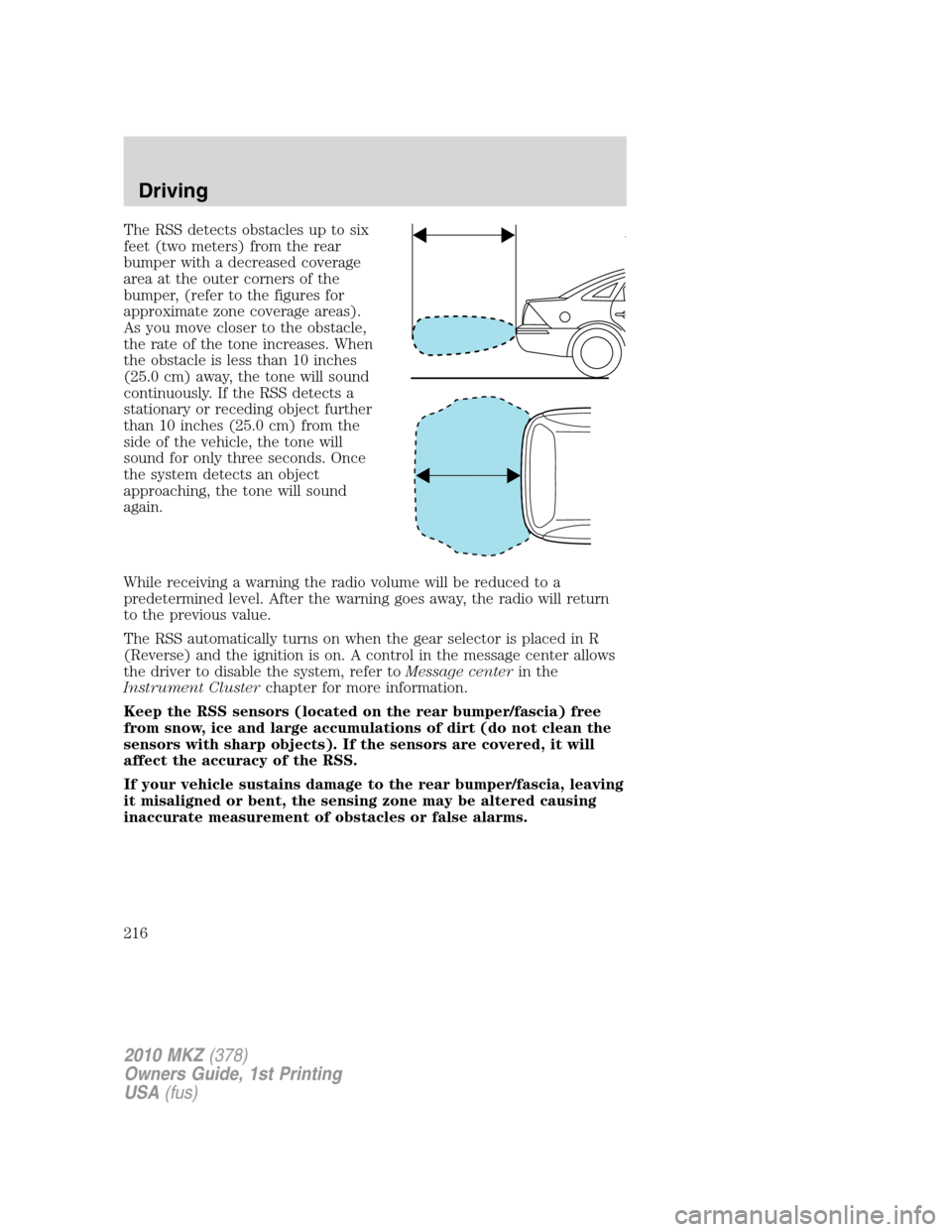
The RSS detects obstacles up to six
feet (two meters) from the rear
bumper with a decreased coverage
area at the outer corners of the
bumper, (refer to the figures for
approximate zone coverage areas).
As you move closer to the obstacle,
the rate of the tone increases. When
the obstacle is less than 10 inches
(25.0 cm) away, the tone will sound
continuously. If the RSS detects a
stationary or receding object further
than 10 inches (25.0 cm) from the
side of the vehicle, the tone will
sound for only three seconds. Once
the system detects an object
approaching, the tone will sound
again.
While receiving a warning the radio volume will be reduced to a
predetermined level. After the warning goes away, the radio will return
to the previous value.
The RSS automatically turns on when the gear selector is placed in R
(Reverse) and the ignition is on. A control in the message center allows
the driver to disable the system, refer toMessage centerin the
Instrument Clusterchapter for more information.
Keep the RSS sensors (located on the rear bumper/fascia) free
from snow, ice and large accumulations of dirt (do not clean the
sensors with sharp objects). If the sensors are covered, it will
affect the accuracy of the RSS.
If your vehicle sustains damage to the rear bumper/fascia, leaving
it misaligned or bent, the sensing zone may be altered causing
inaccurate measurement of obstacles or false alarms.
2010 MKZ(378)
Owners Guide, 1st Printing
USA(fus)
Driving
216
Page 218 of 318
Note:If the camera system image is not clear or seems distorted, it may
be covered with water droplets, snow, mud or any other substance. If
this occurs, clean the camera lens before using the camera system.
WARNING:The camera system is a reverse aid supplement
device that still requires the driver to use it in conjunction with
the rear view mirror and the side mirrors for maximum coverage.
WARNING:Objects that are close to either corner of the
bumper or under the bumper, might not be seen on the screen
due to the limited coverage of the camera system.
WARNING:Backup as slow as possible since higher speeds
might limit your reaction time to stop the vehicle.
WARNING:Do not use the camera system with the trunk open.
If the back end of the vehicle is hit or damaged, then check with your
authorized dealer to have your rear video system checked for proper
coverage and operation.
Night time and dark area use
At night time or in dark areas, the camera system relies on the reverse
lamp lighting to produce an image. Therefore it is necessary that both
reverse lamps are operating in order to get a clear image in the dark. If
either of the lamps are not operating, stop using the camera system, at
least in the dark, until the lamp(s) are replaced and functioning.
Servicing
•If the image comes on while the vehicle is not in R (Reverse), have
the system inspected by your authorized dealer.
•If the image is not clear, then check if there is anything covering the
lens such as dirt, mud, ice, snow, etc. If the image is still not clear
after cleaning, have your system inspected by your authorized dealer.
2010 MKZ(378)
Owners Guide, 1st Printing
USA(fus)
Driving
218
Page 219 of 318
BLIND SPOT INFORMATION SYSTEM™ (BLIS™) WITH CROSS
TRAFFIC ALERT (CTA) (IF EQUIPPED)
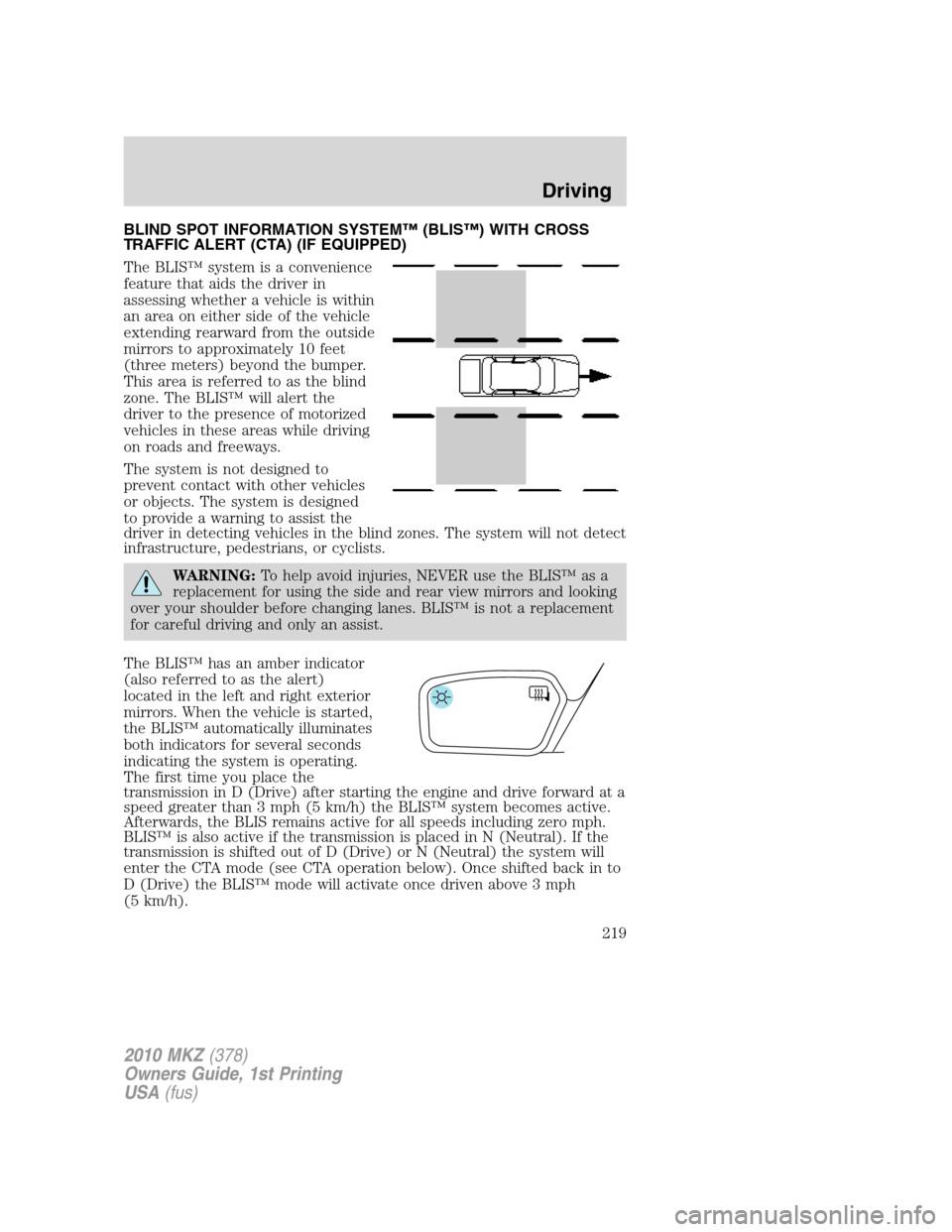
The BLIS™ system is a convenience
feature that aids the driver in
assessing whether a vehicle is within
an area on either side of the vehicle
extending rearward from the outside
mirrors to approximately 10 feet
(three meters) beyond the bumper.
This area is referred to as the blind
zone. The BLIS™ will alert the
driver to the presence of motorized
vehicles in these areas while driving
on roads and freeways.
The system is not designed to
prevent contact with other vehicles
or objects. The system is designed
to provide a warning to assist the
driver in detecting vehicles in the blind zones. The system will not detect
infrastructure, pedestrians, or cyclists.
WARNING:To help avoid injuries, NEVER use the BLIS™ as a
replacement for using the side and rear view mirrors and looking
over your shoulder before changing lanes. BLIS™ is not a replacement
for careful driving and only an assist.
The BLIS™ has an amber indicator
(also referred to as the alert)
located in the left and right exterior
mirrors. When the vehicle is started,
the BLIS™ automatically illuminates
both indicators for several seconds
indicating the system is operating.
The first time you place the
transmission in D (Drive) after starting the engine and drive forward at a
speed greater than 3 mph (5 km/h) the BLIS™ system becomes active.
Afterwards, the BLIS remains active for all speeds including zero mph.
BLIS™ is also active if the transmission is placed in N (Neutral). If the
transmission is shifted out of D (Drive) or N (Neutral) the system will
enter the CTA mode (see CTA operation below). Once shifted back in to
D (Drive) the BLIS™ mode will activate once driven above 3 mph
(5 km/h).
2010 MKZ(378)
Owners Guide, 1st Printing
USA(fus)
Driving
219
Page 220 of 318
The BLIS™ will trigger the alert for vehicles that enter your blind zone
from the rear or merge in to the blind zone from the side. Vehicles that
you pass, or a vehicle that enters the blind zone from the front, will
trigger the alert only after the vehicle is present in the blind zone for
three seconds.Note:For vehicles that pass through the blind zone
quickly, typically less then two seconds, the BLIS will not illuminate the
alert.
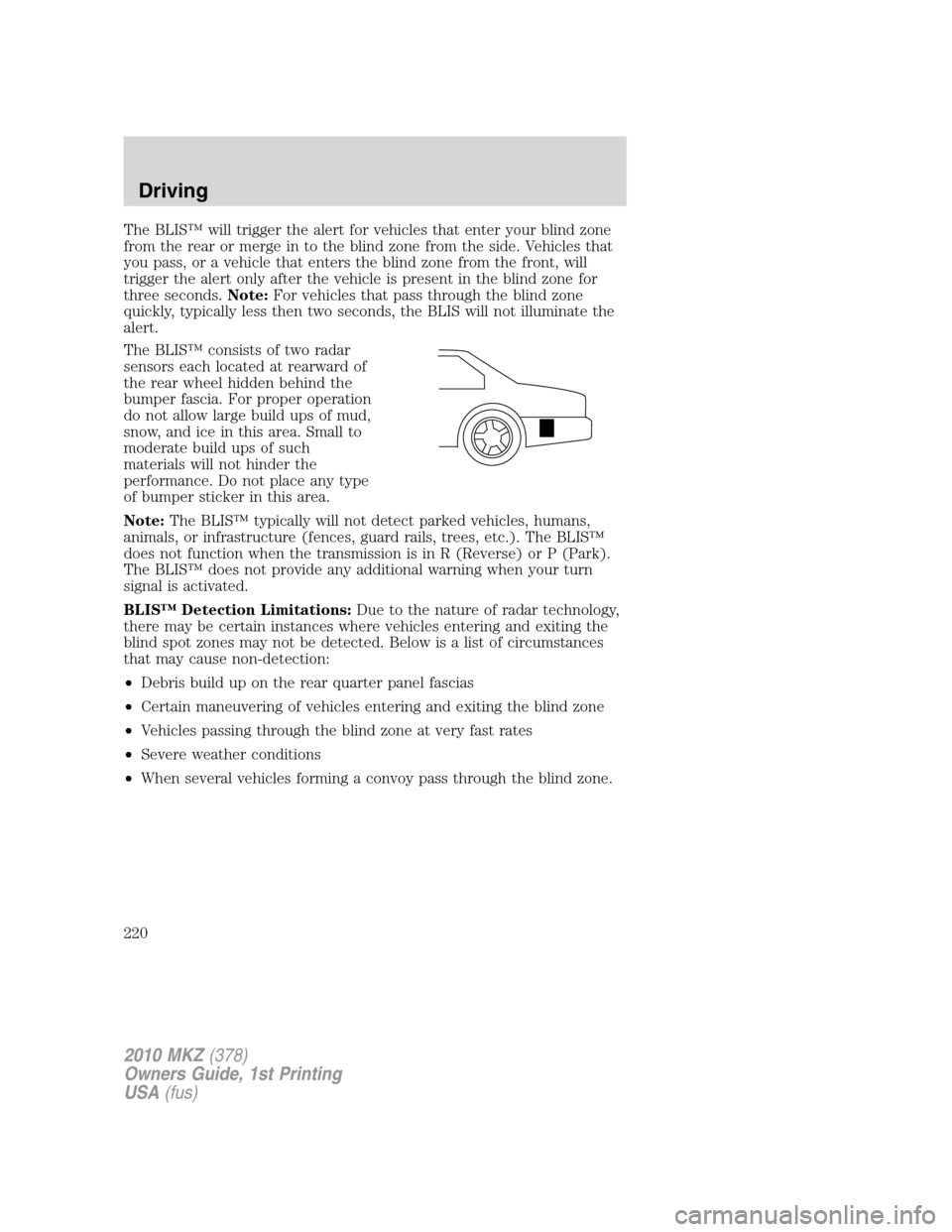
The BLIS™ consists of two radar
sensors each located at rearward of
the rear wheel hidden behind the
bumper fascia. For proper operation
do not allow large build ups of mud,
snow, and ice in this area. Small to
moderate build ups of such
materials will not hinder the
performance. Do not place any type
of bumper sticker in this area.
Note:The BLIS™ typically will not detect parked vehicles, humans,
animals, or infrastructure (fences, guard rails, trees, etc.). The BLIS™
does not function when the transmission is in R (Reverse) or P (Park).
The BLIS™ does not provide any additional warning when your turn
signal is activated.
BLIS™ Detection Limitations:Due to the nature of radar technology,
there may be certain instances where vehicles entering and exiting the
blind spot zones may not be detected. Below is a list of circumstances
that may cause non-detection:
•Debris build up on the rear quarter panel fascias
•Certain maneuvering of vehicles entering and exiting the blind zone
•Vehicles passing through the blind zone at very fast rates
•Severe weather conditions
•When several vehicles forming a convoy pass through the blind zone.
2010 MKZ(378)
Owners Guide, 1st Printing
USA(fus)
Driving
220
Page 221 of 318
Cross traffic alert (CTA) system operation
The cross traffic alert system warns
the driver of approaching vehicles
when R (Reverse) is selected and
the vehicle is backing out of a
front-in parking spot. It sounds a
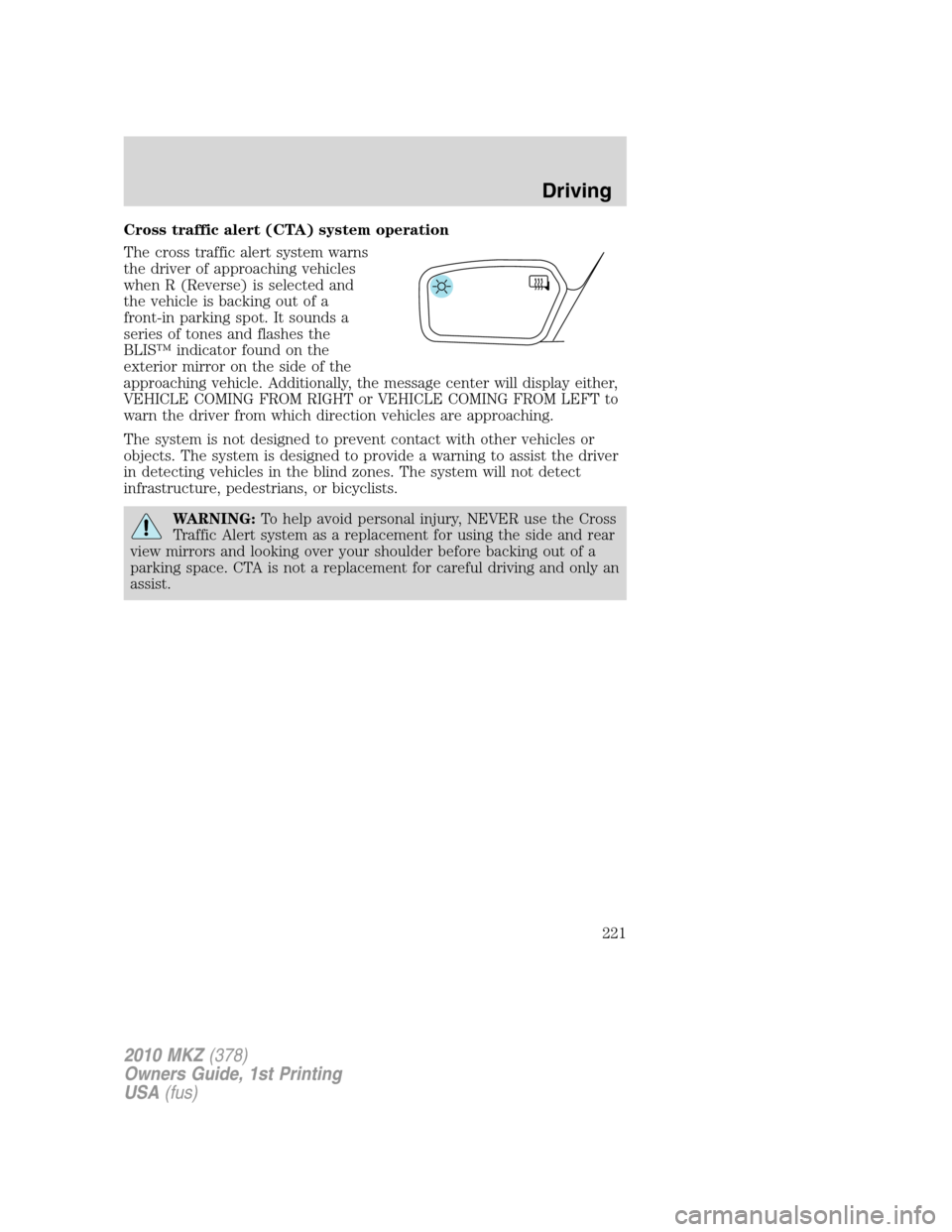
series of tones and flashes the
BLIS™ indicator found on the
exterior mirror on the side of the
approaching vehicle. Additionally, the message center will display either,
VEHICLE COMING FROM RIGHT or VEHICLE COMING FROM LEFT to
warn the driver from which direction vehicles are approaching.
The system is not designed to prevent contact with other vehicles or
objects. The system is designed to provide a warning to assist the driver
in detecting vehicles in the blind zones. The system will not detect
infrastructure, pedestrians, or bicyclists.
WARNING:To help avoid personal injury, NEVER use the Cross
Traffic Alert system as a replacement for using the side and rear
view mirrors and looking over your shoulder before backing out of a
parking space. CTA is not a replacement for careful driving and only an
assist.
2010 MKZ(378)
Owners Guide, 1st Printing
USA(fus)
Driving
221
Page 223 of 318
![LINCOLN MKZ 2010 Owners Manual Cross Traffic coverage also decreases when parking at shallow angles
(refer to figure for approximate zone coverage areas[sensor
obstructed to vehicle on left]).
CTA Detection Limitations:Due to the n](/img/15/6972/w960_6972-222.png "LINCOLN MKZ 2010 Owners Manual Cross Traffic coverage also decreases when parking at shallow angles
(refer to figure for approximate zone coverage areas[sensor
obstructed to vehicle on left]).
CTA Detection Limitations:Due to the n")
Cross Traffic coverage also decreases when parking at shallow angles
(refer to figure for approximate zone coverage areas[sensor
obstructed to vehicle on left]).
CTA Detection Limitations:Due to the nature of radar technology,
there may be certain instances where vehicles entering and exiting the
blind spot zones may not be detected. Below is a list of circumstances
that may cause non detection:
•Debris build up on the rear quarter panel fascias
•The rear quarter panel radar beams are obstructed or partially
obstructed by an adjacently parked vehicle or object.
•Approaching vehicles passing at speeds greater than 15 mph
(24 km/h).
•Severe weather conditions
•Driving in reverse faster than 3 mph (5 km/h).
•Backing out of an angled parking spot.
CTA and Reverse Sensing System (RSS) interaction
CTA works along with the Reverse Sensing System (RSS) (if equipped).
Become familiar with the warning tones of both systems.
2010 MKZ(378)
Owners Guide, 1st Printing
USA(fus)
Driving
223
Page 224 of 318
BLIS™-CTA on/off and disable operation
The BLIS™ and/or the CTA can be turned off via the message center.
Turning the BLIS™ off does not turn off the CTA and visa versa. If either
the BLIS™ or CTA is turned off, the systems will automatically turn back
on at the next ignition key cycle. When either the BLIS™ or CTA is
turned off, the message center displays BLIND SPOT SYS OFF and/or
CTA SYSTEM OFF. When the BLIS™ or CTA system is off, the driver
will not receive alerts. Refer toMessage Centerin theInstrument
Clusterchapter.
The BLIS™-CTA can be disabled permanently even after an ignition key
cycle. This must be done by your dealership service technician.
Once either of the systems are disabled, enabling must also be performed
at the dealership. When disabled, the message center will display BLIND
SPOT DISABLED and/or CTA DISABLED.
BLIS™-CTA fault operation
If the BLIS™-CTA senses a fault on either the left or right sensor, the
BLIS™ alert indicator will go ON and remain ON and the message center
will display BLIND SPOT SYSTEM FAULT or CROSS TRAFFIC SYSTEM
FAULT. For faults that may cause the associated left or right alert
indicator not to illuminate, only the message center faults will occur.
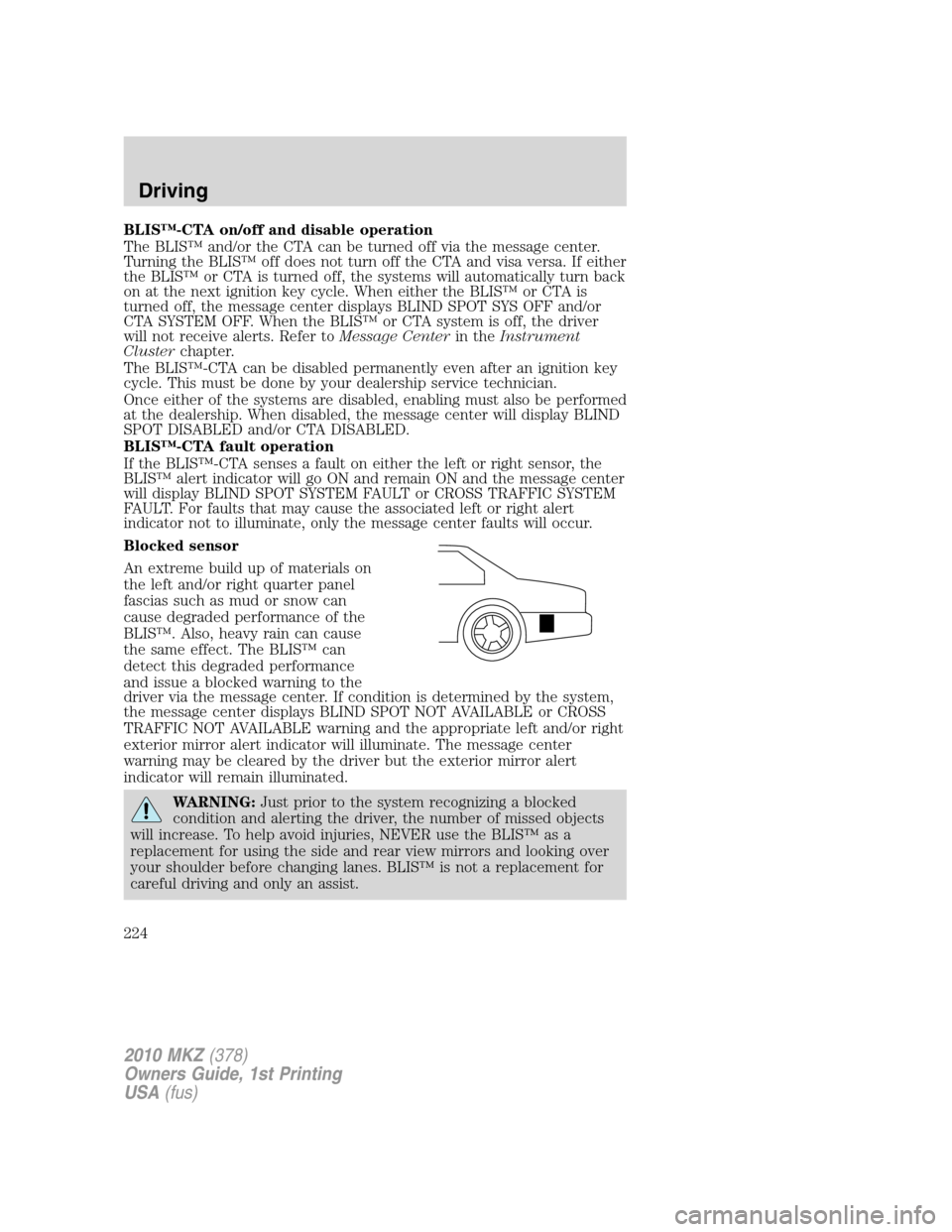
Blocked sensor
An extreme build up of materials on
the left and/or right quarter panel
fascias such as mud or snow can
cause degraded performance of the
BLIS™. Also, heavy rain can cause
the same effect. The BLIS™ can
detect this degraded performance
and issue a blocked warning to the
driver via the message center. If condition is determined by the system,
the message center displays BLIND SPOT NOT AVAILABLE or CROSS
TRAFFIC NOT AVAILABLE warning and the appropriate left and/or right
exterior mirror alert indicator will illuminate. The message center
warning may be cleared by the driver but the exterior mirror alert
indicator will remain illuminated.
WARNING:Just prior to the system recognizing a blocked
condition and alerting the driver, the number of missed objects
will increase. To help avoid injuries, NEVER use the BLIS™ as a
replacement for using the side and rear view mirrors and looking over
your shoulder before changing lanes. BLIS™ is not a replacement for
careful driving and only an assist.
2010 MKZ(378)
Owners Guide, 1st Printing
USA(fus)
Driving
224
Page 226 of 318
ALL WHEEL DRIVE (AWD) SYSTEM (IF EQUIPPED)
Your vehicle may be equipped with a full-time All Wheel Drive (AWD)
system. The AWD system is an active system, meaning it not only
responds to wheel slip between the front and rear axles but also has the
ability to anticipate wheel slip and transfer torque to the rear wheels
before slip occurs. The AWD system is active all the time and requires no
input from the operator.
All components of the AWD system are sealed for life and require no
maintenance.
Note:When an AWD system fault is present, the warning CHECK AWD
will display in the message center. The AWD system is not functioning
correctly and defaulted to front wheel drive. When this warning is
displayed, have your vehicle serviced at an authorized dealer.
If your vehicle is equipped with AWD, a spare tire of a different size
other than the tire provided should never be used. A dissimilar spare tire
size (other than the spare tire provided) or major dissimilar tire sizes
between the front and rear axles could cause the AWD system to stop
functioning and default to front wheel drive.
Note:Your AWD vehicle is not intended for off-road use. The AWD
feature gives your vehicle some limited off-road capabilities in which
driving surfaces are relatively level, obstruction-free and otherwise
similar to normal on-road driving conditions. Operating your vehicle
under other than those conditions could subject the vehicle to excessive
stress which might result in damage which is not covered under your
warranty.
Driving on slippery surfaces with AWD vehicles
AWD vehicles are specially equipped for driving on sand, snow, mud and
rough roads and have operating characteristics that are somewhat
different from conventional vehicles, both on and off the highway.
When driving at slow speeds off-highway under high outside
temperatures, use a low gear or (L) when possible. L (Low) gear
operation will maximize the engine and transmission cooling capability.
Under severe operating conditions, the A/C may cycle on and off to
protect overheating of the engine.
Basic operating principles
•Drive slower in strong crosswinds which can affect the normal steering
characteristics of your vehicle.
•Be extremely careful when driving on pavement made slippery by
loose sand, water, gravel, snow or ice.
2010 MKZ(378)
Owners Guide, 1st Printing
USA(fus)
Driving
226
Page 227 of 318
If your vehicle goes off the edge of the pavement
•If your vehicle goes off the edge of the pavement, slow down, but
avoid severe brake application, ease the vehicle back onto the
pavement only after reducing your speed. Do not turn the steering
wheel too sharply while returning to the road surface.
•It may be safer to stay on the apron or shoulder of the road and slow
down gradually before returning to the pavement. You may lose
control if you do not slow down or if you turn the steering wheel too
sharply or abruptly.
•It often may be less risky to strike small objects, such as highway
reflectors, with minor damage to your vehicle rather than attempt a
sudden return to the pavement which could cause the vehicle to slide
sideways out of control or rollover. Remember, your safety and the
safety of others should be your primary concern.
If your vehicle gets stuck
If your vehicle gets stuck in mud or snow it may be rocked out by
shifting between forward and reverse gears, stopping between shifts, in a
steady pattern. Press lightly on the accelerator in each gear.
If your vehicle is equipped with Traction Control™, it may be beneficial
to disengage the Traction Control™ system while attempting to rock the
vehicle.
Do not rock the vehicle if the engine is not at normal operating
temperature or damage to the transmission may occur.
Do not rock the vehicle for more than a few minutes or damage
to the transmission and tires may occur or the engine may
overheat.
WARNING:Always set the parking brake fully and make sure
the gearshift is latched in P (Park). Turn the ignition to the off
position and remove the key whenever you leave your vehicle.
WARNING:If the parking brake is fully released, but the brake
warning lamp remains illuminated, the brakes may not be
working properly. See your authorized dealer.
WARNING:Do not spin the wheels at over 35 mph (56 km/h).
The tires may fail and injure a passenger or bystander.
2010 MKZ(378)
Owners Guide, 1st Printing
USA(fus)
Driving
227