Exhaust LINCOLN MKZ 2016 User Guide
[x] Cancel search | Manufacturer: LINCOLN, Model Year: 2016, Model line: MKZ, Model: LINCOLN MKZ 2016Pages: 544, PDF Size: 5.77 MB
Page 249 of 544
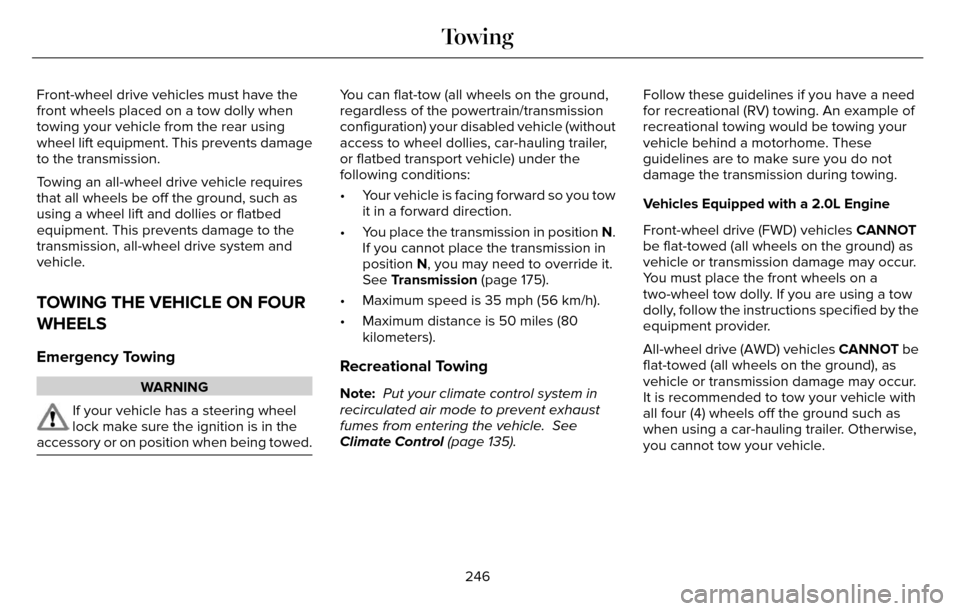
Front-wheel drive vehicles must have the
front wheels placed on a tow dolly when
towing your vehicle from the rear using
wheel lift equipment. This prevents damage
to the transmission.
Towing an all-wheel drive vehicle requires
that all wheels be off the ground, such as
using a wheel lift and dollies or flatbed
equipment. This prevents damage to the
transmission, all-wheel drive system and
vehicle.
TOWING THE VEHICLE ON FOUR
WHEELS
Emergency Towing
WARNING
If your vehicle has a steering wheel
lock make sure the ignition is in the
accessory or on position when being towed.
You can flat-tow (all wheels on the ground,
regardless of the powertrain/transmission
configuration) your disabled vehicle (without
access to wheel dollies, car-hauling trailer,
or flatbed transport vehicle) under the
following conditions:
• Your vehicle is facing forward so you tow it in a forward direction.
• You place the transmission in position N.
If you cannot place the transmission in
position N, you may need to override it.
See Transmission (page 175).
• Maximum speed is 35 mph (56 km/h).
• Maximum distance is 50 miles (80 kilometers).
Recreational Towing
Note: Put your climate control system in
recirculated air mode to prevent exhaust
fumes from entering the vehicle. See
Climate Control (page 135). Follow these guidelines if you have a need
for recreational (RV) towing. An example of
recreational towing would be towing your
vehicle behind a motorhome. These
guidelines are to make sure you do not
damage the transmission during towing.
Vehicles Equipped with a 2.0L Engine
Front-wheel drive (FWD) vehicles CANNOT
be flat-towed (all wheels on the ground) as
vehicle or transmission damage may occur.
You must place the front wheels on a
two-wheel tow dolly. If you are using a tow
dolly, follow the instructions specified by the
equipment provider.
All-wheel drive (AWD) vehicles
CANNOT be
flat-towed (all wheels on the ground), as
vehicle or transmission damage may occur.
It is recommended to tow your vehicle with
all four (4) wheels off the ground such as
when using a car-hauling trailer. Otherwise,
you cannot tow your vehicle.
246
Towing
Page 316 of 544
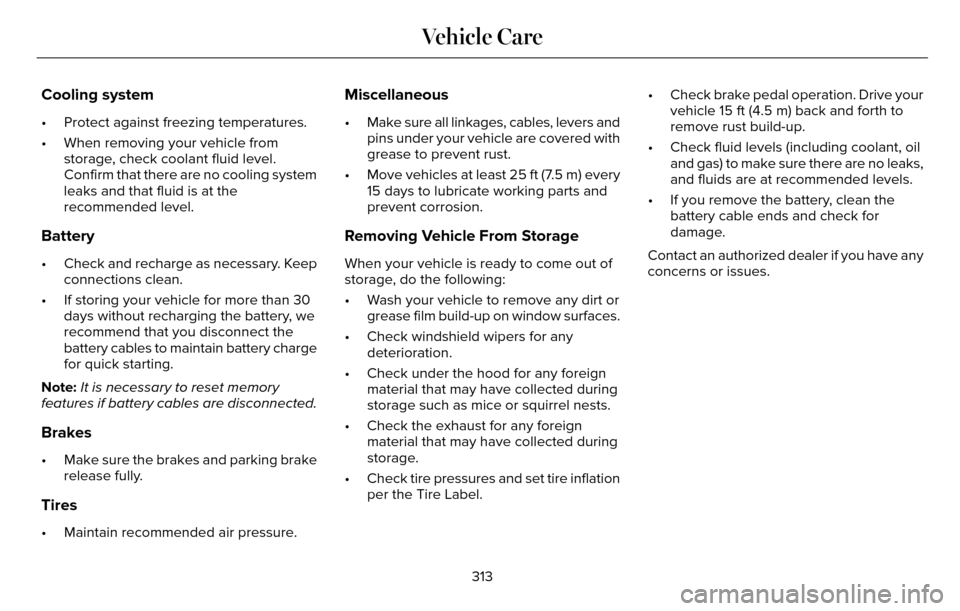
Cooling system
• Protect against freezing temperatures.
• When removing your vehicle fromstorage, check coolant fluid level.
Confirm that there are no cooling system
leaks and that fluid is at the
recommended level.
Battery
• Check and recharge as necessary. Keepconnections clean.
• If storing your vehicle for more than 30 days without recharging the battery, we
recommend that you disconnect the
battery cables to maintain battery charge
for quick starting.
Note: It is necessary to reset memory
features if battery cables are disconnected.
Brakes
• Make sure the brakes and parking brake release fully.
Tires
• Maintain recommended air pressure.
Miscellaneous
• Make sure all linkages, cables, levers andpins under your vehicle are covered with
grease to prevent rust.
• Move vehicles at least 25 ft (7.5 m) every 15 days to lubricate working parts and
prevent corrosion.
Removing Vehicle From Storage
When your vehicle is ready to come out of
storage, do the following:
• Wash your vehicle to remove any dirt orgrease film build-up on window surfaces.
• Check windshield wipers for any deterioration.
• Check under the hood for any foreign material that may have collected during
storage such as mice or squirrel nests.
• Check the exhaust for any foreign material that may have collected during
storage.
• Check tire pressures and set tire inflation per the Tire Label. • Check brake pedal operation. Drive your
vehicle 15 ft (4.5 m) back and forth to
remove rust build-up.
• Check fluid levels (including coolant, oil and gas) to make sure there are no leaks,
and fluids are at recommended levels.
• If you remove the battery, clean the battery cable ends and check for
damage.
Contact an authorized dealer if you have any
concerns or issues.
313
Vehicle Care
Page 481 of 544
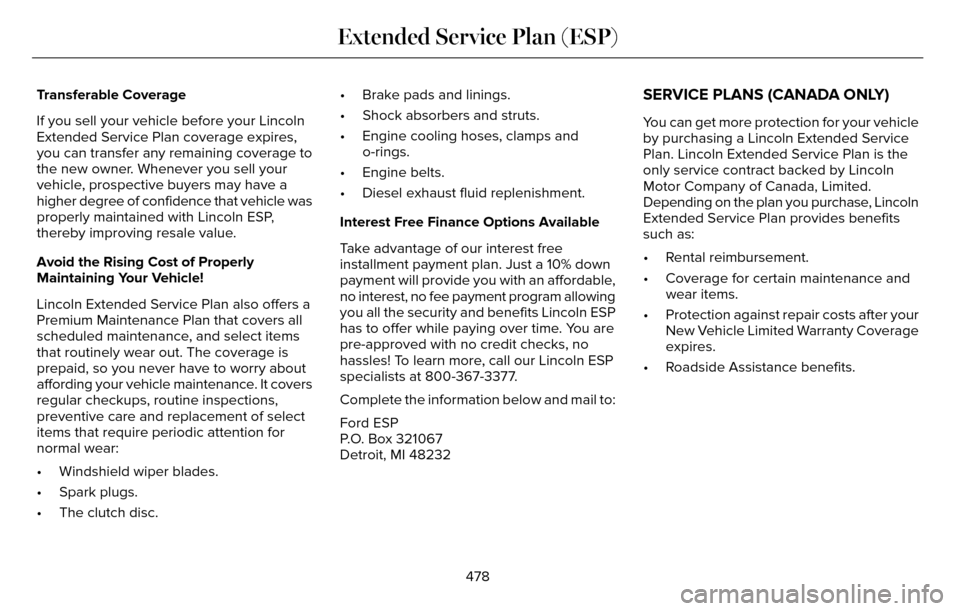
Transferable Coverage
If you sell your vehicle before your Lincoln
Extended Service Plan coverage expires,
you can transfer any remaining coverage to
the new owner. Whenever you sell your
vehicle, prospective buyers may have a
higher degree of confidence that vehicle was
properly maintained with Lincoln ESP,
thereby improving resale value.
Avoid the Rising Cost of Properly
Maintaining Your Vehicle!
Lincoln Extended Service Plan also offers a
Premium Maintenance Plan that covers all
scheduled maintenance, and select items
that routinely wear out. The coverage is
prepaid, so you never have to worry about
affording your vehicle maintenance. It covers
regular checkups, routine inspections,
preventive care and replacement of select
items that require periodic attention for
normal wear:
• Windshield wiper blades.
• Spark plugs.
• The clutch disc.• Brake pads and linings.
• Shock absorbers and struts.
• Engine cooling hoses, clamps and
o-rings.
• Engine belts.
• Diesel exhaust fluid replenishment.
Interest Free Finance Options Available
Take advantage of our interest free
installment payment plan. Just a 10% down
payment will provide you with an affordable,
no interest, no fee payment program allowing
you all the security and benefits Lincoln ESP
has to offer while paying over time. You are
pre-approved with no credit checks, no
hassles! To learn more, call our Lincoln ESP
specialists at 800-367-3377.
Complete the information below and mail to:
Ford ESP
P.O. Box 321067
Detroit, MI 48232SERVICE PLANS (CANADA ONLY)
You can get more protection for your vehicle
by purchasing a Lincoln Extended Service
Plan. Lincoln Extended Service Plan is the
only service contract backed by Lincoln
Motor Company of Canada, Limited.
Depending on the plan you purchase, Lincoln
Extended Service Plan provides benefits
such as:
• Rental reimbursement.
• Coverage for certain maintenance and wear items.
• Protection against repair costs after your New Vehicle Limited Warranty Coverage
expires.
• Roadside Assistance benefits.
478
Extended Service Plan (ESP)
Page 486 of 544
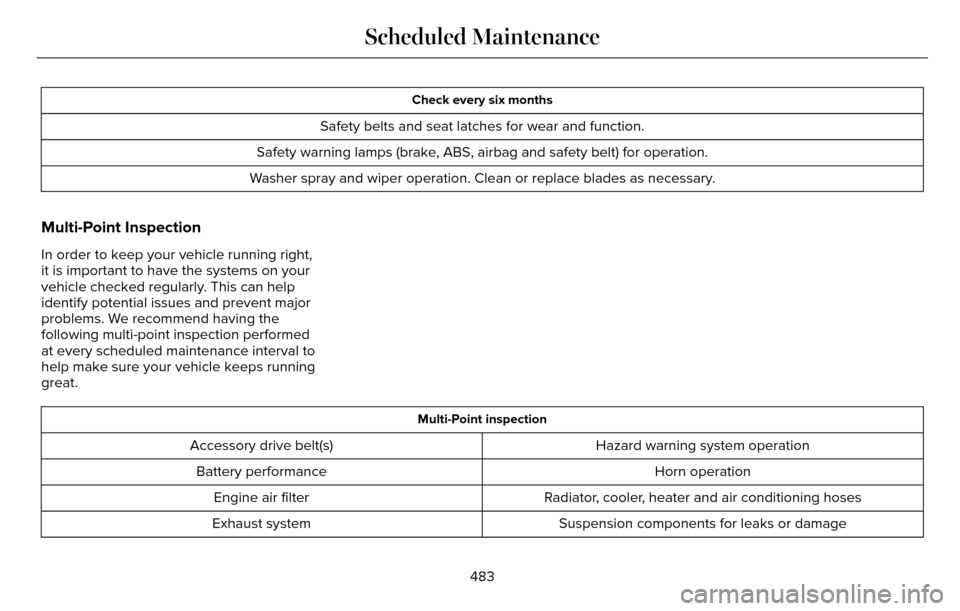
Check every six months
Safety belts and seat latches for wear and function.
Safety warning lamps (brake, ABS, airbag and safety belt) for operation.
Washer spray and wiper operation. Clean or replace blades as necessary.
Multi-Point Inspection
In order to keep your vehicle running right,
it is important to have the systems on your
vehicle checked regularly. This can help
identify potential issues and prevent major
problems. We recommend having the
following multi-point inspection performed
at every scheduled maintenance interval to
help make sure your vehicle keeps running
great.
Multi-Point inspection
Hazard warning system operation
Accessory drive belt(s)
Horn operation
Battery performance
Radiator, cooler, heater and air conditioning hoses
Engine air filter
Suspension components for leaks or damage
Exhaust system
483
Scheduled Maintenance
Page 489 of 544
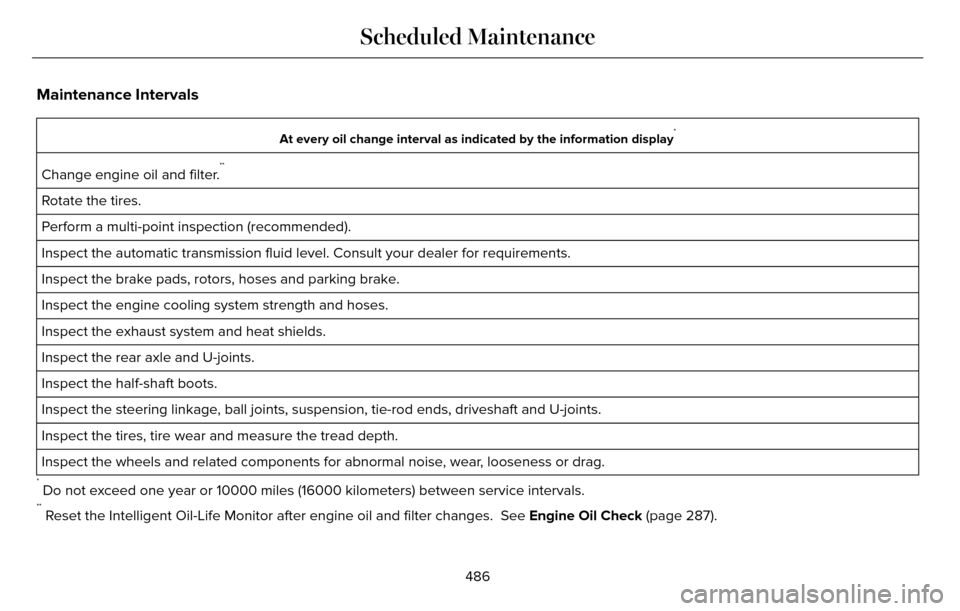
Maintenance Intervals
At every oil change interval as indicated by the information display*
Change engine oil and filter.**
Rotate the tires.
Perform a multi-point inspection (recommended).
Inspect the automatic transmission fluid level. Consult your dealer for \
requirements.
Inspect the brake pads, rotors, hoses and parking brake.
Inspect the engine cooling system strength and hoses.
Inspect the exhaust system and heat shields.
Inspect the rear axle and U-joints.
Inspect the half-shaft boots.
Inspect the steering linkage, ball joints, suspension, tie-rod ends, driveshaft and U-joints.
Inspect the tires, tire wear and measure the tread depth.
Inspect the wheels and related components for abnormal noise, wear, looseness or drag.
* Do not exceed one year or 10000 miles (16000 kilometers) between service interv\
als.** Reset the Intelligent Oil-Life Monitor after engine oil and filter change\
s. See Engine Oil Check (page 287).
486
Scheduled Maintenance
Page 542 of 544
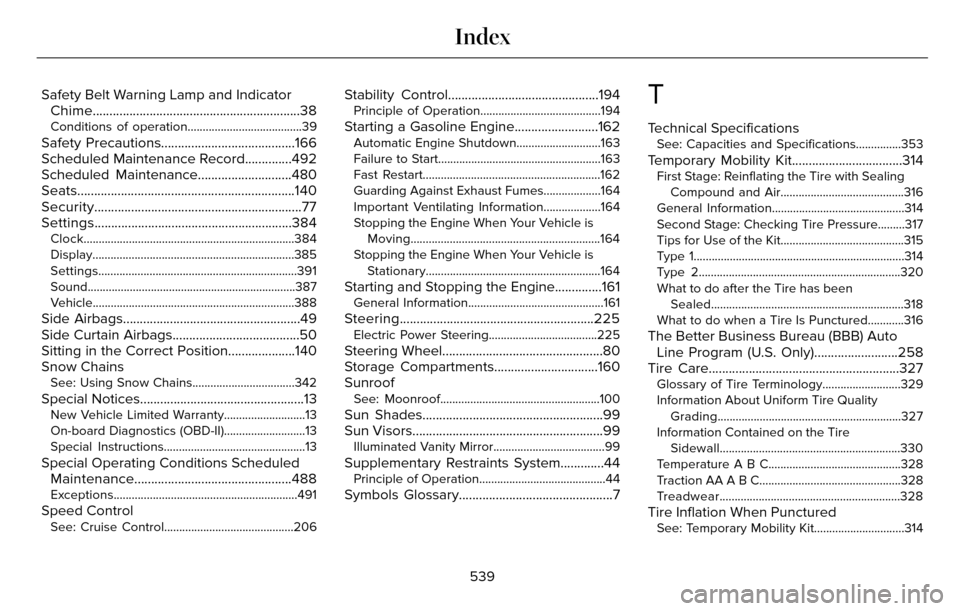
Safety Belt Warning Lamp and IndicatorChime..............................................................38
Conditions of operation......................................39
Safety Precautions........................................166
Scheduled Maintenance Record..............492
Scheduled Maintenance............................480
Seats.................................................................140
Security..............................................................77
Settings...........................................................384
Clock......................................................................384
Display.................................................................\
..385
Settings..................................................................391
Sound...................................................................\
..387
Vehicle..................................................................\
.388
Side Airbags.....................................................49
Side Curtain Airbags......................................50
Sitting in the Correct Position....................140
Snow Chains
See: Using Snow Chains..................................342
Special Notices.................................................13New Vehicle Limited Warranty...........................13
On-board Diagnostics (OBD-II)...........................13
Special Instructions...............................................13
Special Operating Conditions ScheduledMaintenance...............................................488
Exceptions.............................................................491
Speed ControlSee: Cruise Control...........................................206
Stability Control.............................................194Principle of Operation........................................194
Starting a Gasoline Engine.........................162Automatic Engine Shutdown............................163
Failure to Start......................................................163
Fast Restart...........................................................162
Guarding Against Exhaust Fumes...................164
Important Ventilating Information...................164
Stopping the Engine When Your Vehicle is
Moving...............................................................164
Stopping the Engine When Your Vehicle is Stationary..........................................................164
Starting and Stopping the Engine..............161General Information.............................................161
Steering..........................................................225Electric Power Steering....................................225
Steering Wheel................................................80
Storage Compartments...............................160
Sunroof
See: Moonroof.....................................................100
Sun Shades......................................................99
Sun Visors.........................................................99
Illuminated Vanity Mirror.....................................99
Supplementary Restraints System.............44Principle of Operation..........................................44
Symbols Glossary..............................................7
T
Technical SpecificationsSee: Capacities and Specifications...............353
Temporary Mobility Kit.................................314First Stage: Reinflating the Tire with SealingCompound and Air.........................................316
General Information............................................314
Second Stage: Checking Tire Pressure.........317
Tips for Use of the Kit.........................................315
Type 1...................................................................\
...314
Type 2...................................................................\
320
What to do after the Tire has been Sealed................................................................318
What to do when a Tire Is Punctured............316
The Better Business Bureau (BBB) Auto Line Program (U.S. Only).........................258
Tire Care.........................................................327
Glossary of Tire Terminology..........................329
Information About Uniform Tire Quality
Grading.............................................................327
Information Contained on the Tire Sidewall............................................................330
Temperature A B C............................................328
Traction AA A B C...............................................328
Treadwear............................................................328
Tire Inflation When PuncturedSee: Temporary Mobility Kit..............................314
539
Index